DIFFERENT FISH
FARMING SYSTEMS OF
THE WORLD
Presented By
BHUKYA BHASKAR & BHUKYA KALYAN
M. F. Sc (FRM)
• Introduction:
• Roman aquaculture was practiced in the first century
B.C according to Pliny the Elder (Parker 1995).
• The Romans focused on trout and mullet and were quite
adept at breeding fish in ponds.
• The 1st identifiable fish ponds were built by Sumerian's in
their temples around 4000 years ago .
• Peoples of Egypt 1st fished out an artificial tank tilapia in
2500 B.C in the world.
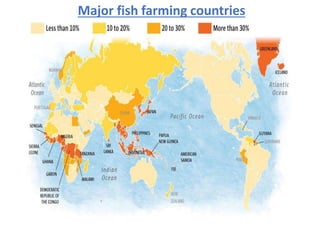
Major fish farming countries
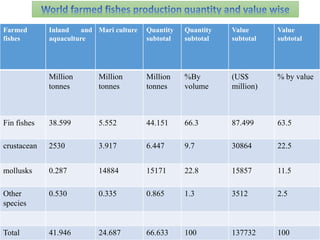
World farmfisheries production(2012)
The World live equivalent weight 90.4 mt in
2012(US$ 144.4 billion), including 66.6 mt
of food fish (US$137.7 billion)
• aquatic algae 23.8mt of mostly seaweeds,
US$ 6.4 billion).
• production of 22400 tonnes of non-food
products (US$ 222.4 million), such as
pearls and seashells for ornamental and
decorative
Farmed
fishes
Inland and
aquaculture
Mari culture Quantity
subtotal
Quantity
subtotal
Value
subtotal
Value
subtotal
Million
tonnes
Million
tonnes
Million
tonnes
%By
volume
(US$
million)
% by value
Fin fishes 38.599 5.552 44.151 66.3 87.499 63.5
crustacean 2530 3.917 6.447 9.7 30864 22.5
mollusks 0.287 14884 15171 22.8 15857 11.5
Other
species
0.530 0.335 0.865 1.3 3512 2.5
Total 41.946 24.687 66.633 100 137732 100
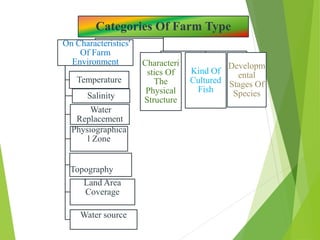
Categories Of Farm Type
On Characteristics'
Of Farm
Environment
Temperature
Salinity
Water
Replacement
Physiographica
l Zone
Topography
Land Area
Coverage
Water source
Characteri
stics Of
The
Physical
Structure
Kind Of
Cultured
Fish
Developm
ental
Stages Of
Species
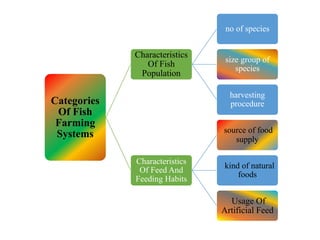
Categories
Of Fish
Farming
Systems
Characteristics
Of Fish
Population
no of species
size group of
species
harvesting
procedure
Characteristics
Of Feed And
Feeding Habits
source of food
supply
kind of natural
foods
Usage Of
Artificial Feed
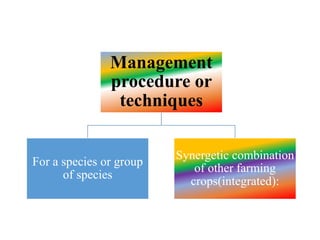
Management
procedure or
techniques
For a species or group
of species
Synergetic combination
of other farming
crops(integrated):
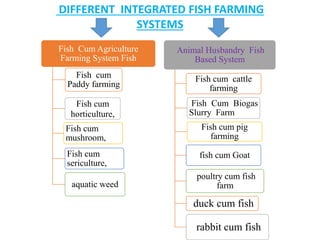
Fish Cum Agriculture
Farming System Fish
Fish cum
Paddy farming
Fish cum
horticulture,
Fish cum
mushroom,
Fish cum
sericulture,
aquatic weed
Animal Husbandry Fish
Based System
Fish cum cattle
farming
Fish Cum Biogas
Slurry Farm
Fish cum pig
farming
fish cum Goat
poultry cum fish
farm
duck cum fish
rabbit cum fish
DIFFERENT INTEGRATED FISH FARMING
SYSTEMS
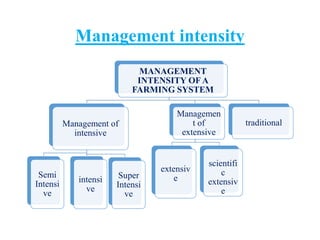
Management intensity
MANAGEMENT
INTENSITY OF A
FARMING SYSTEM
Management of
intensive
Semi
Intensi
ve
intensi
ve
Super
Intensi
ve
Managemen
t of
extensive
extensiv
e
scientifi
c
extensiv
e
traditional
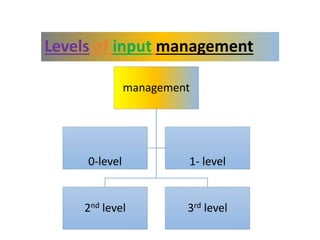
Levels of input management
management
2nd level 3rd level
0-level 1- level
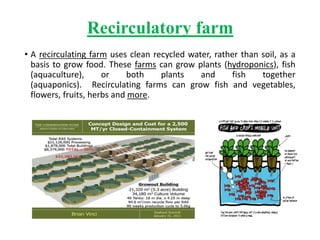
Recirculatory farm
• A recirculating farm uses clean recycled water, rather than soil, as a
basis to grow food. These farms can grow plants (hydroponics), fish
(aquaculture), or both plants and fish together
(aquaponics). Recirculating farms can grow fish and vegetables,
flowers, fruits, herbs and more.
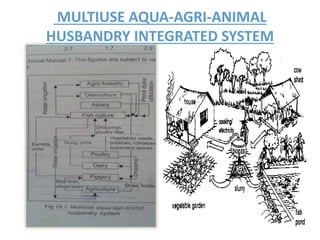
MULTIUSE AQUA-AGRI-ANIMAL
HUSBANDRY INTEGRATED SYSTEM
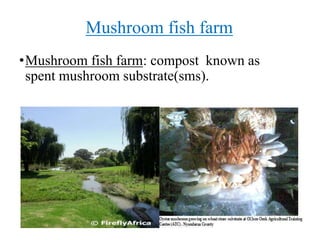
Mushroom fish farm
•Mushroom fish farm: compost known as
spent mushroom substrate(sms).
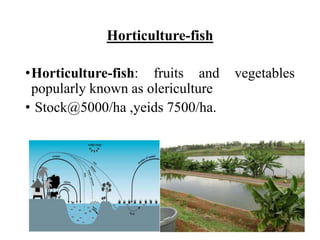
Horticulture-fish
•Horticulture-fish: fruits and vegetables
popularly known as olericulture
• Stock@5000/ha ,yeids 7500/ha.
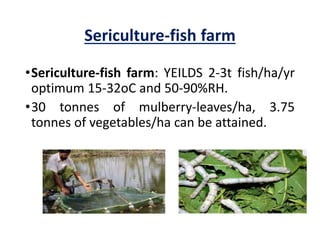
Sericulture-fish farm
•Sericulture-fish farm: YEILDS 2-3t fish/ha/yr
optimum 15-32oC and 50-90%RH.
•30 tonnes of mulberry-leaves/ha, 3.75
tonnes of vegetables/ha can be attained.
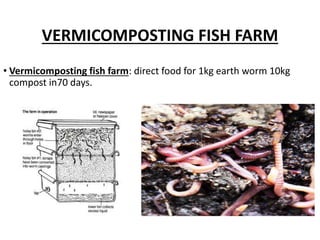
VERMICOMPOSTING FISH FARM
• Vermicomposting fish farm: direct food for 1kg earth worm 10kg
compost in70 days.
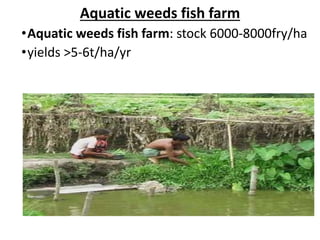
Aquatic weeds fish farm
•Aquatic weeds fish farm: stock 6000-8000fry/ha
•yields >5-6t/ha/yr
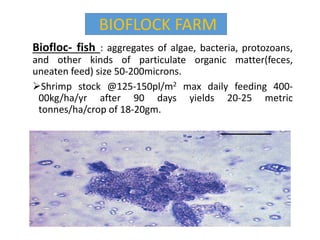
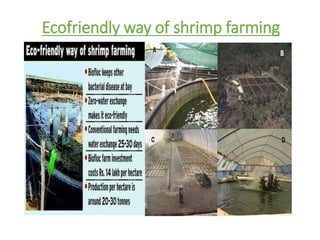
Biofloc- fish : aggregates of algae, bacteria, protozoans,
and other kinds of particulate organic matter(feces,
uneaten feed) size 50-200microns.
Shrimp stock @125-150pl/m2 max daily feeding 400-
00kg/ha/yr after 90 days yields 20-25 metric
tonnes/ha/crop of 18-20gm.
BIOFLOCK FARM
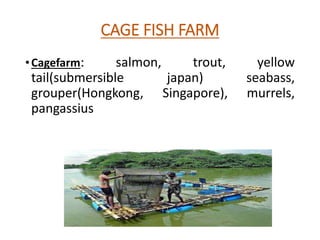
CAGE FISH FARM
•Cagefarm: salmon, trout, yellow
tail(submersible japan) seabass,
grouper(Hongkong, Singapore), murrels,
pangassius
Ecofriendly way of shrimp farming
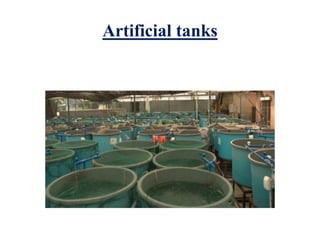
Artificial tanks
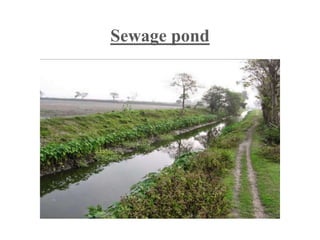
Sewage pond
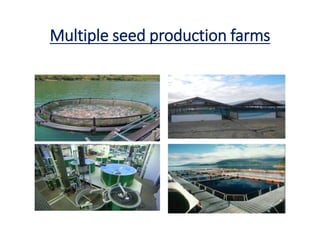
Multiple seed production farms
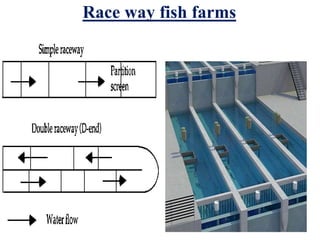
Race way fish farms
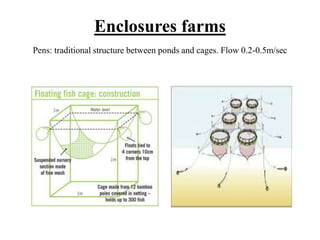
Enclosures farms
Pens: traditional structure between ponds and cages. Flow 0.2-0.5m/sec
Fish Farms Pose Serious Danger
•Fish farms seriously and severely impact Aboriginal
Title Lands and Waters. Water is contaminated,
poisoning
•The immediate dangers include disease, destruction
of habitat,
The antibiotics cause diseases to mutate and these
mutant strains are released into the oceans, inland
water exposing wild stocks.
Viral, fungal and bacterial infections have been passed
to wild stock as a result of fish farms.
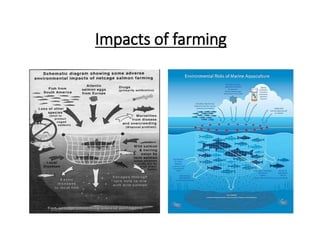
Impacts of farming
• Pollution and effluent flow freely from fish pens
and cause most resident species of fish and
marine life to disappear from the area
• farmed fish eat so many of the young wild stock
that they have little need of additional food.
• Algae can kill wild stocks either by poisoning
them (through production of toxins, etc.)
conclusion
•By practicing ecofriendly fish farming, to
conserve huge no. of flora and fauna in wet
land region of the world.
•Preventing entry of un desirable organisms
such as birds, weed fishes, predators,
infected fishes etc. in farming systems to
control over flow of money in inputs for
chemicals, to control disease carriers.
•Integrated fish farming is consider as
sustainable fish
REFERENCES
Hand book fisheries and aquaculture of
India
Fresh water aquaculture – R.K Rath
General and applied Ichthyology – S.K.
Gupta and P.C. Gupta
Google images
Bio flock s.f.r.a web:
Thank you
FROM
BHUKYA BHASKAR
TO TEACHERS

Aqc 501 bb

  • 1.
    DIFFERENT FISH FARMING SYSTEMSOF THE WORLD Presented By BHUKYA BHASKAR & BHUKYA KALYAN M. F. Sc (FRM)
  • 2.
    • Introduction: • Romanaquaculture was practiced in the first century B.C according to Pliny the Elder (Parker 1995). • The Romans focused on trout and mullet and were quite adept at breeding fish in ponds. • The 1st identifiable fish ponds were built by Sumerian's in their temples around 4000 years ago . • Peoples of Egypt 1st fished out an artificial tank tilapia in 2500 B.C in the world.
  • 3.
  • 4.
    World farmfisheries production(2012) TheWorld live equivalent weight 90.4 mt in 2012(US$ 144.4 billion), including 66.6 mt of food fish (US$137.7 billion) • aquatic algae 23.8mt of mostly seaweeds, US$ 6.4 billion). • production of 22400 tonnes of non-food products (US$ 222.4 million), such as pearls and seashells for ornamental and decorative
  • 5.
    Farmed fishes Inland and aquaculture Mari cultureQuantity subtotal Quantity subtotal Value subtotal Value subtotal Million tonnes Million tonnes Million tonnes %By volume (US$ million) % by value Fin fishes 38.599 5.552 44.151 66.3 87.499 63.5 crustacean 2530 3.917 6.447 9.7 30864 22.5 mollusks 0.287 14884 15171 22.8 15857 11.5 Other species 0.530 0.335 0.865 1.3 3512 2.5 Total 41.946 24.687 66.633 100 137732 100
  • 6.
    Categories Of FarmType On Characteristics' Of Farm Environment Temperature Salinity Water Replacement Physiographica l Zone Topography Land Area Coverage Water source Characteri stics Of The Physical Structure Kind Of Cultured Fish Developm ental Stages Of Species
  • 7.
    Categories Of Fish Farming Systems Characteristics Of Fish Population noof species size group of species harvesting procedure Characteristics Of Feed And Feeding Habits source of food supply kind of natural foods Usage Of Artificial Feed
  • 8.
    Management procedure or techniques For aspecies or group of species Synergetic combination of other farming crops(integrated):
  • 9.
    Fish Cum Agriculture FarmingSystem Fish Fish cum Paddy farming Fish cum horticulture, Fish cum mushroom, Fish cum sericulture, aquatic weed Animal Husbandry Fish Based System Fish cum cattle farming Fish Cum Biogas Slurry Farm Fish cum pig farming fish cum Goat poultry cum fish farm duck cum fish rabbit cum fish DIFFERENT INTEGRATED FISH FARMING SYSTEMS
  • 10.
    Management intensity MANAGEMENT INTENSITY OFA FARMING SYSTEM Management of intensive Semi Intensi ve intensi ve Super Intensi ve Managemen t of extensive extensiv e scientifi c extensiv e traditional
  • 11.
    Levels of inputmanagement management 2nd level 3rd level 0-level 1- level
  • 12.
    Recirculatory farm • Arecirculating farm uses clean recycled water, rather than soil, as a basis to grow food. These farms can grow plants (hydroponics), fish (aquaculture), or both plants and fish together (aquaponics). Recirculating farms can grow fish and vegetables, flowers, fruits, herbs and more.
  • 13.
  • 14.
    Mushroom fish farm •Mushroomfish farm: compost known as spent mushroom substrate(sms).
  • 15.
    Horticulture-fish •Horticulture-fish: fruits andvegetables popularly known as olericulture • Stock@5000/ha ,yeids 7500/ha.
  • 16.
    Sericulture-fish farm •Sericulture-fish farm:YEILDS 2-3t fish/ha/yr optimum 15-32oC and 50-90%RH. •30 tonnes of mulberry-leaves/ha, 3.75 tonnes of vegetables/ha can be attained.
  • 17.
    VERMICOMPOSTING FISH FARM •Vermicomposting fish farm: direct food for 1kg earth worm 10kg compost in70 days.
  • 18.
    Aquatic weeds fishfarm •Aquatic weeds fish farm: stock 6000-8000fry/ha •yields >5-6t/ha/yr
  • 19.
    Biofloc- fish :aggregates of algae, bacteria, protozoans, and other kinds of particulate organic matter(feces, uneaten feed) size 50-200microns. Shrimp stock @125-150pl/m2 max daily feeding 400- 00kg/ha/yr after 90 days yields 20-25 metric tonnes/ha/crop of 18-20gm. BIOFLOCK FARM
  • 20.
    CAGE FISH FARM •Cagefarm:salmon, trout, yellow tail(submersible japan) seabass, grouper(Hongkong, Singapore), murrels, pangassius
  • 21.
    Ecofriendly way ofshrimp farming
  • 22.
  • 23.
  • 24.
  • 25.
  • 26.
    Enclosures farms Pens: traditionalstructure between ponds and cages. Flow 0.2-0.5m/sec
  • 27.
    Fish Farms PoseSerious Danger •Fish farms seriously and severely impact Aboriginal Title Lands and Waters. Water is contaminated, poisoning •The immediate dangers include disease, destruction of habitat, The antibiotics cause diseases to mutate and these mutant strains are released into the oceans, inland water exposing wild stocks. Viral, fungal and bacterial infections have been passed to wild stock as a result of fish farms.
  • 28.
  • 29.
    • Pollution andeffluent flow freely from fish pens and cause most resident species of fish and marine life to disappear from the area • farmed fish eat so many of the young wild stock that they have little need of additional food. • Algae can kill wild stocks either by poisoning them (through production of toxins, etc.)
  • 30.
    conclusion •By practicing ecofriendlyfish farming, to conserve huge no. of flora and fauna in wet land region of the world. •Preventing entry of un desirable organisms such as birds, weed fishes, predators, infected fishes etc. in farming systems to control over flow of money in inputs for chemicals, to control disease carriers. •Integrated fish farming is consider as sustainable fish
  • 31.
    REFERENCES Hand book fisheriesand aquaculture of India Fresh water aquaculture – R.K Rath General and applied Ichthyology – S.K. Gupta and P.C. Gupta Google images Bio flock s.f.r.a web:
  • 32.