AQUACULTURE
GROUP MEMBERS:
PRITESH DESARDA
BHAVIKA MONINGI
NANDESHWAR REDDY
MUKKRAM
KAPARTHI RUTHWIK.
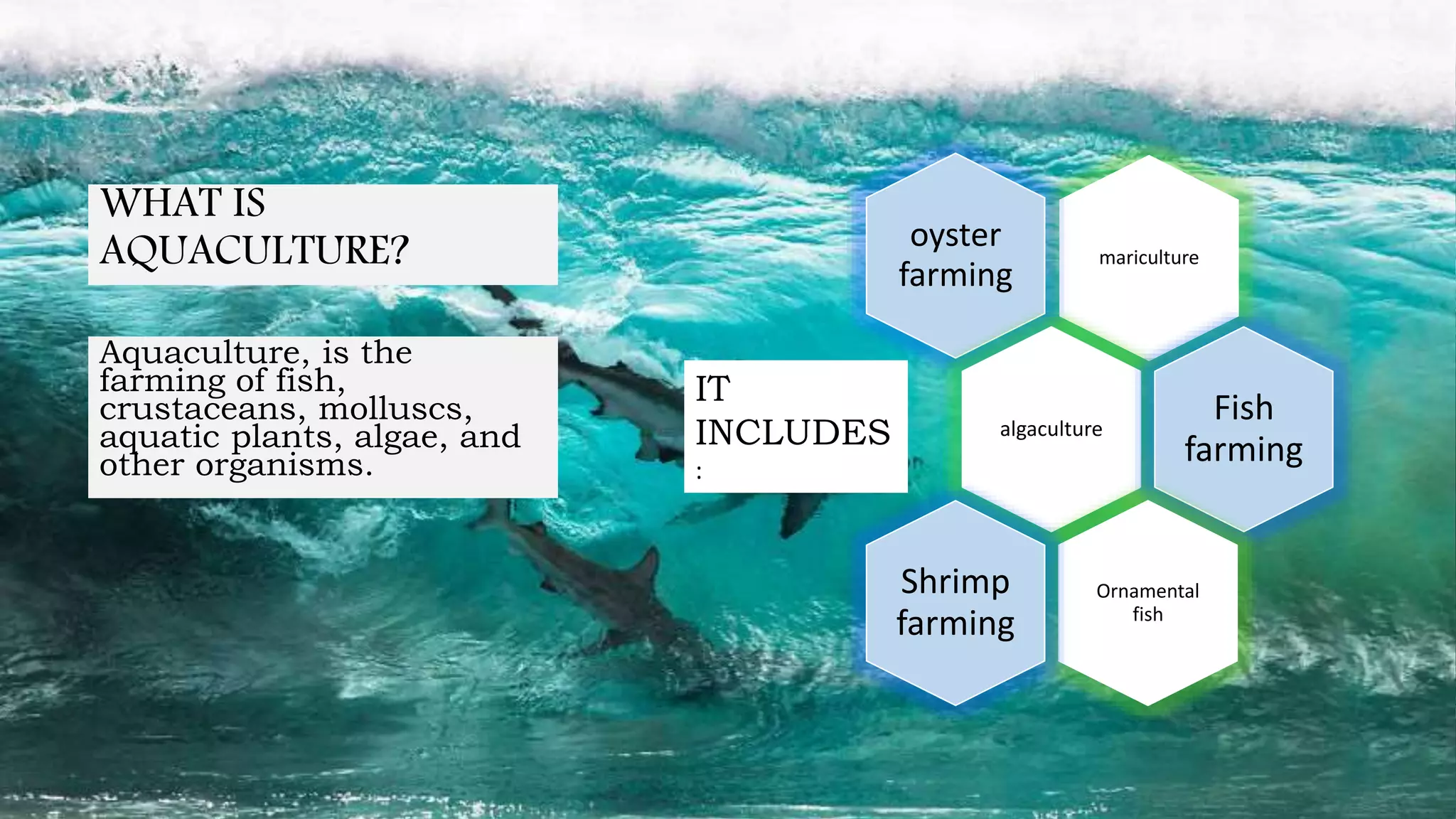
WHAT IS
AQUACULTURE? mariculture
oyster
farming
algaculture
Fish
farming
Ornamental
fish
Shrimp
farming
Aquaculture, is the
farming of fish,
crustaceans, molluscs,
aquatic plants, algae, and
other organisms.
IT
INCLUDES
:
HISTORY OF
AQUACULTURE:
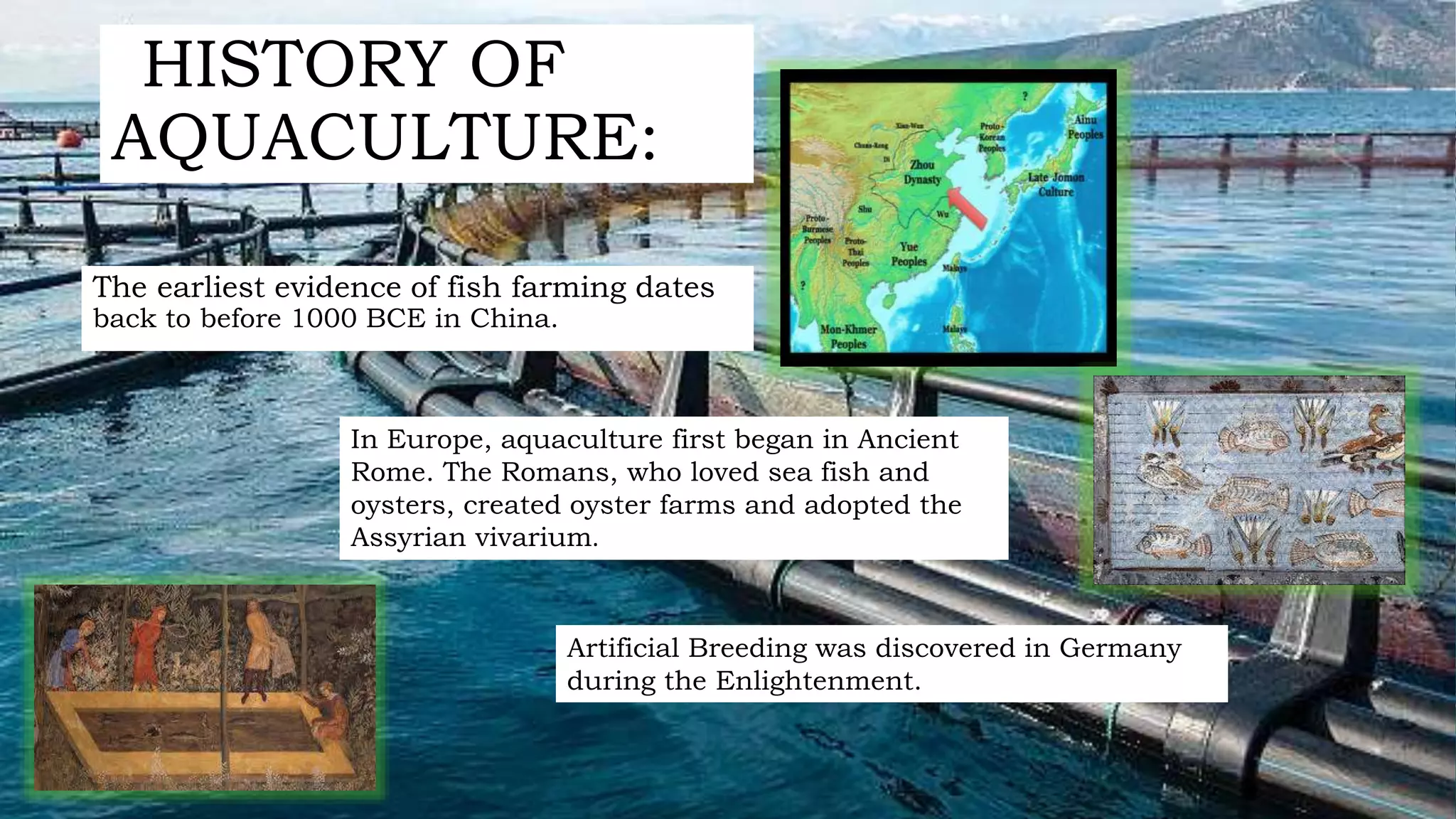
The earliest evidence of fish farming dates
back to before 1000 BCE in China.
In Europe, aquaculture first began in Ancient
Rome. The Romans, who loved sea fish and
oysters, created oyster farms and adopted the
Assyrian vivarium.
Artificial Breeding was discovered in Germany
during the Enlightenment.
ABSTRACT:
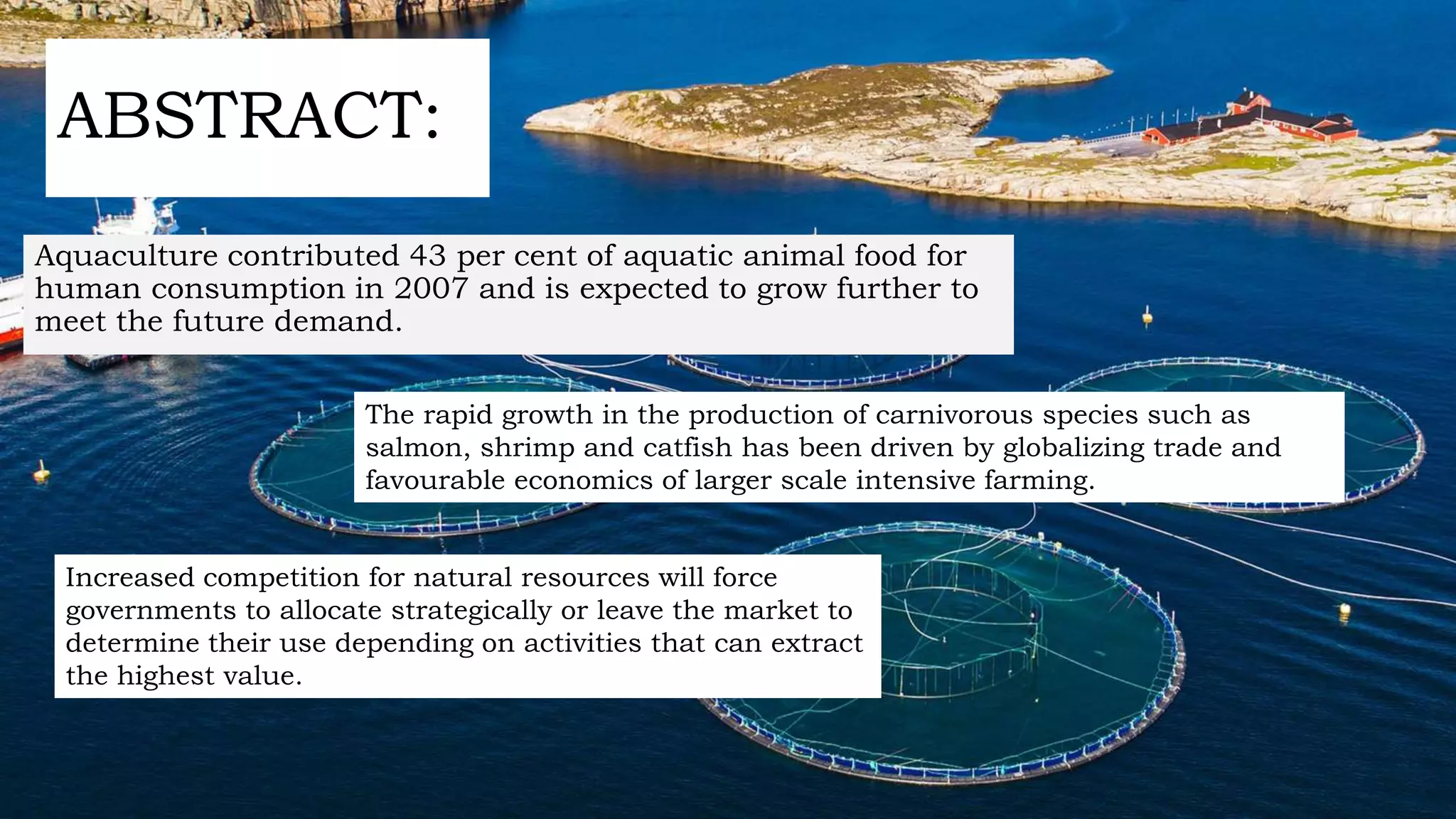
Aquaculture contributed 43 per cent of aquatic animal food for
human consumption in 2007 and is expected to grow further to
meet the future demand.
The rapid growth in the production of carnivorous species such as
salmon, shrimp and catfish has been driven by globalizing trade and
favourable economics of larger scale intensive farming.
Increased competition for natural resources will force
governments to allocate strategically or leave the market to
determine their use depending on activities that can extract
the highest value.
STAGES OF AQUACULTURE
PRODUCTION CHAIN
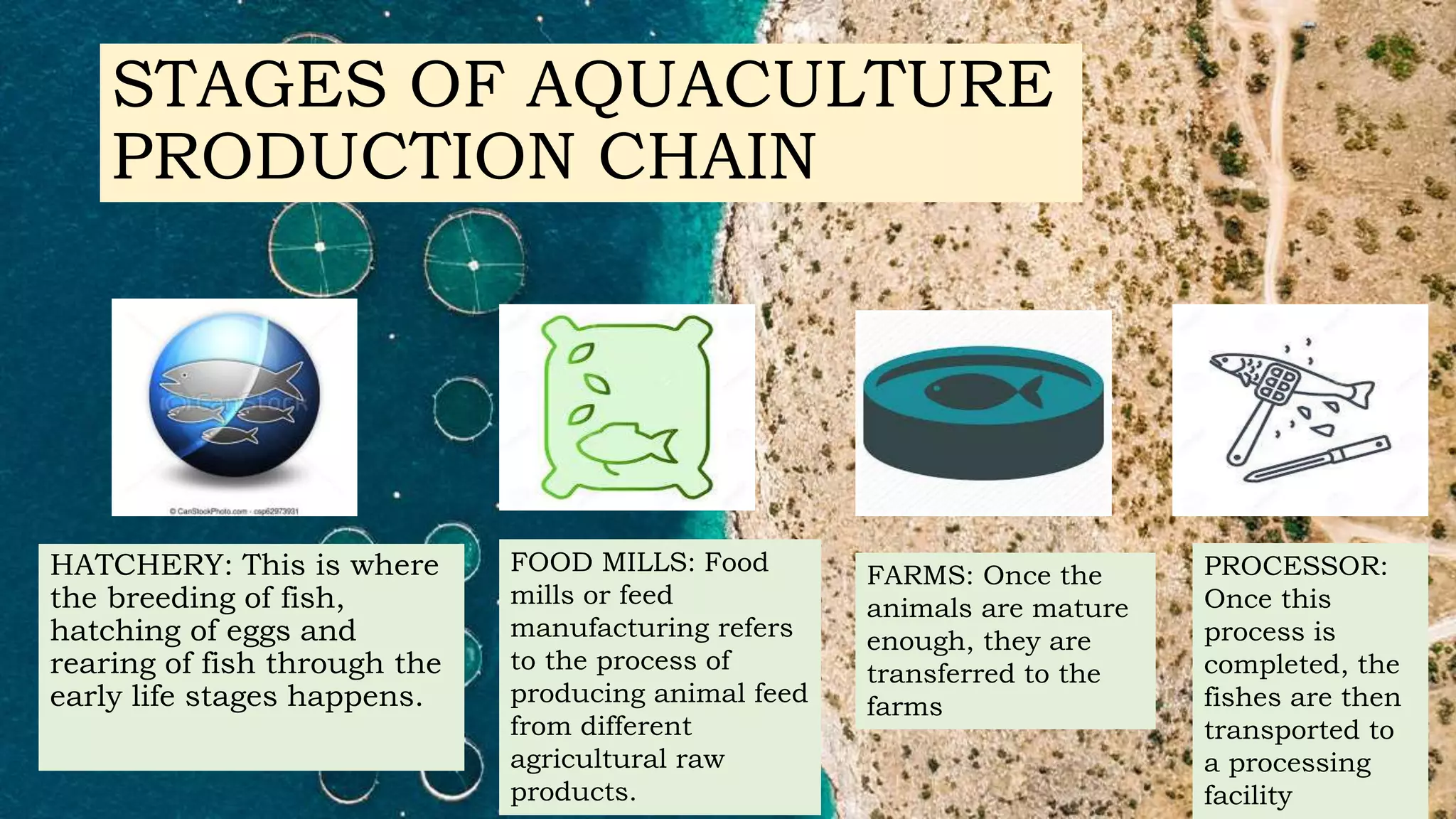
HATCHERY: This is where
the breeding of fish,
hatching of eggs and
rearing of fish through the
early life stages happens.
FOOD MILLS: Food
mills or feed
manufacturing refers
to the process of
producing animal feed
from different
agricultural raw
products.
FARMS: Once the
animals are mature
enough, they are
transferred to the
farms
PROCESSOR:
Once this
process is
completed, the
fishes are then
transported to
a processing
facility
METHODS OF AQUACULTURE:
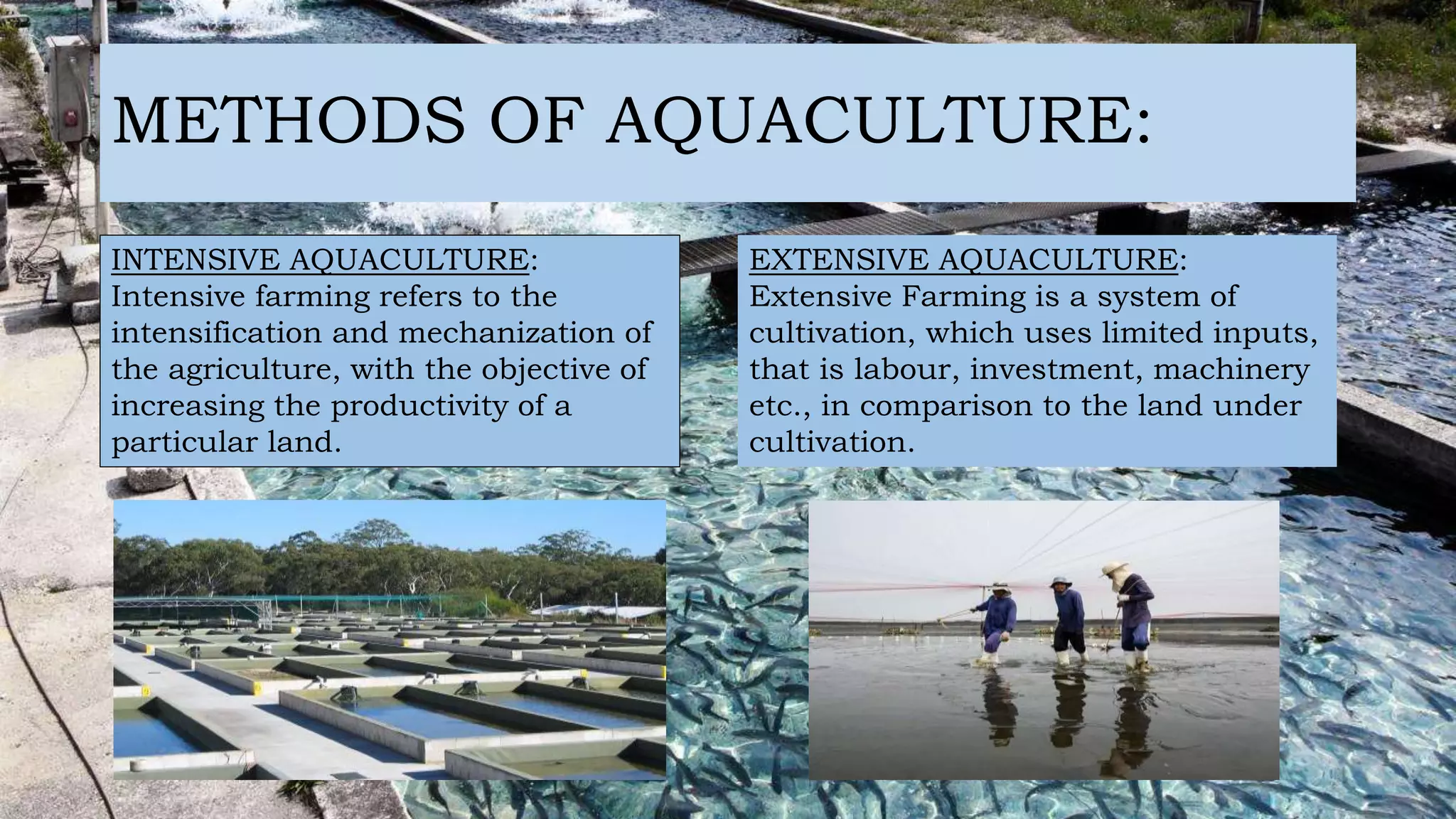
INTENSIVE AQUACULTURE:
Intensive farming refers to the
intensification and mechanization of
the agriculture, with the objective of
increasing the productivity of a
particular land.
EXTENSIVE AQUACULTURE:
Extensive Farming is a system of
cultivation, which uses limited inputs,
that is labour, investment, machinery
etc., in comparison to the land under
cultivation.
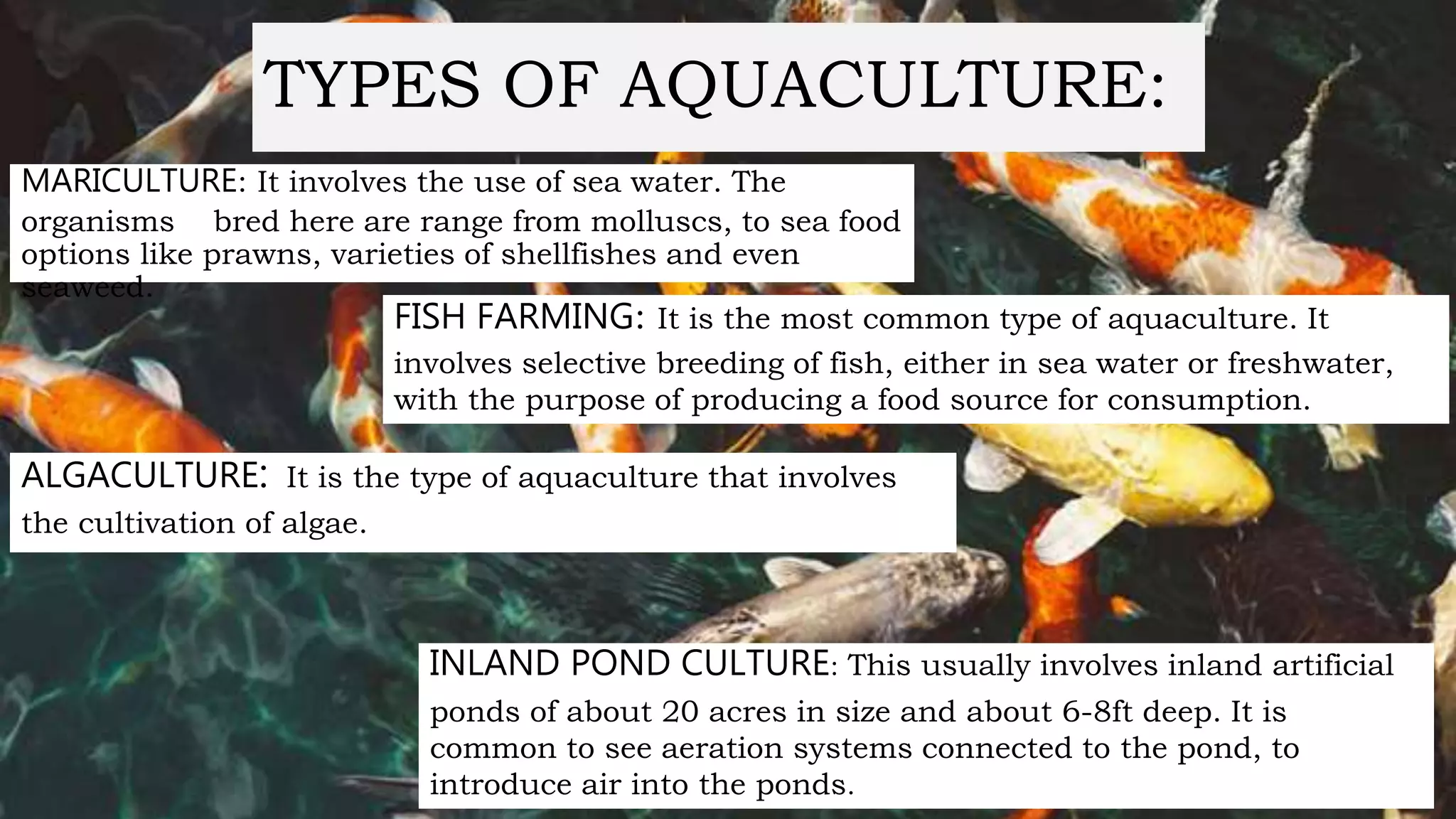
TYPES OF AQUACULTURE:
MARICULTURE: It involves the use of sea water. The
organisms bred here are range from molluscs, to sea food
options like prawns, varieties of shellfishes and even
seaweed.
FISH FARMING: It is the most common type of aquaculture. It
involves selective breeding of fish, either in sea water or freshwater,
with the purpose of producing a food source for consumption.
ALGACULTURE: It is the type of aquaculture that involves
the cultivation of algae.
INLAND POND CULTURE: This usually involves inland artificial
ponds of about 20 acres in size and about 6-8ft deep. It is
common to see aeration systems connected to the pond, to
introduce air into the ponds.
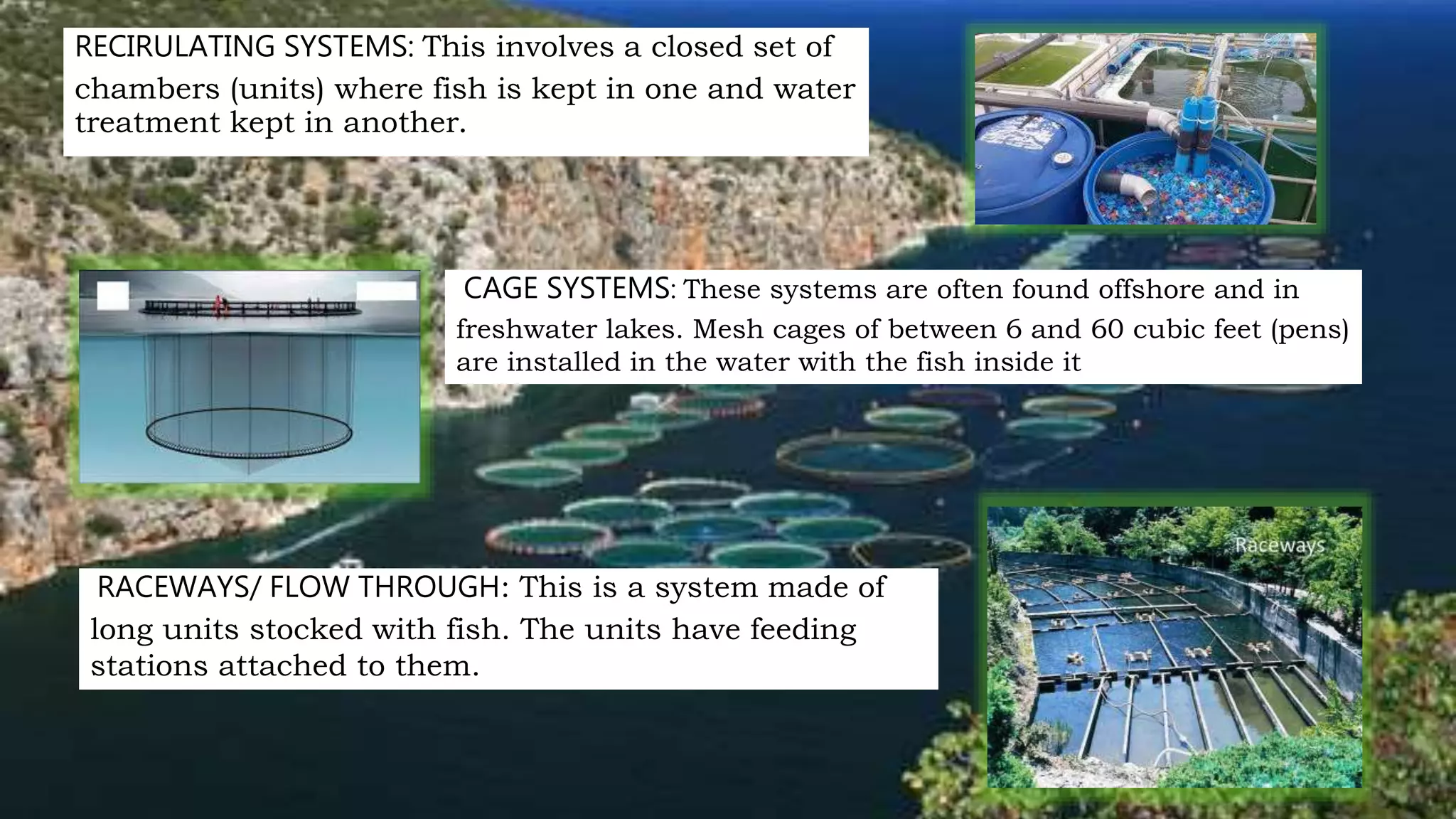
RECIRULATING SYSTEMS: This involves a closed set of
chambers (units) where fish is kept in one and water
treatment kept in another.
CAGE SYSTEMS: These systems are often found offshore and in
freshwater lakes. Mesh cages of between 6 and 60 cubic feet (pens)
are installed in the water with the fish inside it
RACEWAYS/ FLOW THROUGH: This is a system made of
long units stocked with fish. The units have feeding
stations attached to them.
SPECIES IN AQUACULTURE:
• CARPS: They are mostly reproduced in hatcheries. It is native to Asia
and Eastern Europe.
• MUSSELS: Mussels are found in wide variety of habitats ,from tidal
areas to fully submerged zones ,with broad range of temperature and
salinity.
• SALMON: Atlantic salmon is indigenous to the north Atlantic coast of
Europe and the rivers flowing into it.
• OYSTERS: Nowadays the culture of the native flat oyster is very
limited in Europe. Aquaculture accounts 97% of total oyster
production.
ADVANTAGES AND DISADVANTAGES OF
AQUACULTURE:
ADVANTAGES
• Today, fish provides more than 1 billion
people with most of their daily animal
protein.
• Rain-fed pond enable farmers to become 20%
more productive that peers during time of
rainy seasons.
• Aquaculture in an area can provide for crucial
ecological functions for the inhabitant.
• Aquaculture’s contribution to the world’s
food basket is essential as global demand for
fish is growing.
DISADVANTAGES
>Cages occupy space (can disrupt
access to navigation and reduce
land value)
>Need trained operatives
>High construction costs
>High production costs
EXAMPLES OF
AQUACULTURE:
1.ASIA –
freshwater and At least 75 species diverse marine species ,fish cages floating rafts and stakes with
carps dominating production.
2.PACIFIC –
Mussels and oysters ,red seaweeds ,hanging lines for pearls and oysters. Offshore cages for salmon
Pond culture for shrimps ,tilapia ,catfish. Freshwater pens for crayfish.
3. AFRICA –
26 freshwater fish , the most important being tilapia and common carp ,molluscus ,and oysters.
4. MEDITERRANEAN –
50+ individual species mostly freshwater and brackish water fishes. Most important being salmonids
and carps ; oysters and mussels, ocean ranching.
CONCLUSION
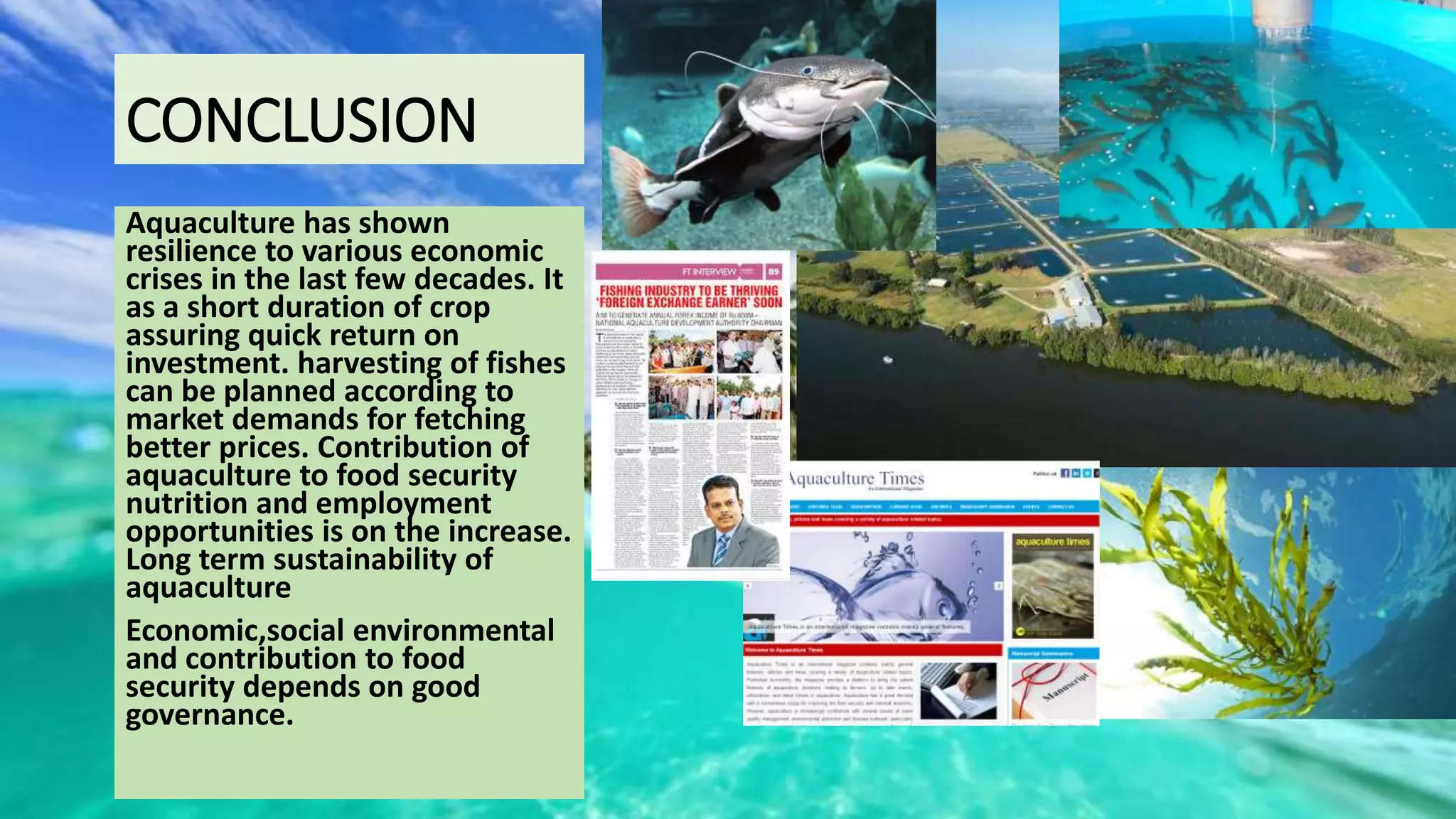
Aquaculture has shown
resilience to various economic
crises in the last few decades. It
as a short duration of crop
assuring quick return on
investment. harvesting of fishes
can be planned according to
market demands for fetching
better prices. Contribution of
aquaculture to food security
nutrition and employment
opportunities is on the increase.
Long term sustainability of
aquaculture
Economic,social environmental
and contribution to food
security depends on good
governance.
Aquaculture

Aquaculture

  • 1.
    AQUACULTURE GROUP MEMBERS: PRITESH DESARDA BHAVIKAMONINGI NANDESHWAR REDDY MUKKRAM KAPARTHI RUTHWIK.
  • 2.
    WHAT IS AQUACULTURE? mariculture oyster farming algaculture Fish farming Ornamental fish Shrimp farming Aquaculture,is the farming of fish, crustaceans, molluscs, aquatic plants, algae, and other organisms. IT INCLUDES :
  • 3.
    HISTORY OF AQUACULTURE: The earliestevidence of fish farming dates back to before 1000 BCE in China. In Europe, aquaculture first began in Ancient Rome. The Romans, who loved sea fish and oysters, created oyster farms and adopted the Assyrian vivarium. Artificial Breeding was discovered in Germany during the Enlightenment.
  • 4.
    ABSTRACT: Aquaculture contributed 43per cent of aquatic animal food for human consumption in 2007 and is expected to grow further to meet the future demand. The rapid growth in the production of carnivorous species such as salmon, shrimp and catfish has been driven by globalizing trade and favourable economics of larger scale intensive farming. Increased competition for natural resources will force governments to allocate strategically or leave the market to determine their use depending on activities that can extract the highest value.
  • 5.
    STAGES OF AQUACULTURE PRODUCTIONCHAIN HATCHERY: This is where the breeding of fish, hatching of eggs and rearing of fish through the early life stages happens. FOOD MILLS: Food mills or feed manufacturing refers to the process of producing animal feed from different agricultural raw products. FARMS: Once the animals are mature enough, they are transferred to the farms PROCESSOR: Once this process is completed, the fishes are then transported to a processing facility
  • 6.
    METHODS OF AQUACULTURE: INTENSIVEAQUACULTURE: Intensive farming refers to the intensification and mechanization of the agriculture, with the objective of increasing the productivity of a particular land. EXTENSIVE AQUACULTURE: Extensive Farming is a system of cultivation, which uses limited inputs, that is labour, investment, machinery etc., in comparison to the land under cultivation.
  • 7.
    TYPES OF AQUACULTURE: MARICULTURE:It involves the use of sea water. The organisms bred here are range from molluscs, to sea food options like prawns, varieties of shellfishes and even seaweed. FISH FARMING: It is the most common type of aquaculture. It involves selective breeding of fish, either in sea water or freshwater, with the purpose of producing a food source for consumption. ALGACULTURE: It is the type of aquaculture that involves the cultivation of algae. INLAND POND CULTURE: This usually involves inland artificial ponds of about 20 acres in size and about 6-8ft deep. It is common to see aeration systems connected to the pond, to introduce air into the ponds.
  • 8.
    RECIRULATING SYSTEMS: Thisinvolves a closed set of chambers (units) where fish is kept in one and water treatment kept in another. CAGE SYSTEMS: These systems are often found offshore and in freshwater lakes. Mesh cages of between 6 and 60 cubic feet (pens) are installed in the water with the fish inside it RACEWAYS/ FLOW THROUGH: This is a system made of long units stocked with fish. The units have feeding stations attached to them.
  • 9.
    SPECIES IN AQUACULTURE: •CARPS: They are mostly reproduced in hatcheries. It is native to Asia and Eastern Europe. • MUSSELS: Mussels are found in wide variety of habitats ,from tidal areas to fully submerged zones ,with broad range of temperature and salinity. • SALMON: Atlantic salmon is indigenous to the north Atlantic coast of Europe and the rivers flowing into it. • OYSTERS: Nowadays the culture of the native flat oyster is very limited in Europe. Aquaculture accounts 97% of total oyster production.
  • 10.
    ADVANTAGES AND DISADVANTAGESOF AQUACULTURE: ADVANTAGES • Today, fish provides more than 1 billion people with most of their daily animal protein. • Rain-fed pond enable farmers to become 20% more productive that peers during time of rainy seasons. • Aquaculture in an area can provide for crucial ecological functions for the inhabitant. • Aquaculture’s contribution to the world’s food basket is essential as global demand for fish is growing. DISADVANTAGES >Cages occupy space (can disrupt access to navigation and reduce land value) >Need trained operatives >High construction costs >High production costs
  • 11.
    EXAMPLES OF AQUACULTURE: 1.ASIA – freshwaterand At least 75 species diverse marine species ,fish cages floating rafts and stakes with carps dominating production. 2.PACIFIC – Mussels and oysters ,red seaweeds ,hanging lines for pearls and oysters. Offshore cages for salmon Pond culture for shrimps ,tilapia ,catfish. Freshwater pens for crayfish. 3. AFRICA – 26 freshwater fish , the most important being tilapia and common carp ,molluscus ,and oysters. 4. MEDITERRANEAN – 50+ individual species mostly freshwater and brackish water fishes. Most important being salmonids and carps ; oysters and mussels, ocean ranching.
  • 12.
    CONCLUSION Aquaculture has shown resilienceto various economic crises in the last few decades. It as a short duration of crop assuring quick return on investment. harvesting of fishes can be planned according to market demands for fetching better prices. Contribution of aquaculture to food security nutrition and employment opportunities is on the increase. Long term sustainability of aquaculture Economic,social environmental and contribution to food security depends on good governance.