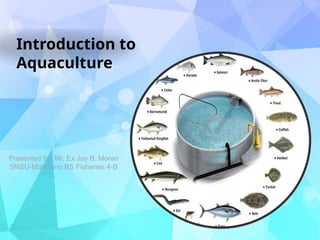
Introduction to
Aquaculture
Presented by: Mr. Ex Jay B. Moran
SNSU-Malimono BS Fisheries 4-B
INTRODUCTION
Definition: The farming of aquatic organisms (fish, shellfish, algae,
etc.)
According to FAO, The farming of aquatic organisms in inland and
coastal areas, involving intervention in the rearing process to
enhance production and the individual or corporate ownership of
the stock being cultivated.
According to RA 8550, Fishery operations involving all forms of raising
and culturing fish and other fishery species in fresh, brackish, and
marine water areas.
Importance: Key role in food security, economic development, and
sustainable resource management.
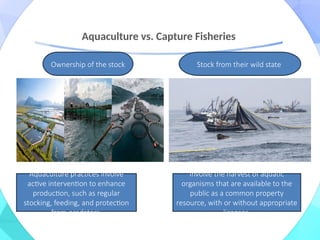
Aquaculture vs. Capture Fisheries
Ownership of the stock
Aquaculture practices involve
active intervention to enhance
production, such as regular
stocking, feeding, and protection
from predators.
Stock from their wild state
Involve the harvest of aquatic
organisms that are available to the
public as a common property
resource, with or without appropriate
licenses.
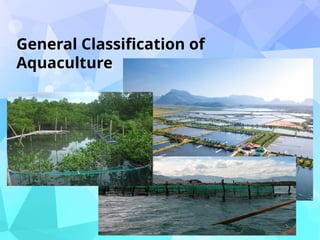
General Classification of
Aquaculture
Different types of aquatic environments
1. Freshwater aquaculture
2. Brackish aquaculture
3. Marine aquaculture
4. Aquasilviculture
Aquatic Environment
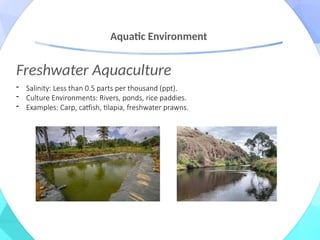
Freshwater Aquaculture
- Salinity: Less than 0.5 parts per thousand (ppt).
- Culture Environments: Rivers, ponds, rice paddies.
- Examples: Carp, catfish, tilapia, freshwater prawns.
Aquatic Environment
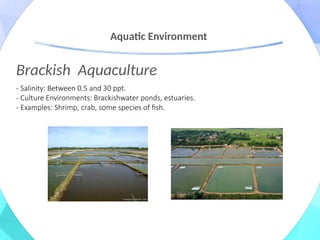
Brackish Aquaculture
- Salinity: Between 0.5 and 30 ppt.
- Culture Environments: Brackishwater ponds, estuaries.
- Examples: Shrimp, crab, some species of fish.
Aquatic Environment
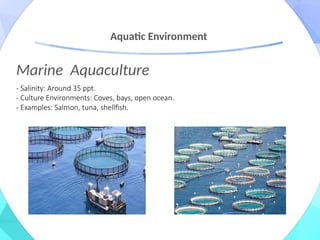
Marine Aquaculture
- Salinity: Around 35 ppt.
- Culture Environments: Coves, bays, open ocean.
- Examples: Salmon, tuna, shellfish.
Aquatic Environment
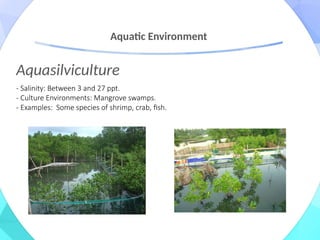
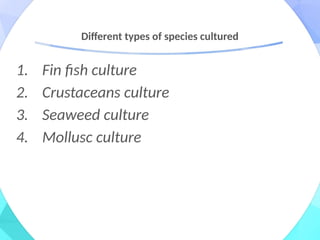
Aquasilviculture
- Salinity: Between 3 and 27 ppt.
- Culture Environments: Mangrove swamps.
- Examples: Some species of shrimp, crab, fish.
Different types of species cultured
1. Fin fish culture
2. Crustaceans culture
3. Seaweed culture
4. Mollusc culture
Species Cultured
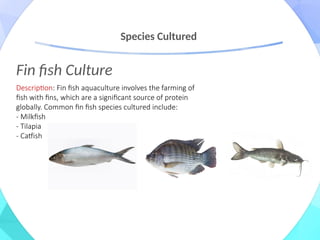
Fin fish Culture
Description: Fin fish aquaculture involves the farming of
fish with fins, which are a significant source of protein
globally. Common fin fish species cultured include:
- Milkfish
- Tilapia
- Catfish
Species Cultured
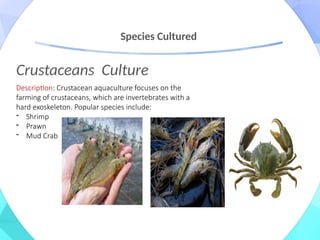
Crustaceans Culture
Description: Crustacean aquaculture focuses on the
farming of crustaceans, which are invertebrates with a
hard exoskeleton. Popular species include:
- Shrimp
- Prawn
- Mud Crab
Species Cultured
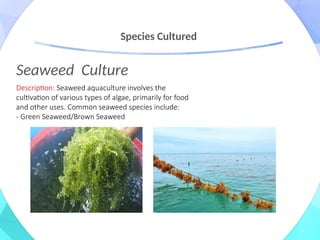
Seaweed Culture
Description: Seaweed aquaculture involves the
cultivation of various types of algae, primarily for food
and other uses. Common seaweed species include:
- Green Seaweed/Brown Seaweed
Species Cultured
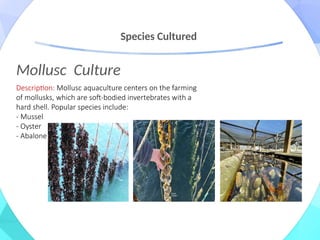
Mollusc Culture
Description: Mollusc aquaculture centers on the farming
of mollusks, which are soft-bodied invertebrates with a
hard shell. Popular species include:
- Mussel
- Oyster
- Abalone
Different types of structures utilized
1. Fish pond
2. Fish tank
3. Fish cage
4. Fish pen
Structures Utilized
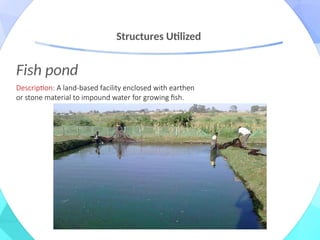
Fish pond
Description: A land-based facility enclosed with earthen
or stone material to impound water for growing fish.
Structures Utilized
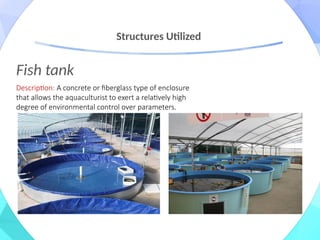
Fish tank
Description: A concrete or fiberglass type of enclosure
that allows the aquaculturist to exert a relatively high
degree of environmental control over parameters.
Structures Utilized
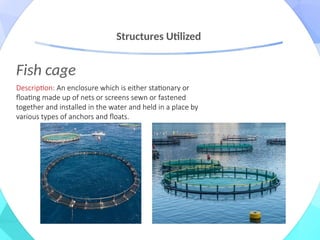
Fish cage
Description: An enclosure which is either stationary or
floating made up of nets or screens sewn or fastened
together and installed in the water and held in a place by
various types of anchors and floats.
Structures Utilized
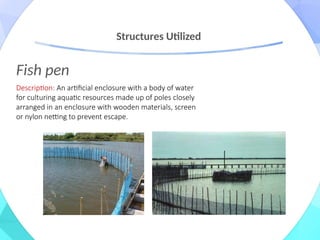
Fish pen
Description: An artificial enclosure with a body of water
for culturing aquatic resources made up of poles closely
arranged in an enclosure with wooden materials, screen
or nylon netting to prevent escape.
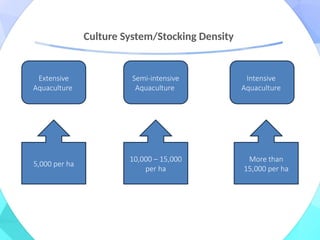
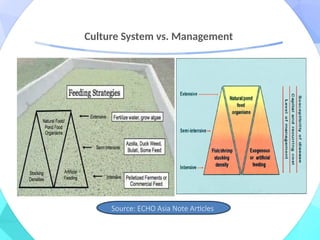
Culture System/Stocking Density
Semi-intensive
Aquaculture
Intensive
Aquaculture
Extensive
Aquaculture
5,000 per ha
10,000 – 15,000
per ha
More than
15,000 per ha
Culture System vs. Management
Source: ECHO Asia Note Articles
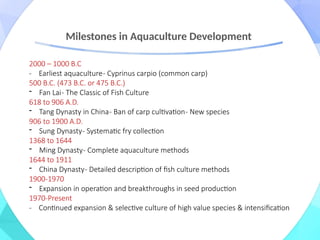
Milestones in Aquaculture Development
2000 – 1000 B.C
- Earliest aquaculture- Cyprinus carpio (common carp)
500 B.C. (473 B.C. or 475 B.C.)
- Fan Lai- The Classic of Fish Culture
618 to 906 A.D.
- Tang Dynasty in China- Ban of carp cultivation- New species
906 to 1900 A.D.
- Sung Dynasty- Systematic fry collection
1368 to 1644
- Ming Dynasty- Complete aquaculture methods
1644 to 1911
- China Dynasty- Detailed description of fish culture methods
1900-1970
- Expansion in operation and breakthroughs in seed production
1970-Present
- Continued expansion & selective culture of high value species & intensification
Conclusion
Summary of Key Points: Briefly reiterate the main
classifications of aquaculture.
Importance of Sustainable Aquaculture: Emphasize
the need for responsible practices to ensure the long-
term viability of the industry.
Future of Aquaculture: Highlight the potential for
innovation and growth in the sector.
THANK
YOU
References
Balarin, J.D., National reviews for aquaculture development in Africa. 1984 1. Zimba
bwe. FAO Fish. Circ. (770.1): 69 p.
Landau, M. Introduction to Aquaculture. Somerset, NJ: John Wiley, 1992.
Food and Agriculture Organization (FAO) of the United Nations
FAO State of World Fisheries and Aquaculture (SOFIA).
ECHO Asia Note Articles