Expressway Life Saver Implementation Report: Using Information
Technology and Applications to Enhance Highway Traffic Control and
Law Enforcement
Weerasinghe S.Y , Waduge N.D , Udadeniya A.S , Gamage S.N , Zoysa W.R.P.
1.0 Introduction
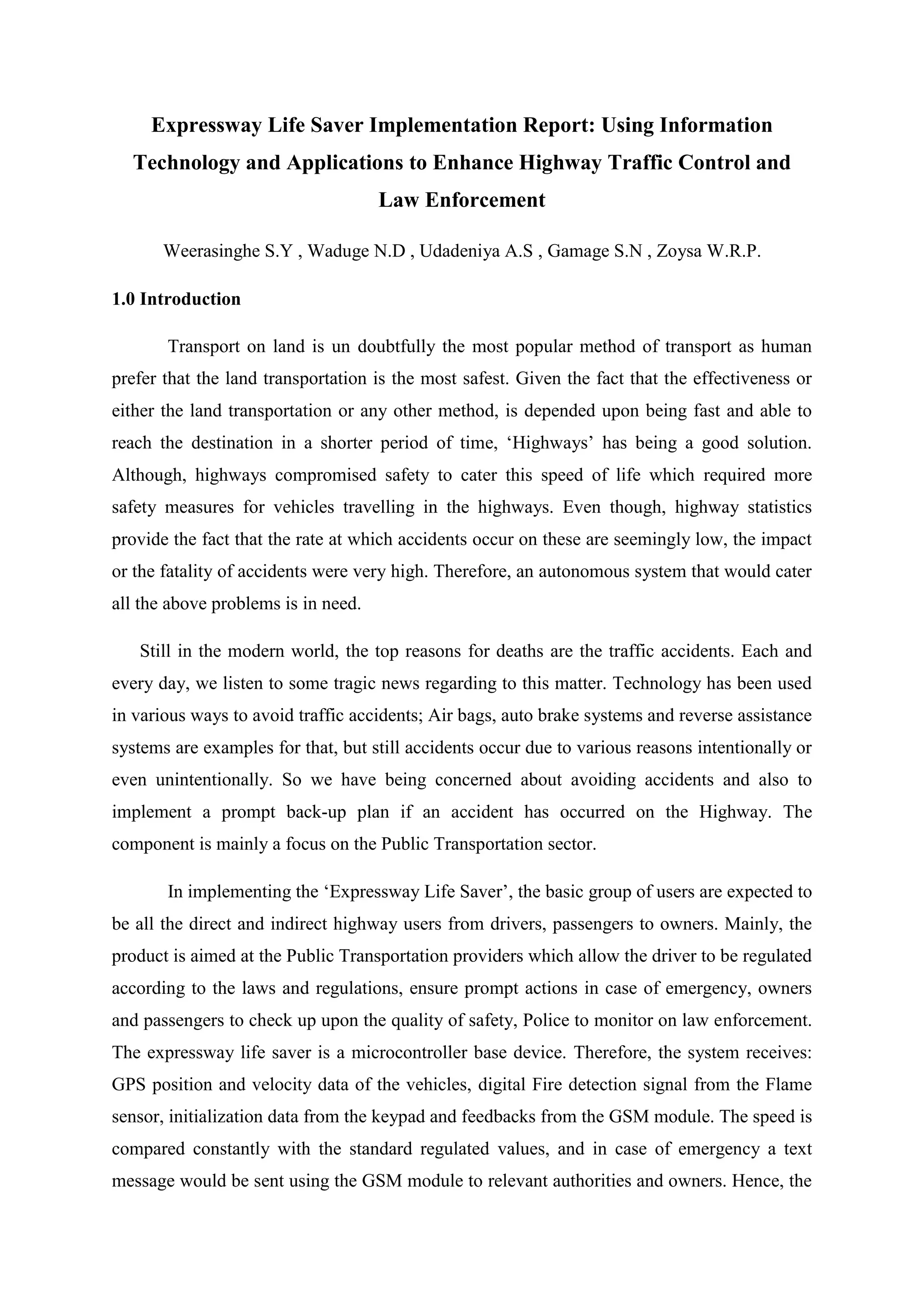
Transport on land is un doubtfully the most popular method of transport as human
prefer that the land transportation is the most safest. Given the fact that the effectiveness or
either the land transportation or any other method, is depended upon being fast and able to
reach the destination in a shorter period of time, ‘Highways’ has being a good solution.
Although, highways compromised safety to cater this speed of life which required more
safety measures for vehicles travelling in the highways. Even though, highway statistics
provide the fact that the rate at which accidents occur on these are seemingly low, the impact
or the fatality of accidents were very high. Therefore, an autonomous system that would cater
all the above problems is in need.
Still in the modern world, the top reasons for deaths are the traffic accidents. Each and
every day, we listen to some tragic news regarding to this matter. Technology has been used
in various ways to avoid traffic accidents; Air bags, auto brake systems and reverse assistance
systems are examples for that, but still accidents occur due to various reasons intentionally or
even unintentionally. So we have being concerned about avoiding accidents and also to
implement a prompt back-up plan if an accident has occurred on the Highway. The
component is mainly a focus on the Public Transportation sector.
In implementing the ‘Expressway Life Saver’, the basic group of users are expected to
be all the direct and indirect highway users from drivers, passengers to owners. Mainly, the
product is aimed at the Public Transportation providers which allow the driver to be regulated
according to the laws and regulations, ensure prompt actions in case of emergency, owners
and passengers to check up upon the quality of safety, Police to monitor on law enforcement.
The expressway life saver is a microcontroller base device. Therefore, the system receives:
GPS position and velocity data of the vehicles, digital Fire detection signal from the Flame
sensor, initialization data from the keypad and feedbacks from the GSM module. The speed is
compared constantly with the standard regulated values, and in case of emergency a text
message would be sent using the GSM module to relevant authorities and owners. Hence, the
users are enabled to interact with the equipment using the LCD screen, Keypad, buzzer and
the LED signal lights.
The concept of the Expressway Life Saver (ELS) is an automated system to reduce
the probability or virtually prevent vehicle collisions during high speed drives. The system
mainly focuses on the enhancing the enforcement of Highway law and its codes in the Law
enforcers side, make sure the vehicle property is being handled properly and lawfully in the
Owners side and reacting to any accidents, breakdowns or break of law. The system could
help locate and inform any responsible person in case of a crash through text messages in
order to better response on such situations. Additionally, the data from the components are
updated to a database where good performances and Transport providers’ safety rating can be
viewed by the public through a Website.
In our country we only have two expressways at the moment and more to be put up,
but we had heard of lots of accidents, deaths, injuries in this short time from these
expressways are opened. So we thought an efficient way to avoid these accidents. When we
are dealing with a very high speed, a tiny little mistake could be converted to a tragedy.
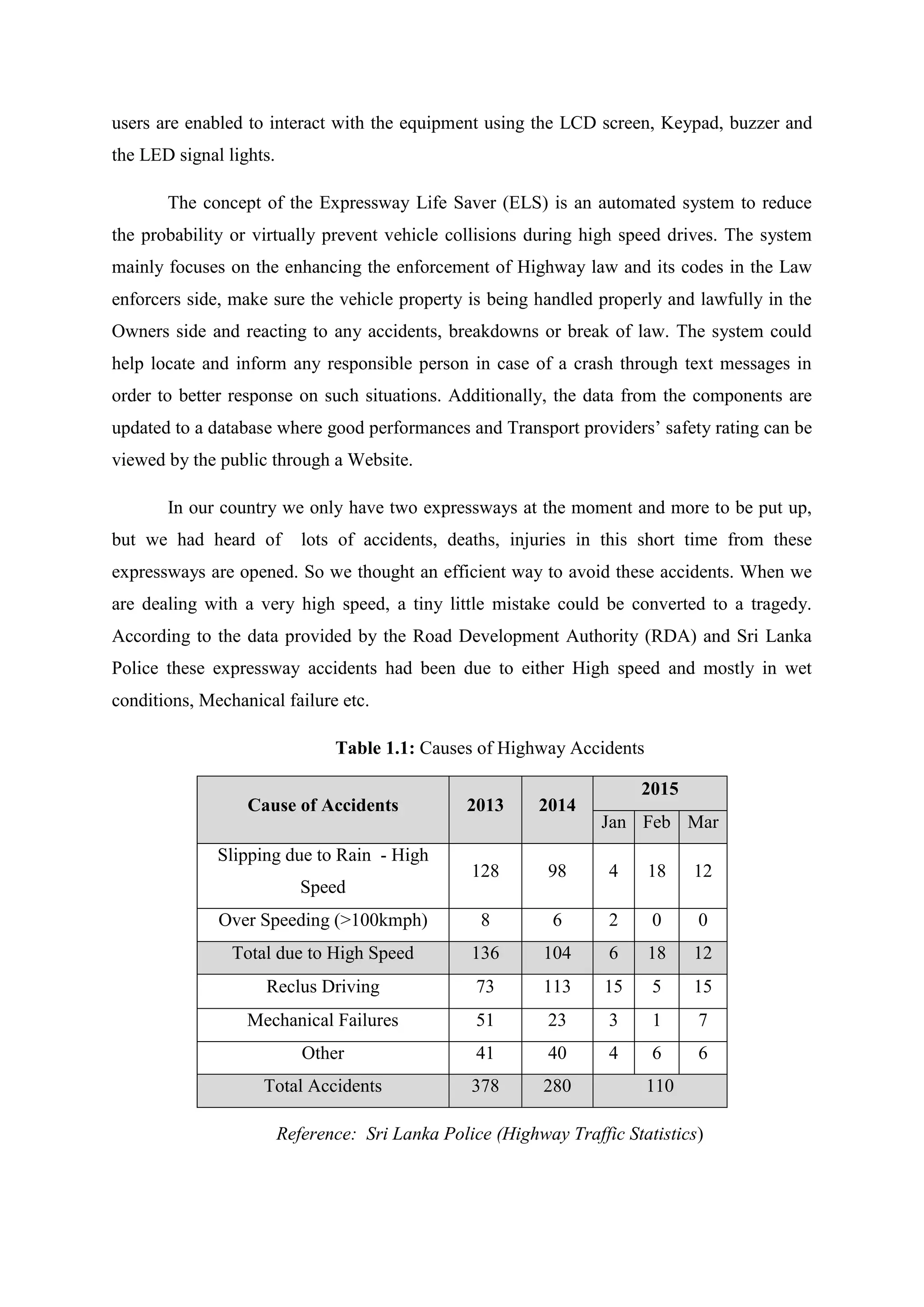
According to the data provided by the Road Development Authority (RDA) and Sri Lanka
Police these expressway accidents had been due to either High speed and mostly in wet
conditions, Mechanical failure etc.
Table 1.1: Causes of Highway Accidents
Reference: Sri Lanka Police (Highway Traffic Statistics)
Cause of Accidents 2013 2014
2015
Jan Feb Mar
Slipping due to Rain - High
Speed
128 98 4 18 12
Over Speeding (>100kmph) 8 6 2 0 0
Total due to High Speed 136 104 6 18 12
Reclus Driving 73 113 15 5 15
Mechanical Failures 51 23 3 1 7
Other 41 40 4 6 6
Total Accidents 378 280 110
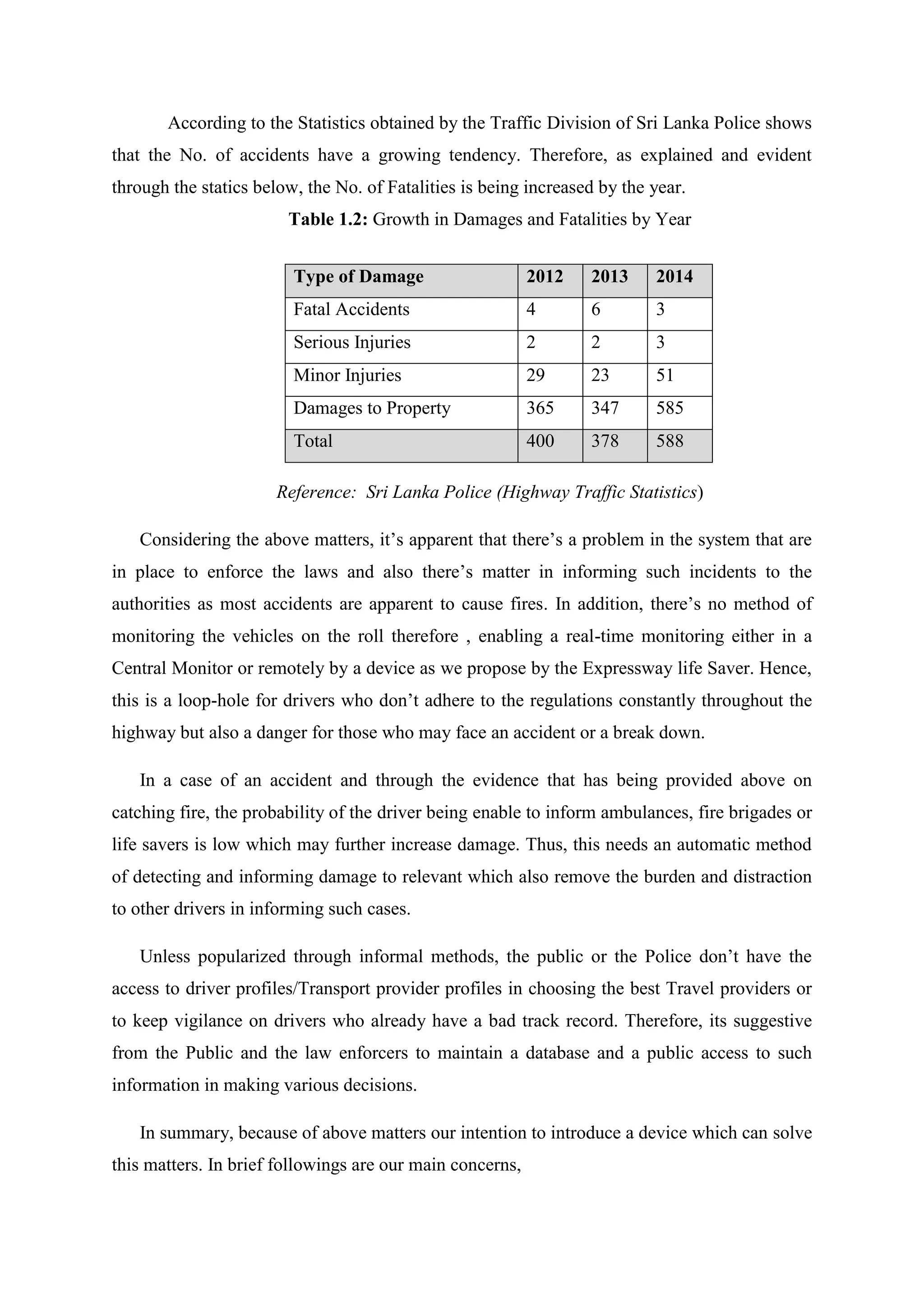
According to the Statistics obtained by the Traffic Division of Sri Lanka Police shows
that the No. of accidents have a growing tendency. Therefore, as explained and evident
through the statics below, the No. of Fatalities is being increased by the year.
Table 1.2: Growth in Damages and Fatalities by Year
Reference: Sri Lanka Police (Highway Traffic Statistics)
Considering the above matters, it’s apparent that there’s a problem in the system that are
in place to enforce the laws and also there’s matter in informing such incidents to the
authorities as most accidents are apparent to cause fires. In addition, there’s no method of
monitoring the vehicles on the roll therefore , enabling a real-time monitoring either in a
Central Monitor or remotely by a device as we propose by the Expressway life Saver. Hence,
this is a loop-hole for drivers who don’t adhere to the regulations constantly throughout the
highway but also a danger for those who may face an accident or a break down.
In a case of an accident and through the evidence that has being provided above on
catching fire, the probability of the driver being enable to inform ambulances, fire brigades or
life savers is low which may further increase damage. Thus, this needs an automatic method
of detecting and informing damage to relevant which also remove the burden and distraction
to other drivers in informing such cases.
Unless popularized through informal methods, the public or the Police don’t have the
access to driver profiles/Transport provider profiles in choosing the best Travel providers or
to keep vigilance on drivers who already have a bad track record. Therefore, its suggestive
from the Public and the law enforcers to maintain a database and a public access to such
information in making various decisions.
In summary, because of above matters our intention to introduce a device which can solve
this matters. In brief followings are our main concerns,
Type of Damage 2012 2013 2014
Fatal Accidents 4 6 3
Serious Injuries 2 2 3
Minor Injuries 29 23 51
Damages to Property 365 347 585
Total 400 378 588
 Avoid accidents
 If an accident has been occurred give immediate help to victims with ambulances,
fire-brigade and police.
 Help the driver in adhering to laws and remotely instructing on how to act according
in each and every situation. There, direct the driver actions on highway.
 Maintain a data base on driver profiles on highway.
When we consider about these concerns, our prior intension is to avoid accidents, because
“Prevention is better than cure”.
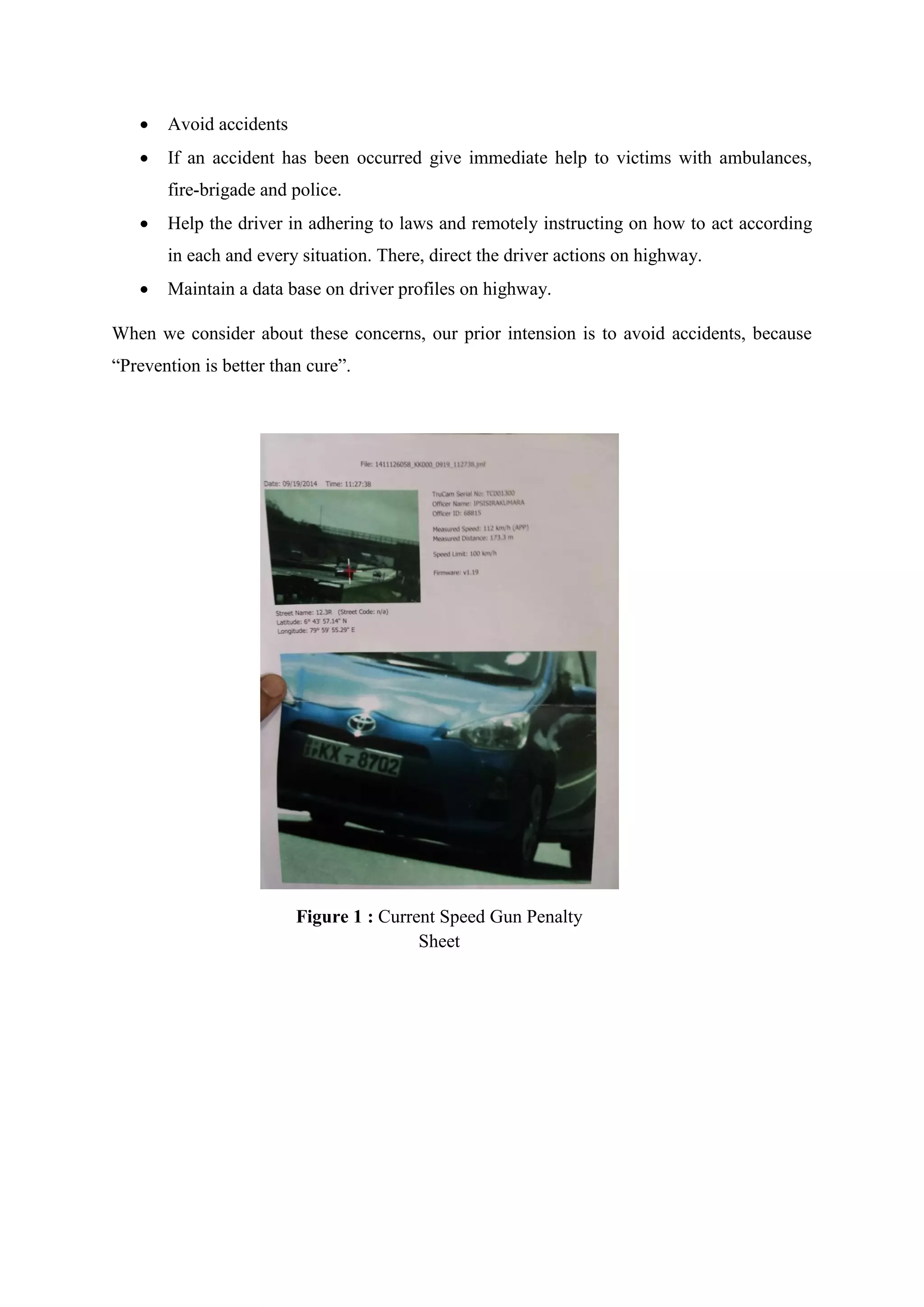
Figure 1 : Current Speed Gun Penalty
Sheet
2. 0 Literature Survey
Expressway Monitoring and Advisory System
Expressway Monitoring and Advisory System or EMAS, was system developed by
the Singapore Technologies and Electronics in 1996 as a contact for the Singapore’s Land
Transport Authority. The system enables the LTA personnel to detect accidents and respond
to them quickly while notifying the driver of adverse traffic conditions and safety
instructions.
The EMAS was implemented as system that consists of cameras and LED sign
boards. The cameras transmit data to a central location and the staffs monitor the traffic and
the staff reacts in case of emergency. In such cases, the drivers are informed of the hazards
through the Sign boards. This system is already implemented in Sri Lanka’s highways as
well. [2]
Figure 2.1 : Current EMAS system in most highways
Traffic Cameras and Number Plate Readers
A traffic enforcement camera (also red light camera, road safety camera, road
rule camera, photo radar, photo enforcement, speed camera, Gatso, safety camera, bus
lane camera, Safe-T-Cam, depending on use) is a camera which may be mounted beside or
over a road or installed in an enforcement vehicle to detect traffic regulation violations,
including speeding, vehicles going through a red traffic light, unauthorized use of a bus lane,
or for recording vehicles inside a congestion charge area. It may be linked to an automated
ticketing system.
The latest automatic number plate recognition systems can be used for the detection
of average speeds and raise concerns over loss of privacy and the potential for governments
to establish mass surveillance of vehicle movements and therefore by association also the
movement of the vehicle’s owner. Vehicles owners are often required by law to identify the
driver of the vehicle and a case was taken to the European Court of Human Rights which
found that human rights were not being breached. Some groups, such as the National
Motorists Association in the USA, claim that systems “encourage … revenue-driven
enforcement” rather than the declared objectives. [1]
Therefore, the traffic cameras have its own inherent problems. Therefore, the problem
of interfering privacy could be addressed by the proposed system by using a GPS tracker
instead of a visual media. This also enables to tack the vehicle’s performances real time since
the cameras are only capable of making a contribution to law enforcement at places where
they exists.
Hence, the case of being specific to one kind (Eg: Bus lane traffic camera) has lessen
the scope of the traffic cameras. This provide the fact that the officials and local governments
who have used these systems would have had to duplicate the cost for similar devices for the
same purpose but different in operation. Therefore, the investment would have being high as
it comes with an installation cost. Thus, the concept of ELS not being vehicle has the
advantage of catering the safety requirement for any vehicle which doesn’t have an
installation cost as well since the device is designed to be mobile and compact.
Highway Performance monitoring using GPS
Embedded sensors such as “loop detectors” and radar/laser speed detectors are placed
in (loop detector) or alongside of (radar/laser speed detector) the pavement to detect the
presence and speed of each vehicle traveling by that specific location. The advantage of
these systems is that they measure the speed of essentially every vehicle passing by that
location. This produces an enormous volume of speed data that effectively characterize the
temporal distribution of speed by time-of day, day-of-week, weather and even some incidents
such as police action, construction and accidents.
The disadvantage is that this speed information is available only at the locations
where there existed both the foresight to monitor that specific location and the substantial
infrastructure funding that these systems require.[3]
40 of the above systems do prevail in Sri Lanka as well. These also have the same
problems as of the Traffic cameras and those mentioned in the text above as well. Another
disadvantage would be the effectiveness of these systems in severe weather conditions as
heavy rain etc. could create lot of noise in the system as these are exposed to the outside
environment. Thus, static charges generating from thunder and lightning also creates a danger
to the systems existence. Therefore, the systems are often offline in severe weather when they
are actually required.
Highway Rescue System
This system was developed by a Sri Lankan school student in 2015 in order to provide
prompt communication between the distressed vehicle and an emergency authority. Further
details of the implementation haven’t been provided.
Expressway Monitoring System
The expressway monitoring system was developed recently by the Computer Science
and Engineering Department of University of Moratuwa. The system is known to have used
cameras for image processing and adopted Artificial intelligence, Robotics technologies
according to the sources.
3.0 Aim and Objectives
Aim
Make the Highway systems safer for all the user groups from drivers to passengers by a
technological solution.
Objectives
 Create a system that is capable of correctly sensing the driver’s behaviour in real
time on the highway and reacting accordingly.
 Create a system that takes the driver’s attention entirely on to road safety.
 Create a system that influences the driver not to push to the limits of the vehicles
performance which could be dangerous.
 Create a system that automatically and also quickly transmit immediate requests for
helps/lifesaving/damage recovery to relevant authorities.
 Create a Database and publically accessed website on drivers/transport providers in
order to create better public understanding on road safety, decision making etc.
 Use the data base extensively in better law enforcement.
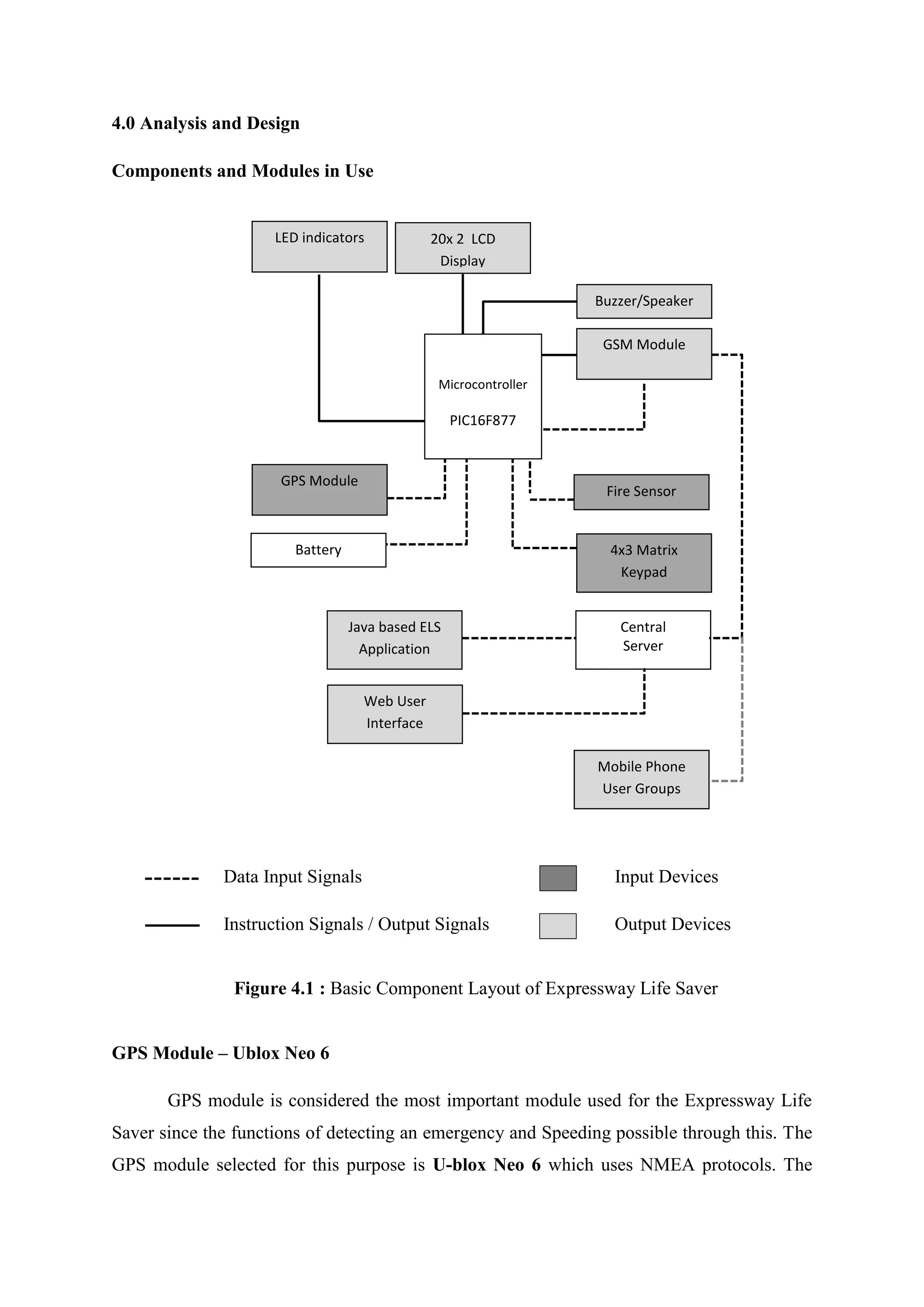
LED indicators 20x 2 LCD
Display
GSM Module
Microcontroller
PIC16F877
Fire Sensor
GPS Module
Battery
Buzzer/Speaker
4x3 Matrix
Keypad
Central
Server
Java based ELS
Application
Web User
Interface
Mobile Phone
User Groups
4.0 Analysis and Design
Components and Modules in Use
Data Input Signals Input Devices
Instruction Signals / Output Signals Output Devices
Figure 4.1 : Basic Component Layout of Expressway Life Saver
GPS Module – Ublox Neo 6
GPS module is considered the most important module used for the Expressway Life
Saver since the functions of detecting an emergency and Speeding possible through this. The
GPS module selected for this purpose is U-blox Neo 6 which uses NMEA protocols. The
GPS communicates via the USART module (Universal Synchronous Asynchronous Receiver
Transmitter) of the PIC16f877A using Asynchronous Reception mode. Therefore, after
initiating a handshaking protocol with the Satellites, the GPS module provides the
Microcontroller with the GPS NMEA sentences as a stream of bytes, which are read
accordingly.
GSM Module – SIM 900
GSM is a SIM 900 module, but only used for transmitting and receiving text
messages. The GSM module is mostly independent in terms of interaction as this only works
either when the vehicle accidents or breach a law. The formats of the messages are predefined
in the codes as to the relevance of the incidents which are sensed by the sensors.
IR Flame Sensor
Flame Sensor is an IR flame detector that is capable of detecting flames using Infrared
Waves from a flame. The simple sensor was designed and implemented by the group.
This is intended to be used in a special scenario of an engine fire. Therefore, this
module is not interrupt driven but only checks if the condition is TRUE (whether the flame
detection signal is setup) before sending out the relevant text message. Also with this, the
Buzzer would sound an alarm in order to create attraction from around and create a reaction.
The above is capable because of the fact that the module is capable of producing a Digital
Output to the microcontroller.
Liquid Crystal Display
The LCD is module with HD44780 controller that supports ASCII character
recognition. Therefore, the LCD is used as the visual interaction media that displays
instructions, warnings, menus etc. to the driver only in the form of Alphanumeric Characters.
The LCD acts as the basic platform in integrating all of the modules. In this device, the LCD
is interfaced using the 4-bit configuration in order to save no. of cycles since the GPS and
GSM module speeds has to be improved.
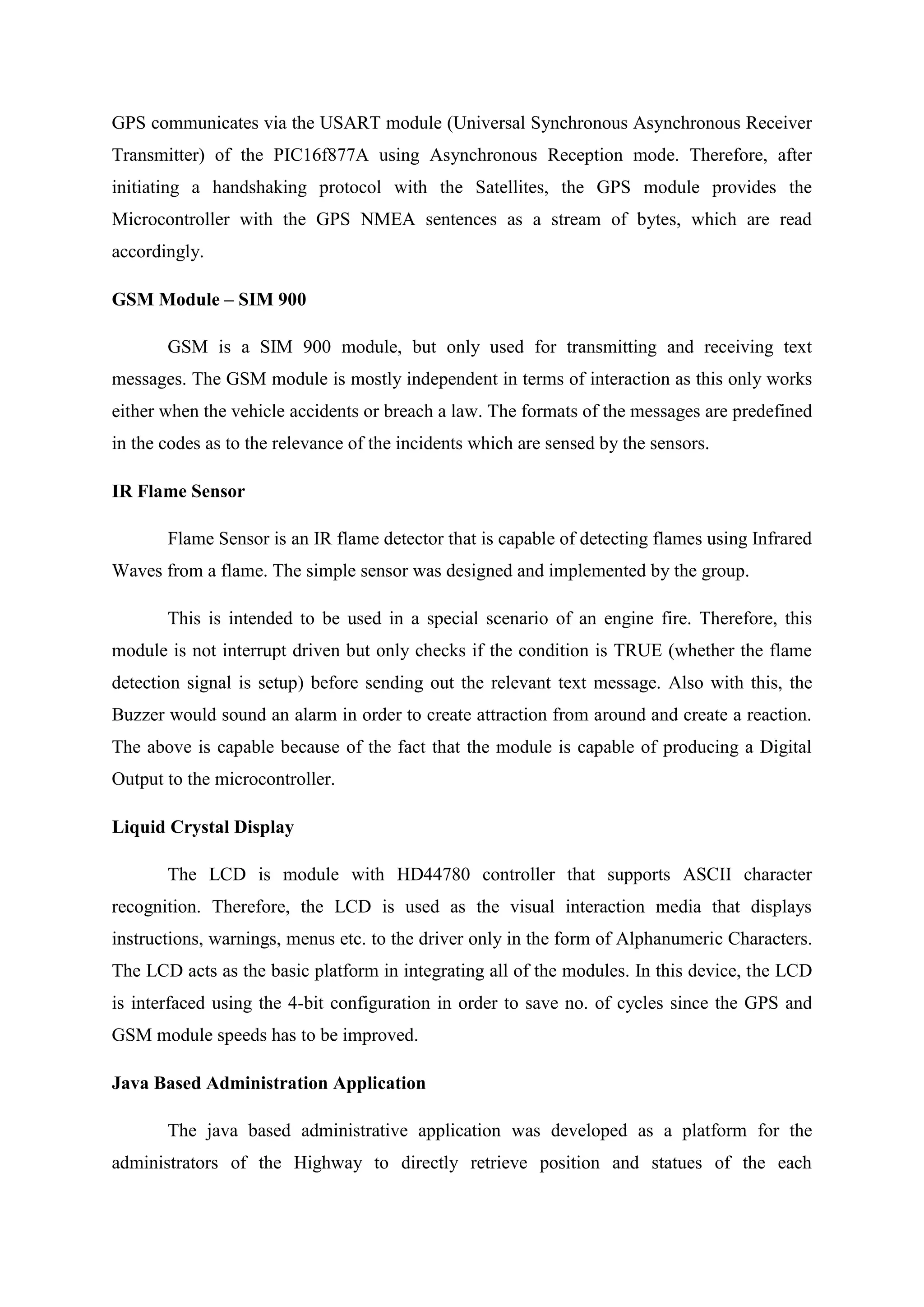
Java Based Administration Application
The java based administrative application was developed as a platform for the
administrators of the Highway to directly retrieve position and statues of the each
device/vehicle. The application is recommended to be implemented at interchanges, control
centre and service areas. The application provides a user friendly interface to retrieve data
based on vehicle number and outputs the relevant up to date information of the vehicle such
as speed, position, Entry point etc. The application also provides the facility to view these
data through Google map which is very much applicable to administrators and emergency
response units to precisely locate the vehicles in distress, as the map position would be a
guide to navigate to the relevant area.
Figure 4.2 : Expressway Life Saver Administrator Application
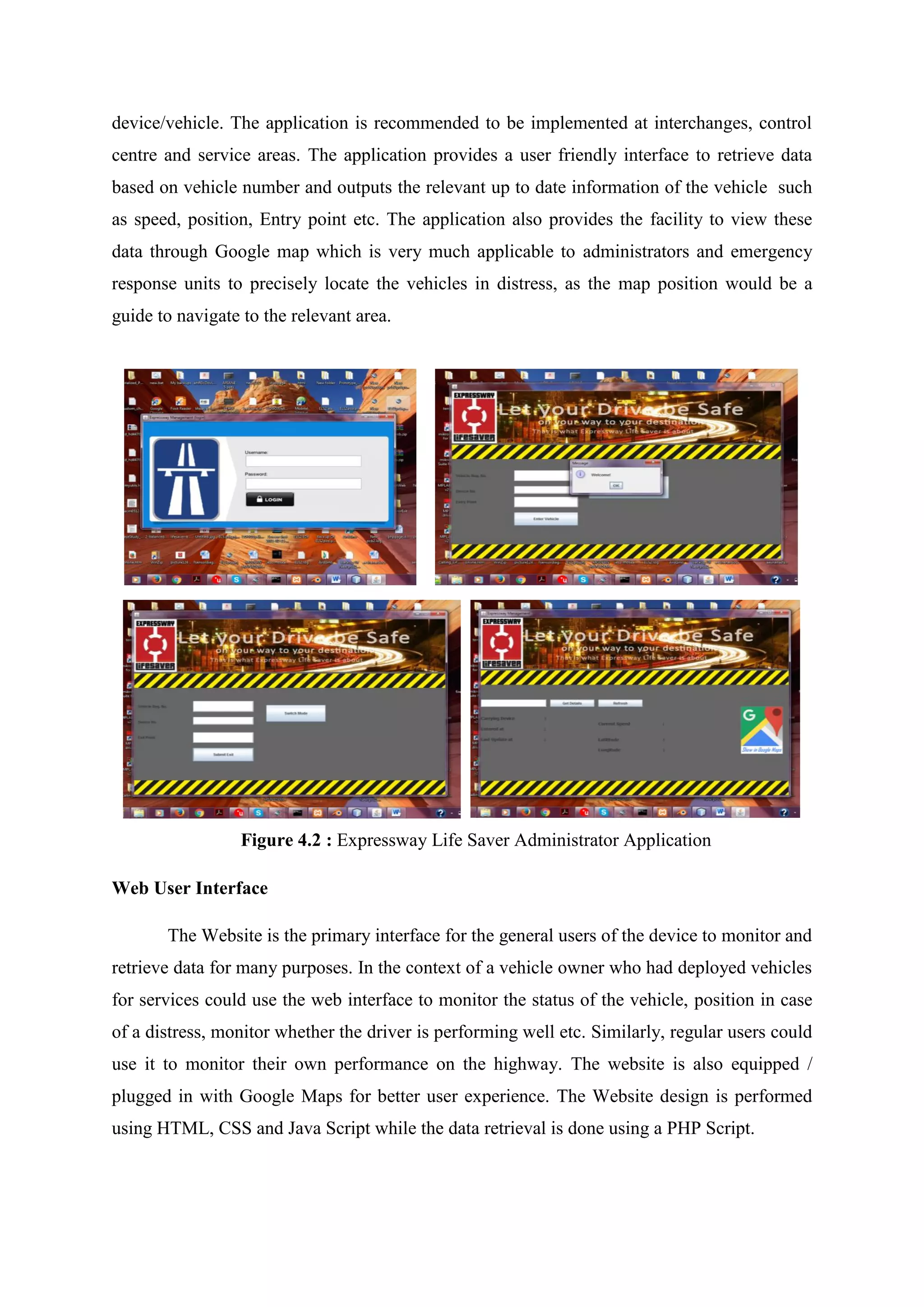
Web User Interface
The Website is the primary interface for the general users of the device to monitor and
retrieve data for many purposes. In the context of a vehicle owner who had deployed vehicles
for services could use the web interface to monitor the status of the vehicle, position in case
of a distress, monitor whether the driver is performing well etc. Similarly, regular users could
use it to monitor their own performance on the highway. The website is also equipped /
plugged in with Google Maps for better user experience. The Website design is performed
using HTML, CSS and Java Script while the data retrieval is done using a PHP Script.
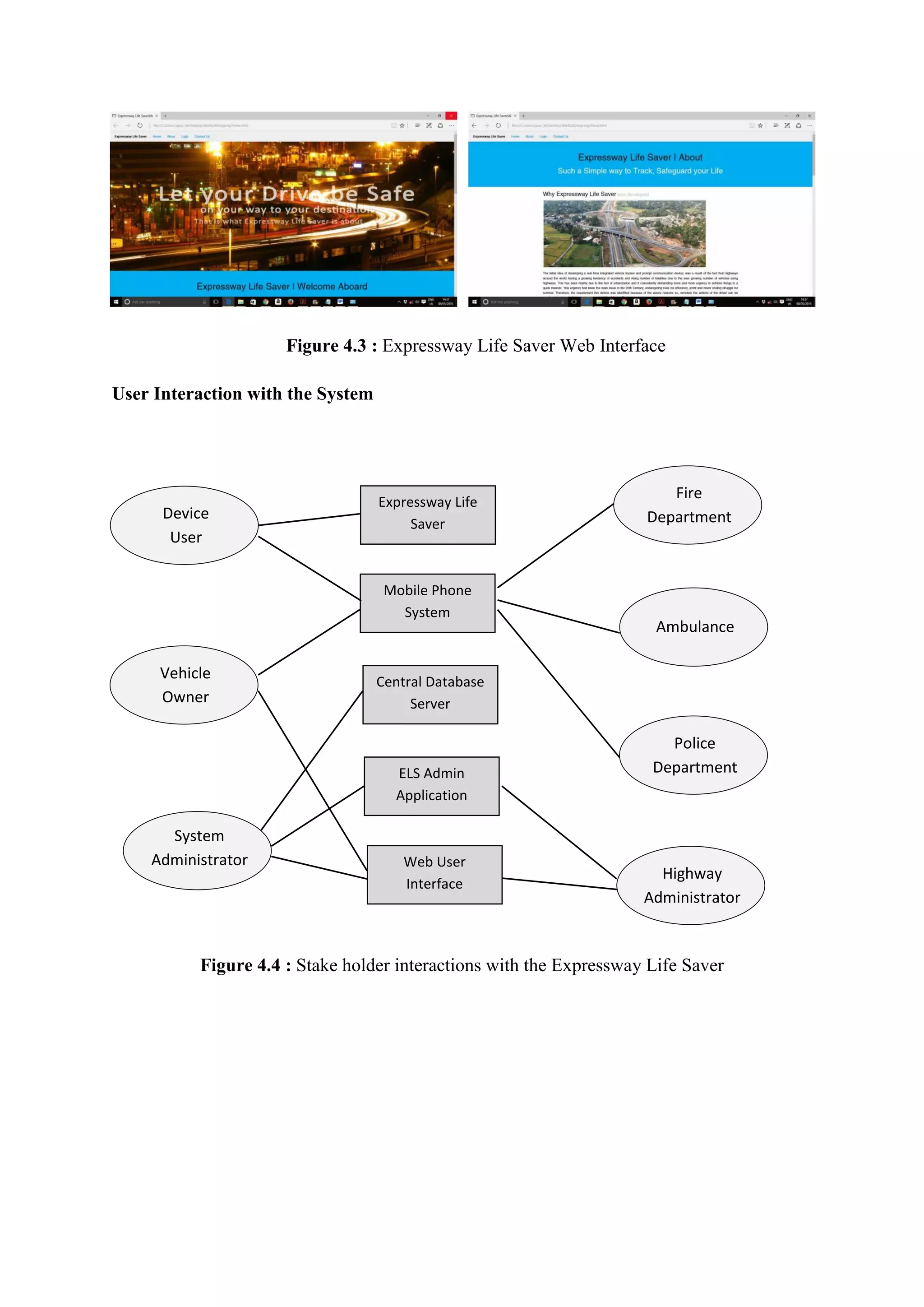
Expressway Life
Saver
Mobile Phone
System
Central Database
Server
ELS Admin
Application
Web User
Interface
Figure 4.3 : Expressway Life Saver Web Interface
User Interaction with the System
Figure 4.4 : Stake holder interactions with the Expressway Life Saver
Device
User
Vehicle
Owner
System
Administrator
Fire
Department
Ambulance
Police
Department
Highway
Administrator
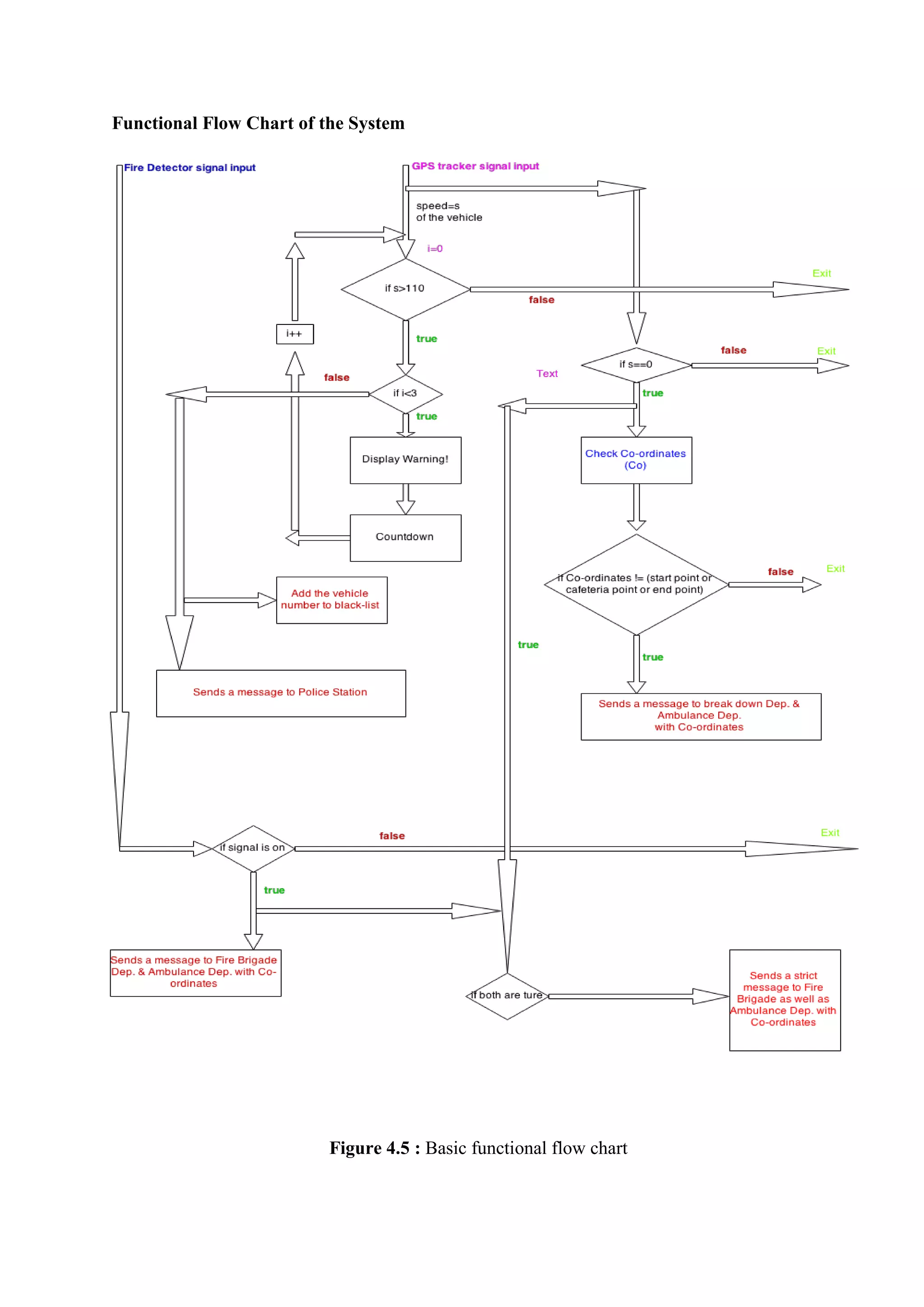
Functional Flow Chart of the System
Figure 4.5 : Basic functional flow chart
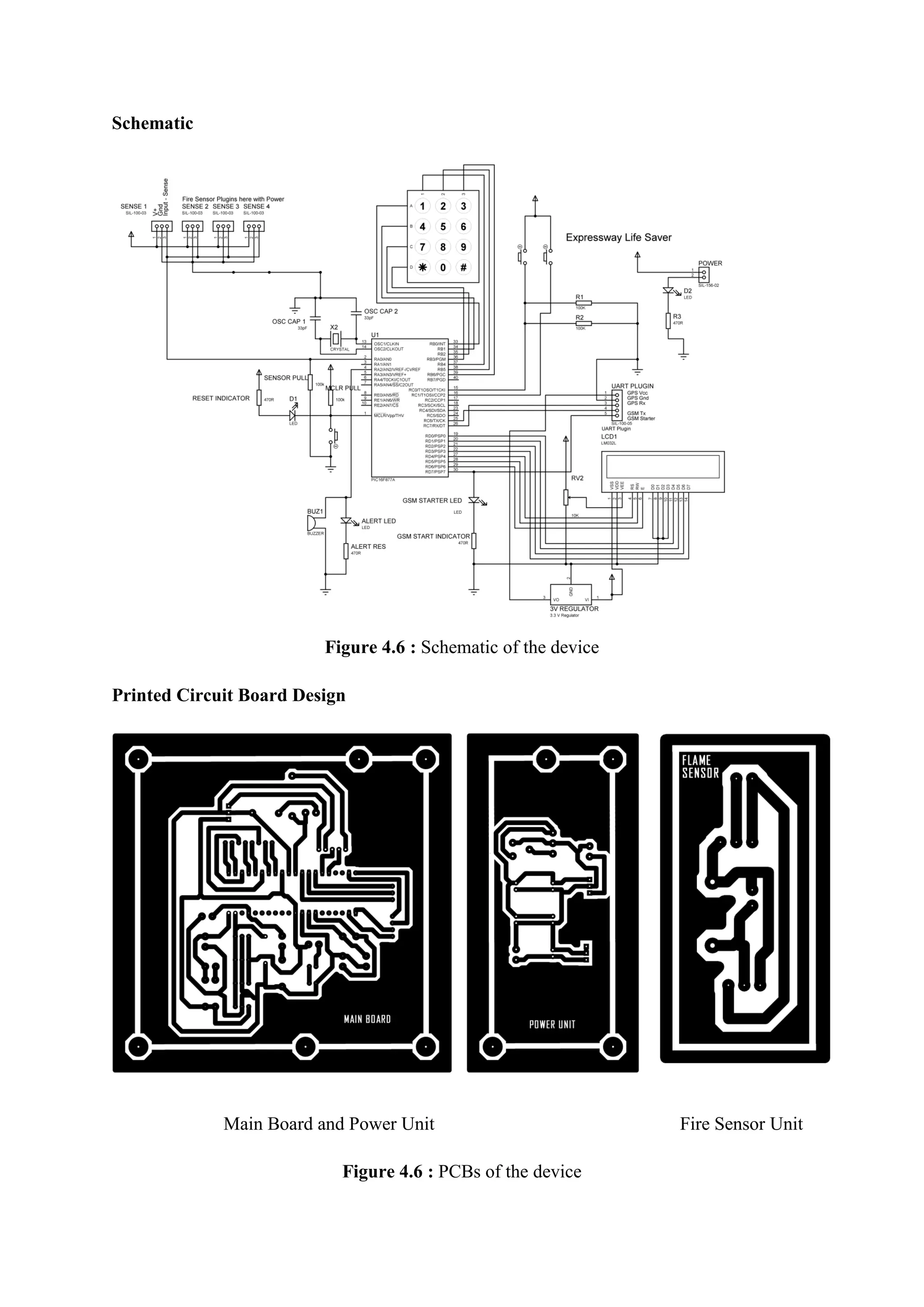
Schematic
Figure 4.6 : Schematic of the device
Printed Circuit Board Design
4
Main Board and Power Unit Fire Sensor Unit
Figure 4.6 : PCBs of the device
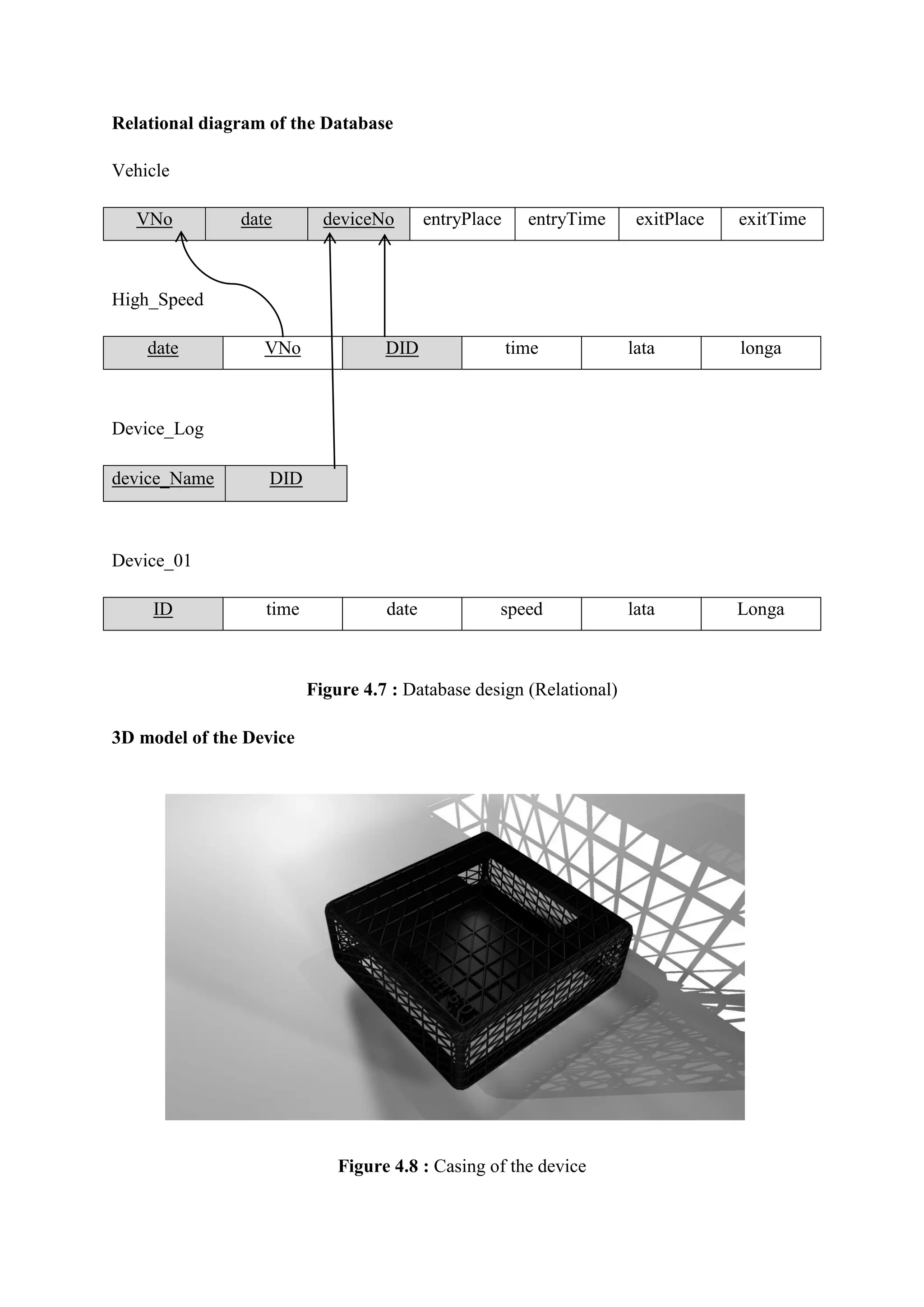
Relational diagram of the Database
Vehicle
VNo date deviceNo entryPlace entryTime exitPlace exitTime
High_Speed
date VNo DID time lata longa
Device_Log
device_Name DID
Device_01
ID time date speed lata Longa
Figure 4.7 : Database design (Relational)
3D model of the Device
Figure 4.8 : Casing of the device
5. 0 Testing and Implementation
Testing an implementation was carried out at separate stages. Initially, the
identification of components and the requirements from each module, according to the device
specifications were discussed intensively within the group and with the help of the supervisor
and instructors. Therefore, PIC 16F877A was selected based on the facts that it was used
regularly, knowledge could be obtained easily as it was easily accessible and the
conformance to the specifications.
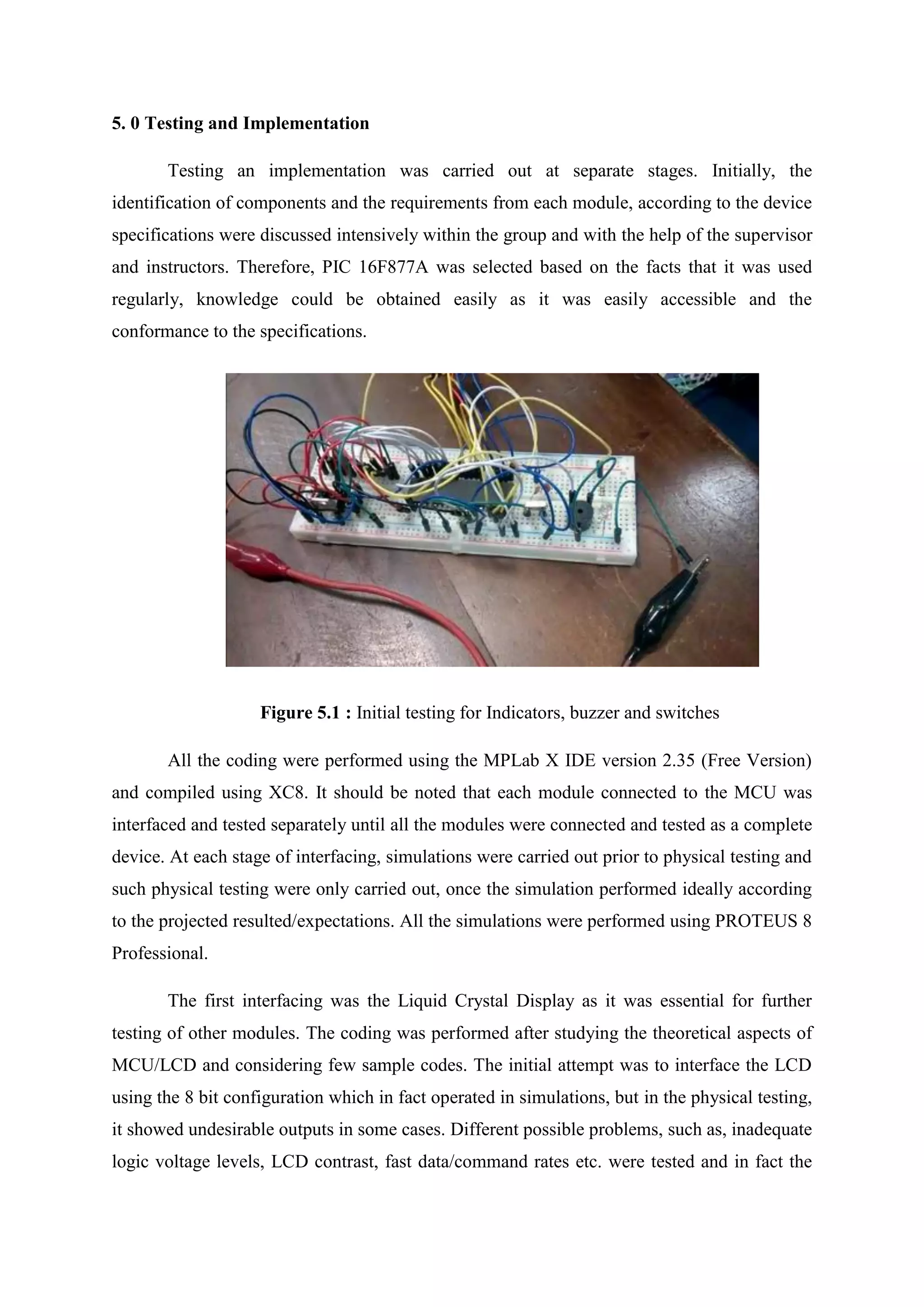
Figure 5.1 : Initial testing for Indicators, buzzer and switches
All the coding were performed using the MPLab X IDE version 2.35 (Free Version)
and compiled using XC8. It should be noted that each module connected to the MCU was
interfaced and tested separately until all the modules were connected and tested as a complete
device. At each stage of interfacing, simulations were carried out prior to physical testing and
such physical testing were only carried out, once the simulation performed ideally according
to the projected resulted/expectations. All the simulations were performed using PROTEUS 8
Professional.
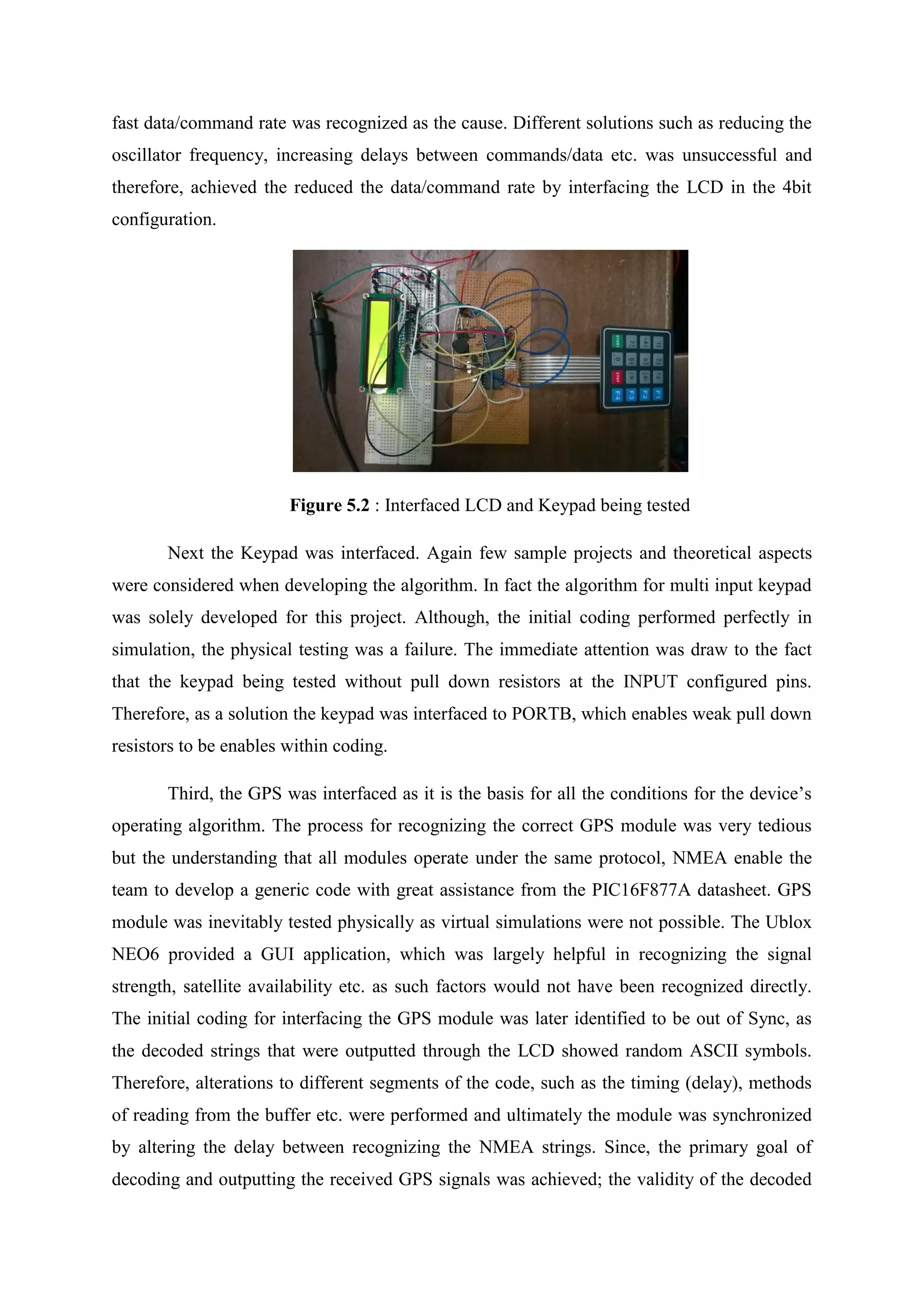
The first interfacing was the Liquid Crystal Display as it was essential for further
testing of other modules. The coding was performed after studying the theoretical aspects of
MCU/LCD and considering few sample codes. The initial attempt was to interface the LCD
using the 8 bit configuration which in fact operated in simulations, but in the physical testing,
it showed undesirable outputs in some cases. Different possible problems, such as, inadequate
logic voltage levels, LCD contrast, fast data/command rates etc. were tested and in fact the
fast data/command rate was recognized as the cause. Different solutions such as reducing the
oscillator frequency, increasing delays between commands/data etc. was unsuccessful and
therefore, achieved the reduced the data/command rate by interfacing the LCD in the 4bit
configuration.
Figure 5.2 : Interfaced LCD and Keypad being tested
Next the Keypad was interfaced. Again few sample projects and theoretical aspects
were considered when developing the algorithm. In fact the algorithm for multi input keypad
was solely developed for this project. Although, the initial coding performed perfectly in
simulation, the physical testing was a failure. The immediate attention was draw to the fact
that the keypad being tested without pull down resistors at the INPUT configured pins.
Therefore, as a solution the keypad was interfaced to PORTB, which enables weak pull down
resistors to be enables within coding.
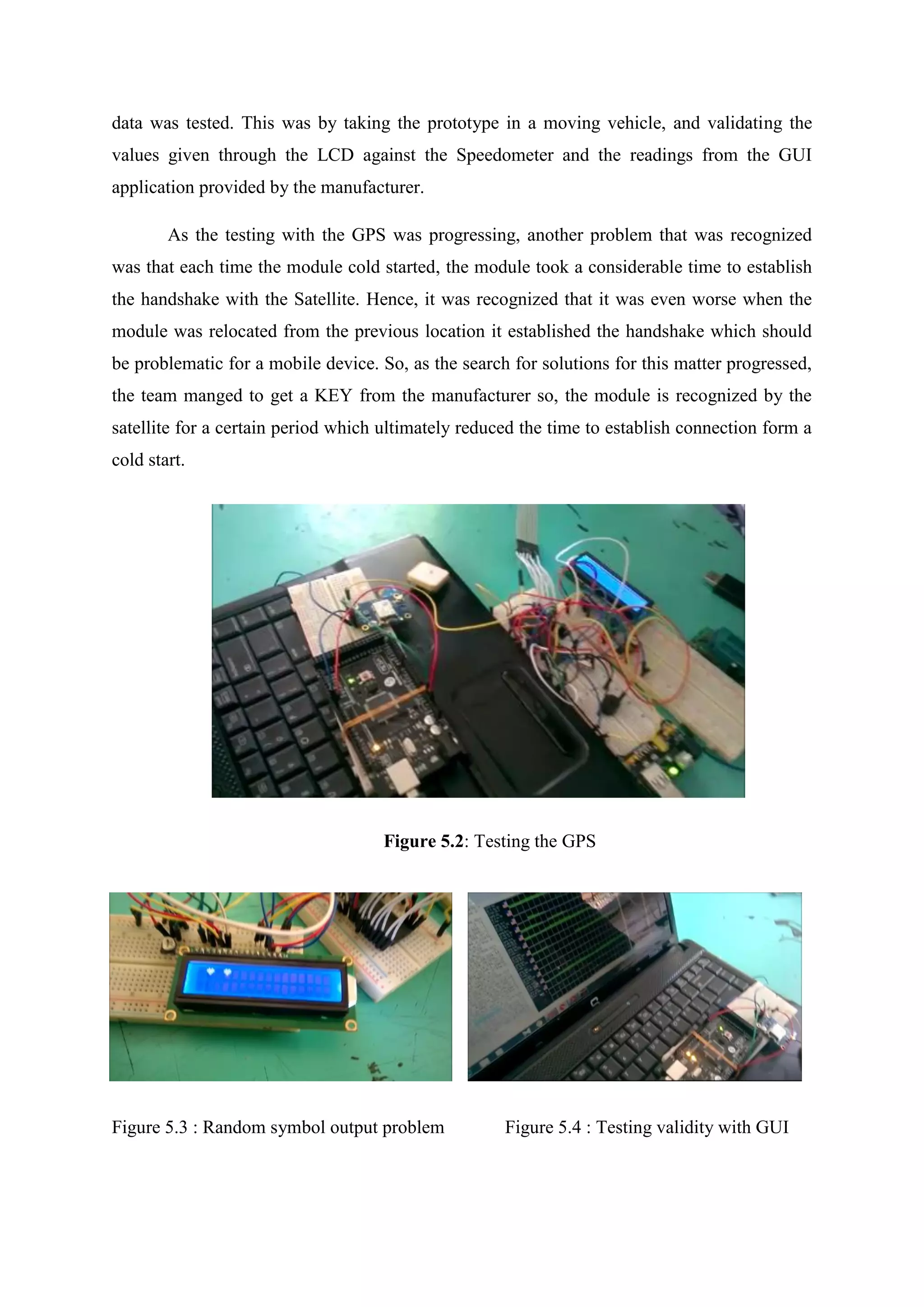
Third, the GPS was interfaced as it is the basis for all the conditions for the device’s
operating algorithm. The process for recognizing the correct GPS module was very tedious
but the understanding that all modules operate under the same protocol, NMEA enable the
team to develop a generic code with great assistance from the PIC16F877A datasheet. GPS
module was inevitably tested physically as virtual simulations were not possible. The Ublox
NEO6 provided a GUI application, which was largely helpful in recognizing the signal
strength, satellite availability etc. as such factors would not have been recognized directly.
The initial coding for interfacing the GPS module was later identified to be out of Sync, as
the decoded strings that were outputted through the LCD showed random ASCII symbols.
Therefore, alterations to different segments of the code, such as the timing (delay), methods
of reading from the buffer etc. were performed and ultimately the module was synchronized
by altering the delay between recognizing the NMEA strings. Since, the primary goal of
decoding and outputting the received GPS signals was achieved; the validity of the decoded
data was tested. This was by taking the prototype in a moving vehicle, and validating the
values given through the LCD against the Speedometer and the readings from the GUI
application provided by the manufacturer.
As the testing with the GPS was progressing, another problem that was recognized
was that each time the module cold started, the module took a considerable time to establish
the handshake with the Satellite. Hence, it was recognized that it was even worse when the
module was relocated from the previous location it established the handshake which should
be problematic for a mobile device. So, as the search for solutions for this matter progressed,
the team manged to get a KEY from the manufacturer so, the module is recognized by the
satellite for a certain period which ultimately reduced the time to establish connection form a
cold start.
Figure 5.2: Testing the GPS
Figure 5.3 : Random symbol output problem Figure 5.4 : Testing validity with GUI
The GSM module was interfaced and tested in PROTEUS using virtual terminal.
Here, the initial interfacing was a failure in simulation as it outputted a repetitive string of
symbols which was undesired. Therefore, the code was re-written due to the complexity of
the previous version and the simplified GSM interfacing was tested in PROTEUS and with
the success of it, the physical testing was carried out which performed well than our
expectation.
At the initial stages of the project implementation/testing, a readymade fire sensor
was used. But, with the advice at the mid evaluations, the team considered developing a
simple fire sensor based on the IR wave recognition emitted from fire. The team looked into
3 different fire sensor circuits on the internet, and directly tested physically. The designed
were based on IR receivers and Op-Amps, but neither gave the desired output. Therefore, the
team solely tested a IR senor, simply considering the basic electronic theories of transistors
and by consecutively testing using the ‘trial and error’ method, the desired output was
achieved and the sensor was included to the project.
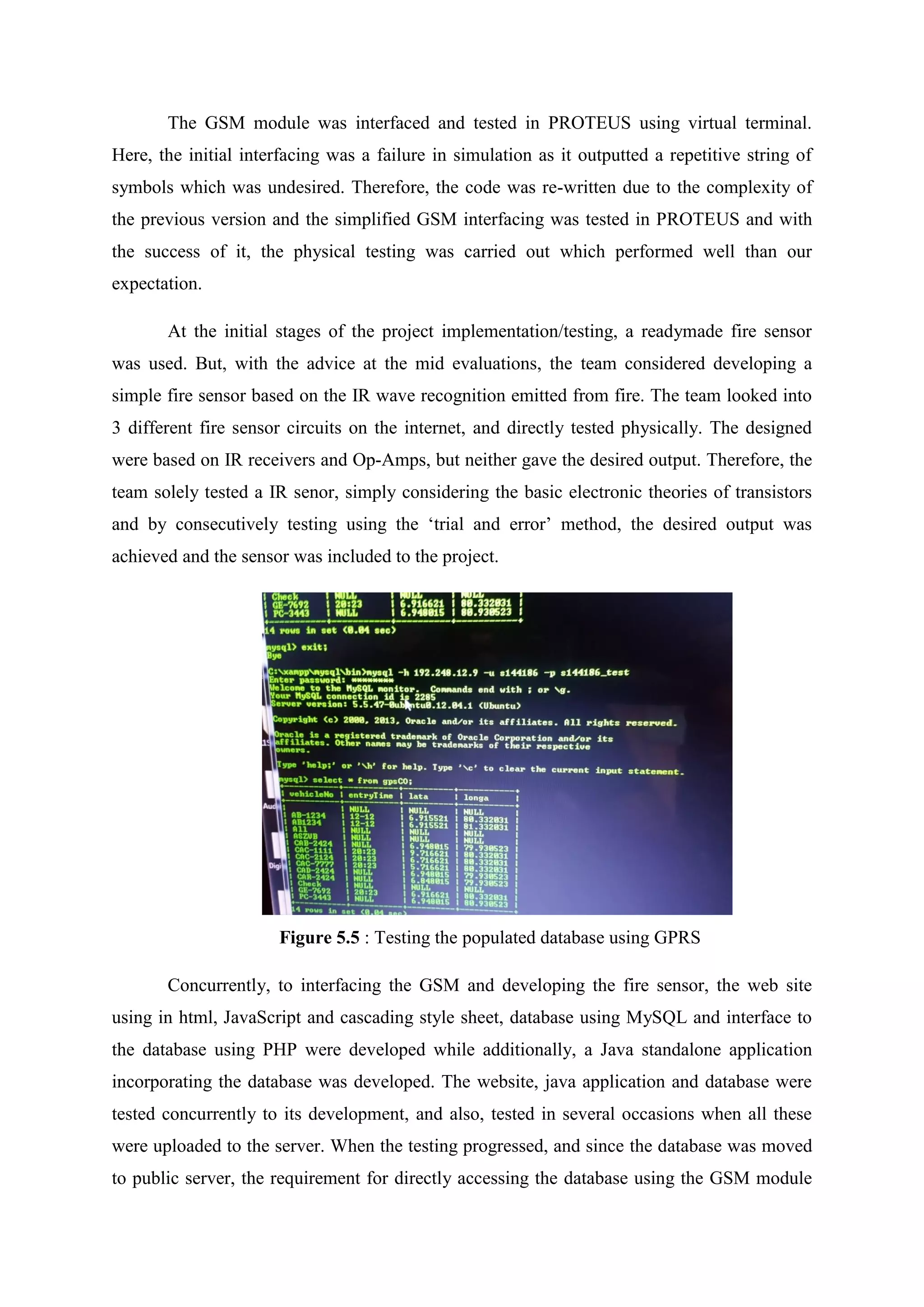
Figure 5.5 : Testing the populated database using GPRS
Concurrently, to interfacing the GSM and developing the fire sensor, the web site
using in html, JavaScript and cascading style sheet, database using MySQL and interface to
the database using PHP were developed while additionally, a Java standalone application
incorporating the database was developed. The website, java application and database were
tested concurrently to its development, and also, tested in several occasions when all these
were uploaded to the server. When the testing progressed, and since the database was moved
to public server, the requirement for directly accessing the database using the GSM module
arose. The GSM module in use also supports GPRS and considering few sample codes, a
code to interface GPRS with the MCU was first tested with PROTEUS and then directly with
the module.
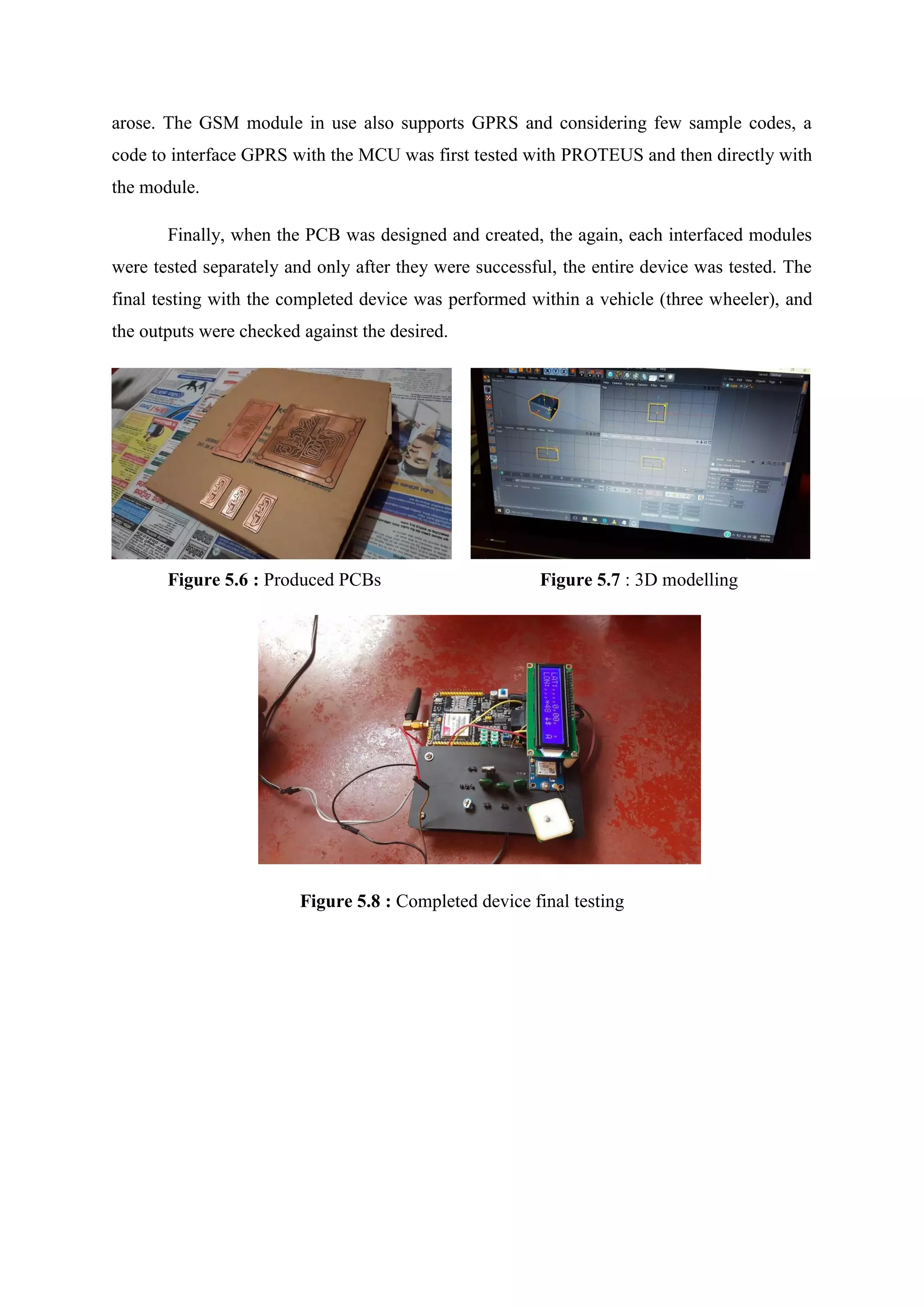
Finally, when the PCB was designed and created, the again, each interfaced modules
were tested separately and only after they were successful, the entire device was tested. The
final testing with the completed device was performed within a vehicle (three wheeler), and
the outputs were checked against the desired.
Figure 5.6 : Produced PCBs Figure 5.7 : 3D modelling
Figure 5.8 : Completed device final testing
6.0 Further work
 Improve the device with more capability to recognize the traffic conditions and it’s
capability to assist the driver in making decisions. By integrating cameras (image
processing) and using sonar/proximity sensors, the life saver could be added with new
features to recognize the surrounding traffic environment and give directions to the
driver in cases like maintaining safe proximity with other vehicles, overtaking etc. so,
the highway safety is further improved.
 The implemented device currently doesn’t have any mechanism to understand
whether the vehicle is on the highway or not apart from recognizing the interchanges
and service areas using GPS coordinates. This was caused by the memory size
constraint which doesn’t allow a large program to recognize the entire length of the
highway using GPS. Therefore, further work would/should include a mechanism to
recognize highways from a free ways.
 Improve the power system by integrating power generators from renewable energy
such as sunlight.
 Expand the data base with the authorities and publicize the product.
7.0 REFERENCES
[1]en.wikipedia.org/wiki/Traffic_enforcement_camera
[2]en.wikipedia.org/wiki/Expressway_Monitoring_and_Advisory_System
[3]Kornhauser, Alain L Ph. D., Highway Performance Monitoring Using GPS:
Characterization of Travel Speeds on any Roadway Segment, pp3
[4]www.adaderana.lk/news/29196/eight-injured-in-e01-expressway-crash
[5]www.police.lk/index.php/traffic-statistics
[6]www.police.lk/index.php/traffic-statistics/112
[7]www.police.lk/index.php/traffic-statistics/113
[8]www.sundaytimes.lk/130505/uploads/Southern-Expressway-accidents.jpg

Expressway Life Saver Implementation Report

  • 1.
    Expressway Life SaverImplementation Report: Using Information Technology and Applications to Enhance Highway Traffic Control and Law Enforcement Weerasinghe S.Y , Waduge N.D , Udadeniya A.S , Gamage S.N , Zoysa W.R.P. 1.0 Introduction Transport on land is un doubtfully the most popular method of transport as human prefer that the land transportation is the most safest. Given the fact that the effectiveness or either the land transportation or any other method, is depended upon being fast and able to reach the destination in a shorter period of time, ‘Highways’ has being a good solution. Although, highways compromised safety to cater this speed of life which required more safety measures for vehicles travelling in the highways. Even though, highway statistics provide the fact that the rate at which accidents occur on these are seemingly low, the impact or the fatality of accidents were very high. Therefore, an autonomous system that would cater all the above problems is in need. Still in the modern world, the top reasons for deaths are the traffic accidents. Each and every day, we listen to some tragic news regarding to this matter. Technology has been used in various ways to avoid traffic accidents; Air bags, auto brake systems and reverse assistance systems are examples for that, but still accidents occur due to various reasons intentionally or even unintentionally. So we have being concerned about avoiding accidents and also to implement a prompt back-up plan if an accident has occurred on the Highway. The component is mainly a focus on the Public Transportation sector. In implementing the ‘Expressway Life Saver’, the basic group of users are expected to be all the direct and indirect highway users from drivers, passengers to owners. Mainly, the product is aimed at the Public Transportation providers which allow the driver to be regulated according to the laws and regulations, ensure prompt actions in case of emergency, owners and passengers to check up upon the quality of safety, Police to monitor on law enforcement. The expressway life saver is a microcontroller base device. Therefore, the system receives: GPS position and velocity data of the vehicles, digital Fire detection signal from the Flame sensor, initialization data from the keypad and feedbacks from the GSM module. The speed is compared constantly with the standard regulated values, and in case of emergency a text message would be sent using the GSM module to relevant authorities and owners. Hence, the
  • 2.
    users are enabledto interact with the equipment using the LCD screen, Keypad, buzzer and the LED signal lights. The concept of the Expressway Life Saver (ELS) is an automated system to reduce the probability or virtually prevent vehicle collisions during high speed drives. The system mainly focuses on the enhancing the enforcement of Highway law and its codes in the Law enforcers side, make sure the vehicle property is being handled properly and lawfully in the Owners side and reacting to any accidents, breakdowns or break of law. The system could help locate and inform any responsible person in case of a crash through text messages in order to better response on such situations. Additionally, the data from the components are updated to a database where good performances and Transport providers’ safety rating can be viewed by the public through a Website. In our country we only have two expressways at the moment and more to be put up, but we had heard of lots of accidents, deaths, injuries in this short time from these expressways are opened. So we thought an efficient way to avoid these accidents. When we are dealing with a very high speed, a tiny little mistake could be converted to a tragedy. According to the data provided by the Road Development Authority (RDA) and Sri Lanka Police these expressway accidents had been due to either High speed and mostly in wet conditions, Mechanical failure etc. Table 1.1: Causes of Highway Accidents Reference: Sri Lanka Police (Highway Traffic Statistics) Cause of Accidents 2013 2014 2015 Jan Feb Mar Slipping due to Rain - High Speed 128 98 4 18 12 Over Speeding (>100kmph) 8 6 2 0 0 Total due to High Speed 136 104 6 18 12 Reclus Driving 73 113 15 5 15 Mechanical Failures 51 23 3 1 7 Other 41 40 4 6 6 Total Accidents 378 280 110
  • 3.
    According to theStatistics obtained by the Traffic Division of Sri Lanka Police shows that the No. of accidents have a growing tendency. Therefore, as explained and evident through the statics below, the No. of Fatalities is being increased by the year. Table 1.2: Growth in Damages and Fatalities by Year Reference: Sri Lanka Police (Highway Traffic Statistics) Considering the above matters, it’s apparent that there’s a problem in the system that are in place to enforce the laws and also there’s matter in informing such incidents to the authorities as most accidents are apparent to cause fires. In addition, there’s no method of monitoring the vehicles on the roll therefore , enabling a real-time monitoring either in a Central Monitor or remotely by a device as we propose by the Expressway life Saver. Hence, this is a loop-hole for drivers who don’t adhere to the regulations constantly throughout the highway but also a danger for those who may face an accident or a break down. In a case of an accident and through the evidence that has being provided above on catching fire, the probability of the driver being enable to inform ambulances, fire brigades or life savers is low which may further increase damage. Thus, this needs an automatic method of detecting and informing damage to relevant which also remove the burden and distraction to other drivers in informing such cases. Unless popularized through informal methods, the public or the Police don’t have the access to driver profiles/Transport provider profiles in choosing the best Travel providers or to keep vigilance on drivers who already have a bad track record. Therefore, its suggestive from the Public and the law enforcers to maintain a database and a public access to such information in making various decisions. In summary, because of above matters our intention to introduce a device which can solve this matters. In brief followings are our main concerns, Type of Damage 2012 2013 2014 Fatal Accidents 4 6 3 Serious Injuries 2 2 3 Minor Injuries 29 23 51 Damages to Property 365 347 585 Total 400 378 588
  • 4.
     Avoid accidents If an accident has been occurred give immediate help to victims with ambulances, fire-brigade and police.  Help the driver in adhering to laws and remotely instructing on how to act according in each and every situation. There, direct the driver actions on highway.  Maintain a data base on driver profiles on highway. When we consider about these concerns, our prior intension is to avoid accidents, because “Prevention is better than cure”. Figure 1 : Current Speed Gun Penalty Sheet
  • 5.
    2. 0 LiteratureSurvey Expressway Monitoring and Advisory System Expressway Monitoring and Advisory System or EMAS, was system developed by the Singapore Technologies and Electronics in 1996 as a contact for the Singapore’s Land Transport Authority. The system enables the LTA personnel to detect accidents and respond to them quickly while notifying the driver of adverse traffic conditions and safety instructions. The EMAS was implemented as system that consists of cameras and LED sign boards. The cameras transmit data to a central location and the staffs monitor the traffic and the staff reacts in case of emergency. In such cases, the drivers are informed of the hazards through the Sign boards. This system is already implemented in Sri Lanka’s highways as well. [2] Figure 2.1 : Current EMAS system in most highways Traffic Cameras and Number Plate Readers A traffic enforcement camera (also red light camera, road safety camera, road rule camera, photo radar, photo enforcement, speed camera, Gatso, safety camera, bus lane camera, Safe-T-Cam, depending on use) is a camera which may be mounted beside or over a road or installed in an enforcement vehicle to detect traffic regulation violations, including speeding, vehicles going through a red traffic light, unauthorized use of a bus lane, or for recording vehicles inside a congestion charge area. It may be linked to an automated ticketing system.
  • 6.
    The latest automaticnumber plate recognition systems can be used for the detection of average speeds and raise concerns over loss of privacy and the potential for governments to establish mass surveillance of vehicle movements and therefore by association also the movement of the vehicle’s owner. Vehicles owners are often required by law to identify the driver of the vehicle and a case was taken to the European Court of Human Rights which found that human rights were not being breached. Some groups, such as the National Motorists Association in the USA, claim that systems “encourage … revenue-driven enforcement” rather than the declared objectives. [1] Therefore, the traffic cameras have its own inherent problems. Therefore, the problem of interfering privacy could be addressed by the proposed system by using a GPS tracker instead of a visual media. This also enables to tack the vehicle’s performances real time since the cameras are only capable of making a contribution to law enforcement at places where they exists. Hence, the case of being specific to one kind (Eg: Bus lane traffic camera) has lessen the scope of the traffic cameras. This provide the fact that the officials and local governments who have used these systems would have had to duplicate the cost for similar devices for the same purpose but different in operation. Therefore, the investment would have being high as it comes with an installation cost. Thus, the concept of ELS not being vehicle has the advantage of catering the safety requirement for any vehicle which doesn’t have an installation cost as well since the device is designed to be mobile and compact. Highway Performance monitoring using GPS Embedded sensors such as “loop detectors” and radar/laser speed detectors are placed in (loop detector) or alongside of (radar/laser speed detector) the pavement to detect the presence and speed of each vehicle traveling by that specific location. The advantage of these systems is that they measure the speed of essentially every vehicle passing by that location. This produces an enormous volume of speed data that effectively characterize the temporal distribution of speed by time-of day, day-of-week, weather and even some incidents such as police action, construction and accidents.
  • 7.
    The disadvantage isthat this speed information is available only at the locations where there existed both the foresight to monitor that specific location and the substantial infrastructure funding that these systems require.[3] 40 of the above systems do prevail in Sri Lanka as well. These also have the same problems as of the Traffic cameras and those mentioned in the text above as well. Another disadvantage would be the effectiveness of these systems in severe weather conditions as heavy rain etc. could create lot of noise in the system as these are exposed to the outside environment. Thus, static charges generating from thunder and lightning also creates a danger to the systems existence. Therefore, the systems are often offline in severe weather when they are actually required. Highway Rescue System This system was developed by a Sri Lankan school student in 2015 in order to provide prompt communication between the distressed vehicle and an emergency authority. Further details of the implementation haven’t been provided. Expressway Monitoring System The expressway monitoring system was developed recently by the Computer Science and Engineering Department of University of Moratuwa. The system is known to have used cameras for image processing and adopted Artificial intelligence, Robotics technologies according to the sources.
  • 8.
    3.0 Aim andObjectives Aim Make the Highway systems safer for all the user groups from drivers to passengers by a technological solution. Objectives  Create a system that is capable of correctly sensing the driver’s behaviour in real time on the highway and reacting accordingly.  Create a system that takes the driver’s attention entirely on to road safety.  Create a system that influences the driver not to push to the limits of the vehicles performance which could be dangerous.  Create a system that automatically and also quickly transmit immediate requests for helps/lifesaving/damage recovery to relevant authorities.  Create a Database and publically accessed website on drivers/transport providers in order to create better public understanding on road safety, decision making etc.  Use the data base extensively in better law enforcement.
  • 9.
    LED indicators 20x2 LCD Display GSM Module Microcontroller PIC16F877 Fire Sensor GPS Module Battery Buzzer/Speaker 4x3 Matrix Keypad Central Server Java based ELS Application Web User Interface Mobile Phone User Groups 4.0 Analysis and Design Components and Modules in Use Data Input Signals Input Devices Instruction Signals / Output Signals Output Devices Figure 4.1 : Basic Component Layout of Expressway Life Saver GPS Module – Ublox Neo 6 GPS module is considered the most important module used for the Expressway Life Saver since the functions of detecting an emergency and Speeding possible through this. The GPS module selected for this purpose is U-blox Neo 6 which uses NMEA protocols. The
  • 10.
    GPS communicates viathe USART module (Universal Synchronous Asynchronous Receiver Transmitter) of the PIC16f877A using Asynchronous Reception mode. Therefore, after initiating a handshaking protocol with the Satellites, the GPS module provides the Microcontroller with the GPS NMEA sentences as a stream of bytes, which are read accordingly. GSM Module – SIM 900 GSM is a SIM 900 module, but only used for transmitting and receiving text messages. The GSM module is mostly independent in terms of interaction as this only works either when the vehicle accidents or breach a law. The formats of the messages are predefined in the codes as to the relevance of the incidents which are sensed by the sensors. IR Flame Sensor Flame Sensor is an IR flame detector that is capable of detecting flames using Infrared Waves from a flame. The simple sensor was designed and implemented by the group. This is intended to be used in a special scenario of an engine fire. Therefore, this module is not interrupt driven but only checks if the condition is TRUE (whether the flame detection signal is setup) before sending out the relevant text message. Also with this, the Buzzer would sound an alarm in order to create attraction from around and create a reaction. The above is capable because of the fact that the module is capable of producing a Digital Output to the microcontroller. Liquid Crystal Display The LCD is module with HD44780 controller that supports ASCII character recognition. Therefore, the LCD is used as the visual interaction media that displays instructions, warnings, menus etc. to the driver only in the form of Alphanumeric Characters. The LCD acts as the basic platform in integrating all of the modules. In this device, the LCD is interfaced using the 4-bit configuration in order to save no. of cycles since the GPS and GSM module speeds has to be improved. Java Based Administration Application The java based administrative application was developed as a platform for the administrators of the Highway to directly retrieve position and statues of the each
  • 11.
    device/vehicle. The applicationis recommended to be implemented at interchanges, control centre and service areas. The application provides a user friendly interface to retrieve data based on vehicle number and outputs the relevant up to date information of the vehicle such as speed, position, Entry point etc. The application also provides the facility to view these data through Google map which is very much applicable to administrators and emergency response units to precisely locate the vehicles in distress, as the map position would be a guide to navigate to the relevant area. Figure 4.2 : Expressway Life Saver Administrator Application Web User Interface The Website is the primary interface for the general users of the device to monitor and retrieve data for many purposes. In the context of a vehicle owner who had deployed vehicles for services could use the web interface to monitor the status of the vehicle, position in case of a distress, monitor whether the driver is performing well etc. Similarly, regular users could use it to monitor their own performance on the highway. The website is also equipped / plugged in with Google Maps for better user experience. The Website design is performed using HTML, CSS and Java Script while the data retrieval is done using a PHP Script.
  • 12.
    Expressway Life Saver Mobile Phone System CentralDatabase Server ELS Admin Application Web User Interface Figure 4.3 : Expressway Life Saver Web Interface User Interaction with the System Figure 4.4 : Stake holder interactions with the Expressway Life Saver Device User Vehicle Owner System Administrator Fire Department Ambulance Police Department Highway Administrator
  • 13.
    Functional Flow Chartof the System Figure 4.5 : Basic functional flow chart
  • 14.
    Schematic Figure 4.6 :Schematic of the device Printed Circuit Board Design 4 Main Board and Power Unit Fire Sensor Unit Figure 4.6 : PCBs of the device
  • 15.
    Relational diagram ofthe Database Vehicle VNo date deviceNo entryPlace entryTime exitPlace exitTime High_Speed date VNo DID time lata longa Device_Log device_Name DID Device_01 ID time date speed lata Longa Figure 4.7 : Database design (Relational) 3D model of the Device Figure 4.8 : Casing of the device
  • 16.
    5. 0 Testingand Implementation Testing an implementation was carried out at separate stages. Initially, the identification of components and the requirements from each module, according to the device specifications were discussed intensively within the group and with the help of the supervisor and instructors. Therefore, PIC 16F877A was selected based on the facts that it was used regularly, knowledge could be obtained easily as it was easily accessible and the conformance to the specifications. Figure 5.1 : Initial testing for Indicators, buzzer and switches All the coding were performed using the MPLab X IDE version 2.35 (Free Version) and compiled using XC8. It should be noted that each module connected to the MCU was interfaced and tested separately until all the modules were connected and tested as a complete device. At each stage of interfacing, simulations were carried out prior to physical testing and such physical testing were only carried out, once the simulation performed ideally according to the projected resulted/expectations. All the simulations were performed using PROTEUS 8 Professional. The first interfacing was the Liquid Crystal Display as it was essential for further testing of other modules. The coding was performed after studying the theoretical aspects of MCU/LCD and considering few sample codes. The initial attempt was to interface the LCD using the 8 bit configuration which in fact operated in simulations, but in the physical testing, it showed undesirable outputs in some cases. Different possible problems, such as, inadequate logic voltage levels, LCD contrast, fast data/command rates etc. were tested and in fact the
  • 17.
    fast data/command ratewas recognized as the cause. Different solutions such as reducing the oscillator frequency, increasing delays between commands/data etc. was unsuccessful and therefore, achieved the reduced the data/command rate by interfacing the LCD in the 4bit configuration. Figure 5.2 : Interfaced LCD and Keypad being tested Next the Keypad was interfaced. Again few sample projects and theoretical aspects were considered when developing the algorithm. In fact the algorithm for multi input keypad was solely developed for this project. Although, the initial coding performed perfectly in simulation, the physical testing was a failure. The immediate attention was draw to the fact that the keypad being tested without pull down resistors at the INPUT configured pins. Therefore, as a solution the keypad was interfaced to PORTB, which enables weak pull down resistors to be enables within coding. Third, the GPS was interfaced as it is the basis for all the conditions for the device’s operating algorithm. The process for recognizing the correct GPS module was very tedious but the understanding that all modules operate under the same protocol, NMEA enable the team to develop a generic code with great assistance from the PIC16F877A datasheet. GPS module was inevitably tested physically as virtual simulations were not possible. The Ublox NEO6 provided a GUI application, which was largely helpful in recognizing the signal strength, satellite availability etc. as such factors would not have been recognized directly. The initial coding for interfacing the GPS module was later identified to be out of Sync, as the decoded strings that were outputted through the LCD showed random ASCII symbols. Therefore, alterations to different segments of the code, such as the timing (delay), methods of reading from the buffer etc. were performed and ultimately the module was synchronized by altering the delay between recognizing the NMEA strings. Since, the primary goal of decoding and outputting the received GPS signals was achieved; the validity of the decoded
  • 18.
    data was tested.This was by taking the prototype in a moving vehicle, and validating the values given through the LCD against the Speedometer and the readings from the GUI application provided by the manufacturer. As the testing with the GPS was progressing, another problem that was recognized was that each time the module cold started, the module took a considerable time to establish the handshake with the Satellite. Hence, it was recognized that it was even worse when the module was relocated from the previous location it established the handshake which should be problematic for a mobile device. So, as the search for solutions for this matter progressed, the team manged to get a KEY from the manufacturer so, the module is recognized by the satellite for a certain period which ultimately reduced the time to establish connection form a cold start. Figure 5.2: Testing the GPS Figure 5.3 : Random symbol output problem Figure 5.4 : Testing validity with GUI
  • 19.
    The GSM modulewas interfaced and tested in PROTEUS using virtual terminal. Here, the initial interfacing was a failure in simulation as it outputted a repetitive string of symbols which was undesired. Therefore, the code was re-written due to the complexity of the previous version and the simplified GSM interfacing was tested in PROTEUS and with the success of it, the physical testing was carried out which performed well than our expectation. At the initial stages of the project implementation/testing, a readymade fire sensor was used. But, with the advice at the mid evaluations, the team considered developing a simple fire sensor based on the IR wave recognition emitted from fire. The team looked into 3 different fire sensor circuits on the internet, and directly tested physically. The designed were based on IR receivers and Op-Amps, but neither gave the desired output. Therefore, the team solely tested a IR senor, simply considering the basic electronic theories of transistors and by consecutively testing using the ‘trial and error’ method, the desired output was achieved and the sensor was included to the project. Figure 5.5 : Testing the populated database using GPRS Concurrently, to interfacing the GSM and developing the fire sensor, the web site using in html, JavaScript and cascading style sheet, database using MySQL and interface to the database using PHP were developed while additionally, a Java standalone application incorporating the database was developed. The website, java application and database were tested concurrently to its development, and also, tested in several occasions when all these were uploaded to the server. When the testing progressed, and since the database was moved to public server, the requirement for directly accessing the database using the GSM module
  • 20.
    arose. The GSMmodule in use also supports GPRS and considering few sample codes, a code to interface GPRS with the MCU was first tested with PROTEUS and then directly with the module. Finally, when the PCB was designed and created, the again, each interfaced modules were tested separately and only after they were successful, the entire device was tested. The final testing with the completed device was performed within a vehicle (three wheeler), and the outputs were checked against the desired. Figure 5.6 : Produced PCBs Figure 5.7 : 3D modelling Figure 5.8 : Completed device final testing
  • 21.
    6.0 Further work Improve the device with more capability to recognize the traffic conditions and it’s capability to assist the driver in making decisions. By integrating cameras (image processing) and using sonar/proximity sensors, the life saver could be added with new features to recognize the surrounding traffic environment and give directions to the driver in cases like maintaining safe proximity with other vehicles, overtaking etc. so, the highway safety is further improved.  The implemented device currently doesn’t have any mechanism to understand whether the vehicle is on the highway or not apart from recognizing the interchanges and service areas using GPS coordinates. This was caused by the memory size constraint which doesn’t allow a large program to recognize the entire length of the highway using GPS. Therefore, further work would/should include a mechanism to recognize highways from a free ways.  Improve the power system by integrating power generators from renewable energy such as sunlight.  Expand the data base with the authorities and publicize the product.
  • 22.
    7.0 REFERENCES [1]en.wikipedia.org/wiki/Traffic_enforcement_camera [2]en.wikipedia.org/wiki/Expressway_Monitoring_and_Advisory_System [3]Kornhauser, AlainL Ph. D., Highway Performance Monitoring Using GPS: Characterization of Travel Speeds on any Roadway Segment, pp3 [4]www.adaderana.lk/news/29196/eight-injured-in-e01-expressway-crash [5]www.police.lk/index.php/traffic-statistics [6]www.police.lk/index.php/traffic-statistics/112 [7]www.police.lk/index.php/traffic-statistics/113 [8]www.sundaytimes.lk/130505/uploads/Southern-Expressway-accidents.jpg