Driving a new age of
connected planning
Statistical Forecasting Methods
Overview of all Methods from Anaplan Statistical Forecast Model
30 Forecast Methods
Including:
• Simple Linear Regression
• Simple Exponential Smoothing
• Multiplicative Decomposition
• Holt-Winters
• Croston’s Intermittent Demand
Predictive Analytics
Forecasting Methods Summary
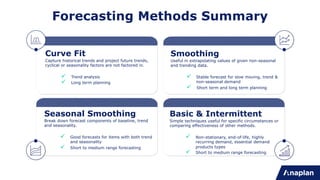
Capture historical trends and project future trends,
cyclical or seasonality factors are not factored in.
ü Trend analysis
ü Long term planning
Curve Fit
Useful in extrapolating values of given non-seasonal
and trending data.
ü Stable forecast for slow moving, trend &
non-seasonal demand
ü Short term and long term planning
Smoothing
Break down forecast components of baseline, trend
and seasonality.
ü Good forecasts for items with both trend
and seasonality
ü Short to medium range forecasting
Seasonal Smoothing
Simple techniques useful for specific circumstances or
comparing effectiveness of other methods.
ü Non-stationary, end-of-life, highly
recurring demand, essential demand
products types
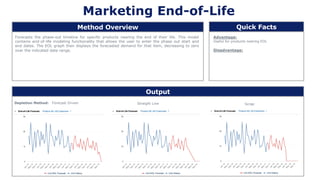
ü Short to medium range forecasting
Basic & Intermittent
Forecasting Methods List
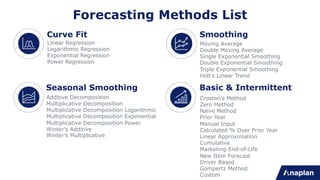
Curve Fit
Linear Regression
Logarithmic Regression
Exponential Regression
Power Regression
Basic & Intermittent
Croston’s Method
Zero Method
Naïve Method
Prior Year
Manual Input
Calculated % Over Prior Year
Linear Approximation
Cumulative
Marketing End-of-Life
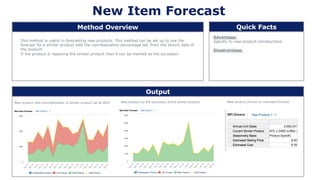
New Item Forecast
Driver Based
Gompertz Method
Custom
Smoothing
Moving Average
Double Moving Average
Single Exponential Smoothing
Double Exponential Smoothing
Triple Exponential Smoothing
Holt’s Linear Trend
Seasonal Smoothing
Additive Decomposition
Multiplicative Decomposition
Multiplicative Decomposition Logarithmic
Multiplicative Decomposition Exponential
Multiplicative Decomposition Power
Winter’s Additive
Winter’s Multiplicative
Curve Fit Methods
Curve Fit techniques capture historical trends
and project future trends. Cyclical or
seasonality factors are not factored into
these methods.
v Curve fit models are
q Most appropriate for trend analysis
q Good for long term planning
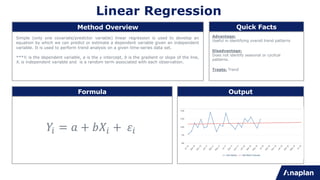
Linear Regression
Simple (only one covariate/predictor variable) linear regression is used to develop an
equation by which we can predict or estimate a dependent variable given an independent
variable. It is used to perform trend analysis on a given time-series data set.
***Yi is the dependent variable, a is the y intercept, b is the gradient or slope of the line,
Xi is independent variable and is a random term associated with each observation.
Advantage:
Useful in identifying overall trend patterns
Treats: Trend
Disadvantage:
Does not identify seasonal or cyclical
patterns.
Method Overview Quick Facts
Formula Output
!" = $ + &'" + ("
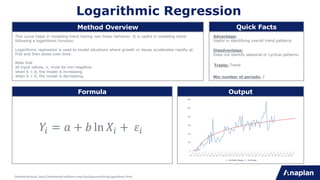
Logarithmic Regression
This curve helps in modeling trend having non-linear behavior. It is useful in modeling trend
following a logarithmic function.
Logarithmic regression is used to model situations where growth or decay accelerates rapidly at
first and then slows over time.
Note that
all input values, x, must be non-negative.
when b > 0, the model is increasing.
when b < 0, the model is decreasing.
Advantage:
Useful in identifying overall trend patterns
Treats: Trend
Disadvantage:
Does not identify seasonal or cyclical patterns.
Detailed formula: http://mathworld.wolfram.com/LeastSquaresFittingLogarithmic.html
!" = $ + & ln )" + *"
Min number of periods: 2
Method Overview Quick Facts
Formula Output
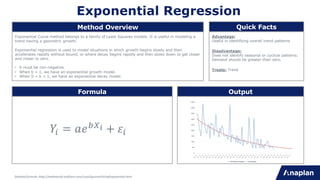
Exponential Regression
Exponential Curve method belongs to a family of Least Squares models. It is useful in modeling a
trend having a geometric growth.
Exponential regression is used to model situations in which growth begins slowly and then
accelerates rapidly without bound, or where decay begins rapidly and then slows down to get closer
and closer to zero.
• b must be non-negative.
• When b > 1, we have an exponential growth model.
• When 0 < b < 1, we have an exponential decay model.
Advantage:
Useful in identifying overall trend patterns
Treats: Trend
Disadvantage:
Does not identify seasonal or cyclical patterns.
Demand should be greater than zero.
!" = $%&'( + *"
Detailed formula: http://mathworld.wolfram.com/LeastSquaresFittingExponential.html
Method Overview Quick Facts
Formula Output
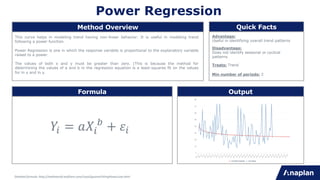
Power Regression
This curve helps in modeling trend having non-linear behavior. It is useful in modeling trend
following a power function.
Power Regression is one in which the response variable is proportional to the explanatory variable
raised to a power.
The values of both x and y must be greater than zero. (This is because the method for
determining the values of a and b in the regression equation is a least-squares fit on the values
for ln x and ln y.
Advantage:
Useful in identifying overall trend patterns
Treats: Trend
Disadvantage:
Does not identify seasonal or cyclical
patterns
Min number of periods: 2
!" = $%"
&
+ ("
Detailed formula: http://mathworld.wolfram.com/LeastSquaresFittingPowerLaw.html
Method Overview Quick Facts
Formula Output
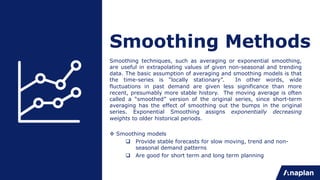
Smoothing Methods
Smoothing techniques, such as averaging or exponential smoothing,
are useful in extrapolating values of given non-seasonal and trending
data. The basic assumption of averaging and smoothing models is that
the time-series is “locally stationary”. In other words, wide
fluctuations in past demand are given less significance than more
recent, presumably more stable history. The moving average is often
called a “smoothed” version of the original series, since short-term
averaging has the effect of smoothing out the bumps in the original
series. Exponential Smoothing assigns exponentially decreasing
weights to older historical periods.
v Smoothing models
q Provide stable forecasts for slow moving, trend and non-
seasonal demand patterns
q Are good for short term and long term planning
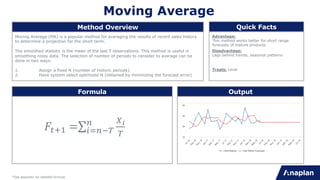
Moving Average
Moving Average (MA) is a popular method for averaging the results of recent sales history
to determine a projection for the short term.
The smoothed statistic is the mean of the last T observations. This method is useful in
smoothing noisy data. The selection of number of periods to consider to average can be
done in two ways:
1. Assign a fixed N (number of historic periods).
2. Have system select optimized N (obtained by minimizing the forecast error)
Advantage:
This method works better for short range
forecasts of mature products.
Treats: Level
Disadvantage:
Lags behind trends, seasonal patterns
*See appendix for detailed formula
Method Overview Quick Facts
Formula Output
!"#$ =∑'()*+
) ,-
+
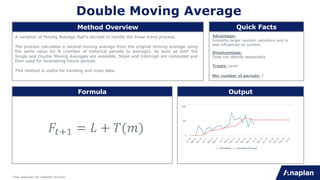
Double Moving Average
A variation of Moving Average that’s devised to handle the linear trend process.
The process calculates a second moving average from the original moving average using
the same value for N (number of historical periods to average). As soon as both the
Single and Double Moving Averages are available, Slope and Intercept are computed and
then used for forecasting future periods.
This method is useful for trending and noisy data.
Advantage:
Smooths larger random variations and is
less influenced by outliers
Treats: Level
Disadvantage:
Does not identify seasonality
Min number of periods: 2
!"#$ = & + ((*)
*See appendix for detailed formula
Method Overview Quick Facts
Formula Output
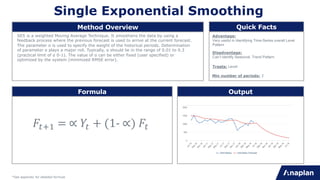
Single Exponential Smoothing
Advantage:
Very useful in Identifying Time-Series overall Level
Pattern
Treats: Level
Disadvantage:
Can’t identify Seasonal, Trend Pattern
Min number of periods: 2
*See appendix for detailed formula
Method Overview Quick Facts
Formula Output
SES is a weighted Moving Average Technique. It smoothens the data by using a
feedback process where the previous forecast is used to arrive at the current forecast.
The parameter α is used to specify the weight of the historical periods. Determination
of parameter α plays a major roll. Typically, α should lie in the range of 0.01 to 0.3
(practical limit of α 0-1). The value of α can be either fixed (user specified) or
optimized by the system (minimized RMSE error).
!"#$ = ∝ (" + (1- ∝) !"
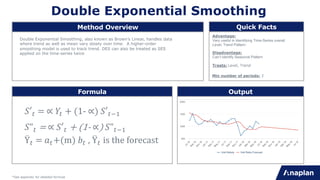
Double Exponential Smoothing
Advantage:
Very useful in Identifying Time-Series overall
Level, Trend Pattern
Treats: Level, Trend
Disadvantage:
Can’t identify Seasonal Pattern
Min number of periods: 2
*See appendix for detailed formula
Method Overview Quick Facts
Formula Output
Double Exponential Smoothing, also known as Brown’s Linear, handles data
where trend as well as mean vary slowly over time. A higher-order
smoothing model is used to track trend. DES can also be treated as SES
applied on the time-series twice
!′# = ∝ '# + (1- ∝) !′#-.
!"# = ∝ !′# + (1- ∝) !"#-.
Ÿ# = 1#+(m) 3# , Ÿ# is the forecast
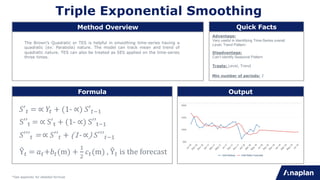
Triple Exponential Smoothing
Advantage:
Very useful in Identifying Time-Series overall
Level, Trend Pattern
Treats: Level, Trend
Disadvantage:
Can’t identify Seasonal Pattern
Min number of periods: 2
*See appendix for detailed formula
Method Overview Quick Facts
Formula Output
The Brown’s Quadratic or TES is helpful in smoothing time-series having a
quadratic (ex: Parabola) nature. The model can track mean and trend of
quadratic nature. TES can also be treated as SES applied on the time-series
three times.
!′# = ∝ '# + (1- ∝) !′#-.
S′′0 = ∝ S′0 + (1- ∝) S′′0-.
!′′′# = ∝ !′′# + (1- ∝) !′′′#-.
Ŷ# = 2#+3#(m) +
.
5
6#(m) , Ŷ# is the forecast
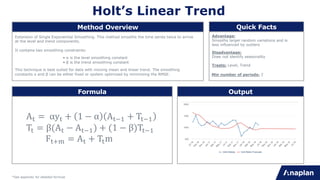
Holt’s Linear Trend
Extension of Single Exponential Smoothing. This method smooths the time series twice to arrive
at the level and trend components.
It contains two smoothing constraints:
• α is the level smoothing constant
• β is the trend smoothing constant
This technique is best suited for data with moving mean and linear trend. The smoothing
constants α and β can be either fixed or system optimized by minimizing the RMSE.
Advantage:
Smooths larger random variations and is
less influenced by outliers
Treats: Level, Trend
Disadvantage:
Does not identify seasonality
Min number of periods: 2
A" = αy" + 1 − α A")* + T")*
T" = β(A" − A")*) + (1 − β)T")*
F"01 = A" + T"m
*See appendix for detailed formula
Method Overview Quick Facts
Formula Output
Seasonal Smoothing
Methods
Seasonal Techniques, such as Winters and
decomposition, break down forecast components of
baseline, trend and seasonality. Seasonal patterns may
be additive or multiplicative. Cyclic patterns (non-
annual) can be isolated in data sets of five years or
greater.
vSeasonal Smoothing models
q Provide useful forecasts for items containing
elements of both trend and seasonality
q are good for short to medium range forecasting
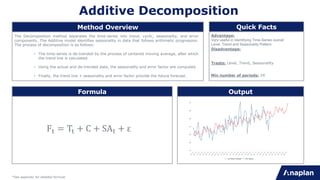
Additive Decomposition
The Decomposition method separates the time-series into trend, cyclic, seasonality, and error
components. The Additive model identifies seasonality in data that follows arithmetic progression.
The process of decomposition is as follows:
• The time-series is de-trended by the process of centered moving average, after which
the trend line is calculated.
• Using the actual and de-trended data, the seasonality and error factor are computed.
• Finally, the trend line + seasonality and error factor provide the future forecast.
Advantage:
Very useful in Identifying Time-Series overall
Level, Trend and Seasonality Pattern
Treats: Level, Trend, Seasonality
Disadvantage:
Min number of periods: 24
F" = T" + C + SA" + ε
*See appendix for detailed formula
Method Overview Quick Facts
Formula Output
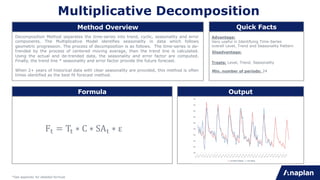
Multiplicative Decomposition
Decomposition Method separates the time-series into trend, cyclic, seasonality and error
components. The Multiplicative Model identifies seasonality in data which follows
geometric progression. The process of decomposition is as follows. The time-series is de-
trended by the process of centered moving average, then the trend line is calculated.
Using the actual and de-trended data, the seasonality and error factor are computed.
Finally, the trend line * seasonality and error factor provide the future forecast.
When 2+ years of historical data with clear seasonality are provided, this method is often
times identified as the best fit forecast method.
Advantage:
Very useful in Identifying Time-Series
overall Level, Trend and Seasonality Pattern
Treats: Level, Trend, Seasonality
Disadvantage:
*See appendix for detailed formula
Method Overview Quick Facts
Formula Output
Min. number of periods: 24
F" = T" ∗ C ∗ SA" ∗ ε
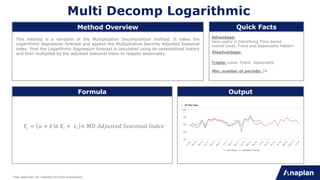
Multi Decomp Logarithmic
*See appendix for detailed formula breakdown
This method is a variation of the Multiplicative Decomposition method. It takes the
Logarithmic Regression forecast and applies the Multiplicative Decomp Adjusted Seasonal
index. First the Logarithmic Regression forecast is calculated using de-seasonalized history
and then multiplied by the adjusted seasonal index to reapply seasonality.
Method Overview Quick Facts
Formula Output
!" = $ + & ln )" + *" × ,- ./01234/ 54$267$8 97/4:
Advantage:
Very useful in Identifying Time-Series
overall Level, Trend and Seasonality Pattern
Treats: Level, Trend, Seasonality
Min. number of periods: 24
Disadvantage:
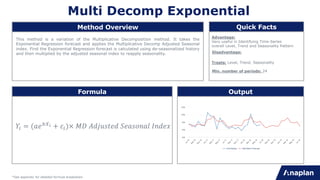
Multi Decomp Exponential
*See appendix for detailed formula breakdown
Method Overview Quick Facts
Formula Output
Advantage:
Very useful in Identifying Time-Series
overall Level, Trend and Seasonality Pattern
Treats: Level, Trend, Seasonality
Min. number of periods: 24
Disadvantage:
This method is a variation of the Multiplicative Decomposition method. It takes the
Exponential Regression forecast and applies the Multiplicative Decomp Adjusted Seasonal
index. First the Exponential Regression forecast is calculated using de-seasonalized history
and then multiplied by the adjusted seasonal index to reapply seasonality.
!" = (%&'() + +")× ./ 012345&1 6&%478%9 :81&;
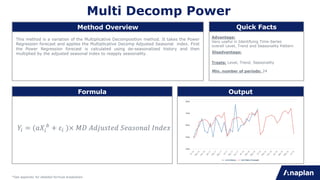
Multi Decomp Power
*See appendix for detailed formula breakdown
Method Overview Quick Facts
Formula Output
Advantage:
Very useful in Identifying Time-Series
overall Level, Trend and Seasonality Pattern
Treats: Level, Trend, Seasonality
Min. number of periods: 24
Disadvantage:
This method is a variation of the Multiplicative Decomposition method. It takes the Power
Regression forecast and applies the Multiplicative Decomp Adjusted Seasonal index. First
the Power Regression forecast is calculated using de-seasonalized history and then
multiplied by the adjusted seasonal index to reapply seasonality.
!" = (%&"
'
+ )" )× ,- ./01234/ 54%267%8 97/4:
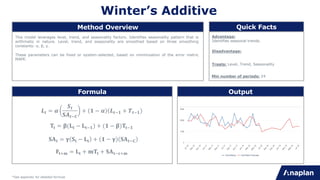
Winter’s Additive
This model leverages level, trend, and seasonality factors. Identifies seasonality pattern that is
arithmetic in nature. Level, trend, and seasonality are smoothed based on three smoothing
constants: α, β, γ.
These parameters can be fixed or system-selected, based on minimization of the error metric
MAPE.
Advantage:
Identifies seasonal trends.
Treats: Level, Trend, Seasonality
Disadvantage:
Min number of periods: 24
!" = $
%"
&'"()
+ + − $ !"(+ + -"(+
./ = 0(2/ − 2/(+) + (+ − 0)./(+
&4/ = 5 &/ − 2/ + + − 5 &4/(6
7/89 = 2/ + 9./ + &4/(:89
*See appendix for detailed formula
Method Overview Quick Facts
Formula Output
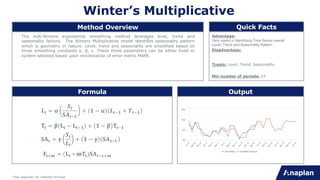
Winter’s Multiplicative
Advantage:
Very useful in Identifying Time-Series overall
Level, Trend and Seasonality Pattern
Treats: Level, Trend, Seasonality
Disadvantage:
Min number of periods: 24
*See appendix for detailed formula
Method Overview Quick Facts
Formula Output
The Holt-Winters exponential smoothing method leverages level, trend and
seasonality factors. The Winters Multiplicative model identifies seasonality pattern
which is geometric in nature. Level, trend and seasonality are smoothed based on
three smoothing constants α, β, γ. These three parameters can be either fixed or
system selected based upon minimization of error metric MAPE.
!" = $
%"
&'"()
+ + − $ !"(+ + -"(+
./ = 0(2/ − 2/(+) + (+ − 0)./(+
&4/ = 5
%"
!"
+ + − 5 &4/(6
7/89 = (2/ ∗ 9./)&4/(;89
Basic & Intermittent
Methods
Basic Methods comprise simple techniques that are useful for specific
circumstances or as a means to compare effectiveness of other
methods.
vBasic Methods
q Are useful for non-stationary, end-of-life, highly recurring
demand, essential demand products types
q Are best for short to medium range forecasting
Intermittent Demand is characterized by periods of inactivity (zero
demand) as well as periods of activity. The challenge is to forecast both
inactive period pattern and quantities for active periods.
vIntermittent Demand Models
q Are best suited for time series with sporadic demand history
and multiple periods of inactivity
q Are best for short to medium range forecasting
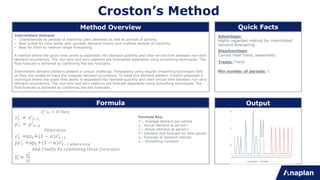
Croston’s Method
Method Overview
Intermittent Demand
• Characterized by periods of inactivity (zero demand) as well as periods of activity.
• Best suited for time series with sporadic demand history and multiple periods of inactivity
• Best for short to medium range forecasting
A method where the given time series is separated into demand quantity and inter-arrival time between non-zero
demand occurrences. The non-zero and zero patterns are forecasted separately using smoothing techniques. The
final forecast is achieved by combining the two forecasts.
Intermittent demand patterns present a unique challenge. Forecasting using regular smoothing techniques fails
as they are unable to trace the irregular demand occurrence. To treat this demand pattern, Croston proposed a
technique where the given time series is separated into demand quantity and inter-arrival time between non-zero
demand occurrences. The non-zero and zero patterns are forecast separately using smoothing techniques. The
final forecast is achieved by combining the two forecasts.
Quick Facts
Advantage:
Highly regarded method for intermittent
demand forecasting
Treats: Trend
Disadvantage:
Cannot treat trend, seasonality
Min number of periods: 1
Output
Formula
!" #$ = 0 'ℎ)*
#$
+ = # $,-
+
.$
+ = . $,-
+
/'ℎ)0123)
#$
+ =4#$+(1 − 8)#$,-
+
.#$
+ =4.$+(1 − 8)#$,- :;<=< >?@
+
A*B "2*4CCD ED FGHE2*2*I 'ℎ)3) "G0)F43'3
J$
+
=
KL
M
NL
M
Formula Key:
J′$- average demand per period
#$- Actual demand at period t
#′$- Actual demand at period t
P– Demand size forecast for next period
P$- Forecast of demand interval
8 – Smoothing constant
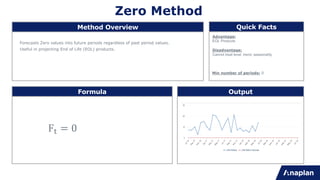
Zero Method
Advantage:
EOL Products
Disadvantage:
Cannot treat level, trend, seasonality
Min number of periods: 0
Method Overview Quick Facts
Formula Output
Forecasts Zero values into future periods regardless of past period values.
Useful in projecting End of Life (EOL) products.
F" = 0
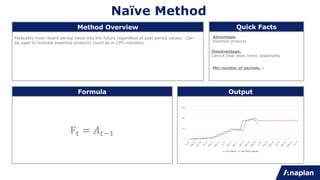
Naïve Method
Forecasts most recent period value into the future regardless of past period values. Can
be used to forecast essential products (such as in CPG markets).
Advantage:
Essential products
Disadvantage:
Cannot treat level, trend, seasonality
Min number of periods: 1
Method Overview Quick Facts
Formula Output
F" = $%&'
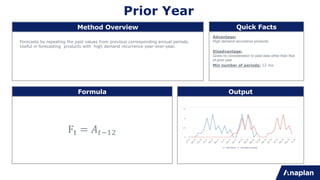
Prior Year
Advantage:
High demand recurrence products
Disadvantage:
Gives no consideration to past data other than that
of prior year
Min number of periods: 12 mo
Method Overview Quick Facts
Formula Output
Forecasts by repeating the past values from previous corresponding annual periods.
Useful in forecasting products with high demand recurrence year-over-year.
F" = $%&'(
Manual Input
Advantage:
Useful for cases of new products and
promotions
Disadvantage:
There is no statistical forecasting applied
Min number of periods:
Method Overview Quick Facts
Formula Output
Forecasts for specific periods are entered manually by the user, based on external
factors (e.g. promotions, builds, new product introductions, etc.)
F" = [ ]
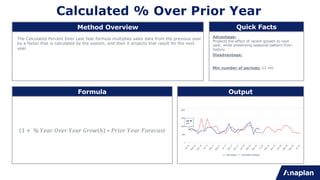
Calculated % Over Prior Year
Advantage:
Projects the effect of recent growth to next
year, while preserving seasonal pattern from
history
Disadvantage:
Min number of periods: 12 mo
Method Overview Quick Facts
Formula Output
The Calculated Percent Over Last Year formula multiplies sales data from the previous year
by a factor that is calculated by the system, and then it projects that result for the next
year.
1 + % $%&' ()%' $%&' *'+,-ℎ ∗ 0'1+' $%&' 2+'%3&4-
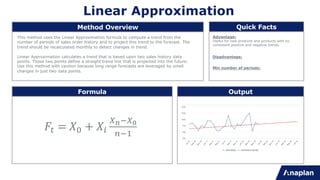
Linear Approximation
Advantage:
Useful for new products and products with no
consistent positive and negative trends.
Disadvantage:
Min number of periods:
Method Overview Quick Facts
Formula Output
This method uses the Linear Approximation formula to compute a trend from the
number of periods of sales order history and to project this trend to the forecast. The
trend should be recalculated monthly to detect changes in trend.
Linear Approximation calculates a trend that is based upon two sales history data
points. Those two points define a straight trend line that is projected into the future.
Use this method with caution because long range forecasts are leveraged by small
changes in just two data points.
!" = $% + $'
()*(+
,*-
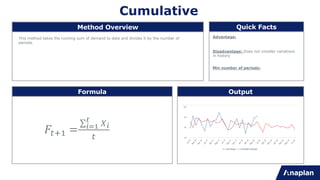
Cumulative
Advantage:
Disadvantage: Does not cinsider variations
in history
Min number of periods:
Method Overview Quick Facts
Formula Output
This method takes the running sum of demand to date and divides it by the number of
periods.
!"#$ =
∑'()
*
+'
"
Marketing End-of-Life
Forecasts the phase-out timeline for specific products nearing the end of their life. This model
contains end-of-life modeling functionality that allows the user to enter the phase out start and
end dates. The EOL graph then displays the forecasted demand for that item, decreasing to zero
over the indicated date range.
Advantage:
Useful for products nearing EOL
Disadvantage:
Method Overview Quick Facts
Output
Depletion Method: Forecast Driven Straight Line Scrap
New Item Forecast
Advantage:
Specific to new product introductions
Disadvantage:
Method Overview Quick Facts
Output
This method is useful in forecasting new products. This method can be set up to use the
forecast for a similar product with the cannibalization percentage set, from the launch date of
the product.
If the product is replacing the similar product then it can be marked as the successor.
New product with cannibalization of similar product set at 40% New product as the successor of the similar product New product drivers to calculate forecast
Driver-Based Method
Advantage: Specify & benchmark external
forecasts in Anaplan
Disadvantage: Must provide external
regression factors
Min number of periods: 0
Method Overview Quick Facts
Formulas Output
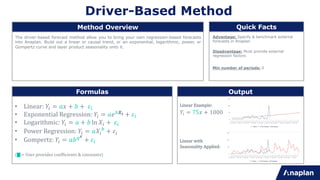
The driver-based forecast method allow you to bring your own regression-based forecasts
into Anaplan. Build out a linear or causal trend, or an exponential, logarithmic, power, or
Gompertz curve and layer product seasonality onto it.
• Linear: )* = ,- + / + 0*
• Exponential Regression: )* = ,:;<= + 0*
• Logarithmic: )* = , + / ln A* + 0*
• Power Regression: )* = ,A*
;
+ 0*
• Gompertz: )* = ,/FG
+ 0*
( = User provides coefficients & constants)
)* = 75- + 1000
Linear Example:
Linear with
Seasonality Applied:
Driver-Based Method: Gompertz
Advantage: Specify & benchmark external
forecasts in Anaplan
Disadvantage: Must provide coefficients
Min number of periods: 0
Method Overview Quick Facts
Formulas Output
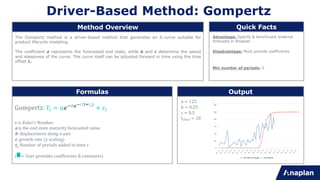
The Gompertz method is a driver-based method that generates an S-curve suitable for
product lifecycle modeling.
The coefficient a represents the forecasted end state, while b and c determine the speed
and steepness of the curve. The curve itself can be adjusted forward in time using the time
offset t0.
Gompertz: +, = ./01234(6768
)
+ ;,
e is Euler’s Number
a is the end state maturity forecasted value
b: displacement along x-axis
c: growth rate (y scaling)
t0: Number of periods added to time t
( = User provides coefficients & constants)
a = 125
b = 0.25
c = 0.5
toffset = 18
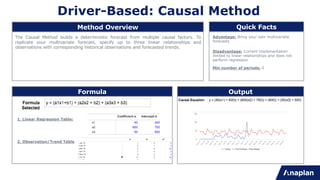
Driver-Based: Causal Method
Advantage: Bring your own multivariate
forecasts
Disadvantage: Current implementation
limited to linear relationships and does not
perform regression
Min number of periods: 0
Method Overview Quick Facts
Formula Output
The Causal Method builds a deterministic forecast from multiple causal factors. To
replicate your multivariate forecast, specify up to three linear relationships and
observations with corresponding historical observations and forecasted trends.
1. Linear Regression Table:
2. Observation/Trend Table
Appendix
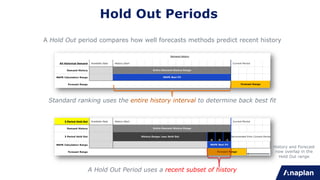
A Hold Out period compares how well forecasts methods predict recent history
Standard ranking uses the entire history interval to determine back best fit
A Hold Out Period uses a recent subset of history
History and Forecast
now overlap in the
Hold Out range
Hold Out Periods
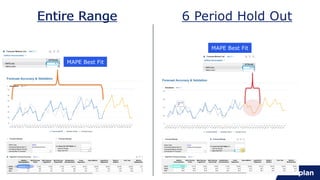
Entire Range
Entire Range 6 Period Hold Out
MAPE Best Fit
MAPE Best Fit

Anaplan Stat Forecasting Methods.pdf

  • 1.
    Driving a newage of connected planning
  • 2.
    Statistical Forecasting Methods Overviewof all Methods from Anaplan Statistical Forecast Model
  • 3.
    30 Forecast Methods Including: •Simple Linear Regression • Simple Exponential Smoothing • Multiplicative Decomposition • Holt-Winters • Croston’s Intermittent Demand Predictive Analytics
  • 4.
    Forecasting Methods Summary Capturehistorical trends and project future trends, cyclical or seasonality factors are not factored in. ü Trend analysis ü Long term planning Curve Fit Useful in extrapolating values of given non-seasonal and trending data. ü Stable forecast for slow moving, trend & non-seasonal demand ü Short term and long term planning Smoothing Break down forecast components of baseline, trend and seasonality. ü Good forecasts for items with both trend and seasonality ü Short to medium range forecasting Seasonal Smoothing Simple techniques useful for specific circumstances or comparing effectiveness of other methods. ü Non-stationary, end-of-life, highly recurring demand, essential demand products types ü Short to medium range forecasting Basic & Intermittent
  • 5.
    Forecasting Methods List CurveFit Linear Regression Logarithmic Regression Exponential Regression Power Regression Basic & Intermittent Croston’s Method Zero Method Naïve Method Prior Year Manual Input Calculated % Over Prior Year Linear Approximation Cumulative Marketing End-of-Life New Item Forecast Driver Based Gompertz Method Custom Smoothing Moving Average Double Moving Average Single Exponential Smoothing Double Exponential Smoothing Triple Exponential Smoothing Holt’s Linear Trend Seasonal Smoothing Additive Decomposition Multiplicative Decomposition Multiplicative Decomposition Logarithmic Multiplicative Decomposition Exponential Multiplicative Decomposition Power Winter’s Additive Winter’s Multiplicative
  • 6.
    Curve Fit Methods CurveFit techniques capture historical trends and project future trends. Cyclical or seasonality factors are not factored into these methods. v Curve fit models are q Most appropriate for trend analysis q Good for long term planning
  • 7.
    Linear Regression Simple (onlyone covariate/predictor variable) linear regression is used to develop an equation by which we can predict or estimate a dependent variable given an independent variable. It is used to perform trend analysis on a given time-series data set. ***Yi is the dependent variable, a is the y intercept, b is the gradient or slope of the line, Xi is independent variable and is a random term associated with each observation. Advantage: Useful in identifying overall trend patterns Treats: Trend Disadvantage: Does not identify seasonal or cyclical patterns. Method Overview Quick Facts Formula Output !" = $ + &'" + ("
  • 8.
    Logarithmic Regression This curvehelps in modeling trend having non-linear behavior. It is useful in modeling trend following a logarithmic function. Logarithmic regression is used to model situations where growth or decay accelerates rapidly at first and then slows over time. Note that all input values, x, must be non-negative. when b > 0, the model is increasing. when b < 0, the model is decreasing. Advantage: Useful in identifying overall trend patterns Treats: Trend Disadvantage: Does not identify seasonal or cyclical patterns. Detailed formula: http://mathworld.wolfram.com/LeastSquaresFittingLogarithmic.html !" = $ + & ln )" + *" Min number of periods: 2 Method Overview Quick Facts Formula Output
  • 9.
    Exponential Regression Exponential Curvemethod belongs to a family of Least Squares models. It is useful in modeling a trend having a geometric growth. Exponential regression is used to model situations in which growth begins slowly and then accelerates rapidly without bound, or where decay begins rapidly and then slows down to get closer and closer to zero. • b must be non-negative. • When b > 1, we have an exponential growth model. • When 0 < b < 1, we have an exponential decay model. Advantage: Useful in identifying overall trend patterns Treats: Trend Disadvantage: Does not identify seasonal or cyclical patterns. Demand should be greater than zero. !" = $%&'( + *" Detailed formula: http://mathworld.wolfram.com/LeastSquaresFittingExponential.html Method Overview Quick Facts Formula Output
  • 10.
    Power Regression This curvehelps in modeling trend having non-linear behavior. It is useful in modeling trend following a power function. Power Regression is one in which the response variable is proportional to the explanatory variable raised to a power. The values of both x and y must be greater than zero. (This is because the method for determining the values of a and b in the regression equation is a least-squares fit on the values for ln x and ln y. Advantage: Useful in identifying overall trend patterns Treats: Trend Disadvantage: Does not identify seasonal or cyclical patterns Min number of periods: 2 !" = $%" & + (" Detailed formula: http://mathworld.wolfram.com/LeastSquaresFittingPowerLaw.html Method Overview Quick Facts Formula Output
  • 11.
    Smoothing Methods Smoothing techniques,such as averaging or exponential smoothing, are useful in extrapolating values of given non-seasonal and trending data. The basic assumption of averaging and smoothing models is that the time-series is “locally stationary”. In other words, wide fluctuations in past demand are given less significance than more recent, presumably more stable history. The moving average is often called a “smoothed” version of the original series, since short-term averaging has the effect of smoothing out the bumps in the original series. Exponential Smoothing assigns exponentially decreasing weights to older historical periods. v Smoothing models q Provide stable forecasts for slow moving, trend and non- seasonal demand patterns q Are good for short term and long term planning
  • 12.
    Moving Average Moving Average(MA) is a popular method for averaging the results of recent sales history to determine a projection for the short term. The smoothed statistic is the mean of the last T observations. This method is useful in smoothing noisy data. The selection of number of periods to consider to average can be done in two ways: 1. Assign a fixed N (number of historic periods). 2. Have system select optimized N (obtained by minimizing the forecast error) Advantage: This method works better for short range forecasts of mature products. Treats: Level Disadvantage: Lags behind trends, seasonal patterns *See appendix for detailed formula Method Overview Quick Facts Formula Output !"#$ =∑'()*+ ) ,- +
  • 13.
    Double Moving Average Avariation of Moving Average that’s devised to handle the linear trend process. The process calculates a second moving average from the original moving average using the same value for N (number of historical periods to average). As soon as both the Single and Double Moving Averages are available, Slope and Intercept are computed and then used for forecasting future periods. This method is useful for trending and noisy data. Advantage: Smooths larger random variations and is less influenced by outliers Treats: Level Disadvantage: Does not identify seasonality Min number of periods: 2 !"#$ = & + ((*) *See appendix for detailed formula Method Overview Quick Facts Formula Output
  • 14.
    Single Exponential Smoothing Advantage: Veryuseful in Identifying Time-Series overall Level Pattern Treats: Level Disadvantage: Can’t identify Seasonal, Trend Pattern Min number of periods: 2 *See appendix for detailed formula Method Overview Quick Facts Formula Output SES is a weighted Moving Average Technique. It smoothens the data by using a feedback process where the previous forecast is used to arrive at the current forecast. The parameter α is used to specify the weight of the historical periods. Determination of parameter α plays a major roll. Typically, α should lie in the range of 0.01 to 0.3 (practical limit of α 0-1). The value of α can be either fixed (user specified) or optimized by the system (minimized RMSE error). !"#$ = ∝ (" + (1- ∝) !"
  • 15.
    Double Exponential Smoothing Advantage: Veryuseful in Identifying Time-Series overall Level, Trend Pattern Treats: Level, Trend Disadvantage: Can’t identify Seasonal Pattern Min number of periods: 2 *See appendix for detailed formula Method Overview Quick Facts Formula Output Double Exponential Smoothing, also known as Brown’s Linear, handles data where trend as well as mean vary slowly over time. A higher-order smoothing model is used to track trend. DES can also be treated as SES applied on the time-series twice !′# = ∝ '# + (1- ∝) !′#-. !"# = ∝ !′# + (1- ∝) !"#-. Ÿ# = 1#+(m) 3# , Ÿ# is the forecast
  • 16.
    Triple Exponential Smoothing Advantage: Veryuseful in Identifying Time-Series overall Level, Trend Pattern Treats: Level, Trend Disadvantage: Can’t identify Seasonal Pattern Min number of periods: 2 *See appendix for detailed formula Method Overview Quick Facts Formula Output The Brown’s Quadratic or TES is helpful in smoothing time-series having a quadratic (ex: Parabola) nature. The model can track mean and trend of quadratic nature. TES can also be treated as SES applied on the time-series three times. !′# = ∝ '# + (1- ∝) !′#-. S′′0 = ∝ S′0 + (1- ∝) S′′0-. !′′′# = ∝ !′′# + (1- ∝) !′′′#-. Ŷ# = 2#+3#(m) + . 5 6#(m) , Ŷ# is the forecast
  • 17.
    Holt’s Linear Trend Extensionof Single Exponential Smoothing. This method smooths the time series twice to arrive at the level and trend components. It contains two smoothing constraints: • α is the level smoothing constant • β is the trend smoothing constant This technique is best suited for data with moving mean and linear trend. The smoothing constants α and β can be either fixed or system optimized by minimizing the RMSE. Advantage: Smooths larger random variations and is less influenced by outliers Treats: Level, Trend Disadvantage: Does not identify seasonality Min number of periods: 2 A" = αy" + 1 − α A")* + T")* T" = β(A" − A")*) + (1 − β)T")* F"01 = A" + T"m *See appendix for detailed formula Method Overview Quick Facts Formula Output
  • 18.
    Seasonal Smoothing Methods Seasonal Techniques,such as Winters and decomposition, break down forecast components of baseline, trend and seasonality. Seasonal patterns may be additive or multiplicative. Cyclic patterns (non- annual) can be isolated in data sets of five years or greater. vSeasonal Smoothing models q Provide useful forecasts for items containing elements of both trend and seasonality q are good for short to medium range forecasting
  • 19.
    Additive Decomposition The Decompositionmethod separates the time-series into trend, cyclic, seasonality, and error components. The Additive model identifies seasonality in data that follows arithmetic progression. The process of decomposition is as follows: • The time-series is de-trended by the process of centered moving average, after which the trend line is calculated. • Using the actual and de-trended data, the seasonality and error factor are computed. • Finally, the trend line + seasonality and error factor provide the future forecast. Advantage: Very useful in Identifying Time-Series overall Level, Trend and Seasonality Pattern Treats: Level, Trend, Seasonality Disadvantage: Min number of periods: 24 F" = T" + C + SA" + ε *See appendix for detailed formula Method Overview Quick Facts Formula Output
  • 20.
    Multiplicative Decomposition Decomposition Methodseparates the time-series into trend, cyclic, seasonality and error components. The Multiplicative Model identifies seasonality in data which follows geometric progression. The process of decomposition is as follows. The time-series is de- trended by the process of centered moving average, then the trend line is calculated. Using the actual and de-trended data, the seasonality and error factor are computed. Finally, the trend line * seasonality and error factor provide the future forecast. When 2+ years of historical data with clear seasonality are provided, this method is often times identified as the best fit forecast method. Advantage: Very useful in Identifying Time-Series overall Level, Trend and Seasonality Pattern Treats: Level, Trend, Seasonality Disadvantage: *See appendix for detailed formula Method Overview Quick Facts Formula Output Min. number of periods: 24 F" = T" ∗ C ∗ SA" ∗ ε
  • 21.
    Multi Decomp Logarithmic *Seeappendix for detailed formula breakdown This method is a variation of the Multiplicative Decomposition method. It takes the Logarithmic Regression forecast and applies the Multiplicative Decomp Adjusted Seasonal index. First the Logarithmic Regression forecast is calculated using de-seasonalized history and then multiplied by the adjusted seasonal index to reapply seasonality. Method Overview Quick Facts Formula Output !" = $ + & ln )" + *" × ,- ./01234/ 54$267$8 97/4: Advantage: Very useful in Identifying Time-Series overall Level, Trend and Seasonality Pattern Treats: Level, Trend, Seasonality Min. number of periods: 24 Disadvantage:
  • 22.
    Multi Decomp Exponential *Seeappendix for detailed formula breakdown Method Overview Quick Facts Formula Output Advantage: Very useful in Identifying Time-Series overall Level, Trend and Seasonality Pattern Treats: Level, Trend, Seasonality Min. number of periods: 24 Disadvantage: This method is a variation of the Multiplicative Decomposition method. It takes the Exponential Regression forecast and applies the Multiplicative Decomp Adjusted Seasonal index. First the Exponential Regression forecast is calculated using de-seasonalized history and then multiplied by the adjusted seasonal index to reapply seasonality. !" = (%&'() + +")× ./ 012345&1 6&%478%9 :81&;
  • 23.
    Multi Decomp Power *Seeappendix for detailed formula breakdown Method Overview Quick Facts Formula Output Advantage: Very useful in Identifying Time-Series overall Level, Trend and Seasonality Pattern Treats: Level, Trend, Seasonality Min. number of periods: 24 Disadvantage: This method is a variation of the Multiplicative Decomposition method. It takes the Power Regression forecast and applies the Multiplicative Decomp Adjusted Seasonal index. First the Power Regression forecast is calculated using de-seasonalized history and then multiplied by the adjusted seasonal index to reapply seasonality. !" = (%&" ' + )" )× ,- ./01234/ 54%267%8 97/4:
  • 24.
    Winter’s Additive This modelleverages level, trend, and seasonality factors. Identifies seasonality pattern that is arithmetic in nature. Level, trend, and seasonality are smoothed based on three smoothing constants: α, β, γ. These parameters can be fixed or system-selected, based on minimization of the error metric MAPE. Advantage: Identifies seasonal trends. Treats: Level, Trend, Seasonality Disadvantage: Min number of periods: 24 !" = $ %" &'"() + + − $ !"(+ + -"(+ ./ = 0(2/ − 2/(+) + (+ − 0)./(+ &4/ = 5 &/ − 2/ + + − 5 &4/(6 7/89 = 2/ + 9./ + &4/(:89 *See appendix for detailed formula Method Overview Quick Facts Formula Output
  • 25.
    Winter’s Multiplicative Advantage: Very usefulin Identifying Time-Series overall Level, Trend and Seasonality Pattern Treats: Level, Trend, Seasonality Disadvantage: Min number of periods: 24 *See appendix for detailed formula Method Overview Quick Facts Formula Output The Holt-Winters exponential smoothing method leverages level, trend and seasonality factors. The Winters Multiplicative model identifies seasonality pattern which is geometric in nature. Level, trend and seasonality are smoothed based on three smoothing constants α, β, γ. These three parameters can be either fixed or system selected based upon minimization of error metric MAPE. !" = $ %" &'"() + + − $ !"(+ + -"(+ ./ = 0(2/ − 2/(+) + (+ − 0)./(+ &4/ = 5 %" !" + + − 5 &4/(6 7/89 = (2/ ∗ 9./)&4/(;89
  • 26.
    Basic & Intermittent Methods BasicMethods comprise simple techniques that are useful for specific circumstances or as a means to compare effectiveness of other methods. vBasic Methods q Are useful for non-stationary, end-of-life, highly recurring demand, essential demand products types q Are best for short to medium range forecasting Intermittent Demand is characterized by periods of inactivity (zero demand) as well as periods of activity. The challenge is to forecast both inactive period pattern and quantities for active periods. vIntermittent Demand Models q Are best suited for time series with sporadic demand history and multiple periods of inactivity q Are best for short to medium range forecasting
  • 27.
    Croston’s Method Method Overview IntermittentDemand • Characterized by periods of inactivity (zero demand) as well as periods of activity. • Best suited for time series with sporadic demand history and multiple periods of inactivity • Best for short to medium range forecasting A method where the given time series is separated into demand quantity and inter-arrival time between non-zero demand occurrences. The non-zero and zero patterns are forecasted separately using smoothing techniques. The final forecast is achieved by combining the two forecasts. Intermittent demand patterns present a unique challenge. Forecasting using regular smoothing techniques fails as they are unable to trace the irregular demand occurrence. To treat this demand pattern, Croston proposed a technique where the given time series is separated into demand quantity and inter-arrival time between non-zero demand occurrences. The non-zero and zero patterns are forecast separately using smoothing techniques. The final forecast is achieved by combining the two forecasts. Quick Facts Advantage: Highly regarded method for intermittent demand forecasting Treats: Trend Disadvantage: Cannot treat trend, seasonality Min number of periods: 1 Output Formula !" #$ = 0 'ℎ)* #$ + = # $,- + .$ + = . $,- + /'ℎ)0123) #$ + =4#$+(1 − 8)#$,- + .#$ + =4.$+(1 − 8)#$,- :;<=< >?@ + A*B "2*4CCD ED FGHE2*2*I 'ℎ)3) "G0)F43'3 J$ + = KL M NL M Formula Key: J′$- average demand per period #$- Actual demand at period t #′$- Actual demand at period t P– Demand size forecast for next period P$- Forecast of demand interval 8 – Smoothing constant
  • 28.
    Zero Method Advantage: EOL Products Disadvantage: Cannottreat level, trend, seasonality Min number of periods: 0 Method Overview Quick Facts Formula Output Forecasts Zero values into future periods regardless of past period values. Useful in projecting End of Life (EOL) products. F" = 0
  • 29.
    Naïve Method Forecasts mostrecent period value into the future regardless of past period values. Can be used to forecast essential products (such as in CPG markets). Advantage: Essential products Disadvantage: Cannot treat level, trend, seasonality Min number of periods: 1 Method Overview Quick Facts Formula Output F" = $%&'
  • 30.
    Prior Year Advantage: High demandrecurrence products Disadvantage: Gives no consideration to past data other than that of prior year Min number of periods: 12 mo Method Overview Quick Facts Formula Output Forecasts by repeating the past values from previous corresponding annual periods. Useful in forecasting products with high demand recurrence year-over-year. F" = $%&'(
  • 31.
    Manual Input Advantage: Useful forcases of new products and promotions Disadvantage: There is no statistical forecasting applied Min number of periods: Method Overview Quick Facts Formula Output Forecasts for specific periods are entered manually by the user, based on external factors (e.g. promotions, builds, new product introductions, etc.) F" = [ ]
  • 32.
    Calculated % OverPrior Year Advantage: Projects the effect of recent growth to next year, while preserving seasonal pattern from history Disadvantage: Min number of periods: 12 mo Method Overview Quick Facts Formula Output The Calculated Percent Over Last Year formula multiplies sales data from the previous year by a factor that is calculated by the system, and then it projects that result for the next year. 1 + % $%&' ()%' $%&' *'+,-ℎ ∗ 0'1+' $%&' 2+'%3&4-
  • 33.
    Linear Approximation Advantage: Useful fornew products and products with no consistent positive and negative trends. Disadvantage: Min number of periods: Method Overview Quick Facts Formula Output This method uses the Linear Approximation formula to compute a trend from the number of periods of sales order history and to project this trend to the forecast. The trend should be recalculated monthly to detect changes in trend. Linear Approximation calculates a trend that is based upon two sales history data points. Those two points define a straight trend line that is projected into the future. Use this method with caution because long range forecasts are leveraged by small changes in just two data points. !" = $% + $' ()*(+ ,*-
  • 34.
    Cumulative Advantage: Disadvantage: Does notcinsider variations in history Min number of periods: Method Overview Quick Facts Formula Output This method takes the running sum of demand to date and divides it by the number of periods. !"#$ = ∑'() * +' "
  • 35.
    Marketing End-of-Life Forecasts thephase-out timeline for specific products nearing the end of their life. This model contains end-of-life modeling functionality that allows the user to enter the phase out start and end dates. The EOL graph then displays the forecasted demand for that item, decreasing to zero over the indicated date range. Advantage: Useful for products nearing EOL Disadvantage: Method Overview Quick Facts Output Depletion Method: Forecast Driven Straight Line Scrap
  • 36.
    New Item Forecast Advantage: Specificto new product introductions Disadvantage: Method Overview Quick Facts Output This method is useful in forecasting new products. This method can be set up to use the forecast for a similar product with the cannibalization percentage set, from the launch date of the product. If the product is replacing the similar product then it can be marked as the successor. New product with cannibalization of similar product set at 40% New product as the successor of the similar product New product drivers to calculate forecast
  • 37.
    Driver-Based Method Advantage: Specify& benchmark external forecasts in Anaplan Disadvantage: Must provide external regression factors Min number of periods: 0 Method Overview Quick Facts Formulas Output The driver-based forecast method allow you to bring your own regression-based forecasts into Anaplan. Build out a linear or causal trend, or an exponential, logarithmic, power, or Gompertz curve and layer product seasonality onto it. • Linear: )* = ,- + / + 0* • Exponential Regression: )* = ,:;<= + 0* • Logarithmic: )* = , + / ln A* + 0* • Power Regression: )* = ,A* ; + 0* • Gompertz: )* = ,/FG + 0* ( = User provides coefficients & constants) )* = 75- + 1000 Linear Example: Linear with Seasonality Applied:
  • 38.
    Driver-Based Method: Gompertz Advantage:Specify & benchmark external forecasts in Anaplan Disadvantage: Must provide coefficients Min number of periods: 0 Method Overview Quick Facts Formulas Output The Gompertz method is a driver-based method that generates an S-curve suitable for product lifecycle modeling. The coefficient a represents the forecasted end state, while b and c determine the speed and steepness of the curve. The curve itself can be adjusted forward in time using the time offset t0. Gompertz: +, = ./01234(6768 ) + ;, e is Euler’s Number a is the end state maturity forecasted value b: displacement along x-axis c: growth rate (y scaling) t0: Number of periods added to time t ( = User provides coefficients & constants) a = 125 b = 0.25 c = 0.5 toffset = 18
  • 39.
    Driver-Based: Causal Method Advantage:Bring your own multivariate forecasts Disadvantage: Current implementation limited to linear relationships and does not perform regression Min number of periods: 0 Method Overview Quick Facts Formula Output The Causal Method builds a deterministic forecast from multiple causal factors. To replicate your multivariate forecast, specify up to three linear relationships and observations with corresponding historical observations and forecasted trends. 1. Linear Regression Table: 2. Observation/Trend Table
  • 40.
  • 41.
    A Hold Outperiod compares how well forecasts methods predict recent history Standard ranking uses the entire history interval to determine back best fit A Hold Out Period uses a recent subset of history History and Forecast now overlap in the Hold Out range Hold Out Periods
  • 42.
    Entire Range Entire Range6 Period Hold Out MAPE Best Fit MAPE Best Fit