Language Acquisition
BETHANY ADAMS, NATHAN WOOD, AND DEREK MOORE
Definition
 The process by which people acquire the capacity to perceive
and comprehend language as well as produce and use words
and sentences to communicate (Wikipedia, n.d.).
Importance
 Language is one of the defining features of culture and self identity
allowing one to communicate meaning (Manitoba Education, 2015).
 Language acquisition is a continuous process and students continue to
improve the skill over time (Manitoba Education, 2015).
 Second Language acquisition is of growing significance as the percentage
of the population who do not speak English increases (U.S. Census
Bureau, 2013)
Importance
 Second language acquisition correlates with higher test scores, linguistic
awareness, and ability to hypothesize in science (ACTFL, 2015).
 As the economy continues to globalize second language acquisition
grows in prominence (ACTFL, 2015).
 Most nations are now multicultural and multilingual (Spring, 2014).
How it applies to 21st Century Education
 Second language acquisition is not occurring; only 20% of students are
enrolled in second language courses (ACFTL, 2015).
 Language education prepares students for post-secondary success
however (ACFTL, 2015).
 Language acquisition helps individuals sympathize with a culture (ACFTL,
2015).
 As the world becomes more and more connected language acquisition
should be a focus in 21st century education (ACFTL, 2015).
Role of Technology
 Technology plays a huge role in language acquisition.
 One way is through the simple computer-assisted second language
programs (Chapelle, 2007).
 Examples - Duolingo, Rosetta Stone, and multiple websites
 A second example is by incorporating technology in projects to promote
language acquisition.
 Examples – Produce restaurant reviews in a second language (ACFTL, 2015) or
producing directions to different locations in target language (ACFTL, 2015).
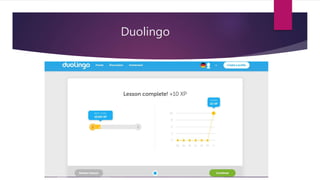
Duolingo
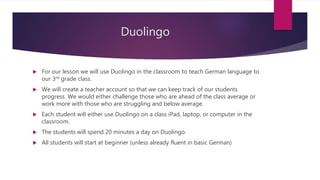
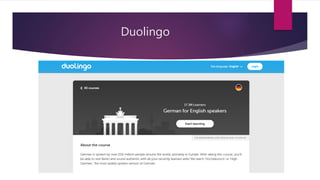
 For our lesson we will use Duolingo in the classroom to teach German language to
our 3rd grade class.
 We will create a teacher account so that we can keep track of our students
progress. We would either challenge those who are ahead of the class average or
work more with those who are struggling and below average.
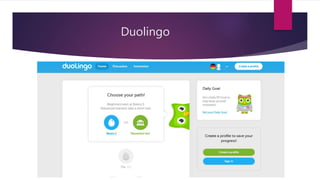
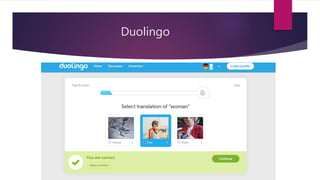
 Each student will either use Duolingo on a class iPad, laptop, or computer in the
classroom.
 The students will spend 20 minutes a day on Duolingo.
 All students will start at beginner (unless already fluent in basic German)
Duolingo
Duolingo
Duolingo
Duolingo
References
 ACTFL. (2015). Retrieved November 5, 2015, from
http://www.actfl.org/advocacy/what-the-research-
shows#academic_achievement
 Chapelle, C. A. (2007). Technology and Second Language Acquisition. Annual
Review of Applied Linguistics, 98-114. doi:10.1017/S0267190508070050
 https://www.duolingo.com
 Facts and Statistics. (2015). In West Virginia Department of Education. Retrieved November 29,
2015, from https://wvde.state.wv.us/abe/literacyestimates.htm
 Language acquisition. (n.d.). In Wikipedia. Retrieved October 29, 2015 from
https://en.wikipedia.org/wiki/Language_acquisition
 Manitoba Education. (2015). Retrieved October 29, 2015, from
http://www.edu.gov.mb.ca/k12/cur/ela/docs/frameworks-ktos1.html
 Spring, J. (2014). American Education (16th ed.). New York City, NY: McGraw-Hill Publishing
Company.
 U.S. Census Bureau. (2013, August). Language Use in the United States: 2011. Retrieved October
29, 2015, from https://www.census.gov/prod/2013pubs/acs-22.pdf

Language acquisition ci350 pp

  • 1.
    Language Acquisition BETHANY ADAMS,NATHAN WOOD, AND DEREK MOORE
  • 2.
    Definition  The processby which people acquire the capacity to perceive and comprehend language as well as produce and use words and sentences to communicate (Wikipedia, n.d.).
  • 3.
    Importance  Language isone of the defining features of culture and self identity allowing one to communicate meaning (Manitoba Education, 2015).  Language acquisition is a continuous process and students continue to improve the skill over time (Manitoba Education, 2015).  Second Language acquisition is of growing significance as the percentage of the population who do not speak English increases (U.S. Census Bureau, 2013)
  • 4.
    Importance  Second languageacquisition correlates with higher test scores, linguistic awareness, and ability to hypothesize in science (ACTFL, 2015).  As the economy continues to globalize second language acquisition grows in prominence (ACTFL, 2015).  Most nations are now multicultural and multilingual (Spring, 2014).
  • 5.
    How it appliesto 21st Century Education  Second language acquisition is not occurring; only 20% of students are enrolled in second language courses (ACFTL, 2015).  Language education prepares students for post-secondary success however (ACFTL, 2015).  Language acquisition helps individuals sympathize with a culture (ACFTL, 2015).  As the world becomes more and more connected language acquisition should be a focus in 21st century education (ACFTL, 2015).
  • 6.
    Role of Technology Technology plays a huge role in language acquisition.  One way is through the simple computer-assisted second language programs (Chapelle, 2007).  Examples - Duolingo, Rosetta Stone, and multiple websites  A second example is by incorporating technology in projects to promote language acquisition.  Examples – Produce restaurant reviews in a second language (ACFTL, 2015) or producing directions to different locations in target language (ACFTL, 2015).
  • 7.
    Duolingo  For ourlesson we will use Duolingo in the classroom to teach German language to our 3rd grade class.  We will create a teacher account so that we can keep track of our students progress. We would either challenge those who are ahead of the class average or work more with those who are struggling and below average.  Each student will either use Duolingo on a class iPad, laptop, or computer in the classroom.  The students will spend 20 minutes a day on Duolingo.  All students will start at beginner (unless already fluent in basic German)
  • 8.
  • 9.
  • 10.
  • 11.
  • 12.
    References  ACTFL. (2015).Retrieved November 5, 2015, from http://www.actfl.org/advocacy/what-the-research- shows#academic_achievement  Chapelle, C. A. (2007). Technology and Second Language Acquisition. Annual Review of Applied Linguistics, 98-114. doi:10.1017/S0267190508070050  https://www.duolingo.com  Facts and Statistics. (2015). In West Virginia Department of Education. Retrieved November 29, 2015, from https://wvde.state.wv.us/abe/literacyestimates.htm  Language acquisition. (n.d.). In Wikipedia. Retrieved October 29, 2015 from https://en.wikipedia.org/wiki/Language_acquisition  Manitoba Education. (2015). Retrieved October 29, 2015, from http://www.edu.gov.mb.ca/k12/cur/ela/docs/frameworks-ktos1.html  Spring, J. (2014). American Education (16th ed.). New York City, NY: McGraw-Hill Publishing Company.  U.S. Census Bureau. (2013, August). Language Use in the United States: 2011. Retrieved October 29, 2015, from https://www.census.gov/prod/2013pubs/acs-22.pdf