Advocating for ESL
    Students
   By Daniela Rotundo Gonzalez
         March 11, 2013
Who are these students?
What can New Jersey schools
 and teachers do to educate
           them?
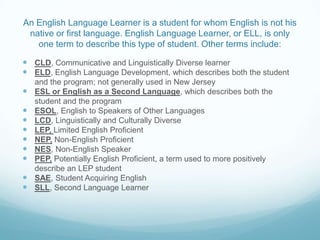
An English Language Learner is a student for whom English is not his
 native or first language. English Language Learner, or ELL, is only
   one term to describe this type of student. Other terms include:

 CLD, Communicative and Linguistically Diverse learner
 ELD, English Language Development, which describes both the student
    and the program; not generally used in New Jersey
   ESL or English as a Second Language, which describes both the
    student and the program
   ESOL, English to Speakers of Other Languages
   LCD, Linguistically and Culturally Diverse
   LEP, Limited English Proficient
   NEP, Non-English Proficient
   NES, Non-English Speaker
   PEP, Potentially English Proficient, a term used to more positively
    describe an LEP student
   SAE, Student Acquiring English
   SLL, Second Language Learner
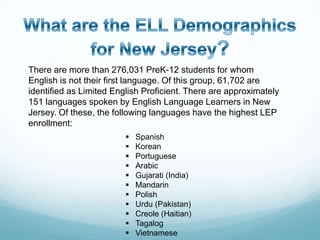
There are more than 276,031 PreK-12 students for whom
English is not their first language. Of this group, 61,702 are
identified as Limited English Proficient. There are approximately
151 languages spoken by English Language Learners in New
Jersey. Of these, the following languages have the highest LEP
enrollment:
                            Spanish
                            Korean
                            Portuguese
                            Arabic
                            Gujarati (India)
                            Mandarin
                            Polish
                            Urdu (Pakistan)
                            Creole (Haitian)
                            Tagalog
                            Vietnamese
The ELLs enter New Jersey's schools with a variety
of different ability levels. They may have:

 never been exposed to English, but have strong first language skills
 some command of social/oral English language
 a small amount of English literacy, having just begun studying English in their
   native country

 weak first language skills due to interrupted or limited schooling in their native
   land.

ELLs in New Jersey may come from various types of
families:
  nuclear two-parent families

  extended families, including grandparents, aunts, uncles and cousins

  single-parent families
What is ELL policy?
The term "ELL policy" to refer to policies at the federal, state, and
local that impact the education of English language learners (ELLs).
This includes:
 Federal ELL regulations
 State ELL regulations
 Local policies at the school or district level impacting ELLs
 The history of U.S. language policy
 Important national and state court cases
 Discussion topics and questions from the field
 Current news and updates
 Tools for advocacy and engagement
To meet the challenges of teaching and learning
on a national and state level, educators and
policymakers need to create or facilitate the
following:
 A set of mutually agreed-upon standards for English
  language teaching and professional development.
 Assessments that accurately measure English language
  learner progress, strengths and weaknesses, and school
  accountability.
 Passage of an immigration bill that encourages all students
  to achieve academically at all levels.
 Support for school reform to ensure safe and effective
  learning environments for all students
On a local and classroom level, educators need
to create classrooms that:
 Foster a vision of immigrant and English language
  learners as assets to our schools, communities and
  country.

 Use a wide variety of teaching methods, including
  collaborative learning.

 Base teaching and learning on the needs of individual
  students.

 Teach many means of communication, including a
  strong focus on writing.
Schools need the following to effectively
  address ELL students:
 A research-based process for the effective teaching of ELLs
 Curriculum design and lesson planning based on sound pedagogical
   principles, practices, and high standards

 Strategic methods to employ for making grade-level materials and
   resources comprehensible for ELLs

 Research-based training on theory, culture, diversity, social status,
   and policy of language acquisition

 Training, technical assistance, and/or funding for programs and
   services for ELL students

 Advocacy that will increase awareness as to the coalitions that
   support educators who work with ELLs

 Resources that will help educators learn more about effective,
   differentiated teaching strategies specifically addressing ELLs.
How to reach out to parents of ELL
                students

 Use their preferred language
This is an essential place to start. Without a common language, very little
communication can take place. Here are some ways to build an ongoing relationship
with parents by reaching out through their native language.

 Find a fully bilingual interpreter.
Whether a school employee, parent liaison, family member, friend, or         community
member, this person can translate for parent-teacher conferences, back-to-school
nights, PTA meetings, and regular communication. It is best to find an adult and not rely
on the student as the translator, as this practice can disempower the parent.
 Translate the written communications that you
   send home.
Find a way to send home personal notes and materials in that language. This will
keep parents in the loop on issues such as report cards, school events, and
homework. Try to offer complete translations in a straightforward preferred
language that parents can understand.

 Learn some words in that language yourself.
Even if it is just some common words and greetings, using words in their
language with parents will make them feel welcome.

 Put parents in touch with bilingual staff.
Give parents a list of names and phone numbers of bilingual staff in the school
and district who they can contact to deal with educational concerns. Also
encourage them to reach out to other parents who are bilingual or monolingual so
they can share experiences and help one another.
Educate parents about the U.S. school system
To support their children's education, the parents of your ELL students
need to understand how the U.S. school system and culture work.
Listen to parents' concerns, answer their questions, and provide them
with written materials in their language. Make sure that they
understand things like:

 How your school works-If necessary, review school hours, school
   holidays, school rules, school trajectory from pre-kindergarten through
   high school, and the school's administrative hierarchy.

 Your school curriculum, standards, benchmarks, and materials-
   Consider that in many Latin American countries, the curriculum is very
   centralized. There is often one set of books. Uniforms are usually
   required. And rules tend to be the same for all schools across an entire
   country
 Teacher/school expectations-Explain that teachers hope and expect
   that parents will help with homework, find tutors, read books, tell
   stories, take their children to the library, visit the classroom, and
   become involved in the school.

 Parent rights-Make certain that your ELL parents know about their
   rights regarding access to interpreters and translated materials from
   your school, free lunch programs, your school's ELL curriculum,
   supplementary school services that may be available to their children,
   and anything else that parents at your school have a right to know. If
   your school receives federal funds, provide information on the No
   Child Left Behind requirements of schools and the rights of parents.

 Language programs-Work in collaboration with your school social
   service worker or guidance counselor, and explain the
   different language program options that your school has, why they
   work the way they do, and why the chosen program may be most
   suitable for their children. If parents have doubts, discuss their options
   and invite them to visit and observe the class.
How to use these resources?

Some settings in which these resources may be useful
include:

 Conversations with students, parents, colleagues, and
  administrators

 Professional development settings district planning
  sessions

 School board meetings
 Meetings with lawmakers
Tips from Educators


                      http://bcove.me/c0muczlb


*In what ways can you advocate for the ELL students in the district in which
you currently work?

*In what ways do can you communicate with ELL parents so that there is open
communication?
Resources for teachers to use when they have
     ELL students in mainstream classroom

 http://www.nj.gov/education/bilingual/

 http://www.esl-guide.com/dir/newjersey/index.html

 http://nationalclearinghouseforenglishlanguageacquisition

 http://colorincolorado.org

 http://www.tesol.org

 http://www.everythingESL.net

Adov. for esl students

  • 1.
    Advocating for ESL Students By Daniela Rotundo Gonzalez March 11, 2013
  • 2.
    Who are thesestudents? What can New Jersey schools and teachers do to educate them?
  • 3.
    An English LanguageLearner is a student for whom English is not his native or first language. English Language Learner, or ELL, is only one term to describe this type of student. Other terms include:  CLD, Communicative and Linguistically Diverse learner  ELD, English Language Development, which describes both the student and the program; not generally used in New Jersey  ESL or English as a Second Language, which describes both the student and the program  ESOL, English to Speakers of Other Languages  LCD, Linguistically and Culturally Diverse  LEP, Limited English Proficient  NEP, Non-English Proficient  NES, Non-English Speaker  PEP, Potentially English Proficient, a term used to more positively describe an LEP student  SAE, Student Acquiring English  SLL, Second Language Learner
  • 4.
    There are morethan 276,031 PreK-12 students for whom English is not their first language. Of this group, 61,702 are identified as Limited English Proficient. There are approximately 151 languages spoken by English Language Learners in New Jersey. Of these, the following languages have the highest LEP enrollment:  Spanish  Korean  Portuguese  Arabic  Gujarati (India)  Mandarin  Polish  Urdu (Pakistan)  Creole (Haitian)  Tagalog  Vietnamese
  • 5.
    The ELLs enterNew Jersey's schools with a variety of different ability levels. They may have:  never been exposed to English, but have strong first language skills  some command of social/oral English language  a small amount of English literacy, having just begun studying English in their native country  weak first language skills due to interrupted or limited schooling in their native land. ELLs in New Jersey may come from various types of families:  nuclear two-parent families  extended families, including grandparents, aunts, uncles and cousins  single-parent families
  • 6.
    What is ELLpolicy? The term "ELL policy" to refer to policies at the federal, state, and local that impact the education of English language learners (ELLs). This includes:  Federal ELL regulations  State ELL regulations  Local policies at the school or district level impacting ELLs  The history of U.S. language policy  Important national and state court cases  Discussion topics and questions from the field  Current news and updates  Tools for advocacy and engagement
  • 7.
    To meet thechallenges of teaching and learning on a national and state level, educators and policymakers need to create or facilitate the following:  A set of mutually agreed-upon standards for English language teaching and professional development.  Assessments that accurately measure English language learner progress, strengths and weaknesses, and school accountability.  Passage of an immigration bill that encourages all students to achieve academically at all levels.  Support for school reform to ensure safe and effective learning environments for all students
  • 8.
    On a localand classroom level, educators need to create classrooms that:  Foster a vision of immigrant and English language learners as assets to our schools, communities and country.  Use a wide variety of teaching methods, including collaborative learning.  Base teaching and learning on the needs of individual students.  Teach many means of communication, including a strong focus on writing.
  • 9.
    Schools need thefollowing to effectively address ELL students:  A research-based process for the effective teaching of ELLs  Curriculum design and lesson planning based on sound pedagogical principles, practices, and high standards  Strategic methods to employ for making grade-level materials and resources comprehensible for ELLs  Research-based training on theory, culture, diversity, social status, and policy of language acquisition  Training, technical assistance, and/or funding for programs and services for ELL students  Advocacy that will increase awareness as to the coalitions that support educators who work with ELLs  Resources that will help educators learn more about effective, differentiated teaching strategies specifically addressing ELLs.
  • 10.
    How to reachout to parents of ELL students  Use their preferred language This is an essential place to start. Without a common language, very little communication can take place. Here are some ways to build an ongoing relationship with parents by reaching out through their native language.  Find a fully bilingual interpreter. Whether a school employee, parent liaison, family member, friend, or community member, this person can translate for parent-teacher conferences, back-to-school nights, PTA meetings, and regular communication. It is best to find an adult and not rely on the student as the translator, as this practice can disempower the parent.
  • 11.
     Translate thewritten communications that you send home. Find a way to send home personal notes and materials in that language. This will keep parents in the loop on issues such as report cards, school events, and homework. Try to offer complete translations in a straightforward preferred language that parents can understand.  Learn some words in that language yourself. Even if it is just some common words and greetings, using words in their language with parents will make them feel welcome.  Put parents in touch with bilingual staff. Give parents a list of names and phone numbers of bilingual staff in the school and district who they can contact to deal with educational concerns. Also encourage them to reach out to other parents who are bilingual or monolingual so they can share experiences and help one another.
  • 12.
    Educate parents aboutthe U.S. school system To support their children's education, the parents of your ELL students need to understand how the U.S. school system and culture work. Listen to parents' concerns, answer their questions, and provide them with written materials in their language. Make sure that they understand things like:  How your school works-If necessary, review school hours, school holidays, school rules, school trajectory from pre-kindergarten through high school, and the school's administrative hierarchy.  Your school curriculum, standards, benchmarks, and materials- Consider that in many Latin American countries, the curriculum is very centralized. There is often one set of books. Uniforms are usually required. And rules tend to be the same for all schools across an entire country
  • 13.
     Teacher/school expectations-Explainthat teachers hope and expect that parents will help with homework, find tutors, read books, tell stories, take their children to the library, visit the classroom, and become involved in the school.  Parent rights-Make certain that your ELL parents know about their rights regarding access to interpreters and translated materials from your school, free lunch programs, your school's ELL curriculum, supplementary school services that may be available to their children, and anything else that parents at your school have a right to know. If your school receives federal funds, provide information on the No Child Left Behind requirements of schools and the rights of parents.  Language programs-Work in collaboration with your school social service worker or guidance counselor, and explain the different language program options that your school has, why they work the way they do, and why the chosen program may be most suitable for their children. If parents have doubts, discuss their options and invite them to visit and observe the class.
  • 14.
    How to usethese resources? Some settings in which these resources may be useful include:  Conversations with students, parents, colleagues, and administrators  Professional development settings district planning sessions  School board meetings  Meetings with lawmakers
  • 15.
    Tips from Educators http://bcove.me/c0muczlb *In what ways can you advocate for the ELL students in the district in which you currently work? *In what ways do can you communicate with ELL parents so that there is open communication?
  • 16.
    Resources for teachersto use when they have ELL students in mainstream classroom  http://www.nj.gov/education/bilingual/  http://www.esl-guide.com/dir/newjersey/index.html  http://nationalclearinghouseforenglishlanguageacquisition  http://colorincolorado.org  http://www.tesol.org  http://www.everythingESL.net