Foreign Language
Education
Computers in Language Learning

Group B


Countries
◦
◦
◦
◦
◦
◦



Japan
China
Brazil
Spain
Poland
Netherlands

Personal Experiences

Index
English education in
Japan
Satoki Kon


10 years old (5th grader). *Recently
changed

Age at when children start
studying English
70 at TOEFL
 Lowest level in Asia


Japanese English Abilities
One of the furthest
 Japanese have to take 2200 class hours to
speak English fluently


How much Japanese is similar to
the English
There are both Japanese teachers and
native teachers in class.
 Native teachers do not come to every
class (once or twice a week).


English teachers in school




English education in Japan attach importance
to reading and writing. Entrance exams for
college do not usually include speaking and
listening test (center test, the common first
stage university entrance
examination, includes listening test)
That’s why most Japanese have to learn
English in crammer or in home by themselves
to speak or listen to English well.

Special features
English education in
China
Shohei Harai
Major: Chinese history
 Many Chinese friends as rivals
 interest to the educational gaps among
Chinese
 Fierce competition for human resources
acquisition


Introduction: why China
Compulsory class in primary school
 About 6 hours class every week
 The great deal of differences between
urban areas and rural areas


First step
Every student must attend to English
classes
 Graduation requirements
 托福,雅思


Higher Education
Earn more money
 Attend foreign educational institutes
/U.S./Japan/ Australia
 Many cram schools for
IELTS, TOEFL,GRE,GMAT preparation


Motivations
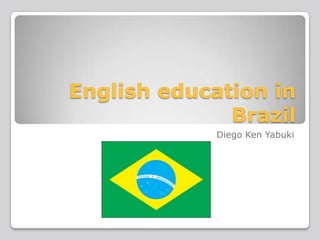
English education in
Brazil
Diego Ken Yabuki


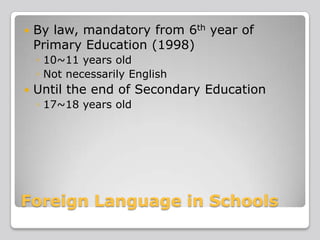
By law, mandatory from 6th year of
Primary Education (1998)
◦ 10~11 years old
◦ Not necessarily English



Until the end of Secondary Education
◦ 17~18 years old

Foreign Language in Schools


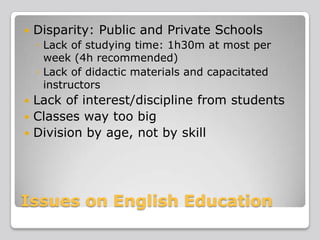
Disparity: Public and Private Schools
◦ Lack of studying time: 1h30m at most per
week (4h recommended)
◦ Lack of didactic materials and capacitated
instructors

Lack of interest/discipline from students
 Classes way too big
 Division by age, not by skill


Issues on English Education
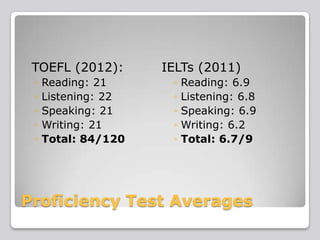
TOEFL (2012):
◦
◦
◦
◦
◦

Reading: 21
Listening: 22
Speaking: 21
Writing: 21
Total: 84/120

IELTs (2011)
◦
◦
◦
◦
◦

Reading: 6.9
Listening: 6.8
Speaking: 6.9
Writing: 6.2
Total: 6.7/9

Proficiency Test Averages
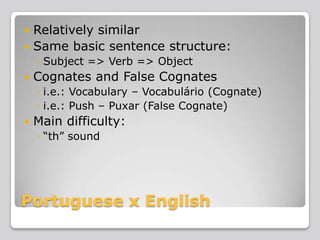
Relatively similar
 Same basic sentence structure:


◦ Subject => Verb => Object


Cognates and False Cognates
◦ i.e.: Vocabulary – Vocabulário (Cognate)
◦ i.e.: Push – Puxar (False Cognate)



Main difficulty:
◦ “th” sound

Portuguese x English
English education in
Spain
Eriko Tanaka
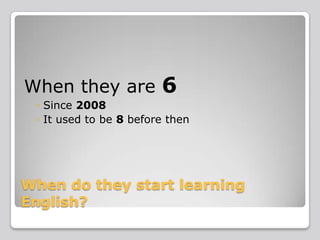
When they are

6

◦ Since 2008
◦ It used to be 8 before then

When do they start learning
English?
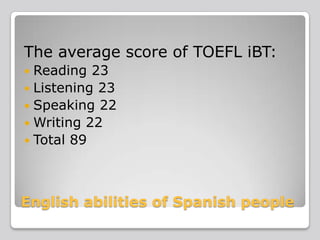
The average score of TOEFL iBT:
Reading 23
 Listening 23
 Speaking 22
 Writing 22
 Total 89


English abilities of Spanish people
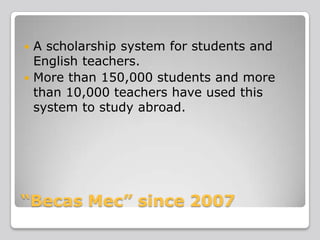
A scholarship system for students and
English teachers.
 More than 150,000 students and more
than 10,000 teachers have used this
system to study abroad.


“Becas Mec” since 2007
English education in
Poland
Keisuke Naito
grammar

English
vocabulary

What is important is…
Start from 3rd year elementary school student

Stories and conversation style textbook
2-3 hours per week

Poland English Education
Text book
is decided
by
teachers.
Text book
How well
students can
speak English
depends on
teachers.
Therefore, th
e level is
different
among
students.

The Problem is…
My trip to Poland and what I felt
there..
Bilingual education in
Netherlands
Anna Goense
Dutch and English
 Entrance procedure
 Half of the classes in English
 365 euro per year extra costs


Bilingual education in the
Netherlands
Not always native language and English
 Japan is recognizing a demand for
bilingual education
 International schools


Bilingual education worldwide
Globalization
 Good way to learn a language
 No focus on learning vocabulary and
grammar rules


Pros


Native language skills might be not fully
developed

I disagree, because of entrance
examination

Cons
From 32 schools in 2002 to 97 schools in
2013
 Start at elementary school
 Competitor of gymnasium
 English as world language


The future of bilingual education
Language Learning
Experience
Started at the age of 12
 When I started studying English, a big
difference between Japanese and English
puzzled me. English pronunciation and
grammar are very difficult, even now.


Satoki Kon


My personal affairs before entering into
this university
◦
◦
◦
◦

Failed to get credit of English classes
No interest to foreign affairs
Intention to specialize in Japanese history
Admired Chinese history

→after attenting to university・・・

Shohei Harai
English
 11~17 y: School
 12~14 y: Language School
 14~16 y: Private Teacher
 20 y: English School in Vancouver (2
months)
Most helpful activity: reading manga

Diego Ken Yabuki
Japanese
 8~10 y: Improvised Japanese School
 10~18 y: Nothing (forgetting all that I
learned on the previous years)
 From 18 y. on: University’s Language
Center
Most helpful activity: watching anime and
Japanese drama

Diego Ken Yabuki
-I started going to English conversation
school when I was 10.
-I started learning English at school when I
was 12.
-I had been staying in the US for 10
months in 2012-2013.
-I feel my English ability is decreasing
rapidly since I came back to Japan.

Eriko Tanaka
Very happy with my decision
 Speak a second language fluently
 Went on a lot of international school trips
 A TOEFL score of 114 without practice


Anna Goense





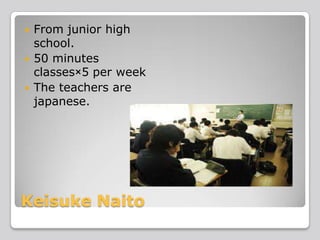
From junior high
school.
50 minutes
classes×5 per week
The teachers are
japanese.

Keisuke Naito
Discussion

Presentation for Computers in Language Learning Class - Osaka University

  • 1.
    Foreign Language Education Computers inLanguage Learning Group B
  • 2.
  • 3.
  • 4.
     10 years old(5th grader). *Recently changed Age at when children start studying English
  • 5.
    70 at TOEFL Lowest level in Asia  Japanese English Abilities
  • 6.
    One of thefurthest  Japanese have to take 2200 class hours to speak English fluently  How much Japanese is similar to the English
  • 7.
    There are bothJapanese teachers and native teachers in class.  Native teachers do not come to every class (once or twice a week).  English teachers in school
  • 8.
      English education inJapan attach importance to reading and writing. Entrance exams for college do not usually include speaking and listening test (center test, the common first stage university entrance examination, includes listening test) That’s why most Japanese have to learn English in crammer or in home by themselves to speak or listen to English well. Special features
  • 9.
  • 10.
    Major: Chinese history Many Chinese friends as rivals  interest to the educational gaps among Chinese  Fierce competition for human resources acquisition  Introduction: why China
  • 11.
    Compulsory class inprimary school  About 6 hours class every week  The great deal of differences between urban areas and rural areas  First step
  • 12.
    Every student mustattend to English classes  Graduation requirements  托福,雅思  Higher Education
  • 13.
    Earn more money Attend foreign educational institutes /U.S./Japan/ Australia  Many cram schools for IELTS, TOEFL,GRE,GMAT preparation  Motivations
  • 14.
  • 15.
     By law, mandatoryfrom 6th year of Primary Education (1998) ◦ 10~11 years old ◦ Not necessarily English  Until the end of Secondary Education ◦ 17~18 years old Foreign Language in Schools
  • 16.
     Disparity: Public andPrivate Schools ◦ Lack of studying time: 1h30m at most per week (4h recommended) ◦ Lack of didactic materials and capacitated instructors Lack of interest/discipline from students  Classes way too big  Division by age, not by skill  Issues on English Education
  • 17.
    TOEFL (2012): ◦ ◦ ◦ ◦ ◦ Reading: 21 Listening:22 Speaking: 21 Writing: 21 Total: 84/120 IELTs (2011) ◦ ◦ ◦ ◦ ◦ Reading: 6.9 Listening: 6.8 Speaking: 6.9 Writing: 6.2 Total: 6.7/9 Proficiency Test Averages
  • 18.
    Relatively similar  Samebasic sentence structure:  ◦ Subject => Verb => Object  Cognates and False Cognates ◦ i.e.: Vocabulary – Vocabulário (Cognate) ◦ i.e.: Push – Puxar (False Cognate)  Main difficulty: ◦ “th” sound Portuguese x English
  • 19.
  • 20.
    When they are 6 ◦Since 2008 ◦ It used to be 8 before then When do they start learning English?
  • 21.
    The average scoreof TOEFL iBT: Reading 23  Listening 23  Speaking 22  Writing 22  Total 89  English abilities of Spanish people
  • 22.
    A scholarship systemfor students and English teachers.  More than 150,000 students and more than 10,000 teachers have used this system to study abroad.  “Becas Mec” since 2007
  • 23.
  • 24.
  • 25.
    Start from 3rdyear elementary school student Stories and conversation style textbook 2-3 hours per week Poland English Education
  • 26.
  • 27.
    How well students can speakEnglish depends on teachers. Therefore, th e level is different among students. The Problem is…
  • 28.
    My trip toPoland and what I felt there..
  • 29.
  • 30.
    Dutch and English Entrance procedure  Half of the classes in English  365 euro per year extra costs  Bilingual education in the Netherlands
  • 31.
    Not always nativelanguage and English  Japan is recognizing a demand for bilingual education  International schools  Bilingual education worldwide
  • 32.
    Globalization  Good wayto learn a language  No focus on learning vocabulary and grammar rules  Pros
  • 33.
     Native language skillsmight be not fully developed I disagree, because of entrance examination Cons
  • 34.
    From 32 schoolsin 2002 to 97 schools in 2013  Start at elementary school  Competitor of gymnasium  English as world language  The future of bilingual education
  • 35.
  • 36.
    Started at theage of 12  When I started studying English, a big difference between Japanese and English puzzled me. English pronunciation and grammar are very difficult, even now.  Satoki Kon
  • 37.
     My personal affairsbefore entering into this university ◦ ◦ ◦ ◦ Failed to get credit of English classes No interest to foreign affairs Intention to specialize in Japanese history Admired Chinese history →after attenting to university・・・ Shohei Harai
  • 38.
    English  11~17 y:School  12~14 y: Language School  14~16 y: Private Teacher  20 y: English School in Vancouver (2 months) Most helpful activity: reading manga Diego Ken Yabuki
  • 39.
    Japanese  8~10 y:Improvised Japanese School  10~18 y: Nothing (forgetting all that I learned on the previous years)  From 18 y. on: University’s Language Center Most helpful activity: watching anime and Japanese drama Diego Ken Yabuki
  • 40.
    -I started goingto English conversation school when I was 10. -I started learning English at school when I was 12. -I had been staying in the US for 10 months in 2012-2013. -I feel my English ability is decreasing rapidly since I came back to Japan. Eriko Tanaka
  • 41.
    Very happy withmy decision  Speak a second language fluently  Went on a lot of international school trips  A TOEFL score of 114 without practice  Anna Goense
  • 42.
       From junior high school. 50minutes classes×5 per week The teachers are japanese. Keisuke Naito
  • 43.