Chapter 1:
English Language Development
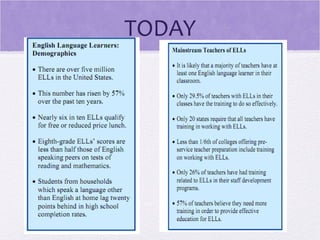
TODAY
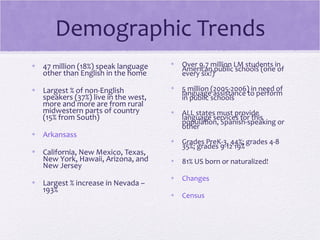
Demographic Trends
• 47 million (18%) speak language    • Over 9.7 million LM students in
                                       American public schools (one of
  other than English in the home       every six!)

• Largest % of non-English           • 5 million (2005-2006) in need of
                                       language assistance to perform
  speakers (37%) live in the west,     in public schools
  more and more are from rural
  midwestern parts of country        • ALL states must provide
  (15% from South)                     language services for this
                                       population, Spanish-speaking or
                                       other
• Arkansass
                                     • Grades PreK-3, 44%; grades 4-8
                                       35%; grades 9-12 19%
• California, New Mexico, Texas,
  New York, Hawaii, Arizona, and     • 81% US born or naturalized!
  New Jersey
                                     • Changes
• Largest % increase in Nevada –
  193%
                                     • Census
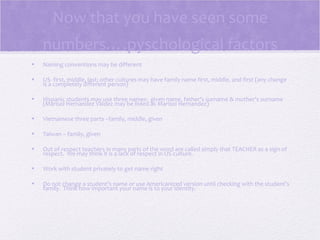
Now that you have seen some
    numbers….pyschological factors
•   Naming conventions may be different

•   US- first, middle, last; other cultures may have family name first, middle, and first (any change
    is a completely different person)

•   Hispanic students may use three names: given name, father’s surname & mother’s surname
    (Marisol Hernandez Valdez may be listed as Marisol Hernandez)

•   Vietnamese three parts –family, middle, given

•   Taiwan – family, given

•   Out of respect teachers in many parts of the word are called simply that TEACHER as a sign of
    respect. We may think it is a lack of respect in US culture.

•   Work with student privately to get name right

•   Do not change a student’s name or use Americanized version until checking with the student’s
    family. Think how important your name is to your identity.
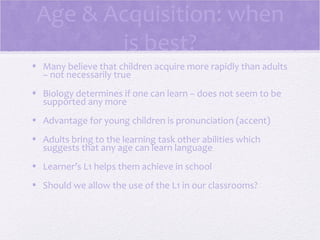
Age & Acquisition: when
        is best?
• Many believe that children acquire more rapidly than adults
  – not necessarily true
• Biology determines if one can learn – does not seem to be
  supported any more
• Advantage for young children is pronunciation (accent)
• Adults bring to the learning task other abilities which
  suggests that any age can learn language
• Learner’s L1 helps them achieve in school
• Should we allow the use of the L1 in our classrooms?
Stages of language
           development
• Preproduction – silent period
• Early production – single words, short phrases
• Speech emergence – beginning to offer independent responses
  with errors!
• Intermediate fluency – sense the beginning of conversations and
  control of language (albeit it with plenty of errors)
• Should we correct those errors as they occur?
• Can we speed up the process?
• What do we do with students in our classrooms who may be in
  the early stages?
Adapted Instruction
           Note
• Encourage families to maintain L1 at home

• IMPORTANT: Learner’s listening/speaking
  abilities MAY BE SIGNIFICANTLY BETTER than
  reading/writing abilities
Social-Emotional Factors
• Self-esteem – the way we express ourselves (language)
  very important – schools that promote all language help
  with self-esteem
• Inhibition big part of language learning – emphasizing
  fluency rather than accuracy helps learners to feel more
  relaxed about learning new language
• Motivation – instrumental & integrative

• Anxiety and language learning – can be the factor that
  causes learner to take long time to produce language
• Attitudes of the learner toward the TL
Psychological Factors:
         cognitive
• Visual/verbal & holistic/analytic cognitive styles
  commonly utilized in classrooms
• Schools (think also standardized testing) tend
  to favor verbal and analytic
• Some cultures do not emphasize these two
  styles which may make it more challenging for
  them in US schools
• Cognitive styles inform learning styles
Codeswitching
• A L2 learner strategy to negotiate new language
• Alternating use of L1 and L2 to express oneself. It
  may be found at the word, phrase or sentence
  level
• Some discourage its use; however, by
  codeswitching, you allow a learner to try to
  communicate with you in English
• What would you do as the teacher if a student
  uses codeswitching with you?
Sociocultural Context of
           ESL
• Language cannot be separated from culture – culture can
  influence or inhibit language learning just as much as the learning
  of individual words might seem to be a deterrent
• Patterns from the person’s first culture may be applied in the
  second culture (American) and may cause misunderstandings
• Success in a second language may be dependent upon
   • Status of primary language in relation to English
   • Own speech community’s view of the English language and
     community
   • Dialect of English they hear and learn in relationship to a standard
     English
   • Patterns of social and cultural language usage in the community
   • Compatibility between the home culture and the cultural patterns
     and organization of schools.
Social variables important to
  acculturation (Schumann, 1978a)
• Primary-language & English-language groups view
  each other as socially equal
• P-L and E-L groups both desire that L1 group assimilate
• Both P-L and E-L groups expect the primary language
  group to share social facilities with E-L group
• P-L group is small and not very cohesive
• P-L group’s culture is congruent with that of E-L
  groups
• Both have positive attitudes toward each other
• P-L group expects to stay in an area for an extended
  period
Family values
• Amol (p. 21)

• School and home may differ – only true for ESL
  students?

• American school values may include – speed and
  efficiency in learning, task orientation (in which
  students stay on a schedule, perform tasks, avoid
  wasting time, achieve academically so that they attain
  personal (individual) worth

• Working alone valued, competitive

• Some cultures, on the other hand, value group work –
  cheating known to US schools is just collaboration in
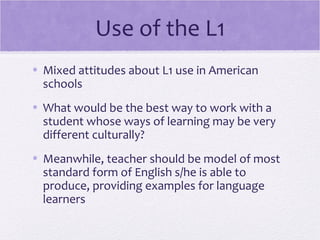
Use of the L1
• Mixed attitudes about L1 use in American
  schools
• What would be the best way to work with a
  student whose ways of learning may be very
  different culturally?
• Meanwhile, teacher should be model of most
  standard form of English s/he is able to
  produce, providing examples for language
  learners

Chapter 1

  • 1.
  • 2.
  • 3.
    Demographic Trends • 47million (18%) speak language • Over 9.7 million LM students in American public schools (one of other than English in the home every six!) • Largest % of non-English • 5 million (2005-2006) in need of language assistance to perform speakers (37%) live in the west, in public schools more and more are from rural midwestern parts of country • ALL states must provide (15% from South) language services for this population, Spanish-speaking or other • Arkansass • Grades PreK-3, 44%; grades 4-8 35%; grades 9-12 19% • California, New Mexico, Texas, New York, Hawaii, Arizona, and • 81% US born or naturalized! New Jersey • Changes • Largest % increase in Nevada – 193% • Census
  • 4.
    Now that youhave seen some numbers….pyschological factors • Naming conventions may be different • US- first, middle, last; other cultures may have family name first, middle, and first (any change is a completely different person) • Hispanic students may use three names: given name, father’s surname & mother’s surname (Marisol Hernandez Valdez may be listed as Marisol Hernandez) • Vietnamese three parts –family, middle, given • Taiwan – family, given • Out of respect teachers in many parts of the word are called simply that TEACHER as a sign of respect. We may think it is a lack of respect in US culture. • Work with student privately to get name right • Do not change a student’s name or use Americanized version until checking with the student’s family. Think how important your name is to your identity.
  • 5.
    Age & Acquisition:when is best? • Many believe that children acquire more rapidly than adults – not necessarily true • Biology determines if one can learn – does not seem to be supported any more • Advantage for young children is pronunciation (accent) • Adults bring to the learning task other abilities which suggests that any age can learn language • Learner’s L1 helps them achieve in school • Should we allow the use of the L1 in our classrooms?
  • 6.
    Stages of language development • Preproduction – silent period • Early production – single words, short phrases • Speech emergence – beginning to offer independent responses with errors! • Intermediate fluency – sense the beginning of conversations and control of language (albeit it with plenty of errors) • Should we correct those errors as they occur? • Can we speed up the process? • What do we do with students in our classrooms who may be in the early stages?
  • 7.
    Adapted Instruction Note • Encourage families to maintain L1 at home • IMPORTANT: Learner’s listening/speaking abilities MAY BE SIGNIFICANTLY BETTER than reading/writing abilities
  • 8.
    Social-Emotional Factors • Self-esteem– the way we express ourselves (language) very important – schools that promote all language help with self-esteem • Inhibition big part of language learning – emphasizing fluency rather than accuracy helps learners to feel more relaxed about learning new language • Motivation – instrumental & integrative • Anxiety and language learning – can be the factor that causes learner to take long time to produce language • Attitudes of the learner toward the TL
  • 9.
    Psychological Factors: cognitive • Visual/verbal & holistic/analytic cognitive styles commonly utilized in classrooms • Schools (think also standardized testing) tend to favor verbal and analytic • Some cultures do not emphasize these two styles which may make it more challenging for them in US schools • Cognitive styles inform learning styles
  • 10.
    Codeswitching • A L2learner strategy to negotiate new language • Alternating use of L1 and L2 to express oneself. It may be found at the word, phrase or sentence level • Some discourage its use; however, by codeswitching, you allow a learner to try to communicate with you in English • What would you do as the teacher if a student uses codeswitching with you?
  • 11.
    Sociocultural Context of ESL • Language cannot be separated from culture – culture can influence or inhibit language learning just as much as the learning of individual words might seem to be a deterrent • Patterns from the person’s first culture may be applied in the second culture (American) and may cause misunderstandings • Success in a second language may be dependent upon • Status of primary language in relation to English • Own speech community’s view of the English language and community • Dialect of English they hear and learn in relationship to a standard English • Patterns of social and cultural language usage in the community • Compatibility between the home culture and the cultural patterns and organization of schools.
  • 12.
    Social variables importantto acculturation (Schumann, 1978a) • Primary-language & English-language groups view each other as socially equal • P-L and E-L groups both desire that L1 group assimilate • Both P-L and E-L groups expect the primary language group to share social facilities with E-L group • P-L group is small and not very cohesive • P-L group’s culture is congruent with that of E-L groups • Both have positive attitudes toward each other • P-L group expects to stay in an area for an extended period
  • 13.
    Family values • Amol(p. 21) • School and home may differ – only true for ESL students? • American school values may include – speed and efficiency in learning, task orientation (in which students stay on a schedule, perform tasks, avoid wasting time, achieve academically so that they attain personal (individual) worth • Working alone valued, competitive • Some cultures, on the other hand, value group work – cheating known to US schools is just collaboration in
  • 14.
    Use of theL1 • Mixed attitudes about L1 use in American schools • What would be the best way to work with a student whose ways of learning may be very different culturally? • Meanwhile, teacher should be model of most standard form of English s/he is able to produce, providing examples for language learners

Editor's Notes

  • #4 http://www.polleverywhere.com/multiple_choice_polls/NzA1MjU3NzYx