Exploring Careers 
How to find the right fit for you!
It takes four steps to 
KnowHow2GO! 
Find an adult to help you plan for college – and 
keep asking until you find someone who will. 
Take the tough courses in high school that will 
prepare you for college – and get involved! 
Explore careers that fit your interests and skills 
– and then research colleges that are a good 
fit for you! 
Money is available to help you pay for 
college – but you have to apply!
It takes four steps to 
KnowHow2GO! 
By doing some career 
planning and 
research NOW, you’ll 
be prepared to find the 
college and career 
that are the right fit 
for you!
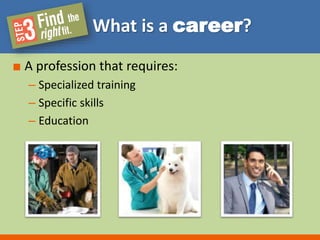
What is a career? 
■ A profession that requires: 
– Specialized training 
– Specific skills 
– Education
What is a career? 
■ A career is a series of similar jobs over a long 
period of time 
Study Computer 
Science in 
college 
Start as IT 
Support 
Move to 
Network 
Administrator 
System 
Analyst 
Database 
Administrator 
College 
Professor
All careers have 
basic skill needs 
Employers say graduates lack these basic skills: 
■ professionalism/work ethic 
■ teamwork 
■ oral communication 
■ thinking/problem solving 
■ written communication 
Build these skills in: 
• School 
• Part-time jobs 
• Volunteer work 
• Involvement in 
organizations
Help Wanted ad from a 
Nebraska newspaper
What are your career options?
When exploring 
careers, ask: 
■ Which career cluster(s)… 
– offers the most job opportunities in your community? 
– do you think you are interested in? 
– does your hobby or volunteer work fall into? 
– do you want more information about?
Career options with 
varying levels of education
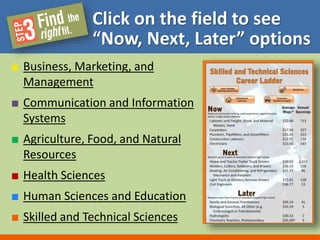
Click on the field to see 
“Now, Next, Later” options 
■ Business, Marketing, and 
Management 
■ Communication and Information 
Systems 
■ Agriculture, Food, and Natural 
Resources 
■ Health Sciences 
■ Human Sciences and Education 
■ Skilled and Technical Sciences
8 steps to 
exploring careers 
1. Make a list of your skills and interests 
2. Ask your counselor about career assessment 
tools at your school 
– MyNextMove.org 
– ONETonline.org 
– BLS.gov/k12 
– H3.ne.gov 
3. Learn about jobs that match your skills and 
interests 
4. Find out what courses and activities to pursue 
in high school
8 steps to 
explore careers 
5. Think about your 
future lifestyle. Use 
Reality Check at 
EducationQuest.org
8 steps to 
explore careers 
6. Discuss your interests with an adult (teacher, 
parent, mentor) 
7. Set up job shadowing opportunities in areas 
that interest you 
8. Make an appointment 
to “interview” someone 
in a career you may 
want to pursue
Once you have a career 
in mind… 
College or University – 4 years 
Bachelor’s degree 
Community College – 2 years 
Associate degree, Certificate, Diploma 
Trade School – 1-2 years 
Certificate, Diploma 
Other Options 
military, apprenticeship, technical training 
■ Find out what kind 
of education is 
required
Then begin 
researching colleges 
For details about colleges in Nebraska and across 
the country, check out: 
■ College Profiles at EducationQuest.org 
■ Big Future at BigFuture.CollegeBoard.org
For more info, check out 
EducationQuest resources 
■ Review the “Find the Right 
Fit” section of the 
KnowHow2GO Handbook 
with your parents or an adult 
■ Visit the 8th, 9th, 10th grade 
section at EducationQuest.org 
‒ Click on “Step 3: Find the Right 
Fit” 
‒ You’ll find helpful career 
exploration resources!
Kearney Lincoln Omaha 
EducationQuest.org 
Kearney – 308.234.6310 or 800.666.3721 
Lincoln – 402.475.5552 or 800.303.3745 
Omaha – 402-391-4033 or 888.357.6300 
Your journey to college begins with us

Exploring Careers

  • 1.
    Exploring Careers Howto find the right fit for you!
  • 2.
    It takes foursteps to KnowHow2GO! Find an adult to help you plan for college – and keep asking until you find someone who will. Take the tough courses in high school that will prepare you for college – and get involved! Explore careers that fit your interests and skills – and then research colleges that are a good fit for you! Money is available to help you pay for college – but you have to apply!
  • 3.
    It takes foursteps to KnowHow2GO! By doing some career planning and research NOW, you’ll be prepared to find the college and career that are the right fit for you!
  • 4.
    What is acareer? ■ A profession that requires: – Specialized training – Specific skills – Education
  • 5.
    What is acareer? ■ A career is a series of similar jobs over a long period of time Study Computer Science in college Start as IT Support Move to Network Administrator System Analyst Database Administrator College Professor
  • 6.
    All careers have basic skill needs Employers say graduates lack these basic skills: ■ professionalism/work ethic ■ teamwork ■ oral communication ■ thinking/problem solving ■ written communication Build these skills in: • School • Part-time jobs • Volunteer work • Involvement in organizations
  • 7.
    Help Wanted adfrom a Nebraska newspaper
  • 8.
    What are yourcareer options?
  • 9.
    When exploring careers,ask: ■ Which career cluster(s)… – offers the most job opportunities in your community? – do you think you are interested in? – does your hobby or volunteer work fall into? – do you want more information about?
  • 10.
    Career options with varying levels of education
  • 11.
    Click on thefield to see “Now, Next, Later” options ■ Business, Marketing, and Management ■ Communication and Information Systems ■ Agriculture, Food, and Natural Resources ■ Health Sciences ■ Human Sciences and Education ■ Skilled and Technical Sciences
  • 12.
    8 steps to exploring careers 1. Make a list of your skills and interests 2. Ask your counselor about career assessment tools at your school – MyNextMove.org – ONETonline.org – BLS.gov/k12 – H3.ne.gov 3. Learn about jobs that match your skills and interests 4. Find out what courses and activities to pursue in high school
  • 13.
    8 steps to explore careers 5. Think about your future lifestyle. Use Reality Check at EducationQuest.org
  • 14.
    8 steps to explore careers 6. Discuss your interests with an adult (teacher, parent, mentor) 7. Set up job shadowing opportunities in areas that interest you 8. Make an appointment to “interview” someone in a career you may want to pursue
  • 15.
    Once you havea career in mind… College or University – 4 years Bachelor’s degree Community College – 2 years Associate degree, Certificate, Diploma Trade School – 1-2 years Certificate, Diploma Other Options military, apprenticeship, technical training ■ Find out what kind of education is required
  • 16.
    Then begin researchingcolleges For details about colleges in Nebraska and across the country, check out: ■ College Profiles at EducationQuest.org ■ Big Future at BigFuture.CollegeBoard.org
  • 17.
    For more info,check out EducationQuest resources ■ Review the “Find the Right Fit” section of the KnowHow2GO Handbook with your parents or an adult ■ Visit the 8th, 9th, 10th grade section at EducationQuest.org ‒ Click on “Step 3: Find the Right Fit” ‒ You’ll find helpful career exploration resources!
  • 18.
    Kearney Lincoln Omaha EducationQuest.org Kearney – 308.234.6310 or 800.666.3721 Lincoln – 402.475.5552 or 800.303.3745 Omaha – 402-391-4033 or 888.357.6300 Your journey to college begins with us

Editor's Notes

  • #2 This is an interactive presentation to be used in helping your students find the right career for them and then the college that would best fit their needs based on that career. The student should be given a folder or asked to bring one to class so they can start to compile information about different careers they would be interested in. They can also record their skills and they would fit into specific careers.
  • #4 Find the right fit is the third step in the KnowHow2Go campaign and guides students to research different careers and plan now for college. By doing early research the student should be able to find the school that best fits their needs.
  • #6 Click on the career diagram to view an interactive diagram that tells students skills they’ll need, courses they should take and activities they should pursue to prepare for different types of careers.
  • #7 During this slide ask the students what other skills would be considered basic and have them make a list of their skills.
  • #8 For this slide we would want to ask the students what basic skills they could build when doing the listed activities as well as brainstorming some of their own skill builders.
  • #9 Again, ask the student what they feel would be specific skills and what specific skills they may have.
  • #10 This slide is an example of possible careers for a student who is strong in math and science.
  • #11 This slide will list careers for a student strong in English.
  • #12 If you have students that like to work with their hands these would be possible career choices.
  • #15 This slide includes a link to EducationQuest’s new Reality Check program if you want to show it to your students.
  • #16 For this slide you would want to discuss any assessments your school has available for the students. You would also want the students to make a list of adults they can take with and what types of jobs they would like to shadow.
  • #17 This page links to this website if you wish to show it.
  • #21 Student loan payment could be as high as $300 per month for 10 years.
  • #22 Student loan payment could be as high as $300 per month for 10 years and would not cover the total cost for the degree.
  • #23 A students monthly loan payment could be as much as $1,000 for the 10 year repayment period.