









Do you…
?
When John was in 8th grade,
college was not on his mind.
College was never discussed at home.
No one in his family went to college.
John was only interested in SKATEBOARDING.
John’s teacher, Mr. Taylor,
told him…
“You’ve got what it takes
to go to college.”
“You’ve got what it takes!”
“But, what do you mean
by college?”
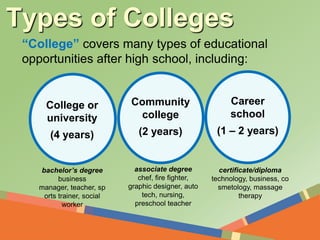
“It can mean any type of education
after high school including…”
College or UniversityCommunity College
Apprenticeship,
Technical Training
Military
42
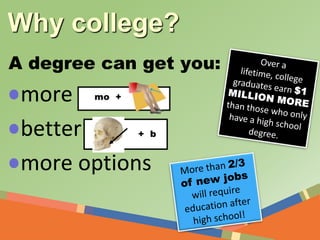
“Why should I go to college?”
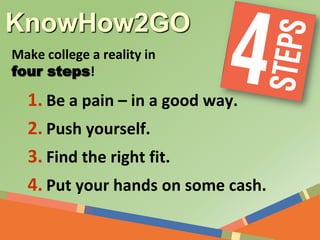
“You can make college happen
by following 4 steps.”
“Ask adults, like me, to help you
prepare for college.”
“Yes…but in a GOOD WAY!”
“You
want me
to be a
pain??”
“Now Step 2…”
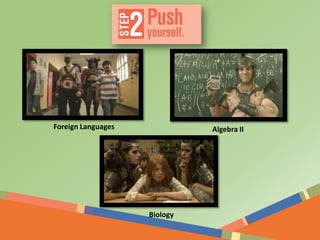
“Take hard classes, like my Algebra ll course.”
“But, Algebra ll is tough!”
“And get involved!”
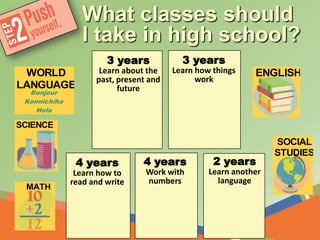
“There are classes you have to take to
qualify for college admission.”
4 years
English
3 years 2 years
Math
Social Sciences
Natural
Sciences
World
Langua
ge
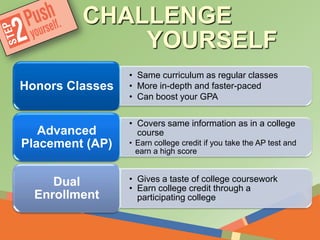
More in-depth and faster-pacedHonors
Classes
Earn college credit if you take the
AP test and score well
Advanced
Placement
Earn college credit through a
participating college
Dual
Credit
“To be even more prepared,
take these kinds of classes.”
He signed up for Mr. Taylor’s
Algebra II class.
He joined band.
And he’s delivering care
packages to the homeless –
on his skateboard!
John accepted the challenge…
He’s tracking his
involvement with
the Activities
Resume at
EducationQuest.org
Hispanic Club
FBLA
President’s Academic Award
Deliver care packages to the homeless
Mow lawns in my neighborhood
Band
“Now let’s talk about Step 3.”
If you could teach a course
on any subject, at any level,
what subject would it be?
“Think about your career interests.”
If you produced a
documentary film, what
subject would you feature?
“Well…I like P.E. and science – and I’m
doing pretty well in them.”
“Then research colleges that offer degrees like
exercise science and engineering.”
Review
college
websites.
Attend
activities
at area
colleges.
Participate in
campus visits
organized by
your school.
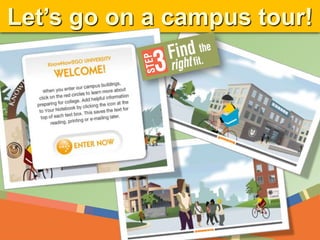
John went on a campus visit with his class
and got excited about college!

KnowHow2GO to College

  • 1.
  • 2.
    When John wasin 8th grade, college was not on his mind. College was never discussed at home. No one in his family went to college. John was only interested in SKATEBOARDING.
  • 3.
    John’s teacher, Mr.Taylor, told him… “You’ve got what it takes to go to college.”
  • 4.
  • 5.
    “But, what doyou mean by college?”
  • 6.
    “It can meanany type of education after high school including…” College or UniversityCommunity College Apprenticeship, Technical Training Military 42
  • 7.
    “Why should Igo to college?”
  • 8.
    “You can makecollege happen by following 4 steps.”
  • 9.
    “Ask adults, likeme, to help you prepare for college.” “Yes…but in a GOOD WAY!” “You want me to be a pain??”
  • 10.
  • 11.
    “Take hard classes,like my Algebra ll course.” “But, Algebra ll is tough!” “And get involved!”
  • 12.
    “There are classesyou have to take to qualify for college admission.” 4 years English 3 years 2 years Math Social Sciences Natural Sciences World Langua ge
  • 13.
    More in-depth andfaster-pacedHonors Classes Earn college credit if you take the AP test and score well Advanced Placement Earn college credit through a participating college Dual Credit “To be even more prepared, take these kinds of classes.”
  • 14.
    He signed upfor Mr. Taylor’s Algebra II class. He joined band. And he’s delivering care packages to the homeless – on his skateboard! John accepted the challenge…
  • 15.
    He’s tracking his involvementwith the Activities Resume at EducationQuest.org Hispanic Club FBLA President’s Academic Award Deliver care packages to the homeless Mow lawns in my neighborhood Band
  • 16.
    “Now let’s talkabout Step 3.”
  • 17.
    If you couldteach a course on any subject, at any level, what subject would it be? “Think about your career interests.” If you produced a documentary film, what subject would you feature?
  • 18.
    “Well…I like P.E.and science – and I’m doing pretty well in them.” “Then research colleges that offer degrees like exercise science and engineering.” Review college websites. Attend activities at area colleges. Participate in campus visits organized by your school.
  • 19.
    John went ona campus visit with his class and got excited about college!

Editor's Notes

  • #3 Describe the different types of “college.”Ask students if they can name NEBRASKA examples of each type of college.Universities and Colleges…University system (UNL, UNK, UNO, UNMC)State college system (Peru, Wayne, Chadron)Private colleges (Bellevue University, Bryan LGH, Clarkson, College of Saint Mary, Concordia, Creative Center – Omaha, Creighton, Doane, Grace, Hastings, Midland, Nebraska Christian College, Nebraska Methodist, Nebraska Wesleyan, Union College, York College)Community Colleges…Central Community College (CCC), Little Priest Tribal College, Metropolitan (MCC), Mid-Plains (MPCC), Nebraska College of Technical Agriculture, Nebraska Indian Community College, Northeast (NECC), Southeast (SCC), Western Nebraska (WNCC) Private Career Schools…Alegent Health, College of Hair Design, Creative Center, ITT Tech, Joseph’s College of Beauty, Kaplan, Myotheraphy Institute, Omaha School of Massage, Radiology schools, Vatterott
  • #4 Point out their correct answers about their reasons why people go to college. If you need additional explanation of these “why college is important” bullet points:Click 1:More (money)! On average, high school graduates earn $175 more per week than high school dropouts. College graduates earn $368 more per week than high school graduates. Over the course of a year, college grads typically earn $20,000 more than a high school grad. (Source: US Census Bureau)Click 2:A better (job)! You’ll have a wider selection of jobs because more employers require education after high school. You’ll be more likely to find something you really enjoy. The more education you get, the more likely it is you will always have a job.More Life Options in the Years Ahead: College introduces students to many career paths that match their skills and interests.Delay of 3 seconds and two boxes automatically come up.Explain the black box – that college graduates earn $1 million more over their lifetime than high school graduates.
  • #7 An opportunity to discuss the terminology of Honors, AP, and Dual Enrollment. Discuss why taking these classes help a student challenge themselves in high school, can improve GPA, help earn college credit, and prepare them for college.
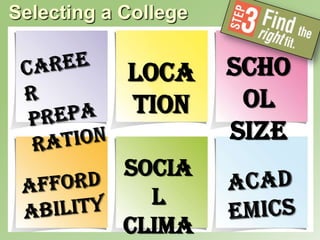
  • #12 These are just some of the things to look for when selecting a college. Ask students for other ideas of things they may look for in a school.
  • #13 Define college costs for students:Tuition – the amount of money a college charges for courses you will takeFees – the amount the college charges for services like computer labs, the fitness center, and career servicesBooks – the college will require you to purchase textbooks for most of your classesRoom and Board – If you live on campus, the college will charge you to live in a residence hall and for the meals you eat in the college cafeteria.
  • #14 Explain that another way to pay for college is by saving money.Click through the numbers of how much students would spend if buying snacks every day. You can save $5000 over four years in high school! If students dispute “I don’t buy snacks,” give more relevant examples of ways they spend money: video games, shopping, going out, etc.
  • #15 Briefly define the types of financial aid.Scholarships – Money for students based on talents such as academics or leadership. Tell them that the scholarships don’t go only to the best academic or athletic students. There are students available from religious organizations and community groups. There are scholarships based on your race/ethnicity, based on what you choose to study in college, and from your parents' work. There is even a scholarship for the best duct tape prom outfit!Grants – Money for college that is based on financial need that students do not need to repay.Work Study – A program that allows students to earn money at a job while attending college.Student Loans – Money students borrow for college that must be repaid with interest.Share what types of aid you are receiving to help pay for college.
  • #16 The one aspect of financial aid students can gain the most control over are scholarships. Offer tips for how students can position themselves to earn scholarships in the future.