2019, Vol. 20, No. 1 (76)
ISSN 2451-1617
Effective Management in Image Crisis
in the Example of Tiger Brand
Dariusz Tworzydło
University of Warsaw
dariusz@tworzydlo.pl
ORCID: 0000-0001-6396-6927
ABSTRACT
The article contains an analysis of Tiger’s brand image during the crisis in 2017. Scientific
objective: To evaluate the effectiveness of crisis communication activities of the studied
company. Research methods: Analysis of materials obtained from media monitoring, as well
as desk research from the analyzed company. Results and conclusions: The study shows the
response methods and actions taken by the company in the analyzed crisis. The key determinants
of the crisis were indicated as well as the factors that contributed to the proper resolution of the
crisis situation. One of the essential components of the paper is also the analysis of actions taken
by the company after the end of the crisis. The mistakes made by the company in the field of
crisis management have also been described. Cognitive value: The paper contains a consistent
description of crisis events that affected the brand, provides an objective look at the image crisis,
along with the assessment of the methods and tools used.
KEYWORDS
crisis, crisis management, image, Maspex/Tiger, public relations
116
Dariusz Tworzydło • Effective Management in Image Crisis in the Example of Tiger Brand
Studia Medioznawcze 2019, Vol. 20, No. 1 (76), pp. 115–128 https://mediastudies.eu
The literature on the subject defines the concept of image crisis in a differentiated and at the
same time quite coherent way. It is understood as specific and unexpected event (or series
of events) that causes a high level of uncertainty and threatens or is perceived as a threat to the
achievement of key organisational goals (Seeger, Sellnow, & Ulmer, 1998, pp. 231–276), and
in addition, it harms the image of the business entity (Coombs & Schmidt, 2000, pp. 163–178).
It can lead to thre e related risks that concern public safety, financial loss and loss of reputation.
Some emergency situations, such as work-related accidents or the delivery of harmful products
to the market, can cause physical injuries and even contribute to death of a consumer. Others
interfere with the smooth operation of the company, result in losses of market share or affect
the withdrawal of consumers from the purchase decision. There are also situations that end in
lawsuits. A badly managed crisis may damage the reputation of the entity concerned. All these
factors are closely related. Work accidents can result in financial losses and loss of reputation that
significantly affect the stability of the business entity (Coombs, 2007).
Although in crisis situations it is more likely to find negative effects, it should be borne in
mind that crises may also have a positive impact on the organisation. However, this will only
occur if the corrective actions are carried out professionally and quickly. Properly implemented
crisis management is one of the key elements of the organisation’s effective achievement of
goals. Failure of the activities undertaken in the field of image-related crisis may result in damage
to stakeholders, losses (also financial) of the organisation or, ultimately, contribute to its collapse
(Coombs, 2007).
Costs of the crisis are considered in both financial and image terms. They affect the areas of
internal and external image. They reflect on sales, but also on the reputation of the entity affected
by the crisis. Crisis management is even more important, as it prevents or marginalizes these
negative effects.
The crisis situation analysed in the article touched one of the largest Polish producers in the
food industry, Maspex in Wadowice. Its portfolio includes several dozen brands and several
thousand items. In the area of almost every brand, the company undertakes marketing activities
using most of available communication tools in all channels. It uses the so-called 360-degree
communication, which means that it is present in every possible medium. It orders the broadcast
of TV commercials, conducts outdoor and internet campaigns, implements a number of BTL
activities, such as events, festivals. Added to this is extensive activity in social media (Facebook,
Instagram, Twitter, Snapchat and YouTube). The entity also runs several hundred commercial
promotions.
The described crisis situation, which affected the Tiger brand, is the result of many factors
that will be analysed and evaluated in detail.
The article was based on the study of source materials obtained from media monitoring, data
obtained at Maspex Wadowice, such as press releases and presentations, and IDI interview with
the vice president of the management board. The analysis was carried out from 8 April to 13
June 2018. The aim of the article was to evaluate the effectiveness of communication activities
of the examined entity in the field of crisis communication. The research hypothesis was put in
the following way: Maspex Wadowice carried out internal and external actions during the crisis
that affected the Tiger brand effectively and safely for long-term image building.
Responding to a crisis situation
Benoit identifies five categories of response strategies in the field of image defence:
1. Denial.
2. Avoiding responsibility.
117
Dariusz Tworzydło • Effective Management in Image Crisis in the Example of Tiger Brand
Studia Medioznawcze 2019, Vol. 20, No. 1 (76), pp. 115–128 https://mediastudies.eu
3. Reducing offensiveness.
4. Corrective actions.
5. Mortification.
Ad. 1. Denial comes in various forms: one of them is to shift blame, while rejecting
accusations regarding mistakes or omissions. The company indicates that it did not commit the
alleged offence. Shifting blame occurs when an entity affected by the crisis says that a third
person committed or caused the action (Benoit & McHalle, 1999, pp. 265–280).
Ad. 2. Avoiding responsibility can take four forms:
• provocation
• defeasibility
• accident
• good intention
In the case of provocation, the organisation claims that its action was a response to another
offensive act. Failure occurs when people within the organisation conclude that they had
insufficient/no information or that they were unable to control the events caused by the act of
crisis. The accident assumes that the mistake occurred unintentionally and was uncontrolled by
the organisation. Finally, mistakes made in good intention suggest that the organisation did not
intend to allow them (Benoit & McHalle, 1999, pp. 265–280).
Ad. 3. Limiting the effects of an event is the third main strategy for image repair. Benoit
distinguishes several types here. The first assumes an increase in positive emotions that the
public experiences in relation to the organisation. It is an attempt to disperse negative feelings.
The second, called minimization, takes place when the entity accused of being responsible
for some act attempts to reduce the perceived damage. The third type of mitigation strategy
– transcendence – is an attempt to situate the event in a more favourable context in order to
improve the image. Attacking the accuser – the fourth type – takes place when an attack on
his credibility is provoked. Finally, the fifth type – compensation – is the remuneration for the
victim, which is also to reduce the primary negative effects of the company’s problem (Benoit,
1997, pp. 177–187).
Ad. 4. Corrective actions – the fourth category of strategy – consist in repairing damage or
taking steps to prevent similar events in the future. Both types can occur together or separately.
Ad 5. The final type of crisis response strategy is confession and repentance. The organisation
hopes for the understanding of the stakeholders (Meyers, 2009).
It should also be pointed out that effective crisis management is based on a number of
principles and a variety of procedures. The point here is, among other things, the procedures
for the circulation of information during the crisis; reacting when the crisis comes; information
management in the network, as well as media monitoring or communication with individual
stakeholder groups (employees, local communities, media). An appropriate solution in the field
of preparing for a crisis situation is creating schemes and procedures in the event of image crises.
However, many entities do not have such documents, which forces the use of rules and principles
that have been developed by the environment or for other entities.
Schemes used during difficult events are usually similar, and communication is one of the
most important issues. It is assumed that it should be parallel in two areas:
• internal
• external.
It is necessary to determine what kind of key target groups we are dealing with, because it
is them who is mainly interested in what is happening around the brand. Among the target
groups that should be within the range of interest of a company affected by the crisis, there are
118
Dariusz Tworzydło • Effective Management in Image Crisis in the Example of Tiger Brand
Studia Medioznawcze 2019, Vol. 20, No. 1 (76), pp. 115–128 https://mediastudies.eu
primarily: employees, management, investors/shareholders, media, local environment, more or
less organised interest groups, experts, intervention services. These groups can also be divided
into: entities directly affected by the crisis; those who are interested in the situation of directly
concerned; special groups that can influence the crisis situation to a greater or lesser extent
(Wojcik, 2005, pp. 381–382). Communication activities based on the mentioned schemes are
addressed to individual groups. In a crisis situation, it is also reasonable to anticipate – put
yourself in the position of a party affected by the crisis, and to define what it would like to hear
at a given moment.
Enterprises do not always have sufficient procedures, complete and tailored to the given
situation, developed response scenarios including
identification of potential directions in which crisis
situations may go, and above all they are not able to
fully prepare for what will come. This was the case with
Maspex, which in 2017 experienced the largest image
crisis in its history. In addition, appropriate preparation is
particularly important in the case of companies operating
in industries susceptible to crises (Tworzydło, Łaszyn,
& Szuba, 2018, p. 19), and the analysed entity operates
in such areas. The crisis of Maspex occurred due to
activities carried out through social media. Nowadays,
they are becoming one of the fastest generators of
problem situations in terms of image. One simple click
triggers an avalanche of events (Schultz, Utz, & Göritz,
2011, p. 22), which is difficult to stop.
It must be remembered, however, that even with
well-designed procedures, model statements and answers
to potentially difficult questions, the company cannot
be completely protected against potential crises,
because they are events that cannot be fully predicted.
Nonetheless, activities such as media monitoring, analysis
of the situation and potential symptoms of the crisis are
important in managing the image, both in the strategic and
operational range. Proper preparation is necessary
because it is an incentive to constantly improve yourself,
your company and procedures.
Initiation of a crisis situation
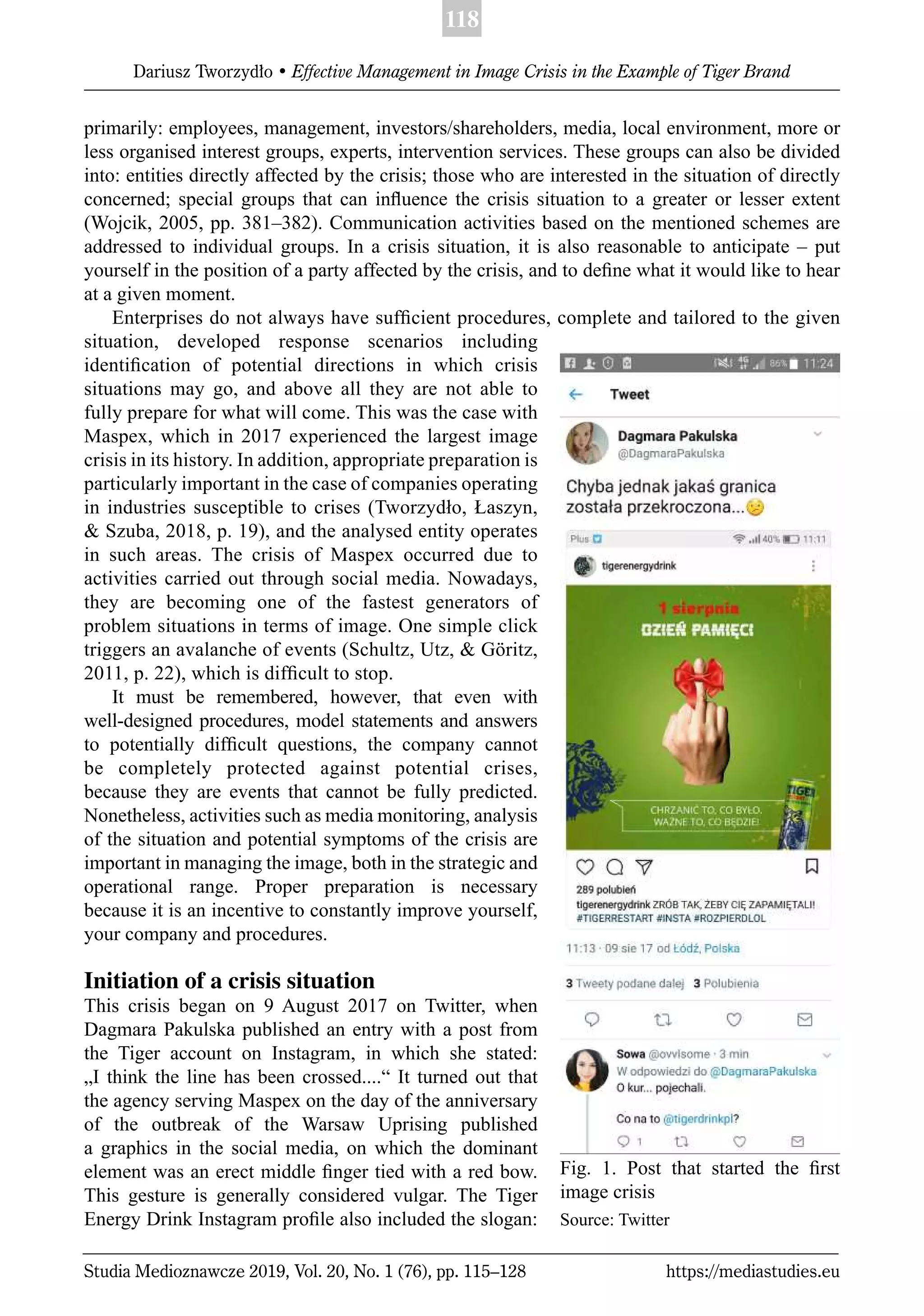
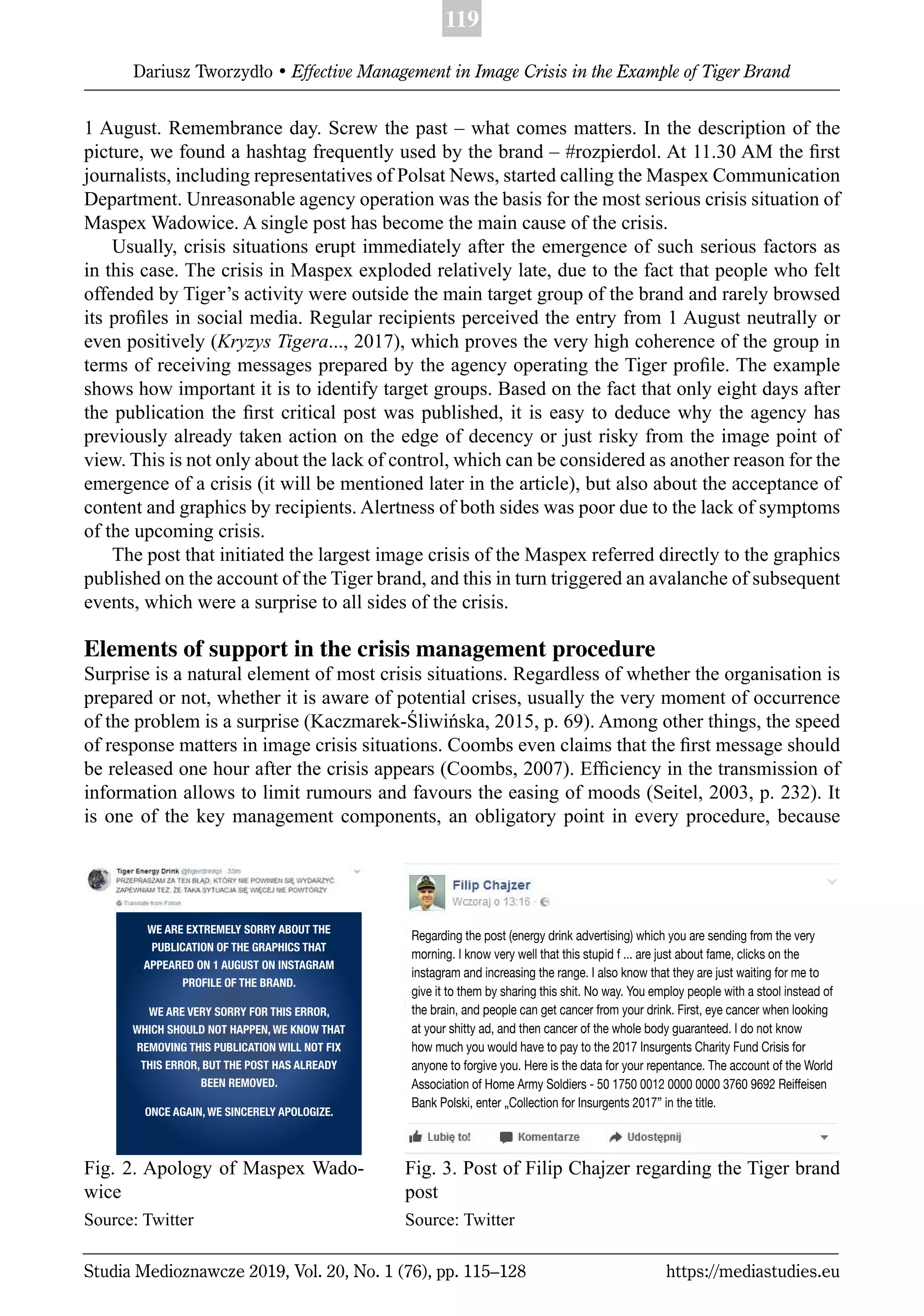
This crisis began on 9 August 2017 on Twitter, when
Dagmara Pakulska published an entry with a post from
the Tiger account on Instagram, in which she stated:
„I think the line has been crossed....“ It turned out that
the agency serving Maspex on the day of the anniversary
of the outbreak of the Warsaw Uprising published
a graphics in the social media, on which the dominant
element was an erect middle finger tied with a red bow.
This gesture is generally considered vulgar. The Tiger
Energy Drink Instagram profile also included the slogan:
Fig. 1. Post that started the first
image crisis
Source: Twitter
119
Dariusz Tworzydło • Effective Management in Image Crisis in the Example of Tiger Brand
Studia Medioznawcze 2019, Vol. 20, No. 1 (76), pp. 115–128 https://mediastudies.eu
1 August. Remembrance day. Screw the past – what comes matters. In the description of the
picture, we found a hashtag frequently used by the brand – #rozpierdol. At 11.30 AM the first
journalists, including representatives of Polsat News, started calling the Maspex Communication
Department. Unreasonable agency operation was the basis for the most serious crisis situation of
Maspex Wadowice. A single post has become the main cause of the crisis.
Usually, crisis situations erupt immediately after the emergence of such serious factors as
in this case. The crisis in Maspex exploded relatively late, due to the fact that people who felt
offended by Tiger’s activity were outside the main target group of the brand and rarely browsed
its profiles in social media. Regular recipients perceived the entry from 1 August neutrally or
even positively (Kryzys Tigera..., 2017), which proves the very high coherence of the group in
terms of receiving messages prepared by the agency operating the Tiger profile. The example
shows how important it is to identify target groups. Based on the fact that only eight days after
the publication the first critical post was published, it is easy to deduce why the agency has
previously already taken action on the edge of decency or just risky from the image point of
view. This is not only about the lack of control, which can be considered as another reason for the
emergence of a crisis (it will be mentioned later in the article), but also about the acceptance of
content and graphics by recipients. Alertness of both sides was poor due to the lack of symptoms
of the upcoming crisis.
The post that initiated the largest image crisis of the Maspex referred directly to the graphics
published on the account of the Tiger brand, and this in turn triggered an avalanche of subsequent
events, which were a surprise to all sides of the crisis.
Elements of support in the crisis management procedure
Surprise is a natural element of most crisis situations. Regardless of whether the organisation is
prepared or not, whether it is aware of potential crises, usually the very moment of occurrence
of the problem is a surprise (Kaczmarek-Śliwińska, 2015, p. 69). Among other things, the speed
of response matters in image crisis situations. Coombs even claims that the first message should
be released one hour after the crisis appears (Coombs, 2007). Efficiency in the transmission of
information allows to limit rumours and favours the easing of moods (Seitel, 2003, p. 232). It
is one of the key management components, an obligatory point in every procedure, because
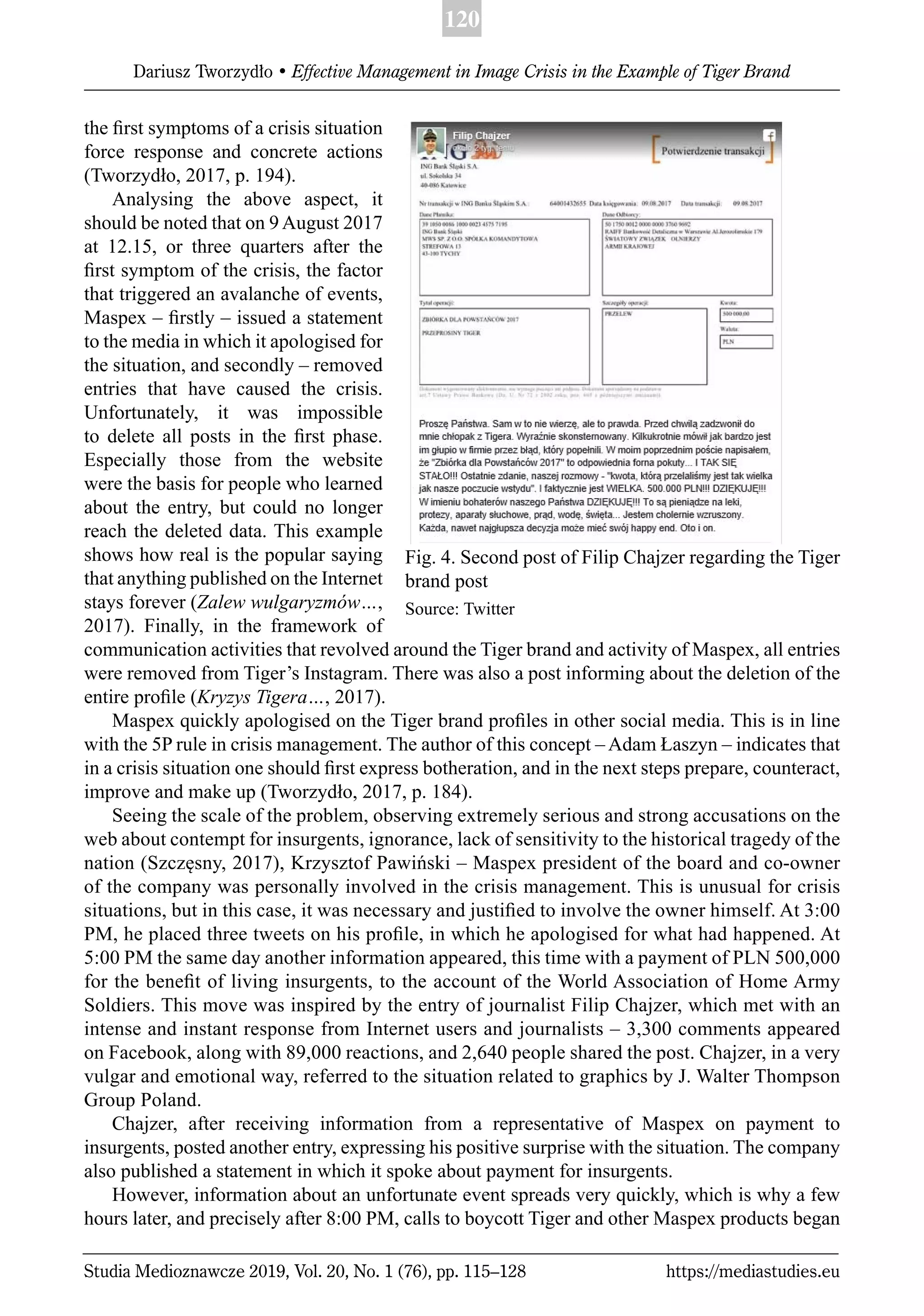
Fig. 2. Apology of Maspex Wado-
wice
Source: Twitter
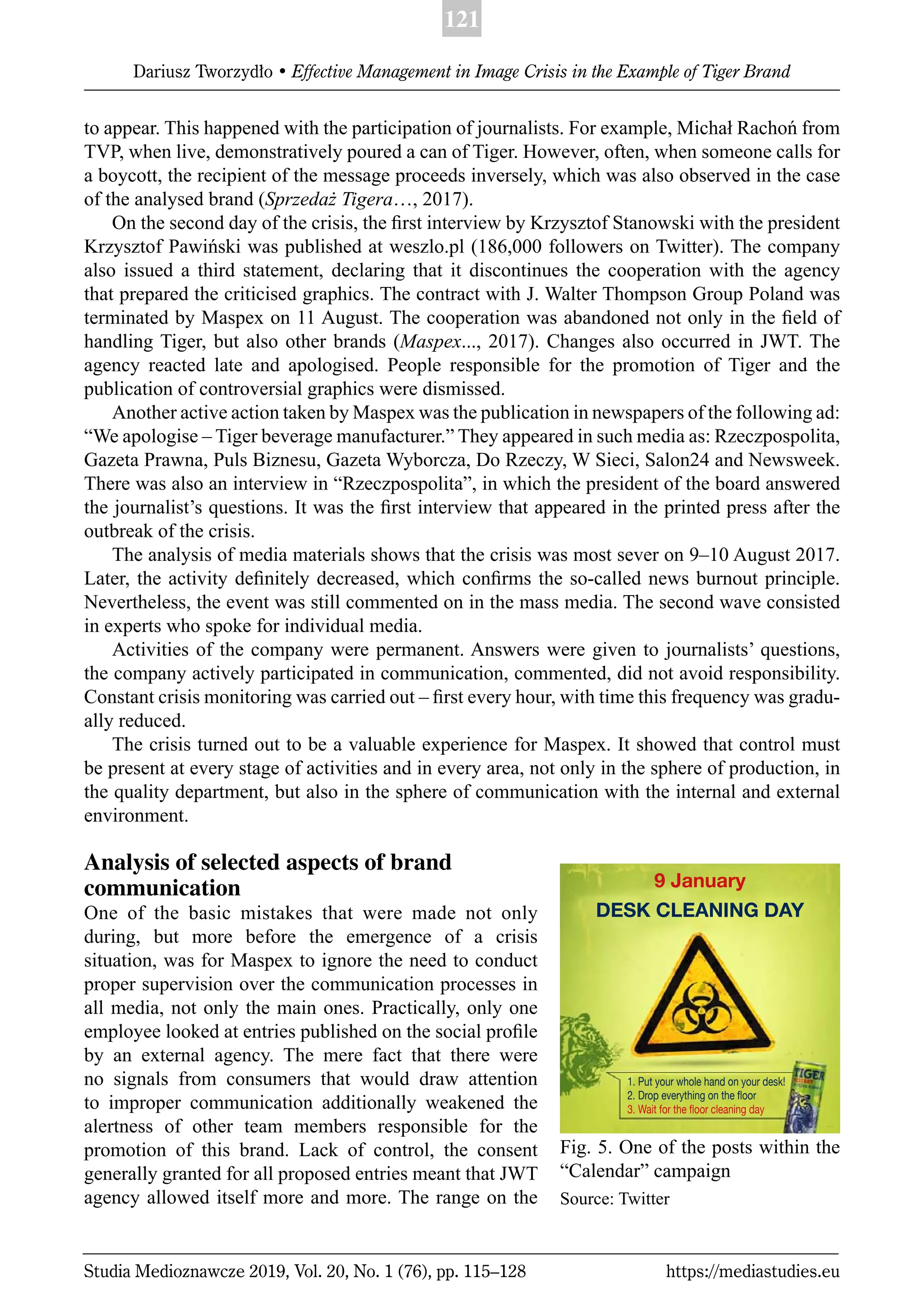
Fig. 3. Post of Filip Chajzer regarding the Tiger brand
post
Source: Twitter
Regarding the post (energy drink advertising) which you are sending from the very
morning. I know very well that this stupid f ... are just about fame, clicks on the
instagram and increasing the range. I also know that they are just waiting for me to
give it to them by sharing this shit. No way. You employ people with a stool instead of
the brain, and people can get cancer from your drink. First, eye cancer when looking
at your shitty ad, and then cancer of the whole body guaranteed. I do not know
how much you would have to pay to the 2017 Insurgents Charity Fund Crisis for
anyone to forgive you. Here is the data for your repentance. The account of the World
Association of Home Army Soldiers - 50 1750 0012 0000 0000 3760 9692 Reiffeisen
Bank Polski, enter „Collection for Insurgents 2017” in the title.
WE ARE EXTREMELY SORRY ABOUT THE
PUBLICATION OF THE GRAPHICS THAT
APPEARED ON 1 AUGUST ON INSTAGRAM
PROFILE OF THE BRAND.
WE ARE VERY SORRY FOR THIS ERROR,
WHICH SHOULD NOT HAPPEN, WE KNOW THAT
REMOVING THIS PUBLICATION WILL NOT FIX
THIS ERROR, BUT THE POST HAS ALREADY
BEEN REMOVED.
ONCE AGAIN, WE SINCERELY APOLOGIZE.
120
Dariusz Tworzydło • Effective Management in Image Crisis in the Example of Tiger Brand
Studia Medioznawcze 2019, Vol. 20, No. 1 (76), pp. 115–128 https://mediastudies.eu
the first symptoms of a crisis situation
force response and concrete actions
(Tworzydło, 2017, p. 194).
Analysing the above aspect, it
should be noted that on 9 August 2017
at 12.15, or three quarters after the
first symptom of the crisis, the factor
that triggered an avalanche of events,
Maspex – firstly – issued a statement
to the media in which it apologised for
the situation, and secondly – removed
entries that have caused the crisis.
Unfortunately, it was impossible
to delete all posts in the first phase.
Especially those from the website
were the basis for people who learned
about the entry, but could no longer
reach the deleted data. This example
shows how real is the popular saying
that anything published on the Internet
stays forever (Zalew wulgaryzmów…,
2017). Finally, in the framework of
communication activities that revolved around the Tiger brand and activity of Maspex, all entries
were removed from Tiger’s Instagram. There was also a post informing about the deletion of the
entire profile (Kryzys Tigera…, 2017).
Maspex quickly apologised on the Tiger brand profiles in other social media. This is in line
with the 5P rule in crisis management. The author of this concept – Adam Łaszyn – indicates that
in a crisis situation one should first express botheration, and in the next steps prepare, counteract,
improve and make up (Tworzydło, 2017, p. 184).
Seeing the scale of the problem, observing extremely serious and strong accusations on the
web about contempt for insurgents, ignorance, lack of sensitivity to the historical tragedy of the
nation (Szczęsny, 2017), Krzysztof Pawiński – Maspex president of the board and co-owner
of the company was personally involved in the crisis management. This is unusual for crisis
situations, but in this case, it was necessary and justified to involve the owner himself. At 3:00
PM, he placed three tweets on his profile, in which he apologised for what had happened. At
5:00 PM the same day another information appeared, this time with a payment of PLN 500,000
for the benefit of living insurgents, to the account of the World Association of Home Army
Soldiers. This move was inspired by the entry of journalist Filip Chajzer, which met with an
intense and instant response from Internet users and journalists – 3,300 comments appeared
on Facebook, along with 89,000 reactions, and 2,640 people shared the post. Chajzer, in a very
vulgar and emotional way, referred to the situation related to graphics by J. Walter Thompson
Group Poland.
Chajzer, after receiving information from a representative of Maspex on payment to
insurgents, posted another entry, expressing his positive surprise with the situation. The company
also published a statement in which it spoke about payment for insurgents.
However, information about an unfortunate event spreads very quickly, which is why a few
hours later, and precisely after 8:00 PM, calls to boycott Tiger and other Maspex products began
Fig. 4. Second post of Filip Chajzer regarding the Tiger
brand post
Source: Twitter
121
Dariusz Tworzydło • Effective Management in Image Crisis in the Example of Tiger Brand
Studia Medioznawcze 2019, Vol. 20, No. 1 (76), pp. 115–128 https://mediastudies.eu
to appear. This happened with the participation of journalists. For example, Michał Rachoń from
TVP, when live, demonstratively poured a can of Tiger. However, often, when someone calls for
a boycott, the recipient of the message proceeds inversely, which was also observed in the case
of the analysed brand (Sprzedaż Tigera…, 2017).
On the second day of the crisis, the first interview by Krzysztof Stanowski with the president
Krzysztof Pawiński was published at weszlo.pl (186,000 followers on Twitter). The company
also issued a third statement, declaring that it discontinues the cooperation with the agency
that prepared the criticised graphics. The contract with J. Walter Thompson Group Poland was
terminated by Maspex on 11 August. The cooperation was abandoned not only in the field of
handling Tiger, but also other brands (Maspex..., 2017). Changes also occurred in JWT. The
agency reacted late and apologised. People responsible for the promotion of Tiger and the
publication of controversial graphics were dismissed.
Another active action taken by Maspex was the publication in newspapers of the following ad:
“We apologise – Tiger beverage manufacturer.” They appeared in such media as: Rzeczpospolita,
Gazeta Prawna, Puls Biznesu, Gazeta Wyborcza, Do Rzeczy, W Sieci, Salon24 and Newsweek.
There was also an interview in “Rzeczpospolita”, in which the president of the board answered
the journalist’s questions. It was the first interview that appeared in the printed press after the
outbreak of the crisis.
The analysis of media materials shows that the crisis was most sever on 9–10 August 2017.
Later, the activity definitely decreased, which confirms the so-called news burnout principle.
Nevertheless, the event was still commented on in the mass media. The second wave consisted
in experts who spoke for individual media.
Activities of the company were permanent. Answers were given to journalists’ questions,
the company actively participated in communication, commented, did not avoid responsibility.
Constant crisis monitoring was carried out – first every hour, with time this frequency was gradu-
ally reduced.
The crisis turned out to be a valuable experience for Maspex. It showed that control must
be present at every stage of activities and in every area, not only in the sphere of production, in
the quality department, but also in the sphere of communication with the internal and external
environment.
Analysis of selected aspects of brand
communication
One of the basic mistakes that were made not only
during, but more before the emergence of a crisis
situation, was for Maspex to ignore the need to conduct
proper supervision over the communication processes in
all media, not only the main ones. Practically, only one
employee looked at entries published on the social profile
by an external agency. The mere fact that there were
no signals from consumers that would draw attention
to improper communication additionally weakened the
alertness of other team members responsible for the
promotion of this brand. Lack of control, the consent
generally granted for all proposed entries meant that JWT
agency allowed itself more and more. The range on the
Fig. 5. One of the posts within the
“Calendar” campaign
Source: Twitter
1. Put your whole hand on your desk!
2. Drop everything on the floor
3. Wait for the floor cleaning day
9 January
DESK CLEANING DAY
122
Dariusz Tworzydło • Effective Management in Image Crisis in the Example of Tiger Brand
Studia Medioznawcze 2019, Vol. 20, No. 1 (76), pp. 115–128 https://mediastudies.eu
Instagram Tiger brand was small, and the communication conducted via TV and Facebook did
not raise any objections, which is why the alertness of responsible employees was weak.
The concept of the “Calendar” campaign, carried out on theTiger’s Instagram profile, assumed
that from 1 January 2017 “calendar cards” will be published daily, referring to unusual holidays
placed in online calendars in such a way as to link the day with the offer of functional energy
drinks of the company. For example, on 25 February, the brand celebrated the “day of slowness”,
with the product for drivers named Tiger Speed, and on 29 January – “day of the puzzle”, with
the product supporting concentration named Tiger Mental. As part of this concept, from January
2017 to the crisis, 221 posts with calendar cards were published on the Tiger’s Instagram profile.
Until 9 August, the company did not receive any negative signals from the recipients.
Graphics were accepted each time in packages – a few dozen a month. They were approved by
a junior employee with little experience, and the lack of alertness of that person eventually led to
the publication of unacceptable graphics. Maspex had a signed contract with the agency preparing
entries, which clearly stressed that some things absolutely cannot appear in communication,
including social media. The document lists such issues as vulgar, obscene content, including the
praise of Nazism or communism, questioning the historical truth, offending religious feelings.
The contract properly protected the company, and yet there was a crisis.
Full confidence in the agency, low budget of the project, lack of multi-level control of
employees’work caused problems that Maspex had to face. Despite the fact the profile contained
controversial advertisements much earlier, for example related to the Mother’s Day, 10 April
or Corpus Christi, no one noticed anything inappropriate. It is also puzzling that although the
controversial graphics were available on the Tiger profile for the first nine days of August, none
of the Internet users paid attention to it, and only on 9 August the crisis began.
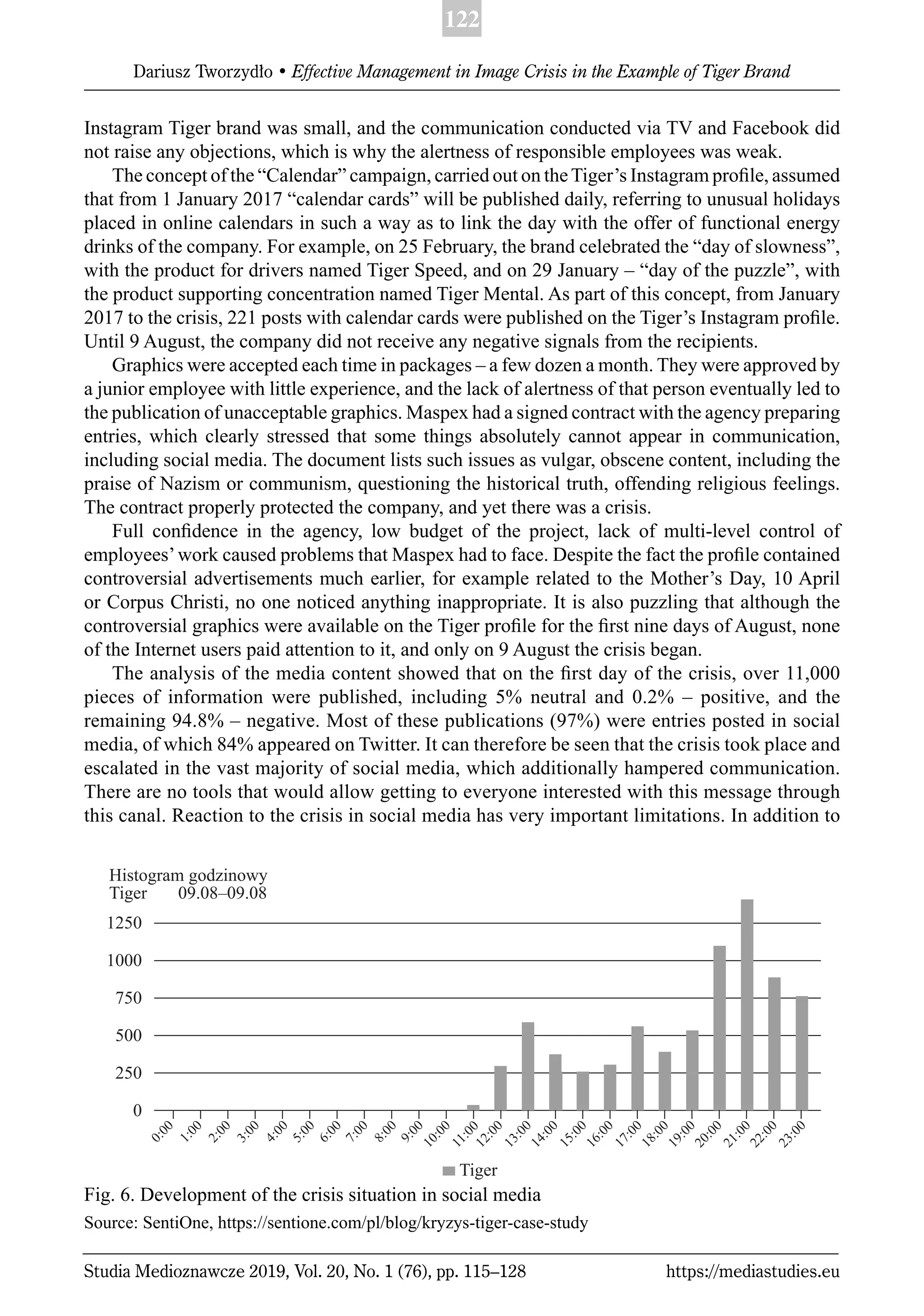
The analysis of the media content showed that on the first day of the crisis, over 11,000
pieces of information were published, including 5% neutral and 0.2% – positive, and the
remaining 94.8% – negative. Most of these publications (97%) were entries posted in social
media, of which 84% appeared on Twitter. It can therefore be seen that the crisis took place and
escalated in the vast majority of social media, which additionally hampered communication.
There are no tools that would allow getting to everyone interested with this message through
this canal. Reaction to the crisis in social media has very important limitations. In addition to
Fig. 6. Development of the crisis situation in social media
Source: SentiOne, https://sentione.com/pl/blog/kryzys-tiger-case-study
1250
1000
750
500
250
0
Tiger
Histogram godzinowy
Tiger 09.08–09.08
0
:
0
0
1
:
0
0
2
:
0
0
3
:
0
0
4
:
0
0
5
:
0
0
6
:
0
0
7
:
0
0
8
:
0
0
9
:
0
0
1
0
:
0
0
1
1
:
0
0
1
2
:
0
0
1
3
:
0
0
1
4
:
0
0
1
5
:
0
0
1
6
:
0
0
1
7
:
0
0
1
8
:
0
0
1
9
:
0
0
2
0
:
0
0
2
1
:
0
0
2
2
:
0
0
2
3
:
0
0
123
Dariusz Tworzydło • Effective Management in Image Crisis in the Example of Tiger Brand
Studia Medioznawcze 2019, Vol. 20, No. 1 (76), pp. 115–128 https://mediastudies.eu
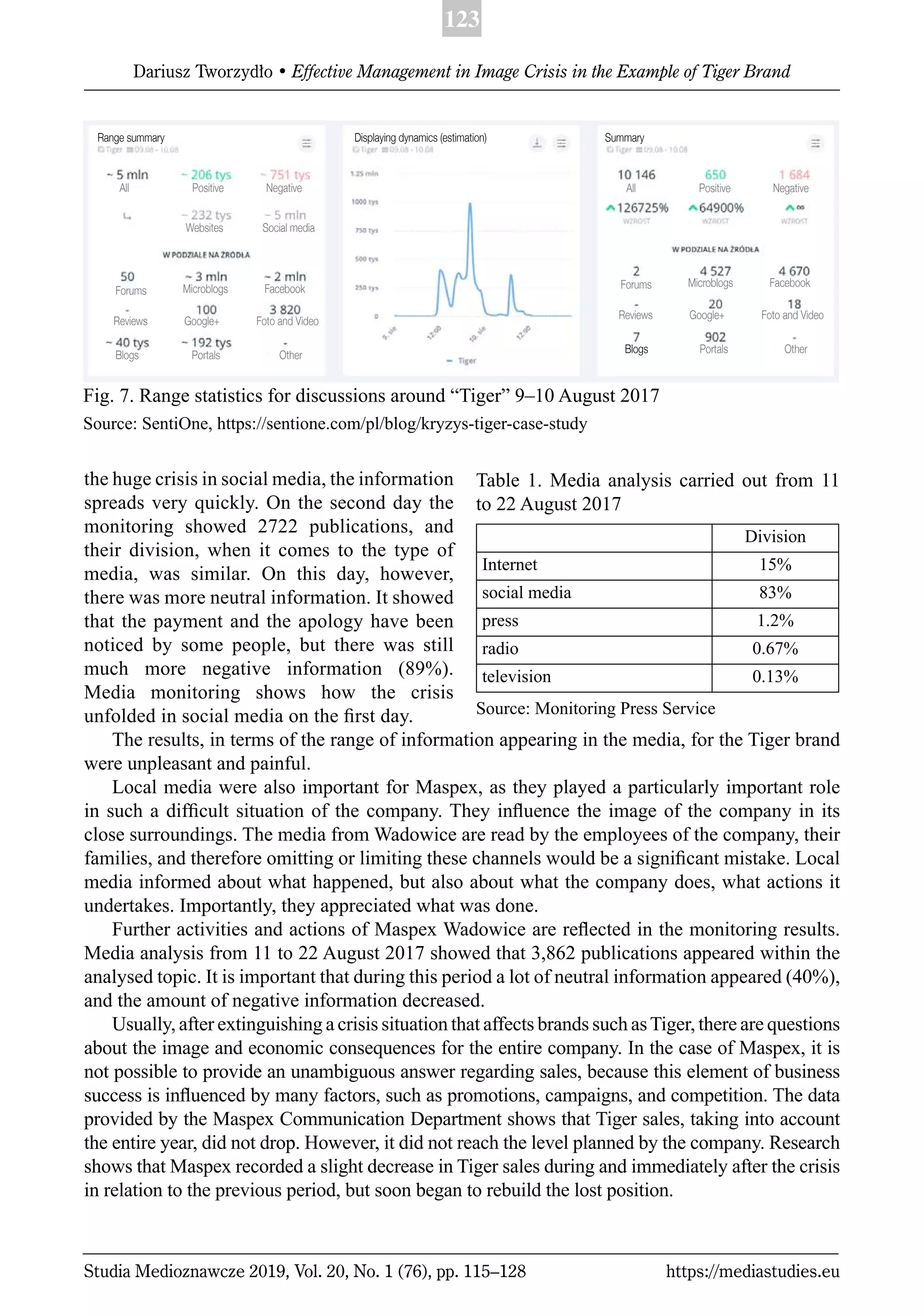
the huge crisis in social media, the information
spreads very quickly. On the second day the
monitoring showed 2722 publications, and
their division, when it comes to the type of
media, was similar. On this day, however,
there was more neutral information. It showed
that the payment and the apology have been
noticed by some people, but there was still
much more negative information (89%).
Media monitoring shows how the crisis
unfolded in social media on the first day.
The results, in terms of the range of information appearing in the media, for the Tiger brand
were unpleasant and painful.
Local media were also important for Maspex, as they played a particularly important role
in such a difficult situation of the company. They influence the image of the company in its
close surroundings. The media from Wadowice are read by the employees of the company, their
families, and therefore omitting or limiting these channels would be a significant mistake. Local
media informed about what happened, but also about what the company does, what actions it
undertakes. Importantly, they appreciated what was done.
Further activities and actions of Maspex Wadowice are reflected in the monitoring results.
Media analysis from 11 to 22 August 2017 showed that 3,862 publications appeared within the
analysed topic. It is important that during this period a lot of neutral information appeared (40%),
and the amount of negative information decreased.
Usually, after extinguishing a crisis situation that affects brands such asTiger, there are questions
about the image and economic consequences for the entire company. In the case of Maspex, it is
not possible to provide an unambiguous answer regarding sales, because this element of business
success is influenced by many factors, such as promotions, campaigns, and competition. The data
provided by the Maspex Communication Department shows that Tiger sales, taking into account
the entire year, did not drop. However, it did not reach the level planned by the company. Research
shows that Maspex recorded a slight decrease in Tiger sales during and immediately after the crisis
in relation to the previous period, but soon began to rebuild the lost position.
Fig. 7. Range statistics for discussions around “Tiger” 9–10 August 2017
Source: SentiOne, https://sentione.com/pl/blog/kryzys-tiger-case-study
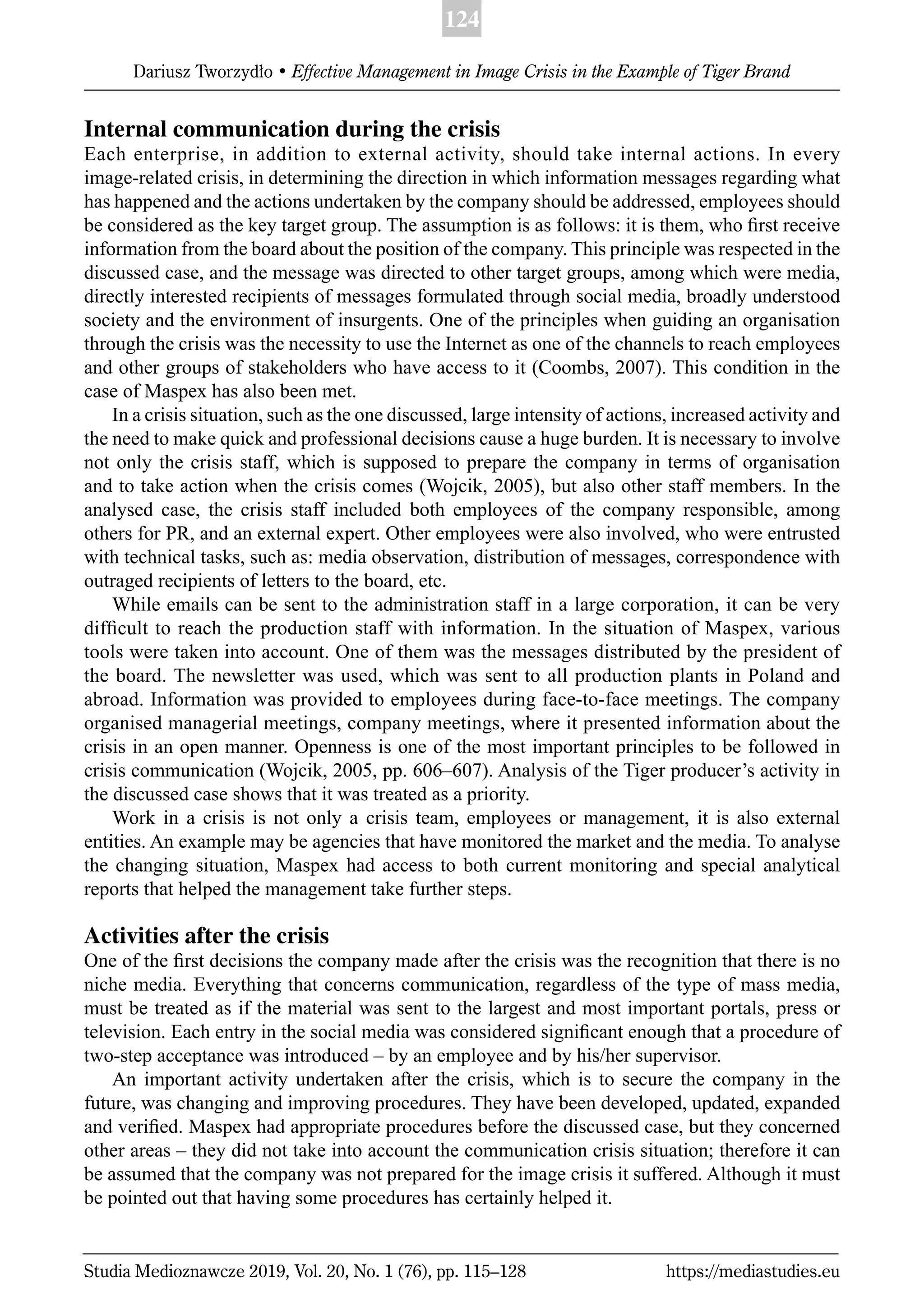
Table 1. Media analysis carried out from 11
to 22 August 2017
Division
Internet 15%
social media 83%
press 1.2%
radio 0.67%
television 0.13%
Source: Monitoring Press Service
Range summary
All All
Forums
Forums
Reviews
Reviews
Blogs
Blogs
Portals
Portals
Other
Other
Positive Positive
Websites
Foto and Video
Foto and Video
Microblogs
Microblogs
Google+
Google+
Facebook
Facebook
Social media
Negative Negative
Displaying dynamics (estimation) Summary
124
Dariusz Tworzydło • Effective Management in Image Crisis in the Example of Tiger Brand
Studia Medioznawcze 2019, Vol. 20, No. 1 (76), pp. 115–128 https://mediastudies.eu
Internal communication during the crisis
Each enterprise, in addition to external activity, should take internal actions. In every
image-related crisis, in determining the direction in which information messages regarding what
has happened and the actions undertaken by the company should be addressed, employees should
be considered as the key target group. The assumption is as follows: it is them, who first receive
information from the board about the position of the company. This principle was respected in the
discussed case, and the message was directed to other target groups, among which were media,
directly interested recipients of messages formulated through social media, broadly understood
society and the environment of insurgents. One of the principles when guiding an organisation
through the crisis was the necessity to use the Internet as one of the channels to reach employees
and other groups of stakeholders who have access to it (Coombs, 2007). This condition in the
case of Maspex has also been met.
In a crisis situation, such as the one discussed, large intensity of actions, increased activity and
the need to make quick and professional decisions cause a huge burden. It is necessary to involve
not only the crisis staff, which is supposed to prepare the company in terms of organisation
and to take action when the crisis comes (Wojcik, 2005), but also other staff members. In the
analysed case, the crisis staff included both employees of the company responsible, among
others for PR, and an external expert. Other employees were also involved, who were entrusted
with technical tasks, such as: media observation, distribution of messages, correspondence with
outraged recipients of letters to the board, etc.
While emails can be sent to the administration staff in a large corporation, it can be very
difficult to reach the production staff with information. In the situation of Maspex, various
tools were taken into account. One of them was the messages distributed by the president of
the board. The newsletter was used, which was sent to all production plants in Poland and
abroad. Information was provided to employees during face-to-face meetings. The company
organised managerial meetings, company meetings, where it presented information about the
crisis in an open manner. Openness is one of the most important principles to be followed in
crisis communication (Wojcik, 2005, pp. 606–607). Analysis of the Tiger producer’s activity in
the discussed case shows that it was treated as a priority.
Work in a crisis is not only a crisis team, employees or management, it is also external
entities. An example may be agencies that have monitored the market and the media. To analyse
the changing situation, Maspex had access to both current monitoring and special analytical
reports that helped the management take further steps.
Activities after the crisis
One of the first decisions the company made after the crisis was the recognition that there is no
niche media. Everything that concerns communication, regardless of the type of mass media,
must be treated as if the material was sent to the largest and most important portals, press or
television. Each entry in the social media was considered significant enough that a procedure of
two-step acceptance was introduced – by an employee and by his/her supervisor.
An important activity undertaken after the crisis, which is to secure the company in the
future, was changing and improving procedures. They have been developed, updated, expanded
and verified. Maspex had appropriate procedures before the discussed case, but they concerned
other areas – they did not take into account the communication crisis situation; therefore it can
be assumed that the company was not prepared for the image crisis it suffered. Although it must
be pointed out that having some procedures has certainly helped it.
125
Dariusz Tworzydło • Effective Management in Image Crisis in the Example of Tiger Brand
Studia Medioznawcze 2019, Vol. 20, No. 1 (76), pp. 115–128 https://mediastudies.eu
Usually after the crisis, activities are undertaken to help reconstruct the strained image.
Maspex decided to implement intensive post-crisis activities closely related to the topic that
was called on 9 August 2017. The company has prepared the program “Umbrella of history –
memory of ‘44”. As part of the information activities, 380 publications were obtained, of which
80% was positive.
The social project “Umbrella of history – memory of ‘44” is based on two pillars. The first
is the educational part, the second is to help the living insurgents. The initiative is guided by
the mission of protecting people and past events from being forgotten. Thanks to a wide range
of activities, the program initiated by Maspex Wadowice will be implemented on many levels.
The company assumed that each of its activities in the context of the August crisis is to be
perceived positively (Tiger płaci…, 2017)
. The program is also an effect of the commitments that
the company made in August 2017.
Maspex has signed a contract with the Warsaw Uprising Museum for educational activities
and as part of the plan to conduct an educational campaign in the largest Polish media. A year after
the crisis, the company intends to publish reports on the Warsaw Uprising in the most important
Polish media. Journalists will prepare a series of texts that will remind about the heroism and
tragedy of the insurgents. In addition, the company decided to support the creation of plaques
placed in various districts of the capital, whose purpose is to commemorate the victims of the
Warsaw Uprising and places associated with this event. Company’s contribution consisted in
funding plaques with texts in English. In the first place, it was planned to mount forty-four plaques
in places frequently visited by tourists. Educational activities will also include supporting the
production of the film under the working title “Kurier” [Courier], initiated and originated by
the Warsaw Uprising Museum.
As part of the help to the living insurgents, Maspex plans to re-join the “Help for the
Insurgents” campaign organised by the World Association of Home Army Soldiers in the next
two years. The company intends to continue to support the Foundation for Aid for Soldiers of the
Home Army of Brigadier General Leopold Okulicki, alias “Niedźwiadek”, which runs the only
specialist clinic in Poland that provides medical assistance for World War II veterans, victims of
repression and their families.
As part of the help for living insurgents, the company also planned to support the activities
carried out by Filip Chajzer. At Christmas, as part of the “Parcel for the Hero” campaign, it handed
over seven tons of products to 930 insurgents and intends to continue providing such aid. In addition
to external activity, internal activities were also undertaken. As part of volunteering, employees
that took care of Tiger brand packed and delivered the parcels. In Kraków and Wrocław they also
cleaned the graves of the insurgents.
Post-crisis activities are a tedious process of rebuilding public trust and drawing conclusions
(Szymańska, 2004, pp. 293–294). With this in mind, on 12 March 2018 Maspex launched a new
advertisement for Tiger. The spot shows people who, despite their failures, still pursue the goal.
It was the company’s first large activity in more than half a year, which recognised that it would
be a good idea to inform about the right to make a mistake.
The company came to the conclusion that it will not use the Instagram and Twitter account
for this particular brand. It was considered appropriate to limit to the Facebook profile, through
which the company intends to support the campaign on television. The fact is that after the crisis,
Maspex did not stop publishing on FB, but it took time to prepare a new communication line for
the Tiger brand.
Although the precise provisions included in the contract with agency theoretically protected
the company from similar situations and could give a sense of comfort and security, there still was
126
Dariusz Tworzydło • Effective Management in Image Crisis in the Example of Tiger Brand
Studia Medioznawcze 2019, Vol. 20, No. 1 (76), pp. 115–128 https://mediastudies.eu
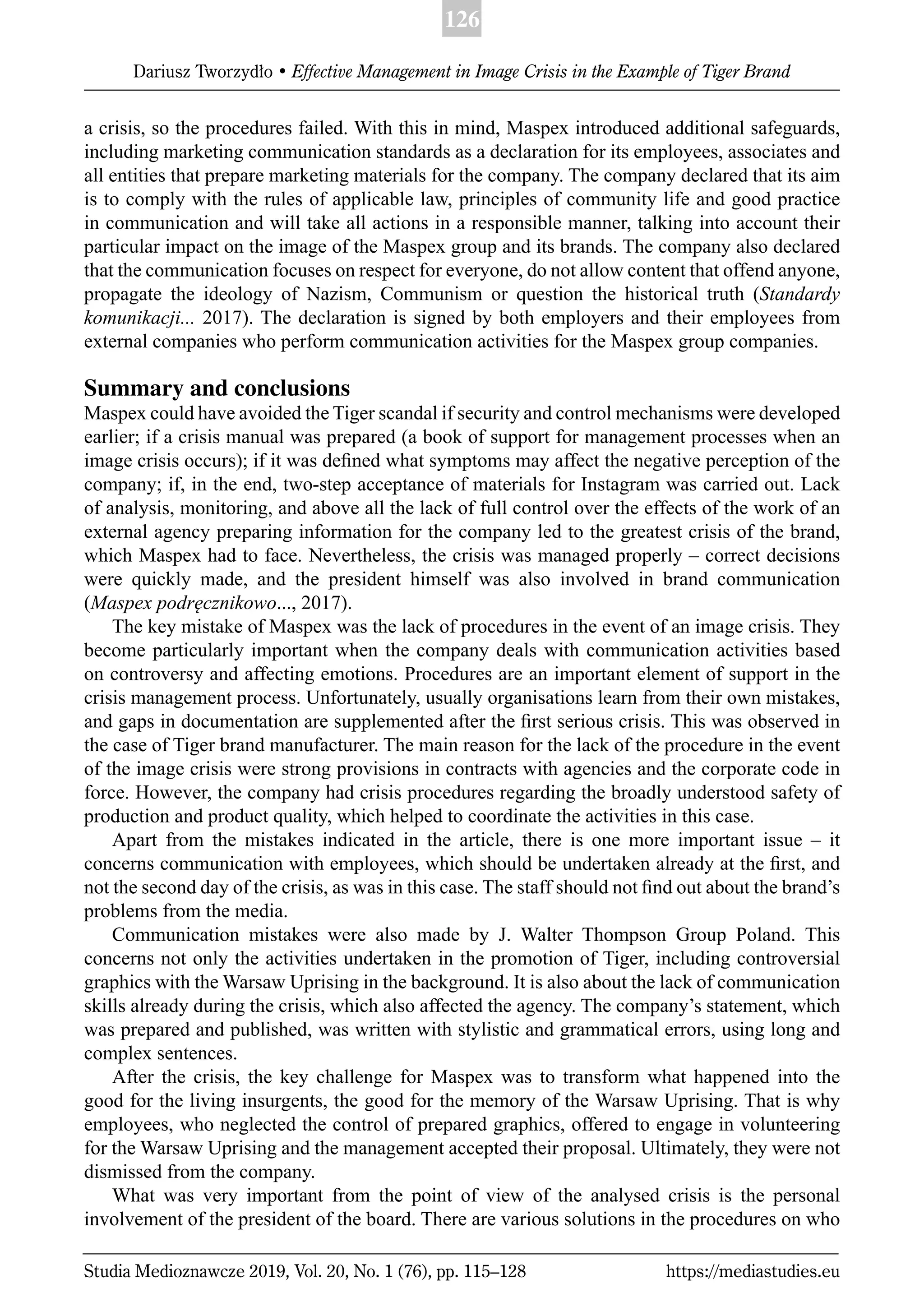
a crisis, so the procedures failed. With this in mind, Maspex introduced additional safeguards,
including marketing communication standards as a declaration for its employees, associates and
all entities that prepare marketing materials for the company. The company declared that its aim
is to comply with the rules of applicable law, principles of community life and good practice
in communication and will take all actions in a responsible manner, talking into account their
particular impact on the image of the Maspex group and its brands. The company also declared
that the communication focuses on respect for everyone, do not allow content that offend anyone,
propagate the ideology of Nazism, Communism or question the historical truth (Standardy
komunikacji... 2017). The declaration is signed by both employers and their employees from
external companies who perform communication activities for the Maspex group companies.
Summary and conclusions
Maspex could have avoided the Tiger scandal if security and control mechanisms were developed
earlier; if a crisis manual was prepared (a book of support for management processes when an
image crisis occurs); if it was defined what symptoms may affect the negative perception of the
company; if, in the end, two-step acceptance of materials for Instagram was carried out. Lack
of analysis, monitoring, and above all the lack of full control over the effects of the work of an
external agency preparing information for the company led to the greatest crisis of the brand,
which Maspex had to face. Nevertheless, the crisis was managed properly – correct decisions
were quickly made, and the president himself was also involved in brand communication
(Maspex podręcznikowo..., 2017).
The key mistake of Maspex was the lack of procedures in the event of an image crisis. They
become particularly important when the company deals with communication activities based
on controversy and affecting emotions. Procedures are an important element of support in the
crisis management process. Unfortunately, usually organisations learn from their own mistakes,
and gaps in documentation are supplemented after the first serious crisis. This was observed in
the case of Tiger brand manufacturer. The main reason for the lack of the procedure in the event
of the image crisis were strong provisions in contracts with agencies and the corporate code in
force. However, the company had crisis procedures regarding the broadly understood safety of
production and product quality, which helped to coordinate the activities in this case.
Apart from the mistakes indicated in the article, there is one more important issue – it
concerns communication with employees, which should be undertaken already at the first, and
not the second day of the crisis, as was in this case. The staff should not find out about the brand’s
problems from the media.
Communication mistakes were also made by J. Walter Thompson Group Poland. This
concerns not only the activities undertaken in the promotion of Tiger, including controversial
graphics with the Warsaw Uprising in the background. It is also about the lack of communication
skills already during the crisis, which also affected the agency. The company’s statement, which
was prepared and published, was written with stylistic and grammatical errors, using long and
complex sentences.
After the crisis, the key challenge for Maspex was to transform what happened into the
good for the living insurgents, the good for the memory of the Warsaw Uprising. That is why
employees, who neglected the control of prepared graphics, offered to engage in volunteering
for the Warsaw Uprising and the management accepted their proposal. Ultimately, they were not
dismissed from the company.
What was very important from the point of view of the analysed crisis is the personal
involvement of the president of the board. There are various solutions in the procedures on who
127
Dariusz Tworzydło • Effective Management in Image Crisis in the Example of Tiger Brand
Studia Medioznawcze 2019, Vol. 20, No. 1 (76), pp. 115–128 https://mediastudies.eu
should take on the burden of communication. Sometimes it is unequivocally suggested that the
management should be protected, while e.g. spokesperson is responsible for contacts in difficult
situations. At Maspex, already on the first day it was recognised that crisis that affected the Tiger
brand, and thus the entire capital group, is serious and requires committing all resources available
to the company. In addition, President Pawiński personally joined in the communication, which
was one of the most important factors supporting the process of recovering from the crisis.
References
Benoit, W. L. (1997). Image Repair Discourse and Crisis Communication. Public Relations Review, no. 23.
Benoit, W. L., & McHale, J. P. (1999). Kenneth Star’s Image Repair Discourse Viewed in 20/20. Commu-
nication Quarterly, no. 47.
Coombs, T., & Schmidt, L. (2000). An Empirical Analysis of Image Restoration: Texaco’s Racism Crisis.
Journal of Public Relations Research, no. 12.
Dąbrowska, J. (2017). Maspex podręcznikowo działał w kryzysie wizerunkowym Tigera, marka odbuduje
reputację [Maspex’s textbook actions in the Tiger’s image crisis, the brand will restore its reputation].
Retrieved on 17 September 2018 from http://www.wirtualnemedia.pl/artykul/maspex-kryzys-wize-
runkowy-tiger-jakie-dzialania-marka-odbuduje-reputacje
Institute for Public Relations. (2018). Crisis Management and Communications. Retrieved on 17 Septem-
ber 2018 from https://instituteforpr.org/crisis-management-and-communications
Kaczmarek-Śliwińska, M. (2015). Public relations w zarządzaniu sytuacjami kryzysowymi organizacji.
Sztuka komunikowania się. [Public relations in managing the crisis situations of the organisation. The
art of communication]. Warszawa: Wydawnictwo Difin.
Kryzys Tigera w social mediach – na co nie może pozwalać sobie marka? [Tiger crisis in social media
– what can a brand afford?] (b.d). Retrieved on 17 September 2018 from https://www.ltb.pl/kryzys-
tigera-w-social-mediach-na-co-nie-moze-pozwalac-sobie-marka/
Maspex. (2017). Standardy komunikacji marketingowej [Marketing communication standards] Retrieved
on 17 September 2018 from https://maspex.com/csr,standardy-komunikacji-marketingowej
Meyers, A. (2009). Crisis Communication and Image Repair Strategies: Audience Attitude and Perceptions
of Toyota in an Online Environment. Valdosta: Valdosta State University.
Rzeczpospolita. (2017). Tiger płaci za kontrowersje [Tiger pays for controversy]. Retrieved on 17 Septem-
ber 2018 from http://www.rp.pl/Sylwetki/308159947-Tiger-placi-za-kontrowersje
Schultz, F., Utz, S., & Göritz,A. (2011). Is the Medium the Message? Perceptions of and Reactions to Crisis
Communication via Twitter, Blogs and Traditional Media. Public Relations Review, no. 37.
Seeger, M. W., Sellnow, T. L., & Ulmer, R. R. (1998). Communication, Organization, and Crisis. Annals of
the International Communication Association, no. 21.
Seitel, F. (2003). Public relations w praktyce [Public relations in practice]. Warszawa: Wydawnictwo Fel-
berg.
Sprzedaż Tigera wzrosła po kryzysie wizerunkowym [Sales of Tiger increased after the image crisis] (b.d).
Retrieved on 17 September 2018 from http://www.wirtualnemedia.pl/artykul/sprzedaz-tigera-wzrosla-
po-kryzysie-wizerunkowym
Szczęsny, J. (2017). Tiger, Żytnia i inni – po co robi się szambo w social media? [Tiger Żytnia and others
- why do they need a social media crisis?] Retrieved on 17 September 2018 from http://antyweb.pl/
tiger-zytnia-kryzysy-social-media
Szymańska, A. (2004). Public relations w systemie zintegrowanej komunikacji marketingowej [Public rela-
tions in the system of integrated marketing communications]. Warszawa: Wydawnictwo Unimex.
Tworzydło, D., Łaszyn, A., & Szuba, P. (2018). Zarządzanie kryzysem w polskich przedsiębiorstwach. Pod-
sumowanie 10 lat badań nad kryzysami [Crisis management in Polish companies. Summary of 10 years
of crisis studies]. Rzeszów: Wydawnictwo Newsline.
Tworzydło, D. (2017). Public relations praktycznie [Public relations in practice]. Rzeszów: Wydawnictwo
Newsline.
128
Dariusz Tworzydło • Effective Management in Image Crisis in the Example of Tiger Brand
Studia Medioznawcze 2019, Vol. 20, No. 1 (76), pp. 115–128 https://mediastudies.eu
Wprost. (2017). Zalew wulgaryzmów na Instagramie Tigera. Internauci wściekli o 1 sierpnia [Flood of
curses on Tiger’s Instagram. Internet users furious about 1 August]. Retrieved on 17 September 2018
from https://www.wprost.pl/zycie/10069461/zalew-wulgaryzmow-na-instagramie-tigera-internauci-
wsciekli-o-1-sierpnia.html
Wojcik, K. (2005). Public relations. Wiarygodny dialog z otoczeniem [Credible dialogue with the en-
vironment]. Warszawa: Wydawnictwo Placet.

Effective Management in Image Crisis in the Example of Tiger Brand.pdf

  • 1.
    2019, Vol. 20,No. 1 (76) ISSN 2451-1617 Effective Management in Image Crisis in the Example of Tiger Brand Dariusz Tworzydło University of Warsaw dariusz@tworzydlo.pl ORCID: 0000-0001-6396-6927 ABSTRACT The article contains an analysis of Tiger’s brand image during the crisis in 2017. Scientific objective: To evaluate the effectiveness of crisis communication activities of the studied company. Research methods: Analysis of materials obtained from media monitoring, as well as desk research from the analyzed company. Results and conclusions: The study shows the response methods and actions taken by the company in the analyzed crisis. The key determinants of the crisis were indicated as well as the factors that contributed to the proper resolution of the crisis situation. One of the essential components of the paper is also the analysis of actions taken by the company after the end of the crisis. The mistakes made by the company in the field of crisis management have also been described. Cognitive value: The paper contains a consistent description of crisis events that affected the brand, provides an objective look at the image crisis, along with the assessment of the methods and tools used. KEYWORDS crisis, crisis management, image, Maspex/Tiger, public relations
  • 2.
    116 Dariusz Tworzydło •Effective Management in Image Crisis in the Example of Tiger Brand Studia Medioznawcze 2019, Vol. 20, No. 1 (76), pp. 115–128 https://mediastudies.eu The literature on the subject defines the concept of image crisis in a differentiated and at the same time quite coherent way. It is understood as specific and unexpected event (or series of events) that causes a high level of uncertainty and threatens or is perceived as a threat to the achievement of key organisational goals (Seeger, Sellnow, & Ulmer, 1998, pp. 231–276), and in addition, it harms the image of the business entity (Coombs & Schmidt, 2000, pp. 163–178). It can lead to thre e related risks that concern public safety, financial loss and loss of reputation. Some emergency situations, such as work-related accidents or the delivery of harmful products to the market, can cause physical injuries and even contribute to death of a consumer. Others interfere with the smooth operation of the company, result in losses of market share or affect the withdrawal of consumers from the purchase decision. There are also situations that end in lawsuits. A badly managed crisis may damage the reputation of the entity concerned. All these factors are closely related. Work accidents can result in financial losses and loss of reputation that significantly affect the stability of the business entity (Coombs, 2007). Although in crisis situations it is more likely to find negative effects, it should be borne in mind that crises may also have a positive impact on the organisation. However, this will only occur if the corrective actions are carried out professionally and quickly. Properly implemented crisis management is one of the key elements of the organisation’s effective achievement of goals. Failure of the activities undertaken in the field of image-related crisis may result in damage to stakeholders, losses (also financial) of the organisation or, ultimately, contribute to its collapse (Coombs, 2007). Costs of the crisis are considered in both financial and image terms. They affect the areas of internal and external image. They reflect on sales, but also on the reputation of the entity affected by the crisis. Crisis management is even more important, as it prevents or marginalizes these negative effects. The crisis situation analysed in the article touched one of the largest Polish producers in the food industry, Maspex in Wadowice. Its portfolio includes several dozen brands and several thousand items. In the area of almost every brand, the company undertakes marketing activities using most of available communication tools in all channels. It uses the so-called 360-degree communication, which means that it is present in every possible medium. It orders the broadcast of TV commercials, conducts outdoor and internet campaigns, implements a number of BTL activities, such as events, festivals. Added to this is extensive activity in social media (Facebook, Instagram, Twitter, Snapchat and YouTube). The entity also runs several hundred commercial promotions. The described crisis situation, which affected the Tiger brand, is the result of many factors that will be analysed and evaluated in detail. The article was based on the study of source materials obtained from media monitoring, data obtained at Maspex Wadowice, such as press releases and presentations, and IDI interview with the vice president of the management board. The analysis was carried out from 8 April to 13 June 2018. The aim of the article was to evaluate the effectiveness of communication activities of the examined entity in the field of crisis communication. The research hypothesis was put in the following way: Maspex Wadowice carried out internal and external actions during the crisis that affected the Tiger brand effectively and safely for long-term image building. Responding to a crisis situation Benoit identifies five categories of response strategies in the field of image defence: 1. Denial. 2. Avoiding responsibility.
  • 3.
    117 Dariusz Tworzydło •Effective Management in Image Crisis in the Example of Tiger Brand Studia Medioznawcze 2019, Vol. 20, No. 1 (76), pp. 115–128 https://mediastudies.eu 3. Reducing offensiveness. 4. Corrective actions. 5. Mortification. Ad. 1. Denial comes in various forms: one of them is to shift blame, while rejecting accusations regarding mistakes or omissions. The company indicates that it did not commit the alleged offence. Shifting blame occurs when an entity affected by the crisis says that a third person committed or caused the action (Benoit & McHalle, 1999, pp. 265–280). Ad. 2. Avoiding responsibility can take four forms: • provocation • defeasibility • accident • good intention In the case of provocation, the organisation claims that its action was a response to another offensive act. Failure occurs when people within the organisation conclude that they had insufficient/no information or that they were unable to control the events caused by the act of crisis. The accident assumes that the mistake occurred unintentionally and was uncontrolled by the organisation. Finally, mistakes made in good intention suggest that the organisation did not intend to allow them (Benoit & McHalle, 1999, pp. 265–280). Ad. 3. Limiting the effects of an event is the third main strategy for image repair. Benoit distinguishes several types here. The first assumes an increase in positive emotions that the public experiences in relation to the organisation. It is an attempt to disperse negative feelings. The second, called minimization, takes place when the entity accused of being responsible for some act attempts to reduce the perceived damage. The third type of mitigation strategy – transcendence – is an attempt to situate the event in a more favourable context in order to improve the image. Attacking the accuser – the fourth type – takes place when an attack on his credibility is provoked. Finally, the fifth type – compensation – is the remuneration for the victim, which is also to reduce the primary negative effects of the company’s problem (Benoit, 1997, pp. 177–187). Ad. 4. Corrective actions – the fourth category of strategy – consist in repairing damage or taking steps to prevent similar events in the future. Both types can occur together or separately. Ad 5. The final type of crisis response strategy is confession and repentance. The organisation hopes for the understanding of the stakeholders (Meyers, 2009). It should also be pointed out that effective crisis management is based on a number of principles and a variety of procedures. The point here is, among other things, the procedures for the circulation of information during the crisis; reacting when the crisis comes; information management in the network, as well as media monitoring or communication with individual stakeholder groups (employees, local communities, media). An appropriate solution in the field of preparing for a crisis situation is creating schemes and procedures in the event of image crises. However, many entities do not have such documents, which forces the use of rules and principles that have been developed by the environment or for other entities. Schemes used during difficult events are usually similar, and communication is one of the most important issues. It is assumed that it should be parallel in two areas: • internal • external. It is necessary to determine what kind of key target groups we are dealing with, because it is them who is mainly interested in what is happening around the brand. Among the target groups that should be within the range of interest of a company affected by the crisis, there are
  • 4.
    118 Dariusz Tworzydło •Effective Management in Image Crisis in the Example of Tiger Brand Studia Medioznawcze 2019, Vol. 20, No. 1 (76), pp. 115–128 https://mediastudies.eu primarily: employees, management, investors/shareholders, media, local environment, more or less organised interest groups, experts, intervention services. These groups can also be divided into: entities directly affected by the crisis; those who are interested in the situation of directly concerned; special groups that can influence the crisis situation to a greater or lesser extent (Wojcik, 2005, pp. 381–382). Communication activities based on the mentioned schemes are addressed to individual groups. In a crisis situation, it is also reasonable to anticipate – put yourself in the position of a party affected by the crisis, and to define what it would like to hear at a given moment. Enterprises do not always have sufficient procedures, complete and tailored to the given situation, developed response scenarios including identification of potential directions in which crisis situations may go, and above all they are not able to fully prepare for what will come. This was the case with Maspex, which in 2017 experienced the largest image crisis in its history. In addition, appropriate preparation is particularly important in the case of companies operating in industries susceptible to crises (Tworzydło, Łaszyn, & Szuba, 2018, p. 19), and the analysed entity operates in such areas. The crisis of Maspex occurred due to activities carried out through social media. Nowadays, they are becoming one of the fastest generators of problem situations in terms of image. One simple click triggers an avalanche of events (Schultz, Utz, & Göritz, 2011, p. 22), which is difficult to stop. It must be remembered, however, that even with well-designed procedures, model statements and answers to potentially difficult questions, the company cannot be completely protected against potential crises, because they are events that cannot be fully predicted. Nonetheless, activities such as media monitoring, analysis of the situation and potential symptoms of the crisis are important in managing the image, both in the strategic and operational range. Proper preparation is necessary because it is an incentive to constantly improve yourself, your company and procedures. Initiation of a crisis situation This crisis began on 9 August 2017 on Twitter, when Dagmara Pakulska published an entry with a post from the Tiger account on Instagram, in which she stated: „I think the line has been crossed....“ It turned out that the agency serving Maspex on the day of the anniversary of the outbreak of the Warsaw Uprising published a graphics in the social media, on which the dominant element was an erect middle finger tied with a red bow. This gesture is generally considered vulgar. The Tiger Energy Drink Instagram profile also included the slogan: Fig. 1. Post that started the first image crisis Source: Twitter
  • 5.
    119 Dariusz Tworzydło •Effective Management in Image Crisis in the Example of Tiger Brand Studia Medioznawcze 2019, Vol. 20, No. 1 (76), pp. 115–128 https://mediastudies.eu 1 August. Remembrance day. Screw the past – what comes matters. In the description of the picture, we found a hashtag frequently used by the brand – #rozpierdol. At 11.30 AM the first journalists, including representatives of Polsat News, started calling the Maspex Communication Department. Unreasonable agency operation was the basis for the most serious crisis situation of Maspex Wadowice. A single post has become the main cause of the crisis. Usually, crisis situations erupt immediately after the emergence of such serious factors as in this case. The crisis in Maspex exploded relatively late, due to the fact that people who felt offended by Tiger’s activity were outside the main target group of the brand and rarely browsed its profiles in social media. Regular recipients perceived the entry from 1 August neutrally or even positively (Kryzys Tigera..., 2017), which proves the very high coherence of the group in terms of receiving messages prepared by the agency operating the Tiger profile. The example shows how important it is to identify target groups. Based on the fact that only eight days after the publication the first critical post was published, it is easy to deduce why the agency has previously already taken action on the edge of decency or just risky from the image point of view. This is not only about the lack of control, which can be considered as another reason for the emergence of a crisis (it will be mentioned later in the article), but also about the acceptance of content and graphics by recipients. Alertness of both sides was poor due to the lack of symptoms of the upcoming crisis. The post that initiated the largest image crisis of the Maspex referred directly to the graphics published on the account of the Tiger brand, and this in turn triggered an avalanche of subsequent events, which were a surprise to all sides of the crisis. Elements of support in the crisis management procedure Surprise is a natural element of most crisis situations. Regardless of whether the organisation is prepared or not, whether it is aware of potential crises, usually the very moment of occurrence of the problem is a surprise (Kaczmarek-Śliwińska, 2015, p. 69). Among other things, the speed of response matters in image crisis situations. Coombs even claims that the first message should be released one hour after the crisis appears (Coombs, 2007). Efficiency in the transmission of information allows to limit rumours and favours the easing of moods (Seitel, 2003, p. 232). It is one of the key management components, an obligatory point in every procedure, because Fig. 2. Apology of Maspex Wado- wice Source: Twitter Fig. 3. Post of Filip Chajzer regarding the Tiger brand post Source: Twitter Regarding the post (energy drink advertising) which you are sending from the very morning. I know very well that this stupid f ... are just about fame, clicks on the instagram and increasing the range. I also know that they are just waiting for me to give it to them by sharing this shit. No way. You employ people with a stool instead of the brain, and people can get cancer from your drink. First, eye cancer when looking at your shitty ad, and then cancer of the whole body guaranteed. I do not know how much you would have to pay to the 2017 Insurgents Charity Fund Crisis for anyone to forgive you. Here is the data for your repentance. The account of the World Association of Home Army Soldiers - 50 1750 0012 0000 0000 3760 9692 Reiffeisen Bank Polski, enter „Collection for Insurgents 2017” in the title. WE ARE EXTREMELY SORRY ABOUT THE PUBLICATION OF THE GRAPHICS THAT APPEARED ON 1 AUGUST ON INSTAGRAM PROFILE OF THE BRAND. WE ARE VERY SORRY FOR THIS ERROR, WHICH SHOULD NOT HAPPEN, WE KNOW THAT REMOVING THIS PUBLICATION WILL NOT FIX THIS ERROR, BUT THE POST HAS ALREADY BEEN REMOVED. ONCE AGAIN, WE SINCERELY APOLOGIZE.
  • 6.
    120 Dariusz Tworzydło •Effective Management in Image Crisis in the Example of Tiger Brand Studia Medioznawcze 2019, Vol. 20, No. 1 (76), pp. 115–128 https://mediastudies.eu the first symptoms of a crisis situation force response and concrete actions (Tworzydło, 2017, p. 194). Analysing the above aspect, it should be noted that on 9 August 2017 at 12.15, or three quarters after the first symptom of the crisis, the factor that triggered an avalanche of events, Maspex – firstly – issued a statement to the media in which it apologised for the situation, and secondly – removed entries that have caused the crisis. Unfortunately, it was impossible to delete all posts in the first phase. Especially those from the website were the basis for people who learned about the entry, but could no longer reach the deleted data. This example shows how real is the popular saying that anything published on the Internet stays forever (Zalew wulgaryzmów…, 2017). Finally, in the framework of communication activities that revolved around the Tiger brand and activity of Maspex, all entries were removed from Tiger’s Instagram. There was also a post informing about the deletion of the entire profile (Kryzys Tigera…, 2017). Maspex quickly apologised on the Tiger brand profiles in other social media. This is in line with the 5P rule in crisis management. The author of this concept – Adam Łaszyn – indicates that in a crisis situation one should first express botheration, and in the next steps prepare, counteract, improve and make up (Tworzydło, 2017, p. 184). Seeing the scale of the problem, observing extremely serious and strong accusations on the web about contempt for insurgents, ignorance, lack of sensitivity to the historical tragedy of the nation (Szczęsny, 2017), Krzysztof Pawiński – Maspex president of the board and co-owner of the company was personally involved in the crisis management. This is unusual for crisis situations, but in this case, it was necessary and justified to involve the owner himself. At 3:00 PM, he placed three tweets on his profile, in which he apologised for what had happened. At 5:00 PM the same day another information appeared, this time with a payment of PLN 500,000 for the benefit of living insurgents, to the account of the World Association of Home Army Soldiers. This move was inspired by the entry of journalist Filip Chajzer, which met with an intense and instant response from Internet users and journalists – 3,300 comments appeared on Facebook, along with 89,000 reactions, and 2,640 people shared the post. Chajzer, in a very vulgar and emotional way, referred to the situation related to graphics by J. Walter Thompson Group Poland. Chajzer, after receiving information from a representative of Maspex on payment to insurgents, posted another entry, expressing his positive surprise with the situation. The company also published a statement in which it spoke about payment for insurgents. However, information about an unfortunate event spreads very quickly, which is why a few hours later, and precisely after 8:00 PM, calls to boycott Tiger and other Maspex products began Fig. 4. Second post of Filip Chajzer regarding the Tiger brand post Source: Twitter
  • 7.
    121 Dariusz Tworzydło •Effective Management in Image Crisis in the Example of Tiger Brand Studia Medioznawcze 2019, Vol. 20, No. 1 (76), pp. 115–128 https://mediastudies.eu to appear. This happened with the participation of journalists. For example, Michał Rachoń from TVP, when live, demonstratively poured a can of Tiger. However, often, when someone calls for a boycott, the recipient of the message proceeds inversely, which was also observed in the case of the analysed brand (Sprzedaż Tigera…, 2017). On the second day of the crisis, the first interview by Krzysztof Stanowski with the president Krzysztof Pawiński was published at weszlo.pl (186,000 followers on Twitter). The company also issued a third statement, declaring that it discontinues the cooperation with the agency that prepared the criticised graphics. The contract with J. Walter Thompson Group Poland was terminated by Maspex on 11 August. The cooperation was abandoned not only in the field of handling Tiger, but also other brands (Maspex..., 2017). Changes also occurred in JWT. The agency reacted late and apologised. People responsible for the promotion of Tiger and the publication of controversial graphics were dismissed. Another active action taken by Maspex was the publication in newspapers of the following ad: “We apologise – Tiger beverage manufacturer.” They appeared in such media as: Rzeczpospolita, Gazeta Prawna, Puls Biznesu, Gazeta Wyborcza, Do Rzeczy, W Sieci, Salon24 and Newsweek. There was also an interview in “Rzeczpospolita”, in which the president of the board answered the journalist’s questions. It was the first interview that appeared in the printed press after the outbreak of the crisis. The analysis of media materials shows that the crisis was most sever on 9–10 August 2017. Later, the activity definitely decreased, which confirms the so-called news burnout principle. Nevertheless, the event was still commented on in the mass media. The second wave consisted in experts who spoke for individual media. Activities of the company were permanent. Answers were given to journalists’ questions, the company actively participated in communication, commented, did not avoid responsibility. Constant crisis monitoring was carried out – first every hour, with time this frequency was gradu- ally reduced. The crisis turned out to be a valuable experience for Maspex. It showed that control must be present at every stage of activities and in every area, not only in the sphere of production, in the quality department, but also in the sphere of communication with the internal and external environment. Analysis of selected aspects of brand communication One of the basic mistakes that were made not only during, but more before the emergence of a crisis situation, was for Maspex to ignore the need to conduct proper supervision over the communication processes in all media, not only the main ones. Practically, only one employee looked at entries published on the social profile by an external agency. The mere fact that there were no signals from consumers that would draw attention to improper communication additionally weakened the alertness of other team members responsible for the promotion of this brand. Lack of control, the consent generally granted for all proposed entries meant that JWT agency allowed itself more and more. The range on the Fig. 5. One of the posts within the “Calendar” campaign Source: Twitter 1. Put your whole hand on your desk! 2. Drop everything on the floor 3. Wait for the floor cleaning day 9 January DESK CLEANING DAY
  • 8.
    122 Dariusz Tworzydło •Effective Management in Image Crisis in the Example of Tiger Brand Studia Medioznawcze 2019, Vol. 20, No. 1 (76), pp. 115–128 https://mediastudies.eu Instagram Tiger brand was small, and the communication conducted via TV and Facebook did not raise any objections, which is why the alertness of responsible employees was weak. The concept of the “Calendar” campaign, carried out on theTiger’s Instagram profile, assumed that from 1 January 2017 “calendar cards” will be published daily, referring to unusual holidays placed in online calendars in such a way as to link the day with the offer of functional energy drinks of the company. For example, on 25 February, the brand celebrated the “day of slowness”, with the product for drivers named Tiger Speed, and on 29 January – “day of the puzzle”, with the product supporting concentration named Tiger Mental. As part of this concept, from January 2017 to the crisis, 221 posts with calendar cards were published on the Tiger’s Instagram profile. Until 9 August, the company did not receive any negative signals from the recipients. Graphics were accepted each time in packages – a few dozen a month. They were approved by a junior employee with little experience, and the lack of alertness of that person eventually led to the publication of unacceptable graphics. Maspex had a signed contract with the agency preparing entries, which clearly stressed that some things absolutely cannot appear in communication, including social media. The document lists such issues as vulgar, obscene content, including the praise of Nazism or communism, questioning the historical truth, offending religious feelings. The contract properly protected the company, and yet there was a crisis. Full confidence in the agency, low budget of the project, lack of multi-level control of employees’work caused problems that Maspex had to face. Despite the fact the profile contained controversial advertisements much earlier, for example related to the Mother’s Day, 10 April or Corpus Christi, no one noticed anything inappropriate. It is also puzzling that although the controversial graphics were available on the Tiger profile for the first nine days of August, none of the Internet users paid attention to it, and only on 9 August the crisis began. The analysis of the media content showed that on the first day of the crisis, over 11,000 pieces of information were published, including 5% neutral and 0.2% – positive, and the remaining 94.8% – negative. Most of these publications (97%) were entries posted in social media, of which 84% appeared on Twitter. It can therefore be seen that the crisis took place and escalated in the vast majority of social media, which additionally hampered communication. There are no tools that would allow getting to everyone interested with this message through this canal. Reaction to the crisis in social media has very important limitations. In addition to Fig. 6. Development of the crisis situation in social media Source: SentiOne, https://sentione.com/pl/blog/kryzys-tiger-case-study 1250 1000 750 500 250 0 Tiger Histogram godzinowy Tiger 09.08–09.08 0 : 0 0 1 : 0 0 2 : 0 0 3 : 0 0 4 : 0 0 5 : 0 0 6 : 0 0 7 : 0 0 8 : 0 0 9 : 0 0 1 0 : 0 0 1 1 : 0 0 1 2 : 0 0 1 3 : 0 0 1 4 : 0 0 1 5 : 0 0 1 6 : 0 0 1 7 : 0 0 1 8 : 0 0 1 9 : 0 0 2 0 : 0 0 2 1 : 0 0 2 2 : 0 0 2 3 : 0 0
  • 9.
    123 Dariusz Tworzydło •Effective Management in Image Crisis in the Example of Tiger Brand Studia Medioznawcze 2019, Vol. 20, No. 1 (76), pp. 115–128 https://mediastudies.eu the huge crisis in social media, the information spreads very quickly. On the second day the monitoring showed 2722 publications, and their division, when it comes to the type of media, was similar. On this day, however, there was more neutral information. It showed that the payment and the apology have been noticed by some people, but there was still much more negative information (89%). Media monitoring shows how the crisis unfolded in social media on the first day. The results, in terms of the range of information appearing in the media, for the Tiger brand were unpleasant and painful. Local media were also important for Maspex, as they played a particularly important role in such a difficult situation of the company. They influence the image of the company in its close surroundings. The media from Wadowice are read by the employees of the company, their families, and therefore omitting or limiting these channels would be a significant mistake. Local media informed about what happened, but also about what the company does, what actions it undertakes. Importantly, they appreciated what was done. Further activities and actions of Maspex Wadowice are reflected in the monitoring results. Media analysis from 11 to 22 August 2017 showed that 3,862 publications appeared within the analysed topic. It is important that during this period a lot of neutral information appeared (40%), and the amount of negative information decreased. Usually, after extinguishing a crisis situation that affects brands such asTiger, there are questions about the image and economic consequences for the entire company. In the case of Maspex, it is not possible to provide an unambiguous answer regarding sales, because this element of business success is influenced by many factors, such as promotions, campaigns, and competition. The data provided by the Maspex Communication Department shows that Tiger sales, taking into account the entire year, did not drop. However, it did not reach the level planned by the company. Research shows that Maspex recorded a slight decrease in Tiger sales during and immediately after the crisis in relation to the previous period, but soon began to rebuild the lost position. Fig. 7. Range statistics for discussions around “Tiger” 9–10 August 2017 Source: SentiOne, https://sentione.com/pl/blog/kryzys-tiger-case-study Table 1. Media analysis carried out from 11 to 22 August 2017 Division Internet 15% social media 83% press 1.2% radio 0.67% television 0.13% Source: Monitoring Press Service Range summary All All Forums Forums Reviews Reviews Blogs Blogs Portals Portals Other Other Positive Positive Websites Foto and Video Foto and Video Microblogs Microblogs Google+ Google+ Facebook Facebook Social media Negative Negative Displaying dynamics (estimation) Summary
  • 10.
    124 Dariusz Tworzydło •Effective Management in Image Crisis in the Example of Tiger Brand Studia Medioznawcze 2019, Vol. 20, No. 1 (76), pp. 115–128 https://mediastudies.eu Internal communication during the crisis Each enterprise, in addition to external activity, should take internal actions. In every image-related crisis, in determining the direction in which information messages regarding what has happened and the actions undertaken by the company should be addressed, employees should be considered as the key target group. The assumption is as follows: it is them, who first receive information from the board about the position of the company. This principle was respected in the discussed case, and the message was directed to other target groups, among which were media, directly interested recipients of messages formulated through social media, broadly understood society and the environment of insurgents. One of the principles when guiding an organisation through the crisis was the necessity to use the Internet as one of the channels to reach employees and other groups of stakeholders who have access to it (Coombs, 2007). This condition in the case of Maspex has also been met. In a crisis situation, such as the one discussed, large intensity of actions, increased activity and the need to make quick and professional decisions cause a huge burden. It is necessary to involve not only the crisis staff, which is supposed to prepare the company in terms of organisation and to take action when the crisis comes (Wojcik, 2005), but also other staff members. In the analysed case, the crisis staff included both employees of the company responsible, among others for PR, and an external expert. Other employees were also involved, who were entrusted with technical tasks, such as: media observation, distribution of messages, correspondence with outraged recipients of letters to the board, etc. While emails can be sent to the administration staff in a large corporation, it can be very difficult to reach the production staff with information. In the situation of Maspex, various tools were taken into account. One of them was the messages distributed by the president of the board. The newsletter was used, which was sent to all production plants in Poland and abroad. Information was provided to employees during face-to-face meetings. The company organised managerial meetings, company meetings, where it presented information about the crisis in an open manner. Openness is one of the most important principles to be followed in crisis communication (Wojcik, 2005, pp. 606–607). Analysis of the Tiger producer’s activity in the discussed case shows that it was treated as a priority. Work in a crisis is not only a crisis team, employees or management, it is also external entities. An example may be agencies that have monitored the market and the media. To analyse the changing situation, Maspex had access to both current monitoring and special analytical reports that helped the management take further steps. Activities after the crisis One of the first decisions the company made after the crisis was the recognition that there is no niche media. Everything that concerns communication, regardless of the type of mass media, must be treated as if the material was sent to the largest and most important portals, press or television. Each entry in the social media was considered significant enough that a procedure of two-step acceptance was introduced – by an employee and by his/her supervisor. An important activity undertaken after the crisis, which is to secure the company in the future, was changing and improving procedures. They have been developed, updated, expanded and verified. Maspex had appropriate procedures before the discussed case, but they concerned other areas – they did not take into account the communication crisis situation; therefore it can be assumed that the company was not prepared for the image crisis it suffered. Although it must be pointed out that having some procedures has certainly helped it.
  • 11.
    125 Dariusz Tworzydło •Effective Management in Image Crisis in the Example of Tiger Brand Studia Medioznawcze 2019, Vol. 20, No. 1 (76), pp. 115–128 https://mediastudies.eu Usually after the crisis, activities are undertaken to help reconstruct the strained image. Maspex decided to implement intensive post-crisis activities closely related to the topic that was called on 9 August 2017. The company has prepared the program “Umbrella of history – memory of ‘44”. As part of the information activities, 380 publications were obtained, of which 80% was positive. The social project “Umbrella of history – memory of ‘44” is based on two pillars. The first is the educational part, the second is to help the living insurgents. The initiative is guided by the mission of protecting people and past events from being forgotten. Thanks to a wide range of activities, the program initiated by Maspex Wadowice will be implemented on many levels. The company assumed that each of its activities in the context of the August crisis is to be perceived positively (Tiger płaci…, 2017) . The program is also an effect of the commitments that the company made in August 2017. Maspex has signed a contract with the Warsaw Uprising Museum for educational activities and as part of the plan to conduct an educational campaign in the largest Polish media. A year after the crisis, the company intends to publish reports on the Warsaw Uprising in the most important Polish media. Journalists will prepare a series of texts that will remind about the heroism and tragedy of the insurgents. In addition, the company decided to support the creation of plaques placed in various districts of the capital, whose purpose is to commemorate the victims of the Warsaw Uprising and places associated with this event. Company’s contribution consisted in funding plaques with texts in English. In the first place, it was planned to mount forty-four plaques in places frequently visited by tourists. Educational activities will also include supporting the production of the film under the working title “Kurier” [Courier], initiated and originated by the Warsaw Uprising Museum. As part of the help to the living insurgents, Maspex plans to re-join the “Help for the Insurgents” campaign organised by the World Association of Home Army Soldiers in the next two years. The company intends to continue to support the Foundation for Aid for Soldiers of the Home Army of Brigadier General Leopold Okulicki, alias “Niedźwiadek”, which runs the only specialist clinic in Poland that provides medical assistance for World War II veterans, victims of repression and their families. As part of the help for living insurgents, the company also planned to support the activities carried out by Filip Chajzer. At Christmas, as part of the “Parcel for the Hero” campaign, it handed over seven tons of products to 930 insurgents and intends to continue providing such aid. In addition to external activity, internal activities were also undertaken. As part of volunteering, employees that took care of Tiger brand packed and delivered the parcels. In Kraków and Wrocław they also cleaned the graves of the insurgents. Post-crisis activities are a tedious process of rebuilding public trust and drawing conclusions (Szymańska, 2004, pp. 293–294). With this in mind, on 12 March 2018 Maspex launched a new advertisement for Tiger. The spot shows people who, despite their failures, still pursue the goal. It was the company’s first large activity in more than half a year, which recognised that it would be a good idea to inform about the right to make a mistake. The company came to the conclusion that it will not use the Instagram and Twitter account for this particular brand. It was considered appropriate to limit to the Facebook profile, through which the company intends to support the campaign on television. The fact is that after the crisis, Maspex did not stop publishing on FB, but it took time to prepare a new communication line for the Tiger brand. Although the precise provisions included in the contract with agency theoretically protected the company from similar situations and could give a sense of comfort and security, there still was
  • 12.
    126 Dariusz Tworzydło •Effective Management in Image Crisis in the Example of Tiger Brand Studia Medioznawcze 2019, Vol. 20, No. 1 (76), pp. 115–128 https://mediastudies.eu a crisis, so the procedures failed. With this in mind, Maspex introduced additional safeguards, including marketing communication standards as a declaration for its employees, associates and all entities that prepare marketing materials for the company. The company declared that its aim is to comply with the rules of applicable law, principles of community life and good practice in communication and will take all actions in a responsible manner, talking into account their particular impact on the image of the Maspex group and its brands. The company also declared that the communication focuses on respect for everyone, do not allow content that offend anyone, propagate the ideology of Nazism, Communism or question the historical truth (Standardy komunikacji... 2017). The declaration is signed by both employers and their employees from external companies who perform communication activities for the Maspex group companies. Summary and conclusions Maspex could have avoided the Tiger scandal if security and control mechanisms were developed earlier; if a crisis manual was prepared (a book of support for management processes when an image crisis occurs); if it was defined what symptoms may affect the negative perception of the company; if, in the end, two-step acceptance of materials for Instagram was carried out. Lack of analysis, monitoring, and above all the lack of full control over the effects of the work of an external agency preparing information for the company led to the greatest crisis of the brand, which Maspex had to face. Nevertheless, the crisis was managed properly – correct decisions were quickly made, and the president himself was also involved in brand communication (Maspex podręcznikowo..., 2017). The key mistake of Maspex was the lack of procedures in the event of an image crisis. They become particularly important when the company deals with communication activities based on controversy and affecting emotions. Procedures are an important element of support in the crisis management process. Unfortunately, usually organisations learn from their own mistakes, and gaps in documentation are supplemented after the first serious crisis. This was observed in the case of Tiger brand manufacturer. The main reason for the lack of the procedure in the event of the image crisis were strong provisions in contracts with agencies and the corporate code in force. However, the company had crisis procedures regarding the broadly understood safety of production and product quality, which helped to coordinate the activities in this case. Apart from the mistakes indicated in the article, there is one more important issue – it concerns communication with employees, which should be undertaken already at the first, and not the second day of the crisis, as was in this case. The staff should not find out about the brand’s problems from the media. Communication mistakes were also made by J. Walter Thompson Group Poland. This concerns not only the activities undertaken in the promotion of Tiger, including controversial graphics with the Warsaw Uprising in the background. It is also about the lack of communication skills already during the crisis, which also affected the agency. The company’s statement, which was prepared and published, was written with stylistic and grammatical errors, using long and complex sentences. After the crisis, the key challenge for Maspex was to transform what happened into the good for the living insurgents, the good for the memory of the Warsaw Uprising. That is why employees, who neglected the control of prepared graphics, offered to engage in volunteering for the Warsaw Uprising and the management accepted their proposal. Ultimately, they were not dismissed from the company. What was very important from the point of view of the analysed crisis is the personal involvement of the president of the board. There are various solutions in the procedures on who
  • 13.
    127 Dariusz Tworzydło •Effective Management in Image Crisis in the Example of Tiger Brand Studia Medioznawcze 2019, Vol. 20, No. 1 (76), pp. 115–128 https://mediastudies.eu should take on the burden of communication. Sometimes it is unequivocally suggested that the management should be protected, while e.g. spokesperson is responsible for contacts in difficult situations. At Maspex, already on the first day it was recognised that crisis that affected the Tiger brand, and thus the entire capital group, is serious and requires committing all resources available to the company. In addition, President Pawiński personally joined in the communication, which was one of the most important factors supporting the process of recovering from the crisis. References Benoit, W. L. (1997). Image Repair Discourse and Crisis Communication. Public Relations Review, no. 23. Benoit, W. L., & McHale, J. P. (1999). Kenneth Star’s Image Repair Discourse Viewed in 20/20. Commu- nication Quarterly, no. 47. Coombs, T., & Schmidt, L. (2000). An Empirical Analysis of Image Restoration: Texaco’s Racism Crisis. Journal of Public Relations Research, no. 12. Dąbrowska, J. (2017). Maspex podręcznikowo działał w kryzysie wizerunkowym Tigera, marka odbuduje reputację [Maspex’s textbook actions in the Tiger’s image crisis, the brand will restore its reputation]. Retrieved on 17 September 2018 from http://www.wirtualnemedia.pl/artykul/maspex-kryzys-wize- runkowy-tiger-jakie-dzialania-marka-odbuduje-reputacje Institute for Public Relations. (2018). Crisis Management and Communications. Retrieved on 17 Septem- ber 2018 from https://instituteforpr.org/crisis-management-and-communications Kaczmarek-Śliwińska, M. (2015). Public relations w zarządzaniu sytuacjami kryzysowymi organizacji. Sztuka komunikowania się. [Public relations in managing the crisis situations of the organisation. The art of communication]. Warszawa: Wydawnictwo Difin. Kryzys Tigera w social mediach – na co nie może pozwalać sobie marka? [Tiger crisis in social media – what can a brand afford?] (b.d). Retrieved on 17 September 2018 from https://www.ltb.pl/kryzys- tigera-w-social-mediach-na-co-nie-moze-pozwalac-sobie-marka/ Maspex. (2017). Standardy komunikacji marketingowej [Marketing communication standards] Retrieved on 17 September 2018 from https://maspex.com/csr,standardy-komunikacji-marketingowej Meyers, A. (2009). Crisis Communication and Image Repair Strategies: Audience Attitude and Perceptions of Toyota in an Online Environment. Valdosta: Valdosta State University. Rzeczpospolita. (2017). Tiger płaci za kontrowersje [Tiger pays for controversy]. Retrieved on 17 Septem- ber 2018 from http://www.rp.pl/Sylwetki/308159947-Tiger-placi-za-kontrowersje Schultz, F., Utz, S., & Göritz,A. (2011). Is the Medium the Message? Perceptions of and Reactions to Crisis Communication via Twitter, Blogs and Traditional Media. Public Relations Review, no. 37. Seeger, M. W., Sellnow, T. L., & Ulmer, R. R. (1998). Communication, Organization, and Crisis. Annals of the International Communication Association, no. 21. Seitel, F. (2003). Public relations w praktyce [Public relations in practice]. Warszawa: Wydawnictwo Fel- berg. Sprzedaż Tigera wzrosła po kryzysie wizerunkowym [Sales of Tiger increased after the image crisis] (b.d). Retrieved on 17 September 2018 from http://www.wirtualnemedia.pl/artykul/sprzedaz-tigera-wzrosla- po-kryzysie-wizerunkowym Szczęsny, J. (2017). Tiger, Żytnia i inni – po co robi się szambo w social media? [Tiger Żytnia and others - why do they need a social media crisis?] Retrieved on 17 September 2018 from http://antyweb.pl/ tiger-zytnia-kryzysy-social-media Szymańska, A. (2004). Public relations w systemie zintegrowanej komunikacji marketingowej [Public rela- tions in the system of integrated marketing communications]. Warszawa: Wydawnictwo Unimex. Tworzydło, D., Łaszyn, A., & Szuba, P. (2018). Zarządzanie kryzysem w polskich przedsiębiorstwach. Pod- sumowanie 10 lat badań nad kryzysami [Crisis management in Polish companies. Summary of 10 years of crisis studies]. Rzeszów: Wydawnictwo Newsline. Tworzydło, D. (2017). Public relations praktycznie [Public relations in practice]. Rzeszów: Wydawnictwo Newsline.
  • 14.
    128 Dariusz Tworzydło •Effective Management in Image Crisis in the Example of Tiger Brand Studia Medioznawcze 2019, Vol. 20, No. 1 (76), pp. 115–128 https://mediastudies.eu Wprost. (2017). Zalew wulgaryzmów na Instagramie Tigera. Internauci wściekli o 1 sierpnia [Flood of curses on Tiger’s Instagram. Internet users furious about 1 August]. Retrieved on 17 September 2018 from https://www.wprost.pl/zycie/10069461/zalew-wulgaryzmow-na-instagramie-tigera-internauci- wsciekli-o-1-sierpnia.html Wojcik, K. (2005). Public relations. Wiarygodny dialog z otoczeniem [Credible dialogue with the en- vironment]. Warszawa: Wydawnictwo Placet.