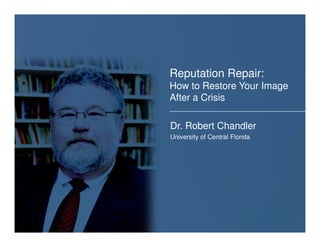
Reputation Repair:
How to Restore Your Image After a Crisis
Robert C. Chandler, Ph.D.
Director, Nicholson School of Communication
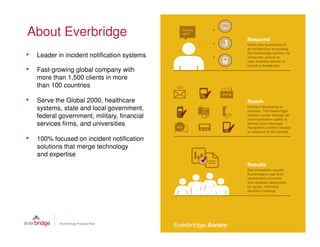
About Everbridge
•   Leader in incident notification systems

•   Fast-growing global company with
    more than 1,500 clients in more
    than 100 countries

•   Serve the Global 2000, healthcare
    systems, state and local government,
    federal government, military, financial
    services firms, and universities

•   100% focused on incident notification
    solutions that merge technology
    and expertise


                                              2
Agenda

Part 1: Presentation
• How to transform crisis into confidence
• Comparing different communication strategies
• What types of messages help you get back into the
    good graces of your constituents

Part 2: Q&A


                                                      3
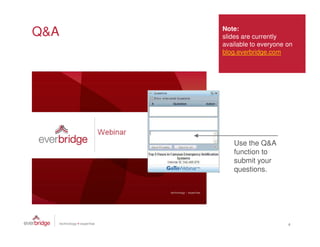
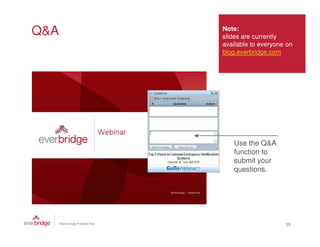
Q&A   Note:
      slides are currently
      available to everyone on
      blog.everbridge.com


         Use the Q&A
         function to
         submit your
         questions.


                            4
Reputation Repair:
       How to Restore Your Image
BracingAfterthe 2010
       for a Crisis
Hurricane Season
       Dr. Robert Chandler
       University of Central Florida
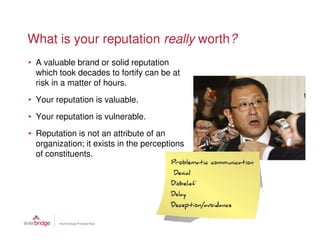
What is your reputation really worth?
• A valuable brand or solid reputation
  which took decades to fortify can be at
  risk in a matter of hours.
• Your reputation is valuable.
• Your reputation is vulnerable.
• Reputation is not an attribute of an
  organization; it exists in the perceptions
  of constituents.
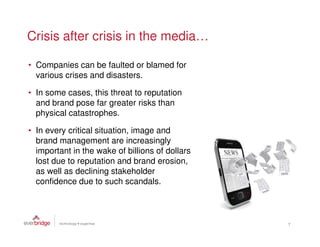
Crisis after crisis in the media…

• Companies can be faulted or blamed for
  various crises and disasters.

• In some cases, this threat to reputation
  and brand pose far greater risks than
  physical catastrophes.

• In every critical situation, image and
  brand management are increasingly
  important in the wake of billions of dollars
  lost due to reputation and brand erosion,
  as well as declining stakeholder
  confidence due to such scandals.


                                                 7
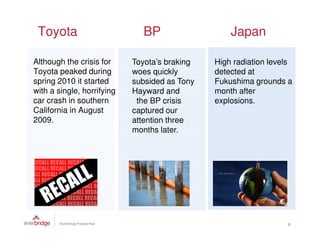
Toyota                       BP                   Japan

Although the crisis for     Toyota’s braking   High radiation levels
Toyota peaked during        woes quickly       detected at
spring 2010 it started      subsided as Tony   Fukushima grounds a
with a single, horrifying   Hayward and        month after
car crash in southern        the BP crisis     explosions.
California in August        captured our
2009.                       attention three
                            months later.


                                                                  8
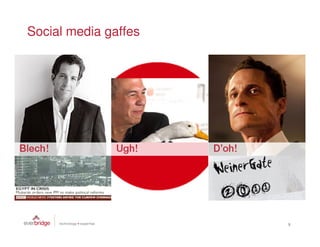
Social media gaffes


                      9
Enron as the Hurricane Katrina of ethical
misconduct disasters
• The cost of corporate recklessness calculated direct
  business/value losses related to the Enron disaster at
  more than $200 billion.
• These estimates include lost investment savings, jobs,
  pension losses and tax revenue. The report estimated
  that more than a million workers lost their jobs at the
  affected companies and those indirectly impacted.
• Further, the costs to businesses, stakeholders, and
  management include hundreds of millions in litigation
  costs; punitive and compensatory fines; tarnished brands,
  images, and reputations; and loss of consumer and
  investor confidence.
Enron as the Hurricane Katrina of ethical
misconduct disasters


In the 2 ½ years following the
implosion of Enron, it is estimated
that world capital markets lost
between $4 and $7 trillion, believed
to be attributable to the Enron ethics
disaster scandal which ruined
pension plans, crashed equity value,
costing jobs, wiping out investments,
and left an enormous hole in the US
and world economy.
Introduction to reputation repair
• All too frequently there is a lack of adequate advance planning
  and preparedness to communicate effective messages – or even
  understanding that various types of message options exist.

• Most managers have little training
  in what to say that best protects
  their image or helps repair it when
  it has been tarnished.


                                                                    12
Introduction to reputation repair
Communication activities involved in responding to a
reputation damaging crisis include determining:

• Optimal timing
• Message or thematic priorities
• Specific messages to be conveyed to the public and media
• Specific messages to be conveyed to targeted individuals
• Source(s) of messages
• Priorities for communication
• Optimal delivery channels


                                                             13
Introduction to reputation repair

• Benoit (1995) has developed the Image Restoration Theory
  (IRT) that offers a descriptive system of examining image
  restoration or repair strategies employed.

• IRT claims that an organization’s central, although
  not only, goal of crisis communication is “restoring
  or protecting one’s reputation.”

• Benoit’s Image Restoration Theory posits five primary macro
  strategies: denial, evading of responsibility, reducing the
  offensiveness, corrective action, and mortification.
  We have added silence as a six strategy.

• Fourteen specific message tactics fall within these
  six broad categories.


                                                                14
Introduction to reputation repair

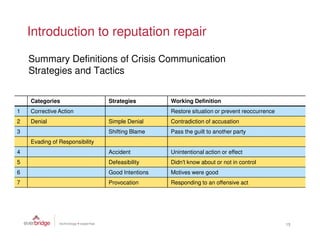
    Summary Definitions of Crisis Communication
    Strategies and Tactics


    Categories                  Strategies        Working Definition
1   Corrective Action                             Restore situation or prevent reoccurrence
2   Denial                      Simple Denial     Contradiction of accusation
3                               Shifting Blame    Pass the guilt to another party
    Evading of Responsibility
4                               Accident          Unintentional action or effect
5                               Defeasibility     Didn't know about or not in control
6                               Good Intentions   Motives were good
7                               Provocation       Responding to an offensive act


                                                                                              15
Introduction to reputation repair

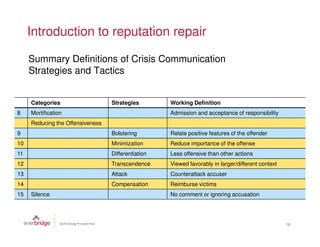
     Summary Definitions of Crisis Communication
     Strategies and Tactics


     Categories                   Strategies        Working Definition
8    Mortification                                  Admission and acceptance of responsibility
     Reducing the Offensiveness
9                                 Bolstering        Relate positive features of the offender
10                                Minimization      Reduce importance of the offense
11                                Differentiation   Less offensive than other actions
12                                Transcendence     Viewed favorably in larger/different context
13                                Attack            Counterattack accuser
14                                Compensation      Reimburse victims
15   Silence                                        No comment or ignoring accusation


                                                                                                   16
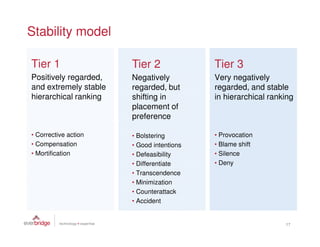
Stability model

Tier 1                 Tier 2              Tier 3
Positively regarded,   Negatively          Very negatively
and extremely stable   regarded, but       regarded, and stable
hierarchical ranking   shifting in         in hierarchical ranking
                       placement of
                       preference

• Corrective action    • Bolstering        • Provocation
• Compensation         • Good intentions   • Blame shift
• Mortification        • Defeasibility     • Silence
                       • Differentiate     • Deny
                       • Transcendence
                       • Minimization
                       • Counterattack
                       • Accident


                                                               17
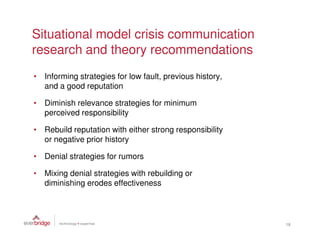
Situational model crisis communication
research and theory recommendations
• Informing strategies for low fault, previous history,
  and a good reputation

• Diminish relevance strategies for minimum
  perceived responsibility

• Rebuild reputation with either strong responsibility
  or negative prior history

• Denial strategies for rumors

• Mixing denial strategies with rebuilding or
  diminishing erodes effectiveness


                                                          18
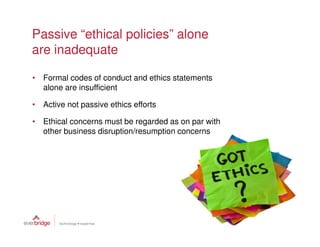
Passive “ethical policies” alone
are inadequate

• Formal codes of conduct and ethics statements
  alone are insufficient

• Active not passive ethics efforts

• Ethical concerns must be regarded as on par with
  other business disruption/resumption concerns
“Integrity continuity”

• “Integrity continuity” planning is also a due diligent
  policy and business continuity priority

• Such planning must go beyond compliance issues
  and reactive disciplinary policies to actually
  manage integrity

• Employees who know that certain workplace
  decisions, behaviors, and processes exist in an
  ethically judged context are more aware and
  motivated to act ethically
What not to do
•   Don’t take too long to respond to the crisis
•   Do not shift the blame – take/accept responsibility
•   Actions should fulfill promises made
•   Don’t drag your feet
•   Don’t make unrealistic promises
•   Don’t lose sight of your audience and critics
•   Don’t fail to understand all facets of the situation

“There’s no one who wants this
 thing over more than I do.
 I’d like my life back.”
                                      "No statement shall be made containing
           - Tony Hayward, CEO, BP     any of the following: promises that
                                       property, ecology or anything else will
                                       be restored to normal."
                                                  - BP’s oil disaster plan filed with the
                                                          federal government in 2009
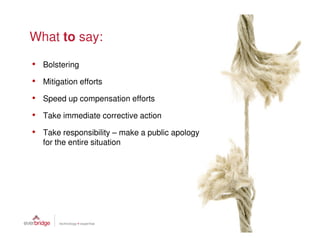
What to say:

• Bolstering
• Mitigation efforts
• Speed up compensation efforts
• Take immediate corrective action
• Take responsibility – make a public apology
   for the entire situation
Script out your communication beforehand
There is no substitute for carefully preparing communication in a crisis
to prevent the blunders and missteps we have seen

•   Prepare messaging in advance
•   Focus on a set of key messages that need to be delivered
•   Each phase of the crisis should be well scripted and practiced
•   Keep comments respectful to all parties involved
•   If you expect to speak in front of a camera, practice beforehand
•   Avoid sounding scripted
•   You will be more comfortable when unexpected events occur
Don’t stray from your plan

Practice your crisis communication plan early and
often to prevent swaying from key messaging. For
example, in two distinct instances, Hayward’s
message has contradicted BP’s oil spill disaster plan.


• Media statement: Promised that BP would
   clean up every drop of oil and “restore the
   shoreline to its original state”

• National TV commercial: Pledges
   "We will make this right.”
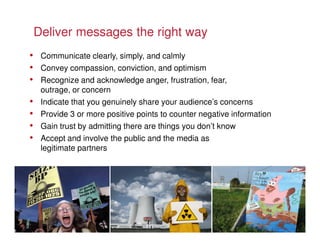
Deliver messages the right way
• Communicate clearly, simply, and calmly
• Convey compassion, conviction, and optimism
• Recognize and acknowledge anger, frustration, fear,
     outrage, or concern
•    Indicate that you genuinely share your audience’s concerns
•    Provide 3 or more positive points to counter negative information
•    Gain trust by admitting there are things you don’t know
•    Accept and involve the public and the media as
     legitimate partners
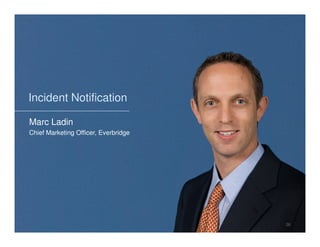
Incident Notification

Marc Ladin
Chief Marketing Officer, Everbridge


                                      26
Incident notification addresses
common challenges
• Communicate brand repair             • Reduce miscommunications and
  messages quickly, easily, and          control rumors with accurate,
  efficiently to avoid lengthy brand     consistent messages which reinforce
  damage                                 your situation or stability model
                                         communications
• Use all contact paths to make sure
  corrective actions are               • Free key personnel to perform
  communicated and received              critical tasks after the crisis by
                                         automating manual, time-intensive,
• Ensure two-way communications          error-prone processes
  for better visibility and planning
                                       • Improve communication
                                         effectiveness by eliminating any
                                         single point of failure


                                                                            27
Key evaluation criteria for an incident
notification system

• Experience and expertise
• Ease of use
• Ability to reach all contact paths,
  including voice, email, native SMS
  (over SMPP and SMTP), IM, and more

• Ease of integration


                                          28
Q&A   Note:
      slides are currently
      available to everyone on
      blog.everbridge.com


         Use the Q&A
         function to
         submit your
         questions.


                           29
Communication resources
Contact information         Upcoming webinars:
                            System Demo (July 28)
                            www.everbridge.com/webinars

                            White papers, literature, case studies
                            www.everbridge.com/resources
Robert C. Chandler, Ph.D.
rcchandl@mail.ucf.edu       Follow us:
1.407.823.2683                   blog.everbridge.com
                                 twitter.com/everbridge
                                 facebook.com/everbridgeinc
                                 youtube.com/user/everbridge
Marc Ladin
marc.ladin@everbridge.com
1.818.230.9700


                                  Reminder
                                  Everbridge Insights webinars
                                  qualify for Continuing Education
                                  Activity Points (CEAPs) for DRII
                                  certifications. Visit www.drii.org
                                  to register your credit.
                                  Item Number (Schedule II): 26.3
                                  Activity Group: A
                                  1 Point for each webinar

Everbridge Webinar - Reputation Repair

  • 1.
    Reputation Repair: How toRestore Your Image After a Crisis Robert C. Chandler, Ph.D. Director, Nicholson School of Communication
  • 2.
    About Everbridge • Leader in incident notification systems • Fast-growing global company with more than 1,500 clients in more than 100 countries • Serve the Global 2000, healthcare systems, state and local government, federal government, military, financial services firms, and universities • 100% focused on incident notification solutions that merge technology and expertise 2
  • 3.
    Agenda Part 1: Presentation •How to transform crisis into confidence • Comparing different communication strategies • What types of messages help you get back into the good graces of your constituents Part 2: Q&A 3
  • 4.
    Q&A Note: slides are currently available to everyone on blog.everbridge.com Use the Q&A function to submit your questions. 4
  • 5.
    Reputation Repair: How to Restore Your Image BracingAfterthe 2010 for a Crisis Hurricane Season Dr. Robert Chandler University of Central Florida
  • 6.
    What is yourreputation really worth? • A valuable brand or solid reputation which took decades to fortify can be at risk in a matter of hours. • Your reputation is valuable. • Your reputation is vulnerable. • Reputation is not an attribute of an organization; it exists in the perceptions of constituents.
  • 7.
    Crisis after crisisin the media… • Companies can be faulted or blamed for various crises and disasters. • In some cases, this threat to reputation and brand pose far greater risks than physical catastrophes. • In every critical situation, image and brand management are increasingly important in the wake of billions of dollars lost due to reputation and brand erosion, as well as declining stakeholder confidence due to such scandals. 7
  • 8.
    Toyota BP Japan Although the crisis for Toyota’s braking High radiation levels Toyota peaked during woes quickly detected at spring 2010 it started subsided as Tony Fukushima grounds a with a single, horrifying Hayward and month after car crash in southern the BP crisis explosions. California in August captured our 2009. attention three months later. 8
  • 9.
  • 10.
    Enron as theHurricane Katrina of ethical misconduct disasters • The cost of corporate recklessness calculated direct business/value losses related to the Enron disaster at more than $200 billion. • These estimates include lost investment savings, jobs, pension losses and tax revenue. The report estimated that more than a million workers lost their jobs at the affected companies and those indirectly impacted. • Further, the costs to businesses, stakeholders, and management include hundreds of millions in litigation costs; punitive and compensatory fines; tarnished brands, images, and reputations; and loss of consumer and investor confidence.
  • 11.
    Enron as theHurricane Katrina of ethical misconduct disasters In the 2 ½ years following the implosion of Enron, it is estimated that world capital markets lost between $4 and $7 trillion, believed to be attributable to the Enron ethics disaster scandal which ruined pension plans, crashed equity value, costing jobs, wiping out investments, and left an enormous hole in the US and world economy.
  • 12.
    Introduction to reputationrepair • All too frequently there is a lack of adequate advance planning and preparedness to communicate effective messages – or even understanding that various types of message options exist. • Most managers have little training in what to say that best protects their image or helps repair it when it has been tarnished. 12
  • 13.
    Introduction to reputationrepair Communication activities involved in responding to a reputation damaging crisis include determining: • Optimal timing • Message or thematic priorities • Specific messages to be conveyed to the public and media • Specific messages to be conveyed to targeted individuals • Source(s) of messages • Priorities for communication • Optimal delivery channels 13
  • 14.
    Introduction to reputationrepair • Benoit (1995) has developed the Image Restoration Theory (IRT) that offers a descriptive system of examining image restoration or repair strategies employed. • IRT claims that an organization’s central, although not only, goal of crisis communication is “restoring or protecting one’s reputation.” • Benoit’s Image Restoration Theory posits five primary macro strategies: denial, evading of responsibility, reducing the offensiveness, corrective action, and mortification. We have added silence as a six strategy. • Fourteen specific message tactics fall within these six broad categories. 14
  • 15.
    Introduction to reputationrepair Summary Definitions of Crisis Communication Strategies and Tactics Categories Strategies Working Definition 1 Corrective Action Restore situation or prevent reoccurrence 2 Denial Simple Denial Contradiction of accusation 3 Shifting Blame Pass the guilt to another party Evading of Responsibility 4 Accident Unintentional action or effect 5 Defeasibility Didn't know about or not in control 6 Good Intentions Motives were good 7 Provocation Responding to an offensive act 15
  • 16.
    Introduction to reputationrepair Summary Definitions of Crisis Communication Strategies and Tactics Categories Strategies Working Definition 8 Mortification Admission and acceptance of responsibility Reducing the Offensiveness 9 Bolstering Relate positive features of the offender 10 Minimization Reduce importance of the offense 11 Differentiation Less offensive than other actions 12 Transcendence Viewed favorably in larger/different context 13 Attack Counterattack accuser 14 Compensation Reimburse victims 15 Silence No comment or ignoring accusation 16
  • 17.
    Stability model Tier 1 Tier 2 Tier 3 Positively regarded, Negatively Very negatively and extremely stable regarded, but regarded, and stable hierarchical ranking shifting in in hierarchical ranking placement of preference • Corrective action • Bolstering • Provocation • Compensation • Good intentions • Blame shift • Mortification • Defeasibility • Silence • Differentiate • Deny • Transcendence • Minimization • Counterattack • Accident 17
  • 18.
    Situational model crisiscommunication research and theory recommendations • Informing strategies for low fault, previous history, and a good reputation • Diminish relevance strategies for minimum perceived responsibility • Rebuild reputation with either strong responsibility or negative prior history • Denial strategies for rumors • Mixing denial strategies with rebuilding or diminishing erodes effectiveness 18
  • 19.
    Passive “ethical policies”alone are inadequate • Formal codes of conduct and ethics statements alone are insufficient • Active not passive ethics efforts • Ethical concerns must be regarded as on par with other business disruption/resumption concerns
  • 20.
    “Integrity continuity” • “Integritycontinuity” planning is also a due diligent policy and business continuity priority • Such planning must go beyond compliance issues and reactive disciplinary policies to actually manage integrity • Employees who know that certain workplace decisions, behaviors, and processes exist in an ethically judged context are more aware and motivated to act ethically
  • 21.
    What not todo • Don’t take too long to respond to the crisis • Do not shift the blame – take/accept responsibility • Actions should fulfill promises made • Don’t drag your feet • Don’t make unrealistic promises • Don’t lose sight of your audience and critics • Don’t fail to understand all facets of the situation “There’s no one who wants this thing over more than I do. I’d like my life back.” "No statement shall be made containing - Tony Hayward, CEO, BP any of the following: promises that property, ecology or anything else will be restored to normal." - BP’s oil disaster plan filed with the federal government in 2009
  • 22.
    What to say: •Bolstering • Mitigation efforts • Speed up compensation efforts • Take immediate corrective action • Take responsibility – make a public apology for the entire situation
  • 23.
    Script out yourcommunication beforehand There is no substitute for carefully preparing communication in a crisis to prevent the blunders and missteps we have seen • Prepare messaging in advance • Focus on a set of key messages that need to be delivered • Each phase of the crisis should be well scripted and practiced • Keep comments respectful to all parties involved • If you expect to speak in front of a camera, practice beforehand • Avoid sounding scripted • You will be more comfortable when unexpected events occur
  • 24.
    Don’t stray fromyour plan Practice your crisis communication plan early and often to prevent swaying from key messaging. For example, in two distinct instances, Hayward’s message has contradicted BP’s oil spill disaster plan. • Media statement: Promised that BP would clean up every drop of oil and “restore the shoreline to its original state” • National TV commercial: Pledges "We will make this right.”
  • 25.
    Deliver messages theright way • Communicate clearly, simply, and calmly • Convey compassion, conviction, and optimism • Recognize and acknowledge anger, frustration, fear, outrage, or concern • Indicate that you genuinely share your audience’s concerns • Provide 3 or more positive points to counter negative information • Gain trust by admitting there are things you don’t know • Accept and involve the public and the media as legitimate partners
  • 26.
    Incident Notification Marc Ladin ChiefMarketing Officer, Everbridge 26
  • 27.
    Incident notification addresses commonchallenges • Communicate brand repair • Reduce miscommunications and messages quickly, easily, and control rumors with accurate, efficiently to avoid lengthy brand consistent messages which reinforce damage your situation or stability model communications • Use all contact paths to make sure corrective actions are • Free key personnel to perform communicated and received critical tasks after the crisis by automating manual, time-intensive, • Ensure two-way communications error-prone processes for better visibility and planning • Improve communication effectiveness by eliminating any single point of failure 27
  • 28.
    Key evaluation criteriafor an incident notification system • Experience and expertise • Ease of use • Ability to reach all contact paths, including voice, email, native SMS (over SMPP and SMTP), IM, and more • Ease of integration 28
  • 29.
    Q&A Note: slides are currently available to everyone on blog.everbridge.com Use the Q&A function to submit your questions. 29
  • 30.
    Communication resources Contact information Upcoming webinars: System Demo (July 28) www.everbridge.com/webinars White papers, literature, case studies www.everbridge.com/resources Robert C. Chandler, Ph.D. rcchandl@mail.ucf.edu Follow us: 1.407.823.2683 blog.everbridge.com twitter.com/everbridge facebook.com/everbridgeinc youtube.com/user/everbridge Marc Ladin marc.ladin@everbridge.com 1.818.230.9700 Reminder Everbridge Insights webinars qualify for Continuing Education Activity Points (CEAPs) for DRII certifications. Visit www.drii.org to register your credit. Item Number (Schedule II): 26.3 Activity Group: A 1 Point for each webinar