
Experimenting with
Basic Income in Finland
Olli Kangas (olli.kangas@kela.fi)
Professor, Research Director
Kela, Social Insurance Institution of Finland
Governmental mandate
• Prime Minister Juha Sipilä’s governmental program
includes a number of social experiments
• The basic income pilot study is one of them
• The aim is to reform existing social policy to better
match with societal changes, abolish work
disincentives and diminish bureaucracy
2
Governmental mandate
• After an open bid, the preliminary study was
awarded to a Kela-led research consortium
consisting of:
• The VATT Institute for Economic Research and the Swedish
School of Social Science, University of Helsinki
• Universities of Turku and Tampere
• Think tank Tänk
• The Finnish Innovation Fund (SITRA)
• Federation of Finnish Enterprises
• Experts representing municipalities and constitutional, social and
tax law
3
Timetable and funding
• Timetable for the consortium:
• First hearing 5 December 2015
• Interim report 30 March 2016
• Final report 15 November 2016
• The experiment will start in the beginning of 2017
and will last for 2 years
• Results will be evaluated in 2019
• Funding comes from the Government
• €20 million for two years
4
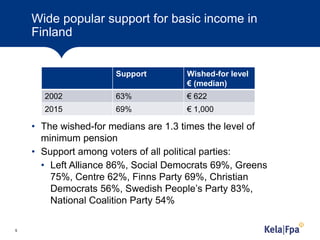
Wide popular support for basic income in
Finland
• The wished-for medians are 1.3 times the level of
minimum pension
• Support among voters of all political parties:
• Left Alliance 86%, Social Democrats 69%, Greens
75%, Centre 62%, Finns Party 69%, Christian
Democrats 56%, Swedish People’s Party 83%,
National Coalition Party 54%
5
Support Wished-for level
€ (median)
2002 63% € 622
2015 69% € 1,000
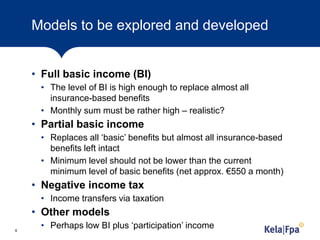
Models to be explored and developed
• Full basic income (BI)
• The level of BI is high enough to replace almost all
insurance-based benefits
• Monthly sum must be rather high – realistic?
• Partial basic income
• Replaces all ‘basic’ benefits but almost all insurance-based
benefits left intact
• Minimum level should not be lower than the current
minimum level of basic benefits (net approx. €550 a month)
• Negative income tax
• Income transfers via taxation
• Other models
• Perhaps low BI plus ‘participation’ income6
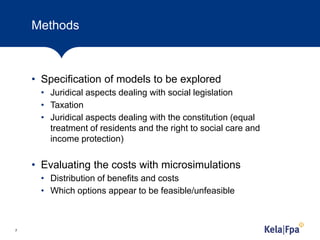
Methods
• Specification of models to be explored
• Juridical aspects dealing with social legislation
• Taxation
• Juridical aspects dealing with the constitution (equal
treatment of residents and the right to social care and
income protection)
• Evaluating the costs with microsimulations
• Distribution of benefits and costs
• Which options appear to be feasible/unfeasible
7
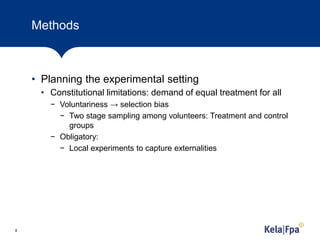
Methods
• Planning the experimental setting
• Constitutional limitations: demand of equal treatment for all
− Voluntariness → selection bias
− Two stage sampling among volunteers: Treatment and control
groups
− Obligatory:
− Local experiments to capture externalities
8
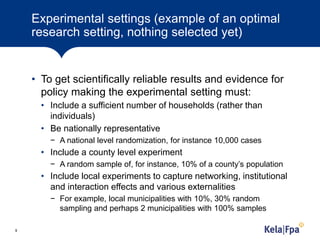
Experimental settings (example of an optimal
research setting, nothing selected yet)
• To get scientifically reliable results and evidence for
policy making the experimental setting must:
• Include a sufficient number of households (rather than
individuals)
• Be nationally representative
− A national level randomization, for instance 10,000 cases
• Include a county level experiment
− A random sample of, for instance, 10% of a county’s population
• Include local experiments to capture networking, institutional
and interaction effects and various externalities
− For example, local municipalities with 10%, 30% random
sampling and perhaps 2 municipalities with 100% samples
9
Working group evaluates the models,
research setting and samples
• The task for the working group is to plan the
experiment
• After the first report (due 30 March, 2016) the
Government will decide which models should be
further developed
• Later in 2016 the Government will decide which
model/s will be experimented with and what the
target population and experimental setting will be
• The expert group will prepare suggestions for the decision
10
More info
www.kela.fi/web/en/experimental-study-
on-a-universal-basic-income
11

Experimental study on a universal basic income in Finland

  • 1.
    Experimenting with Basic Incomein Finland Olli Kangas (olli.kangas@kela.fi) Professor, Research Director Kela, Social Insurance Institution of Finland
  • 2.
    Governmental mandate • PrimeMinister Juha Sipilä’s governmental program includes a number of social experiments • The basic income pilot study is one of them • The aim is to reform existing social policy to better match with societal changes, abolish work disincentives and diminish bureaucracy 2
  • 3.
    Governmental mandate • Afteran open bid, the preliminary study was awarded to a Kela-led research consortium consisting of: • The VATT Institute for Economic Research and the Swedish School of Social Science, University of Helsinki • Universities of Turku and Tampere • Think tank Tänk • The Finnish Innovation Fund (SITRA) • Federation of Finnish Enterprises • Experts representing municipalities and constitutional, social and tax law 3
  • 4.
    Timetable and funding •Timetable for the consortium: • First hearing 5 December 2015 • Interim report 30 March 2016 • Final report 15 November 2016 • The experiment will start in the beginning of 2017 and will last for 2 years • Results will be evaluated in 2019 • Funding comes from the Government • €20 million for two years 4
  • 5.
    Wide popular supportfor basic income in Finland • The wished-for medians are 1.3 times the level of minimum pension • Support among voters of all political parties: • Left Alliance 86%, Social Democrats 69%, Greens 75%, Centre 62%, Finns Party 69%, Christian Democrats 56%, Swedish People’s Party 83%, National Coalition Party 54% 5 Support Wished-for level € (median) 2002 63% € 622 2015 69% € 1,000
  • 6.
    Models to beexplored and developed • Full basic income (BI) • The level of BI is high enough to replace almost all insurance-based benefits • Monthly sum must be rather high – realistic? • Partial basic income • Replaces all ‘basic’ benefits but almost all insurance-based benefits left intact • Minimum level should not be lower than the current minimum level of basic benefits (net approx. €550 a month) • Negative income tax • Income transfers via taxation • Other models • Perhaps low BI plus ‘participation’ income6
  • 7.
    Methods • Specification ofmodels to be explored • Juridical aspects dealing with social legislation • Taxation • Juridical aspects dealing with the constitution (equal treatment of residents and the right to social care and income protection) • Evaluating the costs with microsimulations • Distribution of benefits and costs • Which options appear to be feasible/unfeasible 7
  • 8.
    Methods • Planning theexperimental setting • Constitutional limitations: demand of equal treatment for all − Voluntariness → selection bias − Two stage sampling among volunteers: Treatment and control groups − Obligatory: − Local experiments to capture externalities 8
  • 9.
    Experimental settings (exampleof an optimal research setting, nothing selected yet) • To get scientifically reliable results and evidence for policy making the experimental setting must: • Include a sufficient number of households (rather than individuals) • Be nationally representative − A national level randomization, for instance 10,000 cases • Include a county level experiment − A random sample of, for instance, 10% of a county’s population • Include local experiments to capture networking, institutional and interaction effects and various externalities − For example, local municipalities with 10%, 30% random sampling and perhaps 2 municipalities with 100% samples 9
  • 10.
    Working group evaluatesthe models, research setting and samples • The task for the working group is to plan the experiment • After the first report (due 30 March, 2016) the Government will decide which models should be further developed • Later in 2016 the Government will decide which model/s will be experimented with and what the target population and experimental setting will be • The expert group will prepare suggestions for the decision 10
  • 11.