Attitudes Toward
Universal Basic Income
and Welfare State
in Europe
Soomi Lee
University of La Verne
La Verne Academy Lecture
November 20, 2018
Universal Basic Income
Today’s Talk
1. Introduce the Universal Basic Income.
2. Deliver my research paper in Basic Income
Studies.
3. Share my experience with a universal basic
income course, HONR 313, Universal Basic
Income: Visions and Policies (Spring 2018).
4. Moving Forward…
Universal
Basic Income
(basic income, basic income
guarantee, guaranteed
minimum income, social
dividend)
A periodic cash payment
unconditionally delivered
to all on an individual
basis, without means-test
or work requirement.
(Basic Income Earth Network)
Thomas Paine
(1737-1809)
Advocated a citizen's
dividend to all United States
citizens as compensation for
"loss of his or her natural
inheritance, by the
introduction of the system
of landed property"
(Agrarian Justice, 1795).
J. S. Mill
“In the distribution, a
certain minimum is first
assigned for the
subsistence of every
member of the community,
whether capable or not of
labour.” (Principles of
Political Economy, 1848)
Henry George
Advocated a dividend to be
paid to all citizens from the
revenue generated by a land
value tax. Progress and
Poverty, 1879.
Bertrand Russell
“... a certain small income,
sufficient for necessaries, should
be secured to all, whether they
work or not, and that a larger
income … should be given to
those who are willing to engage
in some work … When education
is finished, no one should be
compelled to work, and those
who choose not to work should
receive a bare livelihood and be
left completely free.” (Roads to
Freedom, 1918)
Martin Luther King Jr.
“I am now convinced that the
simplest approach will prove to
be the most effective—the
solution to poverty is to
abolish it directly by a now
widely discussed measure: the
guaranteed income.” (Where
Do We Go from Here: Chaos or
Community? 1967)
In 1968, 1,200
economists signed a
letter calling for the
US Congress to
introduce in that year
a system of income
guarantees and
supplements.
Milton Friedman’s
Negative Income Tax
• Reduce Government Bureaucracy
• Utilize the Efficiency of
Free Markets
• End the Welfare Trap
• To Enable Work
• Justice & Equality
Experiments in the 1960s-80s
• The New Jersey Income Maintenance
Experiment, 1968–1972 (1357 families)
• The Rural Income Maintenance Experiment in
Iowa and North Carolina, 1969–1973 (809
families)
• Gary, Indiana, 1971–1974 (1800 families)
• Seattle and Denver, 1971–1982 (4800 families)
• Manitoba, Canada, 1974-1979
Richard Nixon,
Family Assistance Plan
(On August 8, 1969)
Proposed the Family
Assistance Plan (FAP), which
was based on a negative
income tax model (a $1600
annual income for a family of
four.)
Alaska Permanent Fund
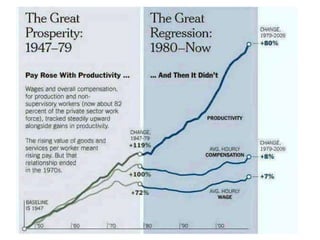
Artificial Intelligence,
automation, a gig
economy, precarious
labor, a jobless
economy, and Basic
Income
Red: corporate profit after tax
Blue: wages and salary / GDP
(1950-2015, FRED)
Poverty & UBI
• Cash vs. in-kind transfer
• Take-up rates
• Welfare cliff (work incentives)
• Stigma (dependency, deserving v. undeserving
poor)
Economic insecurity
in the midst of
growth and abundance.
What’s our plan for the future?
Policy Alternatives???
• Minimum wage & Living wage
• Youth dividend
• Baby bonds
• Federal job guarantee (Kirsten Gillibrand,
Bernie Sanders, Cory Booker)
• The LIFT Act (Kamala Harris)
Americans' Support for a UBI
“Do you support or not support a universal basic income
program as a way to help Americans who lose their jobs because
of advances in artificial intelligence?” N=3297, MOE +/-2, 95%.
48
43
52
52
57
48
All Americans Men Women
Support Do Not Support
“Do you support or not support a universal basic income
program as a way to help Americans who lose their jobs because
of advances in artificial intelligence?”
54
50
46
38
46
50
54
62
18 to 35 36 to 50 51 to 65 66+
Age
Support Do Not Support
“Do you support or not support a universal basic income
program as a way to help Americans who lose their jobs because
of advances in artificial intelligence?”
51
42
49
58
Less than a bachelor's degree Bachelor's degree or higher
Education
Support Do Not Support
“Do you support or not support a universal basic income
program as a way to help Americans who lose their jobs because
of advances in artificial intelligence?”
28
48
65
72
52
35
Republican Independent Democrat
Support Do Not Support
“Attitudes
Towards
Universal Basic
Income and
Welfare State
in Europe”
Examines the relationship
between country-level
socio-economic
conditions and public
attitudes toward UBI in 21
European countries.
Gap in the literature
on public attitudes toward UBI
• Despite the heightened interest, public attitudes
to UBI are not well understood.
• This is an important gap to fill because public
opinion is a key element to transforming an idea
to a public policy.
• Systematic research on this subject has, to date,
been minimal.
• Difficult to compare public attitudes toward UBI
across countries to explain why some countries
are more receptive than others.
Latest Round of ESS
• The 8th Wage of the European Social Survey (ESS)
asked respondents whether they support an
introduction of UBI to their country.
• This paper includes 21 countries: Austria,
Belgium, Czech Republic, Estonia, Finland, France,
Germany, Hungary, Iceland, Ireland, Italy,
Lithuania, the Netherlands, Norway, Poland,
Portugal, Slovenia, Spain, Sweden, Switzerland,
and the United Kingdom.
The Questionnaire on UBI
“Some countries are currently talking about introducing a basic income
scheme. In a moment I will ask you to tell me whether you are against or in
favor of this scheme. First, I will give you some more details. The highlighted
box at the top of this card shows the main features of the scheme. A basic
income scheme includes all of the following.
• The government pays everyone a monthly income to cover essential living
costs.
• It replaces many other social benefits.
• The purpose is to guarantee everyone a minimum standard of living.
• Everyone receives the same amount regardless of whether or not they are
working.
• People also keep the money they earn from work or other sources.
• This scheme is paid for by taxes.
Overall, would you be against or in favor of having this scheme [in your
country]?”
Data
• Respondents chose one of the following:
Strongly against, Against, In favor, Strongly in
favor. To simplify the analyses, I recoded the
four-point scale responses to a binary
variable.
• N=36,355 in 21 counties.
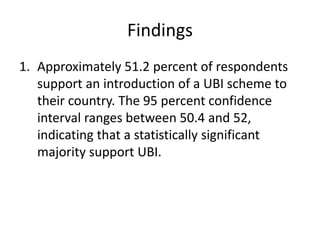
Findings
1. Approximately 51.2 percent of respondents
support an introduction of a UBI scheme to
their country. The 95 percent confidence
interval ranges between 50.4 and 52,
indicating that a statistically significant
majority support UBI.
Findings
2. The support levels for UBI greatly differ
across countries.
Findings
3. Did you notice the surprisingly low support
for UBI in Nordic countries?!?
• The survey results underline the caution by
Raventos (2007).
Social Protection and Support for UBI
• Relationship between support for UBI and
overall social safety net spending
• Relationship between support for UBI and
means-tested program spending
• Relationship between support for UBI and
non-means-tested program spending
Correlation coefficient = -0.89(p<0.05)
Correlation coefficient = -0.28 (p>0.05)
Correlation coefficient = -0.68 (p<0.05)
A Sense of Economic Security and
Support for UBI
• Since countries with the most generous and
universalistic welfare systems must provide a
greater sense of economic security to
individuals and households, it is important to
examine the relationship between economic
security and support for UBI.
The United Nations special rapporteur on
extreme poverty and human rights
UBI is one of the viable proposals to replace or
supplement existing social protection systems
because it recognizes economic insecurity as a
fundamental threat to all human rights (United
Nations Human Rights Council 2017).
Jobs and Economic Security
• Traditionally, the general public’s economic
security is deemed to be associated with
conditions in the job market. Having a job implies
financial stability and security.
• While these traditional measures are not
irrelevant, the approach has been questioned
because of the changing nature of the labor
market, such as the polarization of job quality
and the growth of precarious jobs (Kalleberg
2011).
Changing Labor Market and UBI
• One’s employment status is no longer an
indication of economic security (Shafique
2018) and therefore, UBI supporters argue
that UBI is necessary to prepare for the
changing labor market.
• Nevertheless, it is unclear whether people
who have a sense of economic insecurity
would necessarily demand a basic income
policy.
Correlation coefficient = 0.69 (p<0.05)
Correlation coefficient = 0.78 (p<0.05)
Economic Insecurity, Social Safety Net,
and Support for UBI
• “Social income” comes from various sources.
• For most people, income comes from social
transfers and wages.
• The modern social contract dictates that the
two are complementary: When people cannot
work for various reasons, the government
transfers income from social insurance or
assistance programs.
Discussion
• Contrary to the belief that countries with
greater social protection and universalistic
welfare state would be more sympathetic to
UBI policy, the analyses in this paper show
that it is not necessarily true.
• People who are happy about their social
welfare programs may not want to replace
their current welfare state with UBI.
• UBI are more receptive than we think in
countries with a weak social welfare system.
People in those countries may be open to a
UBI scheme as a way of strengthening their
weak social safety net.
• The feasibility of an introduction of UBI can be
much higher in countries where households
are economically insecure and government
policies are inadequate.
HONR313.
Universal
Basic Income:
Visions and
Policies
UBI as a Window to the Society
• Social justice & freedom; the nature of work
(non-paying work); the future of work (the
precariat); poverty, inequality, and economic
insecurity; welfare policies; financing UBI (tax
policies and the Alaska model); objections to
UBI; political feasibility; alternatives; UBI in
developing countries; UBI pilots.
What is Next?
• Scholarship
– During the sabbatical leave in Spring 2019, conduct research on public
attitudes toward UBI at the individual level.
• Teaching
– Continue offering Universal Basic Income: Visions and Policies in
Spring 2020.
– Seminars with expanded audience (United Way, Los Angeles Catholic
Worker, etc.)
• Engagement
– The United States Basic Income Guarantee Network.
– 2019 North American Basic Income Guarantee Congress (June 15-16,
Silberman School of Social Work at Hunter College, NY)
Thank you!
Pilot programs around the world
• https://futurism.com/images/universal-basic-
income-ubi-pilot-programs-around-the-world

La Verne Academy Talk

  • 1.
    Attitudes Toward Universal BasicIncome and Welfare State in Europe Soomi Lee University of La Verne La Verne Academy Lecture November 20, 2018
  • 3.
  • 4.
    Today’s Talk 1. Introducethe Universal Basic Income. 2. Deliver my research paper in Basic Income Studies. 3. Share my experience with a universal basic income course, HONR 313, Universal Basic Income: Visions and Policies (Spring 2018). 4. Moving Forward…
  • 5.
    Universal Basic Income (basic income,basic income guarantee, guaranteed minimum income, social dividend) A periodic cash payment unconditionally delivered to all on an individual basis, without means-test or work requirement. (Basic Income Earth Network)
  • 6.
    Thomas Paine (1737-1809) Advocated acitizen's dividend to all United States citizens as compensation for "loss of his or her natural inheritance, by the introduction of the system of landed property" (Agrarian Justice, 1795).
  • 7.
    J. S. Mill “Inthe distribution, a certain minimum is first assigned for the subsistence of every member of the community, whether capable or not of labour.” (Principles of Political Economy, 1848)
  • 8.
    Henry George Advocated adividend to be paid to all citizens from the revenue generated by a land value tax. Progress and Poverty, 1879.
  • 9.
    Bertrand Russell “... acertain small income, sufficient for necessaries, should be secured to all, whether they work or not, and that a larger income … should be given to those who are willing to engage in some work … When education is finished, no one should be compelled to work, and those who choose not to work should receive a bare livelihood and be left completely free.” (Roads to Freedom, 1918)
  • 10.
    Martin Luther KingJr. “I am now convinced that the simplest approach will prove to be the most effective—the solution to poverty is to abolish it directly by a now widely discussed measure: the guaranteed income.” (Where Do We Go from Here: Chaos or Community? 1967)
  • 11.
    In 1968, 1,200 economistssigned a letter calling for the US Congress to introduce in that year a system of income guarantees and supplements.
  • 12.
    Milton Friedman’s Negative IncomeTax • Reduce Government Bureaucracy • Utilize the Efficiency of Free Markets • End the Welfare Trap • To Enable Work • Justice & Equality
  • 13.
    Experiments in the1960s-80s • The New Jersey Income Maintenance Experiment, 1968–1972 (1357 families) • The Rural Income Maintenance Experiment in Iowa and North Carolina, 1969–1973 (809 families) • Gary, Indiana, 1971–1974 (1800 families) • Seattle and Denver, 1971–1982 (4800 families) • Manitoba, Canada, 1974-1979
  • 14.
    Richard Nixon, Family AssistancePlan (On August 8, 1969) Proposed the Family Assistance Plan (FAP), which was based on a negative income tax model (a $1600 annual income for a family of four.)
  • 15.
  • 17.
    Artificial Intelligence, automation, agig economy, precarious labor, a jobless economy, and Basic Income
  • 19.
    Red: corporate profitafter tax Blue: wages and salary / GDP (1950-2015, FRED)
  • 20.
    Poverty & UBI •Cash vs. in-kind transfer • Take-up rates • Welfare cliff (work incentives) • Stigma (dependency, deserving v. undeserving poor)
  • 22.
    Economic insecurity in themidst of growth and abundance. What’s our plan for the future?
  • 23.
    Policy Alternatives??? • Minimumwage & Living wage • Youth dividend • Baby bonds • Federal job guarantee (Kirsten Gillibrand, Bernie Sanders, Cory Booker) • The LIFT Act (Kamala Harris)
  • 25.
  • 26.
    “Do you supportor not support a universal basic income program as a way to help Americans who lose their jobs because of advances in artificial intelligence?” N=3297, MOE +/-2, 95%. 48 43 52 52 57 48 All Americans Men Women Support Do Not Support
  • 27.
    “Do you supportor not support a universal basic income program as a way to help Americans who lose their jobs because of advances in artificial intelligence?” 54 50 46 38 46 50 54 62 18 to 35 36 to 50 51 to 65 66+ Age Support Do Not Support
  • 28.
    “Do you supportor not support a universal basic income program as a way to help Americans who lose their jobs because of advances in artificial intelligence?” 51 42 49 58 Less than a bachelor's degree Bachelor's degree or higher Education Support Do Not Support
  • 29.
    “Do you supportor not support a universal basic income program as a way to help Americans who lose their jobs because of advances in artificial intelligence?” 28 48 65 72 52 35 Republican Independent Democrat Support Do Not Support
  • 31.
    “Attitudes Towards Universal Basic Income and WelfareState in Europe” Examines the relationship between country-level socio-economic conditions and public attitudes toward UBI in 21 European countries.
  • 32.
    Gap in theliterature on public attitudes toward UBI • Despite the heightened interest, public attitudes to UBI are not well understood. • This is an important gap to fill because public opinion is a key element to transforming an idea to a public policy. • Systematic research on this subject has, to date, been minimal. • Difficult to compare public attitudes toward UBI across countries to explain why some countries are more receptive than others.
  • 33.
    Latest Round ofESS • The 8th Wage of the European Social Survey (ESS) asked respondents whether they support an introduction of UBI to their country. • This paper includes 21 countries: Austria, Belgium, Czech Republic, Estonia, Finland, France, Germany, Hungary, Iceland, Ireland, Italy, Lithuania, the Netherlands, Norway, Poland, Portugal, Slovenia, Spain, Sweden, Switzerland, and the United Kingdom.
  • 34.
    The Questionnaire onUBI “Some countries are currently talking about introducing a basic income scheme. In a moment I will ask you to tell me whether you are against or in favor of this scheme. First, I will give you some more details. The highlighted box at the top of this card shows the main features of the scheme. A basic income scheme includes all of the following. • The government pays everyone a monthly income to cover essential living costs. • It replaces many other social benefits. • The purpose is to guarantee everyone a minimum standard of living. • Everyone receives the same amount regardless of whether or not they are working. • People also keep the money they earn from work or other sources. • This scheme is paid for by taxes. Overall, would you be against or in favor of having this scheme [in your country]?”
  • 35.
    Data • Respondents choseone of the following: Strongly against, Against, In favor, Strongly in favor. To simplify the analyses, I recoded the four-point scale responses to a binary variable. • N=36,355 in 21 counties.
  • 36.
    Findings 1. Approximately 51.2percent of respondents support an introduction of a UBI scheme to their country. The 95 percent confidence interval ranges between 50.4 and 52, indicating that a statistically significant majority support UBI.
  • 37.
    Findings 2. The supportlevels for UBI greatly differ across countries.
  • 39.
    Findings 3. Did younotice the surprisingly low support for UBI in Nordic countries?!? • The survey results underline the caution by Raventos (2007).
  • 40.
    Social Protection andSupport for UBI • Relationship between support for UBI and overall social safety net spending • Relationship between support for UBI and means-tested program spending • Relationship between support for UBI and non-means-tested program spending
  • 41.
  • 42.
  • 43.
  • 44.
    A Sense ofEconomic Security and Support for UBI • Since countries with the most generous and universalistic welfare systems must provide a greater sense of economic security to individuals and households, it is important to examine the relationship between economic security and support for UBI.
  • 45.
    The United Nationsspecial rapporteur on extreme poverty and human rights UBI is one of the viable proposals to replace or supplement existing social protection systems because it recognizes economic insecurity as a fundamental threat to all human rights (United Nations Human Rights Council 2017).
  • 46.
    Jobs and EconomicSecurity • Traditionally, the general public’s economic security is deemed to be associated with conditions in the job market. Having a job implies financial stability and security. • While these traditional measures are not irrelevant, the approach has been questioned because of the changing nature of the labor market, such as the polarization of job quality and the growth of precarious jobs (Kalleberg 2011).
  • 47.
    Changing Labor Marketand UBI • One’s employment status is no longer an indication of economic security (Shafique 2018) and therefore, UBI supporters argue that UBI is necessary to prepare for the changing labor market. • Nevertheless, it is unclear whether people who have a sense of economic insecurity would necessarily demand a basic income policy.
  • 48.
  • 49.
  • 50.
    Economic Insecurity, SocialSafety Net, and Support for UBI • “Social income” comes from various sources. • For most people, income comes from social transfers and wages. • The modern social contract dictates that the two are complementary: When people cannot work for various reasons, the government transfers income from social insurance or assistance programs.
  • 52.
    Discussion • Contrary tothe belief that countries with greater social protection and universalistic welfare state would be more sympathetic to UBI policy, the analyses in this paper show that it is not necessarily true. • People who are happy about their social welfare programs may not want to replace their current welfare state with UBI.
  • 53.
    • UBI aremore receptive than we think in countries with a weak social welfare system. People in those countries may be open to a UBI scheme as a way of strengthening their weak social safety net. • The feasibility of an introduction of UBI can be much higher in countries where households are economically insecure and government policies are inadequate.
  • 54.
  • 55.
    UBI as aWindow to the Society • Social justice & freedom; the nature of work (non-paying work); the future of work (the precariat); poverty, inequality, and economic insecurity; welfare policies; financing UBI (tax policies and the Alaska model); objections to UBI; political feasibility; alternatives; UBI in developing countries; UBI pilots.
  • 56.
    What is Next? •Scholarship – During the sabbatical leave in Spring 2019, conduct research on public attitudes toward UBI at the individual level. • Teaching – Continue offering Universal Basic Income: Visions and Policies in Spring 2020. – Seminars with expanded audience (United Way, Los Angeles Catholic Worker, etc.) • Engagement – The United States Basic Income Guarantee Network. – 2019 North American Basic Income Guarantee Congress (June 15-16, Silberman School of Social Work at Hunter College, NY)
  • 57.
  • 58.
    Pilot programs aroundthe world • https://futurism.com/images/universal-basic- income-ubi-pilot-programs-around-the-world

Editor's Notes

  • #7 French Emperor Napoleon Bonaparte 'man is entitled by birthright to a share of the Earth's produce sufficient to fill the needs of his existence'
  • #12 , James Tobin, Paul Samuelson, John Kenneth Galbraith