making ideas happenge#ng  more  people  physically  ac1ve  through  sport
#vsfwdthinking
welcome
join  the  conversa1on  on  twi7er  with  
@vicsportAU  
@DoingSomeGood  
#vsfwdthinking
DAVID  HOOD  
@DavidAHood
JULIAN  WATERS-­‐LYNCH  
@jwaterslynch
doingsomething
good
#vsfwdthinking
Julian  Waters-­‐Lynch  
DOING  SOMETHING  GOOD
@jwaterslynch
#vsfwdthinking
Ollie  Dudfield  
VICSPORT
@vicsportAU
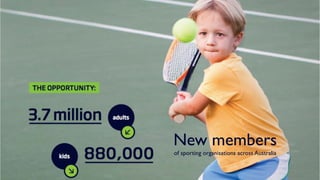
New members
of sporting organisations across Australia
#vsfwdthinking
David  Hood  
DOING  SOMETHING  GOOD
@DavidAHood
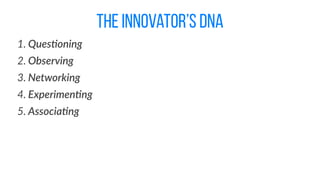
the innovator’s dna
1. Ques%oning  
2. Observing  
3. Networking  
4. Experimen%ng  
5. Associa%ng
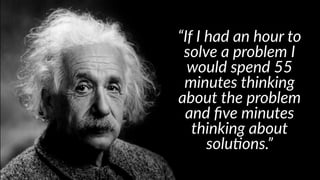
“If  I  had  an  hour  to  
solve  a  problem  I  
would  spend  55  
minutes  thinking  
about  the  problem  
and  five  minutes  
thinking  about  
solu@ons.”
“You  don’t  invent  the  answers,  you  reveal  the  
answers  by  finding  the  right  ques%ons.”    
-­‐  Jonas  Salk
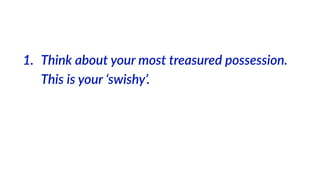
1. Think  about  your  most  treasured  possession.
1. Think  about  your  most  treasured  possession.  
This  is  your  ‘swishy’.
1. Think  about  your  most  treasured  possession.  
This  is  your  ‘swishy’.  
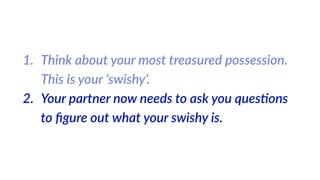
2. Your  partner  now  needs  to  ask  you  ques%ons  
to  figure  out  what  your  swishy  is.
1. Think  about  your  most  treasured  possession.  
This  is  your  ‘swishy’.  
2. Your  partner  now  needs  to  ask  you  ques%ons  
to  figure  out  what  your  swishy  is.  
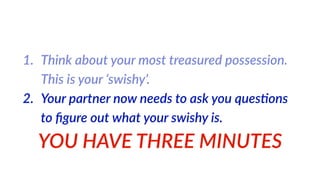
YOU  HAVE  THREE  MINUTES
30    
SECONDS  
LEFT
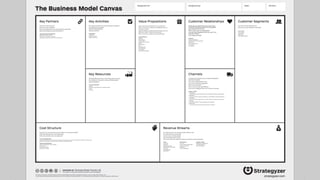
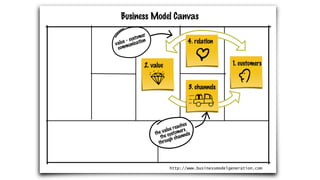
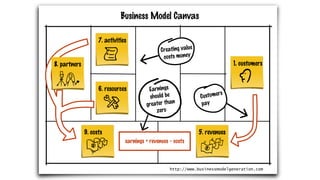
Business Model Canvas
1. customers
4. relation
3. channels
2. value
http://www.businessmodelgeneration.com
the value reaches
the customers
through channels
value - customer
communication
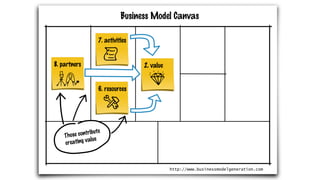
Business Model Canvas
2. value
6. resources
7. activities
8. partners
Those contribute
creating value
http://www.businessmodelgeneration.com
Business Model Canvas
earnings = revenues - costs
1. customers
5. revenues9. costs
6. resources
7. activities
8. partners
Customers
pay
Creating value
costs money
Earnings
should be
greater than
zero
http://www.businessmodelgeneration.com
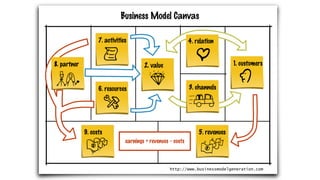
Business Model Canvas
earnings = revenues - costs
1. customers
4. relation
3. channels
2. value
5. revenues9. costs
6. resources
7. activities
8. partner
http://www.businessmodelgeneration.com
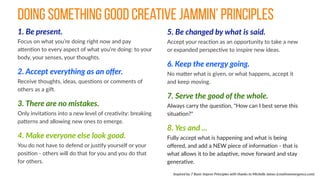
1.  Be  present.

Focus  on  what  you’re  doing  right  now  and  pay  
aBenCon  to  every  aspect  of  what  you’re  doing:  to  your  
body,  your  senses,  your  thoughts.    
2.  Accept  everything  as  an  offer.

Receive  thoughts,  ideas,  quesCons  or  comments  of  
others  as  a  giJ.  
3.  There  are  no  mistakes.

Only  invitaCons  into  a  new  level  of  creaCvity:  breaking  
paBerns  and  allowing  new  ones  to  emerge.  
4.  Make  everyone  else  look  good.  

You  do  not  have  to  defend  or  jusCfy  yourself  or  your  
posiCon  -­‐  others  will  do  that  for  you  and  you  do  that  
for  others.  
5.  Be  changed  by  what  is  said.

Accept  your  reacCon  as  an  opportunity  to  take  a  new  
or  expanded  perspecCve  to  inspire  new  ideas.  
6.  Keep  the  energy  going.

No  maBer  what  is  given,  or  what  happens,  accept  it  
and  keep  moving.    
7.  Serve  the  good  of  the  whole.

Always  carry  the  quesCon,  "How  can  I  best  serve  this  
situaCon?"  
8.  Yes  and  ...  

Fully  accept  what  is  happening  and  what  is  being  
offered,  and  add  a  NEW  piece  of  informaCon  -­‐  that  is  
what  allows  it  to  be  adapCve,  move  forward  and  stay  
generaCve.
Inspired  by  7  Basic  Improv  Principles  with  thanks  to  Michelle  James  (crea%veemergence.com)
DOING SOMETHING GOOD creative jammin’ principles
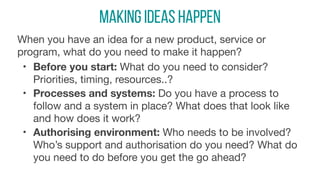
Making Ideas Happen
When you have an idea for a new product, service or
program, what do you need to make it happen? 

• Before you start: What do you need to consider?
Priorities, timing, resources..?

• Processes and systems: Do you have a process to
follow and a system in place? What does that look like
and how does it work?

• Authorising environment: Who needs to be involved?
Who’s support and authorisation do you need? What do
you need to do before you get the go ahead?
30    
SECONDS  
LEFT
What  does  a  good  idea  
look  like?
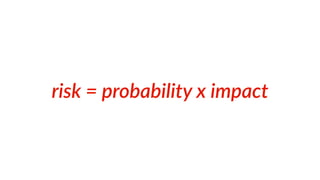
risk  =  probability  x  impact
risk
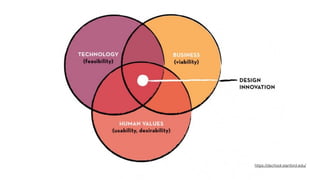
There  are  three  areas  in  which  a  startup  typically  faces  a  very  high  degree  of  
uncertainty—or  risk:  
1.  Technical  risk  (feasibility)  
2.  Customer  risk  (desirability)  
3.  Business  model  (viability)
technical risk
You  could  think  of  this  as  the  ques@on:  Can  we  build  this  thing  
at  all?  For  example,  if  you’re  seeking  a  cure  for  cancer,  there’s  
a  big  risk  that  you’ll  fail  to  find  it.  If  you  do  find  it,  you’ll  
certainly  have  customers,  so  there’s  no  market  risk.
customer risk
This  is  the  ques@on:  If  we  build  this  thing,  will  people  use  or  
buy  it?  Put  another  way:  Should  we  build  this  thing?
business model risk
This  amounts  to  the  ques@on:  Can  we  create  a  way  for  this  
thing  to  make  us  money?
biggest risk = customer risk
Opera@ng  under  the  assump@on  that  the  demand  exists  and  
that  customers  will  buy  and  use  your  product  or  service  in  the  
way  you  believe.  
“learning  what  customers  want  and  will  pay  for  is  your  biggest  
priority.  It’s  the  thing  you  want  to  do  most  quickly  and  
effec@vely.”
https://dschool.stanford.edu/
“Lean  Startup  is  a  method  for  crea@ng  and  sustaining  
innova@on  in  all  kinds  of  organisa@ons.  It  helps  you  get  good  
at  answering  two  cri@cal  ques@ons:  
1.  Should  we  build  this  new  product  or  service?  
2.  And  how  can  we  increase  our  odds  of  success  in  this  new  
thing?”  
~  Sarah  Milstein,  co-­‐founder  Lean  Startup  Produc@ons
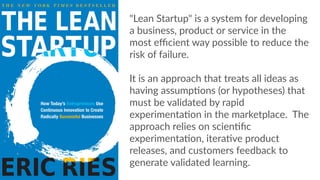
"Lean  Startup"  is  a  system  for  developing  
a  business,  product  or  service  in  the  
most  efficient  way  possible  to  reduce  the  
risk  of  failure.  
    
It  is  an  approach  that  treats  all  ideas  as  
having  assumpCons  (or  hypotheses)  that  
must  be  validated  by  rapid  
experimentaCon  in  the  marketplace.    The  
approach  relies  on  scienCfic  
experimentaCon,  iteraCve  product  
releases,  and  customers  feedback  to  
generate  validated  learning.
“Feedback  is  the  breakfast  of  champions.”    
-­‐Ken  Blanchard
A  startup  is  a  human  ins%tu%on  designed  to  create  a  
new  product  or  service  under  condi%ons  of  extreme  
uncertainty.  In  Lean  Startup  terms,  a  startup  is  a  group  
of  people  working  on  a  risky  new  product,  even  if  that  
group  of  people  works  for  Starbucks  or  the  US  Marine  
Corps.    
-­‐  Eric  Ries
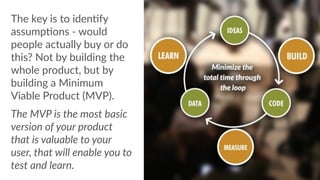
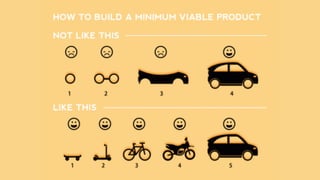
The  key  is  to  idenCfy  
assumpCons  -­‐  would  
people  actually  buy  or  do  
this?  Not  by  building  the  
whole  product,  but  by  
building  a  Minimum  
Viable  Product  (MVP).  
The  MVP  is  the  most  basic  
version  of  your  product  
that  is  valuable  to  your  
user,  that  will  enable  you  to  
test  and  learn.
#vsfwdthinking
Kirsten  Marks,  London  Agency  
PULSERAISER
@LondonAgencyVic
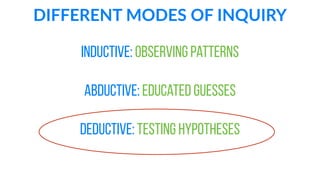
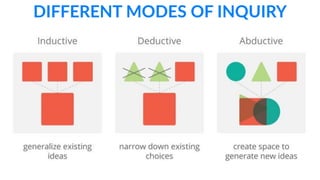
DIFFERENT  MODES  OF  INQUIRY
Inductive: observing patterns
Abductive: educated guesses
Deductive: testing hypotheses
DIFFERENT  MODES  OF  INQUIRY
SCENARIO:  FAST  SOCCER
You  are  a  group  that  manages  a  local  soccer  club  facing  diminishing  revenue  from  declining  
membership  numbers.  
You  have  noCced  recent  trends  around  ‘anyCme  anywhere  fitness’,  such  as  fitness  apps  and  24  
hour  gyms  and  ‘fast  sports’,  such  as  3  on  3  basketball,  and  your  club  wants  to  explore  how  soccer  
might  adapt  and  learn  from  these  innovaCons.  You  have  also  read  the  recent  research  by  the  
CSIRO  and  Australian  Sports  Commission  on  mega  trends  shaping  the  future  of  sport,  trends  
such  as  as  ‘a  perfect  fit’  and  ‘anybody’s  game’.  You  are  also  aware  of  the  Australian  InsCtute  of  
Sport’s  market  segmentaCon  research,  especially    personas  such  as  ‘ponders’,  ‘sidelined  sportsters’  
and  ‘apathe@c  clubbers’  for  whom  tradiConal  sporCng  codes  and  club  membership  models  are  less  
appealing.  Finally  you  are  aware  of  the  wider  trends  around  changes  to  membership  models.    
You  have  decided  to  develop  some  innovaCons  to  the  game  and/or  club  membership  models  
with  the  aim  of  creaCng  more  appeal  for  these  personas.  You  are  looking  to  idenCfy  the  
assumpCons  underpinning  your  innovaCon  ideas  and  design  some  experiments  to  test  these  
assumpCons  with  potenCal  users.
WHAT  IS  A  GAME?
A  game  is  a  voluntary  social  process.  
It  is  made  up  of:  
• game  space    
• boundaries  
• rules  
• artefacts  (equipment)  
• a  goal  (how  you  win)  
hBps://www.safaribooksonline.com/library/view/gamestorming/9781449391195/ch01.html
MORNING  
TEA
what’s  your  innovaFon?
Which  innovaCon  in  the  sport  do  you  think  is  most  likely  to  
get  your  market  segment  joining  in?  
1. changes  to  game  space  (how  people  start  playing)  
2. changes  to  boundaries  (space  or  Cme)  
3. changes  to  rules  
4. changes  to  artefacts  (equipment)  
5. changes  to  the  goal  (purpose  of  the  game/how  you  win)
how  sure  are  you?
How  sure  are  you  from  a  score  of  1  to  10,  that  people  are  
going  to  like  your  change  and  get  them  to  consider  trying  
your  variaCon?
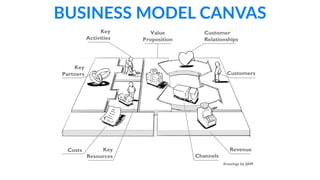
BUSINESS  MODEL  CANVAS
will  they  pay?
If  they  like  your  innovaCon,  would  they  be  willing  to  pay?  
How  much  would  you  be  able  to  get  them  to  pay?  
What  structure  of  offering  (eg  membership,  pay  as  you  go)  do  
you  think  they'd  like  the  most?
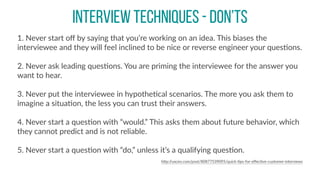
INTERVIEW TECHNIQUES - DON’TS
1.  Never  start  off  by  saying  that  you’re  working  on  an  idea.  This  biases  the  
interviewee  and  they  will  feel  inclined  to  be  nice  or  reverse  engineer  your  quesCons.  
2.  Never  ask  leading  quesCons.  You  are  priming  the  interviewee  for  the  answer  you  
want  to  hear.  
3.  Never  put  the  interviewee  in  hypotheCcal  scenarios.  The  more  you  ask  them  to  
imagine  a  situaCon,  the  less  you  can  trust  their  answers.  
4.  Never  start  a  quesCon  with  “would.”  This  asks  them  about  future  behavior,  which  
they  cannot  predict  and  is  not  reliable.  
5.  Never  start  a  quesCon  with  “do,”  unless  it’s  a  qualifying  quesCon.  
hBp://uxceo.com/post/80877539095/quick-­‐Cps-­‐for-­‐effecCve-­‐customer-­‐interviews
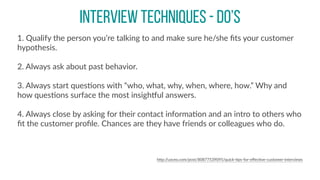
INTERVIEW TECHNIQUES - DO’S
1.  Qualify  the  person  you’re  talking  to  and  make  sure  he/she  fits  your  customer  
hypothesis.  
2.  Always  ask  about  past  behavior.  
3.  Always  start  quesCons  with  “who,  what,  why,  when,  where,  how.”  Why  and  
how  quesCons  surface  the  most  insighpul  answers.  
4.  Always  close  by  asking  for  their  contact  informaCon  and  an  intro  to  others  who  
fit  the  customer  profile.  Chances  are  they  have  friends  or  colleagues  who  do.  
hBp://uxceo.com/post/80877539095/quick-­‐Cps-­‐for-­‐effecCve-­‐customer-­‐interviews
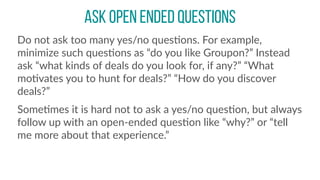
ask open ended questions
Do  not  ask  too  many  yes/no  quesCons.  For  example,  
minimize  such  quesCons  as  “do  you  like  Groupon?”  Instead  
ask  “what  kinds  of  deals  do  you  look  for,  if  any?”  “What  
moCvates  you  to  hunt  for  deals?”  “How  do  you  discover  
deals?”    
SomeCmes  it  is  hard  not  to  ask  a  yes/no  quesCon,  but  always  
follow  up  with  an  open-­‐ended  quesCon  like  “why?”  or  “tell  
me  more  about  that  experience.”
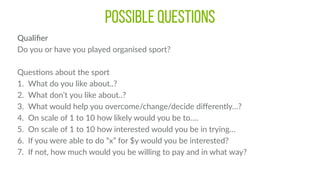
POSSIBLE QUESTIONS
Qualifier  
Do  you  or  have  you  played  organised  sport?  
QuesCons  about  the  sport  
1. What  do  you  like  about..?    
2. What  don’t  you  like  about..?    
3. What  would  help  you  overcome/change/decide  differently…?  
4. On  scale  of  1  to  10  how  likely  would  you  be  to….  
5. On  scale  of  1  to  10  how  interested  would  you  be  in  trying…  
6. If  you  were  able  to  do  “x”  for  $y  would  you  be  interested?  
7. If  not,  how  much  would  you  be  willing  to  pay  and  in  what  way?
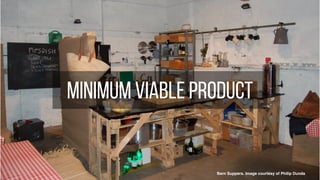
minimum viable product
Barn Suppers. Image courtesy of Philip Dunda
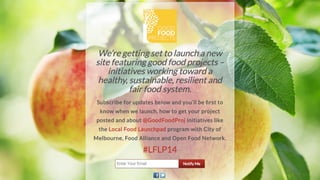
1.  LANDING  PAGE
designing  your  MVP
2.  A  BLOG  POST
3.  EMAIL
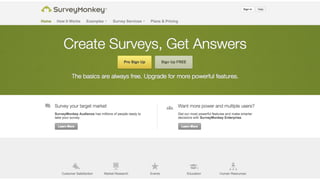
4.  SURVEYS
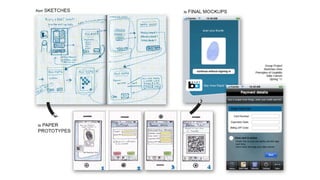
3.  BASIC  
PROTOTYPE
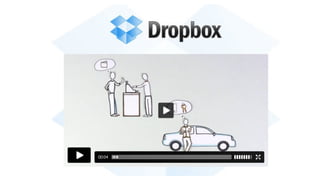
5.  EXPLAINER  
VIDEOS
6.  BASIC  
PROTOTYPE
7.  WIZARD  OF  OZ  
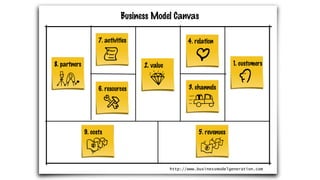
Business Model Canvas
1. customers
4. relation
3. channels
2. value
5. revenues9. costs
6. resources
7. activities
8. partners
http://www.businessmodelgeneration.com
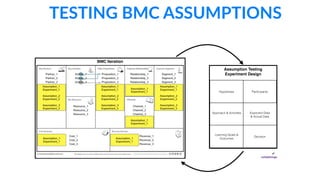
Assumption Testing
Experiment Design
Hypothesis Participants
Approach & Activities Expected Data
& Actual Data
Learning Goals &
Outcomes
Decision
BMC Iteration
TESTING  BMC  ASSUMPTIONS
thank  you
join  the  conversa1on  on  twi7er  with  
@vicsportAU  
@DoingSomeGood  
#vsfwdthinking
DAVID  HOOD  
@DavidAHood
JULIAN  WATERS-­‐LYNCH  
@jwaterslynch
doingsomething
good

Making Ideas Happen workshop for Vicsport

  • 1.
    making ideas happenge#ng more  people  physically  ac1ve  through  sport #vsfwdthinking
  • 2.
    welcome join  the  conversa1on on  twi7er  with   @vicsportAU   @DoingSomeGood   #vsfwdthinking DAVID  HOOD   @DavidAHood JULIAN  WATERS-­‐LYNCH   @jwaterslynch doingsomething good
  • 3.
  • 4.
  • 7.
    New members of sportingorganisations across Australia
  • 8.
    #vsfwdthinking David  Hood   DOING SOMETHING  GOOD @DavidAHood
  • 10.
    the innovator’s dna 1.Ques%oning   2. Observing   3. Networking   4. Experimen%ng   5. Associa%ng
  • 11.
    “If  I  had an  hour  to   solve  a  problem  I   would  spend  55   minutes  thinking   about  the  problem   and  five  minutes   thinking  about   solu@ons.”
  • 12.
    “You  don’t  invent the  answers,  you  reveal  the   answers  by  finding  the  right  ques%ons.”     -­‐  Jonas  Salk
  • 14.
    1. Think  about your  most  treasured  possession.
  • 15.
    1. Think  about your  most  treasured  possession.   This  is  your  ‘swishy’.
  • 16.
    1. Think  about your  most  treasured  possession.   This  is  your  ‘swishy’.   2. Your  partner  now  needs  to  ask  you  ques%ons   to  figure  out  what  your  swishy  is.
  • 17.
    1. Think  about your  most  treasured  possession.   This  is  your  ‘swishy’.   2. Your  partner  now  needs  to  ask  you  ques%ons   to  figure  out  what  your  swishy  is.   YOU  HAVE  THREE  MINUTES
  • 18.
  • 21.
    Business Model Canvas 1.customers 4. relation 3. channels 2. value http://www.businessmodelgeneration.com the value reaches the customers through channels value - customer communication
  • 22.
    Business Model Canvas 2.value 6. resources 7. activities 8. partners Those contribute creating value http://www.businessmodelgeneration.com
  • 23.
    Business Model Canvas earnings= revenues - costs 1. customers 5. revenues9. costs 6. resources 7. activities 8. partners Customers pay Creating value costs money Earnings should be greater than zero http://www.businessmodelgeneration.com
  • 24.
    Business Model Canvas earnings= revenues - costs 1. customers 4. relation 3. channels 2. value 5. revenues9. costs 6. resources 7. activities 8. partner http://www.businessmodelgeneration.com
  • 26.
    1.  Be  present.
 Focus on  what  you’re  doing  right  now  and  pay   aBenCon  to  every  aspect  of  what  you’re  doing:  to  your   body,  your  senses,  your  thoughts.     2.  Accept  everything  as  an  offer.
 Receive  thoughts,  ideas,  quesCons  or  comments  of   others  as  a  giJ.   3.  There  are  no  mistakes.
 Only  invitaCons  into  a  new  level  of  creaCvity:  breaking   paBerns  and  allowing  new  ones  to  emerge.   4.  Make  everyone  else  look  good.  
 You  do  not  have  to  defend  or  jusCfy  yourself  or  your   posiCon  -­‐  others  will  do  that  for  you  and  you  do  that   for  others.   5.  Be  changed  by  what  is  said.
 Accept  your  reacCon  as  an  opportunity  to  take  a  new   or  expanded  perspecCve  to  inspire  new  ideas.   6.  Keep  the  energy  going.
 No  maBer  what  is  given,  or  what  happens,  accept  it   and  keep  moving.     7.  Serve  the  good  of  the  whole.
 Always  carry  the  quesCon,  "How  can  I  best  serve  this   situaCon?"   8.  Yes  and  ...  
 Fully  accept  what  is  happening  and  what  is  being   offered,  and  add  a  NEW  piece  of  informaCon  -­‐  that  is   what  allows  it  to  be  adapCve,  move  forward  and  stay   generaCve. Inspired  by  7  Basic  Improv  Principles  with  thanks  to  Michelle  James  (crea%veemergence.com) DOING SOMETHING GOOD creative jammin’ principles
  • 27.
    Making Ideas Happen Whenyou have an idea for a new product, service or program, what do you need to make it happen? • Before you start: What do you need to consider? Priorities, timing, resources..? • Processes and systems: Do you have a process to follow and a system in place? What does that look like and how does it work? • Authorising environment: Who needs to be involved? Who’s support and authorisation do you need? What do you need to do before you get the go ahead?
  • 28.
  • 29.
    What  does  a good  idea   look  like?
  • 30.
  • 31.
    risk There  are  three areas  in  which  a  startup  typically  faces  a  very  high  degree  of   uncertainty—or  risk:   1.  Technical  risk  (feasibility)   2.  Customer  risk  (desirability)   3.  Business  model  (viability)
  • 32.
    technical risk You  could think  of  this  as  the  ques@on:  Can  we  build  this  thing   at  all?  For  example,  if  you’re  seeking  a  cure  for  cancer,  there’s   a  big  risk  that  you’ll  fail  to  find  it.  If  you  do  find  it,  you’ll   certainly  have  customers,  so  there’s  no  market  risk.
  • 33.
    customer risk This  is the  ques@on:  If  we  build  this  thing,  will  people  use  or   buy  it?  Put  another  way:  Should  we  build  this  thing?
  • 34.
    business model risk This amounts  to  the  ques@on:  Can  we  create  a  way  for  this   thing  to  make  us  money?
  • 35.
    biggest risk =customer risk Opera@ng  under  the  assump@on  that  the  demand  exists  and   that  customers  will  buy  and  use  your  product  or  service  in  the   way  you  believe.   “learning  what  customers  want  and  will  pay  for  is  your  biggest   priority.  It’s  the  thing  you  want  to  do  most  quickly  and   effec@vely.”
  • 36.
  • 37.
    “Lean  Startup  is a  method  for  crea@ng  and  sustaining   innova@on  in  all  kinds  of  organisa@ons.  It  helps  you  get  good   at  answering  two  cri@cal  ques@ons:   1.  Should  we  build  this  new  product  or  service?   2.  And  how  can  we  increase  our  odds  of  success  in  this  new   thing?”   ~  Sarah  Milstein,  co-­‐founder  Lean  Startup  Produc@ons
  • 38.
    "Lean  Startup"  is a  system  for  developing   a  business,  product  or  service  in  the   most  efficient  way  possible  to  reduce  the   risk  of  failure.       It  is  an  approach  that  treats  all  ideas  as   having  assumpCons  (or  hypotheses)  that   must  be  validated  by  rapid   experimentaCon  in  the  marketplace.    The   approach  relies  on  scienCfic   experimentaCon,  iteraCve  product   releases,  and  customers  feedback  to   generate  validated  learning.
  • 39.
    “Feedback  is  the breakfast  of  champions.”     -­‐Ken  Blanchard
  • 40.
    A  startup  is a  human  ins%tu%on  designed  to  create  a   new  product  or  service  under  condi%ons  of  extreme   uncertainty.  In  Lean  Startup  terms,  a  startup  is  a  group   of  people  working  on  a  risky  new  product,  even  if  that   group  of  people  works  for  Starbucks  or  the  US  Marine   Corps.     -­‐  Eric  Ries
  • 41.
    The  key  is to  idenCfy   assumpCons  -­‐  would   people  actually  buy  or  do   this?  Not  by  building  the   whole  product,  but  by   building  a  Minimum   Viable  Product  (MVP).   The  MVP  is  the  most  basic   version  of  your  product   that  is  valuable  to  your   user,  that  will  enable  you  to   test  and  learn.
  • 43.
    #vsfwdthinking Kirsten  Marks,  London Agency   PULSERAISER @LondonAgencyVic
  • 44.
    DIFFERENT  MODES  OF INQUIRY Inductive: observing patterns Abductive: educated guesses Deductive: testing hypotheses
  • 45.
  • 46.
    SCENARIO:  FAST  SOCCER You are  a  group  that  manages  a  local  soccer  club  facing  diminishing  revenue  from  declining   membership  numbers.   You  have  noCced  recent  trends  around  ‘anyCme  anywhere  fitness’,  such  as  fitness  apps  and  24   hour  gyms  and  ‘fast  sports’,  such  as  3  on  3  basketball,  and  your  club  wants  to  explore  how  soccer   might  adapt  and  learn  from  these  innovaCons.  You  have  also  read  the  recent  research  by  the   CSIRO  and  Australian  Sports  Commission  on  mega  trends  shaping  the  future  of  sport,  trends   such  as  as  ‘a  perfect  fit’  and  ‘anybody’s  game’.  You  are  also  aware  of  the  Australian  InsCtute  of   Sport’s  market  segmentaCon  research,  especially    personas  such  as  ‘ponders’,  ‘sidelined  sportsters’   and  ‘apathe@c  clubbers’  for  whom  tradiConal  sporCng  codes  and  club  membership  models  are  less   appealing.  Finally  you  are  aware  of  the  wider  trends  around  changes  to  membership  models.     You  have  decided  to  develop  some  innovaCons  to  the  game  and/or  club  membership  models   with  the  aim  of  creaCng  more  appeal  for  these  personas.  You  are  looking  to  idenCfy  the   assumpCons  underpinning  your  innovaCon  ideas  and  design  some  experiments  to  test  these   assumpCons  with  potenCal  users.
  • 47.
    WHAT  IS  A GAME? A  game  is  a  voluntary  social  process.   It  is  made  up  of:   • game  space     • boundaries   • rules   • artefacts  (equipment)   • a  goal  (how  you  win)   hBps://www.safaribooksonline.com/library/view/gamestorming/9781449391195/ch01.html
  • 48.
  • 49.
    what’s  your  innovaFon? Which innovaCon  in  the  sport  do  you  think  is  most  likely  to   get  your  market  segment  joining  in?   1. changes  to  game  space  (how  people  start  playing)   2. changes  to  boundaries  (space  or  Cme)   3. changes  to  rules   4. changes  to  artefacts  (equipment)   5. changes  to  the  goal  (purpose  of  the  game/how  you  win)
  • 50.
    how  sure  are you? How  sure  are  you  from  a  score  of  1  to  10,  that  people  are   going  to  like  your  change  and  get  them  to  consider  trying   your  variaCon?
  • 51.
  • 52.
    will  they  pay? If they  like  your  innovaCon,  would  they  be  willing  to  pay?   How  much  would  you  be  able  to  get  them  to  pay?   What  structure  of  offering  (eg  membership,  pay  as  you  go)  do   you  think  they'd  like  the  most?
  • 54.
    INTERVIEW TECHNIQUES -DON’TS 1.  Never  start  off  by  saying  that  you’re  working  on  an  idea.  This  biases  the   interviewee  and  they  will  feel  inclined  to  be  nice  or  reverse  engineer  your  quesCons.   2.  Never  ask  leading  quesCons.  You  are  priming  the  interviewee  for  the  answer  you   want  to  hear.   3.  Never  put  the  interviewee  in  hypotheCcal  scenarios.  The  more  you  ask  them  to   imagine  a  situaCon,  the  less  you  can  trust  their  answers.   4.  Never  start  a  quesCon  with  “would.”  This  asks  them  about  future  behavior,  which   they  cannot  predict  and  is  not  reliable.   5.  Never  start  a  quesCon  with  “do,”  unless  it’s  a  qualifying  quesCon.   hBp://uxceo.com/post/80877539095/quick-­‐Cps-­‐for-­‐effecCve-­‐customer-­‐interviews
  • 55.
    INTERVIEW TECHNIQUES -DO’S 1.  Qualify  the  person  you’re  talking  to  and  make  sure  he/she  fits  your  customer   hypothesis.   2.  Always  ask  about  past  behavior.   3.  Always  start  quesCons  with  “who,  what,  why,  when,  where,  how.”  Why  and   how  quesCons  surface  the  most  insighpul  answers.   4.  Always  close  by  asking  for  their  contact  informaCon  and  an  intro  to  others  who   fit  the  customer  profile.  Chances  are  they  have  friends  or  colleagues  who  do.   hBp://uxceo.com/post/80877539095/quick-­‐Cps-­‐for-­‐effecCve-­‐customer-­‐interviews
  • 56.
    ask open endedquestions Do  not  ask  too  many  yes/no  quesCons.  For  example,   minimize  such  quesCons  as  “do  you  like  Groupon?”  Instead   ask  “what  kinds  of  deals  do  you  look  for,  if  any?”  “What   moCvates  you  to  hunt  for  deals?”  “How  do  you  discover   deals?”     SomeCmes  it  is  hard  not  to  ask  a  yes/no  quesCon,  but  always   follow  up  with  an  open-­‐ended  quesCon  like  “why?”  or  “tell   me  more  about  that  experience.”
  • 57.
    POSSIBLE QUESTIONS Qualifier   Do you  or  have  you  played  organised  sport?   QuesCons  about  the  sport   1. What  do  you  like  about..?     2. What  don’t  you  like  about..?     3. What  would  help  you  overcome/change/decide  differently…?   4. On  scale  of  1  to  10  how  likely  would  you  be  to….   5. On  scale  of  1  to  10  how  interested  would  you  be  in  trying…   6. If  you  were  able  to  do  “x”  for  $y  would  you  be  interested?   7. If  not,  how  much  would  you  be  willing  to  pay  and  in  what  way?
  • 58.
    minimum viable product BarnSuppers. Image courtesy of Philip Dunda
  • 60.
  • 61.
  • 62.
  • 64.
  • 66.
  • 67.
  • 68.
  • 71.
  • 73.
  • 75.
    Business Model Canvas 1.customers 4. relation 3. channels 2. value 5. revenues9. costs 6. resources 7. activities 8. partners http://www.businessmodelgeneration.com
  • 76.
    Assumption Testing Experiment Design HypothesisParticipants Approach & Activities Expected Data & Actual Data Learning Goals & Outcomes Decision BMC Iteration TESTING  BMC  ASSUMPTIONS
  • 77.
    thank  you join  the conversa1on  on  twi7er  with   @vicsportAU   @DoingSomeGood   #vsfwdthinking DAVID  HOOD   @DavidAHood JULIAN  WATERS-­‐LYNCH   @jwaterslynch doingsomething good