ENGLISH FOR
ACADEMIC AND
PROFESSIONAL
PURPOSES
Objectives
• Determines the ways a writer can
elucidate on a concept by definition,
explication and clarification
(CS_EN11/12A-EAPP-Ig-j-20)
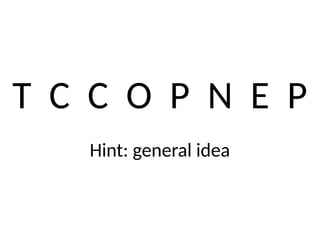
T C C O P N E P
Hint: general idea
D E T C I E U L A
Hint: explain
N O D F I E I T
N I
Hint: meaning
R I F I T I O N C L A
C A
Hint: clearing up
C A E X P L I T I O N
Hint: explanation
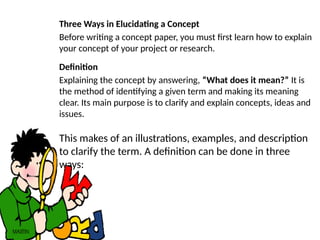
Three Ways in Elucidating a Concept
Before writing a concept paper, you must first learn how to explain
your concept of your project or research.
Definition
Explaining the concept by answering, “What does it mean?” It is
the method of identifying a given term and making its meaning
clear. Its main purpose is to clarify and explain concepts, ideas and
issues.
This makes of an illustrations, examples, and description
to clarify the term. A definition can be done in three
ways:
C A E X P L I T I O N
Hint: explanation
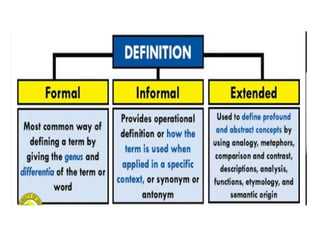
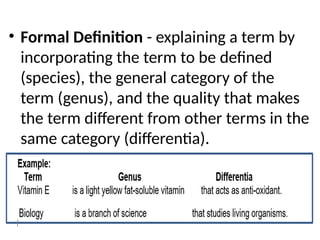
• Formal Definition - explaining a term by
incorporating the term to be defined
(species), the general category of the
term (genus), and the quality that makes
the term different from other terms in the
same category (differentia).
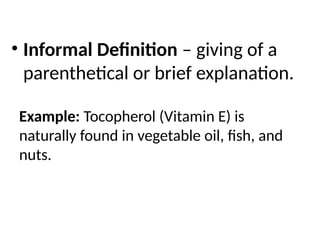
• Informal Definition – giving of a
parenthetical or brief explanation.
Example: Tocopherol (Vitamin E) is
naturally found in vegetable oil, fish, and
nuts.
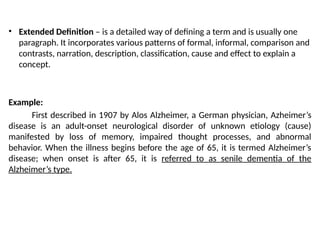
• Extended Definition – is a detailed way of defining a term and is usually one
paragraph. It incorporates various patterns of formal, informal, comparison and
contrasts, narration, description, classification, cause and effect to explain a
concept.
Example:
First described in 1907 by Alos Alzheimer, a German physician, Azheimer’s
disease is an adult-onset neurological disorder of unknown etiology (cause)
manifested by loss of memory, impaired thought processes, and abnormal
behavior. When the illness begins before the age of 65, it is termed Alzheimer’s
disease; when onset is after 65, it is referred to as senile dementia of the
Alzheimer’s type.
2.Explication – is a method of explanation in which
sentences, verses, quotes, or phrases are taken
from a literary or academic work then interpreted
and explained in a detailed way. You may begin by
analyzing and explaining how the text was
constructed and end with a concise conclusion by
restating your major arguments. Explication does
not only illuminate a piece of literature, but also
serves to remind the readers about its historical
setting and formal properties of style and language.
Example:
The poem titled “The Road Not Taken” by Robert Frost is about a man
reflecting on a choice he once made. While the outcome of this choice is
not implied to be positive or negative the speaker notes that the choice
in itself and the consequences of that choice have made a huge
difference in the way his life has unfolded.
In the final stanza of his poem The Road Not Taken, Frost talks about
his dilemma of coming upon two diverging paths, and not knowing
which one to choose. The third line is very important, as it delivers an
idea of choosing between the two divergent paths.
The tone in this stanza shifts from regretful to optimistic. The two
roads symbolically represent individual choices. The mood is neither
depressed nor unhappy, but the poet sighs because he knows what the
complexities our life may have for him. Whether he has chosen a right or
a wrong path, it has a compelling impact on his life. The phrase “less
traveled” suggests the theme of individualism.
3.Clarification – it is a method of explanation
in which the points are organized from a
general abstract idea to specific and concrete
examples. The analysis of the concept is
done by looking at the examples and
specifying its characteristics.
Justice is a broad concept which encompasses a wide set of
ideas, most of which also branch out into smaller notions. For
instance, it can refer to the sentencing of a criminal based on due
process. When an individual gets what he deserves, even outside the
hands of the law, it is also considered justice in some context. This
may come in the form of vigilant justice, in which a person
dissatisfied with the system doles out punishing to wrong-doers.
Poetic justice is also another related concept which is used in
literature to show how the good is always rewarded while bad forces
always meet a grim end. In the context of this paper, justice will be
clearly delineated into any instance in which the law is successfully
and fairly applied to an individual, resulting in either an arrest or a
release. To illustrate, if a theft is caught and tried in court through
due process, and is found to be guilty and then sentenced
accordingly, it can be said that justice was served. However, if the
same thief is caught in the act by a band of villagers and was beaten
right then and there, it will be considered justice in the context of the
paper, as the process has not undergone due process.
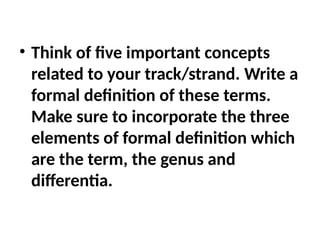
• Think of five important concepts
related to your track/strand. Write a
formal definition of these terms.
Make sure to incorporate the three
elements of formal definition which
are the term, the genus and
differentia.
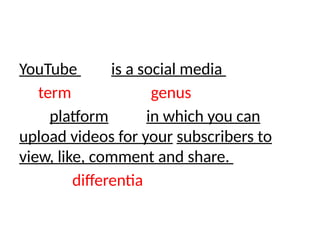
YouTube is a social media
term genus
platform in which you can
upload videos for your subscribers to
view, like, comment and share.
differentia
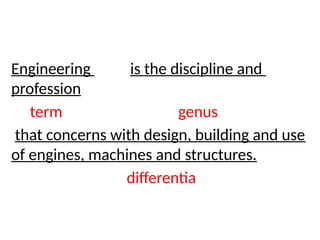
Engineering is the discipline and
profession
term genus
that concerns with design, building and use
of engines, machines and structures.
differentia
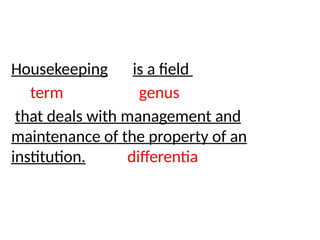
Housekeeping is a field
term genus
that deals with management and
maintenance of the property of an
institution. differentia
1.Democracy is a form of government of government in
which all eligible citizens participate equally-either directly
or through elected representatives-in the proposal,
development and creation of laws. It encompasses social,
economic and cultural conditions that enable the free and
equal practice of political self-determination. The term
originates from the Greek term ‘demokratia’ which means
rule of the people, which was coined from ‘demos’
meaning “people” and ‘kratos’ which means “power” or
“rule” in the 5th century BCE to denote the political
systems then existing in Greek city-states, notably Athens.
2.Mother Tongue-based Multilingual Education (MTB-MLE) is
a curriculum and teaching methodology that enables
learners to participate well in education through the use of
the first language. MTB-MLE provides a strong foundation in
the learners’ first language (L1), enabling them to build on
the knowledge and experiences they bring to the classroom.
MTB-MLE also provides a good bridge to listening, speaking,
reading and writing the second languages (L2, L3) of the
classroom using sound educational principles for building
fluency and confidence in using the other languages for
lifelong learning.” (Dekker 2010:23)
3. In his very first paragraph of “A Tale of Two Cities”, Charles Dickens
demonstrates both similarity and contrast existed between the two
countries, England and France during the French Revolution. This
passage presents an image of chaos and turmoil, which ensue due to a
clash between extreme ideas between the two different countries and
their people.
The tone of this story is both chaotic and melancholic, presenting a
theme of duality. In fact, Dickens has used paradoxes to establish the
plot and theme of this novel. The rich were enjoying lives of
abundance, while, on the other hand, the poor were suffereing from
deprivation. In England, there was a lack of security, and in France, the
clergymen practised inhuman activities against the masses. In other
words, this passage emphasizes the issue of juxtaposition of these two
counties, and sets up the basis for upcoming events in the novel.
4. Research (quantitative, qualitative or
mixed-methods) is a systematic,
controlled, empirical and critical
investigation of a natural phenomenon.
5. Subsequent to materials design is the preparation of
learning materials. Learning materials refer to both printed
and non-printed objects or items that teachers and learners
use to facilitate language learning. Nowadays, materials are
becoming more and more sophisticated, incorporating
authentic language samples and realias that help make a
connection between classrooms and real-life activities. They
also incorporate information and communications technology
(ICT), role-plays, information-gap activities, songs, taped
transcripts, integrated macroskills, and explicit rubrics.
6. Civil law is a branch of law that deals
in resolving disputes on contractual
agreements.
7. Texture (element of art) pertains to
how an object feels when touched.
8. Entrepreneurship is a process of
creating and building a business
enterprise.
9. Carbohydrate (food group) includes
related substances such as sugars,
starches and cellulose.
10. Earth science literacy is one of the types of literacy
defined for Earth systems; the qualities of an Earth-science-
literate person are representative of the qualities for all the
Earth system literacy definitions. According to the earth
Science Literacy Initiative, an earth-science-literate person:
• Understands the fundamental concepts of Earth’s many
systems;
• Knows how to find and assess scientifically credible
information abouth earth;
• Is able to make informed and responsible decisions
regarding Earth and its resources.
Thank you for listening!

Definition, Clarification and Explication in EAPP

  • 1.
  • 2.
    Objectives • Determines theways a writer can elucidate on a concept by definition, explication and clarification (CS_EN11/12A-EAPP-Ig-j-20)
  • 3.
    T C CO P N E P Hint: general idea
  • 4.
    D E TC I E U L A Hint: explain
  • 5.
    N O DF I E I T N I Hint: meaning
  • 6.
    R I FI T I O N C L A C A Hint: clearing up
  • 7.
    C A EX P L I T I O N Hint: explanation
  • 8.
    Three Ways inElucidating a Concept Before writing a concept paper, you must first learn how to explain your concept of your project or research. Definition Explaining the concept by answering, “What does it mean?” It is the method of identifying a given term and making its meaning clear. Its main purpose is to clarify and explain concepts, ideas and issues. This makes of an illustrations, examples, and description to clarify the term. A definition can be done in three ways:
  • 9.
    C A EX P L I T I O N Hint: explanation
  • 10.
    • Formal Definition- explaining a term by incorporating the term to be defined (species), the general category of the term (genus), and the quality that makes the term different from other terms in the same category (differentia).
  • 11.
    • Informal Definition– giving of a parenthetical or brief explanation. Example: Tocopherol (Vitamin E) is naturally found in vegetable oil, fish, and nuts.
  • 12.
    • Extended Definition– is a detailed way of defining a term and is usually one paragraph. It incorporates various patterns of formal, informal, comparison and contrasts, narration, description, classification, cause and effect to explain a concept. Example: First described in 1907 by Alos Alzheimer, a German physician, Azheimer’s disease is an adult-onset neurological disorder of unknown etiology (cause) manifested by loss of memory, impaired thought processes, and abnormal behavior. When the illness begins before the age of 65, it is termed Alzheimer’s disease; when onset is after 65, it is referred to as senile dementia of the Alzheimer’s type.
  • 13.
    2.Explication – isa method of explanation in which sentences, verses, quotes, or phrases are taken from a literary or academic work then interpreted and explained in a detailed way. You may begin by analyzing and explaining how the text was constructed and end with a concise conclusion by restating your major arguments. Explication does not only illuminate a piece of literature, but also serves to remind the readers about its historical setting and formal properties of style and language.
  • 14.
    Example: The poem titled“The Road Not Taken” by Robert Frost is about a man reflecting on a choice he once made. While the outcome of this choice is not implied to be positive or negative the speaker notes that the choice in itself and the consequences of that choice have made a huge difference in the way his life has unfolded. In the final stanza of his poem The Road Not Taken, Frost talks about his dilemma of coming upon two diverging paths, and not knowing which one to choose. The third line is very important, as it delivers an idea of choosing between the two divergent paths. The tone in this stanza shifts from regretful to optimistic. The two roads symbolically represent individual choices. The mood is neither depressed nor unhappy, but the poet sighs because he knows what the complexities our life may have for him. Whether he has chosen a right or a wrong path, it has a compelling impact on his life. The phrase “less traveled” suggests the theme of individualism.
  • 15.
    3.Clarification – itis a method of explanation in which the points are organized from a general abstract idea to specific and concrete examples. The analysis of the concept is done by looking at the examples and specifying its characteristics.
  • 16.
    Justice is abroad concept which encompasses a wide set of ideas, most of which also branch out into smaller notions. For instance, it can refer to the sentencing of a criminal based on due process. When an individual gets what he deserves, even outside the hands of the law, it is also considered justice in some context. This may come in the form of vigilant justice, in which a person dissatisfied with the system doles out punishing to wrong-doers. Poetic justice is also another related concept which is used in literature to show how the good is always rewarded while bad forces always meet a grim end. In the context of this paper, justice will be clearly delineated into any instance in which the law is successfully and fairly applied to an individual, resulting in either an arrest or a release. To illustrate, if a theft is caught and tried in court through due process, and is found to be guilty and then sentenced accordingly, it can be said that justice was served. However, if the same thief is caught in the act by a band of villagers and was beaten right then and there, it will be considered justice in the context of the paper, as the process has not undergone due process.
  • 17.
    • Think offive important concepts related to your track/strand. Write a formal definition of these terms. Make sure to incorporate the three elements of formal definition which are the term, the genus and differentia.
  • 18.
    YouTube is asocial media term genus platform in which you can upload videos for your subscribers to view, like, comment and share. differentia
  • 19.
    Engineering is thediscipline and profession term genus that concerns with design, building and use of engines, machines and structures. differentia
  • 20.
    Housekeeping is afield term genus that deals with management and maintenance of the property of an institution. differentia
  • 21.
    1.Democracy is aform of government of government in which all eligible citizens participate equally-either directly or through elected representatives-in the proposal, development and creation of laws. It encompasses social, economic and cultural conditions that enable the free and equal practice of political self-determination. The term originates from the Greek term ‘demokratia’ which means rule of the people, which was coined from ‘demos’ meaning “people” and ‘kratos’ which means “power” or “rule” in the 5th century BCE to denote the political systems then existing in Greek city-states, notably Athens.
  • 22.
    2.Mother Tongue-based MultilingualEducation (MTB-MLE) is a curriculum and teaching methodology that enables learners to participate well in education through the use of the first language. MTB-MLE provides a strong foundation in the learners’ first language (L1), enabling them to build on the knowledge and experiences they bring to the classroom. MTB-MLE also provides a good bridge to listening, speaking, reading and writing the second languages (L2, L3) of the classroom using sound educational principles for building fluency and confidence in using the other languages for lifelong learning.” (Dekker 2010:23)
  • 23.
    3. In hisvery first paragraph of “A Tale of Two Cities”, Charles Dickens demonstrates both similarity and contrast existed between the two countries, England and France during the French Revolution. This passage presents an image of chaos and turmoil, which ensue due to a clash between extreme ideas between the two different countries and their people. The tone of this story is both chaotic and melancholic, presenting a theme of duality. In fact, Dickens has used paradoxes to establish the plot and theme of this novel. The rich were enjoying lives of abundance, while, on the other hand, the poor were suffereing from deprivation. In England, there was a lack of security, and in France, the clergymen practised inhuman activities against the masses. In other words, this passage emphasizes the issue of juxtaposition of these two counties, and sets up the basis for upcoming events in the novel.
  • 24.
    4. Research (quantitative,qualitative or mixed-methods) is a systematic, controlled, empirical and critical investigation of a natural phenomenon.
  • 25.
    5. Subsequent tomaterials design is the preparation of learning materials. Learning materials refer to both printed and non-printed objects or items that teachers and learners use to facilitate language learning. Nowadays, materials are becoming more and more sophisticated, incorporating authentic language samples and realias that help make a connection between classrooms and real-life activities. They also incorporate information and communications technology (ICT), role-plays, information-gap activities, songs, taped transcripts, integrated macroskills, and explicit rubrics.
  • 26.
    6. Civil lawis a branch of law that deals in resolving disputes on contractual agreements. 7. Texture (element of art) pertains to how an object feels when touched.
  • 27.
    8. Entrepreneurship isa process of creating and building a business enterprise. 9. Carbohydrate (food group) includes related substances such as sugars, starches and cellulose.
  • 28.
    10. Earth scienceliteracy is one of the types of literacy defined for Earth systems; the qualities of an Earth-science- literate person are representative of the qualities for all the Earth system literacy definitions. According to the earth Science Literacy Initiative, an earth-science-literate person: • Understands the fundamental concepts of Earth’s many systems; • Knows how to find and assess scientifically credible information abouth earth; • Is able to make informed and responsible decisions regarding Earth and its resources.
  • 29.
    Thank you forlistening!