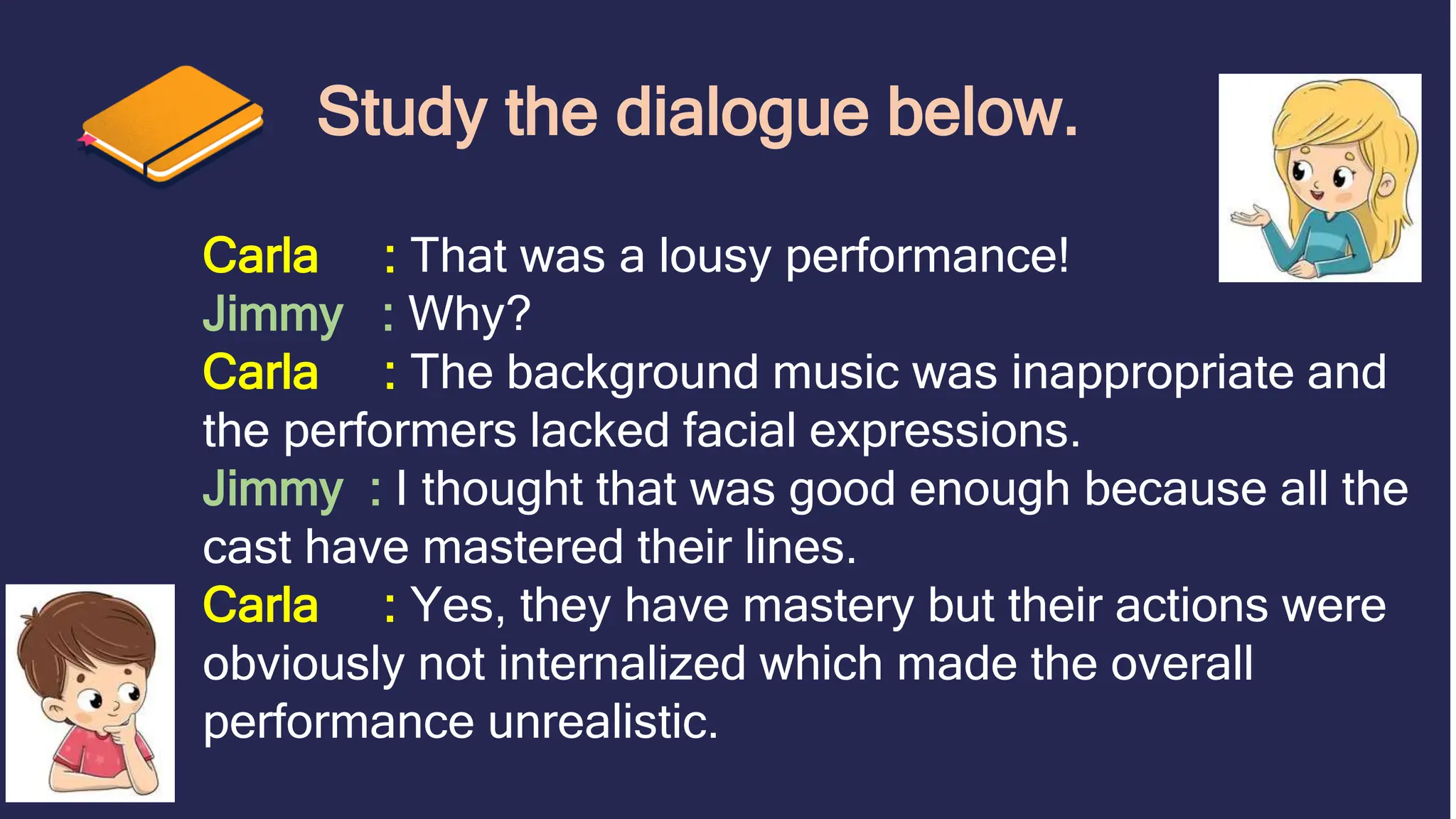
Study the dialogue below.
Carla : That was a lousy performance!
Jimmy : Why?
Carla : The background music was inappropriate and
the performers lacked facial expressions.
Jimmy : I thought that was good enough because all the
cast have mastered their lines.
Carla : Yes, they have mastery but their actions were
obviously not internalized which made the overall
performance unrealistic.
Process Question
1. What are the two
students talking
about?
Process Question
2. What are they
doing in the entire
conversation?
Process Question
3. What was Carla’s
stand about the
performance?
Process Question
4. What about
Jimmy’s stand? Did
he agree with Carla?
Process Question
5. What was Carla
trying to prove?
1.Identify the key structural elements
and language features.
2. Organize an argumentative text
through an outline.
3. Share the importance of
knowledge of structural elements of
an argumentative text.
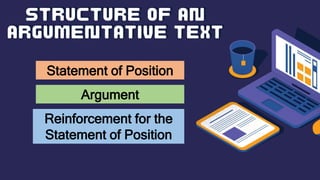
Statement of Position
Argument
Reinforcement for the
Statement of Position
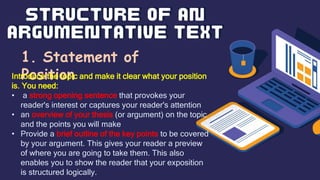
1. Statement of
Position
Introduce the topic and make it clear what your position
is. You need:
• a strong opening sentence that provokes your
reader's interest or captures your reader's attention
• an overview of your thesis (or argument) on the topic
and the points you will make
• Provide a brief outline of the key points to be covered
by your argument. This gives your reader a preview
of where you are going to take them. This also
enables you to show the reader that your exposition
is structured logically.
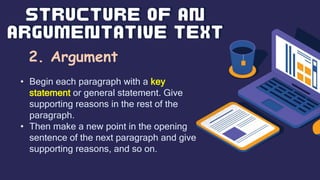
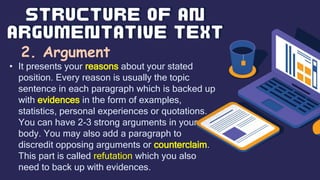
2. Argument
• Begin each paragraph with a key
statement or general statement. Give
supporting reasons in the rest of the
paragraph.
• Then make a new point in the opening
sentence of the next paragraph and give
supporting reasons, and so on.
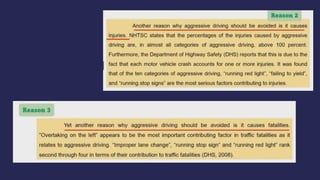
2. Argument
• It presents your reasons about your stated
position. Every reason is usually the topic
sentence in each paragraph which is backed up
with evidences in the form of examples,
statistics, personal experiences or quotations.
You can have 2-3 strong arguments in your
body. You may also add a paragraph to
discredit opposing arguments or counterclaim.
This part is called refutation which you also
need to back up with evidences.
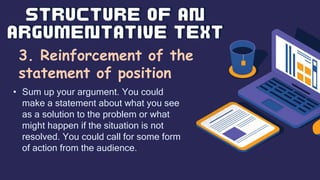
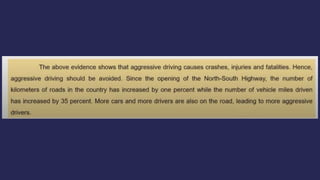
3. Reinforcement of the
statement of position
• Sum up your argument. You could
make a statement about what you see
as a solution to the problem or what
might happen if the situation is not
resolved. You could call for some form
of action from the audience.
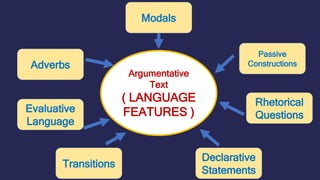
Argumentative
Text
( LANGUAGE
FEATURES )
Modals
Transitions
Declarative
Statements
Evaluative
Language
Rhetorical
Questions
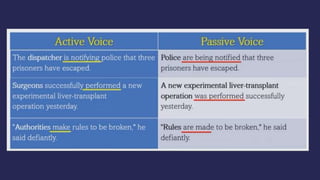
Passive
Constructions
Adverbs
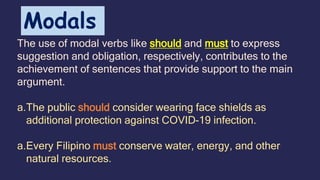
The use of modal verbs like should and must to express
suggestion and obligation, respectively, contributes to the
achievement of sentences that provide support to the main
argument.
a.The public should consider wearing face shields as
additional protection against COVID-19 infection.
a.Every Filipino must conserve water, energy, and other
natural resources.
Modals
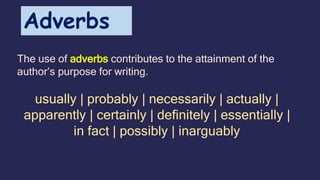
The use of adverbs contributes to the attainment of the
author’s purpose for writing.
usually | probably | necessarily | actually |
apparently | certainly | definitely | essentially |
in fact | possibly | inarguably
Adverbs
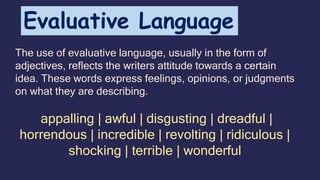
The use of evaluative language, usually in the form of
adjectives, reflects the writers attitude towards a certain
idea. These words express feelings, opinions, or judgments
on what they are describing.
appalling | awful | disgusting | dreadful |
horrendous | incredible | revolting | ridiculous |
shocking | terrible | wonderful
Evaluative Language
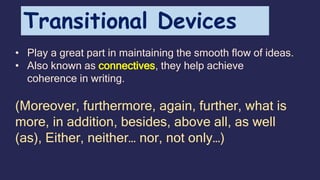
• Play a great part in maintaining the smooth flow of ideas.
• Also known as connectives, they help achieve
coherence in writing.
(Moreover, furthermore, again, further, what is
more, in addition, besides, above all, as well
(as), Either, neither… nor, not only…)
Transitional Devices
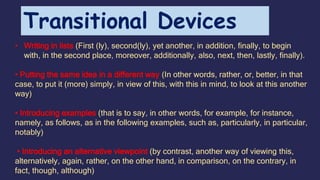
• Writing in lists (First (ly), second(ly), yet another, in addition, finally, to begin
with, in the second place, moreover, additionally, also, next, then, lastly, finally).
• Putting the same idea in a different way (In other words, rather, or, better, in that
case, to put it (more) simply, in view of this, with this in mind, to look at this another
way)
• Introducing examples (that is to say, in other words, for example, for instance,
namely, as follows, as in the following examples, such as, particularly, in particular,
notably)
• Introducing an alternative viewpoint (by contrast, another way of viewing this,
alternatively, again, rather, on the other hand, in comparison, on the contrary, in
fact, though, although)
Transitional Devices
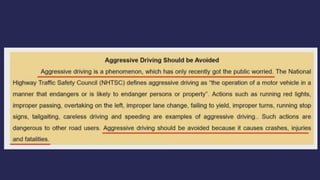
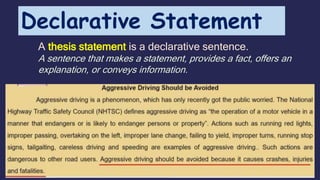
A thesis statement is a declarative sentence.
A sentence that makes a statement, provides a fact, offers an
explanation, or conveys information.
Declarative Statement
A rhetorical question is a statement formed as
a question.
It is used to start a discourse, or as a means of
putting across the speaker's or author's opinion
on a topic.
Rhetorical
Question
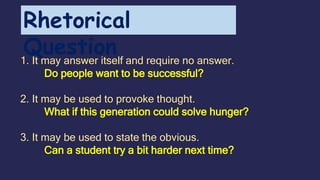
1. It may answer itself and require no answer.
Do people want to be successful?
2. It may be used to provoke thought.
What if this generation could solve hunger?
3. It may be used to state the obvious.
Can a student try a bit harder next time?
Rhetorical
Question
It usually comes in the form (verb be + past
participle of the main verb) depending on the
tense, like was formulated, were discussed,
and will be presented, has been raised, etc.
Highlights the action and what is acted upon
rather than the agent performing the action.
Passive Voice
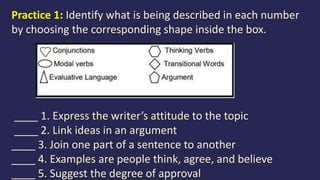
Practice 1: Identify what is being described in each number
by choosing the corresponding shape inside the box.
____ 1. Express the writer’s attitude to the topic
____ 2. Link ideas in an argument
____ 3. Join one part of a sentence to another
____ 4. Examples are people think, agree, and believe
____ 5. Suggest the degree of approval
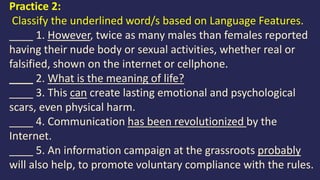
Practice 2:
Classify the underlined word/s based on Language Features.
____ 1. However, twice as many males than females reported
having their nude body or sexual activities, whether real or
falsified, shown on the internet or cellphone.
____ 2. What is the meaning of life?
____ 3. This can create lasting emotional and psychological
scars, even physical harm.
____ 4. Communication has been revolutionized by the
Internet.
____ 5. An information campaign at the grassroots probably
will also help, to promote voluntary compliance with the rules.
Practice 3:
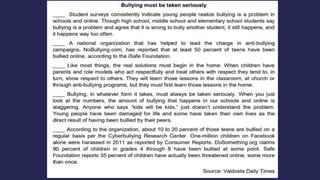
Arrange the editorial according to the
structure of an exposition.
Indicate the numbers 1-5 before the
number.
Quarter-2-Module-2-Key-Structual-Elements-and-Language-Features-of-Argumentative-Text.pptx

Quarter-2-Module-2-Key-Structual-Elements-and-Language-Features-of-Argumentative-Text.pptx

  • 1.
    Study the dialoguebelow. Carla : That was a lousy performance! Jimmy : Why? Carla : The background music was inappropriate and the performers lacked facial expressions. Jimmy : I thought that was good enough because all the cast have mastered their lines. Carla : Yes, they have mastery but their actions were obviously not internalized which made the overall performance unrealistic.
  • 2.
    Process Question 1. Whatare the two students talking about?
  • 3.
    Process Question 2. Whatare they doing in the entire conversation?
  • 4.
    Process Question 3. Whatwas Carla’s stand about the performance?
  • 5.
    Process Question 4. Whatabout Jimmy’s stand? Did he agree with Carla?
  • 6.
    Process Question 5. Whatwas Carla trying to prove?
  • 8.
    1.Identify the keystructural elements and language features. 2. Organize an argumentative text through an outline. 3. Share the importance of knowledge of structural elements of an argumentative text.
  • 9.
    Statement of Position Argument Reinforcementfor the Statement of Position
  • 10.
    1. Statement of Position Introducethe topic and make it clear what your position is. You need: • a strong opening sentence that provokes your reader's interest or captures your reader's attention • an overview of your thesis (or argument) on the topic and the points you will make • Provide a brief outline of the key points to be covered by your argument. This gives your reader a preview of where you are going to take them. This also enables you to show the reader that your exposition is structured logically.
  • 12.
    2. Argument • Begineach paragraph with a key statement or general statement. Give supporting reasons in the rest of the paragraph. • Then make a new point in the opening sentence of the next paragraph and give supporting reasons, and so on.
  • 13.
    2. Argument • Itpresents your reasons about your stated position. Every reason is usually the topic sentence in each paragraph which is backed up with evidences in the form of examples, statistics, personal experiences or quotations. You can have 2-3 strong arguments in your body. You may also add a paragraph to discredit opposing arguments or counterclaim. This part is called refutation which you also need to back up with evidences.
  • 16.
    3. Reinforcement ofthe statement of position • Sum up your argument. You could make a statement about what you see as a solution to the problem or what might happen if the situation is not resolved. You could call for some form of action from the audience.
  • 18.
  • 19.
    The use ofmodal verbs like should and must to express suggestion and obligation, respectively, contributes to the achievement of sentences that provide support to the main argument. a.The public should consider wearing face shields as additional protection against COVID-19 infection. a.Every Filipino must conserve water, energy, and other natural resources. Modals
  • 21.
    The use ofadverbs contributes to the attainment of the author’s purpose for writing. usually | probably | necessarily | actually | apparently | certainly | definitely | essentially | in fact | possibly | inarguably Adverbs
  • 23.
    The use ofevaluative language, usually in the form of adjectives, reflects the writers attitude towards a certain idea. These words express feelings, opinions, or judgments on what they are describing. appalling | awful | disgusting | dreadful | horrendous | incredible | revolting | ridiculous | shocking | terrible | wonderful Evaluative Language
  • 24.
    • Play agreat part in maintaining the smooth flow of ideas. • Also known as connectives, they help achieve coherence in writing. (Moreover, furthermore, again, further, what is more, in addition, besides, above all, as well (as), Either, neither… nor, not only…) Transitional Devices
  • 25.
    • Writing inlists (First (ly), second(ly), yet another, in addition, finally, to begin with, in the second place, moreover, additionally, also, next, then, lastly, finally). • Putting the same idea in a different way (In other words, rather, or, better, in that case, to put it (more) simply, in view of this, with this in mind, to look at this another way) • Introducing examples (that is to say, in other words, for example, for instance, namely, as follows, as in the following examples, such as, particularly, in particular, notably) • Introducing an alternative viewpoint (by contrast, another way of viewing this, alternatively, again, rather, on the other hand, in comparison, on the contrary, in fact, though, although) Transitional Devices
  • 27.
    A thesis statementis a declarative sentence. A sentence that makes a statement, provides a fact, offers an explanation, or conveys information. Declarative Statement
  • 28.
    A rhetorical questionis a statement formed as a question. It is used to start a discourse, or as a means of putting across the speaker's or author's opinion on a topic. Rhetorical Question
  • 29.
    1. It mayanswer itself and require no answer. Do people want to be successful? 2. It may be used to provoke thought. What if this generation could solve hunger? 3. It may be used to state the obvious. Can a student try a bit harder next time? Rhetorical Question
  • 30.
    It usually comesin the form (verb be + past participle of the main verb) depending on the tense, like was formulated, were discussed, and will be presented, has been raised, etc. Highlights the action and what is acted upon rather than the agent performing the action. Passive Voice
  • 32.
    Practice 1: Identifywhat is being described in each number by choosing the corresponding shape inside the box. ____ 1. Express the writer’s attitude to the topic ____ 2. Link ideas in an argument ____ 3. Join one part of a sentence to another ____ 4. Examples are people think, agree, and believe ____ 5. Suggest the degree of approval
  • 33.
    Practice 2: Classify theunderlined word/s based on Language Features. ____ 1. However, twice as many males than females reported having their nude body or sexual activities, whether real or falsified, shown on the internet or cellphone. ____ 2. What is the meaning of life? ____ 3. This can create lasting emotional and psychological scars, even physical harm. ____ 4. Communication has been revolutionized by the Internet. ____ 5. An information campaign at the grassroots probably will also help, to promote voluntary compliance with the rules.
  • 34.
    Practice 3: Arrange theeditorial according to the structure of an exposition. Indicate the numbers 1-5 before the number.