Exothermic and Endothermic
Reactions
AGENDA
AIM: To learn about Exothermic and Endothermic reactions
KEYWORDS:
 Exit
 Entry
 High temperature
 Low temperature
EXPLANATION:
 Exothermic reaction with examples
 Endothermic reaction with examples
SUMMARY:
Activity:
Energy and Chemical Reactions
• Chemical Energy – Energy stored in the
chemical bonds of a substance.
• Chemical reactions always involve energy
changes.
• Making bonds and breaking bonds
involve energy changes
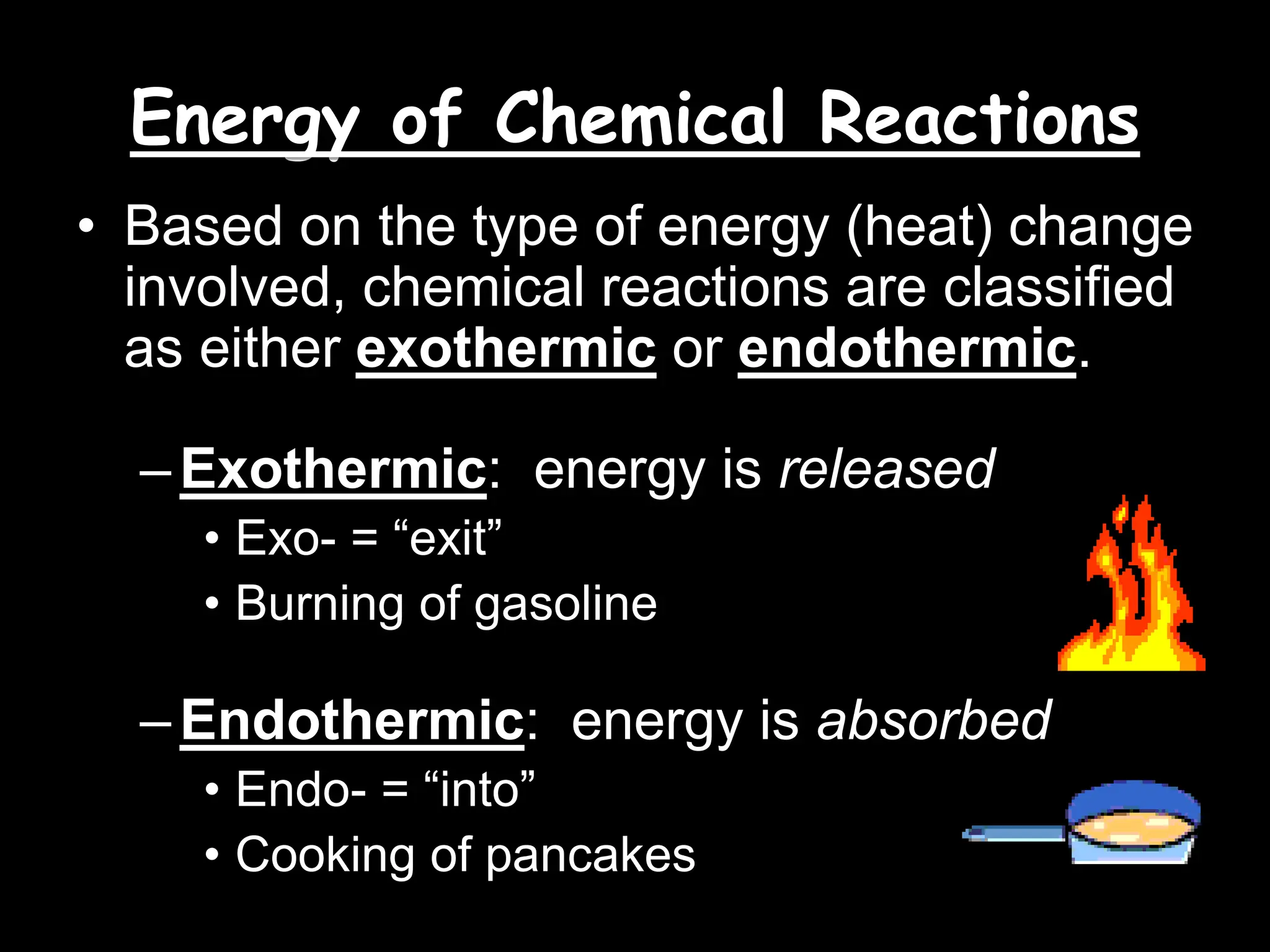
Energy of Chemical Reactions
• Based on the type of energy (heat) change
involved, chemical reactions are classified
as either exothermic or endothermic.
–Exothermic: energy is released
• Exo- = “exit”
• Burning of gasoline
–Endothermic: energy is absorbed
• Endo- = “into”
• Cooking of pancakes
Endothermic and Exothermic reactions
Step 1: Energy must be
SUPPLIED to break
chemical bonds of
reactants:
Step 2: Energy is RELEASED
when new chemical bonds are
made in the products:
A reaction is EXOTHERMIC if more energy is RELEASED
than SUPPLIED. If more energy is SUPPLIED than is
RELEASED then the reaction is ENDOTHERMIC
© Teachable . Some rights reserved. http://teachable.net/res.asp?r=1910
reaction
Endothermic
• Heat (energy) taken in
• Temperature of the substance
drops
• Products feel COLD
Endothermic Reactions
• You may see an endothermic reaction written
like this…
REACTANTS + ENERGY PRODUCTS
OR
REACTANTS + HEAT PRODUCTS
reaction
Exothermic
• Heat (energy) given off
• Temperature of the substance
rises
• Products feel HOT
Exothermic Reactions
• You may see an exothermic reaction written
like this…
REACTANTS PRODUCTS + ENERGY
OR
REACTANTS PRODUCTS + HEAT
© Teachable . Some rights reserved. http://teachable.net/res.asp?r=1910
DAILY LIFE EXAMPLES
© Teachable . Some rights reserved. http://teachable.net/res.asp?r=1910
DAILY LIFE EXAMPLES
© Teachable . Some rights reserved. http://teachable.net/res.asp?r=1910
DAILY LIFE EXAMPLES
Decomposition of vegetable
matter
© Teachable . Some rights reserved. http://teachable.net/res.asp?r=1910
Summary:
Exothermic and
Endothermic Reactions
© Teachable . Some rights reserved. http://teachable.net/res.asp?r=1910
Activity:
Find out some more examples
of exo & endo reactions
© Teachable . Some rights reserved. http://teachable.net/res.asp?r=1910
Thank you

Endothermic and exothermic reacton of class

  • 1.
  • 2.
    AGENDA AIM: To learnabout Exothermic and Endothermic reactions KEYWORDS:  Exit  Entry  High temperature  Low temperature EXPLANATION:  Exothermic reaction with examples  Endothermic reaction with examples SUMMARY: Activity:
  • 3.
    Energy and ChemicalReactions • Chemical Energy – Energy stored in the chemical bonds of a substance. • Chemical reactions always involve energy changes. • Making bonds and breaking bonds involve energy changes
  • 4.
    Energy of ChemicalReactions • Based on the type of energy (heat) change involved, chemical reactions are classified as either exothermic or endothermic. –Exothermic: energy is released • Exo- = “exit” • Burning of gasoline –Endothermic: energy is absorbed • Endo- = “into” • Cooking of pancakes
  • 5.
    Endothermic and Exothermicreactions Step 1: Energy must be SUPPLIED to break chemical bonds of reactants: Step 2: Energy is RELEASED when new chemical bonds are made in the products: A reaction is EXOTHERMIC if more energy is RELEASED than SUPPLIED. If more energy is SUPPLIED than is RELEASED then the reaction is ENDOTHERMIC © Teachable . Some rights reserved. http://teachable.net/res.asp?r=1910
  • 6.
    reaction Endothermic • Heat (energy)taken in • Temperature of the substance drops • Products feel COLD
  • 7.
    Endothermic Reactions • Youmay see an endothermic reaction written like this… REACTANTS + ENERGY PRODUCTS OR REACTANTS + HEAT PRODUCTS
  • 8.
    reaction Exothermic • Heat (energy)given off • Temperature of the substance rises • Products feel HOT
  • 9.
    Exothermic Reactions • Youmay see an exothermic reaction written like this… REACTANTS PRODUCTS + ENERGY OR REACTANTS PRODUCTS + HEAT
  • 10.
    © Teachable .Some rights reserved. http://teachable.net/res.asp?r=1910
  • 11.
    © Teachable .Some rights reserved. http://teachable.net/res.asp?r=1910
  • 12.
    © Teachable .Some rights reserved. http://teachable.net/res.asp?r=1910
  • 13.
    © Teachable .Some rights reserved. http://teachable.net/res.asp?r=1910
  • 14.
    © Teachable .Some rights reserved. http://teachable.net/res.asp?r=1910
  • 15.
    © Teachable .Some rights reserved. http://teachable.net/res.asp?r=1910
  • 16.
    © Teachable .Some rights reserved. http://teachable.net/res.asp?r=1910
  • 17.
    © Teachable .Some rights reserved. http://teachable.net/res.asp?r=1910 DAILY LIFE EXAMPLES
  • 18.
    © Teachable .Some rights reserved. http://teachable.net/res.asp?r=1910 DAILY LIFE EXAMPLES
  • 19.
    © Teachable .Some rights reserved. http://teachable.net/res.asp?r=1910 DAILY LIFE EXAMPLES Decomposition of vegetable matter
  • 20.
    © Teachable .Some rights reserved. http://teachable.net/res.asp?r=1910 Summary: Exothermic and Endothermic Reactions
  • 21.
    © Teachable .Some rights reserved. http://teachable.net/res.asp?r=1910 Activity: Find out some more examples of exo & endo reactions
  • 22.
    © Teachable .Some rights reserved. http://teachable.net/res.asp?r=1910 Thank you