MICROTEACHING ON:
EXISTENTIALISM
by:dipa Chakraborty
roll no:03
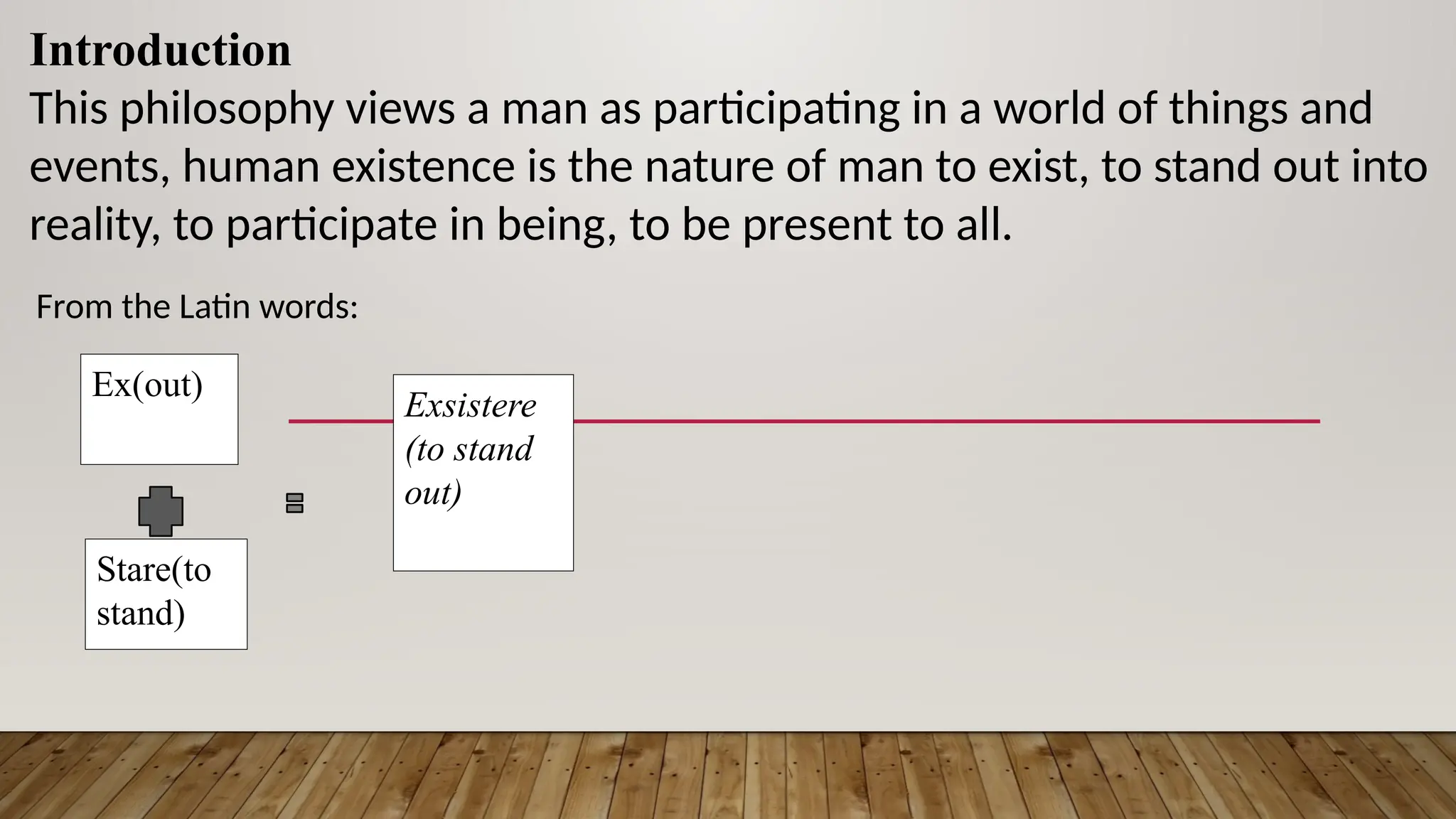
Ex(out)
Stare(to
stand)
Exsistere
(to stand
out)
Introduction
This philosophy views a man as participating in a world of things and
events, human existence is the nature of man to exist, to stand out into
reality, to participate in being, to be present to all.
From the Latin words:
Chief Characteristics of Existentialism
In Existentialism, human person and his freedom are given great importance. personal growth
and development are the result of one's own efforts and none can help in this regard.
1-Criticism of Idealism:
Existentialists oppose the idea of idealists that spiritual element is a universal character and all
men are fundamentally same and share with each other the universal character etc.
2-Criticism of Naturalism:
The existentialism are also critical of the philosophy of naturalism. The existentialists oppose
the idea that life is governed by biochemical laws subject to the universal law of causation.
Due to law of causation, there can be no human freedom of action. The existentialists openly
defend the freedom of man.
3-Criticism of Scientific Philosophy
Due to tremendous progress in science and technology value and importance of man has
been made negligible. that is why existentialists oppose scientific philosophy and culture.
4-Born of Despair:
On account of huge progress of science and technology industrial environment and
townships have made man away from nature. So mechanism of life, there is a growing
despair in the minds of men. In the prevailing perspectives exaggerated sense of
responsibility and duty can produce abnormal personality.
5-Value of Human Personality:
Man is the centre of universe and nothing else is equal to it. The basic feature
of human person is his freedom. Society and institutions are the sake of men
and not vice versa. All rules and principles that hinder the human freedom are
invalid and unjust.
6-Importance of Subjectivity:
The existentialists reject objectivity on which the scientists lay too much
stress. The immediate experience or feeling about which the existentialists talk
is the direct experience by individuals of things like conflict, pain and anxiety
etc.
8-No Construction of Philosophical System:
The existentialists do not ponder over traditional problems/theories like God, soul,
space, time its origin and evolution. They say that true aim of philosophy is action
and not theory.
9-Emphasis on the Relation of Individual and World:
Man and world both are unbound and free. The worth of man is underivable from
any universal element. Briefly, the existentialist consider man to be centre of all
value and activity.
10-Importance of Subjectivity:
These Conflicts and pains tell a person the quality of his life. And the function
of philosophy is to analyze these conflicts and trace their causes
Goal of Education
• To help students understand and appreciate themselves as unique
individuals who accept complete responsibility for their thoughts,
feelings, and actions.
 To educate the whole person, not just the mind, since feeling is not
divorced from reason in decision making.
 To help the learner become fully his authentic self.
Curriculum
1. Content for inner realization and achievement of peace.
II. Besides science humanities, Ethics and Religion for
character building.
III. Religious and moral values.
Iv. Composed of fine arts, drama, creative expression,
literature, and philosophy.
V. Vocational education is seen more as a means
Conclusion
The philosophy of existentialism is one of the most difficult to understand
especially given that it is based not on any empirical evidence but in the thoughts
of the thinkers who are bound to think in different perspectives. The philosophy is
based on the idea that existence precedes essence. Existentialism sources its
explanations about life and existence from a natural view and thus can be seen as
an atheistic theory. Existentialists view deception as an element of bad faith.

micro teaching on Existentialism . pptxn

  • 1.
  • 2.
    Ex(out) Stare(to stand) Exsistere (to stand out) Introduction This philosophyviews a man as participating in a world of things and events, human existence is the nature of man to exist, to stand out into reality, to participate in being, to be present to all. From the Latin words:
  • 3.
    Chief Characteristics ofExistentialism In Existentialism, human person and his freedom are given great importance. personal growth and development are the result of one's own efforts and none can help in this regard. 1-Criticism of Idealism: Existentialists oppose the idea of idealists that spiritual element is a universal character and all men are fundamentally same and share with each other the universal character etc. 2-Criticism of Naturalism: The existentialism are also critical of the philosophy of naturalism. The existentialists oppose the idea that life is governed by biochemical laws subject to the universal law of causation. Due to law of causation, there can be no human freedom of action. The existentialists openly defend the freedom of man.
  • 4.
    3-Criticism of ScientificPhilosophy Due to tremendous progress in science and technology value and importance of man has been made negligible. that is why existentialists oppose scientific philosophy and culture. 4-Born of Despair: On account of huge progress of science and technology industrial environment and townships have made man away from nature. So mechanism of life, there is a growing despair in the minds of men. In the prevailing perspectives exaggerated sense of responsibility and duty can produce abnormal personality.
  • 5.
    5-Value of HumanPersonality: Man is the centre of universe and nothing else is equal to it. The basic feature of human person is his freedom. Society and institutions are the sake of men and not vice versa. All rules and principles that hinder the human freedom are invalid and unjust. 6-Importance of Subjectivity: The existentialists reject objectivity on which the scientists lay too much stress. The immediate experience or feeling about which the existentialists talk is the direct experience by individuals of things like conflict, pain and anxiety etc.
  • 6.
    8-No Construction ofPhilosophical System: The existentialists do not ponder over traditional problems/theories like God, soul, space, time its origin and evolution. They say that true aim of philosophy is action and not theory. 9-Emphasis on the Relation of Individual and World: Man and world both are unbound and free. The worth of man is underivable from any universal element. Briefly, the existentialist consider man to be centre of all value and activity.
  • 7.
    10-Importance of Subjectivity: TheseConflicts and pains tell a person the quality of his life. And the function of philosophy is to analyze these conflicts and trace their causes
  • 8.
    Goal of Education •To help students understand and appreciate themselves as unique individuals who accept complete responsibility for their thoughts, feelings, and actions.  To educate the whole person, not just the mind, since feeling is not divorced from reason in decision making.  To help the learner become fully his authentic self.
  • 9.
    Curriculum 1. Content forinner realization and achievement of peace. II. Besides science humanities, Ethics and Religion for character building. III. Religious and moral values. Iv. Composed of fine arts, drama, creative expression, literature, and philosophy. V. Vocational education is seen more as a means
  • 10.
    Conclusion The philosophy ofexistentialism is one of the most difficult to understand especially given that it is based not on any empirical evidence but in the thoughts of the thinkers who are bound to think in different perspectives. The philosophy is based on the idea that existence precedes essence. Existentialism sources its explanations about life and existence from a natural view and thus can be seen as an atheistic theory. Existentialists view deception as an element of bad faith.