Longman PoliticalScience Interactive Magleby & Light Government by the People Chapter 12 The Presidency Copyright 2009 Pearson Education, Inc., Publishing as Longman
Presidential Power and Limitations Congress often hesitates to curtail presidential powers, especially in times of war Example: In 2002, George W. Bush secretly authorized the NSA to eavesdrop on phone conversations When the policy became public, Congress placed legislative limits on the authority  When concerns arose that these limits exposed the U.S. to a greater terrorism threat, Congress reversed the limits Copyright 2009 Pearson Education, Inc., Publishing as Longman
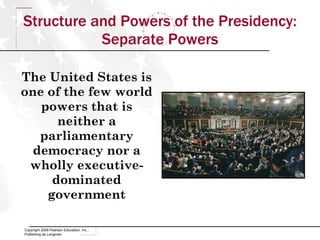
Structure and Powers of the Presidency: Separate Powers The United States is one of the few world powers that is neither a parliamentary democracy nor a wholly executive-dominated government Copyright 2009 Pearson Education, Inc., Publishing as Longman
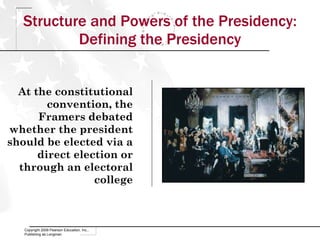
Structure and Powers of the Presidency: Defining the Presidency At the constitutional convention, the Framers debated whether the president should be elected via a direct election or through an electoral college Copyright 2009 Pearson Education, Inc., Publishing as Longman
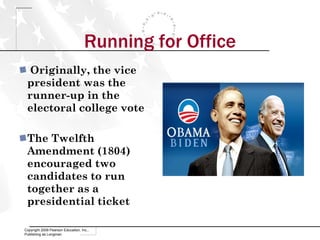
Running for Office Originally, the vice president was the runner-up in the electoral college vote The Twelfth Amendment (1804) encouraged two candidates to run together as a presidential ticket Copyright 2009 Pearson Education, Inc., Publishing as Longman
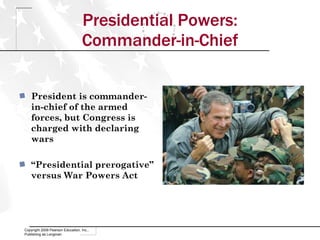
Presidential Powers: Commander-in-Chief Copyright 2009 Pearson Education, Inc., Publishing as Longman President is commander-in-chief of the armed forces, but Congress is charged with declaring wars “ Presidential prerogative” versus War Powers Act
Presidential Powers:  Diplomat-in-Chief Copyright 2009 Pearson Education, Inc., Publishing as Longman Appointing ambassadors Receiving ambassadors Treaties Executive agreements & Congressional-executive agreements Fast-track trade authority Meeting with foreign leaders to forge ties and make formal alliances Foreign policy tools:
Other Executive Powers Appointment Veto and pocket veto Pardon “ Take care” power Article II, Sec. 3: Presidents take care that the laws are faithfully executed, even if they disagree with the purpose of those laws Sometimes used by presidents to claim  inherent powers  (powers that grow out of the very existence of government) Inform and convene Congress State of the Union address Copyright 2009 Pearson Education, Inc., Publishing as Longman
Presidential Succession Twenty-fifth Amendment  Twenty-second Amendment Impeachment  Andrew Johnson and Bill Clinton: Charged by House, acquitted by Senate Richard Nixon: Resigned while House was drafting charges Copyright 2009 Pearson Education, Inc., Publishing as Longman
The War Power Presidents have defended their power to engage American military troops In 1973, Congress enacted the War Powers Act in order to limit the ability of the president to commit the armed forces of the United States; however, presidents have generally ignored it In Korea, Vietnam, Grenada, Panama,  Iraq (twice), Kosovo, and Afghanistan, the president did not ask Congress for a formal declaration of war Copyright 2009 Pearson Education, Inc., Publishing as Longman
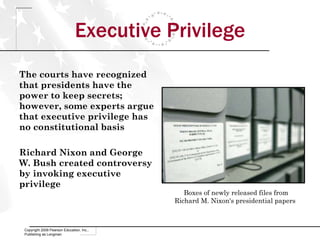
Executive Privilege The courts have recognized that presidents have the power to keep secrets; however, some experts argue that executive privilege has no constitutional basis Richard Nixon and George W. Bush created controversy by invoking executive privilege Copyright 2009 Pearson Education, Inc., Publishing as Longman Boxes of newly released files from Richard M. Nixon's presidential papers
Executive Orders Formal directives that are just as strong as laws and can be challenged in the courts Used frequently throughout American history Copyright 2009 Pearson Education, Inc., Publishing as Longman
Budget and Spending Power Congress appropriates, presidents spend Impoundment Line-item veto Copyright 2009 Pearson Education, Inc., Publishing as Longman
The First Presidency Precedents set by Washington Presidential title Two-term limit White House staff Department secretaries President as sole authority in supervising executive branch Copyright 2009 Pearson Education, Inc., Publishing as Longman
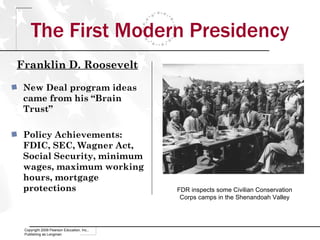
The First Modern Presidency Copyright 2009 Pearson Education, Inc., Publishing as Longman New Deal program ideas came from his “Brain Trust” Policy Achievements: FDIC, SEC, Wagner Act, Social Security, minimum wages, maximum working hours, mortgage protections FDR inspects some Civilian Conservation Corps camps in the Shenandoah Valley Franklin D. Roosevelt
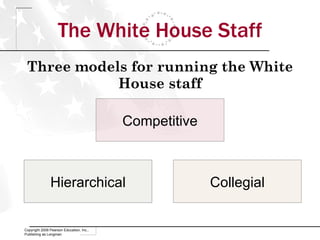
The White House Staff Three models for running the White House staff Copyright 2009 Pearson Education, Inc., Publishing as Longman Competitive Hierarchical Collegial
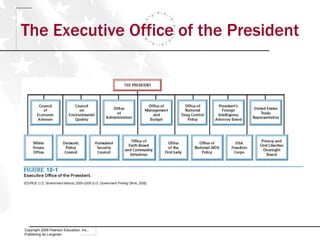
The Executive Office of the President Copyright 2009 Pearson Education, Inc., Publishing as Longman
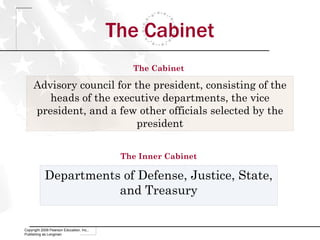
The Cabinet Copyright 2009 Pearson Education, Inc., Publishing as Longman Advisory council for the president, consisting of the heads of the executive departments, the vice president, and a few other officials selected by the president Departments of Defense, Justice, State, and Treasury The Inner Cabinet The Cabinet
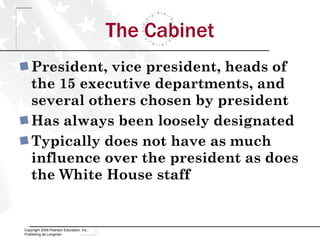
The Cabinet President, vice president, heads of the 15 executive departments, and several others chosen by president Has always been loosely designated Typically does not have as much influence over the president as does the White House staff Copyright 2009 Pearson Education, Inc., Publishing as Longman
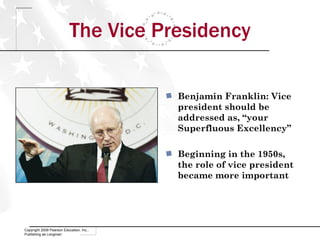
The Vice Presidency Copyright 2009 Pearson Education, Inc., Publishing as Longman Benjamin Franklin: Vice president should be addressed as, “your Superfluous Excellency” Beginning in the 1950s, the role of vice president became more important
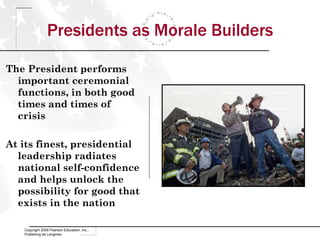
Presidents as Morale Builders Copyright 2009 Pearson Education, Inc., Publishing as Longman The President performs important ceremonial functions, in both good times and times of crisis At its finest, presidential leadership radiates national self-confidence and helps unlock the possibility for good that exists in the nation
Presidents as Agenda Setters National Security Policy Economic Policy Social Policy Copyright 2009 Pearson Education, Inc., Publishing as Longman
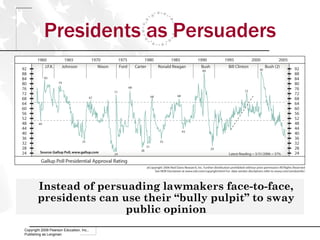
Presidents as Persuaders Copyright 2009 Pearson Education, Inc., Publishing as Longman Instead of persuading lawmakers face-to-face, presidents can use their “bully pulpit” to sway public opinion
Congress and the Presidency Competing constituencies Competing calendars Competing campaigns Copyright 2009 Pearson Education, Inc., Publishing as Longman
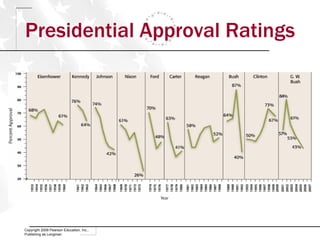
Presidential Mandates A president’s claim of broad public support for the president or a policy issue Depends in part on public approval, which generally falls over time Presidents also benefit from  rally points , spikes in public approval following a crisis Copyright 2009 Pearson Education, Inc., Publishing as Longman
Judging Presidents History tends to judge wars as the most significant test of a president’s leadership Presidents also are judged by their ability to promote a distinctive vision of where the nation should go Corruption and inability to deal with economic problems are sure paths to failure Copyright 2009 Pearson Education, Inc., Publishing as Longman
Presidential Approval Ratings Copyright 2009 Pearson Education, Inc., Publishing as Longman

Presidential power point

  • 1.
    Longman PoliticalScience InteractiveMagleby & Light Government by the People Chapter 12 The Presidency Copyright 2009 Pearson Education, Inc., Publishing as Longman
  • 2.
    Presidential Power andLimitations Congress often hesitates to curtail presidential powers, especially in times of war Example: In 2002, George W. Bush secretly authorized the NSA to eavesdrop on phone conversations When the policy became public, Congress placed legislative limits on the authority When concerns arose that these limits exposed the U.S. to a greater terrorism threat, Congress reversed the limits Copyright 2009 Pearson Education, Inc., Publishing as Longman
  • 3.
    Structure and Powersof the Presidency: Separate Powers The United States is one of the few world powers that is neither a parliamentary democracy nor a wholly executive-dominated government Copyright 2009 Pearson Education, Inc., Publishing as Longman
  • 4.
    Structure and Powersof the Presidency: Defining the Presidency At the constitutional convention, the Framers debated whether the president should be elected via a direct election or through an electoral college Copyright 2009 Pearson Education, Inc., Publishing as Longman
  • 5.
    Running for OfficeOriginally, the vice president was the runner-up in the electoral college vote The Twelfth Amendment (1804) encouraged two candidates to run together as a presidential ticket Copyright 2009 Pearson Education, Inc., Publishing as Longman
  • 6.
    Presidential Powers: Commander-in-ChiefCopyright 2009 Pearson Education, Inc., Publishing as Longman President is commander-in-chief of the armed forces, but Congress is charged with declaring wars “ Presidential prerogative” versus War Powers Act
  • 7.
    Presidential Powers: Diplomat-in-Chief Copyright 2009 Pearson Education, Inc., Publishing as Longman Appointing ambassadors Receiving ambassadors Treaties Executive agreements & Congressional-executive agreements Fast-track trade authority Meeting with foreign leaders to forge ties and make formal alliances Foreign policy tools:
  • 8.
    Other Executive PowersAppointment Veto and pocket veto Pardon “ Take care” power Article II, Sec. 3: Presidents take care that the laws are faithfully executed, even if they disagree with the purpose of those laws Sometimes used by presidents to claim inherent powers (powers that grow out of the very existence of government) Inform and convene Congress State of the Union address Copyright 2009 Pearson Education, Inc., Publishing as Longman
  • 9.
    Presidential Succession Twenty-fifthAmendment Twenty-second Amendment Impeachment Andrew Johnson and Bill Clinton: Charged by House, acquitted by Senate Richard Nixon: Resigned while House was drafting charges Copyright 2009 Pearson Education, Inc., Publishing as Longman
  • 10.
    The War PowerPresidents have defended their power to engage American military troops In 1973, Congress enacted the War Powers Act in order to limit the ability of the president to commit the armed forces of the United States; however, presidents have generally ignored it In Korea, Vietnam, Grenada, Panama, Iraq (twice), Kosovo, and Afghanistan, the president did not ask Congress for a formal declaration of war Copyright 2009 Pearson Education, Inc., Publishing as Longman
  • 11.
    Executive Privilege Thecourts have recognized that presidents have the power to keep secrets; however, some experts argue that executive privilege has no constitutional basis Richard Nixon and George W. Bush created controversy by invoking executive privilege Copyright 2009 Pearson Education, Inc., Publishing as Longman Boxes of newly released files from Richard M. Nixon's presidential papers
  • 12.
    Executive Orders Formaldirectives that are just as strong as laws and can be challenged in the courts Used frequently throughout American history Copyright 2009 Pearson Education, Inc., Publishing as Longman
  • 13.
    Budget and SpendingPower Congress appropriates, presidents spend Impoundment Line-item veto Copyright 2009 Pearson Education, Inc., Publishing as Longman
  • 14.
    The First PresidencyPrecedents set by Washington Presidential title Two-term limit White House staff Department secretaries President as sole authority in supervising executive branch Copyright 2009 Pearson Education, Inc., Publishing as Longman
  • 15.
    The First ModernPresidency Copyright 2009 Pearson Education, Inc., Publishing as Longman New Deal program ideas came from his “Brain Trust” Policy Achievements: FDIC, SEC, Wagner Act, Social Security, minimum wages, maximum working hours, mortgage protections FDR inspects some Civilian Conservation Corps camps in the Shenandoah Valley Franklin D. Roosevelt
  • 16.
    The White HouseStaff Three models for running the White House staff Copyright 2009 Pearson Education, Inc., Publishing as Longman Competitive Hierarchical Collegial
  • 17.
    The Executive Officeof the President Copyright 2009 Pearson Education, Inc., Publishing as Longman
  • 18.
    The Cabinet Copyright2009 Pearson Education, Inc., Publishing as Longman Advisory council for the president, consisting of the heads of the executive departments, the vice president, and a few other officials selected by the president Departments of Defense, Justice, State, and Treasury The Inner Cabinet The Cabinet
  • 19.
    The Cabinet President,vice president, heads of the 15 executive departments, and several others chosen by president Has always been loosely designated Typically does not have as much influence over the president as does the White House staff Copyright 2009 Pearson Education, Inc., Publishing as Longman
  • 20.
    The Vice PresidencyCopyright 2009 Pearson Education, Inc., Publishing as Longman Benjamin Franklin: Vice president should be addressed as, “your Superfluous Excellency” Beginning in the 1950s, the role of vice president became more important
  • 21.
    Presidents as MoraleBuilders Copyright 2009 Pearson Education, Inc., Publishing as Longman The President performs important ceremonial functions, in both good times and times of crisis At its finest, presidential leadership radiates national self-confidence and helps unlock the possibility for good that exists in the nation
  • 22.
    Presidents as AgendaSetters National Security Policy Economic Policy Social Policy Copyright 2009 Pearson Education, Inc., Publishing as Longman
  • 23.
    Presidents as PersuadersCopyright 2009 Pearson Education, Inc., Publishing as Longman Instead of persuading lawmakers face-to-face, presidents can use their “bully pulpit” to sway public opinion
  • 24.
    Congress and thePresidency Competing constituencies Competing calendars Competing campaigns Copyright 2009 Pearson Education, Inc., Publishing as Longman
  • 25.
    Presidential Mandates Apresident’s claim of broad public support for the president or a policy issue Depends in part on public approval, which generally falls over time Presidents also benefit from rally points , spikes in public approval following a crisis Copyright 2009 Pearson Education, Inc., Publishing as Longman
  • 26.
    Judging Presidents Historytends to judge wars as the most significant test of a president’s leadership Presidents also are judged by their ability to promote a distinctive vision of where the nation should go Corruption and inability to deal with economic problems are sure paths to failure Copyright 2009 Pearson Education, Inc., Publishing as Longman
  • 27.
    Presidential Approval RatingsCopyright 2009 Pearson Education, Inc., Publishing as Longman