Prepared By:-
Ravi Sapariya
•Save you lots of time
•Move/Select the first or last cell of a contiguous
data block without scrolling
• Ctrl + Up/Down - Moves to the top or bottom cell
of the current column
• Ctrl + Left/Right - Moves to the cell furthest left
or right in the current row
• Ctrl + Shift + Up/Down/Left/Right - Selects all
the cells above or below the current cell
• Shift + Space to Select current column
• Ctrl + Space to Select current row
Why you
need to
know this
How to
use this
feature
Why you
need to
know this
•Splitting a window allows you to work on multiple parts
of a large spreadsheet simultaneously
•Freezing the pane allows you to always keep one part of
the spreadsheet (e.g., column or row labels) visible
How you
use this
feature
•Drag the split horizontal and split vertical icons to the
desires positions
•Click on the freeze pane icon from the tool bar to
freeze the panes
Why you
need to
know this
•MAX and MIN functions will simply return the largest and
smallest result from a range of numbers. Let’s use our
Test score example from above one more time.
How you
use this
feature
•Select the Range of cell and apply the function
•Eg. =MAX(B6:B31) for maximum
= MIN(B6:B31) for minimum
Why you
need to
know this
•The IF function is used to determine whether a
statement is True or False and then performs an action
based on the result. The IF statement is broken out as
How you
use this
feature
•IF(Criteria,True value,False value)
•Let’s Take an example
Why you
need to
know this
•The AND function is a logical function that checks
multiple criteria and will return a TRUE value if ALL of
the criteria are TRUE. Otherwise it returns a false.
•The OR function works similar to the AND statement. It
checks multiple criteria however it only requires ONE
statement to be true to make the whole statement
TRUE.
•Eg.How you
use this
feature
Why you
need to
know this
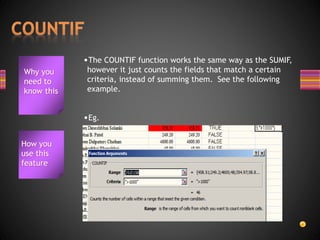
•The COUNTIF function works the same way as the SUMIF,
however it just counts the fields that match a certain
criteria, instead of summing them. See the following
example.
•Eg.
How you
use this
feature
Why you
need to
know this
•PivotTables are essentially summary tables that let you
count, average, sum, and perform other calculations
according to the reference points you enter. They can be
used to summarize, analyze, explore and present your
data.
•Select range of cells and Insert Pivot Table
Lets take and easy and fast example
Reference url : http://letmeknw.in/pivot/
How you
use this
feature
Why you
need to
know this
•PivotTables are essentially summary tables that let you
count, average, sum, and perform other calculations
according to the reference points you enter. They can be
used to summarize, analyze, explore and present your
data.
•Select range of cells and Insert Pivot Table
Lets take and easy and fast example
Reference url : http://letmeknw.in/pivot/
How you
use this
feature
Why you
need to
know this
•Excel charts help you communicate insights &
information with ease. By choosing your charts wisely
and formatting them cleanly, you can convey a lot
•Select Chart Type and Range of Cell
Lets take and easy and fast example. Simple charts,
combination of charts
Reference url : http://letmeknw.in/charts/
How you
use this
feature
Why you
need to
know this
•If data is entered in columns or rows, but you want to
rearrange that data into rows or columns instead, you
can quickly transpose the data from one to the other.
•Select Range Where the data will be pasted
•Select Range which is to be transposed and press
•Ctrl + Shift + Enter
•Eg. Lets Take and example
How you
use this
feature
Why you
need to
know this
•Because of some inconsistence data you may see Errors
in you excel sheet.
•For example is something is divided by zero
•That can be suppressed using following tip
•Eg. Lets Take and example
How you
use this
feature
•If you have tasks in Microsoft Excel that you do
repeatedly, you can record a macro to automate those
tasks.
•A macro is an action or a set of actions that you can run
as many times as you want. When you create a macro,
you are recording your mouse clicks and keystrokes.
Why you
need to
know this
How you
use this
feature
•Excel-> Excel Optins->Show Developer Tab
•Select any cell, Select Record Macro->Ok
•Start your work then press Stop Recording
•To Run Macro-> Enter Short Cut Created or Macro-
>Select the Macro to Run
•Lets take an example
Excel tips and tricks

Excel tips and tricks

  • 1.
  • 2.
    •Save you lotsof time •Move/Select the first or last cell of a contiguous data block without scrolling • Ctrl + Up/Down - Moves to the top or bottom cell of the current column • Ctrl + Left/Right - Moves to the cell furthest left or right in the current row • Ctrl + Shift + Up/Down/Left/Right - Selects all the cells above or below the current cell • Shift + Space to Select current column • Ctrl + Space to Select current row Why you need to know this How to use this feature
  • 3.
    Why you need to knowthis •Splitting a window allows you to work on multiple parts of a large spreadsheet simultaneously •Freezing the pane allows you to always keep one part of the spreadsheet (e.g., column or row labels) visible How you use this feature •Drag the split horizontal and split vertical icons to the desires positions •Click on the freeze pane icon from the tool bar to freeze the panes
  • 4.
    Why you need to knowthis •MAX and MIN functions will simply return the largest and smallest result from a range of numbers. Let’s use our Test score example from above one more time. How you use this feature •Select the Range of cell and apply the function •Eg. =MAX(B6:B31) for maximum = MIN(B6:B31) for minimum
  • 5.
    Why you need to knowthis •The IF function is used to determine whether a statement is True or False and then performs an action based on the result. The IF statement is broken out as How you use this feature •IF(Criteria,True value,False value) •Let’s Take an example
  • 6.
    Why you need to knowthis •The AND function is a logical function that checks multiple criteria and will return a TRUE value if ALL of the criteria are TRUE. Otherwise it returns a false. •The OR function works similar to the AND statement. It checks multiple criteria however it only requires ONE statement to be true to make the whole statement TRUE. •Eg.How you use this feature
  • 7.
    Why you need to knowthis •The COUNTIF function works the same way as the SUMIF, however it just counts the fields that match a certain criteria, instead of summing them. See the following example. •Eg. How you use this feature
  • 8.
    Why you need to knowthis •PivotTables are essentially summary tables that let you count, average, sum, and perform other calculations according to the reference points you enter. They can be used to summarize, analyze, explore and present your data. •Select range of cells and Insert Pivot Table Lets take and easy and fast example Reference url : http://letmeknw.in/pivot/ How you use this feature
  • 9.
    Why you need to knowthis •PivotTables are essentially summary tables that let you count, average, sum, and perform other calculations according to the reference points you enter. They can be used to summarize, analyze, explore and present your data. •Select range of cells and Insert Pivot Table Lets take and easy and fast example Reference url : http://letmeknw.in/pivot/ How you use this feature
  • 10.
    Why you need to knowthis •Excel charts help you communicate insights & information with ease. By choosing your charts wisely and formatting them cleanly, you can convey a lot •Select Chart Type and Range of Cell Lets take and easy and fast example. Simple charts, combination of charts Reference url : http://letmeknw.in/charts/ How you use this feature
  • 11.
    Why you need to knowthis •If data is entered in columns or rows, but you want to rearrange that data into rows or columns instead, you can quickly transpose the data from one to the other. •Select Range Where the data will be pasted •Select Range which is to be transposed and press •Ctrl + Shift + Enter •Eg. Lets Take and example How you use this feature
  • 12.
    Why you need to knowthis •Because of some inconsistence data you may see Errors in you excel sheet. •For example is something is divided by zero •That can be suppressed using following tip •Eg. Lets Take and example How you use this feature
  • 13.
    •If you havetasks in Microsoft Excel that you do repeatedly, you can record a macro to automate those tasks. •A macro is an action or a set of actions that you can run as many times as you want. When you create a macro, you are recording your mouse clicks and keystrokes. Why you need to know this How you use this feature •Excel-> Excel Optins->Show Developer Tab •Select any cell, Select Record Macro->Ok •Start your work then press Stop Recording •To Run Macro-> Enter Short Cut Created or Macro- >Select the Macro to Run •Lets take an example