Acknowledgement
o We would like to thank our respected professor
Mr.Kamaldeep Singh for giving us this
opportunity to manifest our talents, improve
our knowledge of the subject and broaden our
horizons.
o This project has given us an opportunity to
work together thus enhancing our team work
and presentation skills.
 A management approach for an organization.
 Centered on quality and members participation
aiming at long term success through customer
satisfaction and benefits to society.
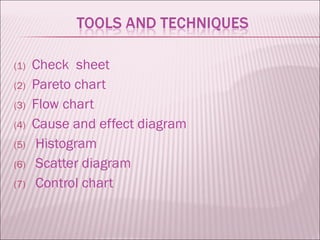
(1) Check sheet
(2) Pareto chart
(3) Flow chart
(4) Cause and effect diagram
(5) Histogram
(6) Scatter diagram
(7) Control chart
 A simple means of data collection.
 Function to present information in an efficient
graphical format.
 Defining characteristic of a check sheet is that
data is recorded by making marks(“checks”).
 Data is read by observing the location and
number of marks on the sheet.
Example of a Check sheet
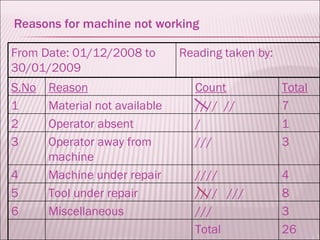
 In a machine shop there is a costly CNC machine
which was not giving the desired output. It was
decided to visit the shop around 25 times in a
week to check the reasons of machine not
working. The check sheet was designed for
collecting the data as follows. This data can be
used further for attacking the important reasons.
Reasons for machine not working
From Date: 01/12/2008 to
30/01/2009
Reading taken by:
S.No Reason Count Total
1 Material not available //// // 7
2 Operator absent / 1
3 Operator away from
machine
/// 3
4 Machine under repair //// 4
5 Tool under repair //// /// 8
6 Miscellaneous /// 3
Total 26
 Used to identify factors that have the greatest
cumulative effect on the system.
 Pareto principle: 80% of problems stem from
20% of the various causes.
 A special type of bar chart created by plotting
the cumulative frequencies of the relative
frequency in decesending order.
 For example, if your business was investigating the
delay associated with processing credit card
applications, you could group the data into the
following categories:
2) No signature
3) Residential address not valid
4) Non-legible handwriting
5) Already a customer
6) Other
 Common type of chart.
 Defined as a pictorial representation of
describing a process used to plan stages of a
project.
 Diagram showing the cause of a certain event.
 Used to identify potential factors causing an
overall effect.
 Used to see all possible causes of a result and
hopefully find the root of process
imperfections.
 It is known as fishbone diagram because its
shape is similar to side view of a fish skeleton.
Fishbone diagram
 A Histogram is a graphic summary of variation
in a set of data.
 It enables us to see patterns that are difficult
to see in a simple table of numbers. Can be
analyzed to draw conclusions about the data
set.
 A histogram is a graph in which the continuous
variable is clustered into categories and the
value of each cluster is plotted to give a series
of bars.
 The below example reveals the skewed
distribution of a set of product measurements
that remain nevertheless within specified
limits.
 Without using some form of graphic this kind of
problem can be difficult to analyze, recognize
or identify.
 A scatter plot is effectively a line graph with no
line - i.e. the point intersections between the
two data sets are plotted but no attempt is
made to physically draw a line.
 The Y axis is conventionally used for the
characteristic whose behaviour we would like to
predict.
 Used, to define the area of relationship
between two variables.
 Control charts are a method of Statistical
Process Control, SPC. (Control system for
production processes).
 They enable the control of distribution of
variation rather than attempting to control each
individual variation.
 Upper and lower control and tolerance limits
are calculated for a process and sampled
measures are regularly plotted about a central
line between the two sets of limits.
 The plotted line corresponds to the
stability/trend of the process. Action can be
taken based on trend rather than on individual
variation.
 This prevents over-correction/compensation for
random variation, which would lead to many
rejects.
Seven traditional tools

Seven traditional tools

  • 3.
    Acknowledgement o We wouldlike to thank our respected professor Mr.Kamaldeep Singh for giving us this opportunity to manifest our talents, improve our knowledge of the subject and broaden our horizons. o This project has given us an opportunity to work together thus enhancing our team work and presentation skills.
  • 4.
     A managementapproach for an organization.  Centered on quality and members participation aiming at long term success through customer satisfaction and benefits to society.
  • 5.
    (1) Check sheet (2)Pareto chart (3) Flow chart (4) Cause and effect diagram (5) Histogram (6) Scatter diagram (7) Control chart
  • 6.
     A simplemeans of data collection.  Function to present information in an efficient graphical format.  Defining characteristic of a check sheet is that data is recorded by making marks(“checks”).  Data is read by observing the location and number of marks on the sheet.
  • 8.
    Example of aCheck sheet  In a machine shop there is a costly CNC machine which was not giving the desired output. It was decided to visit the shop around 25 times in a week to check the reasons of machine not working. The check sheet was designed for collecting the data as follows. This data can be used further for attacking the important reasons.
  • 9.
    Reasons for machinenot working From Date: 01/12/2008 to 30/01/2009 Reading taken by: S.No Reason Count Total 1 Material not available //// // 7 2 Operator absent / 1 3 Operator away from machine /// 3 4 Machine under repair //// 4 5 Tool under repair //// /// 8 6 Miscellaneous /// 3 Total 26
  • 10.
     Used toidentify factors that have the greatest cumulative effect on the system.  Pareto principle: 80% of problems stem from 20% of the various causes.  A special type of bar chart created by plotting the cumulative frequencies of the relative frequency in decesending order.
  • 11.
     For example,if your business was investigating the delay associated with processing credit card applications, you could group the data into the following categories: 2) No signature 3) Residential address not valid 4) Non-legible handwriting 5) Already a customer 6) Other
  • 13.
     Common typeof chart.  Defined as a pictorial representation of describing a process used to plan stages of a project.
  • 15.
     Diagram showingthe cause of a certain event.  Used to identify potential factors causing an overall effect.  Used to see all possible causes of a result and hopefully find the root of process imperfections.  It is known as fishbone diagram because its shape is similar to side view of a fish skeleton.
  • 16.
  • 17.
     A Histogramis a graphic summary of variation in a set of data.  It enables us to see patterns that are difficult to see in a simple table of numbers. Can be analyzed to draw conclusions about the data set.  A histogram is a graph in which the continuous variable is clustered into categories and the value of each cluster is plotted to give a series of bars.
  • 18.
     The belowexample reveals the skewed distribution of a set of product measurements that remain nevertheless within specified limits.  Without using some form of graphic this kind of problem can be difficult to analyze, recognize or identify.
  • 20.
     A scatterplot is effectively a line graph with no line - i.e. the point intersections between the two data sets are plotted but no attempt is made to physically draw a line.  The Y axis is conventionally used for the characteristic whose behaviour we would like to predict.  Used, to define the area of relationship between two variables.
  • 22.
     Control chartsare a method of Statistical Process Control, SPC. (Control system for production processes).  They enable the control of distribution of variation rather than attempting to control each individual variation.  Upper and lower control and tolerance limits are calculated for a process and sampled measures are regularly plotted about a central line between the two sets of limits.
  • 23.
     The plottedline corresponds to the stability/trend of the process. Action can be taken based on trend rather than on individual variation.  This prevents over-correction/compensation for random variation, which would lead to many rejects.