Excel
Formulas And Functions
Dr. Pinki Insan
Asstt. Professor of
Commerce
Overview
Excel is a spreadsheet, a grid
made from columns and rows. It
Is a Software program that can
Make number manipulation easy
And somewhat painless.
Basics of a Spreadsheet
• Spreadsheets are made up of
–Columns
–Rows
–and their intersections are called
cells
• Ina spreadsheetthe
COLUMNisdefined
astheverticalspace
thatisgoingupand
downthewindow.
Lettersare usedto
designateeach
COLUMN'Slocation.
• COLUMNlabeledDishighlighted
.
What is a row?
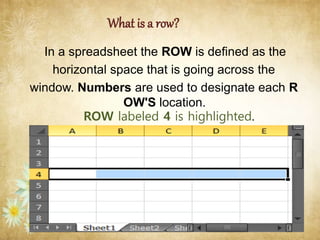
In a spreadsheet the ROW is defined as the
horizontal space that is going across the
window. Numbers are used to designate each R
OW'S location.
ROW labeled 4 is highlighted.
What is a CELL ?
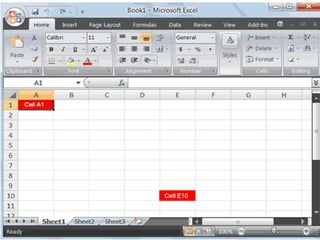
• A CELL is the space where a row and column in
tersect. Each CELL
is assigned a name according to its COLUMN
letter and ROW
number.In the diagram the CELL labeled C2 is highlighted.
Types of Data
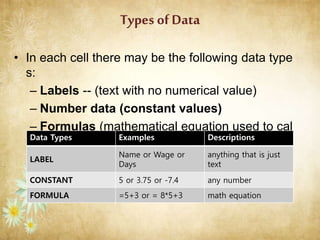
• In each cell there may be the following data type
s:
– Labels -- (text with no numerical value)
– Number data (constant values)
– Formulas (mathematical equation used to cal
culate)Data Types Examples Descriptions
LABEL
Name or Wage or
Days
anything that is just
text
CONSTANT 5 or 3.75 or -7.4 any number
FORMULA =5+3 or = 8*5+3 math equation
Labels
• Labels are text entries
– Labels help identify what we are talking about
– Labels do not have a value associated with the
m
– Sometimes called ‘headers’
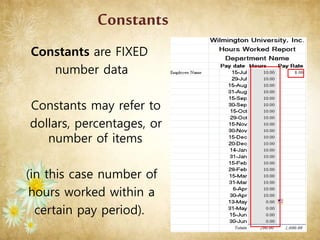
Constants
Constants are FIXED
number data
Constants may refer to
dollars, percentages, or
number of items
(in this case number of
hours worked within a
certain pay period).
Formulas
• Formulas are math equation
s that
CALCULATE a value to be d
isplayed.
• DO NOT type in the numbers
; type in the equation.
• It is BEST to Reference as
much data as possible as op
posed to typing data into
equations. That way when
OTHER
information changes, we D
BASICFORMULAS & FUNCTIONS
In Excel,the calculation can be specified
using either a formula or a function.
ˆFormulas are self-defined instructions f
or
performing calculations. ˆ
Functions are pre-defined formulas that
come with Excel.
In either case, all formulas a
nd functions are entered in a
cell and must begin
with an equal sign ’=’.
A function is a predefined formula th
at performs
calculations using specific values in a
particular
order. All spreadsheet programs inclu
de common
functions that can be used for quickly
finding the sum, average, count, ma
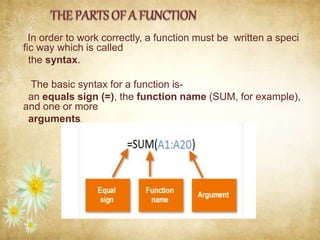
In order to work correctly, a function must be written a speci
fic way which is called
the syntax.
The basic syntax for a function is-
an equals sign (=), the function name (SUM, for example),
and one or more
arguments.
Example of Multiple Arguments
Types of Functions
• Math or String
• Date & Time
• Text
• Financial
• Logical
• Statically
• Lookup or reference
Common functions
• SUM: This function adds all the values of the cells in the argument.
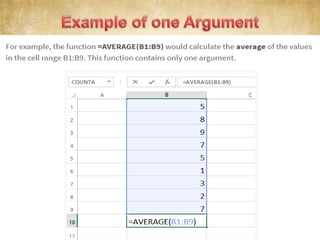
• AVERAGE: This function determines the average of the values included
in the argument. It calculates the sum of the cells and then divides that value by
the number of cells in the argument.
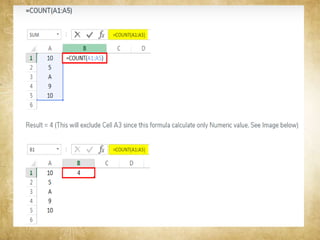
• COUNT: This function counts the number of cells with numerical data in the
argument. This function is useful for quickly counting items in a cell range.
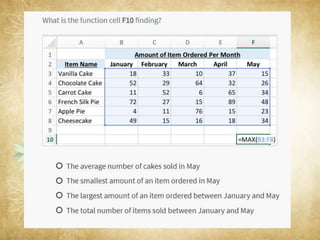
• MAX: This function determines the highest cell value included in the argument
.
• MIN: This function determines the lowest cell value included in the argument.
SUM Function
Definition:
• Probably the most popular function in any
spreadsheet is the SUM function. The Sum function
takes all of the values in each of the specified cells
and totals their values.
The syntax is:
=SUM(first value, second value
, etc)
Sum Function
Sum function
Average Function
The average function
finds the average of
the specified data.
(Simplifies adding all of
the indicated cells
together and dividing
by the total number of ce
lls.)
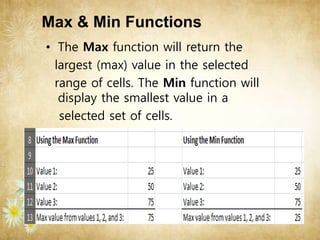
Max & Min Functions
• The Max function will return the
largest (max) value in the selected
range of cells. The Min function will
display the smallest value in a
selected set of cells.
• The Count function will return the number of ent
ries (actually
counts each cell that contains NUMBER DATA)
in the selected
range of cells.
• Remember: cell that are blank or contain text will
not be counted.
Thanks

Excel

  • 1.
    Excel Formulas And Functions Dr.Pinki Insan Asstt. Professor of Commerce
  • 2.
    Overview Excel is aspreadsheet, a grid made from columns and rows. It Is a Software program that can Make number manipulation easy And somewhat painless.
  • 3.
    Basics of aSpreadsheet • Spreadsheets are made up of –Columns –Rows –and their intersections are called cells
  • 5.
    • Ina spreadsheetthe COLUMNisdefined astheverticalspace thatisgoingupand downthewindow. Lettersareusedto designateeach COLUMN'Slocation. • COLUMNlabeledDishighlighted .
  • 6.
    What is arow? In a spreadsheet the ROW is defined as the horizontal space that is going across the window. Numbers are used to designate each R OW'S location. ROW labeled 4 is highlighted.
  • 7.
    What is aCELL ? • A CELL is the space where a row and column in tersect. Each CELL is assigned a name according to its COLUMN letter and ROW number.In the diagram the CELL labeled C2 is highlighted.
  • 8.
    Types of Data •In each cell there may be the following data type s: – Labels -- (text with no numerical value) – Number data (constant values) – Formulas (mathematical equation used to cal culate)Data Types Examples Descriptions LABEL Name or Wage or Days anything that is just text CONSTANT 5 or 3.75 or -7.4 any number FORMULA =5+3 or = 8*5+3 math equation
  • 9.
    Labels • Labels aretext entries – Labels help identify what we are talking about – Labels do not have a value associated with the m – Sometimes called ‘headers’
  • 10.
    Constants Constants are FIXED numberdata Constants may refer to dollars, percentages, or number of items (in this case number of hours worked within a certain pay period).
  • 11.
    Formulas • Formulas aremath equation s that CALCULATE a value to be d isplayed. • DO NOT type in the numbers ; type in the equation. • It is BEST to Reference as much data as possible as op posed to typing data into equations. That way when OTHER information changes, we D
  • 12.
    BASICFORMULAS & FUNCTIONS InExcel,the calculation can be specified using either a formula or a function. ˆFormulas are self-defined instructions f or performing calculations. ˆ Functions are pre-defined formulas that come with Excel.
  • 13.
    In either case,all formulas a nd functions are entered in a cell and must begin with an equal sign ’=’.
  • 18.
    A function isa predefined formula th at performs calculations using specific values in a particular order. All spreadsheet programs inclu de common functions that can be used for quickly finding the sum, average, count, ma
  • 19.
    In order towork correctly, a function must be written a speci fic way which is called the syntax. The basic syntax for a function is- an equals sign (=), the function name (SUM, for example), and one or more arguments.
  • 21.
  • 23.
    Types of Functions •Math or String • Date & Time • Text • Financial • Logical • Statically • Lookup or reference
  • 24.
    Common functions • SUM:This function adds all the values of the cells in the argument. • AVERAGE: This function determines the average of the values included in the argument. It calculates the sum of the cells and then divides that value by the number of cells in the argument. • COUNT: This function counts the number of cells with numerical data in the argument. This function is useful for quickly counting items in a cell range. • MAX: This function determines the highest cell value included in the argument . • MIN: This function determines the lowest cell value included in the argument.
  • 25.
    SUM Function Definition: • Probablythe most popular function in any spreadsheet is the SUM function. The Sum function takes all of the values in each of the specified cells and totals their values. The syntax is: =SUM(first value, second value , etc)
  • 26.
  • 27.
  • 28.
    Average Function The averagefunction finds the average of the specified data. (Simplifies adding all of the indicated cells together and dividing by the total number of ce lls.)
  • 36.
    Max & MinFunctions • The Max function will return the largest (max) value in the selected range of cells. The Min function will display the smallest value in a selected set of cells.
  • 37.
    • The Countfunction will return the number of ent ries (actually counts each cell that contains NUMBER DATA) in the selected range of cells. • Remember: cell that are blank or contain text will not be counted.
  • 40.

Editor's Notes

  • #3 Source: http://people.usd.edu/~bwjames/tut/excel/1.html