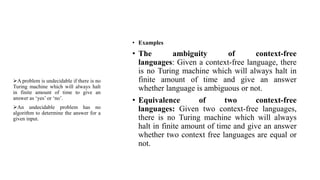
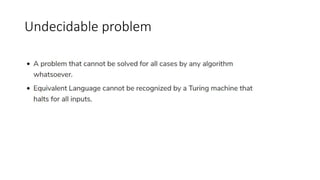
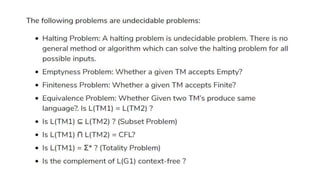
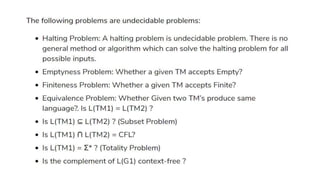
The document discusses examples of undecidable problems in computing. Specifically, it notes that determining whether a context-free language is ambiguous, or whether two context-free languages are equal, are undecidable because there is no algorithm that can always halt and provide a yes or no answer in finite time. It also states that problems like determining if a context-free grammar generates all possible strings of an input alphabet, or determining if a context-free language is regular, are undecidable for the same reason. Finally, it provides definitions of undecidable and semi-decidable problems in relation to decidable problems.