1
Undecidability that is RE
Deepak.M
1VE21CA010
CSE-AI
SRI VENKATESHWARA
COLLEGE
OF ENGINEERING
2
9.2 An Undecidable Problem
That Is RE
 Concepts to be taught:
 RE languages are accepted (recognized) by TM’s.
 RE languages may be grouped into two classes:
 Class 1 (recursive language) --- each language L
in this class has a TM (thought as an algorithm)
which not only accepts strings of L, but also tells
us what strings are not in L by halting.
 Class 2 (RE but not recursive) --- each language L
in this class has a TM (not thought as an algorithm)
which accepts strings of L, but may not halt when
a given input string is not in L.
3
9.2 An Undecidable Problem
That Is RE
 9.2.1 Recursive Languages
 Formally, a language L is recursive if L = L(M)
for some TM M such that:
(1) If wL, then M accepts (and therefore
halts).
(2) If wL, then M eventually halts, although it
never enters an accepting state (i.e., “reject”) .
 A TM of this type corresponds to the formal
notion of algorithm.
4
9.2 An Undecidable Problem
That Is RE
9.2.1 Recursive Languages
 A given language L, regarded as a problem,
is called decidable if L is a recursive
language; and undecidable if not.
 The existence or nonexistence of an
algorithm to solve a problem (i.e., the
problem is decidable or undecidable) is more
important than the existence or nonexistence
of a TM to solve the problem.
5
9.2 An Undecidable Problem
That Is RE
9.2.1 Recursive Languages
 A given language L, regarded as a
problem, is called decidable if L is a
recursive language; and undecidable if not.
Decidable prob.  recursive lang. L
 there is a TM M halts
with L as input
6
9.2 An Undecidable Problem
That Is RE
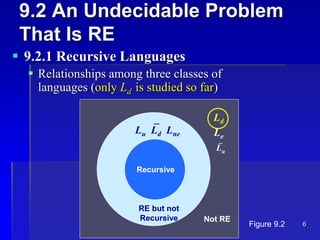
 9.2.1 Recursive Languages
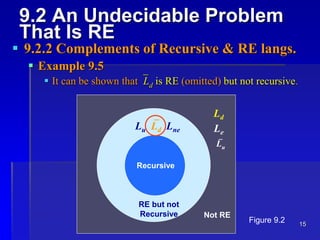
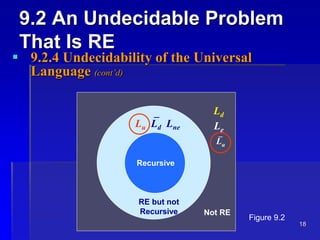
 Relationships among three classes of
languages (only Ld is studied so far)
Recursive
RE but not
Recursive Not RE
Ld
LuLd Lne
Figure 9.2
Le
Lu
7
9.2 An Undecidable Problem
That Is RE
 9.2.1 Recursive Languages
 Lu, the universal language, will soon
be defined and proved not to be
recursive, though it is an RE
language.
 9.2.2 Complements of Recursive and
RE Languages
 A powerful tool of proving is language
complementation.
 We will show that the recursive language
is closed under complementation.
8
9.2 An Undecidable Problem That
Is RE
 9.2.2 Complements of Recursive & RE Langs.
 Theorem 9.3: If a language L is recursive, so isL.
Proof. Prove by constructing a halting TM to acceptL.
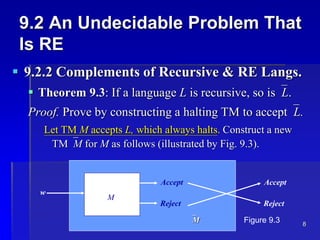
Let TM M accepts L, which always halts. Construct a new
TMM for M as follows (illustrated by Fig. 9.3).
M
w
Accept
Reject
Accept
Reject
Figure 9.3
M
9
9.2 An Undecidable Problem
That Is RE
 9.2.2 Complements of Recursive & RE langs.
Proof. (cont’d).
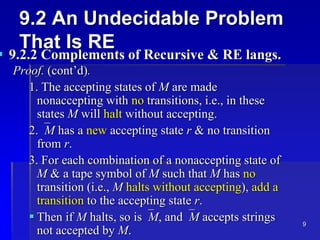
1. The accepting states of M are made
nonaccepting with no transitions, i.e., in these
states M will halt without accepting.
2.M has a new accepting state r & no transition
from r.
3. For each combination of a nonaccepting state of
M & a tape symbol of M such that M has no
transition (i.e., M halts without accepting), add a
transition to the accepting state r.
 Then if M halts, so isM, andM accepts strings
not accepted by M.
10
9.2 An Undecidable Problem
That Is RE
 9.2.2 Complements of Recursive
& RE Languages
 Theorem 9.4
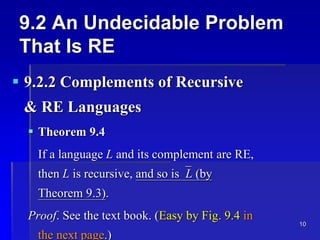
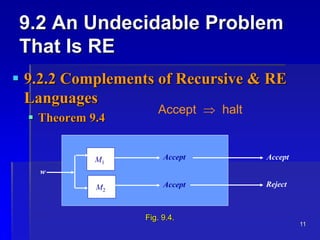
If a language L and its complement are RE,
then L is recursive, and so isL (by
Theorem 9.3).
Proof. See the text book. (Easy by Fig. 9.4 in
the next page.)
11
9.2 An Undecidable Problem
That Is RE
 9.2.2 Complements of Recursive & RE
Languages
 Theorem 9.4
M1
w
Accept Accept
Reject
M2
Accept
Fig. 9.4.
Accept  halt
12
9.2 An Undecidable Problem
That Is RE
 9.2.2 Complements of Recursive & RE langs.
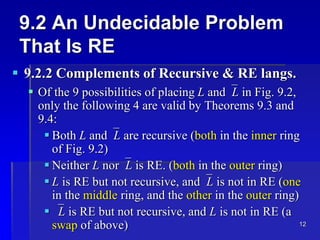
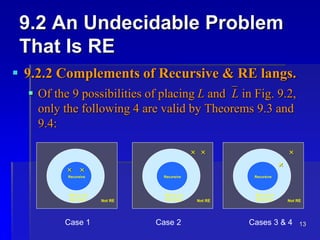
 Of the 9 possibilities of placing L andL in Fig. 9.2,
only the following 4 are valid by Theorems 9.3 and
9.4:
 Both L andL are recursive (both in the inner ring
of Fig. 9.2)
 Neither L norL is RE. (both in the outer ring)
 L is RE but not recursive, andL is not in RE (one
in the middle ring, and the other in the outer ring)
 L is RE but not recursive, and L is not in RE (a
swap of above)
13
9.2 An Undecidable Problem
That Is RE
 9.2.2 Complements of Recursive & RE langs.
 Of the 9 possibilities of placing L andL in Fig. 9.2,
only the following 4 are valid by Theorems 9.3 and
9.4:
Recursive
RE but not
Recursive Not RE
Recursive
RE but not
Recursive Not RE
Recursive
RE but not
Recursive Not RE
 
 


Case 1 Case 2 Cases 3 & 4
14
9.2 An Undecidable Problem
That Is RE
 9.2.2 Complements of Recursive & RE langs.
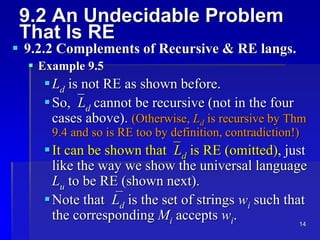
 Example 9.5
Ld is not RE as shown before.
So,Ld cannot be recursive (not in the four
cases above). (Otherwise, Ld is recursive by Thm
9.4 and so is RE too by definition, contradiction!)
It can be shown thatLd is RE (omitted), just
like the way we show the universal language
Lu to be RE (shown next).
Note thatLd is the set of strings wi such that
the corresponding Mi accepts wi.
15
9.2 An Undecidable Problem
That Is RE
 9.2.2 Complements of Recursive & RE langs.
 Example 9.5
 It can be shown thatLd is RE (omitted) but not recursive.
Recursive
RE but not
Recursive Not RE
Ld
LuLd Lne
Figure 9.2
Le
Lu
16
9.2 An Undecidable Problem
That Is RE
 9.2.2 Complements of Recursive & RE langs.
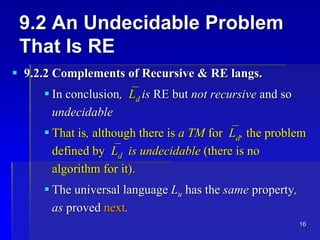
 In conclusion,Ld is RE but not recursive and so
undecidable
 That is, although there is a TM forLd, the problem
defined byLd is undecidable (there is no
algorithm for it).
 The universal language Lu has the same property,
as proved next.
17
9.2 An Undecidable Problem
That Is RE
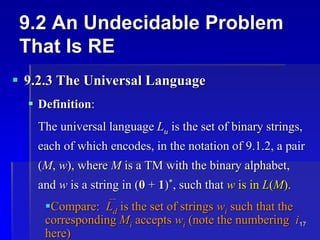
 9.2.3 The Universal Language
 Definition:
The universal language Lu is the set of binary strings,
each of which encodes, in the notation of 9.1.2, a pair
(M, w), where M is a TM with the binary alphabet,
and w is a string in (0 + 1)*, such that w is in L(M).
Compare:Ld is the set of strings wi such that the
corresponding Mi accepts wi (note the numbering i
here)
18
9.2 An Undecidable Problem
That Is RE
 9.2.4 Undecidability of the Universal
Language (cont’d)
Recursive
RE but not
Recursive Not RE
Ld
LuLd Lne
Figure 9.2
Le
Lu
THANK YOU
19

Undecidable problem.pptxUndecidable problemUndecidable problem

  • 1.
    1 Undecidability that isRE Deepak.M 1VE21CA010 CSE-AI SRI VENKATESHWARA COLLEGE OF ENGINEERING
  • 2.
    2 9.2 An UndecidableProblem That Is RE  Concepts to be taught:  RE languages are accepted (recognized) by TM’s.  RE languages may be grouped into two classes:  Class 1 (recursive language) --- each language L in this class has a TM (thought as an algorithm) which not only accepts strings of L, but also tells us what strings are not in L by halting.  Class 2 (RE but not recursive) --- each language L in this class has a TM (not thought as an algorithm) which accepts strings of L, but may not halt when a given input string is not in L.
  • 3.
    3 9.2 An UndecidableProblem That Is RE  9.2.1 Recursive Languages  Formally, a language L is recursive if L = L(M) for some TM M such that: (1) If wL, then M accepts (and therefore halts). (2) If wL, then M eventually halts, although it never enters an accepting state (i.e., “reject”) .  A TM of this type corresponds to the formal notion of algorithm.
  • 4.
    4 9.2 An UndecidableProblem That Is RE 9.2.1 Recursive Languages  A given language L, regarded as a problem, is called decidable if L is a recursive language; and undecidable if not.  The existence or nonexistence of an algorithm to solve a problem (i.e., the problem is decidable or undecidable) is more important than the existence or nonexistence of a TM to solve the problem.
  • 5.
    5 9.2 An UndecidableProblem That Is RE 9.2.1 Recursive Languages  A given language L, regarded as a problem, is called decidable if L is a recursive language; and undecidable if not. Decidable prob.  recursive lang. L  there is a TM M halts with L as input
  • 6.
    6 9.2 An UndecidableProblem That Is RE  9.2.1 Recursive Languages  Relationships among three classes of languages (only Ld is studied so far) Recursive RE but not Recursive Not RE Ld LuLd Lne Figure 9.2 Le Lu
  • 7.
    7 9.2 An UndecidableProblem That Is RE  9.2.1 Recursive Languages  Lu, the universal language, will soon be defined and proved not to be recursive, though it is an RE language.  9.2.2 Complements of Recursive and RE Languages  A powerful tool of proving is language complementation.  We will show that the recursive language is closed under complementation.
  • 8.
    8 9.2 An UndecidableProblem That Is RE  9.2.2 Complements of Recursive & RE Langs.  Theorem 9.3: If a language L is recursive, so isL. Proof. Prove by constructing a halting TM to acceptL. Let TM M accepts L, which always halts. Construct a new TMM for M as follows (illustrated by Fig. 9.3). M w Accept Reject Accept Reject Figure 9.3 M
  • 9.
    9 9.2 An UndecidableProblem That Is RE  9.2.2 Complements of Recursive & RE langs. Proof. (cont’d). 1. The accepting states of M are made nonaccepting with no transitions, i.e., in these states M will halt without accepting. 2.M has a new accepting state r & no transition from r. 3. For each combination of a nonaccepting state of M & a tape symbol of M such that M has no transition (i.e., M halts without accepting), add a transition to the accepting state r.  Then if M halts, so isM, andM accepts strings not accepted by M.
  • 10.
    10 9.2 An UndecidableProblem That Is RE  9.2.2 Complements of Recursive & RE Languages  Theorem 9.4 If a language L and its complement are RE, then L is recursive, and so isL (by Theorem 9.3). Proof. See the text book. (Easy by Fig. 9.4 in the next page.)
  • 11.
    11 9.2 An UndecidableProblem That Is RE  9.2.2 Complements of Recursive & RE Languages  Theorem 9.4 M1 w Accept Accept Reject M2 Accept Fig. 9.4. Accept  halt
  • 12.
    12 9.2 An UndecidableProblem That Is RE  9.2.2 Complements of Recursive & RE langs.  Of the 9 possibilities of placing L andL in Fig. 9.2, only the following 4 are valid by Theorems 9.3 and 9.4:  Both L andL are recursive (both in the inner ring of Fig. 9.2)  Neither L norL is RE. (both in the outer ring)  L is RE but not recursive, andL is not in RE (one in the middle ring, and the other in the outer ring)  L is RE but not recursive, and L is not in RE (a swap of above)
  • 13.
    13 9.2 An UndecidableProblem That Is RE  9.2.2 Complements of Recursive & RE langs.  Of the 9 possibilities of placing L andL in Fig. 9.2, only the following 4 are valid by Theorems 9.3 and 9.4: Recursive RE but not Recursive Not RE Recursive RE but not Recursive Not RE Recursive RE but not Recursive Not RE       Case 1 Case 2 Cases 3 & 4
  • 14.
    14 9.2 An UndecidableProblem That Is RE  9.2.2 Complements of Recursive & RE langs.  Example 9.5 Ld is not RE as shown before. So,Ld cannot be recursive (not in the four cases above). (Otherwise, Ld is recursive by Thm 9.4 and so is RE too by definition, contradiction!) It can be shown thatLd is RE (omitted), just like the way we show the universal language Lu to be RE (shown next). Note thatLd is the set of strings wi such that the corresponding Mi accepts wi.
  • 15.
    15 9.2 An UndecidableProblem That Is RE  9.2.2 Complements of Recursive & RE langs.  Example 9.5  It can be shown thatLd is RE (omitted) but not recursive. Recursive RE but not Recursive Not RE Ld LuLd Lne Figure 9.2 Le Lu
  • 16.
    16 9.2 An UndecidableProblem That Is RE  9.2.2 Complements of Recursive & RE langs.  In conclusion,Ld is RE but not recursive and so undecidable  That is, although there is a TM forLd, the problem defined byLd is undecidable (there is no algorithm for it).  The universal language Lu has the same property, as proved next.
  • 17.
    17 9.2 An UndecidableProblem That Is RE  9.2.3 The Universal Language  Definition: The universal language Lu is the set of binary strings, each of which encodes, in the notation of 9.1.2, a pair (M, w), where M is a TM with the binary alphabet, and w is a string in (0 + 1)*, such that w is in L(M). Compare:Ld is the set of strings wi such that the corresponding Mi accepts wi (note the numbering i here)
  • 18.
    18 9.2 An UndecidableProblem That Is RE  9.2.4 Undecidability of the Universal Language (cont’d) Recursive RE but not Recursive Not RE Ld LuLd Lne Figure 9.2 Le Lu
  • 19.