The 5 C’s of New Media Capacity + Convergence + Control + Connections + Collective Intelligence
Quote “ First, let’s agree that ‘media’ is anything that people want to read, watch, or listen to, amateur or professional. The difference between the ‘old’ media and the ‘new’ is the old media packages content and the new media atomizes it. Old media is all about building businesses around content. New media is about he content, period. Old media is about platforms. New media is about individual people.” Chris Anderson , author of  The Long Tail
Before we go too far… When talking about Old Media and New Media, don’t confuse old with bad and new with good!
A Pessimistic View of the Future
Resistance is Futile! The revolution will NOT be televised! … But it will be blogged, streamed, tagged and mashed up!
What’s at stake? The future of media! Main Stream Media no longer controls the means of production and distribution. Case-in-point: The recording industry Case-in-point: Kodak
Who’s in Control? The end user! "The number one lesson of the internet, whether you're Howard Dean or a media company or a marketer, is that you have to give up control to gain control."   Jeff Jarvis, Buzz Machine blog
Controlling your Brand Jarvis also said,  "There's a conversation going on about your brand in the open. You can either join it or not."
What’s it gonna cost me? Time Money … but not as much as you think!
What’s the learning curve? Your customers and clients are already learning. The Napster effect!
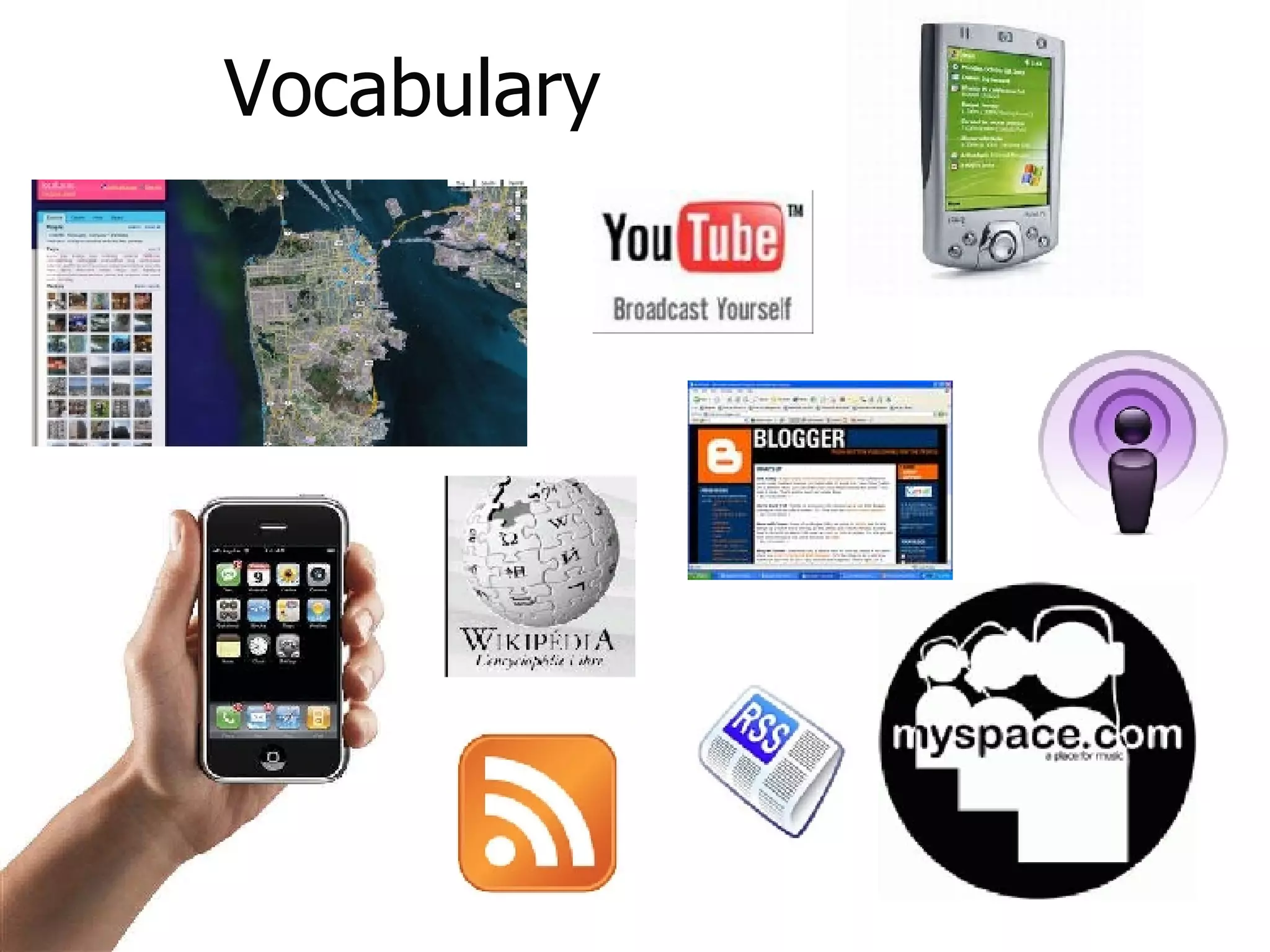
Vocabulary
Vocabulary
An Optimistic View of the Future
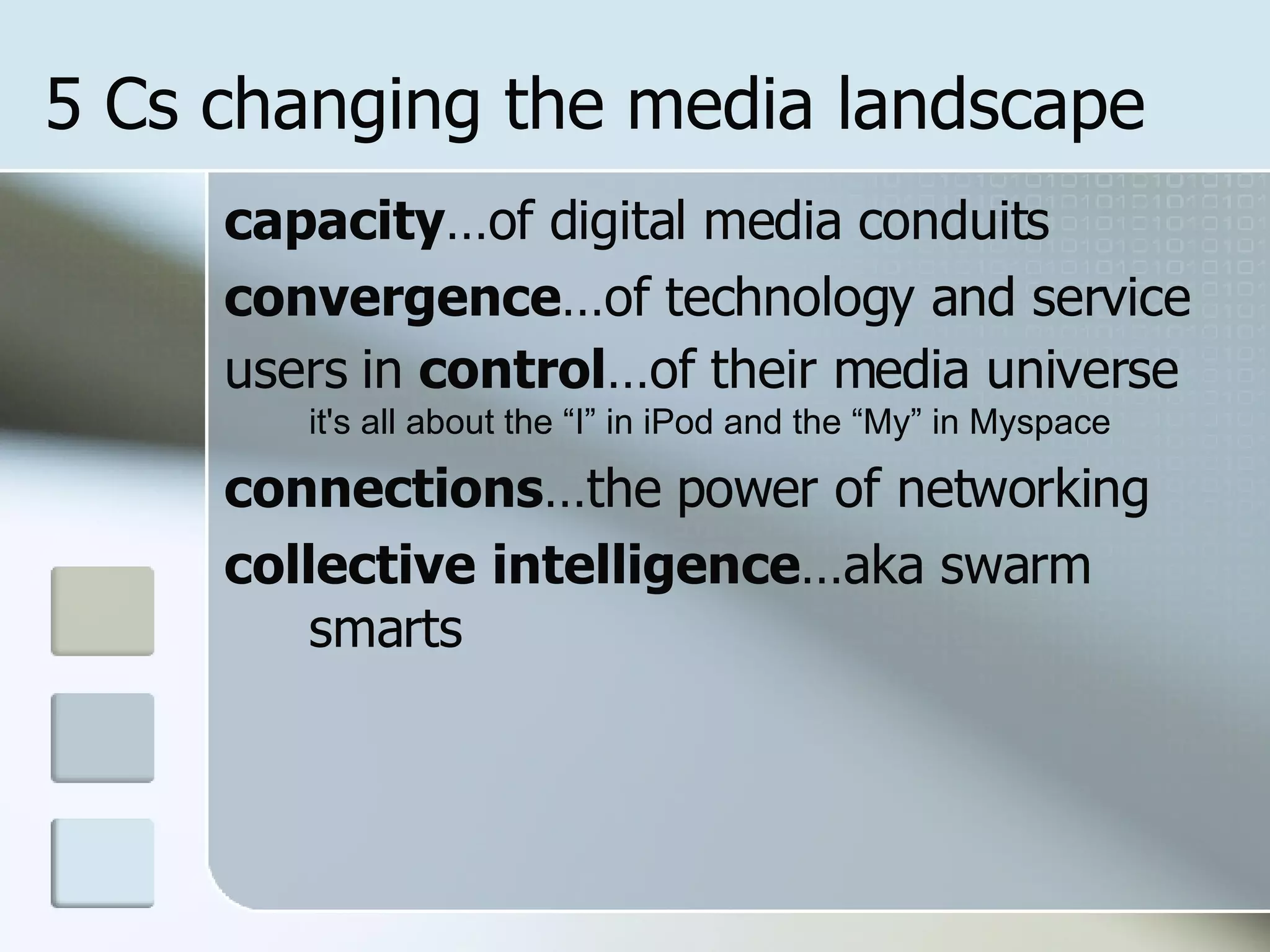
5 Cs changing the media landscape capacity …of digital media conduits convergence …of technology and service users in  control …of their media universe it's all about the “I” in iPod and the “My” in Myspace connections …the power of networking collective   intelligence …aka swarm smarts
Social media The Herd will  be Heard
Social media Other names include… Participatory media Consumer-generated media Web 2.0 Examples: chat, IM, blogs, wikis, message boards, consumer review sites, MMORPGs, photo/video sharing site, SuperBowl ads, etc.
Social media Social networking is more than MySpace and Facebook! Hurricane Information  Maps
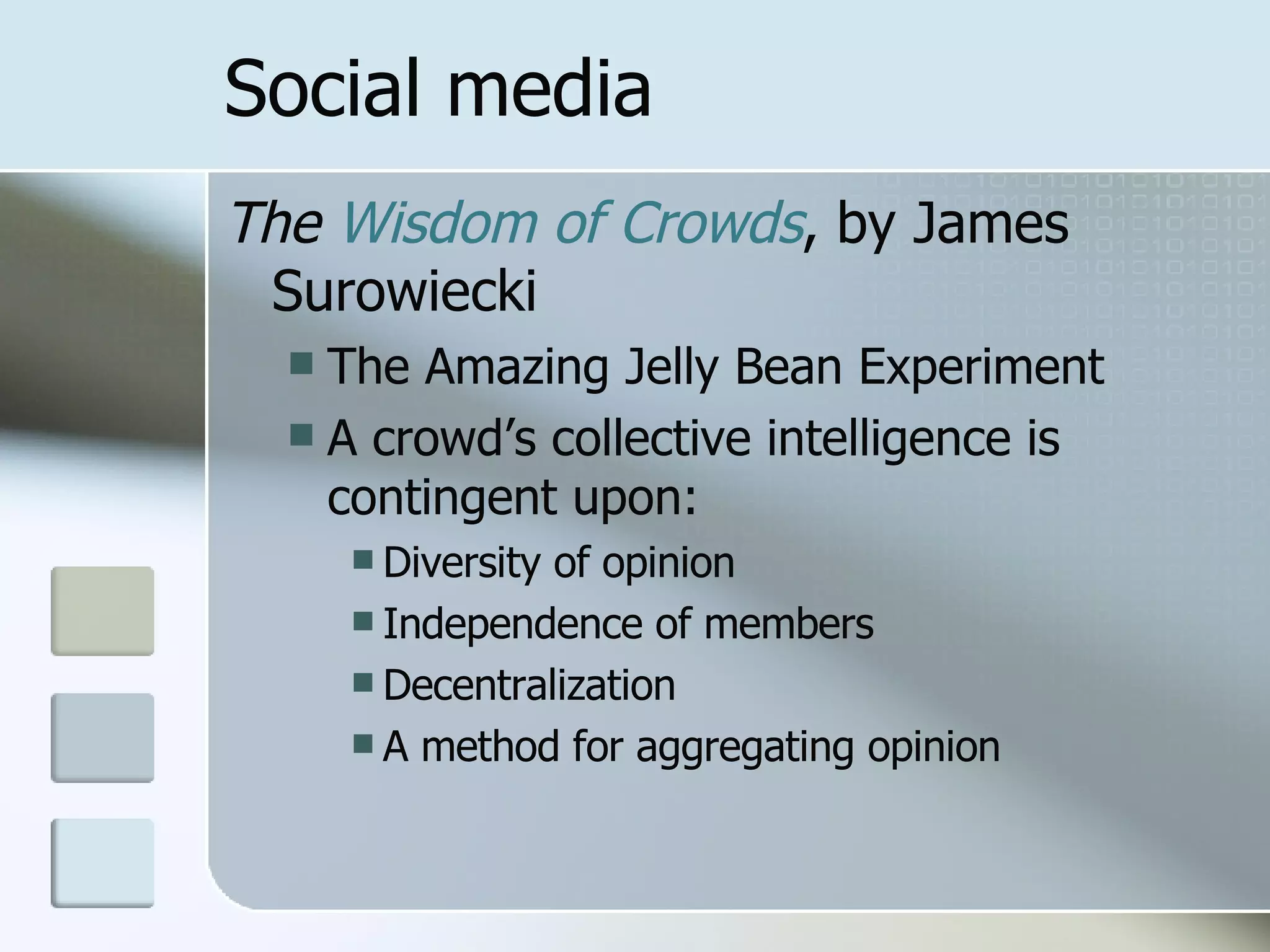
Social media The  Wisdom of Crowds , by James Surowiecki The Amazing Jelly Bean Experiment A crowd’s collective intelligence is contingent upon: Diversity of opinion Independence of members Decentralization A method for aggregating opinion
Networking Theory Sarnoff’s Law Value of a network is proportional to the number of users.  Think  broadcasting Metcalfe’s Law Value of an interactive network is proportional to the square of the number of users, i.e., n 2  Think  internet Reed’s Law Value of social network is two to the  n th power, i.e., 2 n  Think  Web 2.0  and  social software
Harnessing the Power of Blogs Blogs = Web Logs “ Blogs are the new Home Page” More than gossip & personal journals.  Personal publishing characterized by: Ease of use Collection of links Personal style Regular updates Variations on the theme… Moblogs, Vlogs, & Podcasting
Growth As of July 2006,  about 175,000 new weblogs were created each day , which means that  on average, there are more than 2 blogs created each second of each day.
More than a personal diary BTW, Zits author Borgman has his own  blog !
Participatory Journalism Aka, Open Source Journalism “ The line between journalism and personal publishing is a blurry one, thanks to new ubiquitous tools that make it possible for anyone to publish and report news.”
Blogs in the News CBS’s 60 Minutes report on President Bush’s National Guard service Authenticity of the memos was disputed by the blogging community Tiffany Network v. Pajamas Media The rise of “open source” journalism
Podcasting Audio or video files delivered to subscribers using RSS Podcasting 101
Podcasting
Wikis Hawaiian for “quick” Definition:  A collaborative Web site comprised of the perpetual collective work of many authors. Similar to a blog in structure and logic, a wiki allows anyone to edit, delete or modify content that has been placed on the Web site using a browser interface, including the work of previous authors. The first wiki was created by Ward Cunnigham in 1995.
Wikis are Interactive In 1999, Tim Berners-Lee lamented:  “ I wanted the web  to be what I call an interactive space where everybody can edit. And I started saying ‘interactive,’ and then I read in the media that the web was great because it was ‘interactive,’ meaning you could click. This is not what I meant by interactivity.” Lamb, B. (2004, Sept/Oct.). Wide open spaces: Wikis ready or not.  Educause , pp. 36-48.
Fundamental Principles Anyone can change anything Wikis use simplified hypertext markup Content is ego-less, time-less, and never finished
Credibility Issues
Increasing Productivity Blog aggregators, e.g.,  Bloglines Google  Alerts ,  Docs & Spreadsheets Social bookmarking, e.g.,  Del.icio.us
In Conclusion There IS a rocker in your future… or ROKR, the iTunes  Enabled PCS phone
 
 
IM Instant Messaging Text-based synchronous chat Formerly known as IRC (Internet Relay Chat) Pew Internet & American Life surveys reveal that more than four in ten online Americans instant message (IM). That reflects about 53 million American adults who use instant messaging programs. About 11 million of them IM at work and they are becoming fond of its capacity to encourage productivity and interoffice cooperation.  IM goes  graphical 3-D avatars IMVU AOL’s AIM 3D SuperBuddy
CGM Advertising “ Here’s the problem with advertising as I see it,” says Hoffman. “It is almost completely created by professionals.” Frito Lays and General Motors have announced contests to recruit consumer-generated ads to air in this year’s Superbowl! See  http://www.jaffejuice.com/2006/09/super_deduper_b.html See  www.adcandy.com
Growth In summary:  Technorati  is now tracking over 50 Million Blogs.  The Blogosphere is over 100 times bigger than it was just 3 years ago.  Today, the blogosphere is doubling in size every 200 days, or about once every 6 and a half months.  From January 2004 until July 2006, the number of blogs that Technorati tracks has continued to double every 5-7 months.  About 175,000 new weblogs were created each day, which means that on average, there are more than 2 blogs created each second of each day.  About 8% of new blogs get past Technorati's filters, even if it is only for a few hours or days.  About 70% of the pings Technorati receives are from known spam sources, but we drop them before we have to send out a spider to go and index the splog.  Total posting volume of the blogosphere continues to rise, showing about 1.6 Million postings per day, or about 18.6 posts per second.  This is about double the volume of about a year ago.  The most prevalent times for English-language posting is between the hours of 10AM and 2PM Pacific time, with an additional spike at around 5PM Pacific time
Other uses for blogs Student journaling Just in  teractive Digital portfolios http://blog.unbrain.net/archives/2005/04/digital-portfolio/ http://www.perfectusds.com/ http://blogs.writingproject.org/oh/stories/storyReader$43
RSS RSS - or Rich Site Summary (or Really Simple Syndication) - is a metadata format used to describe online content. An RSS file, sometimes known as a 'feed', is an XML file summarizing a website's contents. The RSS file consists of two major sections: a 'channel' element, that describes the website as a whole, and a series of 'item' elements that describe individual resources. There are various sorts of RSS formats, and even an emerging format that does the same thing, called 'Atom', but these are for the most part interoperable. It doesn't really matter which sort of RSS (or Atom) you use. These feeds are collected - or 'harvested' - by RSS file readers or aggregators. At first, it was only possible to read one feed at a time, but new services have emerged that combine lists of items from several feeds, creating topic based or geography based feeds. A great deal could be said of RSS, but the essential points for this discussion can be summarized in a few words: RSS feeds describe content using XML, and they are gathered and reorganized by aggregators, creating content syndication, a means of sharing content quickly and efficiently. From  http://www.downes.ca/cgi-bin/website/view.cgi?dbs=Article&key=1076791198&format=full
Blog resources Technorati   lets you search 53.3 million (as of 9.06) blogs in real time so you can monitor the “buzz” Google  has a blog search RSS aggregators, e.g.,  Bloglines
Wiki samples Wikipedia.org Seedwiki.com Encyclopedia of Interactive Media Romantic Audience Project
Wikiality Note: as a response to the Colbert piece, Wikipedia had to lock the entry on elephants to prevent further vandalism see  http://en.wikipedia.org/wiki/Elephant See also  http://en.wikipedia.org/wiki/Talk:Elephant/Colbert , and  http:// en.wikipedia.org/wiki/Wikiality
So, what about security? “ Think of an open wiki space as a home that leaves it front door unlocked, but doesn’t get robbed because the neighbors are all out on their front steps gossiping, keeping a friendly eye on the street, and never missing a thing.”  This is known as “SoftSecurity.” Also, wikis store previous versions of each page, allowing them to be recovered in the case of vandalism. Hot button issues, e.g., abortion or Iraq, require their own conflict-resolution strategies.
5 C's of New Media Capacity : bandwidth makes possible services we never imagined Convergence : of technology and service Control  (users in): me-media, on demand... it's all about the I in iPod and the My in Myspace Connections  (the power of the network): Sarnoff's law, Metcalf's law, Reed's law Collective   intelligence : blogs, wikis,
You get to choose! or Motorola Rocker another rocker

Rcn 3.07

  • 1.
    The 5 C’sof New Media Capacity + Convergence + Control + Connections + Collective Intelligence
  • 2.
    Quote “ First,let’s agree that ‘media’ is anything that people want to read, watch, or listen to, amateur or professional. The difference between the ‘old’ media and the ‘new’ is the old media packages content and the new media atomizes it. Old media is all about building businesses around content. New media is about he content, period. Old media is about platforms. New media is about individual people.” Chris Anderson , author of The Long Tail
  • 3.
    Before we gotoo far… When talking about Old Media and New Media, don’t confuse old with bad and new with good!
  • 4.
    A Pessimistic Viewof the Future
  • 5.
    Resistance is Futile!The revolution will NOT be televised! … But it will be blogged, streamed, tagged and mashed up!
  • 6.
    What’s at stake?The future of media! Main Stream Media no longer controls the means of production and distribution. Case-in-point: The recording industry Case-in-point: Kodak
  • 7.
    Who’s in Control?The end user! "The number one lesson of the internet, whether you're Howard Dean or a media company or a marketer, is that you have to give up control to gain control." Jeff Jarvis, Buzz Machine blog
  • 8.
    Controlling your BrandJarvis also said, "There's a conversation going on about your brand in the open. You can either join it or not."
  • 9.
    What’s it gonnacost me? Time Money … but not as much as you think!
  • 10.
    What’s the learningcurve? Your customers and clients are already learning. The Napster effect!
  • 11.
  • 12.
  • 13.
    An Optimistic Viewof the Future
  • 14.
    5 Cs changingthe media landscape capacity …of digital media conduits convergence …of technology and service users in control …of their media universe it's all about the “I” in iPod and the “My” in Myspace connections …the power of networking collective intelligence …aka swarm smarts
  • 15.
    Social media TheHerd will be Heard
  • 16.
    Social media Othernames include… Participatory media Consumer-generated media Web 2.0 Examples: chat, IM, blogs, wikis, message boards, consumer review sites, MMORPGs, photo/video sharing site, SuperBowl ads, etc.
  • 17.
    Social media Socialnetworking is more than MySpace and Facebook! Hurricane Information Maps
  • 18.
    Social media The Wisdom of Crowds , by James Surowiecki The Amazing Jelly Bean Experiment A crowd’s collective intelligence is contingent upon: Diversity of opinion Independence of members Decentralization A method for aggregating opinion
  • 19.
    Networking Theory Sarnoff’sLaw Value of a network is proportional to the number of users. Think broadcasting Metcalfe’s Law Value of an interactive network is proportional to the square of the number of users, i.e., n 2 Think internet Reed’s Law Value of social network is two to the n th power, i.e., 2 n Think Web 2.0 and social software
  • 20.
    Harnessing the Powerof Blogs Blogs = Web Logs “ Blogs are the new Home Page” More than gossip & personal journals. Personal publishing characterized by: Ease of use Collection of links Personal style Regular updates Variations on the theme… Moblogs, Vlogs, & Podcasting
  • 21.
    Growth As ofJuly 2006, about 175,000 new weblogs were created each day , which means that on average, there are more than 2 blogs created each second of each day.
  • 22.
    More than apersonal diary BTW, Zits author Borgman has his own blog !
  • 23.
    Participatory Journalism Aka,Open Source Journalism “ The line between journalism and personal publishing is a blurry one, thanks to new ubiquitous tools that make it possible for anyone to publish and report news.”
  • 24.
    Blogs in theNews CBS’s 60 Minutes report on President Bush’s National Guard service Authenticity of the memos was disputed by the blogging community Tiffany Network v. Pajamas Media The rise of “open source” journalism
  • 25.
    Podcasting Audio orvideo files delivered to subscribers using RSS Podcasting 101
  • 26.
  • 27.
    Wikis Hawaiian for“quick” Definition: A collaborative Web site comprised of the perpetual collective work of many authors. Similar to a blog in structure and logic, a wiki allows anyone to edit, delete or modify content that has been placed on the Web site using a browser interface, including the work of previous authors. The first wiki was created by Ward Cunnigham in 1995.
  • 28.
    Wikis are InteractiveIn 1999, Tim Berners-Lee lamented: “ I wanted the web to be what I call an interactive space where everybody can edit. And I started saying ‘interactive,’ and then I read in the media that the web was great because it was ‘interactive,’ meaning you could click. This is not what I meant by interactivity.” Lamb, B. (2004, Sept/Oct.). Wide open spaces: Wikis ready or not. Educause , pp. 36-48.
  • 29.
    Fundamental Principles Anyonecan change anything Wikis use simplified hypertext markup Content is ego-less, time-less, and never finished
  • 30.
  • 31.
    Increasing Productivity Blogaggregators, e.g., Bloglines Google Alerts , Docs & Spreadsheets Social bookmarking, e.g., Del.icio.us
  • 32.
    In Conclusion ThereIS a rocker in your future… or ROKR, the iTunes Enabled PCS phone
  • 33.
  • 34.
  • 35.
    IM Instant MessagingText-based synchronous chat Formerly known as IRC (Internet Relay Chat) Pew Internet & American Life surveys reveal that more than four in ten online Americans instant message (IM). That reflects about 53 million American adults who use instant messaging programs. About 11 million of them IM at work and they are becoming fond of its capacity to encourage productivity and interoffice cooperation. IM goes graphical 3-D avatars IMVU AOL’s AIM 3D SuperBuddy
  • 36.
    CGM Advertising “Here’s the problem with advertising as I see it,” says Hoffman. “It is almost completely created by professionals.” Frito Lays and General Motors have announced contests to recruit consumer-generated ads to air in this year’s Superbowl! See http://www.jaffejuice.com/2006/09/super_deduper_b.html See www.adcandy.com
  • 37.
    Growth In summary: Technorati is now tracking over 50 Million Blogs. The Blogosphere is over 100 times bigger than it was just 3 years ago. Today, the blogosphere is doubling in size every 200 days, or about once every 6 and a half months. From January 2004 until July 2006, the number of blogs that Technorati tracks has continued to double every 5-7 months. About 175,000 new weblogs were created each day, which means that on average, there are more than 2 blogs created each second of each day. About 8% of new blogs get past Technorati's filters, even if it is only for a few hours or days. About 70% of the pings Technorati receives are from known spam sources, but we drop them before we have to send out a spider to go and index the splog. Total posting volume of the blogosphere continues to rise, showing about 1.6 Million postings per day, or about 18.6 posts per second. This is about double the volume of about a year ago. The most prevalent times for English-language posting is between the hours of 10AM and 2PM Pacific time, with an additional spike at around 5PM Pacific time
  • 38.
    Other uses forblogs Student journaling Just in teractive Digital portfolios http://blog.unbrain.net/archives/2005/04/digital-portfolio/ http://www.perfectusds.com/ http://blogs.writingproject.org/oh/stories/storyReader$43
  • 39.
    RSS RSS -or Rich Site Summary (or Really Simple Syndication) - is a metadata format used to describe online content. An RSS file, sometimes known as a 'feed', is an XML file summarizing a website's contents. The RSS file consists of two major sections: a 'channel' element, that describes the website as a whole, and a series of 'item' elements that describe individual resources. There are various sorts of RSS formats, and even an emerging format that does the same thing, called 'Atom', but these are for the most part interoperable. It doesn't really matter which sort of RSS (or Atom) you use. These feeds are collected - or 'harvested' - by RSS file readers or aggregators. At first, it was only possible to read one feed at a time, but new services have emerged that combine lists of items from several feeds, creating topic based or geography based feeds. A great deal could be said of RSS, but the essential points for this discussion can be summarized in a few words: RSS feeds describe content using XML, and they are gathered and reorganized by aggregators, creating content syndication, a means of sharing content quickly and efficiently. From http://www.downes.ca/cgi-bin/website/view.cgi?dbs=Article&key=1076791198&format=full
  • 40.
    Blog resources Technorati lets you search 53.3 million (as of 9.06) blogs in real time so you can monitor the “buzz” Google has a blog search RSS aggregators, e.g., Bloglines
  • 41.
    Wiki samples Wikipedia.orgSeedwiki.com Encyclopedia of Interactive Media Romantic Audience Project
  • 42.
    Wikiality Note: asa response to the Colbert piece, Wikipedia had to lock the entry on elephants to prevent further vandalism see http://en.wikipedia.org/wiki/Elephant See also http://en.wikipedia.org/wiki/Talk:Elephant/Colbert , and http:// en.wikipedia.org/wiki/Wikiality
  • 43.
    So, what aboutsecurity? “ Think of an open wiki space as a home that leaves it front door unlocked, but doesn’t get robbed because the neighbors are all out on their front steps gossiping, keeping a friendly eye on the street, and never missing a thing.” This is known as “SoftSecurity.” Also, wikis store previous versions of each page, allowing them to be recovered in the case of vandalism. Hot button issues, e.g., abortion or Iraq, require their own conflict-resolution strategies.
  • 44.
    5 C's ofNew Media Capacity : bandwidth makes possible services we never imagined Convergence : of technology and service Control (users in): me-media, on demand... it's all about the I in iPod and the My in Myspace Connections (the power of the network): Sarnoff's law, Metcalf's law, Reed's law Collective intelligence : blogs, wikis,
  • 45.
    You get tochoose! or Motorola Rocker another rocker