Participation in Occupation 1 BT230001 Lecture Two:  Technology and communication
Introduction Definitions of Communication/ telecommunications Technology and communication historically Notions and myths about technology and communication What is on offer how does it benefit  Accessing communications technology, community assistance and the digital divide Some examples of online communication
http://www.pritchettcartoons.com/signals.htm , retrieved 13/12/07
Definitions of Communication Communication  is not only the process of sharing information. Communication processes are in most cases sign-mediated interactions which are governed by three levels of semiotic rules: Syntactic, pragmatic and semantic. Therefore, communication is a kind of social interaction where at least two interacting agents share a common set of signs and a common set of semiotic rules. In a simplistic form, information is sent from a sender or encoder to a receiver or decoder. In a more complex form feedback links a sender to a receiver. This requires a symbolic activity, sometimes via a language. Communication development is the development of processes enabling one to understand what others say (or sign, or write) and speak (or sign, or write), translate sounds and symbols into meaning and learn the syntax of the language. Communication is based on the idea of respect, promises and the want for social improvement.    Retrieved 15/12/06  wikipedia.org/wiki/Communication.
Collins concise dictionary plus Communication.  n.  1. the imparting or exchange of information, ideas, or feelings  2. something communicated such as a message  3. the study of the ways in which human beings communicate 4. a conection route or link   Collins concise plus. (1989).Glasgow: Bath Press
Telecommunication … is the transmission of signals over a distance for the purpose of communication. In modern times, this process almost always involves the sending of electromagnetic waves by electronic transmitters but in earlier years it may have involved the use of smoke signals, drums or semaphore. Today, telecommunication is widespread and devices that assist the process, such as the television, radio and telephone, are common in many parts of the world. There is also a vast array of networks that connect these devices, including computer networks, public telephone networks, radio networks and television networks. Computer communication across the Internet, such as e-mail and instant messaging, is just one of many examples of telecommunication. Retrieved 15/12/06  wikipedia.org/wiki/Teleommunication
The basic elements of a telecommunication system are: a transmitter that takes information and converts it to a signal for transmission  a transmission medium over which the signal is transmitted  a receiver that receives and converts the signal back into usable information
Technology and Telecommunication Historically Smoke signals Pony Express Telegraph (Victorian internet) Telephone Today, Chat rooms, Bogs, Video Blogging, Second life, Websites, cell phones (text, pxt, vex)
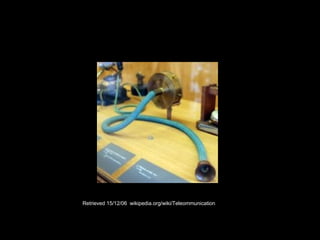
Retrieved 15/12/06  wikipedia.org/wiki/Teleommunication
 
Communication and its Human importance Transmission and development of ideas Commercial and economic development Sharing our life events, staying in touch Finding out more about each other, cultures, generations, our history, others history Being more informed Performing day to day duties Seeking out the unusual Getting info and instruction
Notions, Issues and Myths around Technology and communication The relevance and necessity of information being transferred Misuse of telecommunication tools Legal and control issues Connection with those around us verses connection over distance When are communication devices adopted? New technologies don’t always replace old, need to add something or make something easier
Stuff Articles
Blogs What are they What are they been used for? Examples Who uses they and WHY? Why have they been adopted by so many people?
Wiki Definition A  blog  is a website where entries are made in journal style and displayed in a reverse chronological order. Blogs often provide commentary or news on a particular subject, such as food, politics, or local news; some function as more personal online diaries. A typical blog combines text, images, and links to other blogs, web pages, and other media related to its topic. The ability for readers to leave comments in an interactive format is an important part of many blogs. Most blogs are primarily textual although some focus on photographs (photoblog), sketchblog, videos (vlog), or audio (podcasting), and are part of a wider network of social media. The term "blog" is derived from "Web log." "Blog" can also be used as a verb, meaning  to maintain or add content to a blog. Retrieved December 15 th  from:  http://en.wikipedia.org/wiki/Blog.
Blog Examples
How does this relate to Occupational Therapy?
The   digital divide … is the gap between those with regular, effective access to digital technologies and those without. The term digital divide refers to those who can benefit from it, and those who don't, as opposed to just talking about who has  direct  access to technology, and those who don't. Retrieved 15/12/06  wikipedia.org/wiki/digitaldivide
We are in the business of manipulating contexts not people

Participation in Occupation

  • 1.
    Participation in Occupation1 BT230001 Lecture Two: Technology and communication
  • 2.
    Introduction Definitions ofCommunication/ telecommunications Technology and communication historically Notions and myths about technology and communication What is on offer how does it benefit Accessing communications technology, community assistance and the digital divide Some examples of online communication
  • 3.
  • 4.
    Definitions of CommunicationCommunication is not only the process of sharing information. Communication processes are in most cases sign-mediated interactions which are governed by three levels of semiotic rules: Syntactic, pragmatic and semantic. Therefore, communication is a kind of social interaction where at least two interacting agents share a common set of signs and a common set of semiotic rules. In a simplistic form, information is sent from a sender or encoder to a receiver or decoder. In a more complex form feedback links a sender to a receiver. This requires a symbolic activity, sometimes via a language. Communication development is the development of processes enabling one to understand what others say (or sign, or write) and speak (or sign, or write), translate sounds and symbols into meaning and learn the syntax of the language. Communication is based on the idea of respect, promises and the want for social improvement. Retrieved 15/12/06 wikipedia.org/wiki/Communication.
  • 5.
    Collins concise dictionaryplus Communication. n. 1. the imparting or exchange of information, ideas, or feelings 2. something communicated such as a message 3. the study of the ways in which human beings communicate 4. a conection route or link Collins concise plus. (1989).Glasgow: Bath Press
  • 6.
    Telecommunication … isthe transmission of signals over a distance for the purpose of communication. In modern times, this process almost always involves the sending of electromagnetic waves by electronic transmitters but in earlier years it may have involved the use of smoke signals, drums or semaphore. Today, telecommunication is widespread and devices that assist the process, such as the television, radio and telephone, are common in many parts of the world. There is also a vast array of networks that connect these devices, including computer networks, public telephone networks, radio networks and television networks. Computer communication across the Internet, such as e-mail and instant messaging, is just one of many examples of telecommunication. Retrieved 15/12/06 wikipedia.org/wiki/Teleommunication
  • 7.
    The basic elementsof a telecommunication system are: a transmitter that takes information and converts it to a signal for transmission a transmission medium over which the signal is transmitted a receiver that receives and converts the signal back into usable information
  • 8.
    Technology and TelecommunicationHistorically Smoke signals Pony Express Telegraph (Victorian internet) Telephone Today, Chat rooms, Bogs, Video Blogging, Second life, Websites, cell phones (text, pxt, vex)
  • 9.
    Retrieved 15/12/06 wikipedia.org/wiki/Teleommunication
  • 10.
  • 11.
    Communication and itsHuman importance Transmission and development of ideas Commercial and economic development Sharing our life events, staying in touch Finding out more about each other, cultures, generations, our history, others history Being more informed Performing day to day duties Seeking out the unusual Getting info and instruction
  • 12.
    Notions, Issues andMyths around Technology and communication The relevance and necessity of information being transferred Misuse of telecommunication tools Legal and control issues Connection with those around us verses connection over distance When are communication devices adopted? New technologies don’t always replace old, need to add something or make something easier
  • 13.
  • 14.
    Blogs What arethey What are they been used for? Examples Who uses they and WHY? Why have they been adopted by so many people?
  • 15.
    Wiki Definition A blog is a website where entries are made in journal style and displayed in a reverse chronological order. Blogs often provide commentary or news on a particular subject, such as food, politics, or local news; some function as more personal online diaries. A typical blog combines text, images, and links to other blogs, web pages, and other media related to its topic. The ability for readers to leave comments in an interactive format is an important part of many blogs. Most blogs are primarily textual although some focus on photographs (photoblog), sketchblog, videos (vlog), or audio (podcasting), and are part of a wider network of social media. The term "blog" is derived from "Web log." "Blog" can also be used as a verb, meaning to maintain or add content to a blog. Retrieved December 15 th from: http://en.wikipedia.org/wiki/Blog.
  • 16.
  • 17.
    How does thisrelate to Occupational Therapy?
  • 18.
    The digital divide … is the gap between those with regular, effective access to digital technologies and those without. The term digital divide refers to those who can benefit from it, and those who don't, as opposed to just talking about who has direct access to technology, and those who don't. Retrieved 15/12/06 wikipedia.org/wiki/digitaldivide
  • 19.
    We are inthe business of manipulating contexts not people