Evolution of Computers
• First Generation(Vaccum Tubes)
• Second Generation(Transistor Based)
• Third Generation(Integrated-Circuit Based)
• Fourth Generation(Micro processor)
• Fifth Generation(Artificial Intelligence)
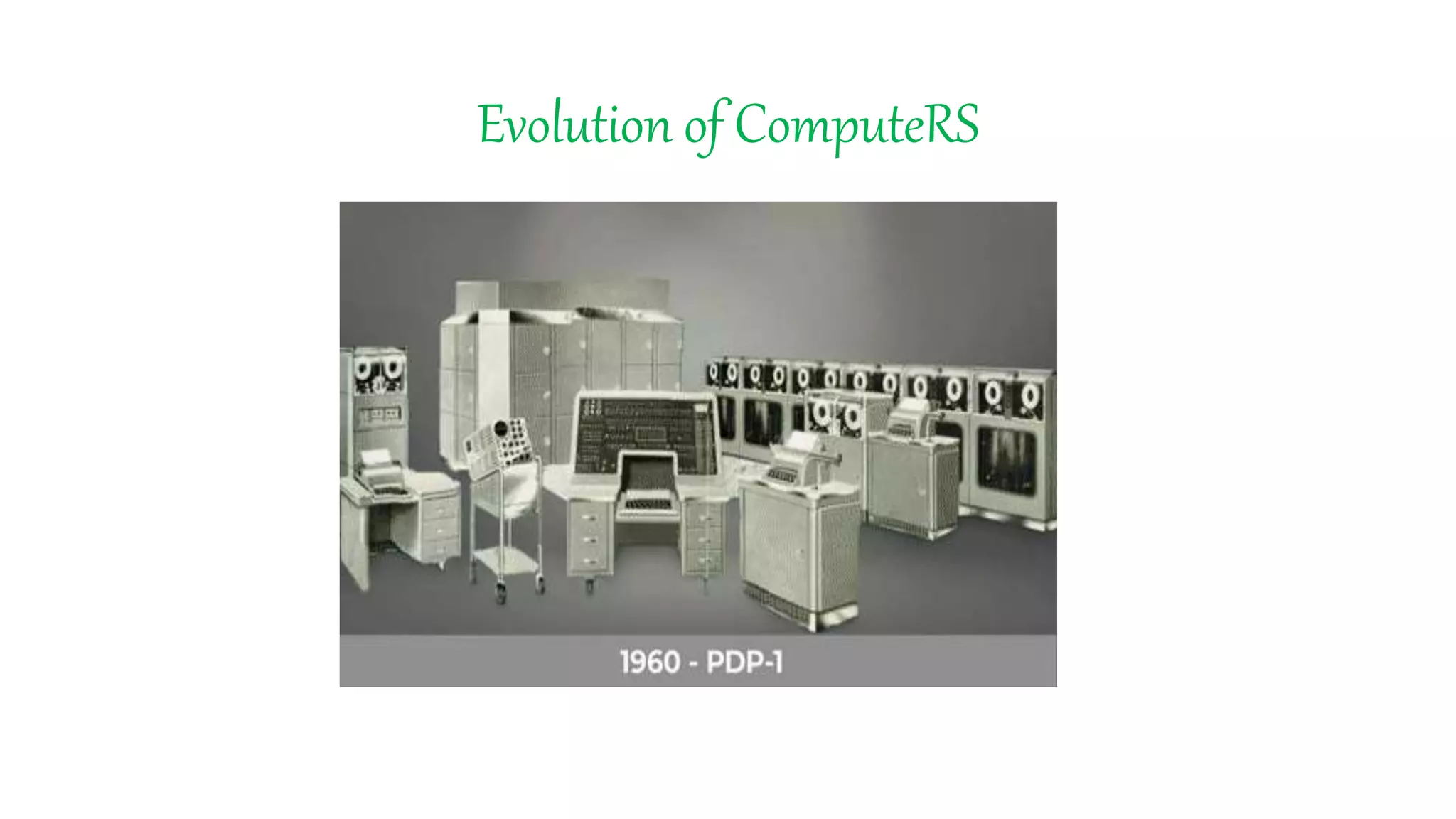
Evolution of ComputeRS
First Generation
• The Ist generation computers were huge, slow, expansive and often
unreliable.
• In 1946 two Americans, Presper Eckert and John Mauchly built the
ENIAC.
• ENIAC was made up of 18,000 vacuum tubes and occupied a 30 * 50
feet room.
• ENIAC stands for Electronic Numeric Integration and Calculator.
First Generation
First Generation
ADVANTAGES
• These computers were designed by using vacuum tubes.
• These generations’ computers were simple architecture.
• These computers calculate data in a millisecond.
• This computer is used for scientific purposes.
DISADVANTAGES
• The computer was very costly.
• Very large in size
• It takes up a lot of space and electricity
• The speed of these computers was very slow
• It is used for commercial purposes.
• It is very expensive.
• These computers heat a lot.
• Cooling is needed to operate these computers because it heats up very quickly.
Second Generation
• The second generation of computers is characterized by the use of
“transistors” and it was developed in 1947
• A transistor is a semiconductor device used to amplify or switch
electronic signals or opens or close a circuit. It is invented in bell labs,
The transistors become the key ingredient of all digital circuits,
including computers.
Second Generation
Second Generation
• It was faster, more reliable, smaller & much cheaper to build than a vacuum.
ENIAC was the world Ist successful electronic computer.
• One transistor replaced the equivalents of 40 vacuum tubes.
• The size of computer also decreased and it became much smaller than that
of earlier computer.
• Therefore, they were very cheap to produce.
• Key Features
• Low electricity consumption. More reliable and faster. Used transistors,
about 1,00,000 circuits per foot.
• Examples – UNIVAC – III, IBM 7070, 7080,7090,1400,1600 series etc...
Second Generation
ADVANTAGES:
• It is smaller in size as compared to the first-generation computer
• It used a less electricity
• Not heated as much as the first-generation computer.
• It has better speed
DISADVANTAGES:
• It is also costly and not versatile
• still, it is expensive for commercial purpose
• Cooling is still needed
• Punch cards were used for input
• The computer is used for the particular purpose
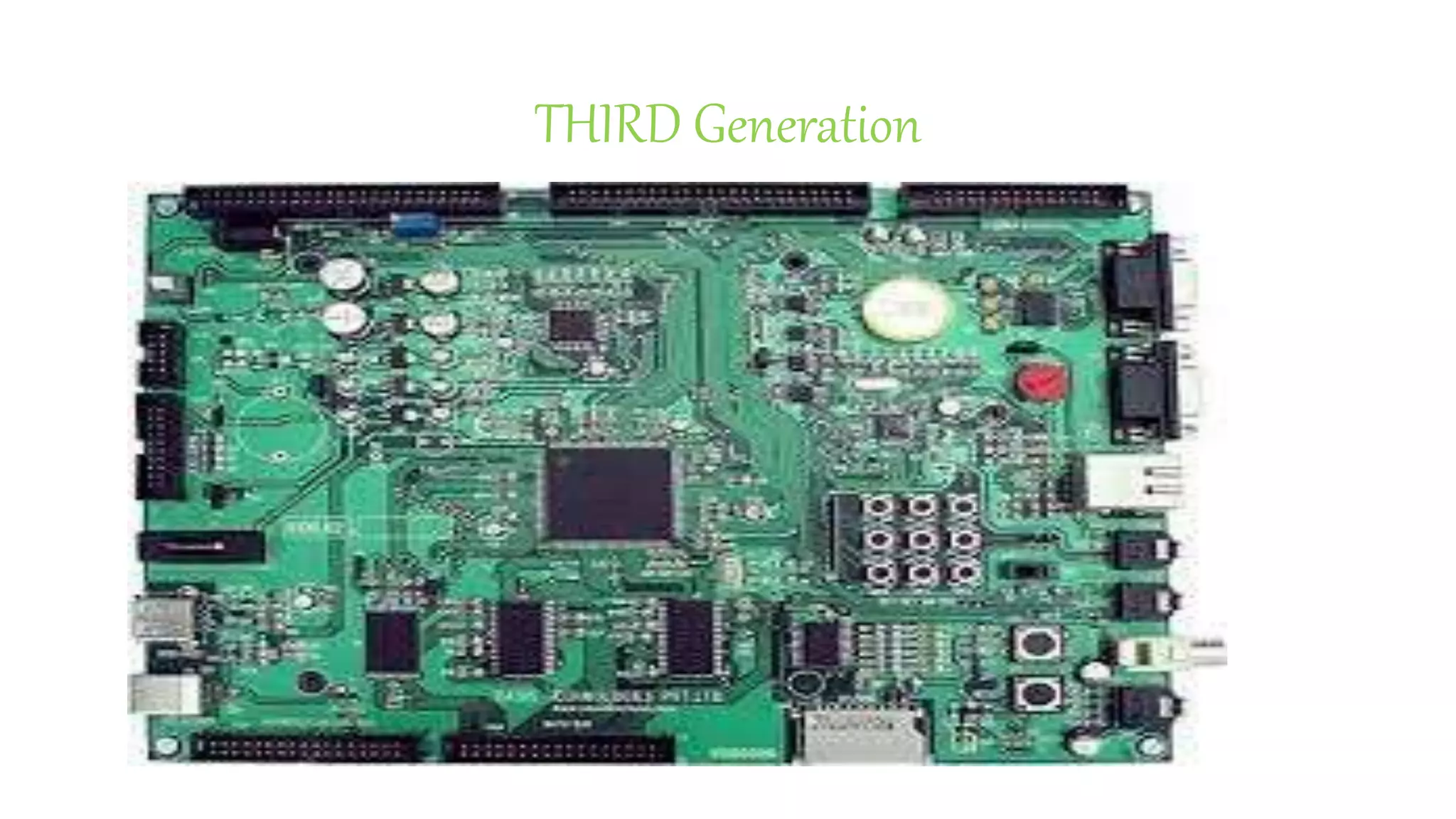
THIRD Generation
• The third generation of computers is characterized by the use
of “Integrated Circuits” it was developed in 1958 by “Jack Kilby”.
• The integrated circuit is a set of electronic circuits on small flat pieces
of semiconductor that is normally known as silicon. The transistors
were miniaturized and placed on silicon chips which are called
semiconductors, which drastically increased the efficiency and speed
of the computers.
• This development made computers smaller in size, low cost, large
memory, and processing. The speed of these computers is very high
and it is efficient and reliable also.
THIRD Generation
THIRD Generation
Examples are NCR 395(National Cash Register),
IBM 360,370 series,
B6500
ADVANTAGES:
• These computers are smaller in size as compared to previous generations
• It consumed less energy and was more reliable
• More Versatile
• It produced less heat as compared to previous generations
• These computers are used for commercial and as well as general-purpose
• These computers used a fan for head discharge to prevent damage
• This generation of computers has increased the storage capacity of computers
DISADVANTAGES:
• Still, a cooling system is needed.
• It is still very costly
• Sophisticated Technology is required to manufacture Integrated Circuits
• It is not easy to maintain the IC chips.
• The performance of these computers is degraded if we execute large applications.
FOURTH Generation
• The fourth generation of computers is characterized by the use of
“Microprocessor”. It was invented in the 1970s
• A microprocessor contains all the circuits required to perform
arithmetic, logic, and control functions on a single chip. Because of
microprocessors, fourth-generation includes more data processing
capacity than equivalent-sized third-generation computers.
• Due to the development of microprocessors, it is possible to place the
CPU(central processing unit) on a single chip. These computers are
also known as microcomputers. The personal computer is a fourth-
generation computer.
FOURTH Generation
FOURTH Generation
ADVANTAGES:
• These computers are smaller in size and much more reliable as compared to other
generations of computers
• he heating issue on these computers is almost negligible
• No A/C or Air conditioner is required in a fourth-generation computer.
• In these computers, all types of higher languages can be used in this generation
• t is totally also for the general-purpose
• less expensive
• These computers are cheaper and also portable
DISADVANTAGES:
• Fans are required to operate these kinds of computers
• It required the latest technology for the need of making microprocessors and
complex software
• These computers were highly sophisticated
FIFTH Generation
• These generations of computers were based on AI(Artificial
Intelligence) technology. Artificial technology is the branch of
computer science concerned with making computers behave like
humans and allowing the computer to take its own decision currently,
no computers exhibit full artificial intelligence
• In the fifth generation of computers, VLSI technology and ULSI
(Ultra Large Scale Integration) technology are used and the speed of
these computers is extremely high
FIFTH Generation
FIFTH Generation
FIFTH Generation
ADVANTAGES:
• These computers are smaller in size and it is more compatible
•These computers are very powerful and cheaper in cost
•It is obviously used for the general purpose
•Higher technology is used
DISADVANTAGES:
• It tends to be sophisticated and complex tool
•It pushes the limit of transistor density

Evolution of Computers ppt.pptx

  • 1.
    Evolution of Computers •First Generation(Vaccum Tubes) • Second Generation(Transistor Based) • Third Generation(Integrated-Circuit Based) • Fourth Generation(Micro processor) • Fifth Generation(Artificial Intelligence)
  • 2.
  • 3.
    First Generation • TheIst generation computers were huge, slow, expansive and often unreliable. • In 1946 two Americans, Presper Eckert and John Mauchly built the ENIAC. • ENIAC was made up of 18,000 vacuum tubes and occupied a 30 * 50 feet room. • ENIAC stands for Electronic Numeric Integration and Calculator.
  • 4.
  • 5.
    First Generation ADVANTAGES • Thesecomputers were designed by using vacuum tubes. • These generations’ computers were simple architecture. • These computers calculate data in a millisecond. • This computer is used for scientific purposes. DISADVANTAGES • The computer was very costly. • Very large in size • It takes up a lot of space and electricity • The speed of these computers was very slow • It is used for commercial purposes. • It is very expensive. • These computers heat a lot. • Cooling is needed to operate these computers because it heats up very quickly.
  • 6.
    Second Generation • Thesecond generation of computers is characterized by the use of “transistors” and it was developed in 1947 • A transistor is a semiconductor device used to amplify or switch electronic signals or opens or close a circuit. It is invented in bell labs, The transistors become the key ingredient of all digital circuits, including computers.
  • 7.
  • 8.
    Second Generation • Itwas faster, more reliable, smaller & much cheaper to build than a vacuum. ENIAC was the world Ist successful electronic computer. • One transistor replaced the equivalents of 40 vacuum tubes. • The size of computer also decreased and it became much smaller than that of earlier computer. • Therefore, they were very cheap to produce. • Key Features • Low electricity consumption. More reliable and faster. Used transistors, about 1,00,000 circuits per foot. • Examples – UNIVAC – III, IBM 7070, 7080,7090,1400,1600 series etc...
  • 9.
    Second Generation ADVANTAGES: • Itis smaller in size as compared to the first-generation computer • It used a less electricity • Not heated as much as the first-generation computer. • It has better speed DISADVANTAGES: • It is also costly and not versatile • still, it is expensive for commercial purpose • Cooling is still needed • Punch cards were used for input • The computer is used for the particular purpose
  • 10.
    THIRD Generation • Thethird generation of computers is characterized by the use of “Integrated Circuits” it was developed in 1958 by “Jack Kilby”. • The integrated circuit is a set of electronic circuits on small flat pieces of semiconductor that is normally known as silicon. The transistors were miniaturized and placed on silicon chips which are called semiconductors, which drastically increased the efficiency and speed of the computers. • This development made computers smaller in size, low cost, large memory, and processing. The speed of these computers is very high and it is efficient and reliable also.
  • 11.
  • 12.
    THIRD Generation Examples areNCR 395(National Cash Register), IBM 360,370 series, B6500 ADVANTAGES: • These computers are smaller in size as compared to previous generations • It consumed less energy and was more reliable • More Versatile • It produced less heat as compared to previous generations • These computers are used for commercial and as well as general-purpose • These computers used a fan for head discharge to prevent damage • This generation of computers has increased the storage capacity of computers DISADVANTAGES: • Still, a cooling system is needed. • It is still very costly • Sophisticated Technology is required to manufacture Integrated Circuits • It is not easy to maintain the IC chips. • The performance of these computers is degraded if we execute large applications.
  • 13.
    FOURTH Generation • Thefourth generation of computers is characterized by the use of “Microprocessor”. It was invented in the 1970s • A microprocessor contains all the circuits required to perform arithmetic, logic, and control functions on a single chip. Because of microprocessors, fourth-generation includes more data processing capacity than equivalent-sized third-generation computers. • Due to the development of microprocessors, it is possible to place the CPU(central processing unit) on a single chip. These computers are also known as microcomputers. The personal computer is a fourth- generation computer.
  • 14.
  • 15.
    FOURTH Generation ADVANTAGES: • Thesecomputers are smaller in size and much more reliable as compared to other generations of computers • he heating issue on these computers is almost negligible • No A/C or Air conditioner is required in a fourth-generation computer. • In these computers, all types of higher languages can be used in this generation • t is totally also for the general-purpose • less expensive • These computers are cheaper and also portable DISADVANTAGES: • Fans are required to operate these kinds of computers • It required the latest technology for the need of making microprocessors and complex software • These computers were highly sophisticated
  • 16.
    FIFTH Generation • Thesegenerations of computers were based on AI(Artificial Intelligence) technology. Artificial technology is the branch of computer science concerned with making computers behave like humans and allowing the computer to take its own decision currently, no computers exhibit full artificial intelligence • In the fifth generation of computers, VLSI technology and ULSI (Ultra Large Scale Integration) technology are used and the speed of these computers is extremely high
  • 17.
  • 18.
  • 19.
    FIFTH Generation ADVANTAGES: • Thesecomputers are smaller in size and it is more compatible •These computers are very powerful and cheaper in cost •It is obviously used for the general purpose •Higher technology is used DISADVANTAGES: • It tends to be sophisticated and complex tool •It pushes the limit of transistor density