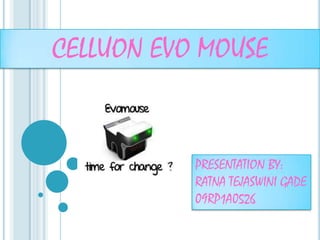
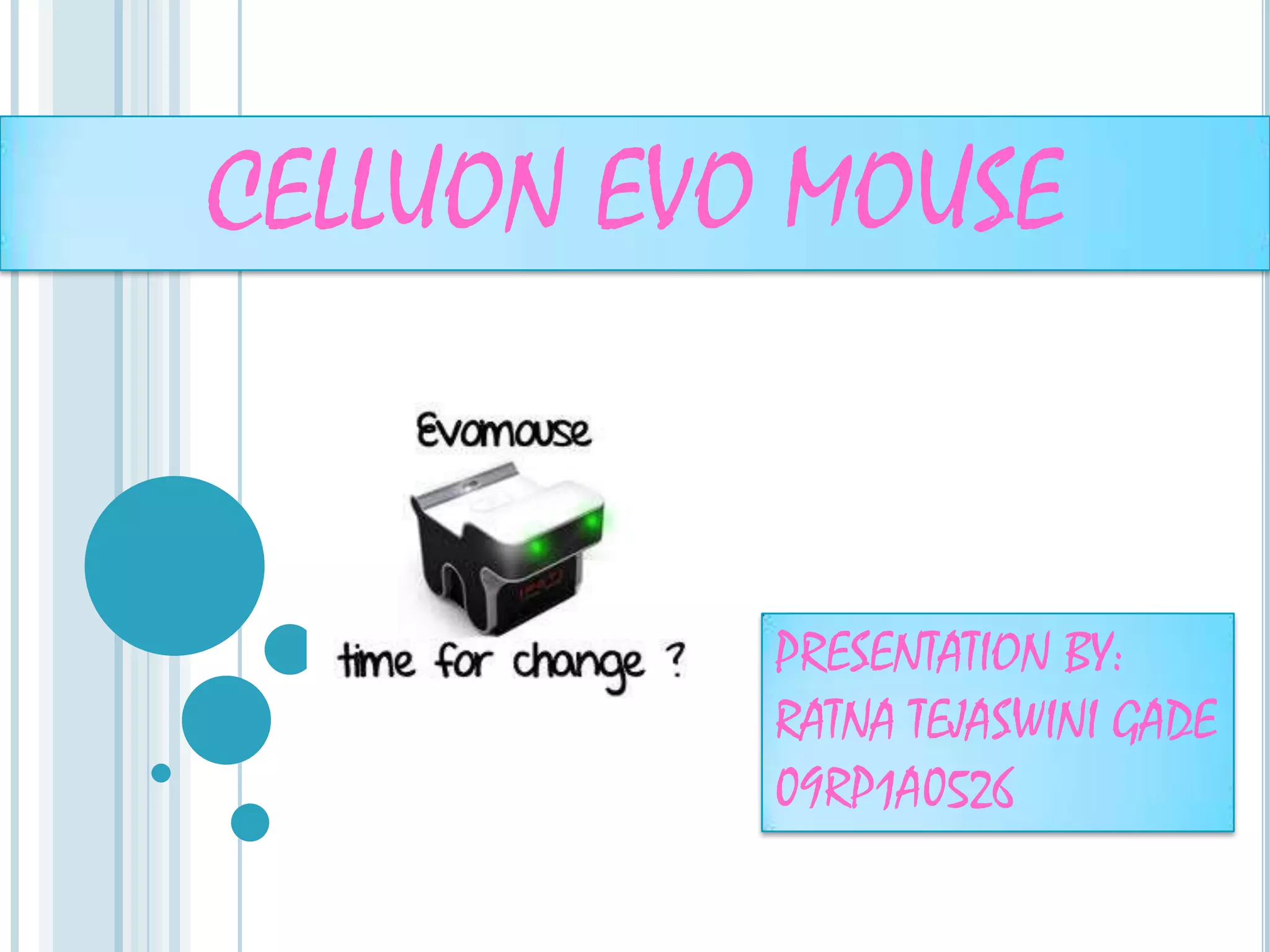
CELLUON EVO MOUSE


           PRESENTATION BY:
           RATNA TEJASWINI GADE
           09RP1A0526
AGENDA
   INTRODUCTION TO EVO MOUSE
   HISTORY OF MOUSE
   WHAT IS EVO MOUSE
   TECHNOLOGIES USED
   HOW IT WORKS
   PRINCIPLES AND COMPONENTS
   FUNCTIONS
   COMPATIBILITY
INTRODUCTION


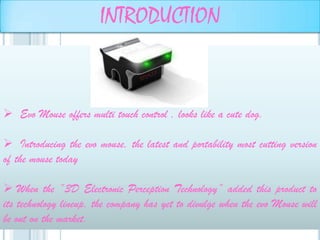
 Evo Mouse offers multi touch control , looks like a cute dog.

 Introducing the evo mouse, the latest and portability most cutting version
of the mouse today

 When the “3D Electronic Perception Technology” added this product to
its technology lineup, the company has yet to divulge when the evo Mouse will
be out on the market.
HISTORY OF MOUSE

   In the 1960's, a relatively unknown inventor
     “Douglas Englebart”, wanted to create
a way for people to interact with a computer screen.
FIRST MOUSE
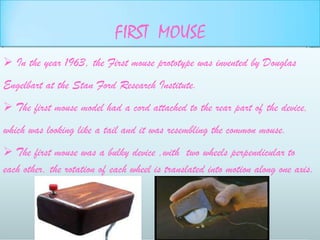
 In the year 1963, the First mouse prototype was invented by Douglas
Engelbart at the Stan Ford Research Institute.
 The first mouse model had a cord attached to the rear part of the device,
which was looking like a tail and it was resembling the common mouse.
 The first mouse was a bulky device ,with two wheels perpendicular to
each other, the rotation of each wheel is translated into motion along one axis.
ROLLER BALL MOUSE
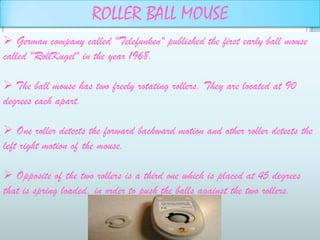
 German company called "Telefunken" published the first early ball mouse
called "RollKugel" in the year 1968.

 The ball mouse has two freely rotating rollers. They are located at 90
degrees each apart.

 One roller detects the forward backward motion and other roller detects the
left right motion of the mouse.

 Opposite of the two rollers is a third one which is placed at 45 degrees
that is spring loaded, in order to push the balls against the two rollers.
OPTICAL MOUSE
 An optical computer mouse battery powered, wireless optical mice flash
the LED intermittently to save power, and only glow steadily when movement
is detected.

 Optical mice make use of one or more light emitting diodes and an
imaginary array of photo diodes to detect movement relative to the underlying
surface.

 The earliest optical mice detected movement on preprinted mouse pad
surfaces, whereas the modern optical mouse works on most opaque surfaces.
LASER MOUSE

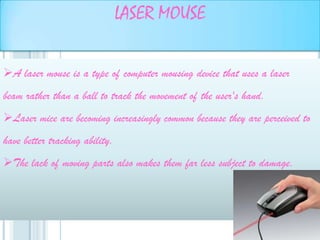
A laser mouse is a type of computer mousing device that uses a laser
beam rather than a ball to track the movement of the user's hand.
Laser mice are becoming increasingly common because they are perceived to
have better tracking ability.
The lack of moving parts also makes them far less subject to damage.
GYROSCOPIC MOUSE
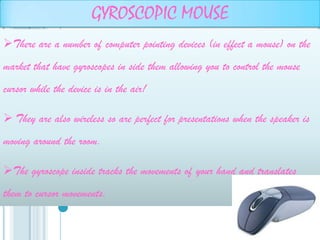
There are a number of computer pointing devices (in effect a mouse) on the
market that have gyroscopes in side them allowing you to control the mouse
cursor while the device is in the air!

 They are also wireless so are perfect for presentations when the speaker is
moving around the room.

The gyroscope inside tracks the movements of your hand and translates
them to cursor movements.
WHAT IS EVO MOUSE……?

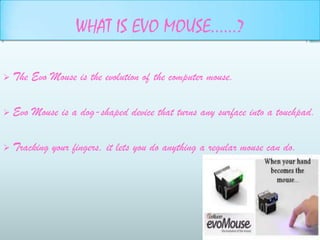
   The Evo Mouse is the evolution of the computer mouse.

   Evo Mouse is a dog-shaped device that turns any surface into a touchpad.

   Tracking your fingers, it lets you do anything a regular mouse can do.
CONTD…..
   The Evo Mouse works on nearly any flat surface and requires very little
    space.

   It tracks effortlessly to your comfortable and natural movements.

   With the Evo Mouse, you can perform common mouse operations using only
    your fingers.

   You can control the cursor, click and select, double-click, right-click and
    drag with basic hand gestures.
TECHNOLOGY USED

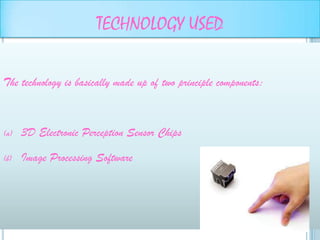
The technology is basically made up of two principle components:


(a)   3D Electronic Perception Sensor Chips

(b)   Image Processing Software
3D ELECTRONIC PERCEPTION TECHNOLOGY
It is a low-cost, single-chip imagining technology that enables

electronic components to form a 3D map of their surroundings

and see what their users are doing.
IMAGE PROCESSING


Image processing is a physical process used to convert an
image signal into a physical image.


The image signal can be either digital or analog.
HOW IT WORKS…?
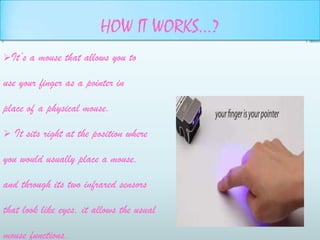
It’s   a mouse that allows you to

use your finger as a pointer in

place of a physical mouse.

   It sits right at the position where

you would usually place a mouse,

and through its two infrared sensors

that look like eyes, it allows the usual

mouse functions.
PRINCIPLE

The basic principle of Evo Mouse:


          Celluon use the "time of flight" principle
                 to detect the motion of object.
COMPONENTS OF EVO MOUSE
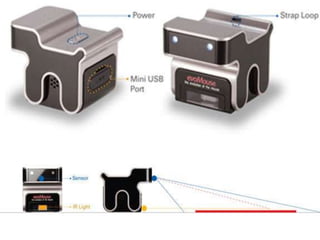
   IR pulse emitter - you can see the rectangle at the bottom.

   TOF CMOS sensor - on the head of the cute shape
    between the two LEDs.
    (LEDs here are indicators of system in operation, not for
    TOF function).
FUNCTIONS
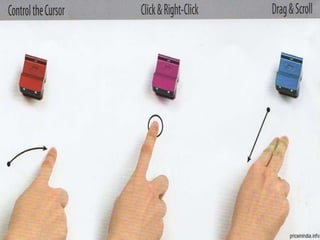
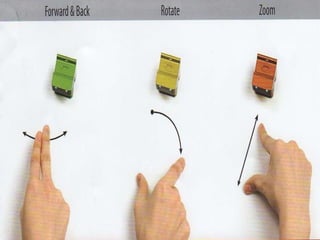
   The Evo Mouse offers multi touch capabilities, letting you
    rotate and zoom on images and scroll text using gestures.


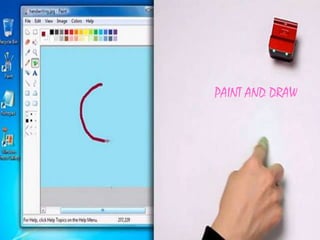
   The device can even recognize your handwriting if you use
    either your finger or pen.
PAINT AND DRAW
DIGITAL HANDWRITING
MORE INTERESTING……
   What’s even more interesting is that the Evo Mouse can be
    connected wirelessly via Bluetooth or can be wired via USB.


   If you choose to use it wirelessly, you can have it running
    for two hours once charged.
COMPATIBILITY


In terms of compatibility, it works with PCs and laptops
with Windows XP, Vista or Windows 7 as operating
systems. Moreover, it works with your Windows Mobile,
Blackberry devices.
Evo mouse seminar
Evo mouse seminar

Evo mouse seminar

  • 1.
    CELLUON EVO MOUSE PRESENTATION BY: RATNA TEJASWINI GADE 09RP1A0526
  • 2.
    AGENDA  INTRODUCTION TO EVO MOUSE  HISTORY OF MOUSE  WHAT IS EVO MOUSE  TECHNOLOGIES USED  HOW IT WORKS  PRINCIPLES AND COMPONENTS  FUNCTIONS  COMPATIBILITY
  • 3.
    INTRODUCTION  Evo Mouseoffers multi touch control , looks like a cute dog.  Introducing the evo mouse, the latest and portability most cutting version of the mouse today  When the “3D Electronic Perception Technology” added this product to its technology lineup, the company has yet to divulge when the evo Mouse will be out on the market.
  • 4.
    HISTORY OF MOUSE In the 1960's, a relatively unknown inventor “Douglas Englebart”, wanted to create a way for people to interact with a computer screen.
  • 5.
    FIRST MOUSE  Inthe year 1963, the First mouse prototype was invented by Douglas Engelbart at the Stan Ford Research Institute.  The first mouse model had a cord attached to the rear part of the device, which was looking like a tail and it was resembling the common mouse.  The first mouse was a bulky device ,with two wheels perpendicular to each other, the rotation of each wheel is translated into motion along one axis.
  • 6.
    ROLLER BALL MOUSE German company called "Telefunken" published the first early ball mouse called "RollKugel" in the year 1968.  The ball mouse has two freely rotating rollers. They are located at 90 degrees each apart.  One roller detects the forward backward motion and other roller detects the left right motion of the mouse.  Opposite of the two rollers is a third one which is placed at 45 degrees that is spring loaded, in order to push the balls against the two rollers.
  • 7.
    OPTICAL MOUSE  Anoptical computer mouse battery powered, wireless optical mice flash the LED intermittently to save power, and only glow steadily when movement is detected.  Optical mice make use of one or more light emitting diodes and an imaginary array of photo diodes to detect movement relative to the underlying surface.  The earliest optical mice detected movement on preprinted mouse pad surfaces, whereas the modern optical mouse works on most opaque surfaces.
  • 8.
    LASER MOUSE A lasermouse is a type of computer mousing device that uses a laser beam rather than a ball to track the movement of the user's hand. Laser mice are becoming increasingly common because they are perceived to have better tracking ability. The lack of moving parts also makes them far less subject to damage.
  • 9.
    GYROSCOPIC MOUSE There area number of computer pointing devices (in effect a mouse) on the market that have gyroscopes in side them allowing you to control the mouse cursor while the device is in the air!  They are also wireless so are perfect for presentations when the speaker is moving around the room. The gyroscope inside tracks the movements of your hand and translates them to cursor movements.
  • 10.
    WHAT IS EVOMOUSE……?  The Evo Mouse is the evolution of the computer mouse.  Evo Mouse is a dog-shaped device that turns any surface into a touchpad.  Tracking your fingers, it lets you do anything a regular mouse can do.
  • 11.
    CONTD…..  The Evo Mouse works on nearly any flat surface and requires very little space.  It tracks effortlessly to your comfortable and natural movements.  With the Evo Mouse, you can perform common mouse operations using only your fingers.  You can control the cursor, click and select, double-click, right-click and drag with basic hand gestures.
  • 12.
    TECHNOLOGY USED The technologyis basically made up of two principle components: (a) 3D Electronic Perception Sensor Chips (b) Image Processing Software
  • 13.
    3D ELECTRONIC PERCEPTIONTECHNOLOGY It is a low-cost, single-chip imagining technology that enables electronic components to form a 3D map of their surroundings and see what their users are doing.
  • 14.
    IMAGE PROCESSING Image processingis a physical process used to convert an image signal into a physical image. The image signal can be either digital or analog.
  • 15.
    HOW IT WORKS…? It’s a mouse that allows you to use your finger as a pointer in place of a physical mouse.  It sits right at the position where you would usually place a mouse, and through its two infrared sensors that look like eyes, it allows the usual mouse functions.
  • 16.
    PRINCIPLE The basic principleof Evo Mouse: Celluon use the "time of flight" principle to detect the motion of object.
  • 17.
    COMPONENTS OF EVOMOUSE  IR pulse emitter - you can see the rectangle at the bottom.  TOF CMOS sensor - on the head of the cute shape between the two LEDs. (LEDs here are indicators of system in operation, not for TOF function).
  • 19.
    FUNCTIONS  The Evo Mouse offers multi touch capabilities, letting you rotate and zoom on images and scroll text using gestures.  The device can even recognize your handwriting if you use either your finger or pen.
  • 22.
  • 23.
  • 24.
    MORE INTERESTING……  What’s even more interesting is that the Evo Mouse can be connected wirelessly via Bluetooth or can be wired via USB.  If you choose to use it wirelessly, you can have it running for two hours once charged.
  • 26.
    COMPATIBILITY In terms ofcompatibility, it works with PCs and laptops with Windows XP, Vista or Windows 7 as operating systems. Moreover, it works with your Windows Mobile, Blackberry devices.