Computer Mouse
Name - Ashish Sahu
Section – K17EC
Roll no. – 45
Registration no. - 11702971
Why it is named as ‘’mouse’’???
● it looks like real mouse with the cord is the
tail and the part we hold is the body.
● One of the researchers helping the
inventor with his creation called the
tool a mouse, and presto! The new tool
had a name!
●
Who is the inventor of computer
mouse?
o
ck, kind of
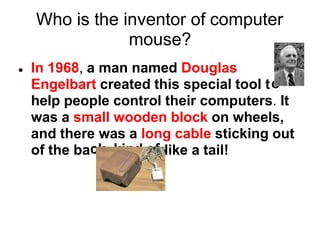
● In 1968, a man named Douglas
Engelbart created this special tool t
help people control their computers. It
was a small wooden block on wheels,
and there was a long cable sticking out
of the ba like a tail!
Mechanical Mouse
● German company Telefunken published on
their early ball mouse, called "Rollkugel"
(German for "rolling ball"), on 2 October 1968.
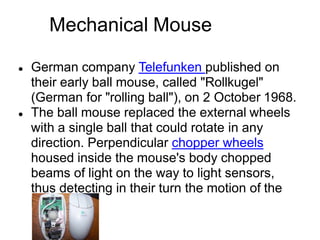
● The ball mouse replaced the external wheels
with a single ball that could rotate in any
direction. Perpendicular chopper wheels
housed inside the mouse's body chopped
beams of light on the way to light sensors,
thus detecting in their turn the motion of the
ball.
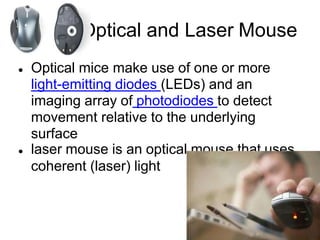
Optical and Laser Mouse
● Optical mice make use of one or more
light-emitting diodes (LEDs) and an
imaging array of photodiodes to detect
movement relative to the underlying
surface
● laser mouse is an optical mouse that uses
coherent (laser) light
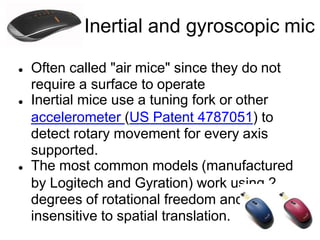
Inertial and gyroscopic mic
are
● Often called "air mice" since they do not
require a surface to operate
● Inertial mice use a tuning fork or other
accelerometer (US Patent 4787051) to
detect rotary movement for every axis
supported.
● The most common models (manufactured
by Logitech and Gyration) work using 2
degrees of rotational freedom and
insensitive to spatial translation.
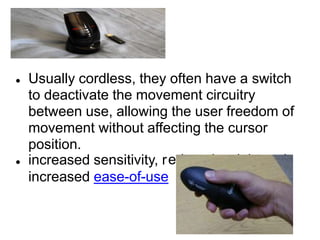
educed weight and
● Usually cordless, they often have a switch
to deactivate the movement circuitry
between use, allowing the user freedom of
movement without affecting the cursor
position.
● increased sensitivity, r
increased ease-of-use
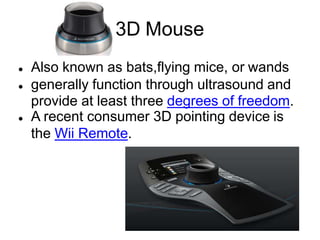
3D Mouse
● Also known as bats,flying mice, or wands
● generally function through ultrasound and
provide at least three degrees of freedom.
● A recent consumer 3D pointing device is
the Wii Remote.
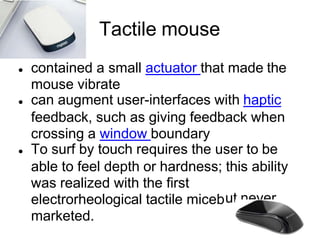
Tactile mouse
ut never
● contained a small actuator that made the
mouse vibrate
● can augment user-interfaces with haptic
feedback, such as giving feedback when
crossing a window boundary
● To surf by touch requires the user to be
able to feel depth or hardness; this ability
was realized with the first
electrorheological tactile miceb
marketed.
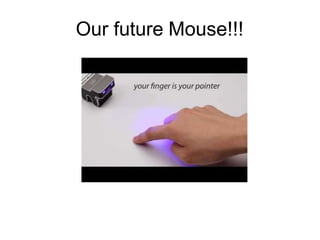
Our future Mouse!!!
Thank You!!!

Computermouse.ppt

  • 1.
    Computer Mouse Name -Ashish Sahu Section – K17EC Roll no. – 45 Registration no. - 11702971
  • 2.
    Why it isnamed as ‘’mouse’’??? ● it looks like real mouse with the cord is the tail and the part we hold is the body. ● One of the researchers helping the inventor with his creation called the tool a mouse, and presto! The new tool had a name! ●
  • 3.
    Who is theinventor of computer mouse? o ck, kind of ● In 1968, a man named Douglas Engelbart created this special tool t help people control their computers. It was a small wooden block on wheels, and there was a long cable sticking out of the ba like a tail!
  • 4.
    Mechanical Mouse ● Germancompany Telefunken published on their early ball mouse, called "Rollkugel" (German for "rolling ball"), on 2 October 1968. ● The ball mouse replaced the external wheels with a single ball that could rotate in any direction. Perpendicular chopper wheels housed inside the mouse's body chopped beams of light on the way to light sensors, thus detecting in their turn the motion of the ball.
  • 5.
    Optical and LaserMouse ● Optical mice make use of one or more light-emitting diodes (LEDs) and an imaging array of photodiodes to detect movement relative to the underlying surface ● laser mouse is an optical mouse that uses coherent (laser) light
  • 6.
    Inertial and gyroscopicmic are ● Often called "air mice" since they do not require a surface to operate ● Inertial mice use a tuning fork or other accelerometer (US Patent 4787051) to detect rotary movement for every axis supported. ● The most common models (manufactured by Logitech and Gyration) work using 2 degrees of rotational freedom and insensitive to spatial translation.
  • 7.
    educed weight and ●Usually cordless, they often have a switch to deactivate the movement circuitry between use, allowing the user freedom of movement without affecting the cursor position. ● increased sensitivity, r increased ease-of-use
  • 8.
    3D Mouse ● Alsoknown as bats,flying mice, or wands ● generally function through ultrasound and provide at least three degrees of freedom. ● A recent consumer 3D pointing device is the Wii Remote.
  • 9.
    Tactile mouse ut never ●contained a small actuator that made the mouse vibrate ● can augment user-interfaces with haptic feedback, such as giving feedback when crossing a window boundary ● To surf by touch requires the user to be able to feel depth or hardness; this ability was realized with the first electrorheological tactile miceb marketed.
  • 10.
  • 11.