TOPIC 3
EVENT
MANAGEMENT
DEVELOPING AND IMPLEMENTING
THE EVENT PLAN
PREPARED BY:
NORHASIMAH BINTI HAMIM
Slide 2 of 32
TOPIC 3: DEVELOPING AND IMPLEMENTING THE EVENT PLAN
LEARNING OUTCOMES
At the end of this topic, the students would be able to:
Conduct comprehensive research for your event.
Identify key sources of information for planning.
Design a program creatively.
Develop an appropriate theme.
Establish and manage an effective strategic plan.
Use emerging technologies to improve and accelerate your planning
process.
Develop and manage the timeline for an event.
Slide 3 of 32
TOPIC 3: DEVELOPING AND IMPLEMENTING THE EVENT PLAN
TOPIC OUTLINES
Introduction
3.1 Five-Card Draw: Playing the Five Senses
3.2 Identifing the Needs of Guests
3.3 Managing the Event Environment
3.4 Themed Events
Summary
Slide 4 of 32
TOPIC 3: DEVELOPING AND IMPLEMENTING THE EVENT PLAN
INTRODUCTION
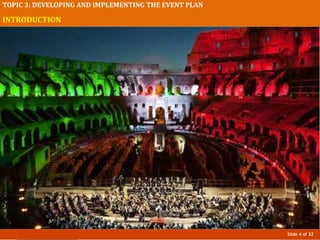
“An event can be described as a public
assembly for the purpose of celebration,
education, and marketing”.
Goldblatt, Joe
Slide 5 of 32
TOPIC 3: DEVELOPING AND IMPLEMENTING THE EVENT PLAN
3.1 Five-Card Draw: Playing the Five Senses
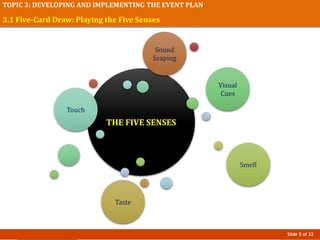
THE FIVE SENSES
Touch
Visual
Cues
Smell
Taste
Sound
Scaping
Slide 6 of 32
TOPIC 3: DEVELOPING AND IMPLEMENTING THE EVENT PLAN
3.1 Five-Card Draw: Playing the Five Senses
SOUND SCAPING
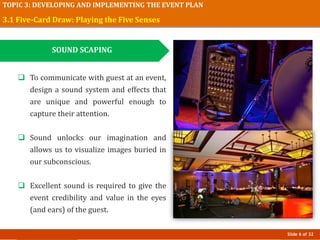
 To communicate with guest at an event,
design a sound system and effects that
are unique and powerful enough to
capture their attention.
 Sound unlocks our imagination and
allows us to visualize images buried in
our subconscious.
 Excellent sound is required to give the
event credibility and value in the eyes
(and ears) of the guest.
Slide 7 of 32
TOPIC 3: DEVELOPING AND IMPLEMENTING THE EVENT PLAN
3.1 Five-Card Draw: Playing the Five Senses
VISUAL CUES
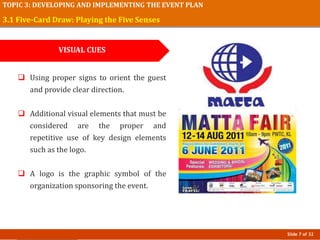
 Using proper signs to orient the guest
and provide clear direction.
 Additional visual elements that must be
considered are the proper and
repetitive use of key design elements
such as the logo.
 A logo is the graphic symbol of the
organization sponsoring the event.
Slide 8 of 32
TOPIC 3: DEVELOPING AND IMPLEMENTING THE EVENT PLAN
3.1 Five-Card Draw: Playing the Five Senses
TOUCH
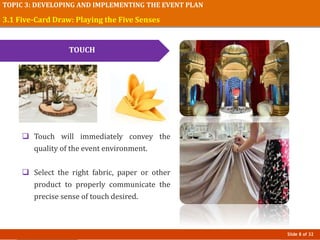
 Touch will immediately convey the
quality of the event environment.
 Select the right fabric, paper or other
product to properly communicate the
precise sense of touch desired.
Slide 9 of 32
TOPIC 3: DEVELOPING AND IMPLEMENTING THE EVENT PLAN
3.1 Five-Card Draw: Playing the Five Senses
SMELL
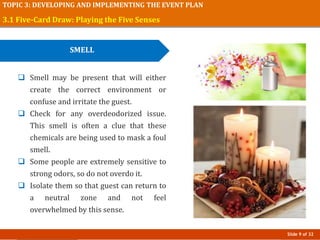
 Smell may be present that will either
create the correct environment or
confuse and irritate the guest.
 Check for any overdeodorized issue.
This smell is often a clue that these
chemicals are being used to mask a foul
smell.
 Some people are extremely sensitive to
strong odors, so do not overdo it.
 Isolate them so that guest can return to
a neutral zone and not feel
overwhelmed by this sense.
Slide 10 of 32
TOPIC 3: DEVELOPING AND IMPLEMENTING THE EVENT PLAN
3.1 Five-Card Draw: Playing the Five Senses
TASTE
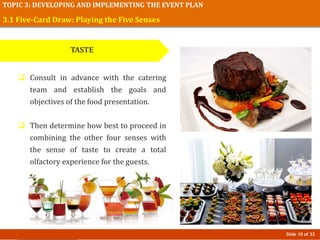
 Consult in advance with the catering
team and establish the goals and
objectives of the food presentation.
 Then determine how best to proceed in
combining the other four senses with
the sense of taste to create a total
olfactory experience for the guests.
Slide 11 of 32
TOPIC 3: DEVELOPING AND IMPLEMENTING THE EVENT PLAN
3.1 Five-Card Draw: Playing the Five Senses
Bells and Whistles : Amenities that Make the Difference
 Best defined as a feature that increase attractiveness or value
 Amenities may include advertising specialty items given as gifts at the
beginning or end of the event, interactive elements (e.g. karaoke, child care)
Blending, Mixing, & Matching for Full Effect
 Do not irritate guests by layering too many different senses
 Design the sensory experience would select paint for a canvas
 Determine in advance what we hope to achieve, then use the five senses as
powerful tools to help accomplish the goals
Slide 12 of 32
TOPIC 3: DEVELOPING AND IMPLEMENTING THE EVENT PLAN
3.2 Identifying the Needs of Guests
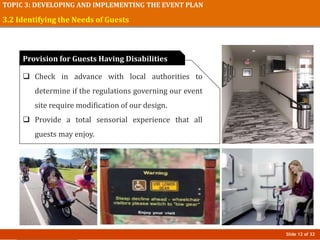
 Check in advance with local authorities to
determine if the regulations governing our event
site require modification of our design.
 Provide a total sensorial experience that all
guests may enjoy.
Provision for Guests Having Disabilities
Slide 13 of 32
TOPIC 3: DEVELOPING AND IMPLEMENTING THE EVENT PLAN
3.2 Identifying the Needs of Guests
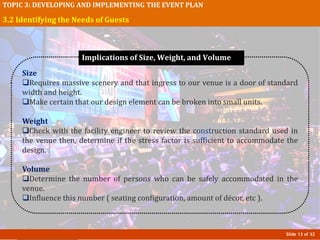
Size
Requires massive scenery and that ingress to our venue is a door of standard
width and height.
Make certain that our design element can be broken into small units.
Weight
Check with the facility engineer to review the construction standard used in
the venue then, determine if the stress factor is sufficient to accommodate the
design.
Volume
Determine the number of persons who can be safely accommodated in the
venue.
Influence this number ( seating configuration, amount of décor, etc ).
Implications of Size, Weight, and Volume
Slide 14 of 32
TOPIC 3: DEVELOPING AND IMPLEMENTING THE EVENT PLAN
3.2 Identifying the Needs of Guests
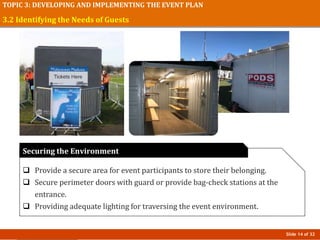
 Provide a secure area for event participants to store their belonging.
 Secure perimeter doors with guard or provide bag-check stations at the
entrance.
 Providing adequate lighting for traversing the event environment.
Securing the Environment
Slide 15 of 32
TOPIC 3: DEVELOPING AND IMPLEMENTING THE EVENT PLAN
3.2 Identifying the Needs of Guests
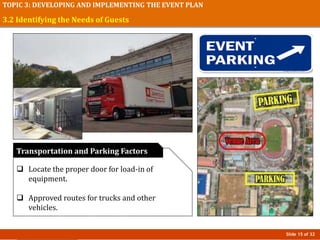
 Locate the proper door for load-in of
equipment.
 Approved routes for trucks and other
vehicles.
Transportation and Parking Factors
Slide 16 of 32
TOPIC 3: DEVELOPING AND IMPLEMENTING THE EVENT PLAN
3.2 Identifying the Needs of Guests
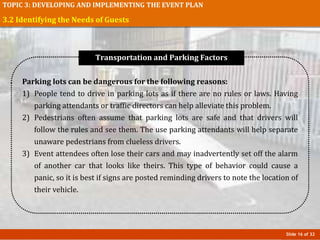
Parking lots can be dangerous for the following reasons:
1) People tend to drive in parking lots as if there are no rules or laws. Having
parking attendants or traffic directors can help alleviate this problem.
2) Pedestrians often assume that parking lots are safe and that drivers will
follow the rules and see them. The use parking attendants will help separate
unaware pedestrians from clueless drivers.
3) Event attendees often lose their cars and may inadvertently set off the alarm
of another car that looks like theirs. This type of behavior could cause a
panic, so it is best if signs are posted reminding drivers to note the location of
their vehicle.
Transportation and Parking Factors
Slide 17 of 32
TOPIC 3: DEVELOPING AND IMPLEMENTING THE EVENT PLAN
3.2 Identifying the Needs of Guests
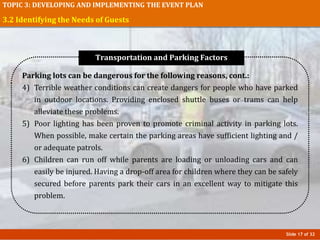
Parking lots can be dangerous for the following reasons, cont.:
4) Terrible weather conditions can create dangers for people who have parked
in outdoor locations. Providing enclosed shuttle buses or trams can help
alleviate these problems.
5) Poor lighting has been proven to promote criminal activity in parking lots.
When possible, make certain the parking areas have sufficient lighting and /
or adequate patrols.
6) Children can run off while parents are loading or unloading cars and can
easily be injured. Having a drop-off area for children where they can be safely
secured before parents park their cars in an excellent way to mitigate this
problem.
Transportation and Parking Factors
Slide 18 of 32
TOPIC 3: DEVELOPING AND IMPLEMENTING THE EVENT PLAN
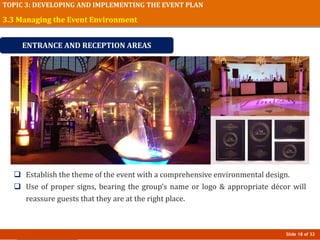
 Establish the theme of the event with a comprehensive environmental design.
 Use of proper signs, bearing the group’s name or logo & appropriate décor will
reassure guests that they are at the right place.
3.3 Managing the Event Environment
ENTRANCE AND RECEPTION AREAS
Slide 19 of 32
TOPIC 3: DEVELOPING AND IMPLEMENTING THE EVENT PLAN
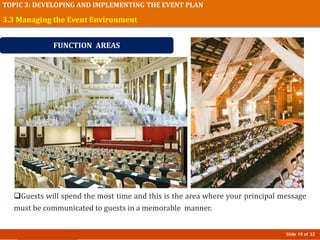
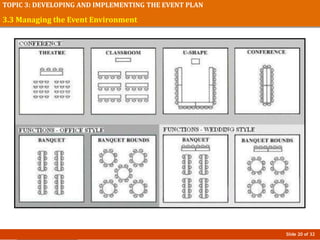
Guests will spend the most time and this is the area where your principal message
must be communicated to guests in a memorable manner.
3.3 Managing the Event Environment
FUNCTION AREAS
Slide 20 of 32
TOPIC 3: DEVELOPING AND IMPLEMENTING THE EVENT PLAN
3.3 Managing the Event Environment
Slide 21 of 32
TOPIC 3: DEVELOPING AND IMPLEMENTING THE EVENT PLAN
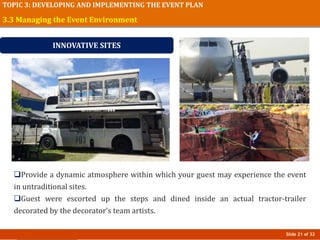
Provide a dynamic atmosphere within which your guest may experience the event
in untraditional sites.
Guest were escorted up the steps and dined inside an actual tractor-trailer
decorated by the decorator’s team artists.
3.3 Managing the Event Environment
INNOVATIVE SITES
Slide 22 of 32
TOPIC 3: DEVELOPING AND IMPLEMENTING THE EVENT PLAN
3.3 Managing the Event Environment
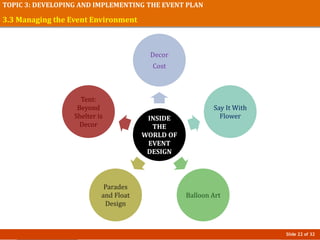
INSIDE
THE
WORLD OF
EVENT
DESIGN
Decor
Cost
Say It With
Flower
Balloon Art
Parades
and Float
Design
Tent:
Beyond
Shelter is
Decor
Slide 23 of 32
TOPIC 3: DEVELOPING AND IMPLEMENTING THE EVENT PLAN
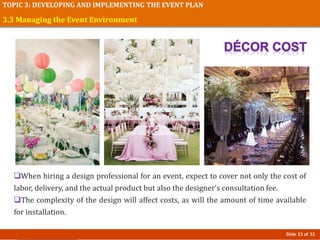
When hiring a design professional for an event, expect to cover not only the cost of
labor, delivery, and the actual product but also the designer’s consultation fee.
The complexity of the design will affect costs, as will the amount of time available
for installation.
3.3 Managing the Event Environment
Slide 24 of 32
TOPIC 3: DEVELOPING AND IMPLEMENTING THE EVENT PLAN
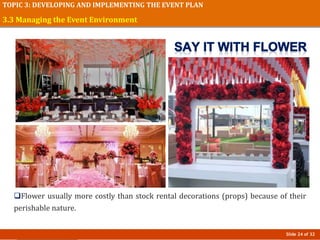
Flower usually more costly than stock rental decorations (props) because of their
perishable nature.
3.3 Managing the Event Environment
Slide 25 of 32
TOPIC 3: DEVELOPING AND IMPLEMENTING THE EVENT PLAN
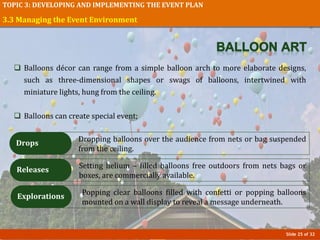
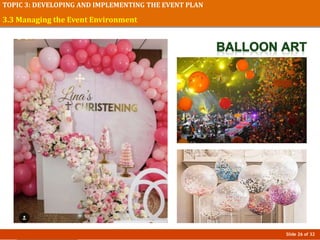
 Balloons décor can range from a simple balloon arch to more elaborate designs,
such as three-dimensional shapes or swags of balloons, intertwined with
miniature lights, hung from the ceiling.
 Balloons can create special event;
3.3 Managing the Event Environment
Dropping balloons over the audience from nets or bag suspended
from the ceiling.
Drops
Setting helium – filled balloons free outdoors from nets bags or
boxes, are commercially available.
Releases
Popping clear balloons filled with confetti or popping balloons
mounted on a wall display to reveal a message underneath.
Explorations
Slide 26 of 32
TOPIC 3: DEVELOPING AND IMPLEMENTING THE EVENT PLAN
3.3 Managing the Event Environment
Slide 27 of 32
TOPIC 3: DEVELOPING AND IMPLEMENTING THE EVENT PLAN
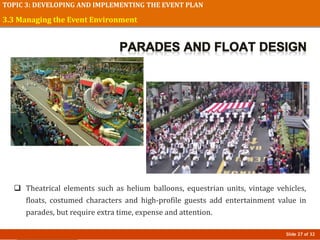
 Theatrical elements such as helium balloons, equestrian units, vintage vehicles,
floats, costumed characters and high-profile guests add entertainment value in
parades, but require extra time, expense and attention.
3.3 Managing the Event Environment
Slide 28 of 32
TOPIC 3: DEVELOPING AND IMPLEMENTING THE EVENT PLAN
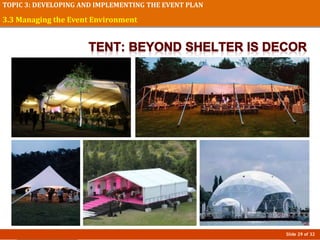
New adaption of a classic environment is in the tenting industry have multiplied the
design possibilities of tents.
Today’s tents fabrics are synthetic rather than muslin: synthetics provide a stronger
structure that is easier to maintain & aesthetically more pleasing.
A parawing tent or marquee is triangular or rectangular piece of fabric that used to
create a shelter for an event.
It is stretched at each corner (tension point) to create a bold & often times dramatic
covering for a stage, a booth or other event area.
A tent provides a special aesthetic appeal, like balloon bobbing in the air, white tent
tops crowned with colorful flaps seemingly touching the clouds signal an event to
your arriving guests.
3.3 Managing the Event Environment
Slide 29 of 32
TOPIC 3: DEVELOPING AND IMPLEMENTING THE EVENT PLAN
3.3 Managing the Event Environment
Slide 30 of 32
TOPIC 3: DEVELOPING AND IMPLEMENTING THE EVENT PLAN
3.4 Themed Events
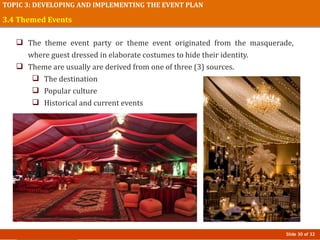
 The theme event party or theme event originated from the masquerade,
where guest dressed in elaborate costumes to hide their identity.
 Theme are usually are derived from one of three (3) sources.
 The destination
 Popular culture
 Historical and current events
Slide 31 of 32
TOPIC 3: DEVELOPING AND IMPLEMENTING THE EVENT PLAN
3.4 Themed Events
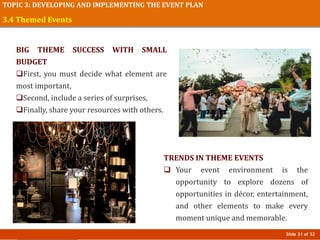
BIG THEME SUCCESS WITH SMALL
BUDGET
First, you must decide what element are
most important,
Second, include a series of surprises,
Finally, share your resources with others.
TRENDS IN THEME EVENTS
 Your event environment is the
opportunity to explore dozens of
opportunities in décor, entertainment,
and other elements to make every
moment unique and memorable.
Slide 32 of 32
TOPIC 3: DEVELOPING AND IMPLEMENTING THE EVENT PLAN
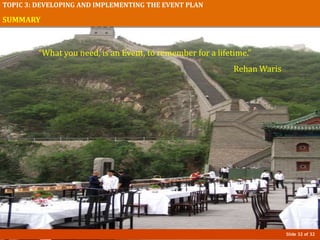
SUMMARY
“What you need, is an Event, to remember for a lifetime.”
Rehan Waris

Event Management - Unit 3

  • 1.
    TOPIC 3 EVENT MANAGEMENT DEVELOPING ANDIMPLEMENTING THE EVENT PLAN PREPARED BY: NORHASIMAH BINTI HAMIM
  • 2.
    Slide 2 of32 TOPIC 3: DEVELOPING AND IMPLEMENTING THE EVENT PLAN LEARNING OUTCOMES At the end of this topic, the students would be able to: Conduct comprehensive research for your event. Identify key sources of information for planning. Design a program creatively. Develop an appropriate theme. Establish and manage an effective strategic plan. Use emerging technologies to improve and accelerate your planning process. Develop and manage the timeline for an event.
  • 3.
    Slide 3 of32 TOPIC 3: DEVELOPING AND IMPLEMENTING THE EVENT PLAN TOPIC OUTLINES Introduction 3.1 Five-Card Draw: Playing the Five Senses 3.2 Identifing the Needs of Guests 3.3 Managing the Event Environment 3.4 Themed Events Summary
  • 4.
    Slide 4 of32 TOPIC 3: DEVELOPING AND IMPLEMENTING THE EVENT PLAN INTRODUCTION “An event can be described as a public assembly for the purpose of celebration, education, and marketing”. Goldblatt, Joe
  • 5.
    Slide 5 of32 TOPIC 3: DEVELOPING AND IMPLEMENTING THE EVENT PLAN 3.1 Five-Card Draw: Playing the Five Senses THE FIVE SENSES Touch Visual Cues Smell Taste Sound Scaping
  • 6.
    Slide 6 of32 TOPIC 3: DEVELOPING AND IMPLEMENTING THE EVENT PLAN 3.1 Five-Card Draw: Playing the Five Senses SOUND SCAPING  To communicate with guest at an event, design a sound system and effects that are unique and powerful enough to capture their attention.  Sound unlocks our imagination and allows us to visualize images buried in our subconscious.  Excellent sound is required to give the event credibility and value in the eyes (and ears) of the guest.
  • 7.
    Slide 7 of32 TOPIC 3: DEVELOPING AND IMPLEMENTING THE EVENT PLAN 3.1 Five-Card Draw: Playing the Five Senses VISUAL CUES  Using proper signs to orient the guest and provide clear direction.  Additional visual elements that must be considered are the proper and repetitive use of key design elements such as the logo.  A logo is the graphic symbol of the organization sponsoring the event.
  • 8.
    Slide 8 of32 TOPIC 3: DEVELOPING AND IMPLEMENTING THE EVENT PLAN 3.1 Five-Card Draw: Playing the Five Senses TOUCH  Touch will immediately convey the quality of the event environment.  Select the right fabric, paper or other product to properly communicate the precise sense of touch desired.
  • 9.
    Slide 9 of32 TOPIC 3: DEVELOPING AND IMPLEMENTING THE EVENT PLAN 3.1 Five-Card Draw: Playing the Five Senses SMELL  Smell may be present that will either create the correct environment or confuse and irritate the guest.  Check for any overdeodorized issue. This smell is often a clue that these chemicals are being used to mask a foul smell.  Some people are extremely sensitive to strong odors, so do not overdo it.  Isolate them so that guest can return to a neutral zone and not feel overwhelmed by this sense.
  • 10.
    Slide 10 of32 TOPIC 3: DEVELOPING AND IMPLEMENTING THE EVENT PLAN 3.1 Five-Card Draw: Playing the Five Senses TASTE  Consult in advance with the catering team and establish the goals and objectives of the food presentation.  Then determine how best to proceed in combining the other four senses with the sense of taste to create a total olfactory experience for the guests.
  • 11.
    Slide 11 of32 TOPIC 3: DEVELOPING AND IMPLEMENTING THE EVENT PLAN 3.1 Five-Card Draw: Playing the Five Senses Bells and Whistles : Amenities that Make the Difference  Best defined as a feature that increase attractiveness or value  Amenities may include advertising specialty items given as gifts at the beginning or end of the event, interactive elements (e.g. karaoke, child care) Blending, Mixing, & Matching for Full Effect  Do not irritate guests by layering too many different senses  Design the sensory experience would select paint for a canvas  Determine in advance what we hope to achieve, then use the five senses as powerful tools to help accomplish the goals
  • 12.
    Slide 12 of32 TOPIC 3: DEVELOPING AND IMPLEMENTING THE EVENT PLAN 3.2 Identifying the Needs of Guests  Check in advance with local authorities to determine if the regulations governing our event site require modification of our design.  Provide a total sensorial experience that all guests may enjoy. Provision for Guests Having Disabilities
  • 13.
    Slide 13 of32 TOPIC 3: DEVELOPING AND IMPLEMENTING THE EVENT PLAN 3.2 Identifying the Needs of Guests Size Requires massive scenery and that ingress to our venue is a door of standard width and height. Make certain that our design element can be broken into small units. Weight Check with the facility engineer to review the construction standard used in the venue then, determine if the stress factor is sufficient to accommodate the design. Volume Determine the number of persons who can be safely accommodated in the venue. Influence this number ( seating configuration, amount of décor, etc ). Implications of Size, Weight, and Volume
  • 14.
    Slide 14 of32 TOPIC 3: DEVELOPING AND IMPLEMENTING THE EVENT PLAN 3.2 Identifying the Needs of Guests  Provide a secure area for event participants to store their belonging.  Secure perimeter doors with guard or provide bag-check stations at the entrance.  Providing adequate lighting for traversing the event environment. Securing the Environment
  • 15.
    Slide 15 of32 TOPIC 3: DEVELOPING AND IMPLEMENTING THE EVENT PLAN 3.2 Identifying the Needs of Guests  Locate the proper door for load-in of equipment.  Approved routes for trucks and other vehicles. Transportation and Parking Factors
  • 16.
    Slide 16 of32 TOPIC 3: DEVELOPING AND IMPLEMENTING THE EVENT PLAN 3.2 Identifying the Needs of Guests Parking lots can be dangerous for the following reasons: 1) People tend to drive in parking lots as if there are no rules or laws. Having parking attendants or traffic directors can help alleviate this problem. 2) Pedestrians often assume that parking lots are safe and that drivers will follow the rules and see them. The use parking attendants will help separate unaware pedestrians from clueless drivers. 3) Event attendees often lose their cars and may inadvertently set off the alarm of another car that looks like theirs. This type of behavior could cause a panic, so it is best if signs are posted reminding drivers to note the location of their vehicle. Transportation and Parking Factors
  • 17.
    Slide 17 of32 TOPIC 3: DEVELOPING AND IMPLEMENTING THE EVENT PLAN 3.2 Identifying the Needs of Guests Parking lots can be dangerous for the following reasons, cont.: 4) Terrible weather conditions can create dangers for people who have parked in outdoor locations. Providing enclosed shuttle buses or trams can help alleviate these problems. 5) Poor lighting has been proven to promote criminal activity in parking lots. When possible, make certain the parking areas have sufficient lighting and / or adequate patrols. 6) Children can run off while parents are loading or unloading cars and can easily be injured. Having a drop-off area for children where they can be safely secured before parents park their cars in an excellent way to mitigate this problem. Transportation and Parking Factors
  • 18.
    Slide 18 of32 TOPIC 3: DEVELOPING AND IMPLEMENTING THE EVENT PLAN  Establish the theme of the event with a comprehensive environmental design.  Use of proper signs, bearing the group’s name or logo & appropriate décor will reassure guests that they are at the right place. 3.3 Managing the Event Environment ENTRANCE AND RECEPTION AREAS
  • 19.
    Slide 19 of32 TOPIC 3: DEVELOPING AND IMPLEMENTING THE EVENT PLAN Guests will spend the most time and this is the area where your principal message must be communicated to guests in a memorable manner. 3.3 Managing the Event Environment FUNCTION AREAS
  • 20.
    Slide 20 of32 TOPIC 3: DEVELOPING AND IMPLEMENTING THE EVENT PLAN 3.3 Managing the Event Environment
  • 21.
    Slide 21 of32 TOPIC 3: DEVELOPING AND IMPLEMENTING THE EVENT PLAN Provide a dynamic atmosphere within which your guest may experience the event in untraditional sites. Guest were escorted up the steps and dined inside an actual tractor-trailer decorated by the decorator’s team artists. 3.3 Managing the Event Environment INNOVATIVE SITES
  • 22.
    Slide 22 of32 TOPIC 3: DEVELOPING AND IMPLEMENTING THE EVENT PLAN 3.3 Managing the Event Environment INSIDE THE WORLD OF EVENT DESIGN Decor Cost Say It With Flower Balloon Art Parades and Float Design Tent: Beyond Shelter is Decor
  • 23.
    Slide 23 of32 TOPIC 3: DEVELOPING AND IMPLEMENTING THE EVENT PLAN When hiring a design professional for an event, expect to cover not only the cost of labor, delivery, and the actual product but also the designer’s consultation fee. The complexity of the design will affect costs, as will the amount of time available for installation. 3.3 Managing the Event Environment
  • 24.
    Slide 24 of32 TOPIC 3: DEVELOPING AND IMPLEMENTING THE EVENT PLAN Flower usually more costly than stock rental decorations (props) because of their perishable nature. 3.3 Managing the Event Environment
  • 25.
    Slide 25 of32 TOPIC 3: DEVELOPING AND IMPLEMENTING THE EVENT PLAN  Balloons décor can range from a simple balloon arch to more elaborate designs, such as three-dimensional shapes or swags of balloons, intertwined with miniature lights, hung from the ceiling.  Balloons can create special event; 3.3 Managing the Event Environment Dropping balloons over the audience from nets or bag suspended from the ceiling. Drops Setting helium – filled balloons free outdoors from nets bags or boxes, are commercially available. Releases Popping clear balloons filled with confetti or popping balloons mounted on a wall display to reveal a message underneath. Explorations
  • 26.
    Slide 26 of32 TOPIC 3: DEVELOPING AND IMPLEMENTING THE EVENT PLAN 3.3 Managing the Event Environment
  • 27.
    Slide 27 of32 TOPIC 3: DEVELOPING AND IMPLEMENTING THE EVENT PLAN  Theatrical elements such as helium balloons, equestrian units, vintage vehicles, floats, costumed characters and high-profile guests add entertainment value in parades, but require extra time, expense and attention. 3.3 Managing the Event Environment
  • 28.
    Slide 28 of32 TOPIC 3: DEVELOPING AND IMPLEMENTING THE EVENT PLAN New adaption of a classic environment is in the tenting industry have multiplied the design possibilities of tents. Today’s tents fabrics are synthetic rather than muslin: synthetics provide a stronger structure that is easier to maintain & aesthetically more pleasing. A parawing tent or marquee is triangular or rectangular piece of fabric that used to create a shelter for an event. It is stretched at each corner (tension point) to create a bold & often times dramatic covering for a stage, a booth or other event area. A tent provides a special aesthetic appeal, like balloon bobbing in the air, white tent tops crowned with colorful flaps seemingly touching the clouds signal an event to your arriving guests. 3.3 Managing the Event Environment
  • 29.
    Slide 29 of32 TOPIC 3: DEVELOPING AND IMPLEMENTING THE EVENT PLAN 3.3 Managing the Event Environment
  • 30.
    Slide 30 of32 TOPIC 3: DEVELOPING AND IMPLEMENTING THE EVENT PLAN 3.4 Themed Events  The theme event party or theme event originated from the masquerade, where guest dressed in elaborate costumes to hide their identity.  Theme are usually are derived from one of three (3) sources.  The destination  Popular culture  Historical and current events
  • 31.
    Slide 31 of32 TOPIC 3: DEVELOPING AND IMPLEMENTING THE EVENT PLAN 3.4 Themed Events BIG THEME SUCCESS WITH SMALL BUDGET First, you must decide what element are most important, Second, include a series of surprises, Finally, share your resources with others. TRENDS IN THEME EVENTS  Your event environment is the opportunity to explore dozens of opportunities in décor, entertainment, and other elements to make every moment unique and memorable.
  • 32.
    Slide 32 of32 TOPIC 3: DEVELOPING AND IMPLEMENTING THE EVENT PLAN SUMMARY “What you need, is an Event, to remember for a lifetime.” Rehan Waris