TOPIC 1
EVENT
MANAGEMENT
INTRODUCTION: THEORY OF EVENT
MANAGEMENT
PREPARED BY:
NORHASIMAH BINTI HAMIM
Slide 2 of 32
TOPIC 1: INTRODUCTION: THEORY OF EVENT MANAGEMENT
LEARNING OUTCOMES
At the end of this topic, the students would be able to:
To understand and appreciate the importance of economic, social,
political and environmental sustainability for planned events.
To recognize and understand the economic, social, political, cultural,
political, and environmental changes that are affecting the global events
industry.
To identify the benefit from the demographic changes affecting the global
events industry.
To identify new and emerging career opportunities in this growing field.
Slide 3 of 32
TOPIC 1: INTRODUCTION: THEORY OF EVENT MANAGEMENT
TOPIC OUTLINES
Introduction
1.1 Understand about Event
1.2 The Event Management Profession
1.3 Event Management Subfield
1.4 Changes in Event Management
1.5 Challenges and Opportunity
Summary
Slide 4 of 32
TOPIC 1: INTRODUCTION: THEORY OF EVENT MANAGEMENT
INTRODUCTION
“An event can be described as a public
assembly for the purpose of celebration,
education, and marketing”.
Goldblatt, Joe
What is Event?
Slide 5 of 32
TOPIC 1: INTRODUCTION: THEORY OF EVENT MANAGEMENT
INTRODUCTION
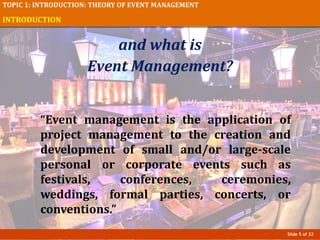
“Event management is the application of
project management to the creation and
development of small and/or large-scale
personal or corporate events such as
festivals, conferences, ceremonies,
weddings, formal parties, concerts, or
conventions.”
and what is
Event Management?
Slide 6 of 32
TOPIC 1: INTRODUCTION: THEORY OF EVENT MANAGEMENT
1.1 Understand about Event
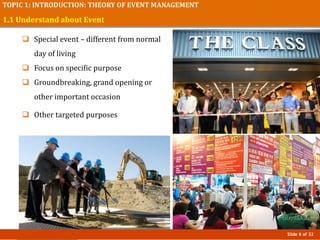
 Special event – different from normal
day of living
 Focus on specific purpose
 Groundbreaking, grand opening or
other important occasion
 Other targeted purposes
Slide 7 of 32
TOPIC 1: INTRODUCTION: THEORY OF EVENT MANAGEMENT
1.1 Understand about Event
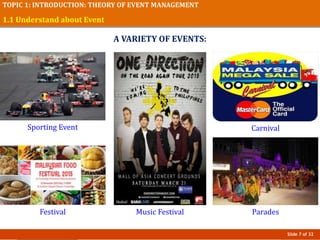
A VARIETY OF EVENTS:
Festival
Sporting Event
Music Festival Parades
Carnival
Slide 8 of 32
TOPIC 1: INTRODUCTION: THEORY OF EVENT MANAGEMENT
1.1 Understand about Event
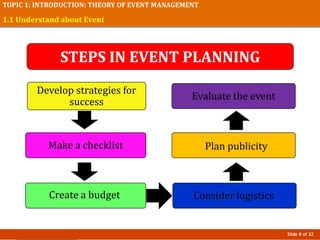
Develop strategies for
success
Make a checklist
Consider logistics
Plan publicity
Create a budget
Evaluate the event
STEPS IN EVENT PLANNING
Slide 9 of 32
TOPIC 1: INTRODUCTION: THEORY OF EVENT MANAGEMENT
1.2 The Event Management Profession
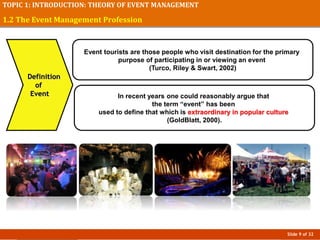
Event tourists are those people who visit destination for the primary
purpose of participating in or viewing an event
(Turco, Riley & Swart, 2002)
In recent years one could reasonably argue that
the term “event” has been
used to define that which is extraordinary in popular culture
(GoldBlatt, 2000).
Definition
of
Event
Slide 10 of 32
TOPIC 1: INTRODUCTION: THEORY OF EVENT MANAGEMENT
1.2 The Event Management Profession
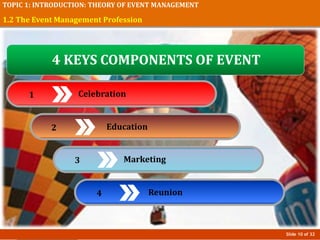
3 Marketing
1 Celebration
2 Education
4 Reunion
4 KEYS COMPONENTS OF EVENT
Slide 11 of 32
TOPIC 1: INTRODUCTION: THEORY OF EVENT MANAGEMENT
1.2 The Event Management Profession
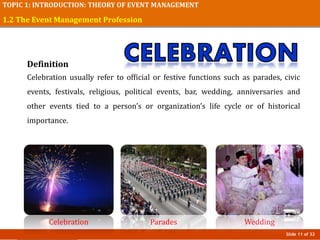
Definition
Celebration usually refer to official or festive functions such as parades, civic
events, festivals, religious, political events, bar, wedding, anniversaries and
other events tied to a person’s or organization’s life cycle or of historical
importance.
Celebration Parades Wedding
Slide 12 of 32
TOPIC 1: INTRODUCTION: THEORY OF EVENT MANAGEMENT
1.2 The Event Management Profession
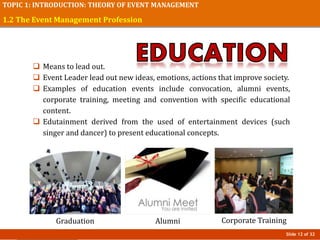
 Means to lead out.
 Event Leader lead out new ideas, emotions, actions that improve society.
 Examples of education events include convocation, alumni events,
corporate training, meeting and convention with specific educational
content.
 Edutainment derived from the used of entertainment devices (such
singer and dancer) to present educational concepts.
Graduation Alumni Corporate Training
Slide 13 of 32
TOPIC 1: INTRODUCTION: THEORY OF EVENT MANAGEMENT
1.2 The Event Management Profession
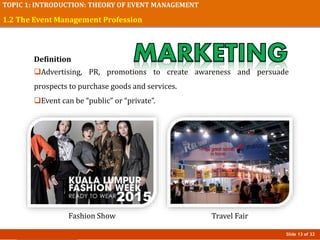
Definition
Advertising, PR, promotions to create awareness and persuade
prospects to purchase goods and services.
Event can be “public” or “private”.
Fashion Show Travel Fair
Slide 14 of 32
TOPIC 1: INTRODUCTION: THEORY OF EVENT MANAGEMENT
1.2 The Event Management Profession
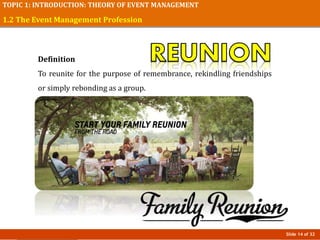
Definition
To reunite for the purpose of remembrance, rekindling friendships
or simply rebonding as a group.
Slide 15 of 32
TOPIC 1: INTRODUCTION: THEORY OF EVENT MANAGEMENT
1.3 Event Management Sub-Field
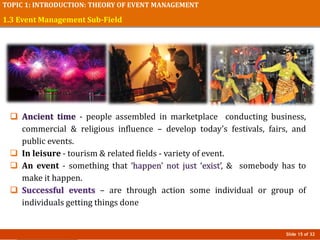
 Ancient time - people assembled in marketplace conducting business,
commercial & religious influence – develop today’s festivals, fairs, and
public events.
 In leisure - tourism & related fields - variety of event.
 An event - something that ‘happen’ not just ‘exist’, & somebody has to
make it happen.
 Successful events – are through action some individual or group of
individuals getting things done
Slide 16 of 32
TOPIC 1: INTRODUCTION: THEORY OF EVENT MANAGEMENT
1.3 Event Management Sub-Field
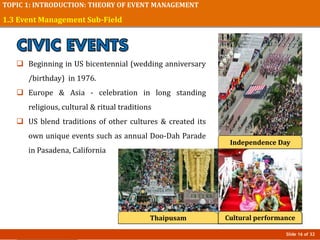
 Beginning in US bicentennial (wedding anniversary
/birthday) in 1976.
 Europe & Asia - celebration in long standing
religious, cultural & ritual traditions
 US blend traditions of other cultures & created its
own unique events such as annual Doo-Dah Parade
in Pasadena, California
Thaipusam Cultural performance
Independence Day
Slide 17 of 32
TOPIC 1: INTRODUCTION: THEORY OF EVENT MANAGEMENT
1.3 Event Management Sub-Field
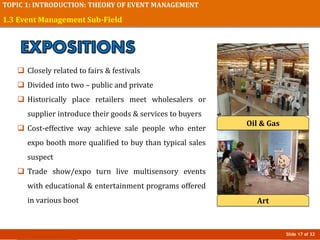
 Closely related to fairs & festivals
 Divided into two – public and private
 Historically place retailers meet wholesalers or
supplier introduce their goods & services to buyers
 Cost-effective way achieve sale people who enter
expo booth more qualified to buy than typical sales
suspect
 Trade show/expo turn live multisensory events
with educational & entertainment programs offered
in various boot
Oil & Gas
Art
Slide 18 of 32
TOPIC 1: INTRODUCTION: THEORY OF EVENT MANAGEMENT
1.3 Event Management Sub-Field
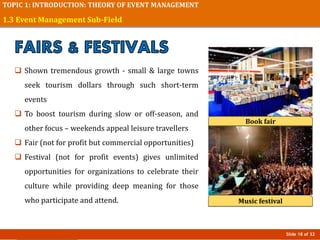
 Shown tremendous growth - small & large towns
seek tourism dollars through such short-term
events
 To boost tourism during slow or off-season, and
other focus – weekends appeal leisure travellers
 Fair (not for profit but commercial opportunities)
 Festival (not for profit events) gives unlimited
opportunities for organizations to celebrate their
culture while providing deep meaning for those
who participate and attend.
Book fair
Music festival
Slide 19 of 32
TOPIC 1: INTRODUCTION: THEORY OF EVENT MANAGEMENT
1.3 Event Management Sub-Field
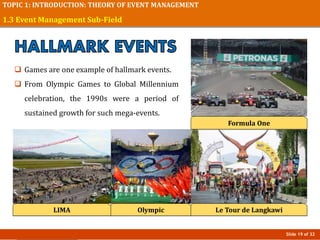
 Games are one example of hallmark events.
 From Olympic Games to Global Millennium
celebration, the 1990s were a period of
sustained growth for such mega-events.
Olympic
Formula One
Le Tour de LangkawiLIMA
Slide 20 of 32
TOPIC 1: INTRODUCTION: THEORY OF EVENT MANAGEMENT
1.3 Event Management Sub-Field
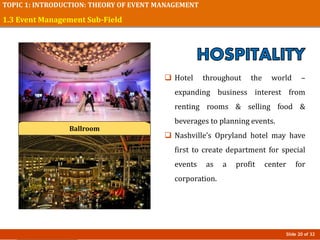
 Hotel throughout the world –
expanding business interest from
renting rooms & selling food &
beverages to planning events.
 Nashville’s Opryland hotel may have
first to create department for special
events as a profit center for
corporation.
Ballroom
Slide 21 of 32
TOPIC 1: INTRODUCTION: THEORY OF EVENT MANAGEMENT
1.3 Event Management Sub-Field
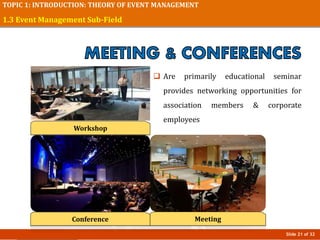
 Are primarily educational seminar
provides networking opportunities for
association members & corporate
employees
Conference Meeting
Workshop
Slide 22 of 32
TOPIC 1: INTRODUCTION: THEORY OF EVENT MANAGEMENT
1.3 Event Management Sub-Field
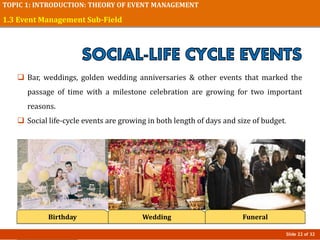
 Bar, weddings, golden wedding anniversaries & other events that marked the
passage of time with a milestone celebration are growing for two important
reasons.
 Social life-cycle events are growing in both length of days and size of budget.
WeddingBirthday Funeral
Slide 23 of 32
TOPIC 1: INTRODUCTION: THEORY OF EVENT MANAGEMENT
1.3 Event Management Sub-Field
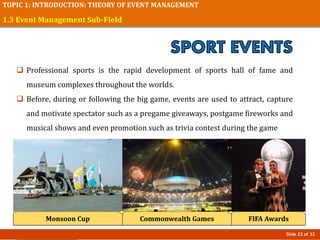
Monsoon Cup
 Professional sports is the rapid development of sports hall of fame and
museum complexes throughout the worlds.
 Before, during or following the big game, events are used to attract, capture
and motivate spectator such as a pregame giveaways, postgame fireworks and
musical shows and even promotion such as trivia contest during the game
Commonwealth Games FIFA Awards
Slide 24 of 32
TOPIC 1: INTRODUCTION: THEORY OF EVENT MANAGEMENT
1.3 Event Management Sub-Field
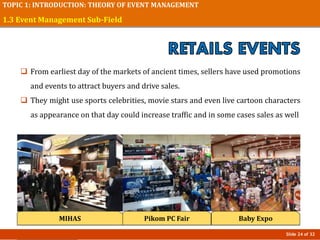
 From earliest day of the markets of ancient times, sellers have used promotions
and events to attract buyers and drive sales.
 They might use sports celebrities, movie stars and even live cartoon characters
as appearance on that day could increase traffic and in some cases sales as well
MIHAS Pikom PC Fair Baby Expo
Slide 25 of 32
TOPIC 1: INTRODUCTION: THEORY OF EVENT MANAGEMENT
1.3 Event Management Sub-Field
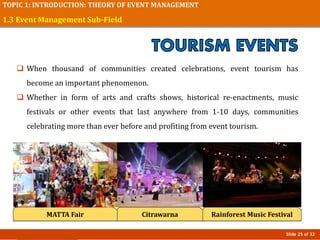
 When thousand of communities created celebrations, event tourism has
become an important phenomenon.
 Whether in form of arts and crafts shows, historical re-enactments, music
festivals or other events that last anywhere from 1-10 days, communities
celebrating more than ever before and profiting from event tourism.
MATTA Fair Citrawarna Rainforest Music Festival
Slide 26 of 32
TOPIC 1: INTRODUCTION: THEORY OF EVENT MANAGEMENT
1.3.1 Stakeholder
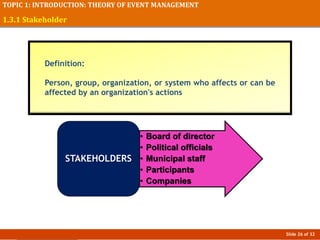
• Board of director
• Political officials
• Municipal staff
• Participants
• Companies
STAKEHOLDERS
Definition:
Person, group, organization, or system who affects or can be
affected by an organization's actions
Slide 27 of 32
TOPIC 1: INTRODUCTION: THEORY OF EVENT MANAGEMENT
1.4 Changes in Event Management
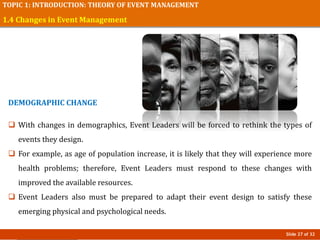
DEMOGRAPHIC CHANGE
 With changes in demographics, Event Leaders will be forced to rethink the types of
events they design.
 For example, as age of population increase, it is likely that they will experience more
health problems; therefore, Event Leaders must respond to these changes with
improved the available resources.
 Event Leaders also must be prepared to adapt their event design to satisfy these
emerging physical and psychological needs.
Slide 28 of 32
TOPIC 1: INTRODUCTION: THEORY OF EVENT MANAGEMENT
1.4 Changes in Event Management
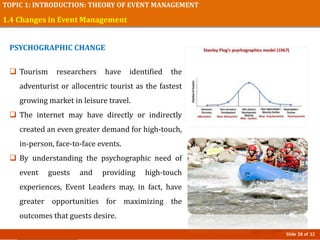
PSYCHOGRAPHIC CHANGE
 Tourism researchers have identified the
adventurist or allocentric tourist as the fastest
growing market in leisure travel.
 The internet may have directly or indirectly
created an even greater demand for high-touch,
in-person, face-to-face events.
 By understanding the psychographic need of
event guests and providing high-touch
experiences, Event Leaders may, in fact, have
greater opportunities for maximizing the
outcomes that guests desire.
Slide 29 of 32
TOPIC 1: INTRODUCTION: THEORY OF EVENT MANAGEMENT
1.5 Challenges and Opportunities
 Three (3) important challenges await you in developing a long, prosperous
professional career in Event Leadership.
 Each of these challenges is related to the other.
 The environment in which business is developed,
 the rapid changes in available resources, and
 the requirement for continuous education from a dynamic triangle that will
either support your climb or entrap you while limiting your success.
BUSINESS DEVELOPMENT
 Every organization faces increased competition as the world economy becomes
smaller and you find that you no longer compete in a local market.
Slide 30 of 32
TOPIC 1: INTRODUCTION: THEORY OF EVENT MANAGEMENT
1.5 Challenges and Opportunities
RESOURCE DEVELOPMENT
 As more and more organizations create their own home pages on the World Wide
Web, consumers will be increasingly exposed to infinite resources for Event
Leadership.
 The challenges is to select those resources that fit with the market demand and
cultivate them to ensure highest consistent quality.
LIFELONG LEARNING: A USER’S GUIDE
 When you audit the business environment, select resources that demonstrate your
quality, dependability and reliability, and engage in a program of lifelong earning,
you will be far ahead of your current and future competitors.
Slide 31 of 32
TOPIC 1: INTRODUCTION: THEORY OF EVENT MANAGEMENT
SUMMARY
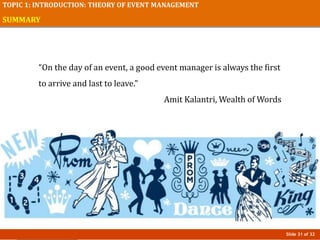
“On the day of an event, a good event manager is always the first
to arrive and last to leave.”
Amit Kalantri, Wealth of Words
Slide 32 of 32
TOPIC 1: INTRODUCTION: THEORY OF EVENT MANAGEMENT
ACTIVITY/TUTORIAL
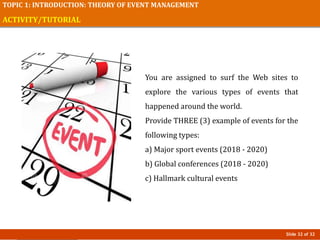
You are assigned to surf the Web sites to
explore the various types of events that
happened around the world.
Provide THREE (3) example of events for the
following types:
a) Major sport events (2018 - 2020)
b) Global conferences (2018 - 2020)
c) Hallmark cultural events

Event Management - Unit 1

  • 1.
    TOPIC 1 EVENT MANAGEMENT INTRODUCTION: THEORYOF EVENT MANAGEMENT PREPARED BY: NORHASIMAH BINTI HAMIM
  • 2.
    Slide 2 of32 TOPIC 1: INTRODUCTION: THEORY OF EVENT MANAGEMENT LEARNING OUTCOMES At the end of this topic, the students would be able to: To understand and appreciate the importance of economic, social, political and environmental sustainability for planned events. To recognize and understand the economic, social, political, cultural, political, and environmental changes that are affecting the global events industry. To identify the benefit from the demographic changes affecting the global events industry. To identify new and emerging career opportunities in this growing field.
  • 3.
    Slide 3 of32 TOPIC 1: INTRODUCTION: THEORY OF EVENT MANAGEMENT TOPIC OUTLINES Introduction 1.1 Understand about Event 1.2 The Event Management Profession 1.3 Event Management Subfield 1.4 Changes in Event Management 1.5 Challenges and Opportunity Summary
  • 4.
    Slide 4 of32 TOPIC 1: INTRODUCTION: THEORY OF EVENT MANAGEMENT INTRODUCTION “An event can be described as a public assembly for the purpose of celebration, education, and marketing”. Goldblatt, Joe What is Event?
  • 5.
    Slide 5 of32 TOPIC 1: INTRODUCTION: THEORY OF EVENT MANAGEMENT INTRODUCTION “Event management is the application of project management to the creation and development of small and/or large-scale personal or corporate events such as festivals, conferences, ceremonies, weddings, formal parties, concerts, or conventions.” and what is Event Management?
  • 6.
    Slide 6 of32 TOPIC 1: INTRODUCTION: THEORY OF EVENT MANAGEMENT 1.1 Understand about Event  Special event – different from normal day of living  Focus on specific purpose  Groundbreaking, grand opening or other important occasion  Other targeted purposes
  • 7.
    Slide 7 of32 TOPIC 1: INTRODUCTION: THEORY OF EVENT MANAGEMENT 1.1 Understand about Event A VARIETY OF EVENTS: Festival Sporting Event Music Festival Parades Carnival
  • 8.
    Slide 8 of32 TOPIC 1: INTRODUCTION: THEORY OF EVENT MANAGEMENT 1.1 Understand about Event Develop strategies for success Make a checklist Consider logistics Plan publicity Create a budget Evaluate the event STEPS IN EVENT PLANNING
  • 9.
    Slide 9 of32 TOPIC 1: INTRODUCTION: THEORY OF EVENT MANAGEMENT 1.2 The Event Management Profession Event tourists are those people who visit destination for the primary purpose of participating in or viewing an event (Turco, Riley & Swart, 2002) In recent years one could reasonably argue that the term “event” has been used to define that which is extraordinary in popular culture (GoldBlatt, 2000). Definition of Event
  • 10.
    Slide 10 of32 TOPIC 1: INTRODUCTION: THEORY OF EVENT MANAGEMENT 1.2 The Event Management Profession 3 Marketing 1 Celebration 2 Education 4 Reunion 4 KEYS COMPONENTS OF EVENT
  • 11.
    Slide 11 of32 TOPIC 1: INTRODUCTION: THEORY OF EVENT MANAGEMENT 1.2 The Event Management Profession Definition Celebration usually refer to official or festive functions such as parades, civic events, festivals, religious, political events, bar, wedding, anniversaries and other events tied to a person’s or organization’s life cycle or of historical importance. Celebration Parades Wedding
  • 12.
    Slide 12 of32 TOPIC 1: INTRODUCTION: THEORY OF EVENT MANAGEMENT 1.2 The Event Management Profession  Means to lead out.  Event Leader lead out new ideas, emotions, actions that improve society.  Examples of education events include convocation, alumni events, corporate training, meeting and convention with specific educational content.  Edutainment derived from the used of entertainment devices (such singer and dancer) to present educational concepts. Graduation Alumni Corporate Training
  • 13.
    Slide 13 of32 TOPIC 1: INTRODUCTION: THEORY OF EVENT MANAGEMENT 1.2 The Event Management Profession Definition Advertising, PR, promotions to create awareness and persuade prospects to purchase goods and services. Event can be “public” or “private”. Fashion Show Travel Fair
  • 14.
    Slide 14 of32 TOPIC 1: INTRODUCTION: THEORY OF EVENT MANAGEMENT 1.2 The Event Management Profession Definition To reunite for the purpose of remembrance, rekindling friendships or simply rebonding as a group.
  • 15.
    Slide 15 of32 TOPIC 1: INTRODUCTION: THEORY OF EVENT MANAGEMENT 1.3 Event Management Sub-Field  Ancient time - people assembled in marketplace conducting business, commercial & religious influence – develop today’s festivals, fairs, and public events.  In leisure - tourism & related fields - variety of event.  An event - something that ‘happen’ not just ‘exist’, & somebody has to make it happen.  Successful events – are through action some individual or group of individuals getting things done
  • 16.
    Slide 16 of32 TOPIC 1: INTRODUCTION: THEORY OF EVENT MANAGEMENT 1.3 Event Management Sub-Field  Beginning in US bicentennial (wedding anniversary /birthday) in 1976.  Europe & Asia - celebration in long standing religious, cultural & ritual traditions  US blend traditions of other cultures & created its own unique events such as annual Doo-Dah Parade in Pasadena, California Thaipusam Cultural performance Independence Day
  • 17.
    Slide 17 of32 TOPIC 1: INTRODUCTION: THEORY OF EVENT MANAGEMENT 1.3 Event Management Sub-Field  Closely related to fairs & festivals  Divided into two – public and private  Historically place retailers meet wholesalers or supplier introduce their goods & services to buyers  Cost-effective way achieve sale people who enter expo booth more qualified to buy than typical sales suspect  Trade show/expo turn live multisensory events with educational & entertainment programs offered in various boot Oil & Gas Art
  • 18.
    Slide 18 of32 TOPIC 1: INTRODUCTION: THEORY OF EVENT MANAGEMENT 1.3 Event Management Sub-Field  Shown tremendous growth - small & large towns seek tourism dollars through such short-term events  To boost tourism during slow or off-season, and other focus – weekends appeal leisure travellers  Fair (not for profit but commercial opportunities)  Festival (not for profit events) gives unlimited opportunities for organizations to celebrate their culture while providing deep meaning for those who participate and attend. Book fair Music festival
  • 19.
    Slide 19 of32 TOPIC 1: INTRODUCTION: THEORY OF EVENT MANAGEMENT 1.3 Event Management Sub-Field  Games are one example of hallmark events.  From Olympic Games to Global Millennium celebration, the 1990s were a period of sustained growth for such mega-events. Olympic Formula One Le Tour de LangkawiLIMA
  • 20.
    Slide 20 of32 TOPIC 1: INTRODUCTION: THEORY OF EVENT MANAGEMENT 1.3 Event Management Sub-Field  Hotel throughout the world – expanding business interest from renting rooms & selling food & beverages to planning events.  Nashville’s Opryland hotel may have first to create department for special events as a profit center for corporation. Ballroom
  • 21.
    Slide 21 of32 TOPIC 1: INTRODUCTION: THEORY OF EVENT MANAGEMENT 1.3 Event Management Sub-Field  Are primarily educational seminar provides networking opportunities for association members & corporate employees Conference Meeting Workshop
  • 22.
    Slide 22 of32 TOPIC 1: INTRODUCTION: THEORY OF EVENT MANAGEMENT 1.3 Event Management Sub-Field  Bar, weddings, golden wedding anniversaries & other events that marked the passage of time with a milestone celebration are growing for two important reasons.  Social life-cycle events are growing in both length of days and size of budget. WeddingBirthday Funeral
  • 23.
    Slide 23 of32 TOPIC 1: INTRODUCTION: THEORY OF EVENT MANAGEMENT 1.3 Event Management Sub-Field Monsoon Cup  Professional sports is the rapid development of sports hall of fame and museum complexes throughout the worlds.  Before, during or following the big game, events are used to attract, capture and motivate spectator such as a pregame giveaways, postgame fireworks and musical shows and even promotion such as trivia contest during the game Commonwealth Games FIFA Awards
  • 24.
    Slide 24 of32 TOPIC 1: INTRODUCTION: THEORY OF EVENT MANAGEMENT 1.3 Event Management Sub-Field  From earliest day of the markets of ancient times, sellers have used promotions and events to attract buyers and drive sales.  They might use sports celebrities, movie stars and even live cartoon characters as appearance on that day could increase traffic and in some cases sales as well MIHAS Pikom PC Fair Baby Expo
  • 25.
    Slide 25 of32 TOPIC 1: INTRODUCTION: THEORY OF EVENT MANAGEMENT 1.3 Event Management Sub-Field  When thousand of communities created celebrations, event tourism has become an important phenomenon.  Whether in form of arts and crafts shows, historical re-enactments, music festivals or other events that last anywhere from 1-10 days, communities celebrating more than ever before and profiting from event tourism. MATTA Fair Citrawarna Rainforest Music Festival
  • 26.
    Slide 26 of32 TOPIC 1: INTRODUCTION: THEORY OF EVENT MANAGEMENT 1.3.1 Stakeholder • Board of director • Political officials • Municipal staff • Participants • Companies STAKEHOLDERS Definition: Person, group, organization, or system who affects or can be affected by an organization's actions
  • 27.
    Slide 27 of32 TOPIC 1: INTRODUCTION: THEORY OF EVENT MANAGEMENT 1.4 Changes in Event Management DEMOGRAPHIC CHANGE  With changes in demographics, Event Leaders will be forced to rethink the types of events they design.  For example, as age of population increase, it is likely that they will experience more health problems; therefore, Event Leaders must respond to these changes with improved the available resources.  Event Leaders also must be prepared to adapt their event design to satisfy these emerging physical and psychological needs.
  • 28.
    Slide 28 of32 TOPIC 1: INTRODUCTION: THEORY OF EVENT MANAGEMENT 1.4 Changes in Event Management PSYCHOGRAPHIC CHANGE  Tourism researchers have identified the adventurist or allocentric tourist as the fastest growing market in leisure travel.  The internet may have directly or indirectly created an even greater demand for high-touch, in-person, face-to-face events.  By understanding the psychographic need of event guests and providing high-touch experiences, Event Leaders may, in fact, have greater opportunities for maximizing the outcomes that guests desire.
  • 29.
    Slide 29 of32 TOPIC 1: INTRODUCTION: THEORY OF EVENT MANAGEMENT 1.5 Challenges and Opportunities  Three (3) important challenges await you in developing a long, prosperous professional career in Event Leadership.  Each of these challenges is related to the other.  The environment in which business is developed,  the rapid changes in available resources, and  the requirement for continuous education from a dynamic triangle that will either support your climb or entrap you while limiting your success. BUSINESS DEVELOPMENT  Every organization faces increased competition as the world economy becomes smaller and you find that you no longer compete in a local market.
  • 30.
    Slide 30 of32 TOPIC 1: INTRODUCTION: THEORY OF EVENT MANAGEMENT 1.5 Challenges and Opportunities RESOURCE DEVELOPMENT  As more and more organizations create their own home pages on the World Wide Web, consumers will be increasingly exposed to infinite resources for Event Leadership.  The challenges is to select those resources that fit with the market demand and cultivate them to ensure highest consistent quality. LIFELONG LEARNING: A USER’S GUIDE  When you audit the business environment, select resources that demonstrate your quality, dependability and reliability, and engage in a program of lifelong earning, you will be far ahead of your current and future competitors.
  • 31.
    Slide 31 of32 TOPIC 1: INTRODUCTION: THEORY OF EVENT MANAGEMENT SUMMARY “On the day of an event, a good event manager is always the first to arrive and last to leave.” Amit Kalantri, Wealth of Words
  • 32.
    Slide 32 of32 TOPIC 1: INTRODUCTION: THEORY OF EVENT MANAGEMENT ACTIVITY/TUTORIAL You are assigned to surf the Web sites to explore the various types of events that happened around the world. Provide THREE (3) example of events for the following types: a) Major sport events (2018 - 2020) b) Global conferences (2018 - 2020) c) Hallmark cultural events