TOPIC 9
EVENT
MANAGEMENT
RISK MANAGEMENT: LEGAL AND RISK
MANAGEMENT
PREPARED BY:
NORHASIMAH BINTI HAMIM
Slide 2 of 40
TOPIC 9: RISK MANAGEMENT: LEGAL AND RISK MANAGEMENT
LEARNING OUTCOMES
At the end of this topic, the students would be able to:
 Understand the concepts of contracts, permits and licenses in event
planning.
 Discuss the types of event management agreements and contracts.
 Outline the risk management procedures in event planning.
 Describe the importance of legal and risk management in event planning.
Slide 3 of 40
TOPIC 9: RISK MANAGEMENT: LEGAL AND RISK MANAGEMENT
TOPIC OUTLINES
Introduction
9.1 Contracts, Permits and Licenses
9.2 Event Management Agreement and Contracts
9.3 Risks Management Procedures
Summary
Slide 4 of 40
TOPIC 9: RISK MANAGEMENT: LEGAL AND RISK MANAGEMENT
INTRODUCTION
Event manager must remain abreast general changes to legislation that
could have an impact on daily operations.
They would also need to seek advice from their insurance company, as
well as from their solicitor, regarding appropriate indemnity forms that
their customers may need to sign.
Responsibility of management:
 to create awareness of legislative compliance requirements.
 to develop appropriate policies and procedures.
 to undertake induction and training of employees.
 to provide leadership that motivates employees to meet the highest
professional standards.
Slide 5 of 40
TOPIC 9: RISK MANAGEMENT: LEGAL AND RISK MANAGEMENT
INTRODUCTION
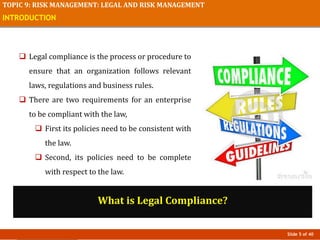
 Legal compliance is the process or procedure to
ensure that an organization follows relevant
laws, regulations and business rules.
 There are two requirements for an enterprise
to be compliant with the law,
 First its policies need to be consistent with
the law.
 Second, its policies need to be complete
with respect to the law.
What is Legal Compliance?
Slide 6 of 40
TOPIC 9: RISK MANAGEMENT: LEGAL AND RISK MANAGEMENT
INTRODUCTION
What is RISK?
The possibility of something happening that impacts on your objectives.
Risks measured in terms of possibility and consequence.
Effective risk management enables to maximize opportunities and achieve
your outputs.
Slide 7 of 40
TOPIC 9: RISK MANAGEMENT: LEGAL AND RISK MANAGEMENT
INTRODUCTION
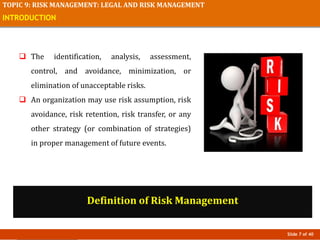
 The identification, analysis, assessment,
control, and avoidance, minimization, or
elimination of unacceptable risks.
 An organization may use risk assumption, risk
avoidance, risk retention, risk transfer, or any
other strategy (or combination of strategies)
in proper management of future events.
Definition of Risk Management
Slide 8 of 40
TOPIC 9: RISK MANAGEMENT: LEGAL AND RISK MANAGEMENT
9.1 Contracts, Permits and Licenses
Contracts, Permits and Licenses
 Permits are issued by local, state, provincial, or federal government agencies
and allow you to conduct certain activities at your event.
 A permit may be issued only after you have submitted the appropriate
documentation and have paid a fee.
 Permit is not issued automatically.
 A permit reflects that an agency is permitting your event organization to
conduct certain activities provided that you conform to the regulations
established.
PERMITS
Slide 9 of 40
TOPIC 9: RISK MANAGEMENT: LEGAL AND RISK MANAGEMENT
9.1 Contracts, Permits and Licenses
Contracts, Permits and Licenses
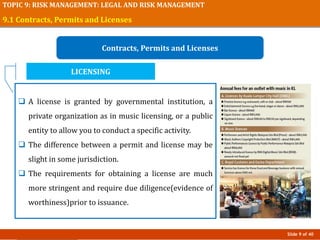
 A license is granted by governmental institution, a
private organization as in music licensing, or a public
entity to allow you to conduct a specific activity.
 The difference between a permit and license may be
slight in some jurisdiction.
 The requirements for obtaining a license are much
more stringent and require due diligence(evidence of
worthiness)prior to issuance.
LICENSING
Slide 10 of 40
TOPIC 9: RISK MANAGEMENT: LEGAL AND RISK MANAGEMENT
9.1 Contracts, Permits and Licenses
Contracts, Permits and Licenses
 Organizing an event involves making a whole range of agreements with a
number of organizations and individuals including funders, sponsors, venues,
suppliers, performers, staff and volunteers.
 It is essential that you put all agreements in writing thus ensuring that each
party understand exactly what is expected of them.
 The agreements you make are likely to range from quite substantial formal
contracts between the key event partners to purchase orders with suppliers.
CONTRACTS
Slide 11 of 40
TOPIC 9: RISK MANAGEMENT: LEGAL AND RISK MANAGEMENT
9.1 Contracts, Permits and Licenses
Protecting Legal Interest
 Preparing proper contracts, researching the permits and licenses that are
required, and complying with other legal requirements helps ensure that your
event may proceed without undue interruption.
 The majority of permits and licenses will be issued by local agencies.
 The permitting and licensing process may require weeks or even month to
accomplish.
 The importance of legal compliance are:
 Honoring ethical practices
 Ensuring the safety and security of event stakeholders
 Protecting your financial investment
Slide 12 of 40
TOPIC 9: RISK MANAGEMENT: LEGAL AND RISK MANAGEMENT
9.1 Contracts, Permits and Licenses
Protecting Legal Interest
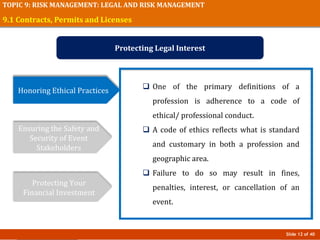
Honoring Ethical Practices
Ensuring the Safety and
Security of Event
Stakeholders
Protecting Your
Financial Investment
 One of the primary definitions of a
profession is adherence to a code of
ethical/ professional conduct.
 A code of ethics reflects what is standard
and customary in both a profession and
geographic area.
 Failure to do so may result in fines,
penalties, interest, or cancellation of an
event.
Slide 13 of 40
TOPIC 9: RISK MANAGEMENT: LEGAL AND RISK MANAGEMENT
9.1 Contracts, Permits and Licenses
Protecting Legal Interest
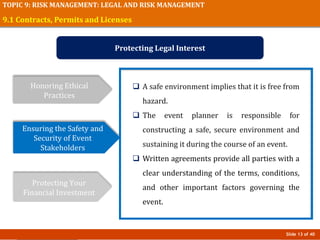
Honoring Ethical
Practices
Ensuring the Safety and
Security of Event
Stakeholders
Protecting Your
Financial Investment
 A safe environment implies that it is free from
hazard.
 The event planner is responsible for
constructing a safe, secure environment and
sustaining it during the course of an event.
 Written agreements provide all parties with a
clear understanding of the terms, conditions,
and other important factors governing the
event.
Slide 14 of 40
TOPIC 9: RISK MANAGEMENT: LEGAL AND RISK MANAGEMENT
9.1 Contracts, Permits and Licenses
Protecting Legal Interest
Honoring Ethical
Practices
Ensuring the Safety and
Security of Event
Stakeholders
Protecting Your Financial
Investment
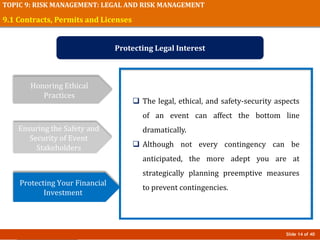
 The legal, ethical, and safety-security aspects
of an event can affect the bottom line
dramatically.
 Although not every contingency can be
anticipated, the more adept you are at
strategically planning preemptive measures
to prevent contingencies.
Slide 15 of 40
TOPIC 9: RISK MANAGEMENT: LEGAL AND RISK MANAGEMENT
9.1 Contracts, Permits and Licenses
Contracts, Permits and Licenses
Relevant Legislation
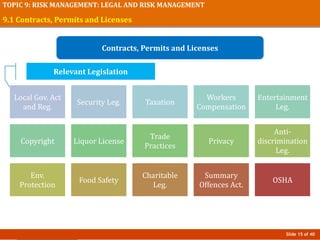
Local Gov. Act
and Reg.
Security Leg. Taxation
Workers
Compensation
Entertainment
Leg.
Copyright Liquor License
Trade
Practices
Privacy
Anti-
discrimination
Leg.
Env.
Protection
Food Safety
Charitable
Leg.
Summary
Offences Act.
OSHA
Slide 16 of 40
TOPIC 9: RISK MANAGEMENT: LEGAL AND RISK MANAGEMENT
9.2 Event Management Agreement and Contracts
Event Management Agreement and Contracts
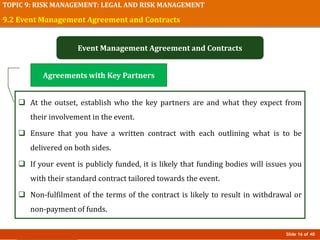
 At the outset, establish who the key partners are and what they expect from
their involvement in the event.
 Ensure that you have a written contract with each outlining what is to be
delivered on both sides.
 If your event is publicly funded, it is likely that funding bodies will issues you
with their standard contract tailored towards the event.
 Non-fulfilment of the terms of the contract is likely to result in withdrawal or
non-payment of funds.
Agreements with Key Partners
Slide 17 of 40
TOPIC 9: RISK MANAGEMENT: LEGAL AND RISK MANAGEMENT
9.2 Event Management Agreement and Contracts
Event Management Agreement and Contracts
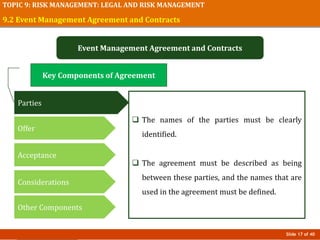
 The names of the parties must be clearly
identified.
 The agreement must be described as being
between these parties, and the names that are
used in the agreement must be defined.
Key Components of Agreement
Parties
Offer
Acceptance
Considerations
Other Components
Slide 18 of 40
TOPIC 9: RISK MANAGEMENT: LEGAL AND RISK MANAGEMENT
9.2 Event Management Agreement and Contracts
Event Management Agreement and Contracts
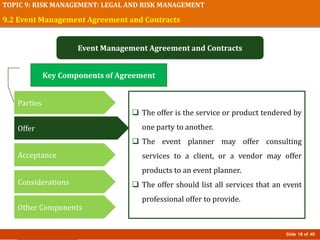
 The offer is the service or product tendered by
one party to another.
 The event planner may offer consulting
services to a client, or a vendor may offer
products to an event planner.
 The offer should list all services that an event
professional offer to provide.
Key Components of Agreement
Parties
Offer
Acceptance
Considerations
Other Components
Slide 19 of 40
TOPIC 9: RISK MANAGEMENT: LEGAL AND RISK MANAGEMENT
9.2 Event Management Agreement and Contracts
Event Management Agreement and Contracts
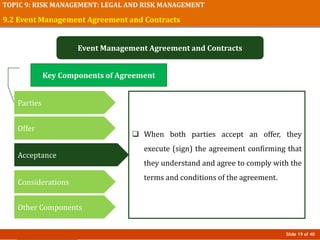
 When both parties accept an offer, they
execute (sign) the agreement confirming that
they understand and agree to comply with the
terms and conditions of the agreement.
Key Components of Agreement
Parties
Offer
Acceptance
Considerations
Other Components
Slide 20 of 40
TOPIC 9: RISK MANAGEMENT: LEGAL AND RISK MANAGEMENT
9.2 Event Management Agreement and Contracts
Event Management Agreement and Contracts
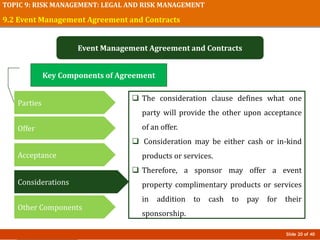
 The consideration clause defines what one
party will provide the other upon acceptance
of an offer.
 Consideration may be either cash or in-kind
products or services.
 Therefore, a sponsor may offer a event
property complimentary products or services
in addition to cash to pay for their
sponsorship.
Key Components of Agreement
Parties
Offer
Acceptance
Considerations
Other Components
Slide 21 of 40
TOPIC 9: RISK MANAGEMENT: LEGAL AND RISK MANAGEMENT
9.2 Event Management Agreement and Contracts
Event Management Agreement and Contracts
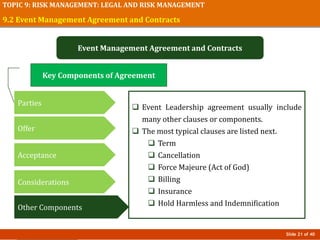
 Event Leadership agreement usually include
many other clauses or components.
 The most typical clauses are listed next.
 Term
 Cancellation
 Force Majeure (Act of God)
 Billing
 Insurance
 Hold Harmless and Indemnification
Key Components of Agreement
Parties
Offer
Acceptance
Considerations
Other Components
Slide 22 of 40
TOPIC 9: RISK MANAGEMENT: LEGAL AND RISK MANAGEMENT
9.2 Event Management Agreement and Contracts
Event Management Agreement and Contracts
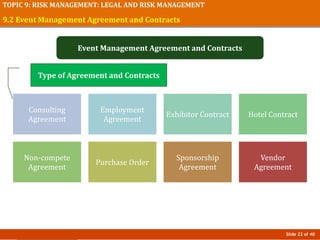
Type of Agreement and Contracts
Consulting
Agreement
Employment
Agreement
Exhibitor Contract Hotel Contract
Non-compete
Agreement
Purchase Order
Sponsorship
Agreement
Vendor
Agreement
Slide 23 of 40
TOPIC 9: RISK MANAGEMENT: LEGAL AND RISK MANAGEMENT
9.3 Risk Management Procedures
Types of Risk
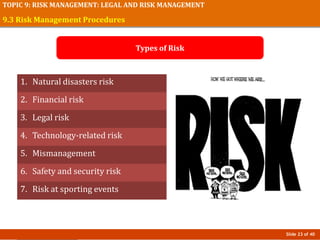
1. Natural disasters risk
2. Financial risk
3. Legal risk
4. Technology-related risk
5. Mismanagement
6. Safety and security risk
7. Risk at sporting events
Slide 24 of 40
TOPIC 9: RISK MANAGEMENT: LEGAL AND RISK MANAGEMENT
First steps in assessing risks
A risk assessment should consider
 existing risks of the site
 risks the event creates, and
 external risks that the event organiser has little control over but may need
to be managed at the event.
There are some questions an event organiser should ask themself when
assessing risks of an event.
This is be no means exhaustive however we hope it helps you get started.
9.3 Risk Management Procedures
Types of Risk
Slide 25 of 40
TOPIC 9: RISK MANAGEMENT: LEGAL AND RISK MANAGEMENT
Risk Management Plan for Events
An event is full of uncertainties like power failure, equipment failure, medical
emergency, brawl, stampede, fire, sponsorship withdrawal, last minute turned
down by an artist etc.
How will you deal with all these contingencies without a well thought out risk
management plan.
Risk management is done at each and every stage of event production.
 For e.g. when risk management is done in the information management
field, then it deals with loss of data due to data theft or hard disk crash.
9.3 Risk Management Procedures
Types of Risk
Slide 26 of 40
TOPIC 9: RISK MANAGEMENT: LEGAL AND RISK MANAGEMENT
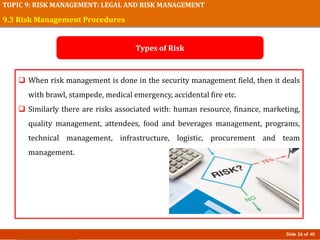
 When risk management is done in the security management field, then it deals
with brawl, stampede, medical emergency, accidental fire etc.
 Similarly there are risks associated with: human resource, finance, marketing,
quality management, attendees, food and beverages management, programs,
technical management, infrastructure, logistic, procurement and team
management.
9.3 Risk Management Procedures
Types of Risk
Slide 27 of 40
TOPIC 9: RISK MANAGEMENT: LEGAL AND RISK MANAGEMENT
Since risk management is a very important part of event management therefore it
should be carried out in a planned and professional manner.
Following steps are involved in risk management:
Step 1: Identify those elements or activities which could carry a risk.
 A list of such elements is already specified above like information
management, security, procurement etc.
Step 2: Identify the risks associated with each element or activity.
 For e.g. cargo theft is associated with logistic management. Similarly, data
loss is associated with information management.
9.3 Risk Management Procedures
Risk Management Procedures
Slide 28 of 40
TOPIC 9: RISK MANAGEMENT: LEGAL AND RISK MANAGEMENT
9.3 Risk Management Procedures
Risk Management Procedures
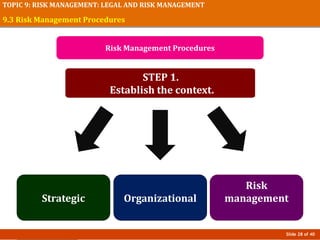
STEP 1.
Establish the context.
Strategic Organizational
Risk
management
Slide 29 of 40
TOPIC 9: RISK MANAGEMENT: LEGAL AND RISK MANAGEMENT
9.3 Risk Management Procedures
Risk Management Procedures
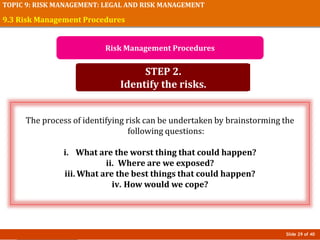
STEP 2.
Identify the risks.
The process of identifying risk can be undertaken by brainstorming the
following questions:
i. What are the worst thing that could happen?
ii. Where are we exposed?
iii. What are the best things that could happen?
iv. How would we cope?
Slide 30 of 40
TOPIC 9: RISK MANAGEMENT: LEGAL AND RISK MANAGEMENT
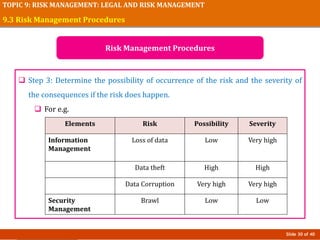
 Step 3: Determine the possibility of occurrence of the risk and the severity of
the consequences if the risk does happen.
 For e.g.
9.3 Risk Management Procedures
Risk Management Procedures
Elements Risk Possibility Severity
Information
Management
Loss of data Low Very high
Data theft High High
Data Corruption Very high Very high
Security
Management
Brawl Low Low
Slide 31 of 40
TOPIC 9: RISK MANAGEMENT: LEGAL AND RISK MANAGEMENT
9.3 Risk Management Procedures
Risk Management Procedures
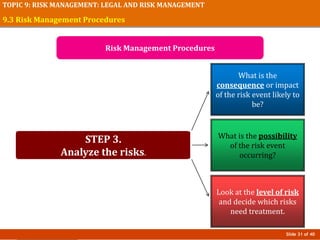
STEP 3.
Analyze the risks.
What is the possibility
of the risk event
occurring?
What is the
consequence or impact
of the risk event likely to
be?
Look at the level of risk
and decide which risks
need treatment.
Slide 32 of 40
TOPIC 9: RISK MANAGEMENT: LEGAL AND RISK MANAGEMENT
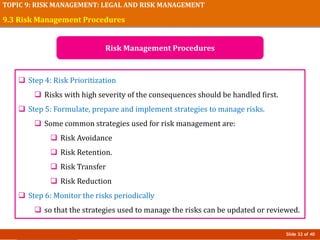
 Step 4: Risk Prioritization
 Risks with high severity of the consequences should be handled first.
 Step 5: Formulate, prepare and implement strategies to manage risks.
 Some common strategies used for risk management are:
 Risk Avoidance
 Risk Retention.
 Risk Transfer
 Risk Reduction
 Step 6: Monitor the risks periodically
 so that the strategies used to manage the risks can be updated or reviewed.
9.3 Risk Management Procedures
Risk Management Procedures
Slide 33 of 40
TOPIC 9: RISK MANAGEMENT: LEGAL AND RISK MANAGEMENT
9.3 Risk Management Procedures
Risk Management Procedures
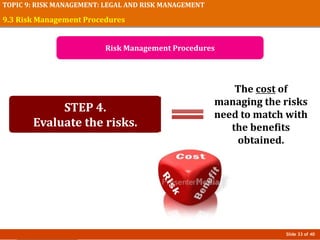
STEP 4.
Evaluate the risks.
The cost of
managing the risks
need to match with
the benefits
obtained.
Slide 34 of 40
TOPIC 9: RISK MANAGEMENT: LEGAL AND RISK MANAGEMENT
9.3 Risk Management Procedures
Risk Management Procedures
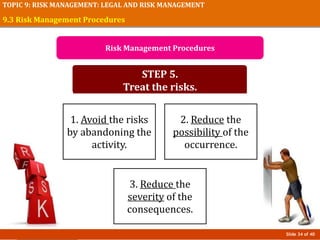
STEP 5.
Treat the risks.
1. Avoid the risks
by abandoning the
activity.
2. Reduce the
possibility of the
occurrence.
3. Reduce the
severity of the
consequences.
Slide 35 of 40
TOPIC 9: RISK MANAGEMENT: LEGAL AND RISK MANAGEMENT
 A risk management plan identifies all the potential risks that may arise from
holding an event and then lists the steps event organisers will take to reduce or
mitigate identified risks.
 The main risks to consider are anything that could:
 cause harm to another person
 cause damage to equipment, infrastructure or the event site, or
 harm the future of the event organising committee and event itself.
 It is important that the risk management plan details who is responsible for
coordinating the safety of every person should something that is out of the
control of the event organiser occur.
9.3 Risk Management Procedures
Importance of Risk Management
Slide 36 of 40
TOPIC 9: RISK MANAGEMENT: LEGAL AND RISK MANAGEMENT
General Controls
Put into place plans for dealing with incidents and emergencies that can be
managed effectively using the resources already on-site.
Create an emergency plan that is proportionate to the size of the event and the
potential extent and severity of the incident.
Clearly define a communication path and decision-making structure
9.3 Risk Management Procedures
Emergency Response Plan
Slide 37 of 40
TOPIC 9: RISK MANAGEMENT: LEGAL AND RISK MANAGEMENT
The Plan
Ensure the plan covers:
Mobilising onsite resources to attend and tackle the incident
Removing people from immediate danger
The management of any casualties including providing medical assistance.
Raising the alarm and informing the public and telling staff what they need to do
Alerting and assisting emergency services
Incident control
Traffic management, including emergency vehicles
Controlling crowds including evacuation
Evacuation of disabled people
9.3 Risk Management Procedures
Emergency Response Plan
Slide 38 of 40
TOPIC 9: RISK MANAGEMENT: LEGAL AND RISK MANAGEMENT
 Handing over to the emergency services where applicable
 Dealing with displaced and non-injured (e.g. at a festival with camping)
 Protecting property.
 Ensure that the plan is flexible to cope with changes in events.
 The plan for emergency situations should set out the overall framework for the initiation,
management, co-ordination and control of personnel and assets to deal with an
emergency onsite.
 Ensure that all relevant staff members, no matter what their normal working role,
understand what they should do in the event of an emergency – including raising the
alarm, the location of exits, emergency equipment, and from whom they should receive
instructions etc
9.3 Risk Management Procedures
Emergency Response Plan
Slide 39 of 40
TOPIC 9: RISK MANAGEMENT: LEGAL AND RISK MANAGEMENT
Emergency procedures
Appoint people to be responsible for implementing the emergency procedures in the event
of an incident or emergency situation.
Ensure that a clear management structure is place, identifying the key decision makers.
Plans are discussed with the police, fire and rescue service, the ambulance service,
emergency planning and, for fixed premises such as stadiums and arenas, the venue
management.
Agreement with the emergency services on issues such as access routes to the site, the use
of any grid-referenced maps, rendezvous points and transfer of authority for a major incident
from the event organiser to the emergency services has been reached.
9.3 Risk Management Procedures
Emergency Response Plan
Slide 40 of 40
TOPIC 9: RISK MANAGEMENT: LEGAL AND RISK MANAGEMENT
SUMMARY
“There are some people who live in a dream world, and there are some
who face reality; and then there are those who turn one into the other.”
Douglas H. Everett

Event Management - Unit 9

  • 1.
    TOPIC 9 EVENT MANAGEMENT RISK MANAGEMENT:LEGAL AND RISK MANAGEMENT PREPARED BY: NORHASIMAH BINTI HAMIM
  • 2.
    Slide 2 of40 TOPIC 9: RISK MANAGEMENT: LEGAL AND RISK MANAGEMENT LEARNING OUTCOMES At the end of this topic, the students would be able to:  Understand the concepts of contracts, permits and licenses in event planning.  Discuss the types of event management agreements and contracts.  Outline the risk management procedures in event planning.  Describe the importance of legal and risk management in event planning.
  • 3.
    Slide 3 of40 TOPIC 9: RISK MANAGEMENT: LEGAL AND RISK MANAGEMENT TOPIC OUTLINES Introduction 9.1 Contracts, Permits and Licenses 9.2 Event Management Agreement and Contracts 9.3 Risks Management Procedures Summary
  • 4.
    Slide 4 of40 TOPIC 9: RISK MANAGEMENT: LEGAL AND RISK MANAGEMENT INTRODUCTION Event manager must remain abreast general changes to legislation that could have an impact on daily operations. They would also need to seek advice from their insurance company, as well as from their solicitor, regarding appropriate indemnity forms that their customers may need to sign. Responsibility of management:  to create awareness of legislative compliance requirements.  to develop appropriate policies and procedures.  to undertake induction and training of employees.  to provide leadership that motivates employees to meet the highest professional standards.
  • 5.
    Slide 5 of40 TOPIC 9: RISK MANAGEMENT: LEGAL AND RISK MANAGEMENT INTRODUCTION  Legal compliance is the process or procedure to ensure that an organization follows relevant laws, regulations and business rules.  There are two requirements for an enterprise to be compliant with the law,  First its policies need to be consistent with the law.  Second, its policies need to be complete with respect to the law. What is Legal Compliance?
  • 6.
    Slide 6 of40 TOPIC 9: RISK MANAGEMENT: LEGAL AND RISK MANAGEMENT INTRODUCTION What is RISK? The possibility of something happening that impacts on your objectives. Risks measured in terms of possibility and consequence. Effective risk management enables to maximize opportunities and achieve your outputs.
  • 7.
    Slide 7 of40 TOPIC 9: RISK MANAGEMENT: LEGAL AND RISK MANAGEMENT INTRODUCTION  The identification, analysis, assessment, control, and avoidance, minimization, or elimination of unacceptable risks.  An organization may use risk assumption, risk avoidance, risk retention, risk transfer, or any other strategy (or combination of strategies) in proper management of future events. Definition of Risk Management
  • 8.
    Slide 8 of40 TOPIC 9: RISK MANAGEMENT: LEGAL AND RISK MANAGEMENT 9.1 Contracts, Permits and Licenses Contracts, Permits and Licenses  Permits are issued by local, state, provincial, or federal government agencies and allow you to conduct certain activities at your event.  A permit may be issued only after you have submitted the appropriate documentation and have paid a fee.  Permit is not issued automatically.  A permit reflects that an agency is permitting your event organization to conduct certain activities provided that you conform to the regulations established. PERMITS
  • 9.
    Slide 9 of40 TOPIC 9: RISK MANAGEMENT: LEGAL AND RISK MANAGEMENT 9.1 Contracts, Permits and Licenses Contracts, Permits and Licenses  A license is granted by governmental institution, a private organization as in music licensing, or a public entity to allow you to conduct a specific activity.  The difference between a permit and license may be slight in some jurisdiction.  The requirements for obtaining a license are much more stringent and require due diligence(evidence of worthiness)prior to issuance. LICENSING
  • 10.
    Slide 10 of40 TOPIC 9: RISK MANAGEMENT: LEGAL AND RISK MANAGEMENT 9.1 Contracts, Permits and Licenses Contracts, Permits and Licenses  Organizing an event involves making a whole range of agreements with a number of organizations and individuals including funders, sponsors, venues, suppliers, performers, staff and volunteers.  It is essential that you put all agreements in writing thus ensuring that each party understand exactly what is expected of them.  The agreements you make are likely to range from quite substantial formal contracts between the key event partners to purchase orders with suppliers. CONTRACTS
  • 11.
    Slide 11 of40 TOPIC 9: RISK MANAGEMENT: LEGAL AND RISK MANAGEMENT 9.1 Contracts, Permits and Licenses Protecting Legal Interest  Preparing proper contracts, researching the permits and licenses that are required, and complying with other legal requirements helps ensure that your event may proceed without undue interruption.  The majority of permits and licenses will be issued by local agencies.  The permitting and licensing process may require weeks or even month to accomplish.  The importance of legal compliance are:  Honoring ethical practices  Ensuring the safety and security of event stakeholders  Protecting your financial investment
  • 12.
    Slide 12 of40 TOPIC 9: RISK MANAGEMENT: LEGAL AND RISK MANAGEMENT 9.1 Contracts, Permits and Licenses Protecting Legal Interest Honoring Ethical Practices Ensuring the Safety and Security of Event Stakeholders Protecting Your Financial Investment  One of the primary definitions of a profession is adherence to a code of ethical/ professional conduct.  A code of ethics reflects what is standard and customary in both a profession and geographic area.  Failure to do so may result in fines, penalties, interest, or cancellation of an event.
  • 13.
    Slide 13 of40 TOPIC 9: RISK MANAGEMENT: LEGAL AND RISK MANAGEMENT 9.1 Contracts, Permits and Licenses Protecting Legal Interest Honoring Ethical Practices Ensuring the Safety and Security of Event Stakeholders Protecting Your Financial Investment  A safe environment implies that it is free from hazard.  The event planner is responsible for constructing a safe, secure environment and sustaining it during the course of an event.  Written agreements provide all parties with a clear understanding of the terms, conditions, and other important factors governing the event.
  • 14.
    Slide 14 of40 TOPIC 9: RISK MANAGEMENT: LEGAL AND RISK MANAGEMENT 9.1 Contracts, Permits and Licenses Protecting Legal Interest Honoring Ethical Practices Ensuring the Safety and Security of Event Stakeholders Protecting Your Financial Investment  The legal, ethical, and safety-security aspects of an event can affect the bottom line dramatically.  Although not every contingency can be anticipated, the more adept you are at strategically planning preemptive measures to prevent contingencies.
  • 15.
    Slide 15 of40 TOPIC 9: RISK MANAGEMENT: LEGAL AND RISK MANAGEMENT 9.1 Contracts, Permits and Licenses Contracts, Permits and Licenses Relevant Legislation Local Gov. Act and Reg. Security Leg. Taxation Workers Compensation Entertainment Leg. Copyright Liquor License Trade Practices Privacy Anti- discrimination Leg. Env. Protection Food Safety Charitable Leg. Summary Offences Act. OSHA
  • 16.
    Slide 16 of40 TOPIC 9: RISK MANAGEMENT: LEGAL AND RISK MANAGEMENT 9.2 Event Management Agreement and Contracts Event Management Agreement and Contracts  At the outset, establish who the key partners are and what they expect from their involvement in the event.  Ensure that you have a written contract with each outlining what is to be delivered on both sides.  If your event is publicly funded, it is likely that funding bodies will issues you with their standard contract tailored towards the event.  Non-fulfilment of the terms of the contract is likely to result in withdrawal or non-payment of funds. Agreements with Key Partners
  • 17.
    Slide 17 of40 TOPIC 9: RISK MANAGEMENT: LEGAL AND RISK MANAGEMENT 9.2 Event Management Agreement and Contracts Event Management Agreement and Contracts  The names of the parties must be clearly identified.  The agreement must be described as being between these parties, and the names that are used in the agreement must be defined. Key Components of Agreement Parties Offer Acceptance Considerations Other Components
  • 18.
    Slide 18 of40 TOPIC 9: RISK MANAGEMENT: LEGAL AND RISK MANAGEMENT 9.2 Event Management Agreement and Contracts Event Management Agreement and Contracts  The offer is the service or product tendered by one party to another.  The event planner may offer consulting services to a client, or a vendor may offer products to an event planner.  The offer should list all services that an event professional offer to provide. Key Components of Agreement Parties Offer Acceptance Considerations Other Components
  • 19.
    Slide 19 of40 TOPIC 9: RISK MANAGEMENT: LEGAL AND RISK MANAGEMENT 9.2 Event Management Agreement and Contracts Event Management Agreement and Contracts  When both parties accept an offer, they execute (sign) the agreement confirming that they understand and agree to comply with the terms and conditions of the agreement. Key Components of Agreement Parties Offer Acceptance Considerations Other Components
  • 20.
    Slide 20 of40 TOPIC 9: RISK MANAGEMENT: LEGAL AND RISK MANAGEMENT 9.2 Event Management Agreement and Contracts Event Management Agreement and Contracts  The consideration clause defines what one party will provide the other upon acceptance of an offer.  Consideration may be either cash or in-kind products or services.  Therefore, a sponsor may offer a event property complimentary products or services in addition to cash to pay for their sponsorship. Key Components of Agreement Parties Offer Acceptance Considerations Other Components
  • 21.
    Slide 21 of40 TOPIC 9: RISK MANAGEMENT: LEGAL AND RISK MANAGEMENT 9.2 Event Management Agreement and Contracts Event Management Agreement and Contracts  Event Leadership agreement usually include many other clauses or components.  The most typical clauses are listed next.  Term  Cancellation  Force Majeure (Act of God)  Billing  Insurance  Hold Harmless and Indemnification Key Components of Agreement Parties Offer Acceptance Considerations Other Components
  • 22.
    Slide 22 of40 TOPIC 9: RISK MANAGEMENT: LEGAL AND RISK MANAGEMENT 9.2 Event Management Agreement and Contracts Event Management Agreement and Contracts Type of Agreement and Contracts Consulting Agreement Employment Agreement Exhibitor Contract Hotel Contract Non-compete Agreement Purchase Order Sponsorship Agreement Vendor Agreement
  • 23.
    Slide 23 of40 TOPIC 9: RISK MANAGEMENT: LEGAL AND RISK MANAGEMENT 9.3 Risk Management Procedures Types of Risk 1. Natural disasters risk 2. Financial risk 3. Legal risk 4. Technology-related risk 5. Mismanagement 6. Safety and security risk 7. Risk at sporting events
  • 24.
    Slide 24 of40 TOPIC 9: RISK MANAGEMENT: LEGAL AND RISK MANAGEMENT First steps in assessing risks A risk assessment should consider  existing risks of the site  risks the event creates, and  external risks that the event organiser has little control over but may need to be managed at the event. There are some questions an event organiser should ask themself when assessing risks of an event. This is be no means exhaustive however we hope it helps you get started. 9.3 Risk Management Procedures Types of Risk
  • 25.
    Slide 25 of40 TOPIC 9: RISK MANAGEMENT: LEGAL AND RISK MANAGEMENT Risk Management Plan for Events An event is full of uncertainties like power failure, equipment failure, medical emergency, brawl, stampede, fire, sponsorship withdrawal, last minute turned down by an artist etc. How will you deal with all these contingencies without a well thought out risk management plan. Risk management is done at each and every stage of event production.  For e.g. when risk management is done in the information management field, then it deals with loss of data due to data theft or hard disk crash. 9.3 Risk Management Procedures Types of Risk
  • 26.
    Slide 26 of40 TOPIC 9: RISK MANAGEMENT: LEGAL AND RISK MANAGEMENT  When risk management is done in the security management field, then it deals with brawl, stampede, medical emergency, accidental fire etc.  Similarly there are risks associated with: human resource, finance, marketing, quality management, attendees, food and beverages management, programs, technical management, infrastructure, logistic, procurement and team management. 9.3 Risk Management Procedures Types of Risk
  • 27.
    Slide 27 of40 TOPIC 9: RISK MANAGEMENT: LEGAL AND RISK MANAGEMENT Since risk management is a very important part of event management therefore it should be carried out in a planned and professional manner. Following steps are involved in risk management: Step 1: Identify those elements or activities which could carry a risk.  A list of such elements is already specified above like information management, security, procurement etc. Step 2: Identify the risks associated with each element or activity.  For e.g. cargo theft is associated with logistic management. Similarly, data loss is associated with information management. 9.3 Risk Management Procedures Risk Management Procedures
  • 28.
    Slide 28 of40 TOPIC 9: RISK MANAGEMENT: LEGAL AND RISK MANAGEMENT 9.3 Risk Management Procedures Risk Management Procedures STEP 1. Establish the context. Strategic Organizational Risk management
  • 29.
    Slide 29 of40 TOPIC 9: RISK MANAGEMENT: LEGAL AND RISK MANAGEMENT 9.3 Risk Management Procedures Risk Management Procedures STEP 2. Identify the risks. The process of identifying risk can be undertaken by brainstorming the following questions: i. What are the worst thing that could happen? ii. Where are we exposed? iii. What are the best things that could happen? iv. How would we cope?
  • 30.
    Slide 30 of40 TOPIC 9: RISK MANAGEMENT: LEGAL AND RISK MANAGEMENT  Step 3: Determine the possibility of occurrence of the risk and the severity of the consequences if the risk does happen.  For e.g. 9.3 Risk Management Procedures Risk Management Procedures Elements Risk Possibility Severity Information Management Loss of data Low Very high Data theft High High Data Corruption Very high Very high Security Management Brawl Low Low
  • 31.
    Slide 31 of40 TOPIC 9: RISK MANAGEMENT: LEGAL AND RISK MANAGEMENT 9.3 Risk Management Procedures Risk Management Procedures STEP 3. Analyze the risks. What is the possibility of the risk event occurring? What is the consequence or impact of the risk event likely to be? Look at the level of risk and decide which risks need treatment.
  • 32.
    Slide 32 of40 TOPIC 9: RISK MANAGEMENT: LEGAL AND RISK MANAGEMENT  Step 4: Risk Prioritization  Risks with high severity of the consequences should be handled first.  Step 5: Formulate, prepare and implement strategies to manage risks.  Some common strategies used for risk management are:  Risk Avoidance  Risk Retention.  Risk Transfer  Risk Reduction  Step 6: Monitor the risks periodically  so that the strategies used to manage the risks can be updated or reviewed. 9.3 Risk Management Procedures Risk Management Procedures
  • 33.
    Slide 33 of40 TOPIC 9: RISK MANAGEMENT: LEGAL AND RISK MANAGEMENT 9.3 Risk Management Procedures Risk Management Procedures STEP 4. Evaluate the risks. The cost of managing the risks need to match with the benefits obtained.
  • 34.
    Slide 34 of40 TOPIC 9: RISK MANAGEMENT: LEGAL AND RISK MANAGEMENT 9.3 Risk Management Procedures Risk Management Procedures STEP 5. Treat the risks. 1. Avoid the risks by abandoning the activity. 2. Reduce the possibility of the occurrence. 3. Reduce the severity of the consequences.
  • 35.
    Slide 35 of40 TOPIC 9: RISK MANAGEMENT: LEGAL AND RISK MANAGEMENT  A risk management plan identifies all the potential risks that may arise from holding an event and then lists the steps event organisers will take to reduce or mitigate identified risks.  The main risks to consider are anything that could:  cause harm to another person  cause damage to equipment, infrastructure or the event site, or  harm the future of the event organising committee and event itself.  It is important that the risk management plan details who is responsible for coordinating the safety of every person should something that is out of the control of the event organiser occur. 9.3 Risk Management Procedures Importance of Risk Management
  • 36.
    Slide 36 of40 TOPIC 9: RISK MANAGEMENT: LEGAL AND RISK MANAGEMENT General Controls Put into place plans for dealing with incidents and emergencies that can be managed effectively using the resources already on-site. Create an emergency plan that is proportionate to the size of the event and the potential extent and severity of the incident. Clearly define a communication path and decision-making structure 9.3 Risk Management Procedures Emergency Response Plan
  • 37.
    Slide 37 of40 TOPIC 9: RISK MANAGEMENT: LEGAL AND RISK MANAGEMENT The Plan Ensure the plan covers: Mobilising onsite resources to attend and tackle the incident Removing people from immediate danger The management of any casualties including providing medical assistance. Raising the alarm and informing the public and telling staff what they need to do Alerting and assisting emergency services Incident control Traffic management, including emergency vehicles Controlling crowds including evacuation Evacuation of disabled people 9.3 Risk Management Procedures Emergency Response Plan
  • 38.
    Slide 38 of40 TOPIC 9: RISK MANAGEMENT: LEGAL AND RISK MANAGEMENT  Handing over to the emergency services where applicable  Dealing with displaced and non-injured (e.g. at a festival with camping)  Protecting property.  Ensure that the plan is flexible to cope with changes in events.  The plan for emergency situations should set out the overall framework for the initiation, management, co-ordination and control of personnel and assets to deal with an emergency onsite.  Ensure that all relevant staff members, no matter what their normal working role, understand what they should do in the event of an emergency – including raising the alarm, the location of exits, emergency equipment, and from whom they should receive instructions etc 9.3 Risk Management Procedures Emergency Response Plan
  • 39.
    Slide 39 of40 TOPIC 9: RISK MANAGEMENT: LEGAL AND RISK MANAGEMENT Emergency procedures Appoint people to be responsible for implementing the emergency procedures in the event of an incident or emergency situation. Ensure that a clear management structure is place, identifying the key decision makers. Plans are discussed with the police, fire and rescue service, the ambulance service, emergency planning and, for fixed premises such as stadiums and arenas, the venue management. Agreement with the emergency services on issues such as access routes to the site, the use of any grid-referenced maps, rendezvous points and transfer of authority for a major incident from the event organiser to the emergency services has been reached. 9.3 Risk Management Procedures Emergency Response Plan
  • 40.
    Slide 40 of40 TOPIC 9: RISK MANAGEMENT: LEGAL AND RISK MANAGEMENT SUMMARY “There are some people who live in a dream world, and there are some who face reality; and then there are those who turn one into the other.” Douglas H. Everett