EVENT COORDINATION
BY BORNALI DAS
Overall Planning
Design, Programmed
design
Event Coordinator by BORNALI DAS
Definition of Event Coordinator
Event coordinators are hired to develop, plan, coordinate and complete
functions within business organizations.
Job Requirements
Coordinating special events requires skills in overseeing, planning,
coordinating, executing, and overseeing the day-to-day operations of
events, whether social, educational, internal or external. The event
coordinator must follow financial constraints and adhere to guest
requests and schedules.
INTRODUCTION
Event Coordinator by BORNALI DAS
INTRODUCTION
Why an Event Coordinator?
Event coordinators offer experience and expertise in an ever-changing
industry. They are familiar with event budgets, catering, décor, facility
rentals and space requirements.
Event Coordinator by BORNALI DAS
What Does an Event Coordinator Do?
 Event coordinators plan and execute a variety of events, such as conventions, meetings,
concerts, parties and weddings.
 There are companies that specialize in event management, but a coordinator might also
work for a venue, for an industry group or as an independent contractor.
 Event coordinators are responsible for meeting with clients to determine their desires and
expectations for an event, and then overseeing its planning and implementation.
 This includes choosing venues, setting the date, estimating the cost, reviewing bills,
scheduling event services and monitoring client satisfaction.
 They also work with multiple vendors and staff members to ensure the success of an
event.
Event Coordinator by BORNALI DAS
What skills do you need?
 Your negotiation skills should be rock solid to lock in the best possible prices with
clients and vendors.
 Good communication skills are also a must.
 You can’t manage relationships with clients and vendors without them.
 Being detail oriented and deadline driven is also important.
 And you have to have stamina, who logged plenty of night and weekend hours after
putting in a full day at the office.
 You don’t always get to quit at quitting time in this line of work.
Event Coordinator by BORNALI DAS
Who is an event coordinator’s boss?
 An event coordinator may report to a director of events, but it largely
depends on the way a company is structured.
 At some companies, an event coordinator assists or reports to an
event manager. At others, responsibilities mirror those of event
managers.
Event Coordinator by BORNALI DAS
OVERALL PLANNING STRUCTURE
GETTING IT ALL TOGETHER
Making a system for reliable and effective co-ordination
ANALYZING THE MEETING OR EVENT
The planning process begins with an analysis of the meeting/event itself. The questions that begin this
process are:
 why are we having this meeting/event?
 What do we hope to accomplish?
 Who will attend?
 Why will they attend?
 What will they hope to accomplish?
 How will it be financed?
Event Coordinator by BORNALI DAS
ASSEMBLING YOUR TEAM
 The next important stage of the planning process is assembling your team.
 Broadly speaking, the team should consist of decision makers and implementers.
 Decision makers are the people who define the parameters and are ultimately responsible for
the success or failure of the meeting/event.
 Implementers are those who do everything from negotiating contracts to inviting speakers to
making sure that the right speaker is in the right room and that the microphone works.
Event Coordinator by BORNALI DAS
Event Coordinator
The planner is the central coordinator and does the following:
 negotiates and recommends contracts for signature;
 solicits bids from suppliers and hires and supervises suppliers;
 prepares and recommends budgets and monitors expenses throughout the planning process;
 establishes the planning schedule, sets deadlines, and monitors progress;
 recommends policies and procedures, supervises registration, maintains communications;
 sets up filing systems for controlling documents and reports; prepares personnel schedules for
on-site activities.
Event Coordinator by BORNALI DAS
Decision makers
 Decision makers may include the organization's president, CEO, executive director, chairman
of the board, corporate officer, and certain department heads.
FUNCTIONS:-
 They approve the concept of conducting the meeting/event, the budget, and all policies;
 they sign all contracts, accept legal and statutory with the organization's public image;
 they are legally responsible for payment of all bills, fees, deposits essentially all policy, legal,
and financial issues.
Event Coordinator by BORNALI DAS
Technical Staff
 Various tasks requiring technical expertise may be assigned to in-house personnel or to
subcontractors. The following list identifies key specialists and briefly describes their
responsibilities-
 Issue, program and product specialists; recommend program topics and speakers.
 Marketing and graphics specialists: Design graphics and write copy for promotional pieces;
coordinate printing; identify and generate customer and other industry-related functions;
provide mailing lists.
 Accounting department specialists: Develop accounting systems.
 Public relations and media department specialists: Coordinate high-tech presentations;
handle press relations; prepare and distribute press releases.
Event Coordinator by BORNALI DAS
Data processing department specialists: Assist with selection of computer
equipment and meeting/event software packages or programming.
Legal department specialists: Review contracts, agreements, and liability risks.
Training and personnel department specialists; Prepare training materials for
on-site personnel (paid and voluntary) and conduct training sessions.
Administrative department specialists: Evaluate and recommend insurance
coverage and risk, management procedures
Event Coordinator by BORNALI DAS
DEVELOPING RECORD-KEEPING SYSTEMS
 Often, the meeting/event planer becomes the central coordinator of all information.
Therefore, record-keeping systems are essential to organize, control, and monitor
activities.
 need financial record-keeping systems;
 invitation and registration record keeping system;
 for tracking the confirmation of speakers,
 their place on the agenda,
 the meeting room share they are speaking,
 and the costs of their participation.
Event Coordinator by BORNALI DAS
ESTABLISHING POLICIES AND PROCEDURES
 Another important planning issue has to do with establishing policies and procedures in
the early stage.
 The key to effective management is deciding the rules up front and advising the people
they affect;.
 Simple things- such as registration cutoff dates, administrative penalties for cancellation,
payment and reimbursement procedures for speakers, to name a few-need to be
established and communicated or meeting/event coordinators will find themselves
continually answering the same questions and mediating disputes.
Event Coordinator by BORNALI DAS
PREPARING A PLANNING SCHEDULE
 A successful event coordinator must have many attributes, but two important characteristics
are good organizational skills and attention to detail.
 The planning schedule is a detailed list of all required tasks and steps, the required completion
dated, and the person, department, or committee responsible for each.
 It should be prepared by the event coordinator.
Event Coordinator by BORNALI DAS
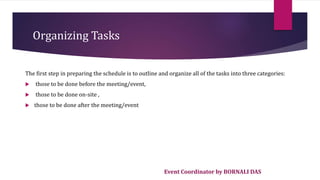
Organizing Tasks
The first step in preparing the schedule is to outline and organize all of the tasks into three categories:
 those to be done before the meeting/event,
 those to be done on-site ,
 those to be done after the meeting/event
Event Coordinator by BORNALI DAS
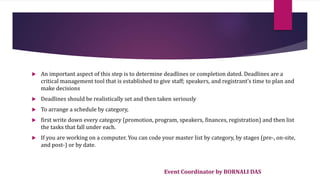
 An important aspect of this step is to determine deadlines or completion dated. Deadlines are a
critical management tool that is established to give staff; speakers, and registrant’s time to plan and
make decisions
 Deadlines should be realistically set and then taken seriously
 To arrange a schedule by category,
 first write down every category (promotion, program, speakers, finances, registration) and then list
the tasks that fall under each.
 If you are working on a computer. You can code your master list by category, by stages (pre-, on-site,
and post-) or by date.
Event Coordinator by BORNALI DAS
Assigning Responsibility
 It is important to let everyone know about responsibilities and deadlines as early as
possible.
Event Coordinator by BORNALI DAS
Communicating
 Members of the planning team communicate effectively with one another nothing is
worse than working on a project and never quite understanding the logic of the
process.
 Communication means listening, asking questions, and exchanging information; and
the first form of information exchanged should be the planning schedule
Event Coordinator by BORNALI DAS
Using the Schedule Properly
 The value of the planning schedule is minimized if you do not use it on a daily basis.
 Keep a record of your progress by noting the date when each task is completed.
 One person is behind on a daily basis but meets the ultimate deadline, or that your
deadlines are unrealistic.
Event Coordinator by BORNALI DAS
THE BUDGET
 Financial decisions affect every area of the meeting or event and must be established early in the
process and monitored on a regular basis.
 The importance of having all the planning issues covered is that, by anticipating problems, special
needs, and hidden costs.
Event Coordinator by BORNALI DAS
OVERALL PLANNING TIPS
CHECKLISTS
 Meeting/event coordinators have checklists for everything imaginable.
 There are site selection checklists, food and beverage checklists, and budget
preparation checklists.
 Expositions checklists and registration checklists
Event Coordinator by BORNALI DAS
PROGRAM DESIGN
 The program is, without question, the vital ingredient of any meeting or event. Oddly, it's
the area coordinators most willingly relinquish control of to others. We leave it in the
hands of technical experts, chief executive officers, committees, or whoever else happens
to be around and willing to tackle the task.
 Program design is the most challenging part of meeting/event coordination, and it is a
golden opportunity for meeting/event coordinators to move out of support roles into
management.
 High-salary professional meeting/event coordinators spend their time on the program
and finances, hiring assistants to handle the details.
Event Coordinator by BORNALI DAS
GETTING IT ALL TOGETHER
 It encompasses all of the activities planned for the attendees, from the moment they arrive
until they depart.
 It includes the content, recreation, meal functions, receptions and parties, tours, expositions,
spouse and children's programs, and informal and unscheduled (free) time.
Event Coordinator by BORNALI DAS
PURPOSE OF THE MEETING OR EVENT
 The first step is to prepare a statement on the purpose of the meeting/event. Identify whether
your objective is to educate, to inform, to solve problems, to reward, to introduce new products
or services, to generate revenue, or whatever.
 THE AUDIENCE
 That brings us to why the attendees will sign up in the first place. Their needs and expectations
should not be overlooked.
 The sponsoring group is often so concerned about the organization's need being met that it
forgets about the attendees.
 The event coordinator should play a strong role in monitoring the program plans to see that the
attendees are not forgotten.
Event Coordinator by BORNALI DAS
SELECTING TOPICS FORMATS. AND SPEAKERS OR PARTICIPANTS
 Prepare a master list of topics or activities that are required for your particular event
and list educational topics important to your group.
 Once your list of topics is complete, you can begin the task of assigning a format to
each topic.
 Some may be debates; others may be group discussions, still others, lectures/papers.
 Finally, there is the challenging task of finding the right person to successfully
implement the selected format.
Event Coordinator by BORNALI DAS
TIME ALLOTMENT
 In addition determining what time of year the meeting/event will be held and how many
days it will run, time allotment means establishing time allowances for each topic and
presenter.
 To do this, you must rough out a program agenda showing the activity, the format, the
amount of time allotted, the sequence (daily), and the topic,
Event Coordinator by BORNALI DAS
BUDGET
 Prepare a budget listing all program costs, including meeting-room rental, attendees'
materials, speakers' fees and expenses
Event Coordinator by BORNALI DAS
PROGRAM DESIGN-TIPS
 In designing a successful program, the coordinator must consider the environment,
mood, tone, and atmosphere of the meeting/event; the format of the sessions; the
time allotted to each topic and segment; and the sequence of events.
Event Coordinator by BORNALI DAS
HOW TO ENGAGE AUDIENCE?
 The meeting/event coordinator's role is to work with the content experts, think through these
ideas, and build a valuable experience for the attendees. The bottom line is that if nobody has
listened, it really doesn't matter what has been covered.
Attention spans
 Most people do not stay "tuned in" for more than twenty minutes. Your attendees mentally check
in and out regularly, and if you don't have a varied, fast-paced program, they will probably check
out for good.
 Most programs have a parade of speakers, each for thirty, forty-five, or even sixty minutes. You
had better have a dynamic speaker and a fascinating topic if you allow that sitting from 9.00 A.M.
to 5.00 P. M. with fifteen-minute breaks and a luncheon speaker is deadly
Event Coordinator by BORNALI DAS
 Most television news programs don't let the same person talk for more than one
minute at a time.
 Television producers keep things moving because they know people's attention
spans are short and they don't want to risk losing their audience.
 Meeting/event coordinators are show producers, and while they may not be
competing with television, they can learn a lot form what television programs do to
maintain attention.
Event Coordinator by BORNALI DAS
Retention Levels
 The retention level has to do with memory.
 Retention increases when information is focused on current problems or new projects.
 When only written words, figures, or illustrations are utilized, retention increases to 20 percent.
 But by combining what is heard with what is seen, you can double the retention rate.
 For program design, that means adding audiovisuals, dramatizations, or some other visual
reinforcement.
 Remember, the more senses you utilize the higher the level of retention.
 The studies have already been done; we just need to read them and incorporate the information into
our body of knowledge about meeting and event planning
Event Coordinator by BORNALI DAS
MATERIALS
 There is no way attendees can absorb all the information presented at a meeting, not should
they have to.
 The materials prepared by your organization or presenters should be the referral source for
referencing ideas and facts.
 The company introducing a new product is going to "sell" the product in the presentation and
provide the technical specs in a handout.
 As a event coordinator, EC should develop materials supportive of the overall communication
goal of the sponsor whether it's a corporation, an association, or a government agency-
measured against the audience's need to know or interest in the subject.
 Materials range from sales brochures to technical papers to long and detailed proceedings,
 In addition to the presentation-related materials, general conference materials must be
prepared, such as the on-site program book, a guidebook to the exposition, and promotional
materials on your organization or products
Event Coordinator by BORNALI DAS
 Evaluate your materials for visual appeal; don't just fill a packet with
volumes of copied paper.
 Consistent or complementary colors, a border, an attractive typeface, and an
easy-to-read format all encourage the reader to use the materials.
Event Coordinator by BORNALI DAS
FORMATS
 Formats refer to the types of presentations your program includes panels, debates, workshops, lectures,
and so on.
 There are several ways this information can be presented, with the first and most common being the
lecture.
 Your lobbyist, legislator, or other experts can give a speech, or you can have a panel of several experts
(which usually results in three speeches instead of one).
 You can make the panel more interesting and fast paced if you hire a professional interviewer and use a
talk-show format.
 You might also consider using several small groups; such a format would allow the attendees to talk
directly to the expert(s).
 Those are four ways to present the information, and many others are equally worthy of consideration.
Just remember, offering too many sessions in the same format is boring and ineffective.
Event Coordinator by BORNALI DAS
Be creative
 Arrange tables and chairs in a circle or semi-circle and have the presenter in the center. This is
very effective if the audience is to be interviewed. Get rid of head tables and set the stage as a
living room.
 Better yet, if your budget permits, order sofas and living-room chairs for the audience, or set
up counters with bar stools, or get beanbag chairs and serve beer!
 Make format decisions based on what you want to accomplish.
 The format has as much to do with the success of an event as the content does, Effective
formats take time and a lot of work with speakers and other program participants-even for the
lecture format, speakers need guidance-but it's well worth the effort.
Event Coordinator by BORNALI DAS
TIME ALLOWANCES
There are countless opportunities for a program to get off schedule, and it's almost impossible to
catch up. The primary reason for time overruns are inaccurate estimates on how long it takes to do
certain things.
Just moving 100 people out a room takes several minutes, and getting them back in takes even
longer.
Whether for breaks, luncheons, movement from general session to breakouts, or resetting of rooms,
schedule a realistic amount of time. If the program begins at 9.00 AM., allow a few "hidden" minutes
on your agenda if you anticipate starting a little late.
Enforce speakers' time limits- Nothing frustrates the attendees more than a program running late
and eating into their breaks and other informal time.
Generally, programs which are over schedules and leave the attendee tired and frustrated rather than
receptive and stimulated. Again, to keep the attendee in mind and to remember that a well-run
meeting/event includes maintaining the Program schedule.
Event Coordinator by BORNALI DAS
 Program design and speaker management are two of the most difficult areas for the
meeting/event coordinator because they are normally handled by upper
management or within a specialized department of the organization.
 As event coordinator, you are responsible for selecting speakers.
 EC has to offer suggestions, help upper managers write and communicate their ideas
to program participants, recommend policies and procedures, or follow up after
invitations have been extended or accepted.
SPEAKERS AND OTHER PROGRAM
PARTICIPANTS
Event Coordinator by BORNALI DAS
GETTING IT ALL TOGETHER
WHO ARE THE PEOPLE ON THE PROGRAM?
 A program requires a variety of types of people-speakers, moderators, interviewers, workshop
leaders, trainers, discussion leaders, panelists, expert witnesses, summarizers.
 eliminating use of the word "speaker" for every warm body on the program and use "program
participants." instead
 Attendees, are also often called participants.
 Successful professional speakers learn very quickly that reading a speech is not good for business.
 They talk to their audience; they usually move off the stage, walk around, and look the audience
squarely in the eye.
Event Coordinator by BORNALI DAS
 Successful professional speakers learn very quickly that reading a speech is not good
for business.
 They talk to their audience; they usually move off the stage, walk around, and look
the audience squarely in the eye.
 Wireless microphones encourage movement. These speakers are often looked upon
as entertainers, and there is nothing wrong with speakers being entertainers.
 In fact, the problem arises when a speaker is not entertaining.
Event Coordinator by BORNALI DAS
 Event coordinators must be more selective, more demanding, and more detailed with
speakers. We have got to learn how to bring out the best in poor speakers who may happen to
be the recognized expert in a field.
 As the competition to attract attendees grows, attendees are becoming more selective about
where they spend their budgeted meeting/event money.
 Programs with high-quality, knowledgeable speakers, a variety of types of program
participants, and focused and varied presentations will capture the market
 The management of program participants is one of the most challenging.
 Both the coordinator and the presenters need to reevaluate the importance of the
participants' role.
Event Coordinator by BORNALI DAS
LOCATING PEOPLE
 Thinking about program participants actually begins in the program design phase, because
this is where you decide what you plant to communicate and how you will do it
 As you select a topic and a format, you must ask if you can locate or recruit qualified people at
a price you can afford.
CLARIFYING ROLES
Write a description-a short paragraph-explaining exactly what is expected of each program
participant
Event Coordinator by BORNALI DAS
DEVELOPING CONTENT GUIDELINES
 The next step is to develop a written list of points or questions you would like to have included in
the speech, discussion, or workshop.
 Then communicate these points to your program participants in writing, through briefing
meetings, or in reviews of their plans.
Event Coordinator by BORNALI DAS
PROGRAM PARTICIPANT TIPS
REFERENCE CHECKS
 A good speakers' bureau will help you in identifying groups that have utilized an individual's
services.
 People at the bureau will be honest because they don't want you to be dissatisfied with their
service
 In addition to performance abilities, consider the person's technical background, political
orientation, or religious philosophy if those would be important to be group.
Event Coordinator by BORNALI DAS
SPEAKER REQUIREMENT FORMS
 Good forms do two things for the meeting/event coordinator.
 They act as checklists or reminders so you won't forget critical information, and they provide an
organized system for collecting and easily retrieving that information.
 Forms are also a quick and easy way to put things in writing
Event Coordinator by BORNALI DAS
SPEAKER'S INTRODUCTION
 The most organized way to handle bios is to establish a written format that includes the
required information for each presenter.
 This may include the prospective speaker's years of experience in the field; educational,
licensing, or certification credentials, id important to your group; accomplishments in areas
directly related to the presentation; and related employment.
 For a high-tech event. You add a photo on a big screen and a professional reader can
prerecord the introductory information. In any case, the introduction should be short and to
the point, with the more detailed information in the program book, if required.
Event Coordinator by BORNALI DAS
FEES AND HONORARIUMS
Fees are what a speaker or participant usually charges, and varies from a token amount Rs.25, 000
and up for top speakers with immediate name recognition.
Honorariums, which are offered by the sponsoring organization don't like to mention fees or
reimbursements if none are provided; it really is best to clarify the arrangement in writing.
Event Coordinator by BORNALI DAS
To avoid embarrassment and confusion, have your controls prepared and clearly
communicate your policies and procedures to participants in advance.
If you don't say that you reimburse coach class and a speaker flies first class, you may have
to pay the first class fare or risk offending a valued program participant.
Areas to think about in addition to transportation and lodging are;
 Shuttles versus taxis
 Meal allocations
 Local versus long-distance telephone calls
 Laundry and dry cleaning
 Personal items
 Conference versus non-conference meals
EXPENSE REIMBURSEMENT
Event Coordinator by BORNALI DAS
TRAVEL ARRANGEMENTS
It is useful to have a speaker request form on which participants can indicate when they
will arrive and depart, whether they need transportation to and from the airport, and
what their hotel reservation preferences are.
THINK THOUGHTFUL
 It takes only a moment more to be thoughtful and is well worth the time to have your program
participants feel appreciated.
 A confirmation letter and general information sheet are two basics.
 Other touches include airport pickup; a welcome note; wine, fruit, candy, cookies, or flowers in their
room when they arrive.
 Pre-register speakers and have their badges and materials waiting in their rooms
 The key is to be thoughtful and appreciative.
 Certainly a speedy thank you note and prompt reimbursement of expenses is the final consideration
in this area.
Event Coordinator by BORNALI DAS

Event coordination -1

  • 1.
  • 2.
  • 3.
    Event Coordinator byBORNALI DAS Definition of Event Coordinator Event coordinators are hired to develop, plan, coordinate and complete functions within business organizations. Job Requirements Coordinating special events requires skills in overseeing, planning, coordinating, executing, and overseeing the day-to-day operations of events, whether social, educational, internal or external. The event coordinator must follow financial constraints and adhere to guest requests and schedules. INTRODUCTION
  • 4.
    Event Coordinator byBORNALI DAS INTRODUCTION Why an Event Coordinator? Event coordinators offer experience and expertise in an ever-changing industry. They are familiar with event budgets, catering, décor, facility rentals and space requirements.
  • 5.
    Event Coordinator byBORNALI DAS What Does an Event Coordinator Do?  Event coordinators plan and execute a variety of events, such as conventions, meetings, concerts, parties and weddings.  There are companies that specialize in event management, but a coordinator might also work for a venue, for an industry group or as an independent contractor.  Event coordinators are responsible for meeting with clients to determine their desires and expectations for an event, and then overseeing its planning and implementation.  This includes choosing venues, setting the date, estimating the cost, reviewing bills, scheduling event services and monitoring client satisfaction.  They also work with multiple vendors and staff members to ensure the success of an event.
  • 6.
    Event Coordinator byBORNALI DAS What skills do you need?  Your negotiation skills should be rock solid to lock in the best possible prices with clients and vendors.  Good communication skills are also a must.  You can’t manage relationships with clients and vendors without them.  Being detail oriented and deadline driven is also important.  And you have to have stamina, who logged plenty of night and weekend hours after putting in a full day at the office.  You don’t always get to quit at quitting time in this line of work.
  • 7.
    Event Coordinator byBORNALI DAS Who is an event coordinator’s boss?  An event coordinator may report to a director of events, but it largely depends on the way a company is structured.  At some companies, an event coordinator assists or reports to an event manager. At others, responsibilities mirror those of event managers.
  • 8.
    Event Coordinator byBORNALI DAS OVERALL PLANNING STRUCTURE GETTING IT ALL TOGETHER Making a system for reliable and effective co-ordination ANALYZING THE MEETING OR EVENT The planning process begins with an analysis of the meeting/event itself. The questions that begin this process are:  why are we having this meeting/event?  What do we hope to accomplish?  Who will attend?  Why will they attend?  What will they hope to accomplish?  How will it be financed?
  • 9.
    Event Coordinator byBORNALI DAS ASSEMBLING YOUR TEAM  The next important stage of the planning process is assembling your team.  Broadly speaking, the team should consist of decision makers and implementers.  Decision makers are the people who define the parameters and are ultimately responsible for the success or failure of the meeting/event.  Implementers are those who do everything from negotiating contracts to inviting speakers to making sure that the right speaker is in the right room and that the microphone works.
  • 10.
    Event Coordinator byBORNALI DAS Event Coordinator The planner is the central coordinator and does the following:  negotiates and recommends contracts for signature;  solicits bids from suppliers and hires and supervises suppliers;  prepares and recommends budgets and monitors expenses throughout the planning process;  establishes the planning schedule, sets deadlines, and monitors progress;  recommends policies and procedures, supervises registration, maintains communications;  sets up filing systems for controlling documents and reports; prepares personnel schedules for on-site activities.
  • 11.
    Event Coordinator byBORNALI DAS Decision makers  Decision makers may include the organization's president, CEO, executive director, chairman of the board, corporate officer, and certain department heads. FUNCTIONS:-  They approve the concept of conducting the meeting/event, the budget, and all policies;  they sign all contracts, accept legal and statutory with the organization's public image;  they are legally responsible for payment of all bills, fees, deposits essentially all policy, legal, and financial issues.
  • 12.
    Event Coordinator byBORNALI DAS Technical Staff  Various tasks requiring technical expertise may be assigned to in-house personnel or to subcontractors. The following list identifies key specialists and briefly describes their responsibilities-  Issue, program and product specialists; recommend program topics and speakers.  Marketing and graphics specialists: Design graphics and write copy for promotional pieces; coordinate printing; identify and generate customer and other industry-related functions; provide mailing lists.  Accounting department specialists: Develop accounting systems.  Public relations and media department specialists: Coordinate high-tech presentations; handle press relations; prepare and distribute press releases.
  • 13.
    Event Coordinator byBORNALI DAS Data processing department specialists: Assist with selection of computer equipment and meeting/event software packages or programming. Legal department specialists: Review contracts, agreements, and liability risks. Training and personnel department specialists; Prepare training materials for on-site personnel (paid and voluntary) and conduct training sessions. Administrative department specialists: Evaluate and recommend insurance coverage and risk, management procedures
  • 14.
    Event Coordinator byBORNALI DAS DEVELOPING RECORD-KEEPING SYSTEMS  Often, the meeting/event planer becomes the central coordinator of all information. Therefore, record-keeping systems are essential to organize, control, and monitor activities.  need financial record-keeping systems;  invitation and registration record keeping system;  for tracking the confirmation of speakers,  their place on the agenda,  the meeting room share they are speaking,  and the costs of their participation.
  • 15.
    Event Coordinator byBORNALI DAS ESTABLISHING POLICIES AND PROCEDURES  Another important planning issue has to do with establishing policies and procedures in the early stage.  The key to effective management is deciding the rules up front and advising the people they affect;.  Simple things- such as registration cutoff dates, administrative penalties for cancellation, payment and reimbursement procedures for speakers, to name a few-need to be established and communicated or meeting/event coordinators will find themselves continually answering the same questions and mediating disputes.
  • 16.
    Event Coordinator byBORNALI DAS PREPARING A PLANNING SCHEDULE  A successful event coordinator must have many attributes, but two important characteristics are good organizational skills and attention to detail.  The planning schedule is a detailed list of all required tasks and steps, the required completion dated, and the person, department, or committee responsible for each.  It should be prepared by the event coordinator.
  • 17.
    Event Coordinator byBORNALI DAS Organizing Tasks The first step in preparing the schedule is to outline and organize all of the tasks into three categories:  those to be done before the meeting/event,  those to be done on-site ,  those to be done after the meeting/event
  • 18.
    Event Coordinator byBORNALI DAS  An important aspect of this step is to determine deadlines or completion dated. Deadlines are a critical management tool that is established to give staff; speakers, and registrant’s time to plan and make decisions  Deadlines should be realistically set and then taken seriously  To arrange a schedule by category,  first write down every category (promotion, program, speakers, finances, registration) and then list the tasks that fall under each.  If you are working on a computer. You can code your master list by category, by stages (pre-, on-site, and post-) or by date.
  • 19.
    Event Coordinator byBORNALI DAS Assigning Responsibility  It is important to let everyone know about responsibilities and deadlines as early as possible.
  • 20.
    Event Coordinator byBORNALI DAS Communicating  Members of the planning team communicate effectively with one another nothing is worse than working on a project and never quite understanding the logic of the process.  Communication means listening, asking questions, and exchanging information; and the first form of information exchanged should be the planning schedule
  • 21.
    Event Coordinator byBORNALI DAS Using the Schedule Properly  The value of the planning schedule is minimized if you do not use it on a daily basis.  Keep a record of your progress by noting the date when each task is completed.  One person is behind on a daily basis but meets the ultimate deadline, or that your deadlines are unrealistic.
  • 22.
    Event Coordinator byBORNALI DAS THE BUDGET  Financial decisions affect every area of the meeting or event and must be established early in the process and monitored on a regular basis.  The importance of having all the planning issues covered is that, by anticipating problems, special needs, and hidden costs.
  • 23.
    Event Coordinator byBORNALI DAS OVERALL PLANNING TIPS CHECKLISTS  Meeting/event coordinators have checklists for everything imaginable.  There are site selection checklists, food and beverage checklists, and budget preparation checklists.  Expositions checklists and registration checklists
  • 24.
    Event Coordinator byBORNALI DAS PROGRAM DESIGN  The program is, without question, the vital ingredient of any meeting or event. Oddly, it's the area coordinators most willingly relinquish control of to others. We leave it in the hands of technical experts, chief executive officers, committees, or whoever else happens to be around and willing to tackle the task.  Program design is the most challenging part of meeting/event coordination, and it is a golden opportunity for meeting/event coordinators to move out of support roles into management.  High-salary professional meeting/event coordinators spend their time on the program and finances, hiring assistants to handle the details.
  • 25.
    Event Coordinator byBORNALI DAS GETTING IT ALL TOGETHER  It encompasses all of the activities planned for the attendees, from the moment they arrive until they depart.  It includes the content, recreation, meal functions, receptions and parties, tours, expositions, spouse and children's programs, and informal and unscheduled (free) time.
  • 26.
    Event Coordinator byBORNALI DAS PURPOSE OF THE MEETING OR EVENT  The first step is to prepare a statement on the purpose of the meeting/event. Identify whether your objective is to educate, to inform, to solve problems, to reward, to introduce new products or services, to generate revenue, or whatever.  THE AUDIENCE  That brings us to why the attendees will sign up in the first place. Their needs and expectations should not be overlooked.  The sponsoring group is often so concerned about the organization's need being met that it forgets about the attendees.  The event coordinator should play a strong role in monitoring the program plans to see that the attendees are not forgotten.
  • 27.
    Event Coordinator byBORNALI DAS SELECTING TOPICS FORMATS. AND SPEAKERS OR PARTICIPANTS  Prepare a master list of topics or activities that are required for your particular event and list educational topics important to your group.  Once your list of topics is complete, you can begin the task of assigning a format to each topic.  Some may be debates; others may be group discussions, still others, lectures/papers.  Finally, there is the challenging task of finding the right person to successfully implement the selected format.
  • 28.
    Event Coordinator byBORNALI DAS TIME ALLOTMENT  In addition determining what time of year the meeting/event will be held and how many days it will run, time allotment means establishing time allowances for each topic and presenter.  To do this, you must rough out a program agenda showing the activity, the format, the amount of time allotted, the sequence (daily), and the topic,
  • 29.
    Event Coordinator byBORNALI DAS BUDGET  Prepare a budget listing all program costs, including meeting-room rental, attendees' materials, speakers' fees and expenses
  • 30.
    Event Coordinator byBORNALI DAS PROGRAM DESIGN-TIPS  In designing a successful program, the coordinator must consider the environment, mood, tone, and atmosphere of the meeting/event; the format of the sessions; the time allotted to each topic and segment; and the sequence of events.
  • 31.
    Event Coordinator byBORNALI DAS HOW TO ENGAGE AUDIENCE?  The meeting/event coordinator's role is to work with the content experts, think through these ideas, and build a valuable experience for the attendees. The bottom line is that if nobody has listened, it really doesn't matter what has been covered. Attention spans  Most people do not stay "tuned in" for more than twenty minutes. Your attendees mentally check in and out regularly, and if you don't have a varied, fast-paced program, they will probably check out for good.  Most programs have a parade of speakers, each for thirty, forty-five, or even sixty minutes. You had better have a dynamic speaker and a fascinating topic if you allow that sitting from 9.00 A.M. to 5.00 P. M. with fifteen-minute breaks and a luncheon speaker is deadly
  • 32.
    Event Coordinator byBORNALI DAS  Most television news programs don't let the same person talk for more than one minute at a time.  Television producers keep things moving because they know people's attention spans are short and they don't want to risk losing their audience.  Meeting/event coordinators are show producers, and while they may not be competing with television, they can learn a lot form what television programs do to maintain attention.
  • 33.
    Event Coordinator byBORNALI DAS Retention Levels  The retention level has to do with memory.  Retention increases when information is focused on current problems or new projects.  When only written words, figures, or illustrations are utilized, retention increases to 20 percent.  But by combining what is heard with what is seen, you can double the retention rate.  For program design, that means adding audiovisuals, dramatizations, or some other visual reinforcement.  Remember, the more senses you utilize the higher the level of retention.  The studies have already been done; we just need to read them and incorporate the information into our body of knowledge about meeting and event planning
  • 34.
    Event Coordinator byBORNALI DAS MATERIALS  There is no way attendees can absorb all the information presented at a meeting, not should they have to.  The materials prepared by your organization or presenters should be the referral source for referencing ideas and facts.  The company introducing a new product is going to "sell" the product in the presentation and provide the technical specs in a handout.  As a event coordinator, EC should develop materials supportive of the overall communication goal of the sponsor whether it's a corporation, an association, or a government agency- measured against the audience's need to know or interest in the subject.  Materials range from sales brochures to technical papers to long and detailed proceedings,  In addition to the presentation-related materials, general conference materials must be prepared, such as the on-site program book, a guidebook to the exposition, and promotional materials on your organization or products
  • 35.
    Event Coordinator byBORNALI DAS  Evaluate your materials for visual appeal; don't just fill a packet with volumes of copied paper.  Consistent or complementary colors, a border, an attractive typeface, and an easy-to-read format all encourage the reader to use the materials.
  • 36.
    Event Coordinator byBORNALI DAS FORMATS  Formats refer to the types of presentations your program includes panels, debates, workshops, lectures, and so on.  There are several ways this information can be presented, with the first and most common being the lecture.  Your lobbyist, legislator, or other experts can give a speech, or you can have a panel of several experts (which usually results in three speeches instead of one).  You can make the panel more interesting and fast paced if you hire a professional interviewer and use a talk-show format.  You might also consider using several small groups; such a format would allow the attendees to talk directly to the expert(s).  Those are four ways to present the information, and many others are equally worthy of consideration. Just remember, offering too many sessions in the same format is boring and ineffective.
  • 37.
    Event Coordinator byBORNALI DAS Be creative  Arrange tables and chairs in a circle or semi-circle and have the presenter in the center. This is very effective if the audience is to be interviewed. Get rid of head tables and set the stage as a living room.  Better yet, if your budget permits, order sofas and living-room chairs for the audience, or set up counters with bar stools, or get beanbag chairs and serve beer!  Make format decisions based on what you want to accomplish.  The format has as much to do with the success of an event as the content does, Effective formats take time and a lot of work with speakers and other program participants-even for the lecture format, speakers need guidance-but it's well worth the effort.
  • 38.
    Event Coordinator byBORNALI DAS TIME ALLOWANCES There are countless opportunities for a program to get off schedule, and it's almost impossible to catch up. The primary reason for time overruns are inaccurate estimates on how long it takes to do certain things. Just moving 100 people out a room takes several minutes, and getting them back in takes even longer. Whether for breaks, luncheons, movement from general session to breakouts, or resetting of rooms, schedule a realistic amount of time. If the program begins at 9.00 AM., allow a few "hidden" minutes on your agenda if you anticipate starting a little late. Enforce speakers' time limits- Nothing frustrates the attendees more than a program running late and eating into their breaks and other informal time. Generally, programs which are over schedules and leave the attendee tired and frustrated rather than receptive and stimulated. Again, to keep the attendee in mind and to remember that a well-run meeting/event includes maintaining the Program schedule.
  • 39.
    Event Coordinator byBORNALI DAS  Program design and speaker management are two of the most difficult areas for the meeting/event coordinator because they are normally handled by upper management or within a specialized department of the organization.  As event coordinator, you are responsible for selecting speakers.  EC has to offer suggestions, help upper managers write and communicate their ideas to program participants, recommend policies and procedures, or follow up after invitations have been extended or accepted. SPEAKERS AND OTHER PROGRAM PARTICIPANTS
  • 40.
    Event Coordinator byBORNALI DAS GETTING IT ALL TOGETHER WHO ARE THE PEOPLE ON THE PROGRAM?  A program requires a variety of types of people-speakers, moderators, interviewers, workshop leaders, trainers, discussion leaders, panelists, expert witnesses, summarizers.  eliminating use of the word "speaker" for every warm body on the program and use "program participants." instead  Attendees, are also often called participants.  Successful professional speakers learn very quickly that reading a speech is not good for business.  They talk to their audience; they usually move off the stage, walk around, and look the audience squarely in the eye.
  • 41.
    Event Coordinator byBORNALI DAS  Successful professional speakers learn very quickly that reading a speech is not good for business.  They talk to their audience; they usually move off the stage, walk around, and look the audience squarely in the eye.  Wireless microphones encourage movement. These speakers are often looked upon as entertainers, and there is nothing wrong with speakers being entertainers.  In fact, the problem arises when a speaker is not entertaining.
  • 42.
    Event Coordinator byBORNALI DAS  Event coordinators must be more selective, more demanding, and more detailed with speakers. We have got to learn how to bring out the best in poor speakers who may happen to be the recognized expert in a field.  As the competition to attract attendees grows, attendees are becoming more selective about where they spend their budgeted meeting/event money.  Programs with high-quality, knowledgeable speakers, a variety of types of program participants, and focused and varied presentations will capture the market  The management of program participants is one of the most challenging.  Both the coordinator and the presenters need to reevaluate the importance of the participants' role.
  • 43.
    Event Coordinator byBORNALI DAS LOCATING PEOPLE  Thinking about program participants actually begins in the program design phase, because this is where you decide what you plant to communicate and how you will do it  As you select a topic and a format, you must ask if you can locate or recruit qualified people at a price you can afford. CLARIFYING ROLES Write a description-a short paragraph-explaining exactly what is expected of each program participant
  • 44.
    Event Coordinator byBORNALI DAS DEVELOPING CONTENT GUIDELINES  The next step is to develop a written list of points or questions you would like to have included in the speech, discussion, or workshop.  Then communicate these points to your program participants in writing, through briefing meetings, or in reviews of their plans.
  • 45.
    Event Coordinator byBORNALI DAS PROGRAM PARTICIPANT TIPS REFERENCE CHECKS  A good speakers' bureau will help you in identifying groups that have utilized an individual's services.  People at the bureau will be honest because they don't want you to be dissatisfied with their service  In addition to performance abilities, consider the person's technical background, political orientation, or religious philosophy if those would be important to be group.
  • 46.
    Event Coordinator byBORNALI DAS SPEAKER REQUIREMENT FORMS  Good forms do two things for the meeting/event coordinator.  They act as checklists or reminders so you won't forget critical information, and they provide an organized system for collecting and easily retrieving that information.  Forms are also a quick and easy way to put things in writing
  • 47.
    Event Coordinator byBORNALI DAS SPEAKER'S INTRODUCTION  The most organized way to handle bios is to establish a written format that includes the required information for each presenter.  This may include the prospective speaker's years of experience in the field; educational, licensing, or certification credentials, id important to your group; accomplishments in areas directly related to the presentation; and related employment.  For a high-tech event. You add a photo on a big screen and a professional reader can prerecord the introductory information. In any case, the introduction should be short and to the point, with the more detailed information in the program book, if required.
  • 48.
    Event Coordinator byBORNALI DAS FEES AND HONORARIUMS Fees are what a speaker or participant usually charges, and varies from a token amount Rs.25, 000 and up for top speakers with immediate name recognition. Honorariums, which are offered by the sponsoring organization don't like to mention fees or reimbursements if none are provided; it really is best to clarify the arrangement in writing.
  • 49.
    Event Coordinator byBORNALI DAS To avoid embarrassment and confusion, have your controls prepared and clearly communicate your policies and procedures to participants in advance. If you don't say that you reimburse coach class and a speaker flies first class, you may have to pay the first class fare or risk offending a valued program participant. Areas to think about in addition to transportation and lodging are;  Shuttles versus taxis  Meal allocations  Local versus long-distance telephone calls  Laundry and dry cleaning  Personal items  Conference versus non-conference meals EXPENSE REIMBURSEMENT
  • 50.
    Event Coordinator byBORNALI DAS TRAVEL ARRANGEMENTS It is useful to have a speaker request form on which participants can indicate when they will arrive and depart, whether they need transportation to and from the airport, and what their hotel reservation preferences are. THINK THOUGHTFUL  It takes only a moment more to be thoughtful and is well worth the time to have your program participants feel appreciated.  A confirmation letter and general information sheet are two basics.  Other touches include airport pickup; a welcome note; wine, fruit, candy, cookies, or flowers in their room when they arrive.  Pre-register speakers and have their badges and materials waiting in their rooms  The key is to be thoughtful and appreciative.  Certainly a speedy thank you note and prompt reimbursement of expenses is the final consideration in this area.
  • 51.