

Chapter 2 Managing Events
Section 2 Operations (How to get Started?)
Prepared By: AY Clores, HRTM 195
Instructor
1
Introd
uctio
n
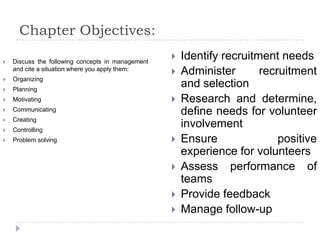
There are no ‘off the peg’
organizational
structures that can be employed to
deliver
events. Each event is as individual
as the
objectives it aims to achieve – and
the
people that deliver it.
Chapter Objectives:
 Discuss the following concepts in management
and cite a situation where you apply them:
 Organizing
 Planning
 Motivating
 Communicating
 Creating
 Controlling
 Problem solving
 Identify recruitment needs
 Administer recruitment
and selection
 Research and determine,
define needs for volunteer
involvement
 Ensure positive
experience for volunteers
 Assess performance of
teams
 Provide feedback
 Manage follow-up
WINTERTemplate
People
involved in
organizing
an event
The following people involved in supporting event:-
Organizers
Sponsors
Partners
Clients
Supporting agencies
These people can either be an individual or a company .they either finances
the whole event or some of its part or provide some service at subsidized rate or
for free.
Organizers
An organizers finances maximum amt. of money in event. Therefore he has
maximum control over the event.
Sponsors
similarly, depending on the type of service financed sponsor can be a venue
sponsor ,gift sponsor, crown & jewellery sponsor, catering sponsor, banner
sponsor etc.
Partners
they generally provide services either at subsidized rates or for free like
media partners(which provide ad space), promotional partners(which do
publicity),logistic partners (which moves goods from one destination to other in
the most efficient manner)
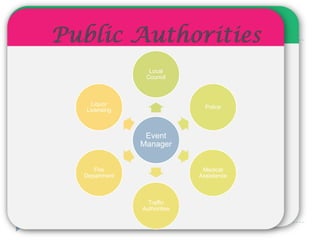
Event
Manager
Local
Council
Police
Medical
Assistance
Traffic
Authorities
Fire
Department
Liquor
Licensing
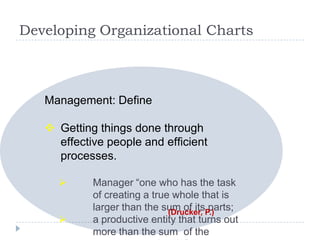
Developing Organizational Charts
Management: Define
 Getting things done through
effective people and efficient
processes.
 Manager “one who has the task
of creating a true whole that is
larger than the sum of its parts;
 a productive entity that turns out
more than the sum of the
(Drucker, P.)
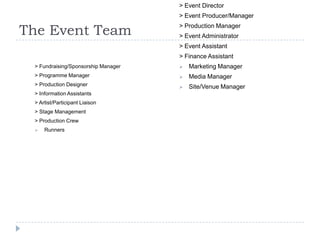
The Event Team
> Fundraising/Sponsorship Manager
> Programme Manager
> Production Designer
> Information Assistants
> Artist/Participant Liaison
> Stage Management
> Production Crew
 Runners
> Event Director
> Event Producer/Manager
> Production Manager
> Event Administrator
> Event Assistant
> Finance Assistant
 Marketing Manager
 Media Manager
 Site/Venue Manager
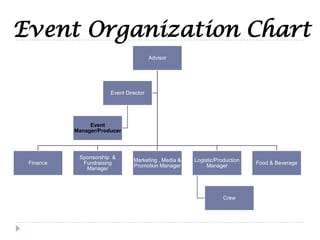
Event Organization Chart
Advisor
Finance
Sponsorship &
Fundraising
Manager
Marketing , Media &
Promotion Manager
Logistic/Production
Manager
Crew
Food & Beverage
Event Director
Event
Manager/Producer
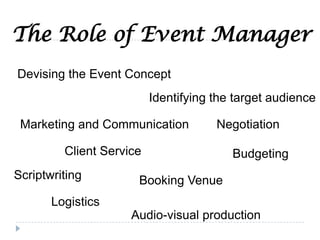
The Role of Event Manager
Client Service
Marketing and Communication
Devising the Event Concept
Audio-visual production
Scriptwriting
Logistics
Budgeting
Negotiation
Booking Venue
Identifying the target audience
Staffing for Event
Event managers
and their
teams are
often behind-
the-scenes
running the
event.
 Event coordinator :-
 responsible for coordinating
with all event professional &
ensure business operation are
efficient and effective .
 Information manager :-
 He has following responsibilities
:-
 a) He manages the
information acquired through
different sources.
 b) he is responsible for the
documentation of all business
operation carried out pre event
,at event & post event.
 c) he maintain data base of
service providers, delegates,
guests, organizers, clients
,sponsors, target audience
,media people & various govt.
officials
23
4) Logistic manager:-
He has following responsibility:
a) responsible for custom clearances and other clearance.
b) responsible for warehousing of cargo
c) cargo insurance
d) he is expected to move goods & merchandise from one
destination to the other in most efficient manager.
e) he is responsible for procurement management and
resources management
f) he formulates , prepares & implement the risk mgmt plan( risk
related to logistic management like cargo theft etc)
24
5) Infrastructure manager :-
He has following responsibility :-
a) He does procurement management & resource mgmt.
b) He is responsible for setting up & dismantling the infrastructure for
the whole event like :-
• Construction of boundary walls , entrance & exit gates, driveways,
walkways, & parking lots.
• Construction of AC / NON AC hangers / halls , seating arrangement , stage
design / setup etc.
• Construction of green rooms , staff rooms , storage rooms, power rooms
etc.
c) He is responsible for setting up electricity , water & phone
connection.
d) He is responsible for conservancy (i.e. cleanliness)
Prepare staff Policies:
1. Work in a safe manner
2. Do not endanger the health
and safety of others
3. Report all accidents and
incidents.
4. Protect the confidentiality of
the organization and
sponsors
5. Do not say anything
derogatory about any aspect
of, or person involved in, the
event.
6. Refer media questions to the correct person
7. Look after equipment, uniforms, and other assets.
8. Act politely and courteously to spectators and team
members.
9. Use and abuse of alcohol or drugs while on duty is strictly
prohibited.
10. Act in a financially responsible manner
11. Follow reasonable instructions of supervisors and senior
event staff.
Assignment: You have been asked to run a tourism destination promotional
forums. The aims are to raise the profile of your region as a
tourist destination; provide a platform for the public and private
sectors of the local tourism industry to gather, discuss and
address regional tourism issues, and assist in the expansion of
marketing networks and opportunities to promote local tourism
destinations and events.
 The buyers and the sellers business session will enable
delegates to network and conduct business with high-level
government officials and representatives of the national and local
tourism organizations, as well as business entrepreneurs,
hotelier and travel agents/operators, and the media.
 Break-out sessions at which all delegates will be invited to voice
their opinions will aim to generate ideas and solutions. Also on
the discussion table will be the issues such as standards, product
ranges, joint promotional efforts, and marketing opportunities and
Assignment cont…..You are to invite:
 Tourism representatives and tourism information officers
 Investors and financiers seeking new opportunities and business
partners
 Hoteliers, tour operators, ground transport providers and tourism
facility operators
 Transport operators serving the area
 Buyers and tourism suppliers
 Media representatives
You have 2 major tasks:
 DEVELOP: ORGANIZATIONAL CHART
 DEVELOP YOUR OWN JOB DESCRIPTION AS TOURISM
FORUM EVENTS MANAGER
Thank You but…..
Don’t forget your
assignment…..
25
Event planning & role of event
planner
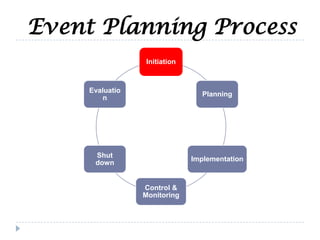
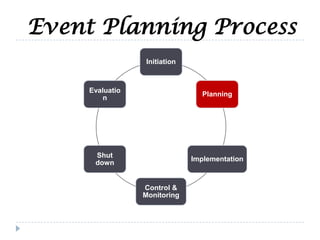
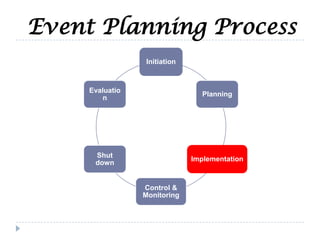
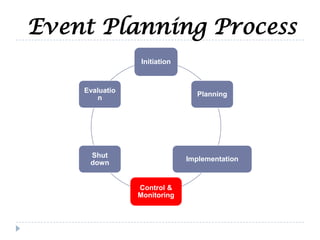
Event Planning Process
Initiation
Planning
Implementation
Control &
Monitoring
Shut
down
Evaluatio
n
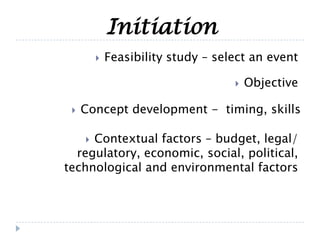
Initiation
 Objective
 Concept development - timing, skills
 Contextual factors – budget, legal/
regulatory, economic, social, political,
technological and environmental factors
 Feasibility study – select an event
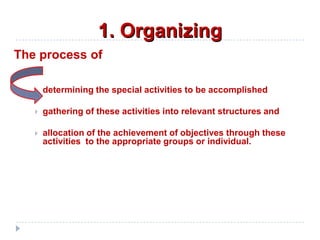
1. Organizing
The process of
 determining the special activities to be accomplished
 gathering of these activities into relevant structures and
 allocation of the achievement of objectives through these
activities to the appropriate groups or individual.
Event Planning Process
Initiation
Planning
Implementation
Control &
Monitoring
Shut
down
Evaluatio
n
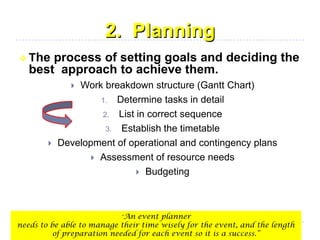
2. Planning
 The process of setting goals and deciding the
best approach to achieve them.
 Work breakdown structure (Gantt Chart)
1. Determine tasks in detail
2. List in correct sequence
3. Establish the timetable
 Development of operational and contingency plans
 Assessment of resource needs
 Budgeting
“An event planner
needs to be able to manage their time wisely for the event, and the length
of preparation needed for each event so it is a success.”
Planning
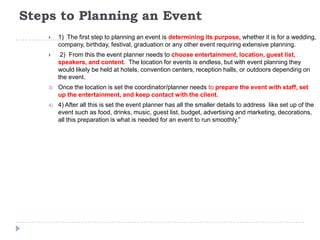
Steps to Planning an Event
 1) The first step to planning an event is determining its purpose, whether it is for a wedding,
company, birthday, festival, graduation or any other event requiring extensive planning.
 2) From this the event planner needs to choose entertainment, location, guest list,
speakers, and content. The location for events is endless, but with event planning they
would likely be held at hotels, convention centers, reception halls, or outdoors depending on
the event.
3) Once the location is set the coordinator/planner needs to prepare the event with staff, set
up the entertainment, and keep contact with the client.
4) 4) After all this is set the event planner has all the smaller details to address like set up of the
event such as food, drinks, music, guest list, budget, advertising and marketing, decorations,
all this preparation is what is needed for an event to run smoothly.”
Event Planning Process
Initiation
Planning
Implementation
Control &
Monitoring
Shut
down
Evaluatio
n
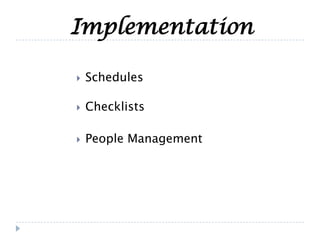
Implementation
 Checklists
 People Management
 Schedules
Event Planning Process
Initiation
Planning
Implementation
Control &
Monitoring
Shut
down
Evaluatio
n
Control & Monitoring
 Tools
 Setting benchmarks/ standards
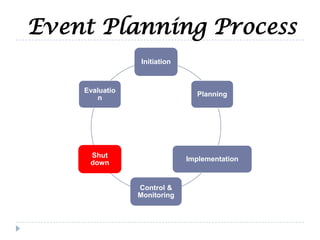
Event Planning Process
Initiation
Planning
Implementation
Control &
Monitoring
Shut
down
Evaluatio
n
Shutdown
 Integration of shutdown into key event tasks
 Key Task
3. Motivating
 In any demanding work situation, it is
important to keep the staff motivated and
interested.
 Events demand an extraordinary commitment from
every individual concerned.
What motivates staff
to do his/her very
best to make the
event successful?
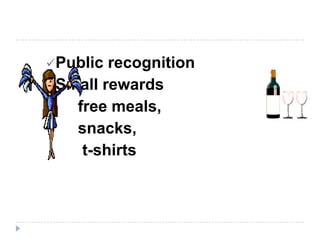
Public recognition
Small rewards
free meals,
snacks,
t-shirts
4. Communicating
 Giving, receiving or exchange of
information so that the material
communicated is completely
understood.
5. Creating
 The ability to produce an original idea or
thought through the use of imagination.
 A good event manager should be equipped with
innovative thinking skills that will help create an
interesting event.
6. Controlling
 Is monitoring the performance of systems and
resources.
 Checks whether what is supposed to happen is
happening or is going to happen.
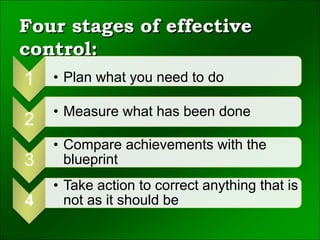
Four stages of effective
control:
1 • Plan what you need to do
2
• Measure what has been done
3
• Compare achievements with the
blueprint
4
• Take action to correct anything that is
not as it should be
 Is important skill for people who
are working on events.
 A positive, innovative thinker is
needed to solve them.
Problem Solving
Other Management
Concepts
 Involves the assessment and
implementation of possible strategies.
In an event it is better to use
democratic decision making and
involve as many people as possible.
It is advisable to use the collective
knowledge of the group in order to
arrive at the correct decision.
Decision Making
 Is the ability of an organized group of
people to work together.
Unity of purpose and cooperation are
necessary to attain success in event
management.
Team Building
 Means giving people something to do
which they are capable of achieving.
Delegation is an important
management activity and is essential
to the success of any event.
Delegation
 Is an interpersonal influence exercised
in situations and
 directed through the communication
process towards the attainment of a
specific goal or goals.
Leadership
 Is an assessment of the
 performance,
 strengths, and
 weaknesses of the
personnel
in order to improve their work
and provide constructive
guidance.
Staff Appraisal and Training
1. Desirable training improves personal
skills such as decision making and
creativity.
2. Essential training make sure that
personnel are aware of legal
requirements such as health and
safety legislation and can perform
word processing and computing tasks.
There are types of training for
event staff:
 Make it clear where the authority,
responsibility and power lie.
 Every individual knows where he/she
stands so that he/she will not be
tempted to underplay or overplay the
role.
 For every decision, someone must
take the responsibility.
Authority, Responsibility
and Power

Events mgt. chapter 2 sy 2013 14.ppt

  • 1.
    Chapter 2 ManagingEvents Section 2 Operations (How to get Started?) Prepared By: AY Clores, HRTM 195 Instructor 1
  • 2.
    Introd uctio n There are no‘off the peg’ organizational structures that can be employed to deliver events. Each event is as individual as the objectives it aims to achieve – and the people that deliver it.
  • 3.
    Chapter Objectives:  Discussthe following concepts in management and cite a situation where you apply them:  Organizing  Planning  Motivating  Communicating  Creating  Controlling  Problem solving  Identify recruitment needs  Administer recruitment and selection  Research and determine, define needs for volunteer involvement  Ensure positive experience for volunteers  Assess performance of teams  Provide feedback  Manage follow-up
  • 4.
  • 6.
    The following peopleinvolved in supporting event:- Organizers Sponsors Partners Clients Supporting agencies These people can either be an individual or a company .they either finances the whole event or some of its part or provide some service at subsidized rate or for free. Organizers An organizers finances maximum amt. of money in event. Therefore he has maximum control over the event. Sponsors similarly, depending on the type of service financed sponsor can be a venue sponsor ,gift sponsor, crown & jewellery sponsor, catering sponsor, banner sponsor etc. Partners they generally provide services either at subsidized rates or for free like media partners(which provide ad space), promotional partners(which do publicity),logistic partners (which moves goods from one destination to other in the most efficient manner)
  • 7.
  • 8.
    Developing Organizational Charts Management:Define  Getting things done through effective people and efficient processes.  Manager “one who has the task of creating a true whole that is larger than the sum of its parts;  a productive entity that turns out more than the sum of the (Drucker, P.)
  • 9.
    The Event Team >Fundraising/Sponsorship Manager > Programme Manager > Production Designer > Information Assistants > Artist/Participant Liaison > Stage Management > Production Crew  Runners > Event Director > Event Producer/Manager > Production Manager > Event Administrator > Event Assistant > Finance Assistant  Marketing Manager  Media Manager  Site/Venue Manager
  • 10.
    Event Organization Chart Advisor Finance Sponsorship& Fundraising Manager Marketing , Media & Promotion Manager Logistic/Production Manager Crew Food & Beverage Event Director Event Manager/Producer
  • 11.
    The Role ofEvent Manager Client Service Marketing and Communication Devising the Event Concept Audio-visual production Scriptwriting Logistics Budgeting Negotiation Booking Venue Identifying the target audience
  • 12.
    Staffing for Event Eventmanagers and their teams are often behind- the-scenes running the event.
  • 13.
     Event coordinator:-  responsible for coordinating with all event professional & ensure business operation are efficient and effective .  Information manager :-  He has following responsibilities :-  a) He manages the information acquired through different sources.  b) he is responsible for the documentation of all business operation carried out pre event ,at event & post event.  c) he maintain data base of service providers, delegates, guests, organizers, clients ,sponsors, target audience ,media people & various govt. officials
  • 14.
    23 4) Logistic manager:- Hehas following responsibility: a) responsible for custom clearances and other clearance. b) responsible for warehousing of cargo c) cargo insurance d) he is expected to move goods & merchandise from one destination to the other in most efficient manager. e) he is responsible for procurement management and resources management f) he formulates , prepares & implement the risk mgmt plan( risk related to logistic management like cargo theft etc)
  • 15.
    24 5) Infrastructure manager:- He has following responsibility :- a) He does procurement management & resource mgmt. b) He is responsible for setting up & dismantling the infrastructure for the whole event like :- • Construction of boundary walls , entrance & exit gates, driveways, walkways, & parking lots. • Construction of AC / NON AC hangers / halls , seating arrangement , stage design / setup etc. • Construction of green rooms , staff rooms , storage rooms, power rooms etc. c) He is responsible for setting up electricity , water & phone connection. d) He is responsible for conservancy (i.e. cleanliness)
  • 16.
    Prepare staff Policies: 1.Work in a safe manner 2. Do not endanger the health and safety of others 3. Report all accidents and incidents. 4. Protect the confidentiality of the organization and sponsors 5. Do not say anything derogatory about any aspect of, or person involved in, the event. 6. Refer media questions to the correct person 7. Look after equipment, uniforms, and other assets. 8. Act politely and courteously to spectators and team members. 9. Use and abuse of alcohol or drugs while on duty is strictly prohibited. 10. Act in a financially responsible manner 11. Follow reasonable instructions of supervisors and senior event staff.
  • 17.
    Assignment: You havebeen asked to run a tourism destination promotional forums. The aims are to raise the profile of your region as a tourist destination; provide a platform for the public and private sectors of the local tourism industry to gather, discuss and address regional tourism issues, and assist in the expansion of marketing networks and opportunities to promote local tourism destinations and events.  The buyers and the sellers business session will enable delegates to network and conduct business with high-level government officials and representatives of the national and local tourism organizations, as well as business entrepreneurs, hotelier and travel agents/operators, and the media.  Break-out sessions at which all delegates will be invited to voice their opinions will aim to generate ideas and solutions. Also on the discussion table will be the issues such as standards, product ranges, joint promotional efforts, and marketing opportunities and
  • 18.
    Assignment cont…..You areto invite:  Tourism representatives and tourism information officers  Investors and financiers seeking new opportunities and business partners  Hoteliers, tour operators, ground transport providers and tourism facility operators  Transport operators serving the area  Buyers and tourism suppliers  Media representatives You have 2 major tasks:  DEVELOP: ORGANIZATIONAL CHART  DEVELOP YOUR OWN JOB DESCRIPTION AS TOURISM FORUM EVENTS MANAGER
  • 19.
    Thank You but….. Don’tforget your assignment…..
  • 20.
    25 Event planning &role of event planner
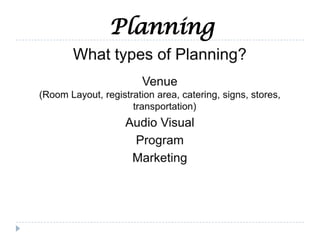
  • 21.
  • 22.
    Initiation  Objective  Conceptdevelopment - timing, skills  Contextual factors – budget, legal/ regulatory, economic, social, political, technological and environmental factors  Feasibility study – select an event
  • 23.
    1. Organizing The processof  determining the special activities to be accomplished  gathering of these activities into relevant structures and  allocation of the achievement of objectives through these activities to the appropriate groups or individual.
  • 24.
  • 25.
    2. Planning  Theprocess of setting goals and deciding the best approach to achieve them.  Work breakdown structure (Gantt Chart) 1. Determine tasks in detail 2. List in correct sequence 3. Establish the timetable  Development of operational and contingency plans  Assessment of resource needs  Budgeting “An event planner needs to be able to manage their time wisely for the event, and the length of preparation needed for each event so it is a success.”
  • 26.
  • 27.
    Steps to Planningan Event  1) The first step to planning an event is determining its purpose, whether it is for a wedding, company, birthday, festival, graduation or any other event requiring extensive planning.  2) From this the event planner needs to choose entertainment, location, guest list, speakers, and content. The location for events is endless, but with event planning they would likely be held at hotels, convention centers, reception halls, or outdoors depending on the event. 3) Once the location is set the coordinator/planner needs to prepare the event with staff, set up the entertainment, and keep contact with the client. 4) 4) After all this is set the event planner has all the smaller details to address like set up of the event such as food, drinks, music, guest list, budget, advertising and marketing, decorations, all this preparation is what is needed for an event to run smoothly.”
  • 28.
  • 29.
  • 30.
  • 31.
    Control & Monitoring Tools  Setting benchmarks/ standards
  • 32.
  • 33.
    Shutdown  Integration ofshutdown into key event tasks  Key Task
  • 34.
    3. Motivating  Inany demanding work situation, it is important to keep the staff motivated and interested.  Events demand an extraordinary commitment from every individual concerned.
  • 35.
    What motivates staff todo his/her very best to make the event successful?
  • 36.
  • 37.
    4. Communicating  Giving,receiving or exchange of information so that the material communicated is completely understood.
  • 38.
    5. Creating  Theability to produce an original idea or thought through the use of imagination.  A good event manager should be equipped with innovative thinking skills that will help create an interesting event.
  • 39.
    6. Controlling  Ismonitoring the performance of systems and resources.  Checks whether what is supposed to happen is happening or is going to happen.
  • 40.
    Four stages ofeffective control: 1 • Plan what you need to do 2 • Measure what has been done 3 • Compare achievements with the blueprint 4 • Take action to correct anything that is not as it should be
  • 41.
     Is importantskill for people who are working on events.  A positive, innovative thinker is needed to solve them. Problem Solving
  • 42.
  • 43.
     Involves theassessment and implementation of possible strategies. In an event it is better to use democratic decision making and involve as many people as possible. It is advisable to use the collective knowledge of the group in order to arrive at the correct decision. Decision Making
  • 44.
     Is theability of an organized group of people to work together. Unity of purpose and cooperation are necessary to attain success in event management. Team Building
  • 45.
     Means givingpeople something to do which they are capable of achieving. Delegation is an important management activity and is essential to the success of any event. Delegation
  • 46.
     Is aninterpersonal influence exercised in situations and  directed through the communication process towards the attainment of a specific goal or goals. Leadership
  • 47.
     Is anassessment of the  performance,  strengths, and  weaknesses of the personnel in order to improve their work and provide constructive guidance. Staff Appraisal and Training
  • 48.
    1. Desirable trainingimproves personal skills such as decision making and creativity. 2. Essential training make sure that personnel are aware of legal requirements such as health and safety legislation and can perform word processing and computing tasks. There are types of training for event staff:
  • 49.
     Make itclear where the authority, responsibility and power lie.  Every individual knows where he/she stands so that he/she will not be tempted to underplay or overplay the role.  For every decision, someone must take the responsibility. Authority, Responsibility and Power

Editor's Notes

  • #22 Intuition is the concept or idea
  • #25 Intuition is the concept or idea