Evaluation Question 1
In what ways does your product use, develop, or challenge forms and conventions of real media products?
Front Cover
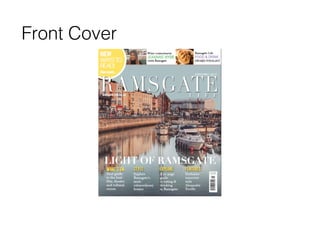
Masthead
Large bold serif serif style font, which is positioned at the top/middle of the page to draw the readers attention and it
instantly gives instant recognition of the producer reinforcing brand awareness. Overlapping the main image, and the
ellipses establishes further importance with the name representing the specific location. Existing media magazines
use similar mastheads;
Main Image
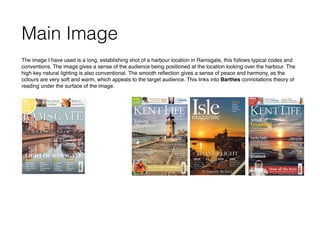
The image I have used is a long, establishing shot of a harbour location in Ramsgate, this follows typical codes and
conventions. The image gives a sense of the audience being positioned at the location looking over the harbour. The
high key natural lighting is also conventional. The smooth reflection gives a sense of peace and harmony, as the
colours are very soft and warm, which appeals to the target audience. This links into Barthes connotations theory of
reading under the surface of the image.
Sell Line
I chose to use a conventional sell line - relating to my magazine. It informs the audience what my magazine is about
and hints whats going to be in the magazine uses and grats. I used a contrasting colour to the background in an
attempt to stand out. I used the same font as the mast head to show consistency throughout, this further follows the
codes and conventions of regional magazines. This follows the hegemonic norms and therefore conforms to my
target audience beliefs meaning the text becomes relatable to them .
House Style
The use of subtle colours throughout, will appeal to the audience. The colours used do not become gender specific
and so can appeal to both male and female - the target audience I was intending to hit. My front cover follows
conventions of using contrasting colours overlapping the image.
The header at the top of the page is a typical convention, as it informs the reader what is going to be in the issue
uses and grats. Existing media examples of typical house styles include;
Contents Page
Fonts and Features
Short and snappy insights into articles is offered. This allows for a range of peoples needs to be full filled, and informs
the reader uses and grats. The font used is arial and a serif due to being more subtle, and reflects the ideologies of
the audience, in turn satisfying the readers preferences and beliefs of how contents pages should look. Furthermore,
the font used is easy to read and suites the general house style of the magazine which gives a more professional
look, as the font is used throughout the issue, therefore this further conforms to my target audience’s needs.
Also the use of larger and smaller sized fonts to emphasise importance fulfills the readers need (uses and grats)
Images
I followed the convention of using images to break up the text on the page. The images conform to conventions as I
have used a variety of shots, close up and long shots. As well as this, I continued to use conventions such as high
key lighting, doing this helps my audience visualize the relevant articles, which creates more of a meaning and
relationship with the audience.
By using two images of people I have followed the conventions of magazines, and I believe this relates to the reader
just as much as using images of objects and landscapes.
These are some images which can be found on the contents pages
of existing media;
Rows & Columns
Organised text allows the text to be read easier for the individuals
reading it, and clear accessible text can lead to the fulfillment of the
individuals needs, also informing the reader (uses and grats)
Tabs separating each section is a common convention which I
replicated in my own production as it clearly distinguishes articles
from each other.
Images in between the rows follows typical codes and conventions,
as it informs the reader what is going to feature in that specific issue
(Barthes)
These are some examples which can be found on the contents
pages of existing media;
Numbering
Numbers lay on the left hand side, in a structured vertical line, which is conventional as seen by the images of
examples. This allows easy navigation to fulfill individuals needs, and it also informs the reader what is going to be
displayed in the issue (uses and grats)
These are some examples which can be found on the contents
pages of existing media;
I believe that my contents page goes against the codes and conventions of many contents pages for regional
magazines which I have researched, as they are extremely linear and formal, emphasised in the examples of existing
media below;
Although my contents does include rows and columns they are positioned in a less formal and organised way,
furthermore, the title of the magazine is positioned at the top right hand corner instead of the top of the page or top
left. After consulting with my focus group they preferred this relaxed contents page as it still informed them about the
specific articles without looking too tacky and informal. The magazine I took my inspiration from was the Isle
Magazine, which also has the same target audience that I decided to cater for.
Editorial Page
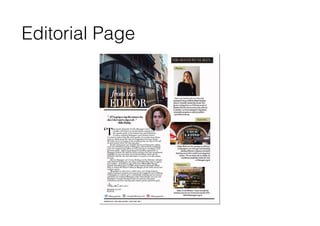
Image
The main image I used was
a mid - long shot in a
conventional style, this
enables the audience a
sense of location, also the
text on the page
compliments and speaks
about the image, which is a
conventional method used
to keep continuity.
I edited all my images by turning up the contrast and vibrance so that
the images appeared more eye catching and more intense.
The images conform to conventions as I have used a variety of shots,
close up and long shots. As well as this, I continued to use
conventions such as high key lighting, doing this helps my audience
visualize the relevant articles, which creates more of a meaning and
relationship with the audience.
A close up of the Editor/ or the person the editor is writing about, is
usually placed next to the text or below it. I have included one next to
my text to inform the reader and fulfill their needs (uses and grats)
Layout
I feel my layout is conventional following typical trends of similar magazine’s editorial page. This will appeal to my target
audience as it creates similarities between magazines and audience.
This is due to factors such as the images, which promotes the text, and makes the page more visual - although there is
a lot of text on the page the images are the focus point. This follows typical codes and conventions as similar audiences
are interested in not only facts and details but the meaning of images, which further expands my target audience.
These are some examples which can be found on the Editorial
pages of existing media;
Text
I used a serif font in order to appeal to my target audience as it is subtle and less intrusive on the page, therefore it
reflects themselves. It contrasts directly from the background and the images, and follows the colour scheme
throughout the page. Although the title can be argued to be in an unconventional position - at the bottom of the image
not at the top of the page, I feel it works well in conjunction to the rest of the product.
Typical convention of the same font used throughout to create recognition, and to appeal to the audience as it seems
more organised and formal. A variety of font sizes in relation to the title also conventional as seen by the examples.
These are some examples which can be found on the Editorial
pages of existing media;
Language
I way i conformed to codes and conventions was the use of sensationalism. I did this by including a quote from a
famous person which would directly impact my audience. This would create a buzz around the text further on in the
page in order to keep the audience involved and satisfied.
Furthermore, I added a formal style in the way I wrote to create a sense of relationship to the audience in turn
allowing them to further interact with the text.
Many other regional magazines use similar techniques to engage
the reader, these are some examples which can be found on the
Editorial pages of existing media;
Advertisement Page
Text
Furthermore, I included Tracey Emin’s signature at the
bottom of the sell line, as she was an important artist who
was from around the area who created a piece of art
which many people looked up to and were inspired by,
therefore including this would attract my target audience
and fulfill their needs (uses and grats)
I followed the convention of using a sell line, this establishes the product, with the word ‘inspired’ emphasised to
the target audience. This allows the target audience to compare and discuss this further which links to the uses
and grats theory.
I used the convention of having a the name of the advert at the top of the page, I used a font similar to the one
associated with the Turner Contemporary to create recognition for the audience which fulfills their needs (uses
and grats).
Finally I used the convention of contact details of the company, this will appeal to the target audience is it allows
them to visit the Turner Centre. In doing so they are abiding to the surveillance factor in uses and grats theory.
Image
In order to appeal to the audience, I followed the conventions of using high key lighting in my image. This allows the
audience to clearly visualize the image, and therefore receive the preferred reading (Hall receptions theory) of
wanting to buy or in this case go to the place which is being advertised.
A mid shot - long shot for this type of advert is also conventional as it is positioned so that the audience can admire
what is being advertised (Hall) - the impression given is walking into the Turner Centre.
The mise en scene was also a factor to consider, the image is just of an LED book in a blank white room which gives
a minimalistic feel which is associated with the Turner Centre, so this creates a relationship based on familiarity (uses
and grats)
Website
Layout
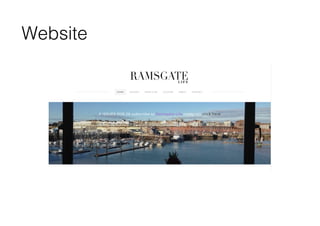
Firstly I conformed to the typical conventions of having the Masthead of my magazine at the centre top of the page.
This allows the audience to clearly recognise who the product is produced by, which instantly creates brand
recognition. Furthermore, having the tabs underneath is conventional as it allows the audience to find relevant
information about a topic of their choice (cognitive needs, uses and grats)
One way I challenged typical conventions of regional magazines was to have the first thing that the audience can see
was how to subscribe to receive multiple issues of the magazine. I have done this throughout my website to further
advertise multiple issues of my magazine. Usually, magazines have a small section dedicated for this but limit the
impact it has on the reader, instead of opting for key articles to be advertised.
Included with this, I added images of my magazines front
cover so that it would further promote my physical product
in an attempt to further consumer base.
Image
I have found the typical conventions of regional magazines, do include their magazine front cover as an image on one
of their pages, therefore I am conforming to this using multiple issues to promote the magazine.
However, I have gone on to challenge the conventions as the positioning of my issues tend to lie central at the top of
the page, whereas other magazines typically place this to the right of the page.
BillBoard
Layout
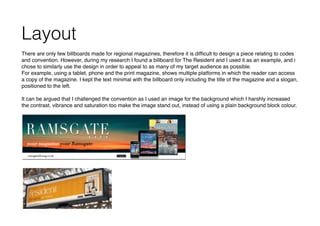
There are only few billboards made for regional magazines, therefore it is difficult to design a piece relating to codes
and convention. However, during my research I found a billboard for The Resident and I used it as an example, and i
chose to similarly use the design in order to appeal to as many of my target audience as possible.
For example, using a tablet, phone and the print magazine, shows multiple platforms in which the reader can access
a copy of the magazine. I kept the text minimal with the billboard only including the title of the magazine and a slogan,
positioned to the left.
It can be argued that I challenged the convention as I used an image for the background which I harshly increased
the contrast, vibrance and saturation too make the image stand out, instead of using a plain background block colour.
Image
The image I chose for my billboard can be seen as unconventional, a plain block colour which I used in my mock up
did not draw enough attention and so I wanted to challenge this. Therefore, I decided to use and image relating to my
magazine - an image of the sunset in one of Ramsgate’s picturesque areas, Pegwell Bay.
However, the image can be seen as conventional as it is positioned over the entire billboard, similarly to that of The
Resident.

Evaluation question 1

  • 1.
    Evaluation Question 1 Inwhat ways does your product use, develop, or challenge forms and conventions of real media products?
  • 2.
  • 3.
    Masthead Large bold serifserif style font, which is positioned at the top/middle of the page to draw the readers attention and it instantly gives instant recognition of the producer reinforcing brand awareness. Overlapping the main image, and the ellipses establishes further importance with the name representing the specific location. Existing media magazines use similar mastheads;
  • 4.
    Main Image The imageI have used is a long, establishing shot of a harbour location in Ramsgate, this follows typical codes and conventions. The image gives a sense of the audience being positioned at the location looking over the harbour. The high key natural lighting is also conventional. The smooth reflection gives a sense of peace and harmony, as the colours are very soft and warm, which appeals to the target audience. This links into Barthes connotations theory of reading under the surface of the image.
  • 5.
    Sell Line I choseto use a conventional sell line - relating to my magazine. It informs the audience what my magazine is about and hints whats going to be in the magazine uses and grats. I used a contrasting colour to the background in an attempt to stand out. I used the same font as the mast head to show consistency throughout, this further follows the codes and conventions of regional magazines. This follows the hegemonic norms and therefore conforms to my target audience beliefs meaning the text becomes relatable to them .
  • 6.
    House Style The useof subtle colours throughout, will appeal to the audience. The colours used do not become gender specific and so can appeal to both male and female - the target audience I was intending to hit. My front cover follows conventions of using contrasting colours overlapping the image. The header at the top of the page is a typical convention, as it informs the reader what is going to be in the issue uses and grats. Existing media examples of typical house styles include;
  • 7.
  • 8.
    Fonts and Features Shortand snappy insights into articles is offered. This allows for a range of peoples needs to be full filled, and informs the reader uses and grats. The font used is arial and a serif due to being more subtle, and reflects the ideologies of the audience, in turn satisfying the readers preferences and beliefs of how contents pages should look. Furthermore, the font used is easy to read and suites the general house style of the magazine which gives a more professional look, as the font is used throughout the issue, therefore this further conforms to my target audience’s needs. Also the use of larger and smaller sized fonts to emphasise importance fulfills the readers need (uses and grats)
  • 9.
    Images I followed theconvention of using images to break up the text on the page. The images conform to conventions as I have used a variety of shots, close up and long shots. As well as this, I continued to use conventions such as high key lighting, doing this helps my audience visualize the relevant articles, which creates more of a meaning and relationship with the audience. By using two images of people I have followed the conventions of magazines, and I believe this relates to the reader just as much as using images of objects and landscapes. These are some images which can be found on the contents pages of existing media;
  • 10.
    Rows & Columns Organisedtext allows the text to be read easier for the individuals reading it, and clear accessible text can lead to the fulfillment of the individuals needs, also informing the reader (uses and grats) Tabs separating each section is a common convention which I replicated in my own production as it clearly distinguishes articles from each other. Images in between the rows follows typical codes and conventions, as it informs the reader what is going to feature in that specific issue (Barthes) These are some examples which can be found on the contents pages of existing media;
  • 11.
    Numbering Numbers lay onthe left hand side, in a structured vertical line, which is conventional as seen by the images of examples. This allows easy navigation to fulfill individuals needs, and it also informs the reader what is going to be displayed in the issue (uses and grats) These are some examples which can be found on the contents pages of existing media;
  • 12.
    I believe thatmy contents page goes against the codes and conventions of many contents pages for regional magazines which I have researched, as they are extremely linear and formal, emphasised in the examples of existing media below; Although my contents does include rows and columns they are positioned in a less formal and organised way, furthermore, the title of the magazine is positioned at the top right hand corner instead of the top of the page or top left. After consulting with my focus group they preferred this relaxed contents page as it still informed them about the specific articles without looking too tacky and informal. The magazine I took my inspiration from was the Isle Magazine, which also has the same target audience that I decided to cater for.
  • 13.
  • 14.
    Image The main imageI used was a mid - long shot in a conventional style, this enables the audience a sense of location, also the text on the page compliments and speaks about the image, which is a conventional method used to keep continuity. I edited all my images by turning up the contrast and vibrance so that the images appeared more eye catching and more intense. The images conform to conventions as I have used a variety of shots, close up and long shots. As well as this, I continued to use conventions such as high key lighting, doing this helps my audience visualize the relevant articles, which creates more of a meaning and relationship with the audience. A close up of the Editor/ or the person the editor is writing about, is usually placed next to the text or below it. I have included one next to my text to inform the reader and fulfill their needs (uses and grats)
  • 15.
    Layout I feel mylayout is conventional following typical trends of similar magazine’s editorial page. This will appeal to my target audience as it creates similarities between magazines and audience. This is due to factors such as the images, which promotes the text, and makes the page more visual - although there is a lot of text on the page the images are the focus point. This follows typical codes and conventions as similar audiences are interested in not only facts and details but the meaning of images, which further expands my target audience. These are some examples which can be found on the Editorial pages of existing media;
  • 16.
    Text I used aserif font in order to appeal to my target audience as it is subtle and less intrusive on the page, therefore it reflects themselves. It contrasts directly from the background and the images, and follows the colour scheme throughout the page. Although the title can be argued to be in an unconventional position - at the bottom of the image not at the top of the page, I feel it works well in conjunction to the rest of the product. Typical convention of the same font used throughout to create recognition, and to appeal to the audience as it seems more organised and formal. A variety of font sizes in relation to the title also conventional as seen by the examples. These are some examples which can be found on the Editorial pages of existing media;
  • 17.
    Language I way iconformed to codes and conventions was the use of sensationalism. I did this by including a quote from a famous person which would directly impact my audience. This would create a buzz around the text further on in the page in order to keep the audience involved and satisfied. Furthermore, I added a formal style in the way I wrote to create a sense of relationship to the audience in turn allowing them to further interact with the text. Many other regional magazines use similar techniques to engage the reader, these are some examples which can be found on the Editorial pages of existing media;
  • 18.
  • 19.
    Text Furthermore, I includedTracey Emin’s signature at the bottom of the sell line, as she was an important artist who was from around the area who created a piece of art which many people looked up to and were inspired by, therefore including this would attract my target audience and fulfill their needs (uses and grats) I followed the convention of using a sell line, this establishes the product, with the word ‘inspired’ emphasised to the target audience. This allows the target audience to compare and discuss this further which links to the uses and grats theory. I used the convention of having a the name of the advert at the top of the page, I used a font similar to the one associated with the Turner Contemporary to create recognition for the audience which fulfills their needs (uses and grats). Finally I used the convention of contact details of the company, this will appeal to the target audience is it allows them to visit the Turner Centre. In doing so they are abiding to the surveillance factor in uses and grats theory.
  • 20.
    Image In order toappeal to the audience, I followed the conventions of using high key lighting in my image. This allows the audience to clearly visualize the image, and therefore receive the preferred reading (Hall receptions theory) of wanting to buy or in this case go to the place which is being advertised. A mid shot - long shot for this type of advert is also conventional as it is positioned so that the audience can admire what is being advertised (Hall) - the impression given is walking into the Turner Centre. The mise en scene was also a factor to consider, the image is just of an LED book in a blank white room which gives a minimalistic feel which is associated with the Turner Centre, so this creates a relationship based on familiarity (uses and grats)
  • 21.
  • 22.
    Layout Firstly I conformedto the typical conventions of having the Masthead of my magazine at the centre top of the page. This allows the audience to clearly recognise who the product is produced by, which instantly creates brand recognition. Furthermore, having the tabs underneath is conventional as it allows the audience to find relevant information about a topic of their choice (cognitive needs, uses and grats) One way I challenged typical conventions of regional magazines was to have the first thing that the audience can see was how to subscribe to receive multiple issues of the magazine. I have done this throughout my website to further advertise multiple issues of my magazine. Usually, magazines have a small section dedicated for this but limit the impact it has on the reader, instead of opting for key articles to be advertised. Included with this, I added images of my magazines front cover so that it would further promote my physical product in an attempt to further consumer base.
  • 23.
    Image I have foundthe typical conventions of regional magazines, do include their magazine front cover as an image on one of their pages, therefore I am conforming to this using multiple issues to promote the magazine. However, I have gone on to challenge the conventions as the positioning of my issues tend to lie central at the top of the page, whereas other magazines typically place this to the right of the page.
  • 24.
  • 25.
    Layout There are onlyfew billboards made for regional magazines, therefore it is difficult to design a piece relating to codes and convention. However, during my research I found a billboard for The Resident and I used it as an example, and i chose to similarly use the design in order to appeal to as many of my target audience as possible. For example, using a tablet, phone and the print magazine, shows multiple platforms in which the reader can access a copy of the magazine. I kept the text minimal with the billboard only including the title of the magazine and a slogan, positioned to the left. It can be argued that I challenged the convention as I used an image for the background which I harshly increased the contrast, vibrance and saturation too make the image stand out, instead of using a plain background block colour.
  • 26.
    Image The image Ichose for my billboard can be seen as unconventional, a plain block colour which I used in my mock up did not draw enough attention and so I wanted to challenge this. Therefore, I decided to use and image relating to my magazine - an image of the sunset in one of Ramsgate’s picturesque areas, Pegwell Bay. However, the image can be seen as conventional as it is positioned over the entire billboard, similarly to that of The Resident.