IOSR Journal of Mechanical and Civil Engineering (IOSR-JMCE)
e-ISSN: 2278-1684,p-ISSN: 2320-334X, Volume 8, Issue 1 (Jul. - Aug. 2013), PP 27-30
www.iosrjournals.org
www.iosrjournals.org 27 | Page
Evaluation of Structural Implication of Incorporating Base
Isolator as Earthquake Protection Device
Md.Arman Chowdhury1
, Rajib Kumar Biswas2,
Md.Nazmul Haq3,
Syeed Md. Iskander4
1
(Graduate student, Department of Civil Engineering, Ahsanullah University of Science and Technology)
2
(Undergraduate student, Department of Civil Engineering, Ahsanullah University of Science and Technology)
3
(Graduate student, Department of Civil Engineering, Bangladesh University of Engineering and Technology)
4
(Lecturer, Department of Civil Engineering, Ahsanullah University of Science and Technology)
Abstract : Introduction of the flexible element at the base of a structure and at the same time ensuring
damping is probably the best option for the seismic isolation technique. The device that meets such criteria is
known as isolator. In this study incorporation of such base isolator in buildings has been investigated. A study
was done considering different building with different plan to justify the applicability of base isolation. The
characteristics and performance effect of a building with and without base isolator system were compared.
Study shows the applicability of base isolator to the range up to buildings of 30m-40m height. The installation
of isolator in building considerably increases the time period of building, which means it reduces the possibility
of resonance of the structure. Provision of isolator in building often increases the total cost, but reinforcement
requirement and construction material cost is reduced due to isolator. So, isolator may be incorporated at the
bottom of the building to exploit economic and structurally safe alternative.
Keywords: Equivalent Static Analysis, Time history method, Base Isolation, Reinforce concrete building.
I. Introduction
Historical seismic catalogues reveal that Bangladesh has been affected by earthquake since ancient
times. Earthquakes occurred in 1664, 1828, 1852 and 1885 are shown to have Dhaka as epicentral area.
Similarly cities like Rangpur, Sylhet, Mymensing, Chittagong, Saidpur, Sirajgong, Pabna etc. have
been shown to be the epicentral area of some of the major earthquakes in the past. Although the ancient record
do not specify the earthquake epicenter by giving coordinates in terms of latitude and longitude. It is difficult to
figure out whether these cities were directly hit by earthquakes. However occurrence of earthquakes both inside
and outside of the country and around major cities indicates that earthquake hazard exists for the country in
general and the cities in particular. Consideration of earthquake forces in structural design, city planning and
infrastructure development is therefore a prerequisite for future disaster mitigation.
Several earthquake of large magnitude (Richter magnitude 7.0 or higher) with epicenters within
Bangladesh and India close to Indo-Bangladesh have occurred (AM and Chowdhury, 1994). Table 1 and Table
2 provide lists of the major earthquakes that have affected Bangladesh and its surroundings. Furthermore the
country is divided into three zones determined from the earthquake magnitude for various return periods and the
acceleration attenuation relationship (Ali and Chowdhury, 1994) namely zones 1,2,3 being most to least severe
gradually (BNBC, 1993).
Table 1. Lists of Major Earthquakes Affecting Bangladesh
Date of occurrence Name (Place) Magnitude
Epicenter distance
from Dhaka(Km)
10 Jan 1869 Cachar Earthquake 7.5 250
14 Jul 1885 Bengal earthquake(Bogra) 7.0 170
12 Jun 1897 Great Indian Earthquake 8.7 230
08 Jul 1918
Srimangal Earthquake
(Srimangal)
7.6 150
02 Jul 1930 Dhubri Earthquake 7.1 250
15 Jan 1934 Bihar-Nepal Earthquake(Bihar) 8.3 510
15 Aug 1950 Asam Earthquake (Aasm) 8.5 780
Evaluation of Structural Implication of Incorporating Base Isolator as Earthquake Protection Device
www.iosrjournals.org 28 | Page
Table 2. Recent Major earthquakes in Bangladesh (Ansary, 2005)
Date of Occurrence Name( Place) Magnitude
Epicentral distance
from Dhaka (Km)
08 May 1997
Sylhet Earthquake
(Sylhet)
6.0 210
21 Nov 1997
Chittagong Earthquake
(Chittagong)
5.5 264
22 Jul 1999
Moheskhali Earthquake
(Cox’s Bazar)
5.2 300
27 Jul 2003 Chittagong-Rangamati Earthquake 5.9 290
The historical seismicity data of Bangladesh and adjoining areas indicate that Bangladesh is vulnerable
to earthquake hazards. As Bangladesh is the world’s most densely populated area, any future earthquake shall
affect more people per unit area than any other seismically active regions of the world. Both of the above factors
call for evaluation of seismic hazard of Bangladesh so that proper hazard mitigation measure may be undertaken
before it is too late.
The basic objective of the research is to: 1) Conduct a through literature survey on the base isolation
principle and its suitability for use in buildings. 2) Perform non linear dynamic analysis of buildings with
isolated bearings and non-isolated one.
The investigation gives emphasis on the feasibility of incorporation of isolators and its structural
implication on buildings is limited to the following extents: 1) Only buildings in Dhaka are considered in this
work. 2) Two types of isolators namely high damping rubber bearing and lead rubber bearing is considered in
this research.
II. MODAL ANALYSIS
A base isolated demonstration building has been considered in Dhaka, Bangladesh as part of an
ongoing effort to promote the use of base isolation technology for common structures in earthquake-prone
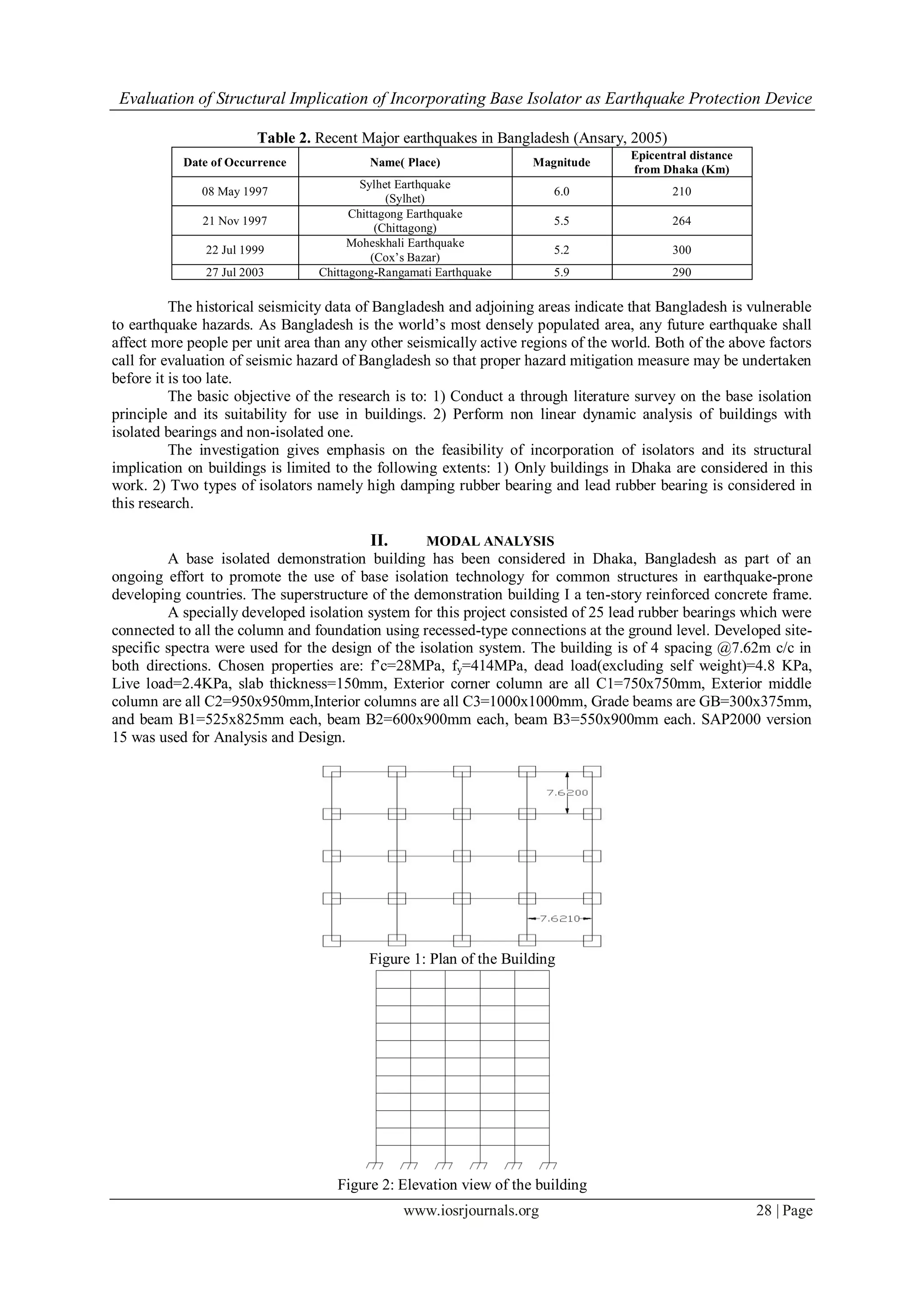
developing countries. The superstructure of the demonstration building I a ten-story reinforced concrete frame.
A specially developed isolation system for this project consisted of 25 lead rubber bearings which were
connected to all the column and foundation using recessed-type connections at the ground level. Developed site-
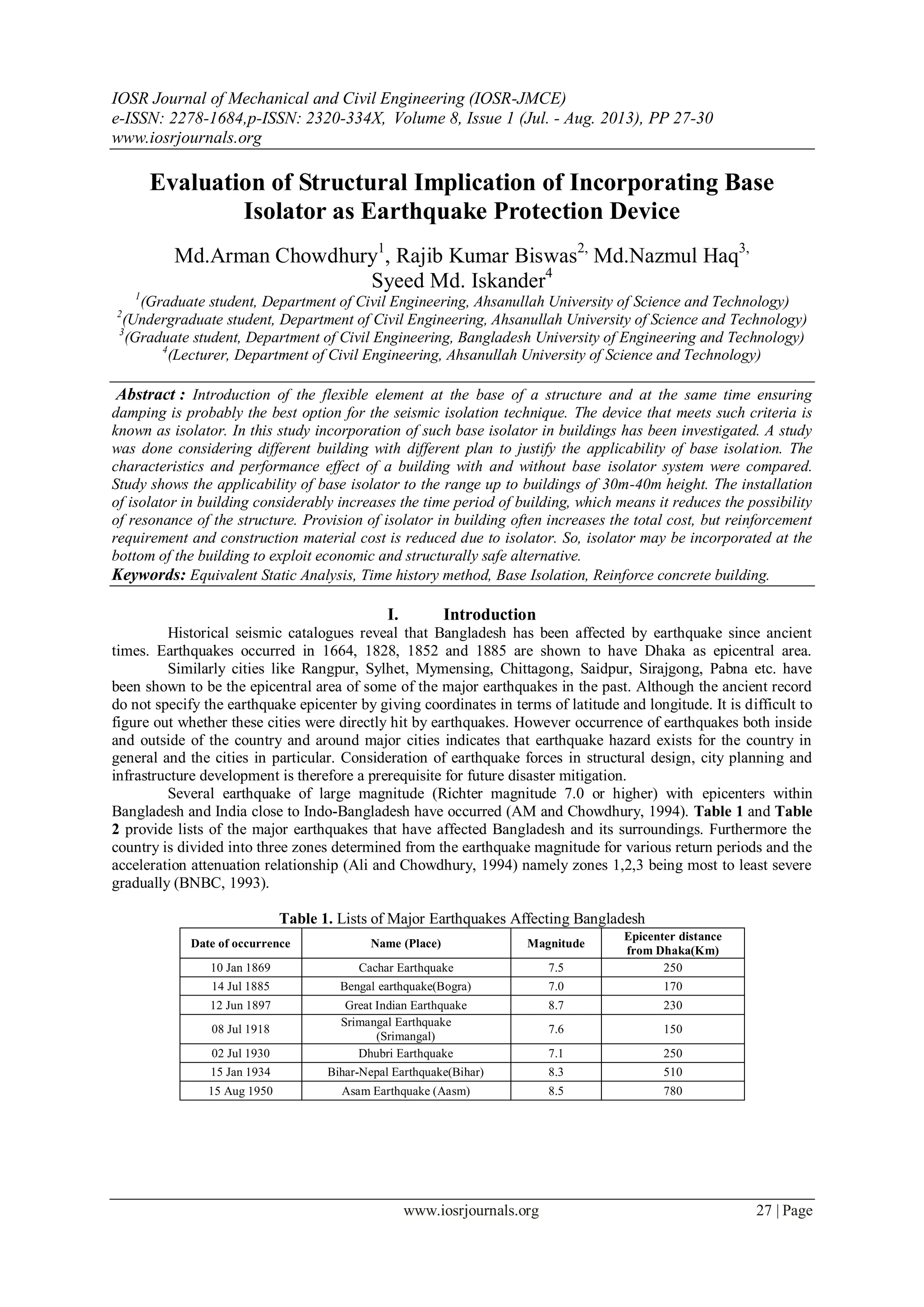
specific spectra were used for the design of the isolation system. The building is of 4 spacing @7.62m c/c in
both directions. Chosen properties are: f’c=28MPa, fy=414MPa, dead load(excluding self weight)=4.8 KPa,
Live load=2.4KPa, slab thickness=150mm, Exterior corner column are all C1=750x750mm, Exterior middle
column are all C2=950x950mm,Interior columns are all C3=1000x1000mm, Grade beams are GB=300x375mm,
and beam B1=525x825mm each, beam B2=600x900mm each, beam B3=550x900mm each. SAP2000 version
15 was used for Analysis and Design.
Figure 1: Plan of the Building
Figure 2: Elevation view of the building
Evaluation of Structural Implication of Incorporating Base Isolator as Earthquake Protection Device
www.iosrjournals.org 29 | Page
III. DESIGN EARTHQUAKE FOR DYNAMIC ANALYSIS
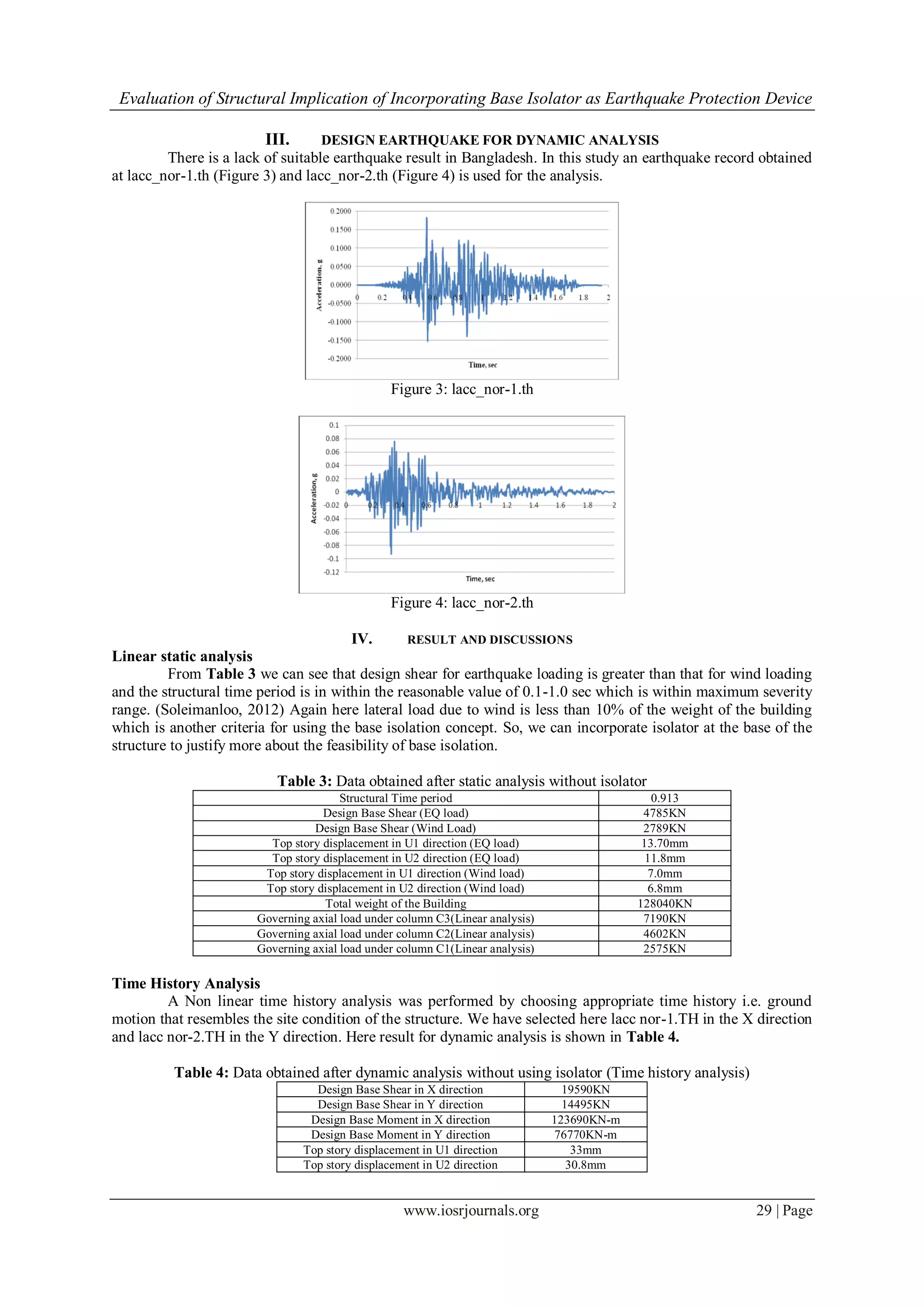
There is a lack of suitable earthquake result in Bangladesh. In this study an earthquake record obtained
at lacc_nor-1.th (Figure 3) and lacc_nor-2.th (Figure 4) is used for the analysis.
Figure 3: lacc_nor-1.th
Figure 4: lacc_nor-2.th
IV. RESULT AND DISCUSSIONS
Linear static analysis
From Table 3 we can see that design shear for earthquake loading is greater than that for wind loading
and the structural time period is in within the reasonable value of 0.1-1.0 sec which is within maximum severity
range. (Soleimanloo, 2012) Again here lateral load due to wind is less than 10% of the weight of the building
which is another criteria for using the base isolation concept. So, we can incorporate isolator at the base of the
structure to justify more about the feasibility of base isolation.
Table 3: Data obtained after static analysis without isolator
Structural Time period 0.913
Design Base Shear (EQ load) 4785KN
Design Base Shear (Wind Load) 2789KN
Top story displacement in U1 direction (EQ load) 13.70mm
Top story displacement in U2 direction (EQ load) 11.8mm
Top story displacement in U1 direction (Wind load) 7.0mm
Top story displacement in U2 direction (Wind load) 6.8mm
Total weight of the Building 128040KN
Governing axial load under column C3(Linear analysis) 7190KN
Governing axial load under column C2(Linear analysis) 4602KN
Governing axial load under column C1(Linear analysis) 2575KN
Time History Analysis
A Non linear time history analysis was performed by choosing appropriate time history i.e. ground
motion that resembles the site condition of the structure. We have selected here lacc nor-1.TH in the X direction
and lacc nor-2.TH in the Y direction. Here result for dynamic analysis is shown in Table 4.
Table 4: Data obtained after dynamic analysis without using isolator (Time history analysis)
Design Base Shear in X direction 19590KN
Design Base Shear in Y direction 14495KN
Design Base Moment in X direction 123690KN-m
Design Base Moment in Y direction 76770KN-m
Top story displacement in U1 direction 33mm
Top story displacement in U2 direction 30.8mm
Evaluation of Structural Implication of Incorporating Base Isolator as Earthquake Protection Device
www.iosrjournals.org 30 | Page
Result of Analysis using Isolator
Assigning the value of the stiffness to the isolators and analyzing the structure with isolator by
SAP2000 we get the following result (Table 5a and 5b). The seismic performance is evaluated for the maximum
seismic events.
Table 5.a: Displacement after dynamic analysis using isolator
Isolator displacement(mm) Total structural drift (mm)
U1 Direction( static Analysis) 151.6 56.3
U2 Direction (Static Analysis) 145.8 53.1
U1 Direction (Time History Analysis) 119.1 30.1
U2 Direction (Time History Analysis) 73.8 28.6
Structural period for model 2.85sec
Table 5.b: Base Shear and Base Moment after dynamic analysis using isolator
Time history analysis
Design Base Shear in X direction 7803KN
Design Base Shear in Y direction 4837.3KN
Design Base Moment in X direction 43932.1KN-m
Design Base Moment in Y direction 26930.8KN-m
All Values of maximum displacements at Table 6 lie below the design displacement 292.61mm. So, the
isolator properties are satisfactory.
Table 6: Comparison of Drift in isolated and non-isolated structure
Base displacement
(mm)
Top displacement
(mm)
Total structure
drift (mm)
Isolated
Building
U1 119.1 149.2 30.1
U2 73.8 102.4 28.6
Non Isolated
Building
U1 12.59 133.35 120.76
U2 3.23 37.57 40.8
V. CONCLUSION
Seismic response and characteristics of an isolated and non-isolated building is studied using the finite
element method by SAP 2000. An elaborate investigation of the influence of various parameters involved in
isolation is performed. For the detail analysis and design, static analysis along with time history analysis is
executed. After an extensive and systemic study, the following conclusions may be drawn:
1) The period for the seismically isolated structures are much greater compared to that of the fixed based
structure.
2) There is a fixed based soft storey in the first floor, but the addition of the base isolation system corrects this
problem (rigid motion of the whole structure).
3) Design base shear due to the presence of isolator is reduced by about 2.5 to 3 times in Time History Analysis.
4) Design Base Moment is reduced by about 2.8 to 2.85 times in Time History Analysis after using Base
Isolator.
5) Top displacement of isolated building decreases by about 2 to 4 times than non-isolated building.
So, installation of isolator provides the greater safety to the building.
REFERENCES
[1] Ali, M.H and Choudhury, J.R. (1994) “Seismic zoning of Bangladesh” Paper presented at the International Seminar on Recent
Developments in “ Earthquake Disaster Mitigation”, Institute of Engineers, Bangladesh.
[2] Ansary, M.A., Al-Hussaini, T.M., Sharfuddin, M and Chowdhury, J.R. (1999), “ Report on Moheskhali Earthquake of July 22,
1999”, earthquake Engineering series, Research Report No. BUET/CE/EQE-99-01, Department of Civil Engineering, BUET,
August,1999.
[3] Bangladesh National Building Code (BNBC, 1993) Published by Housing and Building Research Institute and Bangladesh Standard
and Testing Institute, Bangladesh.
[4] Naeim, F. Kelly,J.(1999) “Design of seismic isolated structure”. John Wiley & Sons,Inc.
[5] Wang, Yen-Po, “Fundamentals of Seismic Base Isolation” International Training Programs for Seismic Design of Building
Structures.
[6] H.S.Soleimanloo (2012)” A Survey study on design procedure of seismic base isolation system”JASEM,2012.
[7] SAP2000(2005), A general purpose Linear and Non-Linear analysis program, Computers and Structures.

Evaluation of Structural Implication of Incorporating Base Isolator as Earthquake Protection Device

  • 1.
    IOSR Journal ofMechanical and Civil Engineering (IOSR-JMCE) e-ISSN: 2278-1684,p-ISSN: 2320-334X, Volume 8, Issue 1 (Jul. - Aug. 2013), PP 27-30 www.iosrjournals.org www.iosrjournals.org 27 | Page Evaluation of Structural Implication of Incorporating Base Isolator as Earthquake Protection Device Md.Arman Chowdhury1 , Rajib Kumar Biswas2, Md.Nazmul Haq3, Syeed Md. Iskander4 1 (Graduate student, Department of Civil Engineering, Ahsanullah University of Science and Technology) 2 (Undergraduate student, Department of Civil Engineering, Ahsanullah University of Science and Technology) 3 (Graduate student, Department of Civil Engineering, Bangladesh University of Engineering and Technology) 4 (Lecturer, Department of Civil Engineering, Ahsanullah University of Science and Technology) Abstract : Introduction of the flexible element at the base of a structure and at the same time ensuring damping is probably the best option for the seismic isolation technique. The device that meets such criteria is known as isolator. In this study incorporation of such base isolator in buildings has been investigated. A study was done considering different building with different plan to justify the applicability of base isolation. The characteristics and performance effect of a building with and without base isolator system were compared. Study shows the applicability of base isolator to the range up to buildings of 30m-40m height. The installation of isolator in building considerably increases the time period of building, which means it reduces the possibility of resonance of the structure. Provision of isolator in building often increases the total cost, but reinforcement requirement and construction material cost is reduced due to isolator. So, isolator may be incorporated at the bottom of the building to exploit economic and structurally safe alternative. Keywords: Equivalent Static Analysis, Time history method, Base Isolation, Reinforce concrete building. I. Introduction Historical seismic catalogues reveal that Bangladesh has been affected by earthquake since ancient times. Earthquakes occurred in 1664, 1828, 1852 and 1885 are shown to have Dhaka as epicentral area. Similarly cities like Rangpur, Sylhet, Mymensing, Chittagong, Saidpur, Sirajgong, Pabna etc. have been shown to be the epicentral area of some of the major earthquakes in the past. Although the ancient record do not specify the earthquake epicenter by giving coordinates in terms of latitude and longitude. It is difficult to figure out whether these cities were directly hit by earthquakes. However occurrence of earthquakes both inside and outside of the country and around major cities indicates that earthquake hazard exists for the country in general and the cities in particular. Consideration of earthquake forces in structural design, city planning and infrastructure development is therefore a prerequisite for future disaster mitigation. Several earthquake of large magnitude (Richter magnitude 7.0 or higher) with epicenters within Bangladesh and India close to Indo-Bangladesh have occurred (AM and Chowdhury, 1994). Table 1 and Table 2 provide lists of the major earthquakes that have affected Bangladesh and its surroundings. Furthermore the country is divided into three zones determined from the earthquake magnitude for various return periods and the acceleration attenuation relationship (Ali and Chowdhury, 1994) namely zones 1,2,3 being most to least severe gradually (BNBC, 1993). Table 1. Lists of Major Earthquakes Affecting Bangladesh Date of occurrence Name (Place) Magnitude Epicenter distance from Dhaka(Km) 10 Jan 1869 Cachar Earthquake 7.5 250 14 Jul 1885 Bengal earthquake(Bogra) 7.0 170 12 Jun 1897 Great Indian Earthquake 8.7 230 08 Jul 1918 Srimangal Earthquake (Srimangal) 7.6 150 02 Jul 1930 Dhubri Earthquake 7.1 250 15 Jan 1934 Bihar-Nepal Earthquake(Bihar) 8.3 510 15 Aug 1950 Asam Earthquake (Aasm) 8.5 780
  • 2.
    Evaluation of StructuralImplication of Incorporating Base Isolator as Earthquake Protection Device www.iosrjournals.org 28 | Page Table 2. Recent Major earthquakes in Bangladesh (Ansary, 2005) Date of Occurrence Name( Place) Magnitude Epicentral distance from Dhaka (Km) 08 May 1997 Sylhet Earthquake (Sylhet) 6.0 210 21 Nov 1997 Chittagong Earthquake (Chittagong) 5.5 264 22 Jul 1999 Moheskhali Earthquake (Cox’s Bazar) 5.2 300 27 Jul 2003 Chittagong-Rangamati Earthquake 5.9 290 The historical seismicity data of Bangladesh and adjoining areas indicate that Bangladesh is vulnerable to earthquake hazards. As Bangladesh is the world’s most densely populated area, any future earthquake shall affect more people per unit area than any other seismically active regions of the world. Both of the above factors call for evaluation of seismic hazard of Bangladesh so that proper hazard mitigation measure may be undertaken before it is too late. The basic objective of the research is to: 1) Conduct a through literature survey on the base isolation principle and its suitability for use in buildings. 2) Perform non linear dynamic analysis of buildings with isolated bearings and non-isolated one. The investigation gives emphasis on the feasibility of incorporation of isolators and its structural implication on buildings is limited to the following extents: 1) Only buildings in Dhaka are considered in this work. 2) Two types of isolators namely high damping rubber bearing and lead rubber bearing is considered in this research. II. MODAL ANALYSIS A base isolated demonstration building has been considered in Dhaka, Bangladesh as part of an ongoing effort to promote the use of base isolation technology for common structures in earthquake-prone developing countries. The superstructure of the demonstration building I a ten-story reinforced concrete frame. A specially developed isolation system for this project consisted of 25 lead rubber bearings which were connected to all the column and foundation using recessed-type connections at the ground level. Developed site- specific spectra were used for the design of the isolation system. The building is of 4 spacing @7.62m c/c in both directions. Chosen properties are: f’c=28MPa, fy=414MPa, dead load(excluding self weight)=4.8 KPa, Live load=2.4KPa, slab thickness=150mm, Exterior corner column are all C1=750x750mm, Exterior middle column are all C2=950x950mm,Interior columns are all C3=1000x1000mm, Grade beams are GB=300x375mm, and beam B1=525x825mm each, beam B2=600x900mm each, beam B3=550x900mm each. SAP2000 version 15 was used for Analysis and Design. Figure 1: Plan of the Building Figure 2: Elevation view of the building
  • 3.
    Evaluation of StructuralImplication of Incorporating Base Isolator as Earthquake Protection Device www.iosrjournals.org 29 | Page III. DESIGN EARTHQUAKE FOR DYNAMIC ANALYSIS There is a lack of suitable earthquake result in Bangladesh. In this study an earthquake record obtained at lacc_nor-1.th (Figure 3) and lacc_nor-2.th (Figure 4) is used for the analysis. Figure 3: lacc_nor-1.th Figure 4: lacc_nor-2.th IV. RESULT AND DISCUSSIONS Linear static analysis From Table 3 we can see that design shear for earthquake loading is greater than that for wind loading and the structural time period is in within the reasonable value of 0.1-1.0 sec which is within maximum severity range. (Soleimanloo, 2012) Again here lateral load due to wind is less than 10% of the weight of the building which is another criteria for using the base isolation concept. So, we can incorporate isolator at the base of the structure to justify more about the feasibility of base isolation. Table 3: Data obtained after static analysis without isolator Structural Time period 0.913 Design Base Shear (EQ load) 4785KN Design Base Shear (Wind Load) 2789KN Top story displacement in U1 direction (EQ load) 13.70mm Top story displacement in U2 direction (EQ load) 11.8mm Top story displacement in U1 direction (Wind load) 7.0mm Top story displacement in U2 direction (Wind load) 6.8mm Total weight of the Building 128040KN Governing axial load under column C3(Linear analysis) 7190KN Governing axial load under column C2(Linear analysis) 4602KN Governing axial load under column C1(Linear analysis) 2575KN Time History Analysis A Non linear time history analysis was performed by choosing appropriate time history i.e. ground motion that resembles the site condition of the structure. We have selected here lacc nor-1.TH in the X direction and lacc nor-2.TH in the Y direction. Here result for dynamic analysis is shown in Table 4. Table 4: Data obtained after dynamic analysis without using isolator (Time history analysis) Design Base Shear in X direction 19590KN Design Base Shear in Y direction 14495KN Design Base Moment in X direction 123690KN-m Design Base Moment in Y direction 76770KN-m Top story displacement in U1 direction 33mm Top story displacement in U2 direction 30.8mm
  • 4.
    Evaluation of StructuralImplication of Incorporating Base Isolator as Earthquake Protection Device www.iosrjournals.org 30 | Page Result of Analysis using Isolator Assigning the value of the stiffness to the isolators and analyzing the structure with isolator by SAP2000 we get the following result (Table 5a and 5b). The seismic performance is evaluated for the maximum seismic events. Table 5.a: Displacement after dynamic analysis using isolator Isolator displacement(mm) Total structural drift (mm) U1 Direction( static Analysis) 151.6 56.3 U2 Direction (Static Analysis) 145.8 53.1 U1 Direction (Time History Analysis) 119.1 30.1 U2 Direction (Time History Analysis) 73.8 28.6 Structural period for model 2.85sec Table 5.b: Base Shear and Base Moment after dynamic analysis using isolator Time history analysis Design Base Shear in X direction 7803KN Design Base Shear in Y direction 4837.3KN Design Base Moment in X direction 43932.1KN-m Design Base Moment in Y direction 26930.8KN-m All Values of maximum displacements at Table 6 lie below the design displacement 292.61mm. So, the isolator properties are satisfactory. Table 6: Comparison of Drift in isolated and non-isolated structure Base displacement (mm) Top displacement (mm) Total structure drift (mm) Isolated Building U1 119.1 149.2 30.1 U2 73.8 102.4 28.6 Non Isolated Building U1 12.59 133.35 120.76 U2 3.23 37.57 40.8 V. CONCLUSION Seismic response and characteristics of an isolated and non-isolated building is studied using the finite element method by SAP 2000. An elaborate investigation of the influence of various parameters involved in isolation is performed. For the detail analysis and design, static analysis along with time history analysis is executed. After an extensive and systemic study, the following conclusions may be drawn: 1) The period for the seismically isolated structures are much greater compared to that of the fixed based structure. 2) There is a fixed based soft storey in the first floor, but the addition of the base isolation system corrects this problem (rigid motion of the whole structure). 3) Design base shear due to the presence of isolator is reduced by about 2.5 to 3 times in Time History Analysis. 4) Design Base Moment is reduced by about 2.8 to 2.85 times in Time History Analysis after using Base Isolator. 5) Top displacement of isolated building decreases by about 2 to 4 times than non-isolated building. So, installation of isolator provides the greater safety to the building. REFERENCES [1] Ali, M.H and Choudhury, J.R. (1994) “Seismic zoning of Bangladesh” Paper presented at the International Seminar on Recent Developments in “ Earthquake Disaster Mitigation”, Institute of Engineers, Bangladesh. [2] Ansary, M.A., Al-Hussaini, T.M., Sharfuddin, M and Chowdhury, J.R. (1999), “ Report on Moheskhali Earthquake of July 22, 1999”, earthquake Engineering series, Research Report No. BUET/CE/EQE-99-01, Department of Civil Engineering, BUET, August,1999. [3] Bangladesh National Building Code (BNBC, 1993) Published by Housing and Building Research Institute and Bangladesh Standard and Testing Institute, Bangladesh. [4] Naeim, F. Kelly,J.(1999) “Design of seismic isolated structure”. John Wiley & Sons,Inc. [5] Wang, Yen-Po, “Fundamentals of Seismic Base Isolation” International Training Programs for Seismic Design of Building Structures. [6] H.S.Soleimanloo (2012)” A Survey study on design procedure of seismic base isolation system”JASEM,2012. [7] SAP2000(2005), A general purpose Linear and Non-Linear analysis program, Computers and Structures.