इंटरनेट मानक 
Disclosure to Promote the Right To Information 
Whereas the Parliament of India has set out to provide a practical regime of right to 
information for citizens to secure access to information under the control of public authorities, 
in order to promote transparency and accountability in the working of every public authority, 
and whereas the attached publication of the Bureau of Indian Standards is of particular interest 
to the public, particularly disadvantaged communities and those engaged in the pursuit of 
education and knowledge, the attached public safety standard is made available to promote the 
timely dissemination of this information in an accurate manner to the public. 
“प0रा1 को छोड न' 5 तरफ” 
IS 1893-1 (2002): Criteria for Earthquake Resistant Design 
of Structures, Part 1: General Provisions and Buildings 
[CED 39: Earthquake Engineering] 
“!ान $ एक न' भारत का +नम-ण” 
Satyanarayan Gangaram Pitroda 
“Invent a New India Using Knowledge” 
Jawaharlal Nehru 
“Step Out From the Old to the New” 
“जान1 का अ+धकार, जी1 का अ+धकार” 
Mazdoor Kisan Shakti Sangathan 
“The Right to Information, The Right to Live” 
“!ान एक ऐसा खजाना > जो कभी च0राया नहB जा सकता है” 
Bhartṛhari—Nītiśatakam 
“Knowledge is such a treasure which cannot be stolen” 
हहहै””
June 2002 
IS 1893 ( Part 1 ) :2002 
Indian Standard 
CRITERIA FOR EARTHQUAKE RESISTANT 
DESIGN OF STRUCTURES 
PART 1 GENERAL PROVISIONS AND BUILDINGS 
( Ffth Revision ) 
ICS 91.120.25 
0 BIS 2002 
BUREAU OF INDIAN STANDARDS 
MANAK BHAVAN, 9 BAHADUR SHAH ZAFAR MARG 
NEW DELHI 110002 
Price Group 12
IS 1893( Part 1 ) :2002 
Indian Standard 
CRITERIA FOR EARTHQUAKE RESISTANT 
DESIGN OF STRUCTURES 
PART 1 GENERAL PROVISIONS AND BUILDINGS 
( Fijth Revision ) 
FOREWORD 
This Indian Standard ( Part 1 ) ( Fifth Revision) was adopted by the Bureau of Indian Standards, afler the 
draft finalized by the Earthquake Engineering Sectional Committee had been approved by the Civil Engineering 
Division Council. 
Himalayan-Nagalushai region, Indo-GangeticPlain, Western India, Kutch and Kathiawarregions are geologically 
unstable parts of the country, and some devastating earthquakes of the world have occurred there. A major 
part of the peninsular India has also been visited by strong earthquakes, but these were relatively few in 
number occurring at much larger time intervals at any site, and had considerably lesser intensity. The earth@ake 
resistant design of structures taking into account seismic data from studies of these Indian earthquakes has 
become very essential, particularly in view of the intense construction activity all over the country. It is to 
serve this purpose that IS 1893 : 1962 ‘Recommendations for earthquake resistant design of structures’ was 
published and revised first time in 1966. 
As a result of additional seismic data collected in India and further knowledge and experience gained since 
the publication of the first revision of this standard, the sectional committee felt the need to revise the standard 
again incorporating many changes, such as revision of maps showing seismic zones and epicentres, and adding 
a more rational approach for design of buildings and sub-structures of bridges. These were covered in the 
second revision of 1S 1893 brought out in 1970. 
As a result of the increased use of the standard, considerable amount of suggestions were received for modifying 
some of the provisions of the standard and, therefore, third revision of the standard was brought out in 1975. 
The following changes were incorporated in the third revision: 
a) 
b) 
c) 
d) 
e) 
8 
The standard incorporated seismic zone factors (previously given as multiplying factors in the second 
revision ) on a more rational basis. 
Importance factors were introduced to account for the varying degrees of importance for various 
structures. 
In the clauses for design of multi-storeyed buildings, the coefficient of flexibility was given in the 
form of a curve with respect to period of buildings. 
A more rational formula was used to combine modal shear forces. 
New clauses were introduced for determination of hydrodynamic pressures in elevated tanks. 
Clauses on concrete and masonry dams were modified, taking into account their dynamic behavionr 
during earthquakes. Simplified formulae for design forces were introduced based on results of extensive 
studies carried out since second revision of the standard was published. 
The fourth revision, brought out in 1984, was prepared to modifi some of the provisions of the standard as a 
result of experience gained with the use of the standard. In this revision, a number of important basic modifications 
with respect to load factors, field values of N, base shear and modal analysis were introduced. A new concept 
of performance factor depending on the structural framing system and on the ductility of construction was 
incorporated. Figure 2 for average acceleration spectra was also modified and a curve for zero percent damping 
incorporated. 
1
IS 1893( Part 1 ) :2002 
In the fifth revision, with a view to keep abreast with the rapid development and extensive research that has 
been carried out in the field of earthquake resistant design of various structures, the committee has decided 
to cover the provisions for different types of structures in separate parts. Hence, IS 1893 has been split into 
the following five parts: 
Part 1 General provisions and buildings 
Part 2 Liquid retaining tanks — Elevated and ground supported 
Part 3 Bridges and retaining walls 
Part 4 Industrial structures including stack like structures 
Part 5 Dams and embankments 
Part 1 contains provisions that are general in nature and applicable to all structures. Also, it contains provisions 
that are specific to buildings only. Unless stated otherwise, the provisions in Parts 2 to 5 shall be read necessarily 
in conjunction with the general provisions in Part 1. 
NOTE — Pending finalization of Parts 2 to 5 of IS 1893, provisions of Part 1 will be read along with the relevant 
clauses of IS 1893 : 1984 for structures other than buildings. 
The following are the major and important moditlcations made in the fifth revision: 
a) 
b) 
c) 
d) 
e) 
f) 
@ 
h) 
J) 
k) 
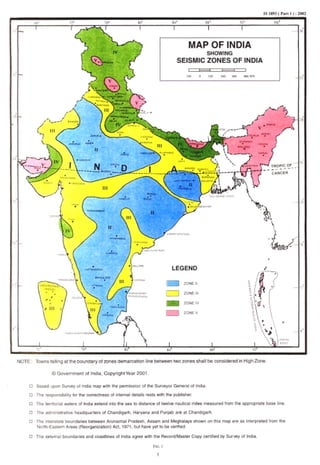
The seismic zone map is revised with only four zones, instead of five. Erstwhile Zone I has been 
merged to Zone 11. Hence, Zone I does not appear in the new zoning; only Zones II, 111,IV and V do. 
The values of seismic zone factors have been changed; these now reflect more realistic values of 
effective peak ground acceleration considering Maximum Considered Earthquake ( MCE ) and service 
life of structure in each seismic zone. 
Response spectra are now specified for three types of founding strata, namely rock and hard soil, 
medium soil and soft soil. 
Empirical expression for estimating the fundamental natural period Taof multi-storeyed buildings 
with regular moment resisting frames has been revised. 
This revision adopts the procedure of first calculating the actual force that maybe experienced by 
the structure during the probable maximum earthquake, if it were to remain elastic. Then, the concept 
of response reduction due to ductile deformation or frictional energy dissipation in the cracks is 
brought into the code explicitly, by introducing the ‘response reduction factor’ in place of the earlier 
performance factor. 
A lower bound is specified for the design base shear of buildings, based on empirical estimate of the 
fimdarnental natural period Ta. 
The soil-foundation system factor is dropped. Instead, a clause is introduced to restrict the use of 
foundations vulnerable to differential settlements in severe seismic zones. 
Torsional eccentricity values have been revised upwards in view of serious darnages observed in 
buildings with irregular plans. 
Modal combination rule in dynamic analysis of buildings has been revised. 
Other clauses have been redrafted where necessary for more effective implementation. 
It is not intended in this standard to lay down regulation so that no structure shall suffer any damage during 
earthquake of all magnitudes. It has been endeavored to ensure that, as far as possible, structures are able 
to respond, without structural darnage to shocks of moderate intensities and without total collapse to shocks 
of heavy intensities. While this standard is intended for the earthquake resistant design of normal structures, 
it has to be emphasized that in the case of special structures, such as large and tall dams, long-span bridges, 
major industrial projects, etc, site-specific detailed investigation should be undertaken, unless otherwise specified 
in the relevant clauses. 
2
IS 1893( Part 1 ): 2002 
Though the basis for the design of different types of structures is covered in this standard, it is not implied 
that detailed dynamic analysis should be made in every case. In highly seismic areas, construction of a type 
which entails hea~y debris and consequent loss of life and property, such as masonry, particularly mud masonry 
and rubble masonry, should preferably be avoided. For guidance on precautions to be observed in the construction 
of buildings, reference maybe made to IS 4326, IS 13827 and IS 13828. 
Earthquake can cause damage not only on account of the shaking which results from them but also due to 
other chain effects like landslides, floods, fires and disruption to communication. It is, therefore, important to 
take necessary precautions in the siting, planning and design of structures so that they are safe against such 
secondary effects also. 
The Sectional Committee has appreciated that there cannot bean entirely scientific basis for zoning in view 
of the scanty data available. Though the magnitudes of different earthquakes which have occurred in the 
past are known to a reasonable degree of accuracy, the intensities of the shocks caused by these earthquakes 
have so far been mostly estimated by damage surveys and there is little instrumental evidence to corroborate 
the conclusions arrived at. Maximum intensity at different places can be fixed on a scale only on the basis of 
the observations made and recorded after the earthquake and thus a zoning map which is based on the maximum 
intensities arrived at, is likely to lead in some cases to an incorrect conclusion in view of(a) incorrectness in 
the assessment of intensities, (b) human error in judgment during the damage survey, and (c) variation in 
quality and design of structures causing variation in type and extent of damage to the structures for the same 
intensity of shock. The Sectional Committee has therefore, considered that a rational approach to the problem 
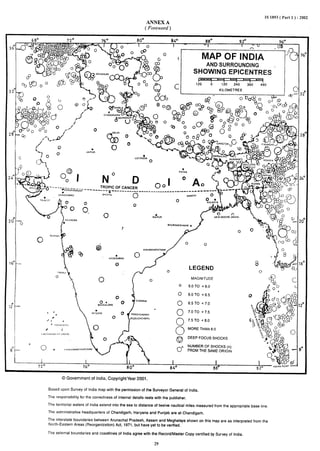
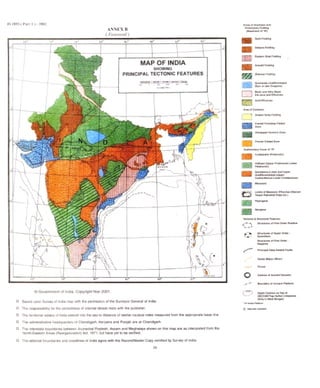
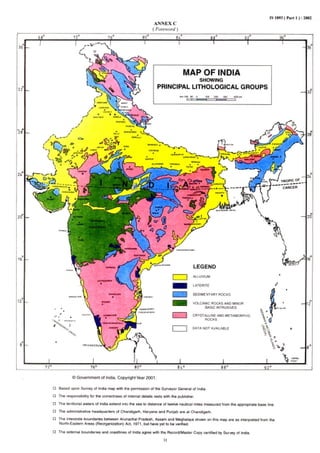
would be to arrive at a zoning map based on known magnitudes and the known epicentres ( see Annex A ) 
assuming all other conditions as being average and to modifi such an idealized isoseismal map in light of 
tectonics ( see Annex B ), lithology ( see Annex C ) and the maximum intensities as recorded from damage 
surveys. The Committee has also reviewed such a map in the light of the past history and future possibilities 
and also attempted to draw the lines demarcating the different zones so as to be clear of important towns, 
cities and industrial areas, after making special examination of such cases, as a little modification in the zonal 
demarcations may mean considerable difference to the economics of a project in that area. Maps shown in 
Fig. 1 and Annexes A, B and C are prepared based on information available upto 1993. 
In the seismic zoning map, Zone I and II of the contemporary map have been merged and assigned the level 
of Zone 11. The Killari area has been included in Zone III and necessary modifications made, keeping in view 
the probabilistic hazard evaluation. The Bellary isolated zone has been removed. The parts of eastern coast 
areas have shown similar hazard to that of the Killari area, the level of Zone II has been enhanced to Zone III 
and connected with Zone III of Godawari Graben area. 
The seismic hazard level with respect to ZPA at 50 percent risk level and 100 years service life goes on 
progressively increasing from southern peninsular portion to the Himalayan main seismic source, the revised 
seismic zoning map has given status of Zone III to Narmada Tectonic Domain, Mahanandi Graben and Godawari 
Graben. This is a logical normalization keeping in view the apprehended higher strain rates in these domains 
on geological consideration of higher neotectonic activity recorded in these areas. 
Attention is particularly drawn to the fact that the intensity of shock due to an earthquake could vary locally 
at anyplace due to variation in soil conditions. Earthquake response of systems would be affected by different 
types of foundation system in addition to variation of ground motion due to various types of soils. Considering 
the effects in a gross manner, the standard gives guidelines for arriving at design seismic coet%cients based 
on stiffness of base soil. 
It is important to note that the seismic coefficient, used in the design of any structure, is dependent on nany 
variable factors and it is an extremely difficult task to determine the exact seismic coefficient in each given 
case. It is, therefore, necessa~ to indicate broadly the seismic coefficients that could generally be adopted 
in different parts or zones of the country though, of course, a rigorous analysis considering all the factors 
involved has to be made in the case of all important projects in order to arrive at a suitable seismic coeftlcients 
for design. The Sectional Committee responsible for the formulation of this standard has attempted to include 
a seismic zoning map (see Fig. 1 ) for this purpose. The object of this map is to classifi the area of the country 
into a number of zones in which one may reasonably expect earthquake shaking of more or less same maximum 
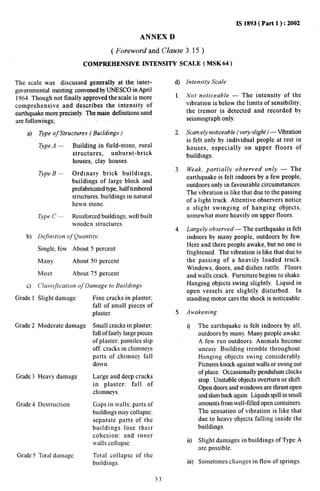
intensity in future. The Intensity as per Comprehensive Intensity Scale ( MSK64 ) ( see Annex D ) broadly 
associated with the various zones is VI ( or less ), VII, VIII and IX ( and above ) for Zones II, III, IV and V 
respectively. The maximum seismic ground acceleration in each zone cannot be presently predicted with 
3
IS 1893( Part 1 ) :2002 
accuracy either on a deterministic or on a probabilistic basis. The basic zone factors included herein are 
reasonable estimates of effective peak ground accelerations for the design of various structures covered in 
this standard. Zone factors for some important towns are given in Annex E. 
Base isolation and energy absorbing devices may be used for earthquake resistant design. Only standard 
devices having detailed experimental data on the performance should be used. The designer must demonstrate 
by detailed analyses that these devices provide sufficient protection to the buildings and equipment as envisaged 
in this standard. Performance of locally assembled isolation and energy absorbing devices should be evaluated 
experimentally before they are used in practice. Design of buildings and equipment using such device should 
be reviewed by the competent authority. 
Base isolation systems are found usefhl for short period structures, say less than 0.7s including soil-structure 
interaction. 
In the formulation of this standard, due weightage has been given to international coordination among the 
standards and practices prevailing in different countries in addition to relating it to the practices in the field 
in this country. Assistance has particularly been derived from the following publications: 
a) UBC 1994, Uniform Building Code, International Conference of Building Officials, Whittier, Ckdifomia, 
U.S.A.1994. 
b) NEHRP 1991, NEHRP Recommended Provisions for the Development of Seismic Regulations for New 
Buildings, Part 1: Provisions,ReportNo.FEMA 222, Federal EmergencyManagement Agency,WashingtO% 
D.C., U.S.A., January 1992. 
c) NEHRP 1991, NEHRP Recommended Provisions for the Development of Seismic Regulations for New 
Buildings, Part 2: Commentary, Report No. FEMA 223, Federal Emergency Management Agency, 
Washington, D. C., U.S.A., January 1992. 
d) NZS 4203:1992, Code of Practice for General Structural Design and Design Loadings for Buildings, 
Standards Association of New Zealand, Wellington, New Zealand, 1992. 
In the preparation of this standard considerable assistance has been given by the Department of Earthquake 
Engineering, University of Roorkee; Indian Institute of Technology, Kanpuq IIT Bombay, Mumbai; Geological 
Survey of India; India Meteorological Department, and several other organizations. 
The units used with the items covered by the symbols shall be consistent throughout this standard, unless 
specifically noted otherwise. 
The composition of the Committee responsible for the formulation of this standard is given in Annex F. 
For the purpose of deciding whether a particular requirement of this standard is complied with, the final value 
observed or calculated, expressing the result of a test or analysis, shall be rounded off in accordance with 
IS 2:1960 ‘Rules for rounding off numerical values ( revised )’. The number of signflcant places retained in 
the rounded off value should be the same as that of the specified value in this standard. 
(Earthquake Engineering Sectional Committee, CED 39 ) 
4
As in the Original Standard, this Page is Intentionally Left Blank
IS 1893( Part 1 ): 2002 
Indian Standard 
CRITERIA FOR EARTHQUAKE RESISTANT 
DESIGN OF STRUCTURES 
PART 1 GENERAL PROVISIONS AND BUILDINGS 
( Ffth Revision ) 
1 SCOPE 
1.1 This standard ( Part 1 ) deals with assessment of 
seismic loads on various structures and earthquake 
resistant design of buildings. Its basic provisions 
are applicable to buildings; elevated structures; 
industrial and stack like structures; bridges; concrete 
masonry and earth dams; embankments and retaining 
walls and other structures. 
1.2 Temporary elements such as scaffolding, temponuy 
excavations need not be designed for earthquake 
forces. 
1.3 This standard does not deal with the construction 
features relating to earthquake resistant design in 
buildings and other structures. For guidance on 
earthquake resistant construction of buildings, 
reference may be made to the following Indian 
Standards: 
IS 4326,1S 13827,IS 13828,IS 13920and IS 13935. 
2 REFERENCES 
2.1 The following Indian Standards are necessary 
adjuncts to this standard: 
Is No. 
456:2000 
800:1984 
875 
(Part l): 1987 
(Part 2):1987 
(Part 3):1987 
(Part4 ):1987 
(Part 5):1987 
Title 
Code of practice for plain and 
reinforced concrete ( fourth 
revision ) 
Code of practice for general 
construction in steel ( second 
revision ) 
Code of practice for design loads 
( other than earthquake ) for buildings 
and structures: 
Dead loads — Unit weights of 
building material and storedmaterials 
( second revision) 
Imposed loads ( second revision) 
Wind loads ( second revision) 
Snow loads ( second revision) 
Special loads and load combinations 
( second revision) 
IS No. 
1343:1980 
1498:1970 
1888:1982 
1893 (Part4) 
2131:1981 
2809:1972 
2810:1979 
4326:1993 
6403:1981 
13827:1993 
13828:1993 
13920:1993 
13935:1993 
Title 
Code of practice for pre-stressed 
concrete (first revision ) 
Classification and identification of 
soils for general engineering 
purposes (first revision ) 
Method of load test on soils (second 
revision ) 
Criteria for earthquake resistant 
design of structures: Part 4 Industrial 
structures including stack like 
structures 
Method of standard penetration test 
for soils (first revision ) 
Glossary of terms and symbols 
relating to soil engineering ( jirst 
revision ) 
Glossary of terms relating to soil 
dynamics (fzrst revision) 
Earthquake resistant design and 
construction of buildings — Code 
of practice ( second revision ) 
Code of practice for determination 
of bearing capacity of shallow 
foundations (first revision ) 
Improving earthquake resistance of 
earthen buildings — Guidelines 
Improving earthquake resistance of 
low strength masonry buildings — 
Guidelines 
Ductile detailing of reinforced 
concrete structures subjected to 
seismic forces — Code of practice 
Repair and seismic strengthening of 
buildings — Guidelines 
SP 6 ( 6 ) :1972 Handbook for structural engineers: 
Application of plastic theory in 
design of steel structures 
7
IS 1893( Part ) :2002 
3 TERMINOLOGY FOR EARTHQUAKE 
ENGINEERING 
3.1 For the purpose of this standard, the following 
definitions shall apply which are applicable generally 
to all structures. 
NOTE — For the definitions of terms pertaining to soil 
mechanics and soil dynamics references may be made 
to IS 2809 and IS 2810. 
3.2 Closely-Spaced Modes 
Closely-spaced modes of a structure are those of its 
natural modes of vibration whose natural frequencies 
differ from each other by 10 percent or less of the 
lower frequency. 
3.3 Critical Damping 
The damping beyond which the free vibration motion 
will not be oscillatory. 
3.4 Damping 
The effect of internal friction, imperfect elasticity of 
material, slipping, sliding, etc in reducing the amplitude 
of vibration and is expressed as a percentage of critical 
damping. 
3.5 Design Acceleration Spectrum 
Design acceleration spectrum refers to an average 
smoothened plot of maximum acceleration as a fimction 
of frequency or time period of vibration for a specitled 
damping ratio for earthquake excitations at the base 
of a single degree of freedom system. 
3.6 Design Basis Earthquake ( DBE ) 
It is the earthquake which can reasonably be expected 
to occur at least once during the design life of the 
structure. 
3.7 Design Horizontal Acceleration Coefficient 
(Ah) 
It is a horizontal acceleration coefficient that shall be 
used for design of structures. 
3.8 Design Lateral Force 
It is the horizontal seismic force prescribed by this 
standard, that shall be used to design a structure. 
3.9 Ductility 
Ductility of a structure, or its members, is the capacity 
to undergo large inelastic deformations without 
significant loss of strength or stiffness. 
3.10 Epicentre 
The geographical point on the surface of earth vertically 
above the focus of the earthquake. 
3.11 Effective Peak Ground Acceleration ( EPGA ) 
It is O.4 times the 5 percent damped average spectral 
acceleration between period 0.1 to 0.3 s. This shall 
be taken as Zero Period Acceleration ( ZPA ). 
3.12 Floor Response Spectra 
Floor response spectra is the response spectra for a 
time history motion of a floor. This floor motion time 
history is obtained by an analysis of multi-storey 
building for appropriate material damping values 
subjected to a specified earthquake motion at the base 
of structure. 
3.13 Focus 
The originating earthquake source of the elastic waves 
inside the earth which cause shaking of ground due 
to earthquake. 
3.14 Importance Factor (1) 
It is a factor used to obtain the design seismic force 
depending on the functional use of the structure, 
characterised by hazardous consequences of its failure, 
its post-earthquake functional need, historic value, 
or economic importance. 
3.15 Intensity of Earthquake 
The intensity of an earthquake at a place is a measure 
of the strength of shaking during the earthquake, and 
is indicated by a number according to the modified 
Mercalli Scale or M.S.K. Scale of seismic intensities 
(see AnnexD ). 
3.16 Liquefaction 
Liquefaction is a state in saturated cohesionless soil 
wherein the effective shear strength is reduced to 
negligible value for all engineering purpose due to 
pore pressure caused by vibrations during an 
earthquake when they approach the total confining 
pressure. In this condition the soil tends to behave 
like a fluid mass. 
3.17 Lithological Features 
The nature of the geological formation of the earths 
crust above bed rock on the basis of such characteristics 
as colour, structure, mineralogical composition and 
grain size. 
3.18 MagnitudeofEarthquake ( Richter% Magnitude) 
The magnitude of earthquake is a number, which is a 
measure of energy released in an earthquake. It is 
defined as logarithm to the base 10 of the maximum 
trace amplitude, expressed in microns, which the 
standard short-period torsion seismometer ( with a 
period of 0.8s, magnification 2800 and damping nemly 
critical ) would register due to the earthquake at an 
epicentral distance of 100 km. 
8
3.19 Maximum Considered Earthquake ( MCE ) 
The most severe earthquake effects considered by 
this standard. 
3.20 Modal Mass ( lf~ ) 
Modal mass of a structure subjected to horizontal or 
vertical, as the case maybe, ground motion is apart 
of the total seismic mass of the structure that is effective 
in mode k of vibration. The modal mass for a given 
mode has a unique value irrespective of scaling of 
the mode shape. 
3.21 Modal Participation Factor ( Pk) 
Modal participation factor of mode k of vibration is 
the amount by which mode k contributes to the overall 
vibration of the structure under horizontal and vertical 
earthquake ground motions. Since the amplitudes of 
95 percent mode shapes can be scaled arbitrarily, the 
value of this factor depends on the scaling used for 
mode shapes. 
3.22 Modes of Vibration ( see Normal Mode) 
3.23 Mode Shape Coefficient ( $i~) 
When a system is vibrating in normal mode k, at any 
particular instant of time, the amplitude of mass 
i expressed as a ratio of the amplitude of one of the 
masses of the system, is known as mode shape 
coefficient ( @i~). 
3.24 Natural Period (T) 
Natural period of a structure is its time period of 
undamped free vibration. 
3.24,1 Fundamental Natural Period ( T1) 
It is the first ( longest ) modal time period of vibration. 
3.24.2 Modal Natural Period ( T~) 
The modal natural period of mode k is the time period 
of vibration in mode k. 
3.25 Normal Mode 
A system is said to be vibrating in a normal mode when 
all its masses attain maximum values of displacements 
and rotations simultaneously, and pass through 
equilibrium positions simultaneously. 
3.26 Response Reduction Factor (R) 
It is the factor by which the actual base shear force, 
that would be generated if the structure were to remain 
elastic during its response to the Design Basis 
Earthquake (DBE ) shaking, shall be reduced to obtain 
the design lateral force. 
3.27 Response Spectrum 
The representation of the maximum response of 
IS 1893( Part 1 ) :2002 
idealized single degree freedom systems having certain 
period and damping, during earthquake ground 
motion. The maximum response is plotted against the 
undamped natural period and for various damping 
values, and can be expressed in terms of maximum 
absolute acceleration, maximum relative velocity, or 
maximum relative displacement. 
3.28 Seismic Mass 
It is the seismic weight divided by acceleration due 
to gravity. 
3.29 Seismic Weight (W) 
It is the total dead load plus appropriate amounts of 
specified imposed load. 
3.30 Structural Response Factors ( S,/g ) 
It is a factor denoting the acceleration response 
spectrum of the structure subjected to earthquake 
ground vibrations, and depends on natural period 
of vibration and damping of the structure. 
3.31 Tectonic Features 
The nature of geological formation of the bedrock in 
the earth’s crust revealing regions characterized by 
structural features, such as dislocation, distortion, 
faults, folding, thrusts, volcanoes with their age of 
formation, which are directly involved in the earth 
movement or quake resulting in the above 
consequences. 
3.32 Time History Analysis 
It is an analysis of the dynamic respmse of the structure 
at each increment of time, when its base is subjected 
to a specific ground motion time history. 
3.33 Zone Factor (Z) 
It is a factor to obtain the design spectrum depending 
on the perceived maximum seismic risk characterized 
by Maximum Considered Earthquake ( MCE ) in the 
zone in which the structure is located. The basic zone 
fiwtorsincluded in this standard are reasonable estimate 
of effective peak ground acceleration. 
3.34 Zero Period Acceleration ( ZPA ) 
It is the value of acceleration response spectrum for 
period below 0.03 s ( frequencies above 33 Hz). 
-,. 
4 TERMINOLOGY FOR EARTHQUAKE 
ENGINEERING OF BUILDINGS 
4.1 For the purpose of earthquake resistant design 
ofbuildings in this standard, the following definitions 
shall apply. 
4.2 Base 
It is the level at which inertia forces generated in the 
strnctnre are transferred to the foundation, which then 
transfers these forces to the ground. 
9
IS 1893( Part 1 ) :2002 
4.3 Base Dimensions (d) 
Base dimension of the building along a direction is 
the dimension at its base, in metre, along that direction. 
4.4 Centre of Mass 
The point through which the resultant of the masses 
of a system acts. This point corresponds to the centre 
of gravity of masses of system. 
4.5 Centre of Stiffness 
The point through which the resultant of the restoring 
forces of a system acts. 
4.6 Design Eccentricity ( e~i) 
It is the value of eccentricity to be used at floor i in 
torsion calculations for design. 
4.7 Design Seismic Base Shear ( V~) 
It is the total design lateral force at the base of a 
structure. 
4.8 Diaphragm 
It is a horizontal, or nearly horizontal system, which 
transmits lateral forces to the vertical resisting elements, 
for example, reinforced concrete floors and horizontal 
bracing systems. 
4.9 Dual System 
Buildings with dual system consist of shear walls 
( or braced frames ) and moment resisting frames such 
that: 
a) The two systems are designed to resist the 
total design lateral force in proportion to their 
lateral stiffness considering the interaction 
of the dual system at all floor levels; and 
b) The moment resisting frames are designed 
to independently resist at least 25 percent 
of the design base shear. 
4.10 Height of Floor ( hi ) 
It is the difference in levels between the base of the 
building and that of floor i. 
4.11 Height of Structure(k) 
It is the difference in levels, in metres, between its 
base and its highest level. 
4.12 Horizontal Bracing System 
It is a horizontal truss system that serves the same 
function as a diaphragm. 
4.13 Joint 
It is the portion of the column that is common to other 
members, for example, beams, framing into it. 
4.14 Lateral Force Resisting Element 
It is part of the structural system assigned to resist 
lateral forces. 
4.15 Moment-Resisting Frame 
It is a frame in which members and joints are capable 
of resisting forces primarily by flexure. 
4.15.1 Ordinary Moment-Resisting Frame 
It is a moment-resisting frame not meeting special 
detailing requirements for ductile behaviour. 
4.15.2 Special Moment-Resisting Frame 
It is a moment-resisting frame specially detailed 
to provide ductile behaviour and comply with 
the requirements given in IS 4326 or IS 13920 or 
SP6(6). 
4.16 Number of Storeys ( n ) 
Number of storeys of a building isthe number of levels 
above the base. This excludes the basement storeys, 
where basement walls are connected with the ground 
floor deck or fitted between the building columns. But, 
it includes the basement storeys, when they are not 
so connected. 
4.17 Principal Axes 
Principal axes of a building are generally two mutually 
perpendicular horizontal directions inphmof abuilding 
along which the geometry of the building is oriented. 
4.18 P-A Effect 
It is the secondary effect on shears and moments of 
frame members due to action of the vertical loads, 
interacting with the lateral displacement of building 
resulting from seismic for~es. 
4.19 Shear Wall 
It is a wall designed to resist lateral forces acting in 
its own plane. 
4.20 Soft Storey 
It is one in which the lateral stiffness is less than 
70 percent of that in the storey above or less than 
80 percent of the average lateral stiffness of the three 
storeys above. 
4.21 Static Eccentricity ( e~l) 
It is the distance between centre of mass and centre 
of rigidity of floor i. 
4.22 Storey 
It is the space between two adjacent floors. 
4.23 Storey Drift 
It is the displacement of one level relative to the other 
level above or below. 
10
4.24 Storey Shear ( ~) 
It is the sum of design lateral forces at all levels above 
the storey under consideration. 
4.25 Weak Storey 
It is one in which the storey lateral strength is less 
than 80 percent of that in the storey above, The storey 
lateral strength is the total strength of all seismic force 
resisting elements sharing the storey shear in the 
considered direction. 
5 SYMBOLS 
The symbols and notations given below apply to the 
provisions of this standard: 
.4h 
A~ 
bi 
c 
d 
DL 
‘dl 
e S1 
ELX 
ELY 
EL, 
Froof 
Fi 
$? 
h 
hi 
I 
IL 
h4k 
Design horizontal seismic coefficient 
Design horizontal acceleration spectrum 
value for mode “kof vibration 
ith Floor plan dimension of the building 
perpendicular to the direction of force 
Index for the closely-spaced modes 
Base dimension of the building, in metres, 
in the direction in which the seismic force 
is considered. 
Response quantity due to dead load 
Design eccentricity to be used at floor i 
calculated as per 7.8.2 
Static eccentricity at floor i defined as the 
distance between centre of mass and centre 
of rigidity 
Response quantity due to earthquake load 
for horizontal shaking along x-direction 
Response quantity due to earthquake load 
for horizontal shaking along y-direction 
Response quantity due to earthquake load 
for vertical shaking along z-direction 
Design lateral forces at the roof due to all 
modes considered 
Design lateral forces at the floor i due to 
all modes considered 
Acceleration due to gravity 
Height of structure, in metres 
Height measured from the base of the 
building to floor i 
Importance factor 
Response quantity due to imposed load 
Modal mass of mode k 
11 
n 
N 
Pk 
Q, 
Q~~ 
r 
R 
S’a/g 
T 
~ 
Tk 
T1 
VB 
pB 
q 
qk 
vroof 
w 
Wi 
z 
Oik 
a 
% 
kc 
A* 
IS 1893( Part 1 ) :2002 
Number of storeys 
SPT value for soil 
Modal participation factor of mode k 
Lateral force at floor i 
Design lateral force at floor i in mode k 
Number of modes to be considered as per 
7.8.4.2 
Response reduction factor 
Average response acceleration coefficient 
for rock or soil sites as given by Fig. 2 
and Table 3 based on appropriate natural 
periods and damping of the structure 
Undamped natural period of vibration of 
the structure (in second ) 
Approximate fundamental period ( in 
seconds ) 
Undamped natural period of mode k of 
vibration (in second ) 
Fundamental natural period of vibration 
(in second ) 
Design seismic base shear 
Design base shear calculated using the 
approximate fimdamental period T, 
Peak storey shear force in storey i due to 
all modes considered 
Shear force in storey i in mode k 
Peak storey shear force at the roof due to 
all modes considered 
Seismic weight of the structure 
Seismic weight of floor i 
Zone factor 
Mode shape coet%cient at floor i in mode 
k 
Peak response (for example member forces, 
displacements, storey forces, storey shears 
or base reactions ) due to all modes 
considered 
Absolute value of maximum response in 
mode k 
Absolute value of maximum response in 
mode c, where mode c is a closely-spaced 
mode. 
Peak response due to the closely-spaced 
modes only
IS 1893( Part 1 ) :2002 
Pij Coefficient used in the Complete Quadratic 
Combination ( CQC ) method while 
combining responses of modes i andj 
oi Circular frequency in rad/second in the 
iti mode 
6 GENERAL PRINCIPLES AND DESIGN 
CRITERIA 
6.1 General Principles 
6.1.1 Ground Motion 
The characteristics ( intensity, duratio~ etc ) of seismic 
ground vibrations expected at any location depends 
upon the magnitude of earthquake, its depth of focus, 
distance from the epicentre, characteristics of the path 
through which the seismic waves travel, and the soil 
strata on which the structure stands. The random 
earthquake ground motions, which cause the structure 
to vibrate, can be resolved in any three mutually 
perpendicular directions. The predominant direction 
of ground vibration is usually horizontal. 
Earthquake-generated vertical inertia forces are to be 
considered in design unless checked and proven by 
specimen calculations to be not significant. Vertical 
acceleration should be considered in structures with 
large spans, those in which stability is a criterion for 
design, or for overall stability analysis of structures. 
Reduction in gravity force due to vertical component 
of ground motions can be particularly detrimental in 
cases of prestressed horizontal members and of 
cantilevered members. Hence, special attention should 
be paid to the effect of vertical component of the ground 
motion on prestressed or cantilevered beams, girders 
and slabs. 
6.1.2 The response of a structure to ground vibrations 
is a fimction of the nature of foundation soil; materials, 
form, size and mode of construction of structures; 
and the duration and characteristics of ground motion. 
This standard specifies design forces for structures 
standing on rocks or soils which do not settle, liquefi 
or slide due to loss of strength during ground vibrations. 
6.1.3 The design approach adopted in this standard 
is to ensure that structures possess at least a minimum 
strength to withstand minor earthquakes ( <DBE ), 
which occur frequently, without damage; resist 
moderate earthquakes ( DBE ) without significant 
structural damage though some non-structural damage 
may OCCUEand aims that structures withstand a major 
earthquake ( MCE ) without collapse, Actual forces 
that appear on structures during earthquakes are much 
greater than the design forces speciiled in this standard. 
However, ductility, arising from inelastic material 
behaviourand detailing, and overstrength, arising from 
the additional reserve strength in structures over and 
above the design strength, are relied upon to account 
for this difference in actual and design lateral loads. 
Reinforced and prestressed concrete members shall 
be suitably designed to ensure that premature failure 
due to shear or bond does not occur, subject to the 
provisions of IS 456 and IS 1343. Provisions for 
appropriate ductile detailing of reinforced concrete 
members are given in IS 13920, 
In steel structures, members and their connections 
should be so proportioned that high ductility is obtain~ 
tide SP 6 ( Part 6 ), avoiding premature failure due to 
elastic or inelastic buckling of any type. 
The specified earthquake loads are based upon post-elastic 
energy dissipation in the structure and because 
of this fact, the provision of this standard for design, 
detailing and construction shall be satisfied even for 
structures and members for which load combinations 
that do not contain the earthquake effect indicate larger 
demands than combinations including earthquake. 
6.1.4 Soil-Structure Interaction 
The soil-structure interaction refers to the effects of 
the supporting foundation medium on the motion of 
structure. The soil-structure interaction may not be 
considered in the seismic analysis for structures 
supported on rock or rock-like material. 
6.1.5 The design lateral force specified in this standard 
shall be considered in each of the two orthogonal 
horizontal directions of the structure. For structures 
which have lateral force resisting elements in the two 
orthogonal directions only, the design lateral force 
shall be considered along one direction at a time, and 
not in both directions simultaneously. Structures, 
having lateral force resisting elements (for example 
frames, shear walls ) in directions other than the two 
orthogonal directions, shall be analysed considering 
the load combinations specified in 6.3.2. 
Where both horizontal and vertical seismic forces are 
taken into account, load combinations specified 
in 6.3.3 shall be considered. 
6.1.6 Equipment and other systems, which are 
supported at various floor levels of the structure, will 
be subjected to motions corresponding to vibration 
at their support points. In important cases, it may be 
necessary to obtain floor response spectra for design 
of equipment supports. For detail reference be made 
to IS 1893 (Part 4). 
6.1.7 Additions to Existing Structures 
Additions shall be made to existing structures only 
as follows: 
a) An addition that is structurally independent 
from an existing structures shall be designed 
and constructed in accordance with the 
seismic requirements for new structures. 
12
IS 1893( Part 1 ): 2002 
b) An addition that is not structurally 
independent from an existing structure shall 
be designed and constructed such that 
the entire structure conforms to the seismic 
force resistance requirements for new 
structures unless the following three 
conditions are complied with: 
1) 
2) 
3) 
The addition shall comply with the 
requirements for new structures, 
The addition shall not increase the seismic 
forces in any structural elements of the 
existing structure by more than 5 percent 
unless the capacity of the element 
subject to the increased force is still in 
compliance with this standard, and 
The additicn shall not decrease the 
seismic resistance of any structural 
element of the existing structure unless 
reduced resistance is equal to or greater 
than that required for new structures. 
6.1.8 Change in Occupancy 
When a change of occupancy results in a structure 
being re-classified to a higher importance factor ( 1 ), 
the structure shall conform to the seismic requirements 
for anew structure with the higher importance factor. 
6.2 Assumptions 
The following assumptions shall be made in the 
earthquake resistant design of structures: 
a) 
b) 
c) 
Earthquake causes impulsive ground motions, 
which are complex and irregular in character, 
changing in period and amplitude each lasting 
for a small duration. Therefore, resonance of 
the type as visualized under steady-state 
sinusoidal excitations, will not occur as it 
would need time to buildup such amplitudes. 
NOTE— However, there are exceptions where 
resonance-like conditions have been seen to occur 
between long distance waves and tall structures 
founded on deep soft soils. 
Earthquake is not likely to occur 
simultaneously with wind or maximum flood 
or maximum sea waves, 
The value of elastic modulus of materials, 
wherever required, may be taken as for static 
analysis unless a more definite value is 
available for use in such condition ( see 
IS 456, IS 1343 and IS 800 ) 
6.3 Load Combination and Increase in Permissible 
Stresses 
6.3.1 Load Combinations 
When earthquake forces are considered on a structure, 
13 
these shall be combined as per 6.3.1.1 and 6.3.1.2 
where the terms DL, IL and EL stand for the response 
quantities due to dead load, imposed load and 
designated earthquake load respectively. 
6.3.1.1 Load factors for plastic design of steel 
structures 
In the plastic design of steel structures, the following 
load combinations shall be accounted for: 
1) 1.7( DL.+IL ) 
2) 1.7( DL*EL) 
3) 1.3( DL+lL*EL) 
6.3.1.2 Partial safety factors for limit state design 
of reinforced concrete and prestressed concrete 
structures 
In the limit state design of reinforced and prestressed 
concrete structures, the following load combinations 
shall be accounted for: 
1) 1.5( DL+lL) 
2) 1.2( DL+ZL+EL) 
3) 1.5( DL+EL) 
4) 0.9DL* 1.5EL 
6.3.2 Design Horizontal Earthquake Load 
6.3.2.1 When the lateral load resisting elements are 
oriented along orthogonal horizontal direction, the 
structure shall be designed for the effects due to till 
design earthquake load in one horizontal direction at 
time. 
6.3.2.2 When the lateral load resisting elements are 
not oriented along the orthogonal horizontal directions, 
the stmcture shall be designed for the effects due to 
foil design earthquake load in one horizontal direction 
plus 30 percent of the design earthquake load in the 
other direction. 
NOTE — For instance, the building should be designed 
for ( + ELx i 0.3 EL.y ) as well as ( * 0.3 ELx * ELy ), 
where x and y are two orthogonal horizontal directions, 
EL in 6.3.1.1 and 6.3.1,2 shall be replaced by ( ELx i 
0.3 ELy ) or ( ELy i 0.3 .!Lh ). 
6.3.3 Design Vertical Earthquake Load 
When effects due to vertical earthquake loads are to 
be considered, the design vertical force shall be 
calculated in accordance with 6.4.5. 
6.3.4 Combination for Two or Three Component 
Motion 
6.3.4.1 When responses from the three earthquake 
components are to be considered, the responses due 
to each component may be combined using the
IS 1893( Part 1 ) :2002 
assumption that when the maximum response from 
one component occurs, the responses from the other 
two component are 30 percent of their maximum. All 
possible combinations of the three components ( ELx, 
ELy and ELz ) including variations in sign ( plus or 
minus ) shall be considered, Thus, the response due 
earthquake force (EL ) is the maximum of the following 
three cases: 
1) %ELX*O.3 ELyho.3ELz 
2) *ELy*O.3 ELx&O.3 ELz 
3) *ELz* 0.3 ELx&O.3 ELy 
where x and y are two orthogonal directions and z is 
vertical direction. 
6.3.4.2 As an alternative to the procedure in 6.3.4.1, 
the response (EL ) due to the combined effect of the 
three components can be obtained on the basis of 
‘square root of the sum of the square ( SRSS )‘ that 
is 
EL = ~ (ELx)2+ (ELy)z+(ELz)2 
NOTE — The combination procedure of 6.3.4.1 and 
6.3.4.2 apply to the same response quantity (say, moment 
in a column about its major axis, or storey shear in a 
frame) due to different components of the ground motion. 
6.3.4.3 When two component motions ( say one 
horizontal and one vertical, or only two horizontal) 
are combined, the equations in 6.3.4.1 and 6.3.4.2 
should be modified by del >tingthe term representing 
the response due to the component of motion not being 
considered. 
6.3.5 Increase in Permissible Stresses 
6.3.5.1 Increase impermissible stresses in materials 
When earthquake forces are considered along with 
other normal design forces, the permissible stresses 
in material, in the elastic method of design, maybe 
increased by one-third. However, for steels having a 
definite yield stress, the stress be limited to the yield 
stress; for steels without a definite yield point, the 
stress will be limited to 80 percent of the ultimate 
strength or 0.2 percent proof stress, whichever is 
smaller; and that in prestressed concrete members, 
the tensile stre’ssin the extreme fibers of the concrete 
may be permitted so as not to exceed two-thirds of 
the modulus of rupture of concrete. 
6.3.5.2 Increase in allowable pressure in soils 
When earthquake forces are included, the allowable 
bearing pressure in soils shall be increased as per 
Table 1, depending upon type of foundation of the 
structure and the type of soil. 
In soil deposits consisting of submerged loose sands 
and soils falling under classification SP with 
standard penetration N-values less than 15 in seismic 
14 
Zones III, IV, V and less than 10 in seismic Zone II, 
the vibration caused by earthquake may cause 
liquefaction or excessive total and differential 
settlements. Such sites should preferably be avoided 
while locating new settlements or important projects. 
Otherwise, this aspect of the problem needs to be 
investigated and appropriate methods of compaction 
or stabilization adopted to achieve suitable N-values 
as indicated in Note 3 under Table 1. Alternatively, 
deep pile foundation may be provided and taken to 
depths well into the layer which is not likely to liquefi. 
Marine clays and other sensitive clays are also known 
to lique~ due to collapse of soil structure and will 
need special treatment according to site condition. 
NOTE — Specialist literature may be referred for 
determining liquefaction potential of a site. 
6.4 Design Spectrum 
6.4.1 For the purpose of determining seismic forces, 
the country is classified into four seismic zones as 
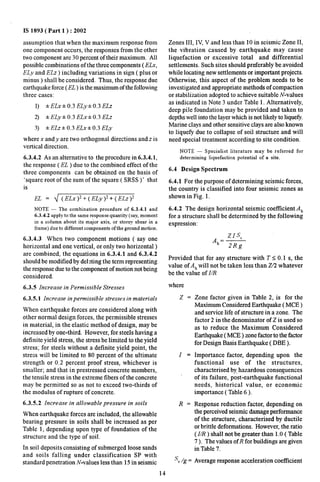
shown in Fig. 1. 
6.4.2 The design horizontal seismic coefficient Ah 
for a structure shall be determined by the following 
expression: 
.zIsa 
Ah=— 
2Rg 
Provided that for any structure with T <0.1 s, the 
value of A~will not be taken less than Z/2 whatever 
be the value of I/R 
where 
z. 
z= 
R= 
S’a/g = 
Zone factor given in Table 2, is for the 
Maximum Considered Earthquake (MCE ) 
and service life of structure in a zone. The 
factor 2 in the denominator of Z is used so 
as to reduce the Maximum Considered 
Earthquake ( MCE ) zone factor to the fktor 
for Design Basis Earthquake ( DBE ). 
Importance factor, depending upon the 
functional use of the structures, 
characterised by.hazardous consequences 
of its failure, post-earthquake functional 
needs, historical value, or economic 
importance ( Table 6 ). 
Response reduction factor, depending on 
the perceived seismic damage performance 
of the structure, characterised by ductile 
or brittle deformations. However, the ratio 
(I/R ) shall not be greater than 1.0( Table 
7). The values ofR for buildings are given 
in Table 7. 
Average response acceleration coefficient
IS 1893( Part 1 ): 2002 
Table 1 Percentage of Permissible Increase in Allowable Bearing Pressure or Resistance of Soils 
(L’lause 6.3.5.2) 
S1 No. Foundation Type of Soil Mainly Constituting the Foundation 
r A > 
Type I Rock or Hard Soil : Type H Medium S&ls : Type III Soft Soils: AU 
Well graded gravel and sand All soils with N between 10 soils other than SP’J 
gravel mixtures with or and 30, and poorly graded with N< 10 
without clay binder, and sands or gravelly sands with 
clayey sands poorly graded little or no fines ( SP1~) 
or sand clay mixtures ( GB, with N> 15 
CW, SB, SW, and SC )1) 
having )@ above 30, where 
N is the standard penetration 
value 
(1) (2) (3) (4) (5) 
1) Piles passing through any 50 50 50 
soil but resting on soil type I 
ii) Piles not covered under 25 25 
item i 
iii) Raft foundations 50 50 50 
iv) Combined isolated RCC 50 25 25 
footing with tie beams 
v) Isolated RCC footing without 50 25 — 
tie beams, or unreinforced 
strip foundations 
vi) Well foundations 50 25 25 
NOTES 
1 The allowable bearing pressure shall be determined in accordance with IS 6403 or IS 1888. 
2 If any increase in bearing pressure has already been permitted for forces other than seismic forces, the total increase 
in allowable bearing pressure when seismic force is also included shall not exceed the limits specified above. 
3 Desirable minimum field values of N — If soils of smaller N-values are met, compacting may be adopted to achieve 
these values or deep pile foundations going to stronger strata should be used. 
4 The values of N ( corrected values ) are at the founding level and the allowable bearing pressure shall be determined in 
accordance with IS 6403 or IS 1888. 
, 
Seismic Zone Depth Below Ground N-Values Remark 
level (in metres ) 
III, IV and V <5 15 
> lo 25 For values of depths between 5 m and 
10 m, linear interpolation is 
11 ( for important <5 15 recommended 
structures only ) > Ir) 20 
1) 
2) 
5 The piles should be designed for lateral loads neglecting lateral resistance of soil layers liable to liquefy. 
6 IS 1498 and IS 2131 may also be referred. 
7 Isolated R, C.C. footing without tie beams, or unreinforced strip foundation shall not be permitted in soft soils with 
N<1O. 
See IS 1498. 
See IS 2131. 
15
IS-1893 ( Part 1 ) :2002 
for rock or soil sites as given by Fig. 2 and 
Table 3 based on appropriate natural periods 
and damping of the structure. These curves 
represent free tleld ground motion. 
NOTE — For various types of structures, the 
values of Importance Factor I, Response Reduction 
Factor R, and damping values are given in the 
respective parts of this standard. The method 
( empirical or otherwise ) to calculate the natural 
periods of the structure to be adopted for evaluating 
S,/g is sdso given in the respective parts of this 
standard. 
Table 2 Zone Factor, Z 
( Clause 6.4.2) 
Seismic II 111 Iv v 
Zone 
Seismic Low Moderate Severe Very 
Intensity Severe 
z 0.10 0.16 0,24 0.36 
6.4.3 Where a number of modes are to be considered 
for dynamic analysis, the value of Ah as defined 
in 6.4.2 for each mode shall be determined using the 
natural period of vibration of that mode. 
6.4.4 For underground structures and foundations 
at depths of 30 m or below, the design horizontal 
acceleration spectrum value shall be taken as half the 
value obtained from 6.4.2. For structures and 
3.0 
2.5 
2.0 
1.5 
1.0 
0.5 
foundations placed between the ground level and 
30m depth, the design horizontal acceleration spectrum 
value shall be linearly interpolated between Ah and 
0.5 Ah, where Ah is as specified in 6.4.2. 
6.4.5 The design acceleration spectrum for vertical 
motions, when required, may be taken as two-thirds 
of the design horizontal acceleration spectrum specitled 
in 6.4.2. 
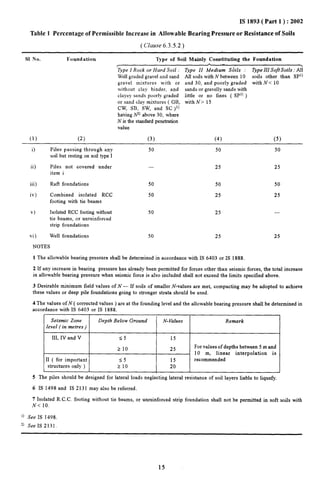
Figure 2 shows the proposed 5 percent spectra for 
rocky and soils sites and Table 3 gives the multiplying 
factors for obtaining spectral values for various other 
clampings. 
For rocky, or hard soil sites 
-1 
1+15~ 0.00< Ts”o.lo 
s, 
g 
= 2.50 O.1O<T<O.4O 
l.00/T 0.40< TS4.00 
For medium soil sites 
I 
1+15~ 
s 
O.OO<TSO.1O 
~ = 2.50 
g 
O.1O<T<O.55 
1.361T 0.55 sT<4.00 
For soft soil sites 
1 
1+15Z 
Sa 
0.00 S T<O.1O 
T 
= 2.50 0.10 S TsO.67 
1.67/T 0.67 ST<4.00 
1 r I r r , , 
Type 1 (Rock, or Hard So 
T 
..... 
‘, Type II (Medium Soil) ‘, ,. 
‘! ,, 
 ‘. /Tv~e II1(Soft Soil) 
h 
— ----------- --.--.--:.. ........ ---------- 
— 
0.0 
0.0 0.5 1.0 1“5 2’0 2“5 3“0 3“5 4“0 
Period(s) 
Fm. 2 RESPONSE SPECTRA ~R ROCKANDSOILSITESFOR5 PERC~ DAMPM 
16
6.4.6 In case design spectrum is specifically prepared 
for a structure at a particular project site, the same 
may be used for design at the discretion of the project 
authorities 
7 BUILDINGS 
7.1 Regular and Irregular Configuration 
To perform well in an earthquake, a building should 
possess four main attributes, namely simple and regular 
cotilguration, and adequate lateral strength, stiffness 
and ductility. Buildings having simple regolar geomet~ 
and uniformly distributed mass and stiffness in plan 
as well as in elevation, suffer much less damage than 
buildings with irregular configurations. A building 
shall be considered as irregular for the purposes of 
this standard, if at least one of the conditions given 
in Tables 4 and 5 is applicable, 
7.2 Importance Factor Zand Response Reduction 
FactorR 
The minimum value of importanm factor,1, for ditlerent 
building systems shall be as given in Table 6. The 
response reduction factor, R, for different building 
systems shall be as given in Table 7. 
7.3 Design Imposed Loads for Earthquakes Force 
Calculation 
7.3.1 For various loading classes as specified in 
IS 875( Part 2 ), the earthquake force shall be calculatcxl 
for the full dead load plus the percentage of imposed 
load as given in Table 8. 
7.3.2 For calculating the design seismic forces of the 
structure, the imposed load on roof need not be 
considered. 
7.3.3 The percentage of imposed loads given in 7.3.1 
and 7.3.2 shall also be used for ‘Whole frame loaded’ 
condition in the load combinations specified in 6.3.L 1 
IS 1893( Part 1 ): 2002 
and 6.3.1.2 where the gravity loads are combined with 
the earthquake loads [ that is, in load combinations 
(3) in 6.3.1.1, and (2) in 6.3.1.2 ]. No further reduction 
in the imposed load will be used as envisaged in 
IS 875( Part 2 ) for number of storeys above the one 
under consideration or for large spans of beams or 
floors. 
7.3.4 The proportions of imposed load indicated above 
for calculating the lateral design forces for earthquakes 
are applicable to average conditions. Where the 
probable loads at the time of earthquake are more 
accurately assessed, the designer may alter the 
proportions indicated or even replace the entire 
imposed load proportions by the actual assessed load. 
In such cases, where the imposed load is not assessed 
as per 7.3.1 and 7.3.2 only that part of imposed load, 
which possesses mass, shall be considered. Lateral 
design force for earthquakes shall not be calculated 
on contribution of impact effects from imposed loads. 
7.3.5 Other loads apart from those given above ( for 
example snow and permanent equipment ) shall be 
considered as appropriate. 
7.4 Seismic Weight 
7.4.1 Seismic Weight of Floors 
The seismic weight of each floor is its full dead load 
plus appropriate amount of imposed load, as specified 
in 7.3.1 and 7.3.2. While computing the seismic weight 
of each floor, the weight of columns and walls in any 
storey shall be equally distributed to the floors above 
and below the storey. 
7.4.2 Seismic Weight of Building 
The seismic weight of the whole building is the sum 
of the seismic weights of all the floors. 
7.4.3 Any weight supported in between storeys shall 
be distributed to the floors above and below in inverse 
proportion to its distance from the floors. 
Table 3 Multiplying Factors for Obtaining Values for Other Damping 
( Clause 6.4.2) 
Damping, o 2 5 7 10 15 20 25 30 
percent 
Factors 3.20 1,40 1.00 0.90 0.80 0.70 0,60 0.55 0.50 
17
IS 1893( Part 1 ) :2002 
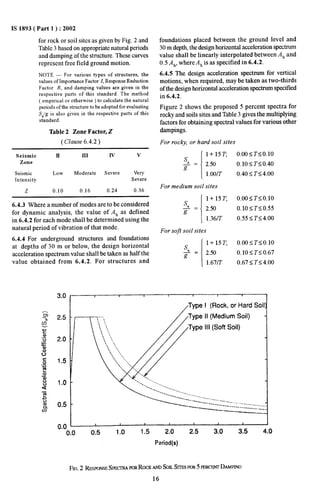
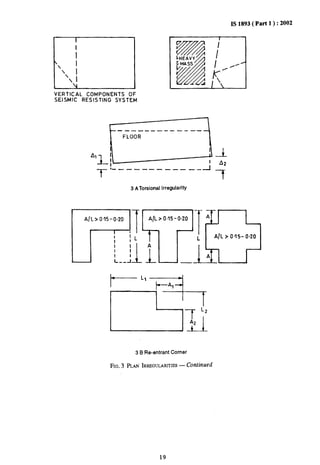
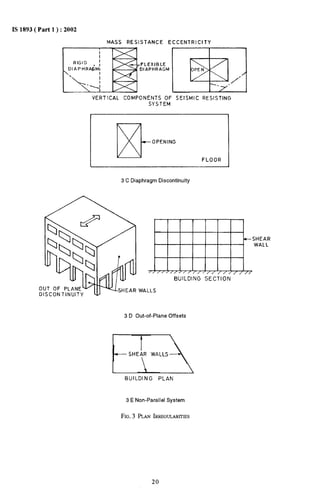
Table 4 Definitions of Irregular Buildings — 
Plan Irregularities ( Fig. 3 ) 
( Clause 7.1 ) 
S1 No. 
(1) 
i) 
ii) 
iii) 
iv) 
v) 
Irregularity Type and Description 
(2) 
Torsion Irregularity 
To be considered when floor diaphragms are rigid 
in their own plan in relation to the vertical structural 
elements that resist the lateral forces. Torsional 
irregularity to be considered to exist when the 
maximum storey drift, computed with design 
eccentricity, at one end of the structures transverse 
to an axis is more than 1.2 times the average of 
the storey drifts at the two ends of the structure 
Re-en?rant Corners 
Plan configurations of a structure and its lateral 
force resisting system contain re-entrant corners, 
where both projections of the structure beyond the 
re-entrant corner are greater than 15 percent of 
its plan dimension in the given direction 
Diaphragm Discontinuity 
Diaphragms with abrupt discontinuities or variations 
in stiffness, including those having cut-out or open 
areas greater than 50 percent of the gross enclosed 
diaphragm area, or changes in effective diaphragm 
stiffness of more than 50 percent from one storey 
to the next 
Out-of-Plane Offsets 
Discontinuities in a lateral force resistance path, 
such as out-of-plane offsets of vertical elements 
Non-parallel Systems 
The vertical elements resisting the lateral force 
are not parallel to or symmetric about the major 
orthogonal axes or the lateral force resisting elements 
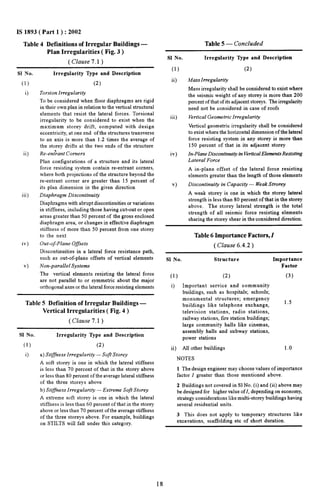
Table 5 Definition of Irregular Buildings — 
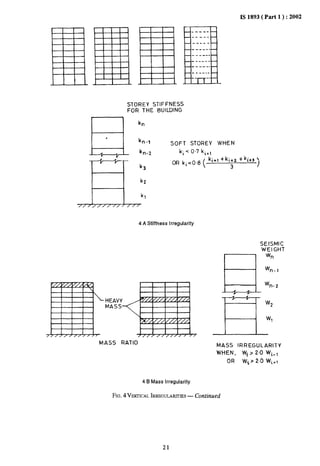
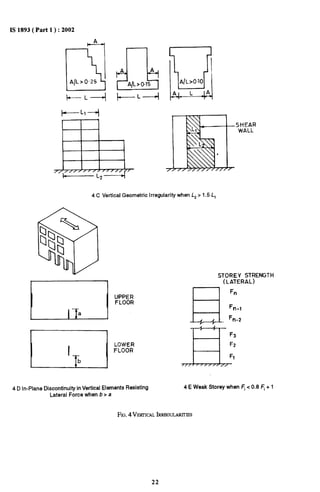
Vertical Irregularities ( Fig. 4 ) 
( Clause 7.1 ) 
S1 No. Irregularity Type and Description 
(1) (2) 
i) a) Stiffness Irregularity —Soft Storey 
A soft storey is one in which the lateral stiffness 
is less than 70 percent of that in the storey above 
or less than 80 percent of the average lateral stiffness 
of the three storeys above 
b) Stiffness Irregularity —Extreme Soft Storey 
A extreme soft storey is one in which the lateral 
stiffness is less than 60 percent of that in the storey 
above or less than 70 percent of the average stiffness 
of the three storeys above. For example, buildings 
on STILTS will fall under this category, 
Table 5 — Concluded 
S1 No. 
(1) 
ii) 
iii) 
iv) 
v) 
Irregularity Type and Description 
(2) 
Mass Irregulari@ 
Mass irregularity shall be considered to exist where 
the seismic weight of any storey is more than 200 
percent of that of its adjacent storeys. The irregularity 
need not be considered in case of roofs 
Vertical Geometric Irregularity 
Vertical geometric irregularity shall be considered 
to exist where the horizontal dimension of the lateral 
force resisting system in any storey is more than 
150 percent of that in its adjacent storey 
In-Plane Discontinuity in VerticalElenrentsResisttng 
Lateral Force 
A in-plane offset of the lateral force resisting 
elements greater than the length of those elements 
Discontinuity in CapaciQ — Weak Strorey 
A weak storey is one in which the storey lateral 
strength is less than 80 percent of that in the storey 
above, The storey lateral strength is the total 
strength of all seismic force resisting elements 
sharing the storey shear in the considered direction. 
Table 6 Importance Factors, 1 
( Clause 6.4.2) 
S1 No. Strue tur e Importance 
Factor 
(1) (2) (3) 
i) Important service and community 
buildings, such as hospitals; schools; 
monumental structures; emergency 
buildings like telephone exchange, 
1.5 
television stations, radio stations, 
railway stations, fire station buildings; 
large community halls like cinemas, 
assembly halls and subway stations, 
power stations 
ii) AU other buildings 1.0 
NOTES 
1 The design engineer may choose values of importance 
factor I greater than those mentioned above. 
2 Buildings not covered in SI No. (i) and (ii) above may 
be designed for higher value ofZ, depending on economy, 
strategy considerations like multi-storey buildings having 
several residential units. 
3 This does not apply to temporary structures like 
excavations, scaffolding etc of short duration. 
18
IS 1893 (Part 1 ): 2002 
I 
I 
  
i, / 
l 
i . 
VERTICAL COMPONENTS OF 
SEISMIC RESISTING SYSTEM 
—-—— -- —.. —.—— 
FLOOR 
i 
i 
Al I 
J_ I Az 
+-----------+f 
3 ATorsional Irregularity 
-r I A L> O-15-0,20 
IL-r 
L ‘7 7 L2 
A2 
Al 
3 B Re-entrant Corner 
FIG. 3 PLAN IRREGULARITI—ES Continued 
19
IS 1893( Part 1 ) :2002 
MASS RESISTANCE ECCENTRICITY m“m VERTICAL COMPONENTS OF SEISMIC RESISTING 
SYSTEM 
EOPENING 
FLOOR 
3 C Diaphragm Discontinuity 
o 
D 
+--SHEAR 
WALL 
///////// ///,’// /////// 
BUILDING SECTION 
WALLS 
3 D Out-of-Plane Offsets 
EE3 BUILDING PLAN 
3 E Non-Parallel System 
FIG.3 PLANIRREGULARITIES 
20
--------------.------------------------------ ---- 
EEEl!iliE13lIS 18i93( Part 1 ) :2002 
STOREY STIFFNESS 
FOR THE BUILDING 
B 
kn 
# 
kn-l 
SOFT STOREY WHEN 
kn-2 ki< 0.7 kl+l 
H 
ki+l +ki+2 +ki+s ~ 
k3 
OR ki<08 ( 
3 1 
kz 
k, 
// / 
4 A Stiffness Irregularity 
SEISMIC 
WEIGHT 
B 
Wn 
w n-l 
n-2 
mw 
W2 
MASS IRREGULARITY 
WHEN, Wt >20 Wi_l 
OR Wi> 20 Wl+l 
4 B Mass Irregularity 
FIG.4 VERTICALIRREGULARITI—ESContinued 
21
IS 1893( Part 1 ): 2002 
QA A&j 
AIL >0-15 AIL>O-10 
ALA 
4 C Vertical Geometric Iregularity when L2>1.5 L, 
STOREY STRENGTH 
B.(LATERAL) Fn 
Fn.l 
Fn.2 
4 D In-Plane Discontinuity in Vertical Elements Resisting 4 E weak Storey when ~ c 0,8 ~ + 1 
Lateral Force when b > a 
FIG.4 VEKHCALIRREGULAIUHSS 
22
IS 1893( Part 1 ): 2002 
Table 7 Response Reduction Factor l), R, for Building Systems . 
( Clause 6.4.2) 
S1 No. Lateral Load Resisting System R 
(1) 
i) 
ii) 
iii) 
iv) 
v) 
vi) 
vii) 
viii) 
ix) 
x) 
xi) 
(2) 
Building Frame Systems 
Ordinary RC moment-resisting frame ( OMRF )2) 
Special RC moment-resisting frame ( SMRF )3) 
Steel frame with 
. 
a) Concentric braces 
b) Eccentric braces 
Steel moment resisting frame designed as per SP 6 ( 6 ) 
Building with Shear Walls4~ 
Load bearing masonry wall buildings) 
a) Unreinforced 
b) Reinforced with horizontal RC bands 
c) Reinforced with horizontal RC bands and vertical bars at corners of rooms and 
jambs of openings 
Ordinary reinforced concrete shear walls@ 
Ductile shear walls7) 
Buildings with Dual Systemss) 
Ordinary shear wall with OMRF 
Ordinary shear wall with SMRF 
Ductile shear wall with OMRF 
Ductile shear wall with SMRF 
(3) 
3.0 
5.0 
4.0 
5.0 
5.0 
1.5 
2.5 
3.0 
3.0 
4.0” 
3.0 
4,0 
4.5 
5.0 
0 The va]ues of response riduction fact&s are to be used for buildings with lateral load resisting elements, and not Just 
for the lateral load resisting elements built in isolation. 
2) OMRF are those designed and detailedas per IS 456 or Is 800” but not meeting ductile detailing reqllirertleMllt 
per IS 13920 or SP 6 (6) respectively. 
3) 
4) 
5) 
6) 
n 
s) 
SMRF defined in 4.15.2. 
Buildings with shear walls also include buildings having shear walls and frames, but where: 
a) frames are not designed to carry lateral loads, or 
b) frames are designed to carry lateral loads but do not fulfil the requirements of ‘dual systems’. 
Reinforcement should be as per IS 4326. 
Prohibited in zones IV and V. 
Ductile shear walls are those designed and detailed as per IS 13920. 
Buildings with dual systems consist of shear walls ( or braced frames ) and moment resisting frames such that: 
a) the two systems are designed to resist the total design force in proportion to their lateral stiffness considering 
the interaction of the dual system at all floor levels,; and 
b) the moment resisting frames are designed to independently resist at least 25 percent of the design seismic base 
shear, 
.23
IS 1893( Part 1 ): 2002 
Table 8 Percentage of Imposed Load to be 
Considered in Seismic Weight Calculation 
(Clause 7.3.1 ) 
Imposed Uniformity Percentage of Imposed 
Distributed Floor Load 
Loads ( kN/ mz ) 
(1) (2) 
Upto and including 3.0 25 
Above 3.0 50 
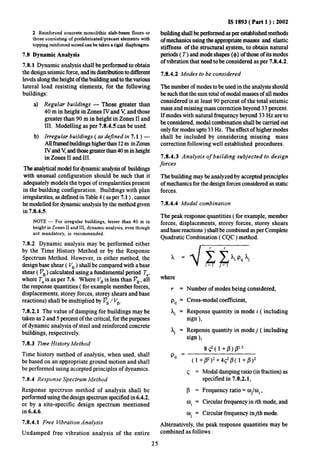
7.5 Design Lateral Force 
7.5.1 Buildings andportionsthereofshall be designed 
and constructed, to resist the effects of design lateral 
force specified in 7.5.3 as a minimum. 
7.5.2 The design lateral force shall first be computed 
for the building as a whole. This design lateral force 
shall then be distributed to the various floor levels. 
The overall design seismic force thus obtained at each 
floor level, shall thenbe distributed to individual lateral 
load resisting elements depending on the floor 
diaphragm action. 
7.5.3 Design Seismic Base Shear 
The total design lateral force or design seismic base 
shear ( VB)along any principal direction shall 
be determined by the following expression: 
where 
Ah = 
w. 
V~ = AhW 
Design horizontal acceleration spectrum 
value as per 6.4.2, using the fundamental 
natural period T,as per 7.6 in the considered 
direction of vibration, and 
Seismic weight of the building as per 7.4.2. 
7.6 Fundamental Natural Period 
7.6.1 The approximate fundamental natural period 
of vibration ( T, ), in seconds, of a moment-resisting 
frame building without brick in.fd panels may be 
estimated by the empirical expression: 
T. = 0,075 h07s for RC frame building 
= 0.085 h075 for steel frame building 
where 
h = Height of building, in m. This excludes 
the basement storeys, where basement walls 
are connected with the ground floor deck 
or fitted between the building columns. 
But it includes the basement storeys, when 
they are not so connected. 
7.6.2 The approximate fundamental natural period 
of vibration ( T, ), in seconds, of all other buildings, 
including moment-resisting fimne buildings with brick 
intil panels, may be estimated by the empirical 
expression: 
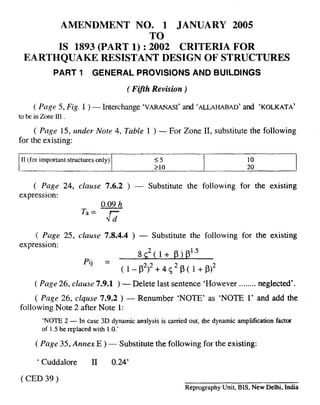
0.09 
‘= m 
where 
h= 
d= 
Height ofbuilding, inw as defined in7.6.l; 
and 
Base dimension of the building at the plinth 
level, in m, along the considered direction 
of the lateral force. 
7.7 Distribution of Design Force 
7.7.1 Vertical Distribution of Base Shear to Differmt 
Floor LeveLr 
The design base shear ( V~) computed in 7.5.3 shall 
be distributed along the height of the building as per 
the following expression: 
W h,z 
Qi=J’B. l’ 
where 
Qi = 
Wi = 
hi = 
n . 
Design lateral force at floor i, 
Seismic weight of floor i, 
Height of floor i measured from base, and 
Number of storeys in the building is the 
number of levels at which the masses are 
located. 
7.7.2 Distribution of Horizontal Design Lateral Force 
to Different Lateral Force Resisting Elements 
7.7.2.1 In case of buildings whose floors are capable 
of providing rigid horizontal diaphragm action, the 
total shear in any horizontal plane shall be distributed 
to the various vertieal elements of lateral force resisting 
system, assuming the floors to be infinitely rigid in 
the horizontal plane. 
7.7.2.2 In case of building whose floor diaphragms 
can not be treated as infinitely rigid in their own plane, 
the lateral shear at each floor shall be distributed to 
the vertical elements resisting the lateral forces, 
considering the in-plane flexibility of the diaphragms. 
NOTES 
1 A floor diaphragm shaJl be considered to be flexible, 
if it deforms such that the maximum lateral displacement 
measured from the chord of the deformed shape at 
any point of the diaphragm is more than 1.5 times the 
average displacement of the entire diaphragm. 
24 .
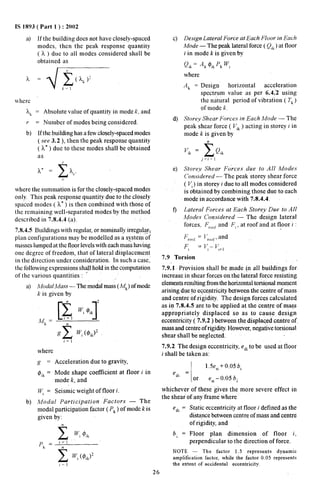
7.8 
2 Reinforced concrete monolithic slab-beam floors or 
those consisting of prefabricated/precast elements with 
topping reinforced screed can be taken a rigid diaphragms. 
Dynamic Analysis 
7.8.1 Dynamic analysis shall be pefiormed to obtain 
the design seismic force, andits distributionto different 
levels along the height of the building andtothevarious 
lateral load resisting elements, for the following 
buildings: 
a) Regular buildings — Those greater than 
40 m in height in Zones IV and ~ and those 
greater than 90 m in height in Zones II and 
111. Modelling as per 7.8.4.5 can be used. 
b) irregular buildings ( as defined in 7.1 ) — 
Allfiamedbuildingshigherthan12minZones 
IVand~andthosegreaterthan40minheight 
in Zones 11and III. 
Theanalyticalmo&l fordynamicanalysisof buildings 
with unusual configuration should be such that it 
adequately models the types of irregularities present 
in the building configuration. Buildings with plan 
irregularities,as defimedin Table4 ( as per7.1 ), cannot 
be modelled for dynamic analysisby the method given 
in 7.8.4.5. 
NOTE — For irregular buildings, lesser than 40 m in 
height in Zones 11and III, dynamic anrdysis, even though 
not mandatory, is recommended. 
7.8.2 Dynamic analysis may be performed either 
by the Time History Method or by the Response 
Spectrum Method. However, in either method, the 
design base shear ( VB) shall be compared with abase 
shmr ( J?B) calculated using a fundamental period T,, 
where T, is as per 7.6. Where t’~is less than ~~, all 
the response quantities (for example memberforces, 
displacements, storey forces, storey shears and base 
reactions) shall be multiplied by ~~ / V~. 
7.8.2.1 The value of damping for buildings maybe 
takenas 2 and 5 percentof the critical,forthe purposes 
of dynamic analysis of steel and reinforced concrete 
buildings, respectively. 
7.8.3 TimeHistory Method 
Time history method of analysis, when used, shall 
be based on an appropriate ground motion and shall 
be performed using accepted principles of dynamics. 
‘7.8.4 Response Spectrum Method 
Response spectrum method of analysis shall be 
performed using the design spectrum specified in 6.4.2, 
or by a site-specific design spectrum mentioned 
in 6.4.6. 
7.8.4.1 Free Ebration Analysis 
Undamped free vibration analysis of the entire 
25 
IS 1893( Part 1 ): 2002 
building shall be petiormed as per establishedmethods 
of mechanicsusing the appropriatemasses and elastic 
stiffness of the structural system, to obtain natural 
periods (T) and mode shapes {$} of those of its modes 
of vibration that need to be considered as per 7.8.4.2. 
7.8.4.2 Modes to be considered 
The number of modes to be used in the analysis should 
be such that the sum total of modal masses of all modes 
considered is at least 90 percent of the total seismic 
mass and missing mass correction beyond 33 percent. 
If modes with natural frequency beyond33 Hz are to 
be considered, modal combination shall be carried out 
only for modes upto 33 Hz. The effect of higher modes 
shall be included by considering missing mass 
correction following well established procedures. 
7.8.4.3 Analysis of building subjected to design 
forces 
The building may be analyzed by accepted principles 
of mechanics for the design forces considered as static 
forces. 
7.8.4.4 Modal combination 
The peak response quantities ( for example, member 
forces, displacements, storey forces, storey shears 
and base reactions ) shall be combined as per Complete 
Quadratic Combination ( CQC ) method. 
I ,, 
where 
r . 
pij = 
Ai = 
Lj = 
Number of modes being considered, 
Cross-modal coeffkient, 
Response quantity in mode i ( including 
sign ), 
Response quantity in mode j ( including 
sign ), 
8&(l+J3)~15 
pij = 
(l+p2)2+452p( l+/.3)2 
~= 
p= 
0.),= 
(l)j= 
Modal damping ratio (in ffaction) as 
specified in 7.8.2.1, 
Frequency ratio = O,/(oi, 
Circular frequeney in ith mode, and 
Circular frequeney injth mode. 
Alternatively, the peak response quantities may be 
combined as follows:
IS 1893 ( Part 1 ) : 20{)2 
a) If the building does not have closely-spaced 
modes, then the peak response quantity 
( k ) due to all modes considered shall be 
obtained as 
k~ = Absolute value of quantity in mode k, and 
r = Number of modes being considered 
b) If the building has a few closely-spaced modes 
( see 3.2), then the peak response quantity 
( k“ ) due to these modes shall be obtained 
as 
where the summation is for the closely-spaced modes 
only This peak response quantity due to the closely 
spaced modes ( L“ ) is then combined with those of 
the remaining well-separated modes by the method 
described in 7.8.4.4 (a). 
7.8.4.5 Buildings with regular, or nominally irregyla~{ 
plan configurations may be modelled as a system of 
nm.ses lumped at the floor levels with each mass having 
one degree of freedom, that of lateral displacement 
in the direction under consideration. In such a case; 
the following expressions shall hold in the computation 
of the various quantities : “ 
a) A40dalA4ass — The mockdmass (M~)of mode 
k is given by 
where 
~ = Acceleration due to gravity, 
$i~ = Mode shape coefficient at floor J in 
mode k, and 
Py = Seismic weight of floor i. 
b) Modal Participation Factors — The 
modal participation factor ( P~ ) of mode k is 
given by: 
n x ‘, @,k 
,=1 
c) 
d) 
e) 
f) 
Design Lateral Force at Each Floor in Each 
Mode — The peak lateral force ( Qi~) at floor 
i in mode k is given by 
Q,k= .4k ~,~‘k ‘, 
where 
.4k = Design’ horizontal acceleration 
spectrum value as per 6.4.’2 using 
the natural period of vibration ( Tk) 
of mode k. 
Storey Shear Forcev in Each Mode — The 
peak shear force ( P’,k) acting in storey i in 
mode k is given by 
& 
j=l+l 
Storey Shear Forcetv due to .411 A40dev 
C’onividered — The peak storey shear force 
( Vi) in storey i due to all modes considered 
is obtained by combining those due to each 
mode in accordarice with 7:8.4.4. 
Lateral ~orces at Each Storey Due to .411 
Mode,v Con,videred — The design lateral 
forces, F,,,,,f and F,, at roof and at floor i : 
F,,,,,f = I;,,(,f, and 
F, * [/;– J.:+, 
7.9 Torsion 
.! 
7.9.1 Provision shall be made jn all buildings for. 
increase in shear forces on.the lateral force resisting 
elements resulting from the horizontal torsional moment 
arising due to eccentricity between the centre of mass 
and centre of rigidity. The design forces calculated 
as in 7,8.4.5 are to be applied at the centre of nl~s 
appropriately displaced so as to cause design 
eccentricity ( 7.9.2 ) between the displaced centre of, 
mass and centre of rigidity. However, negative torsional 
shear shall be neglected. 
7.9.2 The design eccentricity, e~ito be used at floor 
-. 
i shall be taken as: 
,1 
1.5e,, + 0,05 b, 
‘dl = 
or e,i – 0.05 bi 
whichever of these gives the more severe effect 
the shear of any ’frame where 
n 
‘dl = Static eccentricity at floor i defined as the 
distance between centre of mass and centre 
of rigidity, and 
b, = Floor plan dimension of floor i, 
perpendicular to the direction of force. 
NOTE — The factor 1.5 represents dynamic 
amplification factor, while the factor 0,05 represents 
the extent of accidental eccentricity. 
26
IS 1893( Part 1 ) :2002 
7.9.3 In case of highly irregular buildings analyzed 
according to 7.8.4”.5, additive shears will be 
superimposed for a statically applied eccentricity of 
+ ().()5b, with respect to the centre of rigidity 
7.10 Buildings with Soft Storey 
7.10.1 In case buildings with a flexible storey, such 
as the ground storey consisting of open spaces for 
parking that is Stilt buildings, special arrangement needs 
to be made to increase the lateral strength and stiffness 
of the soft/open storey. 
7.10.2 Dynamic analysis of building is carried out 
including the strength and stiffness effects of infills 
and inelastic deformations in the members, particularly, 
those in the soft storey, and the members designed 
direction under consideration, do not lose their vertical 
load-carrying capacity under the induced moments 
resulting from storey deformations equal to R times 
the storey displacements calculated as per 7.11.1. 
where R is specified in Table 7. 
NOTE— For instauce, cnnsider a flat-slab building in 
which lateral Inad resistance is provided by shear walls. 
Since the Isstersdload resistance rfthe slab-column system 
is small. these are nften designed nnly for the gravity 
loads, while all the seismic force is resisted by the shear 
walls. Even thnugh the slabs and columns are not required 
to share the lateral forces, these det-orm with rest ot’ 
the structure. under seismic force, The concern is tbtit 
under such detbrmations, the slab-column system should 
not lose its vertical Iuad capucity. 
7.11.3 Separation Between .4djacent [Jnits 
accordingly, Two adjacent buildings. or two adjacent units of the 
same building with separatiolljoint in between shall 
7.10.3 Alternatively, the following design criteria are 
to be adopted after carrying out the earthquake 
be separated by a distance equal to the amount R times 
analysis, neglecting the effect of infill walls in other 
the sum of the calculated storey displacements as per 
7.11.1 of each of them, to avoid damaging con~act 
storeys: when the two units deflect towards each other. When 
a) the columns and beams of the soft storey are floor levels of two similar adjacent units or buildings 
to be designed for 2.5 times the storey shears are at the same elevation levels, factor R in this 
and moments calculated under seismic loads requirement may be replaced by R/2. 
specified in the other relevant clauses: or. 7.12 Miscellaneous 
b) besides the columns designed and detailed 
for the calculated storey shears and moments, 
shear walls placed symmetrically in both 
directions of the building as far away from 
the centre of the building as feasible; to be 
designed exclusively for 1.5 times the lateral 
storey shear force calculated as before, 
7.11 Deformations 
7.11.1 Store,v Drift Limitation 
7.12.1 Foundations 
The use of foundations vulnerable to significant 
differential settlement due to ground shaking shall 
be avoided for structures in seismic Zones III, IV and 
V In seismicZones IV and V,individual spread footings 
or pile caps shall be interconnected with ties, 
( .~ee5.3.4.1 of 1S4326 ) except when individual spread 
footings are directly supported on rock. All ties shall 
be capable of carrying, in tension and in compression, 
an axial force equal to .4, /4 times the larger of the 
,1 
The storey drift in any storey due to the minimum column or pile cap load, in addition to the otherwise 
specified design lateral force, with partial load factor computed forces, Here, i4h is as per 6.4.2. 
of 1,(). shall not exceed O.()()4 times the storey height, 7.12.2 Cantilever Projectioniv 
For the purposes of displacement requirements only 
( see 7.11.1,7.11.2 and 7.11.3 only), it is permissible 
to use seismic force obtained from the computed 
fundamental period (7’) of the building without the 
lower bound limit on design seismic force specified 
in 7.8.2. 
There shall be no drift limit for single storey building 
which has been designed to accommodate storey drift. 
7.11.2 Defer-mation Conlpatibility of Non-Se isnlic 
A~enlhers 
7.12.2.1 Wrtica[ projection,r 
Tower, tanks, parapets, smoke stacks ( chimneys) 
and other vertical cantilever projections attached to 
buildings and projecting above the roof, shall be 
designed and checked for stability for five times the 
design horizontal seismic coefficient Ah specified 
in 6.4.2. In the analysis of the building, the weight 
of these projecting elements will be lumped with the 
roof weight. 
7.12.2.2 Horizontal projection 
For building located in seismic Zones IV and ~ it shall All horizontal projections like cornices and balconies 
be ensured that the structural components, that are shall be designed and checked for stability for 
not a part of the seismic force resisting system in the five times the design vertical coefficient specified 
27
IS 1893( Part 1 ): 2002 
in 6.4.5 (that is = 10/3 A~). 
7.12.2.3 The increased design forces specified 
in 7.12.2.1 and 7.12.2.2 are only for designing the 
projecting parts and their connections with the main 
structures. For the design of the main structure,such 
increase need not be considered. 
7.12.3 Compound Walls 
Compound walls shall be designed for the design 
horizontal coeftlcient Ah with importance factor 
1= 1.0 specified in 6.4.2. 
7.12.4 Connections Between Parts 
All partsof the building, exceptbetween the separation 
sections, shall be tied together to act as integrated 
single unit. All connections between different parts, 
such as beams to columns and columns to their 
footings, should be made capable of transmitting 
a force, in all possible directions, of magnitude 
( Qi/wi) times but not less t&m 0.05 times the weight 
of the smaller part or the total of dead and imposed 
load reaction. Frictional resistance shall not be relied 
upon for fulfilling these requirements. 
28
1S 1893 ( Part 1 ) :2002 
ANNEX A 
( Foreword) 
68° 72° 
AND SURROUNDING 
SHOWING EPICENTRES ‘ 
8 ,,~ 
48o 
32° KILOMETRES c 
o V&, ~ ~’p 
n-o n 
RA?PUR 
o 
~ 
2 20 
1 16’ 
1 12“ 
8° 
@ Government of India, Copyright Year 2001. 
Based upon Survey of India map with the permission of the Surveyor General of India. 
The responsibility for the correctness of internal details rests with the publisher. 
The territorial waters of India extend into the sea to distance of twelve nautical miles measured from the appropriate base line. 
The administrative headquarters of Chandigarh, Haryana and Punjab are at Chandigarh. 
The interstate boundaries between Arunachal Pradesh, Assam and Meghalaya shown on this map are as interpreted from the 
North-Eastern Areas (Reorganization) Act, 1971, but have yet to be verified. 
The external boundaries and coastlines of India agree with the Record/Maater Copy certified by Survay of India. 
29
As in the Original Standard, this Page is Intentionally Left Blank
IS 1893( Part 1 ): 2002 
ANNEX D 
( Foreword and Clause 3.15 ) 
COMPREHENSIVE INTENSITY SCALE ( MSK 64 ) 
The scale was discussed generally at the inter-govermnental 
meeting convened byUNESCO in April 
1964. Though not finally approved the scale is more 
comprehensive and describes the intensity of 
earthquake more precisely. The main definitions used 
are followings; 
a) 
b) 
c) 
Grade 1 
Grade 2 
Grade 3 
Grade 4 
Tvpe of Structures (Buildings) 
Type.4 — Building in field-stone, rural 
structures, unburnt-brick 
houses, clay houses. 
Tvpe B — Ordinary brick buildings, 
buildings of large block and 
prefabricated type, half timbered 
structures, buildings in natural 
hewn stone, 
Tvpe C — Reinforced buildings, well built 
wooden structures, 
Definition qfQuantitv: 
Single, few About 5 percent 
Many About 50 percent 
Most About 75 percent 
Cla.~~iflcation of Danlage to Buildings 
Slight damage 
Moderate damage 
Hea%ydamage 
Destruction 
Grade 5 Total damage 
Fine cracks in plaster: 
fall of small pieces of 
plaster. 
Small cracks in plaster: 
fall of fairly large pieces 
of plaster: pantiles slip 
off cracks in chimneys 
parts of chimney fall 
down, 
Large and deep cracks 
in plaster: fall of 
chimneys, 
Gaps in walls: parts of 
buildings may collapse: 
separate parts of the 
buildings lose their 
cohesion: and inner 
walls collapse, 
Total collapse of the 
buildings. 
33 
d) 
1. 
2. 
3. 
4. 
5. 
Intensity Scale 
Not noticeable — The intensity of the 
vibration is below the limits of sensibility: 
the tremor is detected and recorded by 
seismograph only. 
Sca~e(y noticeable (very slight) — Vibration 
is felt only by individual people at rest in 
houses, especially on upper floors of 
buildings. 
Weak, partially observed only — The 
earthquake is felt indoors by a few people, 
outdoors only in favorable circumstances. 
The vibration is like that due to the passing 
of a light truck. Attentive observers notice 
a slight swinging of hanging objects. 
somewhat more heavily on upper floors. 
Largelv ob.verved — The earthquake is felt 
indoors by many people, outdoors by few. 
Here and there people awake, but no one is 
frightened. The vibration is like that due to 
the passing of a heavily loaded truck. 
Windows, doors, and dishes rattle. Floors 
and walls crack. Furniture begins to shake. 
Hanging objects swing slightly. Liquid in 
open vessels are slightly disturbed. In 
standing motor cars the shock is noticeable. 
Awakening 
i) 
ii) 
iii) 
The earthquake is felt indoors by all, 
outdoors by many. Many people awake. 
A few run outdoors. Animals become 
uneasy. Building tremble throughout. 
Hanging objects swing consider~bly. 
Pictures knock against walls or swing out 
of place. Occasionally pendulum clocks 
stop. Unstable objects overturn or shift. 
Open doors and windows are thrust open 
and slam back again. Liquids spill in small 
amounts from well-filled open containers. 
The sensation of vibration is like that 
due to heavy objects falling inside the 
buildipgs. 
Slight damages in buildings of Type A 
are possible. 
Sometimes changes in flow of springs.
IS 1893( Part 1 ) :2002 
6. Frightening 
i) Felt by most indoors and outdoors. Many 
people in buildings are frightened and 
run outdoors. A few persons loose their 
balance. Domestic animals run out of 
their stalls. In few instances, dishes and 
glassware maybreak, and booksfall down. 
Heavy furniture may possibly move and 
small steeple bells may ring. 
ii) Damage of Grade 1is sustained in single 
buildings of Type B and in many of Type 
A. Damage in few buildings of Type A 
is of Grade 2. 
iii) In few cases, cracks up to widths of 
1cm possible in wet ground in mountains 
occasional landslips: change in flow of 
springs and in level of well water are 
observed. 
7. Darnuge qf’ h uildingv 
i) 
ii) 
iii) 
Most people are frightened and run 
outdoors. Many find it difllcult to stand. 
The vibration is noticed by persons 
driving motor cars. Large bells ring. 
In many buildings of Type C damage of 
Grade 1 is caused: in many buildings of 
Type B damage is of Grade 2. Most 
buildings of Type A suffer damage of 
Grade 3, few of Grade 4. In single 
instances, landslides of roadway on steep 
slopes: crack inroads; seams of pipelines 
damaged; cracks in stone walls. 
Waves are formed on water, and is made 
turbid by mud stirred up, Water levels 
in wells change. and the flow of springs 
changes. Some times dry springs have 
their flow resorted and existing springs 
stop flowing. In isolated instances parts 
of sand and gravelly banks slip off. 
8. Destruction of buildings 
i) Fright and panic; also persons driving 
motor cars are disturbed, Here and there 
branches of trees break off. Even heavy 
furniture moves and partly overturns. 
Hanging lamps are damaged in part. 
ii) Most buildings of Type C suffer damage 
of Grade 2, and few of Grade 3, Most 
buildings of Type B suffer damage of 
Grade 3. Most buildings of Type A suffer 
damage of Grade 4. Occasional breaking 
of pipe seams. Memorials and 
monuments move and twist. Tombstones 
o~.erturn. Stone walls collapse. 
iii) Small landslips in hollows and on banked 
j4 
roads on steep slopes; cracks in ground 
upto widths of several centimetres. Water 
in lakes become turbid. New reservoirs 
come into existence. Dry wells refill and 
existing wells become dry. In many cases, 
change in flow and level of water is 
observed. 
9. General damage of buildings 
i) 
ii) 
iii) 
General panic; considerable damage to 
furniture. Animals run to and fro in 
confusion, and cry. 
Many buildings of Type C stier damage 
of Grade 3, and a few of Grade 4. Many 
buildings of Type B show a damage of 
Grade 4 and a few of Grade 5. Many 
buildings of Type A suffer damage of 
Grade 5. Monuments and columns fall. 
Considerable damage to reservoirs; 
underground pipes partly broken, In 
individual cases, railway lines are bent 
and roadway damaged. 
On flat land overflow of water, sand and 
mud is often observed. Ground cracks 
to widths of up to 10 cm, on slopes and 
river banks more than 10 cm. Further 
more, a large number of slight cracks in 
ground; falls of rock, many land slides 
and earth flows; large waves in water. 
Dry wells renew their flow and existing 
wells dry up. 
10. General destruction of building~ 
i) Many buildings of Type C suffer damage 
of Grade 4, and a few of Grade 5. Many 
buildings of Type B show damage of 
Grade 5. Most of Type A have 
destruction of Grade 5. Critical damage 
to dykes and dams. Severe damage to 
bridges. Railway lines are bent slightly. 
Underground pipes are bent or broken. 
Road paving and asphalt show waves. 
ii) In ground, cracks up to widths of several 
cent.imetres,sometimesup to 1m, Parallel 
to water courses occur broad fissures. 
Loose ground slides from steep slopes. 
From river banks and steep coasts, 
considerable landslides are possible. In 
coastal areas, displacement of sand and 
mud: change of water level in wells; water 
from canals, lakes. rivers. etc. thrown 
on land. New lakes occur. 
11, Destruction 
i) Severe damage even to well built 
buildings. bridges, water dams and
IS 1893( Part 1 ) :2002 
railway lines. Highways become useless 
Underground pipes destroyed. 
ii) Ground considerably distorted by broad 
cracks and fissures, as well as movement 
in horizontal and vertical directions. 
Numerous landslips and falls of rocks. 
The intensity of the earthquake requires 
to be investigated specifically, 
12, Land.~cape changes 
i) Practically all structures above and below 
ground are greatly damaged or 
destroyed. 
ii) The surface of the ground is radically 
changed. Considerable ground cracks 
with extensive vertical and horizontal 
movements are observed. Falling of rock 
and slumping of river banks over wide 
areas, lakes are dammed; waterfalls 
appear and rivers are deflected. The 
intensity of the earthquake requires to 
be investigated specially. 
ANNEX E 
( Foreword) 
ZONE FACTORS FOR SOME IMPORTANT TOWNS 
Town 
Agra 
Ahmedabad 
Ajmer 
Allahabad 
Ahnora 
Ambala 
Arnritsar 
Asansol 
Aurangabad 
Bahraich 
Bangalore 
Barauni 
Bareilly 
Belgaum 
Bhatinda 
Bhilai 
Bhopal 
Bhubaneswar 
Blmj 
Bijapur 
Bikaner 
Bokaro 
Bulandshahr 
Burdwan 
Cailcut 
Chandigarh 
Chcnnai 
Zone Zone Facto< Z Tbwn 
III 
HI 
II 
11 
Iv 
IV 
Iv 
III 
H 
w 
II 
Iv 
III 
III 
III 
I1 
D 
111 
v 
III 
III 
111 
Iv 
111 
HI 
N 
111 
0.16 
0.16 
0,10 
0.10 
0,24 
0.24 
0.24 
0,16 
0.10 
0,24 
0.10 
0.24 
0.16 
0.16 
0.16 
0.10 
0.10 
0.16 
0.36 
0.16 
0.16 
0.16 
0,24 
0.16 
0.16 
().24 
0.16 
Chitradurga 
Coimbatore 
Cuddalore 
Cuttack 
Darbhanga 
Darjeeling 
Dharwad 
Debra Dun 
Dharampuri 
Delhi 
Durfypur 
Gangtok 
Guwahati 
Goa 
Gulbarga 
Gaya 
Gorakhpur 
Hyderabad 
hllphd 
Jabalpur 
JaipLLr 
Jamshedpur 
Jhansi 
Jodhpur 
Jorhat 
Kakrapara 
Kalapakkam 
35 
Zone 
II 
HI 
III 
111 
v 
lv 
III 
N 
III 
Iv 
111 
N 
v 
111 
II 
III 
N 
II 
v 
111 
II 
H 
II 
II 
v 
111 
111 
Zone Facto< Z 
0.10 
0,16 
0.16 
0.16 
0.36 
0.24 
0.16 
0.24 
0,16 
0,24 
0,16 
().24 
0,36 
0.16 
0.10 
0.16 
0.24 
0.10 
0.36 
0.16 
0.10 
0,10 
0.10 
0.10 
0,36 
().16 
0.16
IS 1893( Part 1 ) :2002 
70wn 
Kanchipuram 
Kanpur 
Karwar 
Kohima 
Kolkata 
Kota 
Kurnool 
Lucknow 
Ludhiana 
Madurai 
Mandi 
Mangalore 
Monghyr 
Moradabad 
Mumbai 
Mysore 
Nagpur 
Nagarjunasagar 
Nainital 
Nasik 
Nellore 
Osmanabad 
Panjim 
Patiala 
Patna 
Pilibhit 
Zone 
III 
III 
III 
v 
III 
II 
II 
III 
Iv 
II 
v 
III 
w 
IV 
III 
It 
II 
II 
lv 
III 
III 
III 
III 
III 
lv 
lv 
Zone Factor Z 
0.16 
0.16 
0.16 
0.36 
0.16 
0,10 
0.10 
0.16 
0.24 
0.10 
0.36 
0.16 
0,24 
0,24 
0.16 
0,10 
0.10 
0.10 
0.24 
0.16 
0.16 
0.16 
0.16 
0.16 
0.24 
0,24 
Town 
Pondicherry 
Pune 
Raipur 
Rajkot 
Ranchi 
Roorkee 
Rourkela 
Sadiya 
Salem 
Simla 
Sironj 
Solapur 
Snnagar 
Surat 
Tarapur 
Tezpur 
Thane 
Thanjavur 
Thiruvananthapuram 
Tiruchirappali 
Tiruvennamalai 
Udaipur 
Vadodara 
Varanasi 
Vellore 
Viayawada 
Vkhakhapatnam 
Zone 
II 
III 
II 
III 
II 
W 
II 
v 
III 
lv 
II 
III 
v 
III 
III 
v 
III 
II 
III 
II 
III 
II 
III 
IiI 
III 
IN 
It 
Zone Factoc Z 
0.10 
0.16 
0.10 
0.16 
0.10 
0.24 
0.10 
0.36 
0.16 
0.24 
0.10 
0.16 
0.36 
0.16 
0.16 
0.36 
0.16 
0.10 
0.16 
0.10 
0.16 
0.10 
0.16 
0.16 
0.16 
0.16 
0.10 
36
IS 1893( Part 1 ): 2002 
ANNEX F 
( Foreword) 
COMMITTEE COMPOS~ON 
Earthquake Engineering Sectional Committee, CED 39 
Organization 
In personal capcity ( 72/6 Civil Lines, Roorkee 247667) 
Bharat Heavy Electricrd Ltd, New Delhi 
Building Materials Technology Promotion Council, 
New Delhi 
Central Building Research Institute, Roorkee 
Central Public Works Department, New Delhi 
Central Water Commission ( ERDD ), New Delhi 
Central Water and Power Research Station, Pune 
D-CAD Technologies Pvt Ltd, New Delhi 
Delhi College of Engineering, Delhi 
Department of Atomic Energy, Mumbai 
Department of Civil Engineering, University of Roorkee, 
Roorkee 
Department of Earthquake Engineering, University of 
Roorkee, Roorkee 
Engineer-in-Cbief’s Branch, Army Headquarters, New Delhi 
Engineers India Ltd, New Delhi 
Gammon India Limited, Mumbai 
Geological Survey of India, Lucknow 
Housing Urban and Development Corporation, New Delhi 
Indian Institute of Technology, Kanpur 
Indian Institute of Technology, Mumbai 
Indian Meteorological Department, New Delhi 
Representative(s) 
DRA. S. AR~A( Chairman ) 
SHRIN. C. ADDY 
DR C. KAME.SHWARRAO( Alternate 1 ) 
SHRIA. K. SINGH( Alternate 11) 
SHRIT. N. GUPTA 
SHRIJ. K. PRASAD( Alternate ) 
SHRIS. K. MHTAL 
SHRIV. K. GUPTA( Alternate ) 
SUPERINTENDINEGNGINEER(D) 
EXECUTIVENGINEER(D) HI ( Alternate ) 
DIRECTORCMDD ( N&W ) 
DIRECTOREMBANKMEN(TN&W) ( Alternate) 
SHRI1. D. GUPTA 
SHRI S. G. CHAPHALAKAR ( Alternate ) 
DR K. G. BHATIA 
DR ( SHRIMATI ) P. R. BOSE 
SHRIP. C. KGTESWARAO 
SHRIS. RAMANLHAM( Alternate ) 
PROFASHOKJAIN 
DR S.K. THAKKAR 
DR D.K. PAUL( Alernate I ) 
DR S. BASU( Alrernate 11) 
COL ( DR ) SHRIPAL 
SHRIY. K. SINGHAL( Alternate ) 
DR V. Y. SALPEKAR 
SHRIR. K. GROVER( Alternate ) 
SHRIS. A. REDDI 
SHRIA. K. CHATTERJEE ( Alternate 1 ) 
SHRIV. N. HAGGADE( Alternate 11 ) 
SHRIP. PANDEY 
SHRIY. F?SHARDA( Alternate ) 
SHRIV. ROY 
SHRID. P. SINGH( Alternate ) 
DR S. K. JAIN 
DR C. V. R. MURTY( Alternate ) 
DR RAWSINHA 
DR A. GOYAL( Al?ernate ) 
DR S. N. ,BHAITACHARYA 
SHRIV. K. MITTAL( AJternate ) 
( Continued on page 38) 
37
IS 1893( Part 1 ): 2002 
( Continued from page 37) 
Organization 
Indian Society of Earthquake Technology, Roorkee 
Larsen and Toubro, Chennai 
Maharashtra Engineering Research Centre ( MERI ), Nasik 
Ministry of Surface Transport, New Delhi 
National Geophysical Research Institute ( CSIR ), Hyderabad 
NationaJ Highway Authority of India, New Delhi 
National Hydro-Electric Power Corporation Ltd, New Delhi 
National Thermal Power Corporation Ltd, New Delhi 
North Eastern Council, Shillong 
Nuclear Power Corporation, Mumbai 
Railway Board, Ministry of Railways, Lucknow 
School of Planning and Architecture, New Delhi 
Structural Engineering Research Centre ( CSIR ), Chennai 
Tandon Consultants Ltd, New Delhi 
Tata Consulting Engineers, Mumbai 
Wadia Institute of Himalayan Geology, Debra Dun 
In personal capacity ( E-53, Kapil Whan Faridabad ) 
BIS Directorate GeneraJ 
Representative(s) 
SHRIM. K. GUPTA 
DR D. K. PAUL( Alrernate ) 
SHRIK. JAYARAMAN 
SHRIS. KANAPPAN( Alternate ) 
SHRIR. L. DAMANI 
SHRIS. V. KUMARASWAMY( Alternate ) 
SHRIN. K. SINHA 
SHRIR. S. NINAN( Alternate ) 
SHRIS. C. BHATIA 
SHRIM. RAVIKUMAR( Alternate ) 
SHRIN. K. SINHA 
SHRIG. SHARAN( Alternate ) 
CHIEPENGINEER,CD-HI 
SHRIR. S. BAJAI 
SHRIH. K. RAMKUMAR( Alternate ) 
SHRIL. K. GANJU 
SHRIA. D. KHARSHING( Alternate ) 
SHRtU. S. P. VERMA 
EXECUTIVEDIRECTOR( B&S ) 
JOINTDIRECTOR( B&S ) CB-1 ( Alternate ) 
SHRIV. THIRUVENDGADAM 
SHRIC. V. VAIDYANATErAN 
DR B. SWARAMSARMA( Alternate ) 
DR MAHESHTANDON 
SHRIVINAYGUPTA( Alternate ) 
SHRIK. V. SUBRA~ANIAN 
SHRIM. K. S. YOGI( Alternate ) 
SHRISURINDERKUMAR 
SHRIP. L. NARULA 
SHRtS.K. JAIN, Director & Head ( Civ Engg ) 
[ Representing Director General ( Ex-officio ) ] 
Member-Secretary 
SHRIS. CHATURVEDI 
Joint Director ( Civ Engg ), BIS 
Earthquake Resistant Construction Subcommittee, CED 39:1 
In personal capacity ( 72/6 Civil Lines, Roorkee 247667) DR A. S. ARYA( Convener) 
Building Material Technology Promotion Council, New Delhi SHRIT. N. GUPTA 
SHRIJ. K. PRASAD( Alternate ) 
Central Building Research Institute, Roorkee SHRIM. P. JAISINGH 
SHRIV. K. GUPTA( Alternate ) 
( Continued on page 39) 
38
IS 1893( Part 1 ): 2002 
( Continued from page 38) 
Organization 
Central Public Works Department, New Delhi 
Delhi College of Engineering, Delhi 
Department of Earthquake Engineering, University of 
Roorkee, Roorkee 
Engineer-in-Chief’s Branch, Army Headquarters, New Delhi 
Housing and Urban Development Corporation, New Delhi 
Hindustan Prefab Ltd, New Delhi 
Indian Institute of Technology, Mumbai 
Indian Institute of Technology, Kanpur 
North Eastern Council, Shillong 
Public Works Department, Goverment of Himachat Pradesh, 
Simla 
Public Works Department, Goverment of Jammu & Kashmir 
Public Works Department, Goverment of Assam, Guwahati 
Public Works Department, Government of Gujarat, Gandhi Nagar 
Research, Design and Standards Organization, Lucknow 
Structural Engineering Research Centre ( CSIR ), Chennai 
Tandon Consultants Pvt Ltd, Delhi 
Representative(s) 
SUPERINTENDING SURVEYOR OFWORKS( NDZ ) 
SUPERINTENDINEGNGINEER(D) ( Alternate ) 
DR ( SHRIMATI ) P. R. BOSE 
DR S. K. THAKKAR 
DR D. K. PAUL( Alternate ) 
EXECUTIVENGINEER( DESIGN) 
SHRIB. K. CHAKRABORTY 
SHRID. P. SINGH( Alternate ) 
SHRIM. KUNDU 
DR ALOKGOYAL 
DR RAVISINHA ( Al[ernate ) 
DR SUDHIRK. JAIN 
DR C. V. R. MURTY( Alternate ) 
SHRi D. N. GHOSAI 
SHRIV. KAPUR 
SHRIV. K KAPOOR( Alternate ) 
SHRI G. M. SHOUNTHU 
SHRI SUBRATACHAKRAVARTY 
SUPERINTENDINGENGINEER( DESIGN ) 
JOINTDIRECTORSTDS (B&S)lCB-I 
ASSISTANTDIRECTORSTtX ( B&S )/CB-11 
( Alternate) 
SHRf C. V. VAIDYANATHAN 
SHR1B. StVARAMASARMA( Alternate ) 
DR MAHESHTANDON 
SHRIVINAYGUPTA( Alternate ) 
Maps Subcommittee, CED 39:4 
In personal capacity ( E-53 Kapil VihaC Faridabad ) SHRI P. L. NARULA( Convener ) 
BRIG K. K. GUPTA( Alternate ) 
Centrrd Water and Power Research Station, Pune DIRECTOR 
SHRIL D. GUPTA( Alternate) 
Department of Earthquake Engineering, University of DR S. BASU 
Roorkee, Roorkee DR ASHWANI KUMAR( Alternate) 
Indian Meteorological Department, New Delhi DR S. N. BHATTACHARYA 
SHRIV. K. MHTAL ( Alternate ) 
Institute of Petroleum Engineering Oil and Natural Gas DEPUTYGENERALMANAGER 
Commission, Debra Dun SUPERINTENDINGEOPHYSICIST( Alternate ) 
National Geophysical Research Institute ( CSIR ), Hyderabad SHRIS, C. BHATIA 
DR B. K. RASTOG]( Alternate ) 
Survey of India, Debra Dun SHRIG. M. LAL 
39
Bureau of Indian Standards 
BIS is a statutory institution established under the Bureau of Indian Standards Act, 1986 to promote 
harmonious development of the activities of standardization, marking and quality certification of goods and 
attending to connected matters in the country. 
Copyright 
BIS has the copyright of all its publications. No part of these publications maybe reproduced in any form without 
the prior permission in writing of BIS. This does not preclude the free use, in the course of implementing the 
standard, of necessary details, such as symbols and sizes, type or grade designations. Enquiries relating to 
copyright be addressed to the Director (Publications), BIS. 
Review of Indian Standards 
Amendments are issued to standards as the need arises on the basis of comments. Standards are also reviewed 
periodically; a standard along with amendments is reaffirmed when such review indicates that no changes are 
needed; if the review indicates that changes are needed, it is taken up for revision. Users of Indian Standards 
should ascertain that they are in possession of the latest amendments or edition by referring to the latest issue 
of ‘BIS Catalogue’ and ‘Standards : Monthly Additions’. 
This Indian Standard has been developed from Doc : No. CED 39 ( 5341 ). 
Amendments Issued Since Publication 
Amend No. Date of Issue Text Affected 
BUREAU OF INDIAN STANDARDS 
Headquarters: 
Manak Bhavan, 9 Bahadur Shah Zafar Marg, New Delhi 110002 Telegrams: Manaksanstha 
Telephones: 3230131,3233375,3239402 ( Common to all offices) 
Regional Offices: Telephone 
Central: Manak Bhavan, 9 Bahadur Shah Zafar Marg 
{ 
3237617 
NEW DELHI 110002 3233841 
. 
Eastern: 1/14 C. I. T. Scheme VII M, V. I. P. Road, Kankurgachi 
{ 
3378499,3378561 
KOLKATA 700054 3378626,3379120 
Northern: SCO 335-336, Sector 34-A, CHANDIGARH 160022 
{ 
603843 
602025 
Southern: C. I. T. Campus, IV Cross Road, CHENNAI 600113 
{ 
2541216,2541442 
2542519,2541315 
Western : Manakalaya, E9 MIDC, Marol, Andheri (East) 
{ 
8329295,8327858 
MUMBA1400 093 8327891,8327892 
Branches : AHMADABAD. BANGALORE. BHOPAL. BHUBANESHWAR. COIMBATORE. 
FARIDABAD. GHAZIABAD. GUWAHATI. HYDERABAD. JAIPUR. KANPUR. 
LUCKNOW. NAGPUR. NALAGARH.PATNA. PUNE. RAJKOT. THIRWANANTHAPURAM. 
Printed at New India Printing Press, Khrrrja, India
AMENDMENT NO. 1 JANUARY 2005 
TO 
IS 1893 (PART 1) :2002 CRITERIA FOR 
EARTHQUAKE RESISTANT DESIGN OF STRUCTURES 
PART 1 GENERAL PROVISIONS AND BUILDINGS 
( Fifih Revision ) 
( Page 5, Fig. 1 ) — Interchange ‘VARANASI’and ‘ALLAHABAD’ and ‘KOLKATA’ 
to bc in Zone 111. 
( Page 15, under Note 4, Table 1 ) — For Zone II, substitute the following 
————— 
for the existing: 
E 
1 11(for important structures only) <5 10 
———— 210 20 
( Page 24, clause 7.6.2 ) — Substitute the following for the existing 
expression: 
O09h 
‘“7 
( Page 25, clause 7.8.4.4 ) — Substitute the following for the existing 
expression: 
8S 2(1+ B)B 
1.5 
Pij = 
(1-p2f+4q2p(l+p)2 
( Page 26, clause 7.9.1 ) — Delete last sentence ‘However ........ negketed’. 
( Page 26, clquse 7.9.2 ) — Renumber ‘NOTE’ as ‘NOTE 1’ and add the 
following Note 2 after Note 1: 
‘NOTE 2 — In case 3D dynamic analysis is earned out, the dynamic amplification factor 
of 1.5 be replaced with 1.0.’ 
( Page 35, Annex E ) — Substitute the following for the existing: 
‘ Cuddalore II 0.24’ 
( CED 39 ) 
Reprography Unit, BIS, New Delhi, India

Ap's IS-1893.1.2002

  • 1.
    इंटरनेट मानक Disclosureto Promote the Right To Information Whereas the Parliament of India has set out to provide a practical regime of right to information for citizens to secure access to information under the control of public authorities, in order to promote transparency and accountability in the working of every public authority, and whereas the attached publication of the Bureau of Indian Standards is of particular interest to the public, particularly disadvantaged communities and those engaged in the pursuit of education and knowledge, the attached public safety standard is made available to promote the timely dissemination of this information in an accurate manner to the public. “प0रा1 को छोड न' 5 तरफ” IS 1893-1 (2002): Criteria for Earthquake Resistant Design of Structures, Part 1: General Provisions and Buildings [CED 39: Earthquake Engineering] “!ान $ एक न' भारत का +नम-ण” Satyanarayan Gangaram Pitroda “Invent a New India Using Knowledge” Jawaharlal Nehru “Step Out From the Old to the New” “जान1 का अ+धकार, जी1 का अ+धकार” Mazdoor Kisan Shakti Sangathan “The Right to Information, The Right to Live” “!ान एक ऐसा खजाना > जो कभी च0राया नहB जा सकता है” Bhartṛhari—Nītiśatakam “Knowledge is such a treasure which cannot be stolen” हहहै””
  • 4.
    June 2002 IS1893 ( Part 1 ) :2002 Indian Standard CRITERIA FOR EARTHQUAKE RESISTANT DESIGN OF STRUCTURES PART 1 GENERAL PROVISIONS AND BUILDINGS ( Ffth Revision ) ICS 91.120.25 0 BIS 2002 BUREAU OF INDIAN STANDARDS MANAK BHAVAN, 9 BAHADUR SHAH ZAFAR MARG NEW DELHI 110002 Price Group 12
  • 5.
    IS 1893( Part1 ) :2002 Indian Standard CRITERIA FOR EARTHQUAKE RESISTANT DESIGN OF STRUCTURES PART 1 GENERAL PROVISIONS AND BUILDINGS ( Fijth Revision ) FOREWORD This Indian Standard ( Part 1 ) ( Fifth Revision) was adopted by the Bureau of Indian Standards, afler the draft finalized by the Earthquake Engineering Sectional Committee had been approved by the Civil Engineering Division Council. Himalayan-Nagalushai region, Indo-GangeticPlain, Western India, Kutch and Kathiawarregions are geologically unstable parts of the country, and some devastating earthquakes of the world have occurred there. A major part of the peninsular India has also been visited by strong earthquakes, but these were relatively few in number occurring at much larger time intervals at any site, and had considerably lesser intensity. The earth@ake resistant design of structures taking into account seismic data from studies of these Indian earthquakes has become very essential, particularly in view of the intense construction activity all over the country. It is to serve this purpose that IS 1893 : 1962 ‘Recommendations for earthquake resistant design of structures’ was published and revised first time in 1966. As a result of additional seismic data collected in India and further knowledge and experience gained since the publication of the first revision of this standard, the sectional committee felt the need to revise the standard again incorporating many changes, such as revision of maps showing seismic zones and epicentres, and adding a more rational approach for design of buildings and sub-structures of bridges. These were covered in the second revision of 1S 1893 brought out in 1970. As a result of the increased use of the standard, considerable amount of suggestions were received for modifying some of the provisions of the standard and, therefore, third revision of the standard was brought out in 1975. The following changes were incorporated in the third revision: a) b) c) d) e) 8 The standard incorporated seismic zone factors (previously given as multiplying factors in the second revision ) on a more rational basis. Importance factors were introduced to account for the varying degrees of importance for various structures. In the clauses for design of multi-storeyed buildings, the coefficient of flexibility was given in the form of a curve with respect to period of buildings. A more rational formula was used to combine modal shear forces. New clauses were introduced for determination of hydrodynamic pressures in elevated tanks. Clauses on concrete and masonry dams were modified, taking into account their dynamic behavionr during earthquakes. Simplified formulae for design forces were introduced based on results of extensive studies carried out since second revision of the standard was published. The fourth revision, brought out in 1984, was prepared to modifi some of the provisions of the standard as a result of experience gained with the use of the standard. In this revision, a number of important basic modifications with respect to load factors, field values of N, base shear and modal analysis were introduced. A new concept of performance factor depending on the structural framing system and on the ductility of construction was incorporated. Figure 2 for average acceleration spectra was also modified and a curve for zero percent damping incorporated. 1
  • 6.
    IS 1893( Part1 ) :2002 In the fifth revision, with a view to keep abreast with the rapid development and extensive research that has been carried out in the field of earthquake resistant design of various structures, the committee has decided to cover the provisions for different types of structures in separate parts. Hence, IS 1893 has been split into the following five parts: Part 1 General provisions and buildings Part 2 Liquid retaining tanks — Elevated and ground supported Part 3 Bridges and retaining walls Part 4 Industrial structures including stack like structures Part 5 Dams and embankments Part 1 contains provisions that are general in nature and applicable to all structures. Also, it contains provisions that are specific to buildings only. Unless stated otherwise, the provisions in Parts 2 to 5 shall be read necessarily in conjunction with the general provisions in Part 1. NOTE — Pending finalization of Parts 2 to 5 of IS 1893, provisions of Part 1 will be read along with the relevant clauses of IS 1893 : 1984 for structures other than buildings. The following are the major and important moditlcations made in the fifth revision: a) b) c) d) e) f) @ h) J) k) The seismic zone map is revised with only four zones, instead of five. Erstwhile Zone I has been merged to Zone 11. Hence, Zone I does not appear in the new zoning; only Zones II, 111,IV and V do. The values of seismic zone factors have been changed; these now reflect more realistic values of effective peak ground acceleration considering Maximum Considered Earthquake ( MCE ) and service life of structure in each seismic zone. Response spectra are now specified for three types of founding strata, namely rock and hard soil, medium soil and soft soil. Empirical expression for estimating the fundamental natural period Taof multi-storeyed buildings with regular moment resisting frames has been revised. This revision adopts the procedure of first calculating the actual force that maybe experienced by the structure during the probable maximum earthquake, if it were to remain elastic. Then, the concept of response reduction due to ductile deformation or frictional energy dissipation in the cracks is brought into the code explicitly, by introducing the ‘response reduction factor’ in place of the earlier performance factor. A lower bound is specified for the design base shear of buildings, based on empirical estimate of the fimdarnental natural period Ta. The soil-foundation system factor is dropped. Instead, a clause is introduced to restrict the use of foundations vulnerable to differential settlements in severe seismic zones. Torsional eccentricity values have been revised upwards in view of serious darnages observed in buildings with irregular plans. Modal combination rule in dynamic analysis of buildings has been revised. Other clauses have been redrafted where necessary for more effective implementation. It is not intended in this standard to lay down regulation so that no structure shall suffer any damage during earthquake of all magnitudes. It has been endeavored to ensure that, as far as possible, structures are able to respond, without structural darnage to shocks of moderate intensities and without total collapse to shocks of heavy intensities. While this standard is intended for the earthquake resistant design of normal structures, it has to be emphasized that in the case of special structures, such as large and tall dams, long-span bridges, major industrial projects, etc, site-specific detailed investigation should be undertaken, unless otherwise specified in the relevant clauses. 2
  • 7.
    IS 1893( Part1 ): 2002 Though the basis for the design of different types of structures is covered in this standard, it is not implied that detailed dynamic analysis should be made in every case. In highly seismic areas, construction of a type which entails hea~y debris and consequent loss of life and property, such as masonry, particularly mud masonry and rubble masonry, should preferably be avoided. For guidance on precautions to be observed in the construction of buildings, reference maybe made to IS 4326, IS 13827 and IS 13828. Earthquake can cause damage not only on account of the shaking which results from them but also due to other chain effects like landslides, floods, fires and disruption to communication. It is, therefore, important to take necessary precautions in the siting, planning and design of structures so that they are safe against such secondary effects also. The Sectional Committee has appreciated that there cannot bean entirely scientific basis for zoning in view of the scanty data available. Though the magnitudes of different earthquakes which have occurred in the past are known to a reasonable degree of accuracy, the intensities of the shocks caused by these earthquakes have so far been mostly estimated by damage surveys and there is little instrumental evidence to corroborate the conclusions arrived at. Maximum intensity at different places can be fixed on a scale only on the basis of the observations made and recorded after the earthquake and thus a zoning map which is based on the maximum intensities arrived at, is likely to lead in some cases to an incorrect conclusion in view of(a) incorrectness in the assessment of intensities, (b) human error in judgment during the damage survey, and (c) variation in quality and design of structures causing variation in type and extent of damage to the structures for the same intensity of shock. The Sectional Committee has therefore, considered that a rational approach to the problem would be to arrive at a zoning map based on known magnitudes and the known epicentres ( see Annex A ) assuming all other conditions as being average and to modifi such an idealized isoseismal map in light of tectonics ( see Annex B ), lithology ( see Annex C ) and the maximum intensities as recorded from damage surveys. The Committee has also reviewed such a map in the light of the past history and future possibilities and also attempted to draw the lines demarcating the different zones so as to be clear of important towns, cities and industrial areas, after making special examination of such cases, as a little modification in the zonal demarcations may mean considerable difference to the economics of a project in that area. Maps shown in Fig. 1 and Annexes A, B and C are prepared based on information available upto 1993. In the seismic zoning map, Zone I and II of the contemporary map have been merged and assigned the level of Zone 11. The Killari area has been included in Zone III and necessary modifications made, keeping in view the probabilistic hazard evaluation. The Bellary isolated zone has been removed. The parts of eastern coast areas have shown similar hazard to that of the Killari area, the level of Zone II has been enhanced to Zone III and connected with Zone III of Godawari Graben area. The seismic hazard level with respect to ZPA at 50 percent risk level and 100 years service life goes on progressively increasing from southern peninsular portion to the Himalayan main seismic source, the revised seismic zoning map has given status of Zone III to Narmada Tectonic Domain, Mahanandi Graben and Godawari Graben. This is a logical normalization keeping in view the apprehended higher strain rates in these domains on geological consideration of higher neotectonic activity recorded in these areas. Attention is particularly drawn to the fact that the intensity of shock due to an earthquake could vary locally at anyplace due to variation in soil conditions. Earthquake response of systems would be affected by different types of foundation system in addition to variation of ground motion due to various types of soils. Considering the effects in a gross manner, the standard gives guidelines for arriving at design seismic coet%cients based on stiffness of base soil. It is important to note that the seismic coefficient, used in the design of any structure, is dependent on nany variable factors and it is an extremely difficult task to determine the exact seismic coefficient in each given case. It is, therefore, necessa~ to indicate broadly the seismic coefficients that could generally be adopted in different parts or zones of the country though, of course, a rigorous analysis considering all the factors involved has to be made in the case of all important projects in order to arrive at a suitable seismic coeftlcients for design. The Sectional Committee responsible for the formulation of this standard has attempted to include a seismic zoning map (see Fig. 1 ) for this purpose. The object of this map is to classifi the area of the country into a number of zones in which one may reasonably expect earthquake shaking of more or less same maximum intensity in future. The Intensity as per Comprehensive Intensity Scale ( MSK64 ) ( see Annex D ) broadly associated with the various zones is VI ( or less ), VII, VIII and IX ( and above ) for Zones II, III, IV and V respectively. The maximum seismic ground acceleration in each zone cannot be presently predicted with 3
  • 8.
    IS 1893( Part1 ) :2002 accuracy either on a deterministic or on a probabilistic basis. The basic zone factors included herein are reasonable estimates of effective peak ground accelerations for the design of various structures covered in this standard. Zone factors for some important towns are given in Annex E. Base isolation and energy absorbing devices may be used for earthquake resistant design. Only standard devices having detailed experimental data on the performance should be used. The designer must demonstrate by detailed analyses that these devices provide sufficient protection to the buildings and equipment as envisaged in this standard. Performance of locally assembled isolation and energy absorbing devices should be evaluated experimentally before they are used in practice. Design of buildings and equipment using such device should be reviewed by the competent authority. Base isolation systems are found usefhl for short period structures, say less than 0.7s including soil-structure interaction. In the formulation of this standard, due weightage has been given to international coordination among the standards and practices prevailing in different countries in addition to relating it to the practices in the field in this country. Assistance has particularly been derived from the following publications: a) UBC 1994, Uniform Building Code, International Conference of Building Officials, Whittier, Ckdifomia, U.S.A.1994. b) NEHRP 1991, NEHRP Recommended Provisions for the Development of Seismic Regulations for New Buildings, Part 1: Provisions,ReportNo.FEMA 222, Federal EmergencyManagement Agency,WashingtO% D.C., U.S.A., January 1992. c) NEHRP 1991, NEHRP Recommended Provisions for the Development of Seismic Regulations for New Buildings, Part 2: Commentary, Report No. FEMA 223, Federal Emergency Management Agency, Washington, D. C., U.S.A., January 1992. d) NZS 4203:1992, Code of Practice for General Structural Design and Design Loadings for Buildings, Standards Association of New Zealand, Wellington, New Zealand, 1992. In the preparation of this standard considerable assistance has been given by the Department of Earthquake Engineering, University of Roorkee; Indian Institute of Technology, Kanpuq IIT Bombay, Mumbai; Geological Survey of India; India Meteorological Department, and several other organizations. The units used with the items covered by the symbols shall be consistent throughout this standard, unless specifically noted otherwise. The composition of the Committee responsible for the formulation of this standard is given in Annex F. For the purpose of deciding whether a particular requirement of this standard is complied with, the final value observed or calculated, expressing the result of a test or analysis, shall be rounded off in accordance with IS 2:1960 ‘Rules for rounding off numerical values ( revised )’. The number of signflcant places retained in the rounded off value should be the same as that of the specified value in this standard. (Earthquake Engineering Sectional Committee, CED 39 ) 4
  • 10.
    As in theOriginal Standard, this Page is Intentionally Left Blank
  • 11.
    IS 1893( Part1 ): 2002 Indian Standard CRITERIA FOR EARTHQUAKE RESISTANT DESIGN OF STRUCTURES PART 1 GENERAL PROVISIONS AND BUILDINGS ( Ffth Revision ) 1 SCOPE 1.1 This standard ( Part 1 ) deals with assessment of seismic loads on various structures and earthquake resistant design of buildings. Its basic provisions are applicable to buildings; elevated structures; industrial and stack like structures; bridges; concrete masonry and earth dams; embankments and retaining walls and other structures. 1.2 Temporary elements such as scaffolding, temponuy excavations need not be designed for earthquake forces. 1.3 This standard does not deal with the construction features relating to earthquake resistant design in buildings and other structures. For guidance on earthquake resistant construction of buildings, reference may be made to the following Indian Standards: IS 4326,1S 13827,IS 13828,IS 13920and IS 13935. 2 REFERENCES 2.1 The following Indian Standards are necessary adjuncts to this standard: Is No. 456:2000 800:1984 875 (Part l): 1987 (Part 2):1987 (Part 3):1987 (Part4 ):1987 (Part 5):1987 Title Code of practice for plain and reinforced concrete ( fourth revision ) Code of practice for general construction in steel ( second revision ) Code of practice for design loads ( other than earthquake ) for buildings and structures: Dead loads — Unit weights of building material and storedmaterials ( second revision) Imposed loads ( second revision) Wind loads ( second revision) Snow loads ( second revision) Special loads and load combinations ( second revision) IS No. 1343:1980 1498:1970 1888:1982 1893 (Part4) 2131:1981 2809:1972 2810:1979 4326:1993 6403:1981 13827:1993 13828:1993 13920:1993 13935:1993 Title Code of practice for pre-stressed concrete (first revision ) Classification and identification of soils for general engineering purposes (first revision ) Method of load test on soils (second revision ) Criteria for earthquake resistant design of structures: Part 4 Industrial structures including stack like structures Method of standard penetration test for soils (first revision ) Glossary of terms and symbols relating to soil engineering ( jirst revision ) Glossary of terms relating to soil dynamics (fzrst revision) Earthquake resistant design and construction of buildings — Code of practice ( second revision ) Code of practice for determination of bearing capacity of shallow foundations (first revision ) Improving earthquake resistance of earthen buildings — Guidelines Improving earthquake resistance of low strength masonry buildings — Guidelines Ductile detailing of reinforced concrete structures subjected to seismic forces — Code of practice Repair and seismic strengthening of buildings — Guidelines SP 6 ( 6 ) :1972 Handbook for structural engineers: Application of plastic theory in design of steel structures 7
  • 12.
    IS 1893( Part) :2002 3 TERMINOLOGY FOR EARTHQUAKE ENGINEERING 3.1 For the purpose of this standard, the following definitions shall apply which are applicable generally to all structures. NOTE — For the definitions of terms pertaining to soil mechanics and soil dynamics references may be made to IS 2809 and IS 2810. 3.2 Closely-Spaced Modes Closely-spaced modes of a structure are those of its natural modes of vibration whose natural frequencies differ from each other by 10 percent or less of the lower frequency. 3.3 Critical Damping The damping beyond which the free vibration motion will not be oscillatory. 3.4 Damping The effect of internal friction, imperfect elasticity of material, slipping, sliding, etc in reducing the amplitude of vibration and is expressed as a percentage of critical damping. 3.5 Design Acceleration Spectrum Design acceleration spectrum refers to an average smoothened plot of maximum acceleration as a fimction of frequency or time period of vibration for a specitled damping ratio for earthquake excitations at the base of a single degree of freedom system. 3.6 Design Basis Earthquake ( DBE ) It is the earthquake which can reasonably be expected to occur at least once during the design life of the structure. 3.7 Design Horizontal Acceleration Coefficient (Ah) It is a horizontal acceleration coefficient that shall be used for design of structures. 3.8 Design Lateral Force It is the horizontal seismic force prescribed by this standard, that shall be used to design a structure. 3.9 Ductility Ductility of a structure, or its members, is the capacity to undergo large inelastic deformations without significant loss of strength or stiffness. 3.10 Epicentre The geographical point on the surface of earth vertically above the focus of the earthquake. 3.11 Effective Peak Ground Acceleration ( EPGA ) It is O.4 times the 5 percent damped average spectral acceleration between period 0.1 to 0.3 s. This shall be taken as Zero Period Acceleration ( ZPA ). 3.12 Floor Response Spectra Floor response spectra is the response spectra for a time history motion of a floor. This floor motion time history is obtained by an analysis of multi-storey building for appropriate material damping values subjected to a specified earthquake motion at the base of structure. 3.13 Focus The originating earthquake source of the elastic waves inside the earth which cause shaking of ground due to earthquake. 3.14 Importance Factor (1) It is a factor used to obtain the design seismic force depending on the functional use of the structure, characterised by hazardous consequences of its failure, its post-earthquake functional need, historic value, or economic importance. 3.15 Intensity of Earthquake The intensity of an earthquake at a place is a measure of the strength of shaking during the earthquake, and is indicated by a number according to the modified Mercalli Scale or M.S.K. Scale of seismic intensities (see AnnexD ). 3.16 Liquefaction Liquefaction is a state in saturated cohesionless soil wherein the effective shear strength is reduced to negligible value for all engineering purpose due to pore pressure caused by vibrations during an earthquake when they approach the total confining pressure. In this condition the soil tends to behave like a fluid mass. 3.17 Lithological Features The nature of the geological formation of the earths crust above bed rock on the basis of such characteristics as colour, structure, mineralogical composition and grain size. 3.18 MagnitudeofEarthquake ( Richter% Magnitude) The magnitude of earthquake is a number, which is a measure of energy released in an earthquake. It is defined as logarithm to the base 10 of the maximum trace amplitude, expressed in microns, which the standard short-period torsion seismometer ( with a period of 0.8s, magnification 2800 and damping nemly critical ) would register due to the earthquake at an epicentral distance of 100 km. 8
  • 13.
    3.19 Maximum ConsideredEarthquake ( MCE ) The most severe earthquake effects considered by this standard. 3.20 Modal Mass ( lf~ ) Modal mass of a structure subjected to horizontal or vertical, as the case maybe, ground motion is apart of the total seismic mass of the structure that is effective in mode k of vibration. The modal mass for a given mode has a unique value irrespective of scaling of the mode shape. 3.21 Modal Participation Factor ( Pk) Modal participation factor of mode k of vibration is the amount by which mode k contributes to the overall vibration of the structure under horizontal and vertical earthquake ground motions. Since the amplitudes of 95 percent mode shapes can be scaled arbitrarily, the value of this factor depends on the scaling used for mode shapes. 3.22 Modes of Vibration ( see Normal Mode) 3.23 Mode Shape Coefficient ( $i~) When a system is vibrating in normal mode k, at any particular instant of time, the amplitude of mass i expressed as a ratio of the amplitude of one of the masses of the system, is known as mode shape coefficient ( @i~). 3.24 Natural Period (T) Natural period of a structure is its time period of undamped free vibration. 3.24,1 Fundamental Natural Period ( T1) It is the first ( longest ) modal time period of vibration. 3.24.2 Modal Natural Period ( T~) The modal natural period of mode k is the time period of vibration in mode k. 3.25 Normal Mode A system is said to be vibrating in a normal mode when all its masses attain maximum values of displacements and rotations simultaneously, and pass through equilibrium positions simultaneously. 3.26 Response Reduction Factor (R) It is the factor by which the actual base shear force, that would be generated if the structure were to remain elastic during its response to the Design Basis Earthquake (DBE ) shaking, shall be reduced to obtain the design lateral force. 3.27 Response Spectrum The representation of the maximum response of IS 1893( Part 1 ) :2002 idealized single degree freedom systems having certain period and damping, during earthquake ground motion. The maximum response is plotted against the undamped natural period and for various damping values, and can be expressed in terms of maximum absolute acceleration, maximum relative velocity, or maximum relative displacement. 3.28 Seismic Mass It is the seismic weight divided by acceleration due to gravity. 3.29 Seismic Weight (W) It is the total dead load plus appropriate amounts of specified imposed load. 3.30 Structural Response Factors ( S,/g ) It is a factor denoting the acceleration response spectrum of the structure subjected to earthquake ground vibrations, and depends on natural period of vibration and damping of the structure. 3.31 Tectonic Features The nature of geological formation of the bedrock in the earth’s crust revealing regions characterized by structural features, such as dislocation, distortion, faults, folding, thrusts, volcanoes with their age of formation, which are directly involved in the earth movement or quake resulting in the above consequences. 3.32 Time History Analysis It is an analysis of the dynamic respmse of the structure at each increment of time, when its base is subjected to a specific ground motion time history. 3.33 Zone Factor (Z) It is a factor to obtain the design spectrum depending on the perceived maximum seismic risk characterized by Maximum Considered Earthquake ( MCE ) in the zone in which the structure is located. The basic zone fiwtorsincluded in this standard are reasonable estimate of effective peak ground acceleration. 3.34 Zero Period Acceleration ( ZPA ) It is the value of acceleration response spectrum for period below 0.03 s ( frequencies above 33 Hz). -,. 4 TERMINOLOGY FOR EARTHQUAKE ENGINEERING OF BUILDINGS 4.1 For the purpose of earthquake resistant design ofbuildings in this standard, the following definitions shall apply. 4.2 Base It is the level at which inertia forces generated in the strnctnre are transferred to the foundation, which then transfers these forces to the ground. 9
  • 14.
    IS 1893( Part1 ) :2002 4.3 Base Dimensions (d) Base dimension of the building along a direction is the dimension at its base, in metre, along that direction. 4.4 Centre of Mass The point through which the resultant of the masses of a system acts. This point corresponds to the centre of gravity of masses of system. 4.5 Centre of Stiffness The point through which the resultant of the restoring forces of a system acts. 4.6 Design Eccentricity ( e~i) It is the value of eccentricity to be used at floor i in torsion calculations for design. 4.7 Design Seismic Base Shear ( V~) It is the total design lateral force at the base of a structure. 4.8 Diaphragm It is a horizontal, or nearly horizontal system, which transmits lateral forces to the vertical resisting elements, for example, reinforced concrete floors and horizontal bracing systems. 4.9 Dual System Buildings with dual system consist of shear walls ( or braced frames ) and moment resisting frames such that: a) The two systems are designed to resist the total design lateral force in proportion to their lateral stiffness considering the interaction of the dual system at all floor levels; and b) The moment resisting frames are designed to independently resist at least 25 percent of the design base shear. 4.10 Height of Floor ( hi ) It is the difference in levels between the base of the building and that of floor i. 4.11 Height of Structure(k) It is the difference in levels, in metres, between its base and its highest level. 4.12 Horizontal Bracing System It is a horizontal truss system that serves the same function as a diaphragm. 4.13 Joint It is the portion of the column that is common to other members, for example, beams, framing into it. 4.14 Lateral Force Resisting Element It is part of the structural system assigned to resist lateral forces. 4.15 Moment-Resisting Frame It is a frame in which members and joints are capable of resisting forces primarily by flexure. 4.15.1 Ordinary Moment-Resisting Frame It is a moment-resisting frame not meeting special detailing requirements for ductile behaviour. 4.15.2 Special Moment-Resisting Frame It is a moment-resisting frame specially detailed to provide ductile behaviour and comply with the requirements given in IS 4326 or IS 13920 or SP6(6). 4.16 Number of Storeys ( n ) Number of storeys of a building isthe number of levels above the base. This excludes the basement storeys, where basement walls are connected with the ground floor deck or fitted between the building columns. But, it includes the basement storeys, when they are not so connected. 4.17 Principal Axes Principal axes of a building are generally two mutually perpendicular horizontal directions inphmof abuilding along which the geometry of the building is oriented. 4.18 P-A Effect It is the secondary effect on shears and moments of frame members due to action of the vertical loads, interacting with the lateral displacement of building resulting from seismic for~es. 4.19 Shear Wall It is a wall designed to resist lateral forces acting in its own plane. 4.20 Soft Storey It is one in which the lateral stiffness is less than 70 percent of that in the storey above or less than 80 percent of the average lateral stiffness of the three storeys above. 4.21 Static Eccentricity ( e~l) It is the distance between centre of mass and centre of rigidity of floor i. 4.22 Storey It is the space between two adjacent floors. 4.23 Storey Drift It is the displacement of one level relative to the other level above or below. 10
  • 15.
    4.24 Storey Shear( ~) It is the sum of design lateral forces at all levels above the storey under consideration. 4.25 Weak Storey It is one in which the storey lateral strength is less than 80 percent of that in the storey above, The storey lateral strength is the total strength of all seismic force resisting elements sharing the storey shear in the considered direction. 5 SYMBOLS The symbols and notations given below apply to the provisions of this standard: .4h A~ bi c d DL ‘dl e S1 ELX ELY EL, Froof Fi $? h hi I IL h4k Design horizontal seismic coefficient Design horizontal acceleration spectrum value for mode “kof vibration ith Floor plan dimension of the building perpendicular to the direction of force Index for the closely-spaced modes Base dimension of the building, in metres, in the direction in which the seismic force is considered. Response quantity due to dead load Design eccentricity to be used at floor i calculated as per 7.8.2 Static eccentricity at floor i defined as the distance between centre of mass and centre of rigidity Response quantity due to earthquake load for horizontal shaking along x-direction Response quantity due to earthquake load for horizontal shaking along y-direction Response quantity due to earthquake load for vertical shaking along z-direction Design lateral forces at the roof due to all modes considered Design lateral forces at the floor i due to all modes considered Acceleration due to gravity Height of structure, in metres Height measured from the base of the building to floor i Importance factor Response quantity due to imposed load Modal mass of mode k 11 n N Pk Q, Q~~ r R S’a/g T ~ Tk T1 VB pB q qk vroof w Wi z Oik a % kc A* IS 1893( Part 1 ) :2002 Number of storeys SPT value for soil Modal participation factor of mode k Lateral force at floor i Design lateral force at floor i in mode k Number of modes to be considered as per 7.8.4.2 Response reduction factor Average response acceleration coefficient for rock or soil sites as given by Fig. 2 and Table 3 based on appropriate natural periods and damping of the structure Undamped natural period of vibration of the structure (in second ) Approximate fundamental period ( in seconds ) Undamped natural period of mode k of vibration (in second ) Fundamental natural period of vibration (in second ) Design seismic base shear Design base shear calculated using the approximate fimdamental period T, Peak storey shear force in storey i due to all modes considered Shear force in storey i in mode k Peak storey shear force at the roof due to all modes considered Seismic weight of the structure Seismic weight of floor i Zone factor Mode shape coet%cient at floor i in mode k Peak response (for example member forces, displacements, storey forces, storey shears or base reactions ) due to all modes considered Absolute value of maximum response in mode k Absolute value of maximum response in mode c, where mode c is a closely-spaced mode. Peak response due to the closely-spaced modes only
  • 16.
    IS 1893( Part1 ) :2002 Pij Coefficient used in the Complete Quadratic Combination ( CQC ) method while combining responses of modes i andj oi Circular frequency in rad/second in the iti mode 6 GENERAL PRINCIPLES AND DESIGN CRITERIA 6.1 General Principles 6.1.1 Ground Motion The characteristics ( intensity, duratio~ etc ) of seismic ground vibrations expected at any location depends upon the magnitude of earthquake, its depth of focus, distance from the epicentre, characteristics of the path through which the seismic waves travel, and the soil strata on which the structure stands. The random earthquake ground motions, which cause the structure to vibrate, can be resolved in any three mutually perpendicular directions. The predominant direction of ground vibration is usually horizontal. Earthquake-generated vertical inertia forces are to be considered in design unless checked and proven by specimen calculations to be not significant. Vertical acceleration should be considered in structures with large spans, those in which stability is a criterion for design, or for overall stability analysis of structures. Reduction in gravity force due to vertical component of ground motions can be particularly detrimental in cases of prestressed horizontal members and of cantilevered members. Hence, special attention should be paid to the effect of vertical component of the ground motion on prestressed or cantilevered beams, girders and slabs. 6.1.2 The response of a structure to ground vibrations is a fimction of the nature of foundation soil; materials, form, size and mode of construction of structures; and the duration and characteristics of ground motion. This standard specifies design forces for structures standing on rocks or soils which do not settle, liquefi or slide due to loss of strength during ground vibrations. 6.1.3 The design approach adopted in this standard is to ensure that structures possess at least a minimum strength to withstand minor earthquakes ( <DBE ), which occur frequently, without damage; resist moderate earthquakes ( DBE ) without significant structural damage though some non-structural damage may OCCUEand aims that structures withstand a major earthquake ( MCE ) without collapse, Actual forces that appear on structures during earthquakes are much greater than the design forces speciiled in this standard. However, ductility, arising from inelastic material behaviourand detailing, and overstrength, arising from the additional reserve strength in structures over and above the design strength, are relied upon to account for this difference in actual and design lateral loads. Reinforced and prestressed concrete members shall be suitably designed to ensure that premature failure due to shear or bond does not occur, subject to the provisions of IS 456 and IS 1343. Provisions for appropriate ductile detailing of reinforced concrete members are given in IS 13920, In steel structures, members and their connections should be so proportioned that high ductility is obtain~ tide SP 6 ( Part 6 ), avoiding premature failure due to elastic or inelastic buckling of any type. The specified earthquake loads are based upon post-elastic energy dissipation in the structure and because of this fact, the provision of this standard for design, detailing and construction shall be satisfied even for structures and members for which load combinations that do not contain the earthquake effect indicate larger demands than combinations including earthquake. 6.1.4 Soil-Structure Interaction The soil-structure interaction refers to the effects of the supporting foundation medium on the motion of structure. The soil-structure interaction may not be considered in the seismic analysis for structures supported on rock or rock-like material. 6.1.5 The design lateral force specified in this standard shall be considered in each of the two orthogonal horizontal directions of the structure. For structures which have lateral force resisting elements in the two orthogonal directions only, the design lateral force shall be considered along one direction at a time, and not in both directions simultaneously. Structures, having lateral force resisting elements (for example frames, shear walls ) in directions other than the two orthogonal directions, shall be analysed considering the load combinations specified in 6.3.2. Where both horizontal and vertical seismic forces are taken into account, load combinations specified in 6.3.3 shall be considered. 6.1.6 Equipment and other systems, which are supported at various floor levels of the structure, will be subjected to motions corresponding to vibration at their support points. In important cases, it may be necessary to obtain floor response spectra for design of equipment supports. For detail reference be made to IS 1893 (Part 4). 6.1.7 Additions to Existing Structures Additions shall be made to existing structures only as follows: a) An addition that is structurally independent from an existing structures shall be designed and constructed in accordance with the seismic requirements for new structures. 12
  • 17.
    IS 1893( Part1 ): 2002 b) An addition that is not structurally independent from an existing structure shall be designed and constructed such that the entire structure conforms to the seismic force resistance requirements for new structures unless the following three conditions are complied with: 1) 2) 3) The addition shall comply with the requirements for new structures, The addition shall not increase the seismic forces in any structural elements of the existing structure by more than 5 percent unless the capacity of the element subject to the increased force is still in compliance with this standard, and The additicn shall not decrease the seismic resistance of any structural element of the existing structure unless reduced resistance is equal to or greater than that required for new structures. 6.1.8 Change in Occupancy When a change of occupancy results in a structure being re-classified to a higher importance factor ( 1 ), the structure shall conform to the seismic requirements for anew structure with the higher importance factor. 6.2 Assumptions The following assumptions shall be made in the earthquake resistant design of structures: a) b) c) Earthquake causes impulsive ground motions, which are complex and irregular in character, changing in period and amplitude each lasting for a small duration. Therefore, resonance of the type as visualized under steady-state sinusoidal excitations, will not occur as it would need time to buildup such amplitudes. NOTE— However, there are exceptions where resonance-like conditions have been seen to occur between long distance waves and tall structures founded on deep soft soils. Earthquake is not likely to occur simultaneously with wind or maximum flood or maximum sea waves, The value of elastic modulus of materials, wherever required, may be taken as for static analysis unless a more definite value is available for use in such condition ( see IS 456, IS 1343 and IS 800 ) 6.3 Load Combination and Increase in Permissible Stresses 6.3.1 Load Combinations When earthquake forces are considered on a structure, 13 these shall be combined as per 6.3.1.1 and 6.3.1.2 where the terms DL, IL and EL stand for the response quantities due to dead load, imposed load and designated earthquake load respectively. 6.3.1.1 Load factors for plastic design of steel structures In the plastic design of steel structures, the following load combinations shall be accounted for: 1) 1.7( DL.+IL ) 2) 1.7( DL*EL) 3) 1.3( DL+lL*EL) 6.3.1.2 Partial safety factors for limit state design of reinforced concrete and prestressed concrete structures In the limit state design of reinforced and prestressed concrete structures, the following load combinations shall be accounted for: 1) 1.5( DL+lL) 2) 1.2( DL+ZL+EL) 3) 1.5( DL+EL) 4) 0.9DL* 1.5EL 6.3.2 Design Horizontal Earthquake Load 6.3.2.1 When the lateral load resisting elements are oriented along orthogonal horizontal direction, the structure shall be designed for the effects due to till design earthquake load in one horizontal direction at time. 6.3.2.2 When the lateral load resisting elements are not oriented along the orthogonal horizontal directions, the stmcture shall be designed for the effects due to foil design earthquake load in one horizontal direction plus 30 percent of the design earthquake load in the other direction. NOTE — For instance, the building should be designed for ( + ELx i 0.3 EL.y ) as well as ( * 0.3 ELx * ELy ), where x and y are two orthogonal horizontal directions, EL in 6.3.1.1 and 6.3.1,2 shall be replaced by ( ELx i 0.3 ELy ) or ( ELy i 0.3 .!Lh ). 6.3.3 Design Vertical Earthquake Load When effects due to vertical earthquake loads are to be considered, the design vertical force shall be calculated in accordance with 6.4.5. 6.3.4 Combination for Two or Three Component Motion 6.3.4.1 When responses from the three earthquake components are to be considered, the responses due to each component may be combined using the
  • 18.
    IS 1893( Part1 ) :2002 assumption that when the maximum response from one component occurs, the responses from the other two component are 30 percent of their maximum. All possible combinations of the three components ( ELx, ELy and ELz ) including variations in sign ( plus or minus ) shall be considered, Thus, the response due earthquake force (EL ) is the maximum of the following three cases: 1) %ELX*O.3 ELyho.3ELz 2) *ELy*O.3 ELx&O.3 ELz 3) *ELz* 0.3 ELx&O.3 ELy where x and y are two orthogonal directions and z is vertical direction. 6.3.4.2 As an alternative to the procedure in 6.3.4.1, the response (EL ) due to the combined effect of the three components can be obtained on the basis of ‘square root of the sum of the square ( SRSS )‘ that is EL = ~ (ELx)2+ (ELy)z+(ELz)2 NOTE — The combination procedure of 6.3.4.1 and 6.3.4.2 apply to the same response quantity (say, moment in a column about its major axis, or storey shear in a frame) due to different components of the ground motion. 6.3.4.3 When two component motions ( say one horizontal and one vertical, or only two horizontal) are combined, the equations in 6.3.4.1 and 6.3.4.2 should be modified by del >tingthe term representing the response due to the component of motion not being considered. 6.3.5 Increase in Permissible Stresses 6.3.5.1 Increase impermissible stresses in materials When earthquake forces are considered along with other normal design forces, the permissible stresses in material, in the elastic method of design, maybe increased by one-third. However, for steels having a definite yield stress, the stress be limited to the yield stress; for steels without a definite yield point, the stress will be limited to 80 percent of the ultimate strength or 0.2 percent proof stress, whichever is smaller; and that in prestressed concrete members, the tensile stre’ssin the extreme fibers of the concrete may be permitted so as not to exceed two-thirds of the modulus of rupture of concrete. 6.3.5.2 Increase in allowable pressure in soils When earthquake forces are included, the allowable bearing pressure in soils shall be increased as per Table 1, depending upon type of foundation of the structure and the type of soil. In soil deposits consisting of submerged loose sands and soils falling under classification SP with standard penetration N-values less than 15 in seismic 14 Zones III, IV, V and less than 10 in seismic Zone II, the vibration caused by earthquake may cause liquefaction or excessive total and differential settlements. Such sites should preferably be avoided while locating new settlements or important projects. Otherwise, this aspect of the problem needs to be investigated and appropriate methods of compaction or stabilization adopted to achieve suitable N-values as indicated in Note 3 under Table 1. Alternatively, deep pile foundation may be provided and taken to depths well into the layer which is not likely to liquefi. Marine clays and other sensitive clays are also known to lique~ due to collapse of soil structure and will need special treatment according to site condition. NOTE — Specialist literature may be referred for determining liquefaction potential of a site. 6.4 Design Spectrum 6.4.1 For the purpose of determining seismic forces, the country is classified into four seismic zones as shown in Fig. 1. 6.4.2 The design horizontal seismic coefficient Ah for a structure shall be determined by the following expression: .zIsa Ah=— 2Rg Provided that for any structure with T <0.1 s, the value of A~will not be taken less than Z/2 whatever be the value of I/R where z. z= R= S’a/g = Zone factor given in Table 2, is for the Maximum Considered Earthquake (MCE ) and service life of structure in a zone. The factor 2 in the denominator of Z is used so as to reduce the Maximum Considered Earthquake ( MCE ) zone factor to the fktor for Design Basis Earthquake ( DBE ). Importance factor, depending upon the functional use of the structures, characterised by.hazardous consequences of its failure, post-earthquake functional needs, historical value, or economic importance ( Table 6 ). Response reduction factor, depending on the perceived seismic damage performance of the structure, characterised by ductile or brittle deformations. However, the ratio (I/R ) shall not be greater than 1.0( Table 7). The values ofR for buildings are given in Table 7. Average response acceleration coefficient
  • 19.
    IS 1893( Part1 ): 2002 Table 1 Percentage of Permissible Increase in Allowable Bearing Pressure or Resistance of Soils (L’lause 6.3.5.2) S1 No. Foundation Type of Soil Mainly Constituting the Foundation r A > Type I Rock or Hard Soil : Type H Medium S&ls : Type III Soft Soils: AU Well graded gravel and sand All soils with N between 10 soils other than SP’J gravel mixtures with or and 30, and poorly graded with N< 10 without clay binder, and sands or gravelly sands with clayey sands poorly graded little or no fines ( SP1~) or sand clay mixtures ( GB, with N> 15 CW, SB, SW, and SC )1) having )@ above 30, where N is the standard penetration value (1) (2) (3) (4) (5) 1) Piles passing through any 50 50 50 soil but resting on soil type I ii) Piles not covered under 25 25 item i iii) Raft foundations 50 50 50 iv) Combined isolated RCC 50 25 25 footing with tie beams v) Isolated RCC footing without 50 25 — tie beams, or unreinforced strip foundations vi) Well foundations 50 25 25 NOTES 1 The allowable bearing pressure shall be determined in accordance with IS 6403 or IS 1888. 2 If any increase in bearing pressure has already been permitted for forces other than seismic forces, the total increase in allowable bearing pressure when seismic force is also included shall not exceed the limits specified above. 3 Desirable minimum field values of N — If soils of smaller N-values are met, compacting may be adopted to achieve these values or deep pile foundations going to stronger strata should be used. 4 The values of N ( corrected values ) are at the founding level and the allowable bearing pressure shall be determined in accordance with IS 6403 or IS 1888. , Seismic Zone Depth Below Ground N-Values Remark level (in metres ) III, IV and V <5 15 > lo 25 For values of depths between 5 m and 10 m, linear interpolation is 11 ( for important <5 15 recommended structures only ) > Ir) 20 1) 2) 5 The piles should be designed for lateral loads neglecting lateral resistance of soil layers liable to liquefy. 6 IS 1498 and IS 2131 may also be referred. 7 Isolated R, C.C. footing without tie beams, or unreinforced strip foundation shall not be permitted in soft soils with N<1O. See IS 1498. See IS 2131. 15
  • 20.
    IS-1893 ( Part1 ) :2002 for rock or soil sites as given by Fig. 2 and Table 3 based on appropriate natural periods and damping of the structure. These curves represent free tleld ground motion. NOTE — For various types of structures, the values of Importance Factor I, Response Reduction Factor R, and damping values are given in the respective parts of this standard. The method ( empirical or otherwise ) to calculate the natural periods of the structure to be adopted for evaluating S,/g is sdso given in the respective parts of this standard. Table 2 Zone Factor, Z ( Clause 6.4.2) Seismic II 111 Iv v Zone Seismic Low Moderate Severe Very Intensity Severe z 0.10 0.16 0,24 0.36 6.4.3 Where a number of modes are to be considered for dynamic analysis, the value of Ah as defined in 6.4.2 for each mode shall be determined using the natural period of vibration of that mode. 6.4.4 For underground structures and foundations at depths of 30 m or below, the design horizontal acceleration spectrum value shall be taken as half the value obtained from 6.4.2. For structures and 3.0 2.5 2.0 1.5 1.0 0.5 foundations placed between the ground level and 30m depth, the design horizontal acceleration spectrum value shall be linearly interpolated between Ah and 0.5 Ah, where Ah is as specified in 6.4.2. 6.4.5 The design acceleration spectrum for vertical motions, when required, may be taken as two-thirds of the design horizontal acceleration spectrum specitled in 6.4.2. Figure 2 shows the proposed 5 percent spectra for rocky and soils sites and Table 3 gives the multiplying factors for obtaining spectral values for various other clampings. For rocky, or hard soil sites -1 1+15~ 0.00< Ts”o.lo s, g = 2.50 O.1O<T<O.4O l.00/T 0.40< TS4.00 For medium soil sites I 1+15~ s O.OO<TSO.1O ~ = 2.50 g O.1O<T<O.55 1.361T 0.55 sT<4.00 For soft soil sites 1 1+15Z Sa 0.00 S T<O.1O T = 2.50 0.10 S TsO.67 1.67/T 0.67 ST<4.00 1 r I r r , , Type 1 (Rock, or Hard So T ..... ‘, Type II (Medium Soil) ‘, ,. ‘! ,, ‘. /Tv~e II1(Soft Soil) h — ----------- --.--.--:.. ........ ---------- — 0.0 0.0 0.5 1.0 1“5 2’0 2“5 3“0 3“5 4“0 Period(s) Fm. 2 RESPONSE SPECTRA ~R ROCKANDSOILSITESFOR5 PERC~ DAMPM 16
  • 21.
    6.4.6 In casedesign spectrum is specifically prepared for a structure at a particular project site, the same may be used for design at the discretion of the project authorities 7 BUILDINGS 7.1 Regular and Irregular Configuration To perform well in an earthquake, a building should possess four main attributes, namely simple and regular cotilguration, and adequate lateral strength, stiffness and ductility. Buildings having simple regolar geomet~ and uniformly distributed mass and stiffness in plan as well as in elevation, suffer much less damage than buildings with irregular configurations. A building shall be considered as irregular for the purposes of this standard, if at least one of the conditions given in Tables 4 and 5 is applicable, 7.2 Importance Factor Zand Response Reduction FactorR The minimum value of importanm factor,1, for ditlerent building systems shall be as given in Table 6. The response reduction factor, R, for different building systems shall be as given in Table 7. 7.3 Design Imposed Loads for Earthquakes Force Calculation 7.3.1 For various loading classes as specified in IS 875( Part 2 ), the earthquake force shall be calculatcxl for the full dead load plus the percentage of imposed load as given in Table 8. 7.3.2 For calculating the design seismic forces of the structure, the imposed load on roof need not be considered. 7.3.3 The percentage of imposed loads given in 7.3.1 and 7.3.2 shall also be used for ‘Whole frame loaded’ condition in the load combinations specified in 6.3.L 1 IS 1893( Part 1 ): 2002 and 6.3.1.2 where the gravity loads are combined with the earthquake loads [ that is, in load combinations (3) in 6.3.1.1, and (2) in 6.3.1.2 ]. No further reduction in the imposed load will be used as envisaged in IS 875( Part 2 ) for number of storeys above the one under consideration or for large spans of beams or floors. 7.3.4 The proportions of imposed load indicated above for calculating the lateral design forces for earthquakes are applicable to average conditions. Where the probable loads at the time of earthquake are more accurately assessed, the designer may alter the proportions indicated or even replace the entire imposed load proportions by the actual assessed load. In such cases, where the imposed load is not assessed as per 7.3.1 and 7.3.2 only that part of imposed load, which possesses mass, shall be considered. Lateral design force for earthquakes shall not be calculated on contribution of impact effects from imposed loads. 7.3.5 Other loads apart from those given above ( for example snow and permanent equipment ) shall be considered as appropriate. 7.4 Seismic Weight 7.4.1 Seismic Weight of Floors The seismic weight of each floor is its full dead load plus appropriate amount of imposed load, as specified in 7.3.1 and 7.3.2. While computing the seismic weight of each floor, the weight of columns and walls in any storey shall be equally distributed to the floors above and below the storey. 7.4.2 Seismic Weight of Building The seismic weight of the whole building is the sum of the seismic weights of all the floors. 7.4.3 Any weight supported in between storeys shall be distributed to the floors above and below in inverse proportion to its distance from the floors. Table 3 Multiplying Factors for Obtaining Values for Other Damping ( Clause 6.4.2) Damping, o 2 5 7 10 15 20 25 30 percent Factors 3.20 1,40 1.00 0.90 0.80 0.70 0,60 0.55 0.50 17
  • 22.
    IS 1893( Part1 ) :2002 Table 4 Definitions of Irregular Buildings — Plan Irregularities ( Fig. 3 ) ( Clause 7.1 ) S1 No. (1) i) ii) iii) iv) v) Irregularity Type and Description (2) Torsion Irregularity To be considered when floor diaphragms are rigid in their own plan in relation to the vertical structural elements that resist the lateral forces. Torsional irregularity to be considered to exist when the maximum storey drift, computed with design eccentricity, at one end of the structures transverse to an axis is more than 1.2 times the average of the storey drifts at the two ends of the structure Re-en?rant Corners Plan configurations of a structure and its lateral force resisting system contain re-entrant corners, where both projections of the structure beyond the re-entrant corner are greater than 15 percent of its plan dimension in the given direction Diaphragm Discontinuity Diaphragms with abrupt discontinuities or variations in stiffness, including those having cut-out or open areas greater than 50 percent of the gross enclosed diaphragm area, or changes in effective diaphragm stiffness of more than 50 percent from one storey to the next Out-of-Plane Offsets Discontinuities in a lateral force resistance path, such as out-of-plane offsets of vertical elements Non-parallel Systems The vertical elements resisting the lateral force are not parallel to or symmetric about the major orthogonal axes or the lateral force resisting elements Table 5 Definition of Irregular Buildings — Vertical Irregularities ( Fig. 4 ) ( Clause 7.1 ) S1 No. Irregularity Type and Description (1) (2) i) a) Stiffness Irregularity —Soft Storey A soft storey is one in which the lateral stiffness is less than 70 percent of that in the storey above or less than 80 percent of the average lateral stiffness of the three storeys above b) Stiffness Irregularity —Extreme Soft Storey A extreme soft storey is one in which the lateral stiffness is less than 60 percent of that in the storey above or less than 70 percent of the average stiffness of the three storeys above. For example, buildings on STILTS will fall under this category, Table 5 — Concluded S1 No. (1) ii) iii) iv) v) Irregularity Type and Description (2) Mass Irregulari@ Mass irregularity shall be considered to exist where the seismic weight of any storey is more than 200 percent of that of its adjacent storeys. The irregularity need not be considered in case of roofs Vertical Geometric Irregularity Vertical geometric irregularity shall be considered to exist where the horizontal dimension of the lateral force resisting system in any storey is more than 150 percent of that in its adjacent storey In-Plane Discontinuity in VerticalElenrentsResisttng Lateral Force A in-plane offset of the lateral force resisting elements greater than the length of those elements Discontinuity in CapaciQ — Weak Strorey A weak storey is one in which the storey lateral strength is less than 80 percent of that in the storey above, The storey lateral strength is the total strength of all seismic force resisting elements sharing the storey shear in the considered direction. Table 6 Importance Factors, 1 ( Clause 6.4.2) S1 No. Strue tur e Importance Factor (1) (2) (3) i) Important service and community buildings, such as hospitals; schools; monumental structures; emergency buildings like telephone exchange, 1.5 television stations, radio stations, railway stations, fire station buildings; large community halls like cinemas, assembly halls and subway stations, power stations ii) AU other buildings 1.0 NOTES 1 The design engineer may choose values of importance factor I greater than those mentioned above. 2 Buildings not covered in SI No. (i) and (ii) above may be designed for higher value ofZ, depending on economy, strategy considerations like multi-storey buildings having several residential units. 3 This does not apply to temporary structures like excavations, scaffolding etc of short duration. 18
  • 23.
    IS 1893 (Part1 ): 2002 I I i, / l i . VERTICAL COMPONENTS OF SEISMIC RESISTING SYSTEM —-—— -- —.. —.—— FLOOR i i Al I J_ I Az +-----------+f 3 ATorsional Irregularity -r I A L> O-15-0,20 IL-r L ‘7 7 L2 A2 Al 3 B Re-entrant Corner FIG. 3 PLAN IRREGULARITI—ES Continued 19
  • 24.
    IS 1893( Part1 ) :2002 MASS RESISTANCE ECCENTRICITY m“m VERTICAL COMPONENTS OF SEISMIC RESISTING SYSTEM EOPENING FLOOR 3 C Diaphragm Discontinuity o D +--SHEAR WALL ///////// ///,’// /////// BUILDING SECTION WALLS 3 D Out-of-Plane Offsets EE3 BUILDING PLAN 3 E Non-Parallel System FIG.3 PLANIRREGULARITIES 20
  • 25.
    --------------.------------------------------ ---- EEEl!iliE13lIS18i93( Part 1 ) :2002 STOREY STIFFNESS FOR THE BUILDING B kn # kn-l SOFT STOREY WHEN kn-2 ki< 0.7 kl+l H ki+l +ki+2 +ki+s ~ k3 OR ki<08 ( 3 1 kz k, // / 4 A Stiffness Irregularity SEISMIC WEIGHT B Wn w n-l n-2 mw W2 MASS IRREGULARITY WHEN, Wt >20 Wi_l OR Wi> 20 Wl+l 4 B Mass Irregularity FIG.4 VERTICALIRREGULARITI—ESContinued 21
  • 26.
    IS 1893( Part1 ): 2002 QA A&j AIL >0-15 AIL>O-10 ALA 4 C Vertical Geometric Iregularity when L2>1.5 L, STOREY STRENGTH B.(LATERAL) Fn Fn.l Fn.2 4 D In-Plane Discontinuity in Vertical Elements Resisting 4 E weak Storey when ~ c 0,8 ~ + 1 Lateral Force when b > a FIG.4 VEKHCALIRREGULAIUHSS 22
  • 27.
    IS 1893( Part1 ): 2002 Table 7 Response Reduction Factor l), R, for Building Systems . ( Clause 6.4.2) S1 No. Lateral Load Resisting System R (1) i) ii) iii) iv) v) vi) vii) viii) ix) x) xi) (2) Building Frame Systems Ordinary RC moment-resisting frame ( OMRF )2) Special RC moment-resisting frame ( SMRF )3) Steel frame with . a) Concentric braces b) Eccentric braces Steel moment resisting frame designed as per SP 6 ( 6 ) Building with Shear Walls4~ Load bearing masonry wall buildings) a) Unreinforced b) Reinforced with horizontal RC bands c) Reinforced with horizontal RC bands and vertical bars at corners of rooms and jambs of openings Ordinary reinforced concrete shear walls@ Ductile shear walls7) Buildings with Dual Systemss) Ordinary shear wall with OMRF Ordinary shear wall with SMRF Ductile shear wall with OMRF Ductile shear wall with SMRF (3) 3.0 5.0 4.0 5.0 5.0 1.5 2.5 3.0 3.0 4.0” 3.0 4,0 4.5 5.0 0 The va]ues of response riduction fact&s are to be used for buildings with lateral load resisting elements, and not Just for the lateral load resisting elements built in isolation. 2) OMRF are those designed and detailedas per IS 456 or Is 800” but not meeting ductile detailing reqllirertleMllt per IS 13920 or SP 6 (6) respectively. 3) 4) 5) 6) n s) SMRF defined in 4.15.2. Buildings with shear walls also include buildings having shear walls and frames, but where: a) frames are not designed to carry lateral loads, or b) frames are designed to carry lateral loads but do not fulfil the requirements of ‘dual systems’. Reinforcement should be as per IS 4326. Prohibited in zones IV and V. Ductile shear walls are those designed and detailed as per IS 13920. Buildings with dual systems consist of shear walls ( or braced frames ) and moment resisting frames such that: a) the two systems are designed to resist the total design force in proportion to their lateral stiffness considering the interaction of the dual system at all floor levels,; and b) the moment resisting frames are designed to independently resist at least 25 percent of the design seismic base shear, .23
  • 28.
    IS 1893( Part1 ): 2002 Table 8 Percentage of Imposed Load to be Considered in Seismic Weight Calculation (Clause 7.3.1 ) Imposed Uniformity Percentage of Imposed Distributed Floor Load Loads ( kN/ mz ) (1) (2) Upto and including 3.0 25 Above 3.0 50 7.5 Design Lateral Force 7.5.1 Buildings andportionsthereofshall be designed and constructed, to resist the effects of design lateral force specified in 7.5.3 as a minimum. 7.5.2 The design lateral force shall first be computed for the building as a whole. This design lateral force shall then be distributed to the various floor levels. The overall design seismic force thus obtained at each floor level, shall thenbe distributed to individual lateral load resisting elements depending on the floor diaphragm action. 7.5.3 Design Seismic Base Shear The total design lateral force or design seismic base shear ( VB)along any principal direction shall be determined by the following expression: where Ah = w. V~ = AhW Design horizontal acceleration spectrum value as per 6.4.2, using the fundamental natural period T,as per 7.6 in the considered direction of vibration, and Seismic weight of the building as per 7.4.2. 7.6 Fundamental Natural Period 7.6.1 The approximate fundamental natural period of vibration ( T, ), in seconds, of a moment-resisting frame building without brick in.fd panels may be estimated by the empirical expression: T. = 0,075 h07s for RC frame building = 0.085 h075 for steel frame building where h = Height of building, in m. This excludes the basement storeys, where basement walls are connected with the ground floor deck or fitted between the building columns. But it includes the basement storeys, when they are not so connected. 7.6.2 The approximate fundamental natural period of vibration ( T, ), in seconds, of all other buildings, including moment-resisting fimne buildings with brick intil panels, may be estimated by the empirical expression: 0.09 ‘= m where h= d= Height ofbuilding, inw as defined in7.6.l; and Base dimension of the building at the plinth level, in m, along the considered direction of the lateral force. 7.7 Distribution of Design Force 7.7.1 Vertical Distribution of Base Shear to Differmt Floor LeveLr The design base shear ( V~) computed in 7.5.3 shall be distributed along the height of the building as per the following expression: W h,z Qi=J’B. l’ where Qi = Wi = hi = n . Design lateral force at floor i, Seismic weight of floor i, Height of floor i measured from base, and Number of storeys in the building is the number of levels at which the masses are located. 7.7.2 Distribution of Horizontal Design Lateral Force to Different Lateral Force Resisting Elements 7.7.2.1 In case of buildings whose floors are capable of providing rigid horizontal diaphragm action, the total shear in any horizontal plane shall be distributed to the various vertieal elements of lateral force resisting system, assuming the floors to be infinitely rigid in the horizontal plane. 7.7.2.2 In case of building whose floor diaphragms can not be treated as infinitely rigid in their own plane, the lateral shear at each floor shall be distributed to the vertical elements resisting the lateral forces, considering the in-plane flexibility of the diaphragms. NOTES 1 A floor diaphragm shaJl be considered to be flexible, if it deforms such that the maximum lateral displacement measured from the chord of the deformed shape at any point of the diaphragm is more than 1.5 times the average displacement of the entire diaphragm. 24 .
  • 29.
    7.8 2 Reinforcedconcrete monolithic slab-beam floors or those consisting of prefabricated/precast elements with topping reinforced screed can be taken a rigid diaphragms. Dynamic Analysis 7.8.1 Dynamic analysis shall be pefiormed to obtain the design seismic force, andits distributionto different levels along the height of the building andtothevarious lateral load resisting elements, for the following buildings: a) Regular buildings — Those greater than 40 m in height in Zones IV and ~ and those greater than 90 m in height in Zones II and 111. Modelling as per 7.8.4.5 can be used. b) irregular buildings ( as defined in 7.1 ) — Allfiamedbuildingshigherthan12minZones IVand~andthosegreaterthan40minheight in Zones 11and III. Theanalyticalmo&l fordynamicanalysisof buildings with unusual configuration should be such that it adequately models the types of irregularities present in the building configuration. Buildings with plan irregularities,as defimedin Table4 ( as per7.1 ), cannot be modelled for dynamic analysisby the method given in 7.8.4.5. NOTE — For irregular buildings, lesser than 40 m in height in Zones 11and III, dynamic anrdysis, even though not mandatory, is recommended. 7.8.2 Dynamic analysis may be performed either by the Time History Method or by the Response Spectrum Method. However, in either method, the design base shear ( VB) shall be compared with abase shmr ( J?B) calculated using a fundamental period T,, where T, is as per 7.6. Where t’~is less than ~~, all the response quantities (for example memberforces, displacements, storey forces, storey shears and base reactions) shall be multiplied by ~~ / V~. 7.8.2.1 The value of damping for buildings maybe takenas 2 and 5 percentof the critical,forthe purposes of dynamic analysis of steel and reinforced concrete buildings, respectively. 7.8.3 TimeHistory Method Time history method of analysis, when used, shall be based on an appropriate ground motion and shall be performed using accepted principles of dynamics. ‘7.8.4 Response Spectrum Method Response spectrum method of analysis shall be performed using the design spectrum specified in 6.4.2, or by a site-specific design spectrum mentioned in 6.4.6. 7.8.4.1 Free Ebration Analysis Undamped free vibration analysis of the entire 25 IS 1893( Part 1 ): 2002 building shall be petiormed as per establishedmethods of mechanicsusing the appropriatemasses and elastic stiffness of the structural system, to obtain natural periods (T) and mode shapes {$} of those of its modes of vibration that need to be considered as per 7.8.4.2. 7.8.4.2 Modes to be considered The number of modes to be used in the analysis should be such that the sum total of modal masses of all modes considered is at least 90 percent of the total seismic mass and missing mass correction beyond 33 percent. If modes with natural frequency beyond33 Hz are to be considered, modal combination shall be carried out only for modes upto 33 Hz. The effect of higher modes shall be included by considering missing mass correction following well established procedures. 7.8.4.3 Analysis of building subjected to design forces The building may be analyzed by accepted principles of mechanics for the design forces considered as static forces. 7.8.4.4 Modal combination The peak response quantities ( for example, member forces, displacements, storey forces, storey shears and base reactions ) shall be combined as per Complete Quadratic Combination ( CQC ) method. I ,, where r . pij = Ai = Lj = Number of modes being considered, Cross-modal coeffkient, Response quantity in mode i ( including sign ), Response quantity in mode j ( including sign ), 8&(l+J3)~15 pij = (l+p2)2+452p( l+/.3)2 ~= p= 0.),= (l)j= Modal damping ratio (in ffaction) as specified in 7.8.2.1, Frequency ratio = O,/(oi, Circular frequeney in ith mode, and Circular frequeney injth mode. Alternatively, the peak response quantities may be combined as follows:
  • 30.
    IS 1893 (Part 1 ) : 20{)2 a) If the building does not have closely-spaced modes, then the peak response quantity ( k ) due to all modes considered shall be obtained as k~ = Absolute value of quantity in mode k, and r = Number of modes being considered b) If the building has a few closely-spaced modes ( see 3.2), then the peak response quantity ( k“ ) due to these modes shall be obtained as where the summation is for the closely-spaced modes only This peak response quantity due to the closely spaced modes ( L“ ) is then combined with those of the remaining well-separated modes by the method described in 7.8.4.4 (a). 7.8.4.5 Buildings with regular, or nominally irregyla~{ plan configurations may be modelled as a system of nm.ses lumped at the floor levels with each mass having one degree of freedom, that of lateral displacement in the direction under consideration. In such a case; the following expressions shall hold in the computation of the various quantities : “ a) A40dalA4ass — The mockdmass (M~)of mode k is given by where ~ = Acceleration due to gravity, $i~ = Mode shape coefficient at floor J in mode k, and Py = Seismic weight of floor i. b) Modal Participation Factors — The modal participation factor ( P~ ) of mode k is given by: n x ‘, @,k ,=1 c) d) e) f) Design Lateral Force at Each Floor in Each Mode — The peak lateral force ( Qi~) at floor i in mode k is given by Q,k= .4k ~,~‘k ‘, where .4k = Design’ horizontal acceleration spectrum value as per 6.4.’2 using the natural period of vibration ( Tk) of mode k. Storey Shear Forcev in Each Mode — The peak shear force ( P’,k) acting in storey i in mode k is given by & j=l+l Storey Shear Forcetv due to .411 A40dev C’onividered — The peak storey shear force ( Vi) in storey i due to all modes considered is obtained by combining those due to each mode in accordarice with 7:8.4.4. Lateral ~orces at Each Storey Due to .411 Mode,v Con,videred — The design lateral forces, F,,,,,f and F,, at roof and at floor i : F,,,,,f = I;,,(,f, and F, * [/;– J.:+, 7.9 Torsion .! 7.9.1 Provision shall be made jn all buildings for. increase in shear forces on.the lateral force resisting elements resulting from the horizontal torsional moment arising due to eccentricity between the centre of mass and centre of rigidity. The design forces calculated as in 7,8.4.5 are to be applied at the centre of nl~s appropriately displaced so as to cause design eccentricity ( 7.9.2 ) between the displaced centre of, mass and centre of rigidity. However, negative torsional shear shall be neglected. 7.9.2 The design eccentricity, e~ito be used at floor -. i shall be taken as: ,1 1.5e,, + 0,05 b, ‘dl = or e,i – 0.05 bi whichever of these gives the more severe effect the shear of any ’frame where n ‘dl = Static eccentricity at floor i defined as the distance between centre of mass and centre of rigidity, and b, = Floor plan dimension of floor i, perpendicular to the direction of force. NOTE — The factor 1.5 represents dynamic amplification factor, while the factor 0,05 represents the extent of accidental eccentricity. 26
  • 31.
    IS 1893( Part1 ) :2002 7.9.3 In case of highly irregular buildings analyzed according to 7.8.4”.5, additive shears will be superimposed for a statically applied eccentricity of + ().()5b, with respect to the centre of rigidity 7.10 Buildings with Soft Storey 7.10.1 In case buildings with a flexible storey, such as the ground storey consisting of open spaces for parking that is Stilt buildings, special arrangement needs to be made to increase the lateral strength and stiffness of the soft/open storey. 7.10.2 Dynamic analysis of building is carried out including the strength and stiffness effects of infills and inelastic deformations in the members, particularly, those in the soft storey, and the members designed direction under consideration, do not lose their vertical load-carrying capacity under the induced moments resulting from storey deformations equal to R times the storey displacements calculated as per 7.11.1. where R is specified in Table 7. NOTE— For instauce, cnnsider a flat-slab building in which lateral Inad resistance is provided by shear walls. Since the Isstersdload resistance rfthe slab-column system is small. these are nften designed nnly for the gravity loads, while all the seismic force is resisted by the shear walls. Even thnugh the slabs and columns are not required to share the lateral forces, these det-orm with rest ot’ the structure. under seismic force, The concern is tbtit under such detbrmations, the slab-column system should not lose its vertical Iuad capucity. 7.11.3 Separation Between .4djacent [Jnits accordingly, Two adjacent buildings. or two adjacent units of the same building with separatiolljoint in between shall 7.10.3 Alternatively, the following design criteria are to be adopted after carrying out the earthquake be separated by a distance equal to the amount R times analysis, neglecting the effect of infill walls in other the sum of the calculated storey displacements as per 7.11.1 of each of them, to avoid damaging con~act storeys: when the two units deflect towards each other. When a) the columns and beams of the soft storey are floor levels of two similar adjacent units or buildings to be designed for 2.5 times the storey shears are at the same elevation levels, factor R in this and moments calculated under seismic loads requirement may be replaced by R/2. specified in the other relevant clauses: or. 7.12 Miscellaneous b) besides the columns designed and detailed for the calculated storey shears and moments, shear walls placed symmetrically in both directions of the building as far away from the centre of the building as feasible; to be designed exclusively for 1.5 times the lateral storey shear force calculated as before, 7.11 Deformations 7.11.1 Store,v Drift Limitation 7.12.1 Foundations The use of foundations vulnerable to significant differential settlement due to ground shaking shall be avoided for structures in seismic Zones III, IV and V In seismicZones IV and V,individual spread footings or pile caps shall be interconnected with ties, ( .~ee5.3.4.1 of 1S4326 ) except when individual spread footings are directly supported on rock. All ties shall be capable of carrying, in tension and in compression, an axial force equal to .4, /4 times the larger of the ,1 The storey drift in any storey due to the minimum column or pile cap load, in addition to the otherwise specified design lateral force, with partial load factor computed forces, Here, i4h is as per 6.4.2. of 1,(). shall not exceed O.()()4 times the storey height, 7.12.2 Cantilever Projectioniv For the purposes of displacement requirements only ( see 7.11.1,7.11.2 and 7.11.3 only), it is permissible to use seismic force obtained from the computed fundamental period (7’) of the building without the lower bound limit on design seismic force specified in 7.8.2. There shall be no drift limit for single storey building which has been designed to accommodate storey drift. 7.11.2 Defer-mation Conlpatibility of Non-Se isnlic A~enlhers 7.12.2.1 Wrtica[ projection,r Tower, tanks, parapets, smoke stacks ( chimneys) and other vertical cantilever projections attached to buildings and projecting above the roof, shall be designed and checked for stability for five times the design horizontal seismic coefficient Ah specified in 6.4.2. In the analysis of the building, the weight of these projecting elements will be lumped with the roof weight. 7.12.2.2 Horizontal projection For building located in seismic Zones IV and ~ it shall All horizontal projections like cornices and balconies be ensured that the structural components, that are shall be designed and checked for stability for not a part of the seismic force resisting system in the five times the design vertical coefficient specified 27
  • 32.
    IS 1893( Part1 ): 2002 in 6.4.5 (that is = 10/3 A~). 7.12.2.3 The increased design forces specified in 7.12.2.1 and 7.12.2.2 are only for designing the projecting parts and their connections with the main structures. For the design of the main structure,such increase need not be considered. 7.12.3 Compound Walls Compound walls shall be designed for the design horizontal coeftlcient Ah with importance factor 1= 1.0 specified in 6.4.2. 7.12.4 Connections Between Parts All partsof the building, exceptbetween the separation sections, shall be tied together to act as integrated single unit. All connections between different parts, such as beams to columns and columns to their footings, should be made capable of transmitting a force, in all possible directions, of magnitude ( Qi/wi) times but not less t&m 0.05 times the weight of the smaller part or the total of dead and imposed load reaction. Frictional resistance shall not be relied upon for fulfilling these requirements. 28
  • 33.
    1S 1893 (Part 1 ) :2002 ANNEX A ( Foreword) 68° 72° AND SURROUNDING SHOWING EPICENTRES ‘ 8 ,,~ 48o 32° KILOMETRES c o V&, ~ ~’p n-o n RA?PUR o ~ 2 20 1 16’ 1 12“ 8° @ Government of India, Copyright Year 2001. Based upon Survey of India map with the permission of the Surveyor General of India. The responsibility for the correctness of internal details rests with the publisher. The territorial waters of India extend into the sea to distance of twelve nautical miles measured from the appropriate base line. The administrative headquarters of Chandigarh, Haryana and Punjab are at Chandigarh. The interstate boundaries between Arunachal Pradesh, Assam and Meghalaya shown on this map are as interpreted from the North-Eastern Areas (Reorganization) Act, 1971, but have yet to be verified. The external boundaries and coastlines of India agree with the Record/Maater Copy certified by Survay of India. 29
  • 36.
    As in theOriginal Standard, this Page is Intentionally Left Blank
  • 37.
    IS 1893( Part1 ): 2002 ANNEX D ( Foreword and Clause 3.15 ) COMPREHENSIVE INTENSITY SCALE ( MSK 64 ) The scale was discussed generally at the inter-govermnental meeting convened byUNESCO in April 1964. Though not finally approved the scale is more comprehensive and describes the intensity of earthquake more precisely. The main definitions used are followings; a) b) c) Grade 1 Grade 2 Grade 3 Grade 4 Tvpe of Structures (Buildings) Type.4 — Building in field-stone, rural structures, unburnt-brick houses, clay houses. Tvpe B — Ordinary brick buildings, buildings of large block and prefabricated type, half timbered structures, buildings in natural hewn stone, Tvpe C — Reinforced buildings, well built wooden structures, Definition qfQuantitv: Single, few About 5 percent Many About 50 percent Most About 75 percent Cla.~~iflcation of Danlage to Buildings Slight damage Moderate damage Hea%ydamage Destruction Grade 5 Total damage Fine cracks in plaster: fall of small pieces of plaster. Small cracks in plaster: fall of fairly large pieces of plaster: pantiles slip off cracks in chimneys parts of chimney fall down, Large and deep cracks in plaster: fall of chimneys, Gaps in walls: parts of buildings may collapse: separate parts of the buildings lose their cohesion: and inner walls collapse, Total collapse of the buildings. 33 d) 1. 2. 3. 4. 5. Intensity Scale Not noticeable — The intensity of the vibration is below the limits of sensibility: the tremor is detected and recorded by seismograph only. Sca~e(y noticeable (very slight) — Vibration is felt only by individual people at rest in houses, especially on upper floors of buildings. Weak, partially observed only — The earthquake is felt indoors by a few people, outdoors only in favorable circumstances. The vibration is like that due to the passing of a light truck. Attentive observers notice a slight swinging of hanging objects. somewhat more heavily on upper floors. Largelv ob.verved — The earthquake is felt indoors by many people, outdoors by few. Here and there people awake, but no one is frightened. The vibration is like that due to the passing of a heavily loaded truck. Windows, doors, and dishes rattle. Floors and walls crack. Furniture begins to shake. Hanging objects swing slightly. Liquid in open vessels are slightly disturbed. In standing motor cars the shock is noticeable. Awakening i) ii) iii) The earthquake is felt indoors by all, outdoors by many. Many people awake. A few run outdoors. Animals become uneasy. Building tremble throughout. Hanging objects swing consider~bly. Pictures knock against walls or swing out of place. Occasionally pendulum clocks stop. Unstable objects overturn or shift. Open doors and windows are thrust open and slam back again. Liquids spill in small amounts from well-filled open containers. The sensation of vibration is like that due to heavy objects falling inside the buildipgs. Slight damages in buildings of Type A are possible. Sometimes changes in flow of springs.
  • 38.
    IS 1893( Part1 ) :2002 6. Frightening i) Felt by most indoors and outdoors. Many people in buildings are frightened and run outdoors. A few persons loose their balance. Domestic animals run out of their stalls. In few instances, dishes and glassware maybreak, and booksfall down. Heavy furniture may possibly move and small steeple bells may ring. ii) Damage of Grade 1is sustained in single buildings of Type B and in many of Type A. Damage in few buildings of Type A is of Grade 2. iii) In few cases, cracks up to widths of 1cm possible in wet ground in mountains occasional landslips: change in flow of springs and in level of well water are observed. 7. Darnuge qf’ h uildingv i) ii) iii) Most people are frightened and run outdoors. Many find it difllcult to stand. The vibration is noticed by persons driving motor cars. Large bells ring. In many buildings of Type C damage of Grade 1 is caused: in many buildings of Type B damage is of Grade 2. Most buildings of Type A suffer damage of Grade 3, few of Grade 4. In single instances, landslides of roadway on steep slopes: crack inroads; seams of pipelines damaged; cracks in stone walls. Waves are formed on water, and is made turbid by mud stirred up, Water levels in wells change. and the flow of springs changes. Some times dry springs have their flow resorted and existing springs stop flowing. In isolated instances parts of sand and gravelly banks slip off. 8. Destruction of buildings i) Fright and panic; also persons driving motor cars are disturbed, Here and there branches of trees break off. Even heavy furniture moves and partly overturns. Hanging lamps are damaged in part. ii) Most buildings of Type C suffer damage of Grade 2, and few of Grade 3, Most buildings of Type B suffer damage of Grade 3. Most buildings of Type A suffer damage of Grade 4. Occasional breaking of pipe seams. Memorials and monuments move and twist. Tombstones o~.erturn. Stone walls collapse. iii) Small landslips in hollows and on banked j4 roads on steep slopes; cracks in ground upto widths of several centimetres. Water in lakes become turbid. New reservoirs come into existence. Dry wells refill and existing wells become dry. In many cases, change in flow and level of water is observed. 9. General damage of buildings i) ii) iii) General panic; considerable damage to furniture. Animals run to and fro in confusion, and cry. Many buildings of Type C stier damage of Grade 3, and a few of Grade 4. Many buildings of Type B show a damage of Grade 4 and a few of Grade 5. Many buildings of Type A suffer damage of Grade 5. Monuments and columns fall. Considerable damage to reservoirs; underground pipes partly broken, In individual cases, railway lines are bent and roadway damaged. On flat land overflow of water, sand and mud is often observed. Ground cracks to widths of up to 10 cm, on slopes and river banks more than 10 cm. Further more, a large number of slight cracks in ground; falls of rock, many land slides and earth flows; large waves in water. Dry wells renew their flow and existing wells dry up. 10. General destruction of building~ i) Many buildings of Type C suffer damage of Grade 4, and a few of Grade 5. Many buildings of Type B show damage of Grade 5. Most of Type A have destruction of Grade 5. Critical damage to dykes and dams. Severe damage to bridges. Railway lines are bent slightly. Underground pipes are bent or broken. Road paving and asphalt show waves. ii) In ground, cracks up to widths of several cent.imetres,sometimesup to 1m, Parallel to water courses occur broad fissures. Loose ground slides from steep slopes. From river banks and steep coasts, considerable landslides are possible. In coastal areas, displacement of sand and mud: change of water level in wells; water from canals, lakes. rivers. etc. thrown on land. New lakes occur. 11, Destruction i) Severe damage even to well built buildings. bridges, water dams and
  • 39.
    IS 1893( Part1 ) :2002 railway lines. Highways become useless Underground pipes destroyed. ii) Ground considerably distorted by broad cracks and fissures, as well as movement in horizontal and vertical directions. Numerous landslips and falls of rocks. The intensity of the earthquake requires to be investigated specifically, 12, Land.~cape changes i) Practically all structures above and below ground are greatly damaged or destroyed. ii) The surface of the ground is radically changed. Considerable ground cracks with extensive vertical and horizontal movements are observed. Falling of rock and slumping of river banks over wide areas, lakes are dammed; waterfalls appear and rivers are deflected. The intensity of the earthquake requires to be investigated specially. ANNEX E ( Foreword) ZONE FACTORS FOR SOME IMPORTANT TOWNS Town Agra Ahmedabad Ajmer Allahabad Ahnora Ambala Arnritsar Asansol Aurangabad Bahraich Bangalore Barauni Bareilly Belgaum Bhatinda Bhilai Bhopal Bhubaneswar Blmj Bijapur Bikaner Bokaro Bulandshahr Burdwan Cailcut Chandigarh Chcnnai Zone Zone Facto< Z Tbwn III HI II 11 Iv IV Iv III H w II Iv III III III I1 D 111 v III III 111 Iv 111 HI N 111 0.16 0.16 0,10 0.10 0,24 0.24 0.24 0,16 0.10 0,24 0.10 0.24 0.16 0.16 0.16 0.10 0.10 0.16 0.36 0.16 0.16 0.16 0,24 0.16 0.16 ().24 0.16 Chitradurga Coimbatore Cuddalore Cuttack Darbhanga Darjeeling Dharwad Debra Dun Dharampuri Delhi Durfypur Gangtok Guwahati Goa Gulbarga Gaya Gorakhpur Hyderabad hllphd Jabalpur JaipLLr Jamshedpur Jhansi Jodhpur Jorhat Kakrapara Kalapakkam 35 Zone II HI III 111 v lv III N III Iv 111 N v 111 II III N II v 111 II H II II v 111 111 Zone Facto< Z 0.10 0,16 0.16 0.16 0.36 0.24 0.16 0.24 0,16 0,24 0,16 ().24 0,36 0.16 0.10 0.16 0.24 0.10 0.36 0.16 0.10 0,10 0.10 0.10 0,36 ().16 0.16
  • 40.
    IS 1893( Part1 ) :2002 70wn Kanchipuram Kanpur Karwar Kohima Kolkata Kota Kurnool Lucknow Ludhiana Madurai Mandi Mangalore Monghyr Moradabad Mumbai Mysore Nagpur Nagarjunasagar Nainital Nasik Nellore Osmanabad Panjim Patiala Patna Pilibhit Zone III III III v III II II III Iv II v III w IV III It II II lv III III III III III lv lv Zone Factor Z 0.16 0.16 0.16 0.36 0.16 0,10 0.10 0.16 0.24 0.10 0.36 0.16 0,24 0,24 0.16 0,10 0.10 0.10 0.24 0.16 0.16 0.16 0.16 0.16 0.24 0,24 Town Pondicherry Pune Raipur Rajkot Ranchi Roorkee Rourkela Sadiya Salem Simla Sironj Solapur Snnagar Surat Tarapur Tezpur Thane Thanjavur Thiruvananthapuram Tiruchirappali Tiruvennamalai Udaipur Vadodara Varanasi Vellore Viayawada Vkhakhapatnam Zone II III II III II W II v III lv II III v III III v III II III II III II III IiI III IN It Zone Factoc Z 0.10 0.16 0.10 0.16 0.10 0.24 0.10 0.36 0.16 0.24 0.10 0.16 0.36 0.16 0.16 0.36 0.16 0.10 0.16 0.10 0.16 0.10 0.16 0.16 0.16 0.16 0.10 36
  • 41.
    IS 1893( Part1 ): 2002 ANNEX F ( Foreword) COMMITTEE COMPOS~ON Earthquake Engineering Sectional Committee, CED 39 Organization In personal capcity ( 72/6 Civil Lines, Roorkee 247667) Bharat Heavy Electricrd Ltd, New Delhi Building Materials Technology Promotion Council, New Delhi Central Building Research Institute, Roorkee Central Public Works Department, New Delhi Central Water Commission ( ERDD ), New Delhi Central Water and Power Research Station, Pune D-CAD Technologies Pvt Ltd, New Delhi Delhi College of Engineering, Delhi Department of Atomic Energy, Mumbai Department of Civil Engineering, University of Roorkee, Roorkee Department of Earthquake Engineering, University of Roorkee, Roorkee Engineer-in-Cbief’s Branch, Army Headquarters, New Delhi Engineers India Ltd, New Delhi Gammon India Limited, Mumbai Geological Survey of India, Lucknow Housing Urban and Development Corporation, New Delhi Indian Institute of Technology, Kanpur Indian Institute of Technology, Mumbai Indian Meteorological Department, New Delhi Representative(s) DRA. S. AR~A( Chairman ) SHRIN. C. ADDY DR C. KAME.SHWARRAO( Alternate 1 ) SHRIA. K. SINGH( Alternate 11) SHRIT. N. GUPTA SHRIJ. K. PRASAD( Alternate ) SHRIS. K. MHTAL SHRIV. K. GUPTA( Alternate ) SUPERINTENDINEGNGINEER(D) EXECUTIVENGINEER(D) HI ( Alternate ) DIRECTORCMDD ( N&W ) DIRECTOREMBANKMEN(TN&W) ( Alternate) SHRI1. D. GUPTA SHRI S. G. CHAPHALAKAR ( Alternate ) DR K. G. BHATIA DR ( SHRIMATI ) P. R. BOSE SHRIP. C. KGTESWARAO SHRIS. RAMANLHAM( Alternate ) PROFASHOKJAIN DR S.K. THAKKAR DR D.K. PAUL( Alernate I ) DR S. BASU( Alrernate 11) COL ( DR ) SHRIPAL SHRIY. K. SINGHAL( Alternate ) DR V. Y. SALPEKAR SHRIR. K. GROVER( Alternate ) SHRIS. A. REDDI SHRIA. K. CHATTERJEE ( Alternate 1 ) SHRIV. N. HAGGADE( Alternate 11 ) SHRIP. PANDEY SHRIY. F?SHARDA( Alternate ) SHRIV. ROY SHRID. P. SINGH( Alternate ) DR S. K. JAIN DR C. V. R. MURTY( Alternate ) DR RAWSINHA DR A. GOYAL( Al?ernate ) DR S. N. ,BHAITACHARYA SHRIV. K. MITTAL( AJternate ) ( Continued on page 38) 37
  • 42.
    IS 1893( Part1 ): 2002 ( Continued from page 37) Organization Indian Society of Earthquake Technology, Roorkee Larsen and Toubro, Chennai Maharashtra Engineering Research Centre ( MERI ), Nasik Ministry of Surface Transport, New Delhi National Geophysical Research Institute ( CSIR ), Hyderabad NationaJ Highway Authority of India, New Delhi National Hydro-Electric Power Corporation Ltd, New Delhi National Thermal Power Corporation Ltd, New Delhi North Eastern Council, Shillong Nuclear Power Corporation, Mumbai Railway Board, Ministry of Railways, Lucknow School of Planning and Architecture, New Delhi Structural Engineering Research Centre ( CSIR ), Chennai Tandon Consultants Ltd, New Delhi Tata Consulting Engineers, Mumbai Wadia Institute of Himalayan Geology, Debra Dun In personal capacity ( E-53, Kapil Whan Faridabad ) BIS Directorate GeneraJ Representative(s) SHRIM. K. GUPTA DR D. K. PAUL( Alrernate ) SHRIK. JAYARAMAN SHRIS. KANAPPAN( Alternate ) SHRIR. L. DAMANI SHRIS. V. KUMARASWAMY( Alternate ) SHRIN. K. SINHA SHRIR. S. NINAN( Alternate ) SHRIS. C. BHATIA SHRIM. RAVIKUMAR( Alternate ) SHRIN. K. SINHA SHRIG. SHARAN( Alternate ) CHIEPENGINEER,CD-HI SHRIR. S. BAJAI SHRIH. K. RAMKUMAR( Alternate ) SHRIL. K. GANJU SHRIA. D. KHARSHING( Alternate ) SHRtU. S. P. VERMA EXECUTIVEDIRECTOR( B&S ) JOINTDIRECTOR( B&S ) CB-1 ( Alternate ) SHRIV. THIRUVENDGADAM SHRIC. V. VAIDYANATErAN DR B. SWARAMSARMA( Alternate ) DR MAHESHTANDON SHRIVINAYGUPTA( Alternate ) SHRIK. V. SUBRA~ANIAN SHRIM. K. S. YOGI( Alternate ) SHRISURINDERKUMAR SHRIP. L. NARULA SHRtS.K. JAIN, Director & Head ( Civ Engg ) [ Representing Director General ( Ex-officio ) ] Member-Secretary SHRIS. CHATURVEDI Joint Director ( Civ Engg ), BIS Earthquake Resistant Construction Subcommittee, CED 39:1 In personal capacity ( 72/6 Civil Lines, Roorkee 247667) DR A. S. ARYA( Convener) Building Material Technology Promotion Council, New Delhi SHRIT. N. GUPTA SHRIJ. K. PRASAD( Alternate ) Central Building Research Institute, Roorkee SHRIM. P. JAISINGH SHRIV. K. GUPTA( Alternate ) ( Continued on page 39) 38
  • 43.
    IS 1893( Part1 ): 2002 ( Continued from page 38) Organization Central Public Works Department, New Delhi Delhi College of Engineering, Delhi Department of Earthquake Engineering, University of Roorkee, Roorkee Engineer-in-Chief’s Branch, Army Headquarters, New Delhi Housing and Urban Development Corporation, New Delhi Hindustan Prefab Ltd, New Delhi Indian Institute of Technology, Mumbai Indian Institute of Technology, Kanpur North Eastern Council, Shillong Public Works Department, Goverment of Himachat Pradesh, Simla Public Works Department, Goverment of Jammu & Kashmir Public Works Department, Goverment of Assam, Guwahati Public Works Department, Government of Gujarat, Gandhi Nagar Research, Design and Standards Organization, Lucknow Structural Engineering Research Centre ( CSIR ), Chennai Tandon Consultants Pvt Ltd, Delhi Representative(s) SUPERINTENDING SURVEYOR OFWORKS( NDZ ) SUPERINTENDINEGNGINEER(D) ( Alternate ) DR ( SHRIMATI ) P. R. BOSE DR S. K. THAKKAR DR D. K. PAUL( Alternate ) EXECUTIVENGINEER( DESIGN) SHRIB. K. CHAKRABORTY SHRID. P. SINGH( Alternate ) SHRIM. KUNDU DR ALOKGOYAL DR RAVISINHA ( Al[ernate ) DR SUDHIRK. JAIN DR C. V. R. MURTY( Alternate ) SHRi D. N. GHOSAI SHRIV. KAPUR SHRIV. K KAPOOR( Alternate ) SHRI G. M. SHOUNTHU SHRI SUBRATACHAKRAVARTY SUPERINTENDINGENGINEER( DESIGN ) JOINTDIRECTORSTDS (B&S)lCB-I ASSISTANTDIRECTORSTtX ( B&S )/CB-11 ( Alternate) SHRf C. V. VAIDYANATHAN SHR1B. StVARAMASARMA( Alternate ) DR MAHESHTANDON SHRIVINAYGUPTA( Alternate ) Maps Subcommittee, CED 39:4 In personal capacity ( E-53 Kapil VihaC Faridabad ) SHRI P. L. NARULA( Convener ) BRIG K. K. GUPTA( Alternate ) Centrrd Water and Power Research Station, Pune DIRECTOR SHRIL D. GUPTA( Alternate) Department of Earthquake Engineering, University of DR S. BASU Roorkee, Roorkee DR ASHWANI KUMAR( Alternate) Indian Meteorological Department, New Delhi DR S. N. BHATTACHARYA SHRIV. K. MHTAL ( Alternate ) Institute of Petroleum Engineering Oil and Natural Gas DEPUTYGENERALMANAGER Commission, Debra Dun SUPERINTENDINGEOPHYSICIST( Alternate ) National Geophysical Research Institute ( CSIR ), Hyderabad SHRIS, C. BHATIA DR B. K. RASTOG]( Alternate ) Survey of India, Debra Dun SHRIG. M. LAL 39
  • 44.
    Bureau of IndianStandards BIS is a statutory institution established under the Bureau of Indian Standards Act, 1986 to promote harmonious development of the activities of standardization, marking and quality certification of goods and attending to connected matters in the country. Copyright BIS has the copyright of all its publications. No part of these publications maybe reproduced in any form without the prior permission in writing of BIS. This does not preclude the free use, in the course of implementing the standard, of necessary details, such as symbols and sizes, type or grade designations. Enquiries relating to copyright be addressed to the Director (Publications), BIS. Review of Indian Standards Amendments are issued to standards as the need arises on the basis of comments. Standards are also reviewed periodically; a standard along with amendments is reaffirmed when such review indicates that no changes are needed; if the review indicates that changes are needed, it is taken up for revision. Users of Indian Standards should ascertain that they are in possession of the latest amendments or edition by referring to the latest issue of ‘BIS Catalogue’ and ‘Standards : Monthly Additions’. This Indian Standard has been developed from Doc : No. CED 39 ( 5341 ). Amendments Issued Since Publication Amend No. Date of Issue Text Affected BUREAU OF INDIAN STANDARDS Headquarters: Manak Bhavan, 9 Bahadur Shah Zafar Marg, New Delhi 110002 Telegrams: Manaksanstha Telephones: 3230131,3233375,3239402 ( Common to all offices) Regional Offices: Telephone Central: Manak Bhavan, 9 Bahadur Shah Zafar Marg { 3237617 NEW DELHI 110002 3233841 . Eastern: 1/14 C. I. T. Scheme VII M, V. I. P. Road, Kankurgachi { 3378499,3378561 KOLKATA 700054 3378626,3379120 Northern: SCO 335-336, Sector 34-A, CHANDIGARH 160022 { 603843 602025 Southern: C. I. T. Campus, IV Cross Road, CHENNAI 600113 { 2541216,2541442 2542519,2541315 Western : Manakalaya, E9 MIDC, Marol, Andheri (East) { 8329295,8327858 MUMBA1400 093 8327891,8327892 Branches : AHMADABAD. BANGALORE. BHOPAL. BHUBANESHWAR. COIMBATORE. FARIDABAD. GHAZIABAD. GUWAHATI. HYDERABAD. JAIPUR. KANPUR. LUCKNOW. NAGPUR. NALAGARH.PATNA. PUNE. RAJKOT. THIRWANANTHAPURAM. Printed at New India Printing Press, Khrrrja, India
  • 45.
    AMENDMENT NO. 1JANUARY 2005 TO IS 1893 (PART 1) :2002 CRITERIA FOR EARTHQUAKE RESISTANT DESIGN OF STRUCTURES PART 1 GENERAL PROVISIONS AND BUILDINGS ( Fifih Revision ) ( Page 5, Fig. 1 ) — Interchange ‘VARANASI’and ‘ALLAHABAD’ and ‘KOLKATA’ to bc in Zone 111. ( Page 15, under Note 4, Table 1 ) — For Zone II, substitute the following ————— for the existing: E 1 11(for important structures only) <5 10 ———— 210 20 ( Page 24, clause 7.6.2 ) — Substitute the following for the existing expression: O09h ‘“7 ( Page 25, clause 7.8.4.4 ) — Substitute the following for the existing expression: 8S 2(1+ B)B 1.5 Pij = (1-p2f+4q2p(l+p)2 ( Page 26, clause 7.9.1 ) — Delete last sentence ‘However ........ negketed’. ( Page 26, clquse 7.9.2 ) — Renumber ‘NOTE’ as ‘NOTE 1’ and add the following Note 2 after Note 1: ‘NOTE 2 — In case 3D dynamic analysis is earned out, the dynamic amplification factor of 1.5 be replaced with 1.0.’ ( Page 35, Annex E ) — Substitute the following for the existing: ‘ Cuddalore II 0.24’ ( CED 39 ) Reprography Unit, BIS, New Delhi, India