In what ways does your media
product use, develop, or challenge
forms and conventions of real media
products?
Our documentary is mixed documentary as it has the elements of Cutaways,
Archive Footage, Interviews and a voice over. Our documentary is a reflection
of the type of documentary ‘Festival Britannia’ as these two documentaries
both consist of the codes and conventions of professional media products.
Professional media products are based on one topic and for our media
documentary, we as a group decided that we would create our documentary
on the subject Hair. The contents of hair that were discussed in the
documentary were current hair trends, hair trends of the past, psychological
effects of hair and phobias of hair. For each one of these aspects, we recorded
interviews, cut-a-ways and gathered archive footage as this would help
advance and explain our point about what the voice over was explaining. But
even though there are all this topics within the whole documentary, it is still
single-stranded to one topic, which is hair. Most documentaries generally are
single-stranded to one topic and also stick to information about the theme, all
of the way through which is what we set out to achieve when we first started
our documentary.
graphics
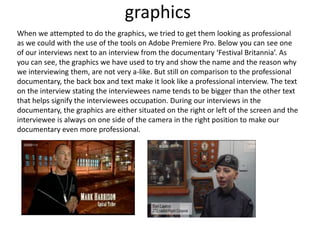
When we attempted to do the graphics, we tried to get them looking as professional
as we could with the use of the tools on Adobe Premiere Pro. Below you can see one
of our interviews next to an interview from the documentary ‘Festival Britannia’. As
you can see, the graphics we have used to try and show the name and the reason why
we interviewing them, are not very a-like. But still on comparison to the professional
documentary, the back box and text make it look like a professional interview. The text
on the interview stating the interviewees name tends to be bigger than the other text
that helps signify the interviewees occupation. During our interviews in the
documentary, the graphics are either situated on the right or left of the screen and the
interviewee is always on one side of the camera in the right position to make our
documentary even more professional.
Mise en Scene:
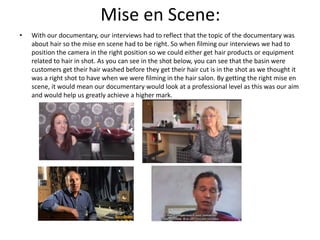
• With our documentary, our interviews had to reflect that the topic of the documentary was
about hair so the mise en scene had to be right. So when filming our interviews we had to
position the camera in the right position so we could either get hair products or equipment
related to hair in shot. As you can see in the shot below, you can see that the basin were
customers get their hair washed before they get their hair cut is in the shot as we thought it
was a right shot to have when we were filming in the hair salon. By getting the right mise en
scene, it would mean our documentary would look at a professional level as this was our aim
and would help us greatly achieve a higher mark.
Cut Away's
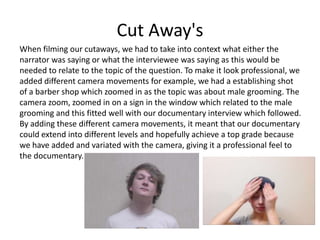
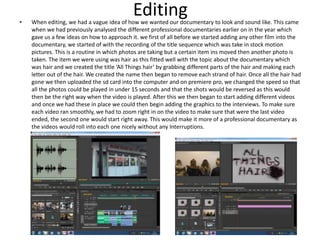
When filming our cutaways, we had to take into context what either the
narrator was saying or what the interviewee was saying as this would be
needed to relate to the topic of the question. To make it look professional, we
added different camera movements for example, we had a establishing shot
of a barber shop which zoomed in as the topic was about male grooming. The
camera zoom, zoomed in on a sign in the window which related to the male
grooming and this fitted well with our documentary interview which followed.
By adding these different camera movements, it meant that our documentary
could extend into different levels and hopefully achieve a top grade because
we have added and variated with the camera, giving it a professional feel to
the documentary.
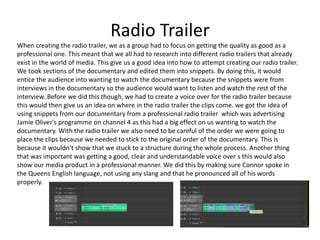
Editing• When editing, we had a vague idea of how we wanted our documentary to look and sound like. This came
when we had previously analysed the different professional documentaries earlier on in the year which
gave us a few ideas on how to approach it. we first of all before we started adding any other film into the
documentary, we started of with the recording of the title sequence which was take in stock motion
pictures. This is a routine in which photos are taking but a certain item ins moved then another photo is
taken. The item we were using was hair as this fitted well with the topic about the documentary which
was hair and we created the title ‘All Things hair’ by grabbing different parts of the hair and making each
letter out of the hair. We created the name then began to remove each strand of hair. Once all the hair had
gone we then uploaded the sd card into the computer and on premiere pro, we changed the speed so that
all the photos could be played in under 15 seconds and that the shots would be reversed as this would
then be the right way when the video is played. After this we then began to start adding different videos
and once we had these in place we could then begin adding the graphics to the interviews. To make sure
each video ran smoothly, we had to zoom right in on the video to make sure that were the last video
ended, the second one would start right away. This would make it more of a professional documentary as
the videos would roll into each one nicely without any Interruptions.
Radio Trailer
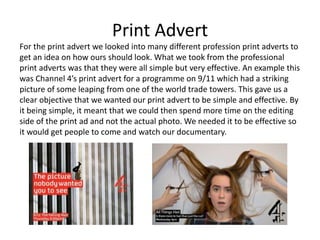
When creating the radio trailer, we as a group had to focus on getting the quality as good as a
professional one. This meant that we all had to research into different radio trailers that already
exist in the world of media. This give us a good idea into how to attempt creating our radio trailer.
We took sections of the documentary and edited them into snippets. By doing this, it would
entice the audience into wanting to watch the documentary because the snippets were from
interviews in the documentary so the audience would want to listen and watch the rest of the
interview. Before we did this though, we had to create a voice over for the radio trailer because
this would then give us an idea on where in the radio trailer the clips come. we got the idea of
using snippets from our documentary from a professional radio trailer which was advertising
Jamie Oliver's programme on channel 4 as this had a big effect on us wanting to watch the
documentary. With the radio trailer we also need to be careful of the order we were going to
place the clips because we needed to stick to the original order of the documentary. This is
because it wouldn’t show that we stuck to a structure during the whole process. Another thing
that was important was getting a good, clear and understandable voice over s this would also
show our media product in a professional manner. We did this by making sure Connor spoke in
the Queens English language, not using any slang and that he pronounced all of his words
properly.
Print Advert
For the print advert we looked into many different profession print adverts to
get an idea on how ours should look. What we took from the professional
print adverts was that they were all simple but very effective. An example this
was Channel 4’s print advert for a programme on 9/11 which had a striking
picture of some leaping from one of the world trade towers. This gave us a
clear objective that we wanted our print advert to be simple and effective. By
it being simple, it meant that we could then spend more time on the editing
side of the print ad and not the actual photo. We needed it to be effective so
it would get people to come and watch our documentary.

Evaluation 1

  • 1.
    In what waysdoes your media product use, develop, or challenge forms and conventions of real media products?
  • 2.
    Our documentary ismixed documentary as it has the elements of Cutaways, Archive Footage, Interviews and a voice over. Our documentary is a reflection of the type of documentary ‘Festival Britannia’ as these two documentaries both consist of the codes and conventions of professional media products. Professional media products are based on one topic and for our media documentary, we as a group decided that we would create our documentary on the subject Hair. The contents of hair that were discussed in the documentary were current hair trends, hair trends of the past, psychological effects of hair and phobias of hair. For each one of these aspects, we recorded interviews, cut-a-ways and gathered archive footage as this would help advance and explain our point about what the voice over was explaining. But even though there are all this topics within the whole documentary, it is still single-stranded to one topic, which is hair. Most documentaries generally are single-stranded to one topic and also stick to information about the theme, all of the way through which is what we set out to achieve when we first started our documentary.
  • 3.
    graphics When we attemptedto do the graphics, we tried to get them looking as professional as we could with the use of the tools on Adobe Premiere Pro. Below you can see one of our interviews next to an interview from the documentary ‘Festival Britannia’. As you can see, the graphics we have used to try and show the name and the reason why we interviewing them, are not very a-like. But still on comparison to the professional documentary, the back box and text make it look like a professional interview. The text on the interview stating the interviewees name tends to be bigger than the other text that helps signify the interviewees occupation. During our interviews in the documentary, the graphics are either situated on the right or left of the screen and the interviewee is always on one side of the camera in the right position to make our documentary even more professional.
  • 4.
    Mise en Scene: •With our documentary, our interviews had to reflect that the topic of the documentary was about hair so the mise en scene had to be right. So when filming our interviews we had to position the camera in the right position so we could either get hair products or equipment related to hair in shot. As you can see in the shot below, you can see that the basin were customers get their hair washed before they get their hair cut is in the shot as we thought it was a right shot to have when we were filming in the hair salon. By getting the right mise en scene, it would mean our documentary would look at a professional level as this was our aim and would help us greatly achieve a higher mark.
  • 5.
    Cut Away's When filmingour cutaways, we had to take into context what either the narrator was saying or what the interviewee was saying as this would be needed to relate to the topic of the question. To make it look professional, we added different camera movements for example, we had a establishing shot of a barber shop which zoomed in as the topic was about male grooming. The camera zoom, zoomed in on a sign in the window which related to the male grooming and this fitted well with our documentary interview which followed. By adding these different camera movements, it meant that our documentary could extend into different levels and hopefully achieve a top grade because we have added and variated with the camera, giving it a professional feel to the documentary.
  • 6.
    Editing• When editing,we had a vague idea of how we wanted our documentary to look and sound like. This came when we had previously analysed the different professional documentaries earlier on in the year which gave us a few ideas on how to approach it. we first of all before we started adding any other film into the documentary, we started of with the recording of the title sequence which was take in stock motion pictures. This is a routine in which photos are taking but a certain item ins moved then another photo is taken. The item we were using was hair as this fitted well with the topic about the documentary which was hair and we created the title ‘All Things hair’ by grabbing different parts of the hair and making each letter out of the hair. We created the name then began to remove each strand of hair. Once all the hair had gone we then uploaded the sd card into the computer and on premiere pro, we changed the speed so that all the photos could be played in under 15 seconds and that the shots would be reversed as this would then be the right way when the video is played. After this we then began to start adding different videos and once we had these in place we could then begin adding the graphics to the interviews. To make sure each video ran smoothly, we had to zoom right in on the video to make sure that were the last video ended, the second one would start right away. This would make it more of a professional documentary as the videos would roll into each one nicely without any Interruptions.
  • 7.
    Radio Trailer When creatingthe radio trailer, we as a group had to focus on getting the quality as good as a professional one. This meant that we all had to research into different radio trailers that already exist in the world of media. This give us a good idea into how to attempt creating our radio trailer. We took sections of the documentary and edited them into snippets. By doing this, it would entice the audience into wanting to watch the documentary because the snippets were from interviews in the documentary so the audience would want to listen and watch the rest of the interview. Before we did this though, we had to create a voice over for the radio trailer because this would then give us an idea on where in the radio trailer the clips come. we got the idea of using snippets from our documentary from a professional radio trailer which was advertising Jamie Oliver's programme on channel 4 as this had a big effect on us wanting to watch the documentary. With the radio trailer we also need to be careful of the order we were going to place the clips because we needed to stick to the original order of the documentary. This is because it wouldn’t show that we stuck to a structure during the whole process. Another thing that was important was getting a good, clear and understandable voice over s this would also show our media product in a professional manner. We did this by making sure Connor spoke in the Queens English language, not using any slang and that he pronounced all of his words properly.
  • 8.
    Print Advert For theprint advert we looked into many different profession print adverts to get an idea on how ours should look. What we took from the professional print adverts was that they were all simple but very effective. An example this was Channel 4’s print advert for a programme on 9/11 which had a striking picture of some leaping from one of the world trade towers. This gave us a clear objective that we wanted our print advert to be simple and effective. By it being simple, it meant that we could then spend more time on the editing side of the print ad and not the actual photo. We needed it to be effective so it would get people to come and watch our documentary.