

PERFORMANCE &
CONDUCT
PERFORMANCE VS CONDUCT
• Employee expectations fall into two categories -
 Performance and Conduct.

• PERFORMANCE expectations relate to the employee’s
 job classification or job assignment and include the
 quantity, quality, accuracy and timeliness of work
 products.

• CONDUCT expectations are work rules that relate to
 employee behavior. Examples include adhering to work
 hours, proper use and reporting of time, honesty, and
 interactions with clients and co-workers, to name a few.
• What is the difference between performance and conduct?


• In general, performance relates to the quantity, quality,
 accuracy and timeliness of work products.

• Conduct issues relate to compliance with work rules.
 Performance problems usually involve a “can’t do” issue
 while conduct problems generally involve a “won’t do” issue.

• Conversely, if an employee is frequently late or absent (won’t
 do), it is usually not because he/she lacks the training, ability or
 experience to report to work. Counseling and corrective action,
 rather than training is usually appropriate.
• Why do we make a distinction between performance
 and conduct?

• Conduct and performance are handled differently in terms
 of the corrective action process.
CORRECTIVE ACTION &
DISCIPLINARY ACTION
• Corrective action and disciplinary action are two terms
 that you will encounter in dealing with performance and
 conduct issues. Although corrective action may lead to
 discipline, they are not the same.

• What is corrective action?
• Corrective action is the process the supervisor begins
 when an employee's performance or conduct is first
 identified as needing improvement. Normally, the first step
 in corrective action is bringing the issue to the employee's
 attention (counseling), and suggesting ways to "correct"
 the problem
• The intent of corrective action is to assist employees
 in correcting their performance and/or conduct to
 meet expectations.

• Corrective action includes verbal counseling, written
 counseling memos, corrective action plans, letters of
 warning, leave restriction letters, and letters of reprimand.

• For Performance problems, performance evaluations
 may also be considered corrective action.
• What is disciplinary action?
• Disciplinary action is taken when corrective action has not
 caused the employee to correct his/her performance to an
 acceptable level. Disciplinary action may be taken
 without prior corrective action when an employee’s
 performance or conduct is so egregious or serious
 that informal corrective action is not an appropriate
 response.

• Disciplinary action includes suspensions, temporary
 reductions in step, demotions, dismissals and disciplinary
 letters that equate to a suspension ("non-punitive
 discipline").
• What is non-punitive discipline?
• Non-punitive discipline is a program that replaces unpaid
 suspensions with a disciplinary letter that equates to a
 suspension, thereby establishing that there has been
 previous discipline if misconduct occurs again. Positive
 aspects of non-punitive discipline from management's
 perspective are that the employee does not actually leave
 the workplace, thereby avoiding the disruption to workflow
 and cost to fill in behind the employee. Positive aspects
 from the employee's perspective are that no money is
 lost, and the "rehabilitation plan" which, if successfully
 completed, results in removal of the disciplinary letter
 within a specific period of time.
PERFORMANCE
• Consistent attention to the employee's performance
 allows positive reinforcement of desired work habits and
 early identification and correction of bad work habits and
 performance problems.
What is the supervisor's /HR’s
responsibility regarding employee
performance?
• First, clearly communicate your expectations. These
 expectations may include written performance standards
 for the position as well as specific objectives for the
 individual employee.

• You may also want to give the employee their job
 specification, any department specific job description
 which has been developed, departmental handbooks, etc.
Following this initial discussion, your
responsibilities are to:
• Discuss specific objectives, due dates, timeliness, and
  quality and quantity standards in one-on-one
  conversations and in group meetings with employees, and
  confirm specific objectives in writing prior to the beginning
  of each review period.
• Meet with individual employees regularly to discuss their
  progress, both positive and negative.
• Counsel when minor performance concerns come to your
  attention.
• Prepare written evaluations every three months for
  probationary employees, and on an annual basis for all
  other employees.
What are performance
expectations?
• Performance expectations are the standards for the
 position and the objectives for the individual employee.

• Expectations often have two aspects:


• 1) the quantity or timeliness of work products, and
• 2) the quality or accuracy of those products.
What should be done if an employee
is not meeting performance
expectations?
• Formally counsel the employee, giving specific examples
 of where he/she is not meeting the performance
 standard(s).

• Refer to any previous informal counseling sessions that
 were held and ask the employee if he/she understands
 the area of concern. It is usually a good idea to have the
 employee state back to you what the problem is and what
 you expect so there is no confusion.
• Document the results of the counseling session to writing,
  and share this memo with the employee.
• The counseling memo should clearly outline your
  concerns, the employee’s response (if any), what the
  employee has to do to improve, and the steps you will
  take to assist her or him.

• Meet with the employee on a regularly scheduled basis,
 giving specific assignments and deadlines and providing
 feedback on his/her progress. Document these meetings
 in writing and give the employee a copy.
• If the employee does not improve, complete a formal
 performance evaluation
How does the supervisor know what
to do next, and when to do it?
• In performance cases, there are two options - demotion
 or dismissal.

• If an employee has the skills and abilities to do a less
 complex job, demotion is the preferred option, especially if
 the employee has previously held a lower classification,
 unless the current level of performance indicates an
 inability to perform even the simplest portions of the
 current position.

• If the employee's deficiencies demonstrate that demotion
 is not a viable alternative, the choice would be dismissal.
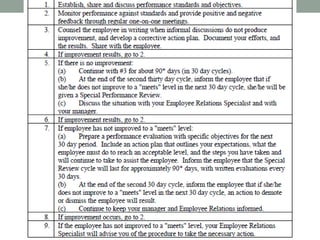
• SAMPLE FLOWCHART FOR PERFORMANCE
EVALUATIONS AND CORRECTIVE ACTIONS (not for
probationary employees)
Performance & conduct

Performance & conduct

  • 1.
  • 2.
    PERFORMANCE VS CONDUCT •Employee expectations fall into two categories - Performance and Conduct. • PERFORMANCE expectations relate to the employee’s job classification or job assignment and include the quantity, quality, accuracy and timeliness of work products. • CONDUCT expectations are work rules that relate to employee behavior. Examples include adhering to work hours, proper use and reporting of time, honesty, and interactions with clients and co-workers, to name a few.
  • 3.
    • What isthe difference between performance and conduct? • In general, performance relates to the quantity, quality, accuracy and timeliness of work products. • Conduct issues relate to compliance with work rules. Performance problems usually involve a “can’t do” issue while conduct problems generally involve a “won’t do” issue. • Conversely, if an employee is frequently late or absent (won’t do), it is usually not because he/she lacks the training, ability or experience to report to work. Counseling and corrective action, rather than training is usually appropriate.
  • 4.
    • Why dowe make a distinction between performance and conduct? • Conduct and performance are handled differently in terms of the corrective action process.
  • 5.
    CORRECTIVE ACTION & DISCIPLINARYACTION • Corrective action and disciplinary action are two terms that you will encounter in dealing with performance and conduct issues. Although corrective action may lead to discipline, they are not the same. • What is corrective action? • Corrective action is the process the supervisor begins when an employee's performance or conduct is first identified as needing improvement. Normally, the first step in corrective action is bringing the issue to the employee's attention (counseling), and suggesting ways to "correct" the problem
  • 6.
    • The intentof corrective action is to assist employees in correcting their performance and/or conduct to meet expectations. • Corrective action includes verbal counseling, written counseling memos, corrective action plans, letters of warning, leave restriction letters, and letters of reprimand. • For Performance problems, performance evaluations may also be considered corrective action.
  • 7.
    • What isdisciplinary action? • Disciplinary action is taken when corrective action has not caused the employee to correct his/her performance to an acceptable level. Disciplinary action may be taken without prior corrective action when an employee’s performance or conduct is so egregious or serious that informal corrective action is not an appropriate response. • Disciplinary action includes suspensions, temporary reductions in step, demotions, dismissals and disciplinary letters that equate to a suspension ("non-punitive discipline").
  • 8.
    • What isnon-punitive discipline? • Non-punitive discipline is a program that replaces unpaid suspensions with a disciplinary letter that equates to a suspension, thereby establishing that there has been previous discipline if misconduct occurs again. Positive aspects of non-punitive discipline from management's perspective are that the employee does not actually leave the workplace, thereby avoiding the disruption to workflow and cost to fill in behind the employee. Positive aspects from the employee's perspective are that no money is lost, and the "rehabilitation plan" which, if successfully completed, results in removal of the disciplinary letter within a specific period of time.
  • 9.
  • 10.
    • Consistent attentionto the employee's performance allows positive reinforcement of desired work habits and early identification and correction of bad work habits and performance problems.
  • 11.
    What is thesupervisor's /HR’s responsibility regarding employee performance? • First, clearly communicate your expectations. These expectations may include written performance standards for the position as well as specific objectives for the individual employee. • You may also want to give the employee their job specification, any department specific job description which has been developed, departmental handbooks, etc.
  • 12.
    Following this initialdiscussion, your responsibilities are to: • Discuss specific objectives, due dates, timeliness, and quality and quantity standards in one-on-one conversations and in group meetings with employees, and confirm specific objectives in writing prior to the beginning of each review period. • Meet with individual employees regularly to discuss their progress, both positive and negative. • Counsel when minor performance concerns come to your attention. • Prepare written evaluations every three months for probationary employees, and on an annual basis for all other employees.
  • 13.
    What are performance expectations? •Performance expectations are the standards for the position and the objectives for the individual employee. • Expectations often have two aspects: • 1) the quantity or timeliness of work products, and • 2) the quality or accuracy of those products.
  • 14.
    What should bedone if an employee is not meeting performance expectations? • Formally counsel the employee, giving specific examples of where he/she is not meeting the performance standard(s). • Refer to any previous informal counseling sessions that were held and ask the employee if he/she understands the area of concern. It is usually a good idea to have the employee state back to you what the problem is and what you expect so there is no confusion.
  • 15.
    • Document theresults of the counseling session to writing, and share this memo with the employee. • The counseling memo should clearly outline your concerns, the employee’s response (if any), what the employee has to do to improve, and the steps you will take to assist her or him. • Meet with the employee on a regularly scheduled basis, giving specific assignments and deadlines and providing feedback on his/her progress. Document these meetings in writing and give the employee a copy.
  • 16.
    • If theemployee does not improve, complete a formal performance evaluation
  • 17.
    How does thesupervisor know what to do next, and when to do it? • In performance cases, there are two options - demotion or dismissal. • If an employee has the skills and abilities to do a less complex job, demotion is the preferred option, especially if the employee has previously held a lower classification, unless the current level of performance indicates an inability to perform even the simplest portions of the current position. • If the employee's deficiencies demonstrate that demotion is not a viable alternative, the choice would be dismissal.
  • 18.
    • SAMPLE FLOWCHARTFOR PERFORMANCE EVALUATIONS AND CORRECTIVE ACTIONS (not for probationary employees)

Editor's Notes

  • #6 This first step is informal and may not result in a memo confirming the counseling. However, if a written memo confirming the counseling is not issued to the employee, the supervisor should still retain some written evidence that the counseling session occurred (e.g., a note in the supervisory file, or a note in one’s calendar).