It is a union
= it unites countries and people.
It is European
= it is situated in Europe
What is the European Union?
2
Let's have
a closer look:
What do Europeans
have in common?
How has the EU
developed?
What does the EU
do today?
3
Europe –
our continent
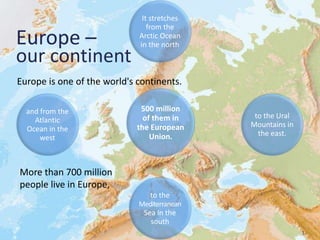
Europe is one of the world's continents.
It stretches
from the
Arctic Ocean
in the north
and from the
Atlantic
Ocean in the
west
to the
Mediterranean
Sea in the
south
to the Ural
Mountains in
the east.
500 million
of them in
the European
Union.
More than 700 million
people live in Europe,
Europe – our history
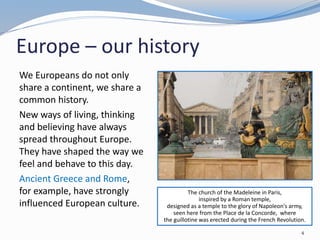
The church of the Madeleine in Paris,
inspired by a Roman temple,
designed as a temple to the glory of Napoleon's army,
seen here from the Place de la Concorde, where
the guillotine was erected during the French Revolution.
4
We Europeans do not only
share a continent, we share a
common history.
New ways of living, thinking
and believing have always
spread throughout Europe.
They have shaped the way we
feel and behave to this day.
Ancient Greece and Rome,
for example, have strongly
influenced European culture.
Languages
5
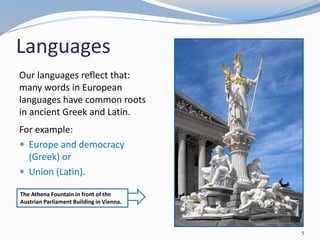
Our languages reflect that:
many words in European
languages have common roots
in ancient Greek and Latin.
For example:
 Europe and democracy
(Greek) or
 Union (Latin).
The Athena Fountain in front of the
Austrian Parliament Building in Vienna.
Arts and culture
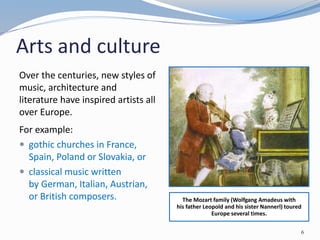
The Mozart family (Wolfgang Amadeus with
his father Leopold and his sister Nannerl) toured
Europe several times.
6
Over the centuries, new styles of
music, architecture and
literature have inspired artists all
over Europe.
For example:
 gothic churches in France,
Spain, Poland or Slovakia, or
 classical music written
by German, Italian, Austrian,
or British composers.
European wars
Sadly, the story of Europe is not
all about great achievements of
which we can be proud.
Throughout history, European
nations have fought terrible
wars against each other.
In the 20th century, two wars
that started on this continent
spread and involved countries
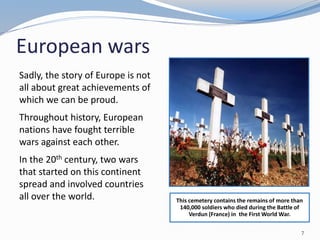
all over the world. This cemetery contains the remains of more than
140,000 soldiers who died during the Battle of
Verdun (France) in the First World War.
7
European wars
At the end of the Second World
War, people in Europe asked
themselves:
"Can anything be done to
stop these terrible things
from happening again?"
"Will Europeans ever learn to
work together instead of
fighting each other?"
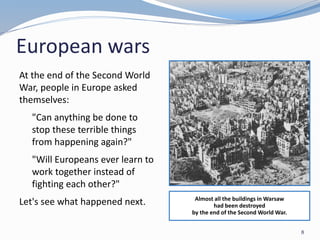
Let's see what happened next. Almost all the buildings in Warsaw
had been destroyed
by the end of the Second World War.
8
Founding of the European Union
9
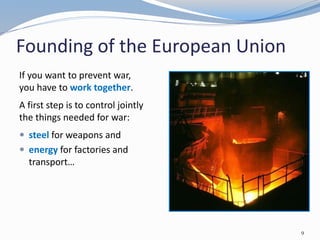
If you want to prevent war,
you have to work together.
A first step is to control jointly
the things needed for war:
 steel for weapons and
 energy for factories and
transport…
European Coal and Steel Community
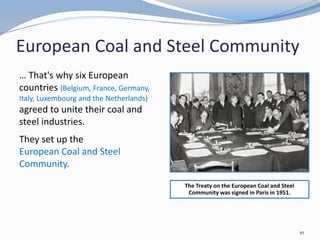
… That's why six European
countries (Belgium, France, Germany,
Italy, Luxembourg and the Netherlands)
agreed to unite their coal and
steel industries.
They set up the
European Coal and Steel
Community.
The Treaty on the European Coal and Steel
Community was signed in Paris in 1951.
10
European Economic Community
The six countries got on so well
that they decided to go a step
further and to set up the
European Economic Community
(EEC).
The main idea was to create a
'common market'. That means
getting rid of all national
obstacles to free trade, such as
border checks and customs
duties, as if Europe were one
country.
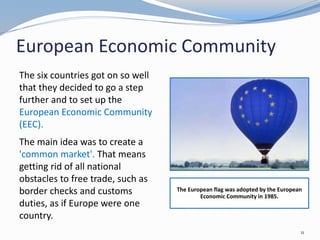
The European flag was adopted by the European
Economic Community in 1985.
11
Not just economics…
12
That's why the
EEC decided to
change its name
to the
'European
Union'.
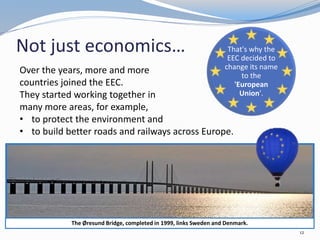
The Øresund Bridge, completed in 1999, links Sweden and Denmark.
Over the years, more and more
countries joined the EEC.
They started working together in
many more areas, for example,
• to protect the environment and
• to build better roads and railways across Europe.
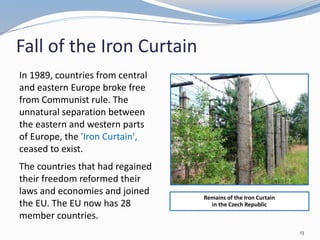
Fall of the Iron Curtain
In 1989, countries from central
and eastern Europe broke free
from Communist rule. The
unnatural separation between
the eastern and western parts
of Europe, the 'Iron Curtain',
ceased to exist.
The countries that had regained
their freedom reformed their
laws and economies and joined
the EU. The EU now has 28
member countries.
Remains of the Iron Curtain
in the Czech Republic
13
What the European Union does today
The EU tries to make life better for all
of us. Let's have a look at some
examples.
14
:
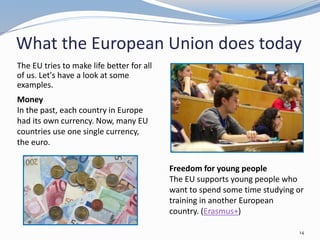
Money
In the past, each country in Europe
had its own currency. Now, many EU
countries use one single currency,
the euro.
Freedom for young people
The EU supports young people who
want to spend some time studying or
training in another European
country. (Erasmus+)
What the European Union does today
15
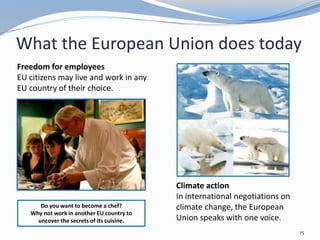
Climate action
In international negotiations on
climate change, the European
Union speaks with one voice.
Do you want to become a chef?
Why not work in another EU country to
uncover the secrets of its cuisine.
Freedom for employees
EU citizens may live and work in any
EU country of their choice.
What the European Union does today
16
Helping poorer regions
Some areas in Europe need money to
build new roads and railways; in other
places many people are looking for a job.
The EU provides funding for specific
projects that address these needs.
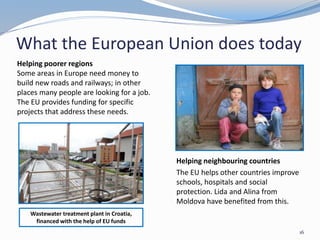
Helping neighbouring countries
The EU helps other countries improve
schools, hospitals and social
protection. Lida and Alina from
Moldova have benefited from this.
Wastewater treatment plant in Croatia,
financed with the help of EU funds
What the European Union does today
17
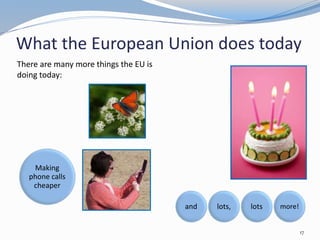
There are many more things the EU is
doing today:
Making
phone calls
cheaper
and lots, lots more!
18
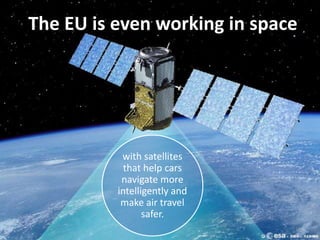
The EU is even working in space
with satellites
that help cars
navigate more
intelligently and
make air travel
safer.
How the EU makes decisions
19
As you can imagine, it takes a lot of effort by many people to organise
the EU and make everything work. So who does what?
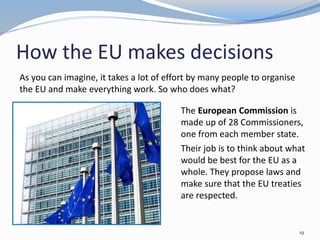
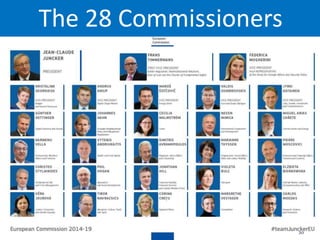
The European Commission is
made up of 28 Commissioners,
one from each member state.
Their job is to think about what
would be best for the EU as a
whole. They propose laws and
make sure that the EU treaties
are respected.
The 28 Commissioners
20
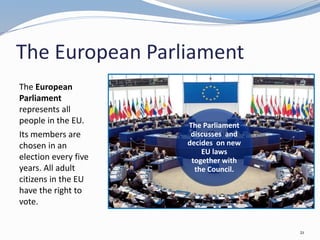
The European Parliament
The European
Parliament
represents all
people in the EU.
Its members are
chosen in an
election every five
years. All adult
citizens in the EU
have the right to
vote.
21
The Parliament
discusses and
decides on new
EU laws
together with
the Council.
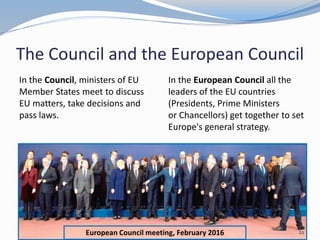
European Council meeting, February 2016
The Council and the European Council
In the Council, ministers of EU
Member States meet to discuss
EU matters, take decisions and
pass laws.
22
In the European Council all the
leaders of the EU countries
(Presidents, Prime Ministers
or Chancellors) get together to set
Europe's general strategy.
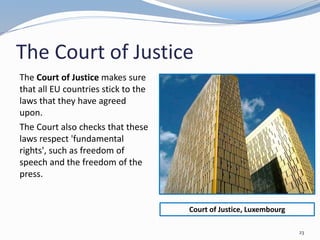
The Court of Justice
The Court of Justice makes sure
that all EU countries stick to the
laws that they have agreed
upon.
The Court also checks that these
laws respect 'fundamental
rights', such as freedom of
speech and the freedom of the
press.
23
Court of Justice, Luxembourg
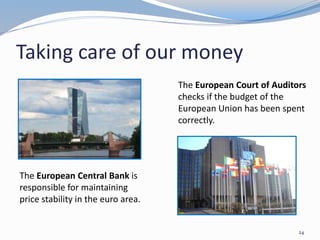
Taking care of our money
The European Central Bank is
responsible for maintaining
price stability in the euro area.
24
The European Court of Auditors
checks if the budget of the
European Union has been spent
correctly.
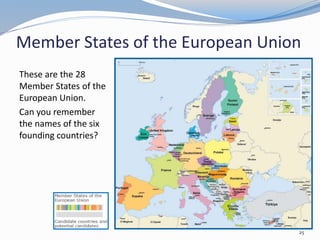
Member States of the European Union
These are the 28
Member States of the
European Union.
Can you remember
the names of the six
founding countries?
25
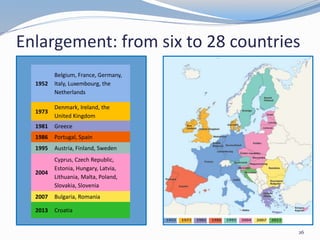
Enlargement: from six to 28 countries
26
1952
Belgium, France, Germany,
Italy, Luxembourg, the
Netherlands
1973
Denmark, Ireland, the
United Kingdom
1981 Greece
1986 Portugal, Spain
1995 Austria, Finland, Sweden
2004
Cyprus, Czech Republic,
Estonia, Hungary, Latvia,
Lithuania, Malta, Poland,
Slovakia, Slovenia
2007 Bulgaria, Romania
2013 Croatia
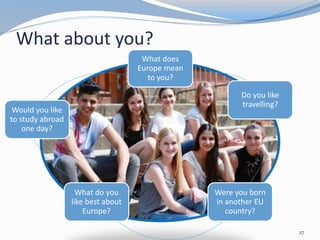
What does
Europe mean
to you?
Do you like
travelling?
Were you born
in another EU
country?
What do you
like best about
Europe?
Would you like
to study abroad
one day?
What about you?
27
Ready for more?
This presentation was originally
designed by the European
Commission. The current version
can be downloaded here.
Many more teaching materials
about the European Union and its
policies are available on our
Teachers' Corner.
© European Union 2016. Reproduction is authorised.
© Photos: see notes pages.

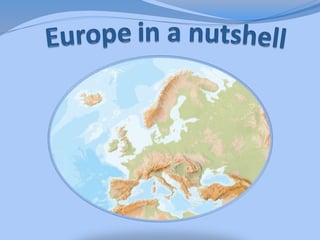
Europe in a nutshell

  • 2.
    It is aunion = it unites countries and people. It is European = it is situated in Europe What is the European Union? 2 Let's have a closer look: What do Europeans have in common? How has the EU developed? What does the EU do today?
  • 3.
    3 Europe – our continent Europeis one of the world's continents. It stretches from the Arctic Ocean in the north and from the Atlantic Ocean in the west to the Mediterranean Sea in the south to the Ural Mountains in the east. 500 million of them in the European Union. More than 700 million people live in Europe,
  • 4.
    Europe – ourhistory The church of the Madeleine in Paris, inspired by a Roman temple, designed as a temple to the glory of Napoleon's army, seen here from the Place de la Concorde, where the guillotine was erected during the French Revolution. 4 We Europeans do not only share a continent, we share a common history. New ways of living, thinking and believing have always spread throughout Europe. They have shaped the way we feel and behave to this day. Ancient Greece and Rome, for example, have strongly influenced European culture.
  • 5.
    Languages 5 Our languages reflectthat: many words in European languages have common roots in ancient Greek and Latin. For example:  Europe and democracy (Greek) or  Union (Latin). The Athena Fountain in front of the Austrian Parliament Building in Vienna.
  • 6.
    Arts and culture TheMozart family (Wolfgang Amadeus with his father Leopold and his sister Nannerl) toured Europe several times. 6 Over the centuries, new styles of music, architecture and literature have inspired artists all over Europe. For example:  gothic churches in France, Spain, Poland or Slovakia, or  classical music written by German, Italian, Austrian, or British composers.
  • 7.
    European wars Sadly, thestory of Europe is not all about great achievements of which we can be proud. Throughout history, European nations have fought terrible wars against each other. In the 20th century, two wars that started on this continent spread and involved countries all over the world. This cemetery contains the remains of more than 140,000 soldiers who died during the Battle of Verdun (France) in the First World War. 7
  • 8.
    European wars At theend of the Second World War, people in Europe asked themselves: "Can anything be done to stop these terrible things from happening again?" "Will Europeans ever learn to work together instead of fighting each other?" Let's see what happened next. Almost all the buildings in Warsaw had been destroyed by the end of the Second World War. 8
  • 9.
    Founding of theEuropean Union 9 If you want to prevent war, you have to work together. A first step is to control jointly the things needed for war:  steel for weapons and  energy for factories and transport…
  • 10.
    European Coal andSteel Community … That's why six European countries (Belgium, France, Germany, Italy, Luxembourg and the Netherlands) agreed to unite their coal and steel industries. They set up the European Coal and Steel Community. The Treaty on the European Coal and Steel Community was signed in Paris in 1951. 10
  • 11.
    European Economic Community Thesix countries got on so well that they decided to go a step further and to set up the European Economic Community (EEC). The main idea was to create a 'common market'. That means getting rid of all national obstacles to free trade, such as border checks and customs duties, as if Europe were one country. The European flag was adopted by the European Economic Community in 1985. 11
  • 12.
    Not just economics… 12 That'swhy the EEC decided to change its name to the 'European Union'. The Øresund Bridge, completed in 1999, links Sweden and Denmark. Over the years, more and more countries joined the EEC. They started working together in many more areas, for example, • to protect the environment and • to build better roads and railways across Europe.
  • 13.
    Fall of theIron Curtain In 1989, countries from central and eastern Europe broke free from Communist rule. The unnatural separation between the eastern and western parts of Europe, the 'Iron Curtain', ceased to exist. The countries that had regained their freedom reformed their laws and economies and joined the EU. The EU now has 28 member countries. Remains of the Iron Curtain in the Czech Republic 13
  • 14.
    What the EuropeanUnion does today The EU tries to make life better for all of us. Let's have a look at some examples. 14 : Money In the past, each country in Europe had its own currency. Now, many EU countries use one single currency, the euro. Freedom for young people The EU supports young people who want to spend some time studying or training in another European country. (Erasmus+)
  • 15.
    What the EuropeanUnion does today 15 Climate action In international negotiations on climate change, the European Union speaks with one voice. Do you want to become a chef? Why not work in another EU country to uncover the secrets of its cuisine. Freedom for employees EU citizens may live and work in any EU country of their choice.
  • 16.
    What the EuropeanUnion does today 16 Helping poorer regions Some areas in Europe need money to build new roads and railways; in other places many people are looking for a job. The EU provides funding for specific projects that address these needs. Helping neighbouring countries The EU helps other countries improve schools, hospitals and social protection. Lida and Alina from Moldova have benefited from this. Wastewater treatment plant in Croatia, financed with the help of EU funds
  • 17.
    What the EuropeanUnion does today 17 There are many more things the EU is doing today: Making phone calls cheaper and lots, lots more!
  • 18.
    18 The EU iseven working in space with satellites that help cars navigate more intelligently and make air travel safer.
  • 19.
    How the EUmakes decisions 19 As you can imagine, it takes a lot of effort by many people to organise the EU and make everything work. So who does what? The European Commission is made up of 28 Commissioners, one from each member state. Their job is to think about what would be best for the EU as a whole. They propose laws and make sure that the EU treaties are respected.
  • 20.
  • 21.
    The European Parliament TheEuropean Parliament represents all people in the EU. Its members are chosen in an election every five years. All adult citizens in the EU have the right to vote. 21 The Parliament discusses and decides on new EU laws together with the Council.
  • 22.
    European Council meeting,February 2016 The Council and the European Council In the Council, ministers of EU Member States meet to discuss EU matters, take decisions and pass laws. 22 In the European Council all the leaders of the EU countries (Presidents, Prime Ministers or Chancellors) get together to set Europe's general strategy.
  • 23.
    The Court ofJustice The Court of Justice makes sure that all EU countries stick to the laws that they have agreed upon. The Court also checks that these laws respect 'fundamental rights', such as freedom of speech and the freedom of the press. 23 Court of Justice, Luxembourg
  • 24.
    Taking care ofour money The European Central Bank is responsible for maintaining price stability in the euro area. 24 The European Court of Auditors checks if the budget of the European Union has been spent correctly.
  • 25.
    Member States ofthe European Union These are the 28 Member States of the European Union. Can you remember the names of the six founding countries? 25
  • 26.
    Enlargement: from sixto 28 countries 26 1952 Belgium, France, Germany, Italy, Luxembourg, the Netherlands 1973 Denmark, Ireland, the United Kingdom 1981 Greece 1986 Portugal, Spain 1995 Austria, Finland, Sweden 2004 Cyprus, Czech Republic, Estonia, Hungary, Latvia, Lithuania, Malta, Poland, Slovakia, Slovenia 2007 Bulgaria, Romania 2013 Croatia
  • 27.
    What does Europe mean toyou? Do you like travelling? Were you born in another EU country? What do you like best about Europe? Would you like to study abroad one day? What about you? 27
  • 28.
    Ready for more? Thispresentation was originally designed by the European Commission. The current version can be downloaded here. Many more teaching materials about the European Union and its policies are available on our Teachers' Corner. © European Union 2016. Reproduction is authorised. © Photos: see notes pages.

Editor's Notes

  • #2 1) © European Union 2) © fotolia/Dionisvera
  • #3 1) © Wikimedia Commons/Ssolbergj 2) © fotolia/FotolEdhar Background information: The European Union counts nine Outermost Regions, which are geographically very distant from the European continent: http://ec.europa.eu/regional_policy/en/policy/themes/outermost-regions/
  • #5 © Wikimedia Commons/Moonik
  • #6 © Wikimedia Commons
  • #7 © Wikimedia Commons/Brianboulton
  • #8 © Wikimedia Commons/Ketounette
  • #9 © Wikimedia Commons/M. Swierczynski
  • #10 © Wikimedia Commons/Eugen Nosko Background information: http://europa.eu/about-eu/eu-history/index_en.htm
  • #11 © European Union
  • #12 © European Union
  • #13 © Wikimedia Commons/Soerfm
  • #14 © Wikimedia Commons/Orange.man
  • #15 1) © Wikimedia Commons/Avij 2) © Gruber/Haigermoser Background information: The euro: http://europa.eu/about-eu/basic-information/money/euro/index_en.htm Erasmus +: http://ec.europa.eu/programmes/erasmus-plus/discover/index_en.htm
  • #16 1) © Wikimedia Commons/aldenchadwick 2) © Flickr/Christopher Michel Background information: Free Movement - EU nationals: http://ec.europa.eu/social/main.jsp?catId=457&langId=en Climate action: http://ec.europa.eu/clima/citizens/eu/index_en.htm
  • #17 © European Union © European Union Background information: Regional policy: http://ec.europa.eu/regional_policy/en/ EU development aid: https://europa.eu/eyd2015/en/content/eu-development-aid
  • #18 1) © flickr/Franck Vassen 2) © flickr/Mystery People 3) © fotolia/FOOD-pictures Background information: Environment: http://europa.eu/pol/env/index_en.htm Making phone calls cheaper: The EU has liberalised the telecommunications market which means that national monopolies have been broken up and competition permitted. The EU intervenes directly where there is insufficient competition. For example, mobile calls abroad have become cheaper as a result of action by the European Parliament and the European Commission. Energy: http://europa.eu/pol/ener/index_en.htm Food safety: http://europa.eu/pol/food/index_en.htm
  • #19 © European Union Background information: http://europa.eu/pol/space/index_en.htm
  • #20 © flickr/Álvaro Millán Background information: How the European Union works: http://bookshop.europa.eu/en/how-the-european-union-works-pbNA0414810/ European Commission http://ec.europa.eu/index_en.htm
  • #21 © European Union
  • #22 © European Union 2015 - European Parliament Background information: http://www.europarl.europa.eu/portal/en
  • #23 © European Union Background information: http://www.consilium.europa.eu/en/home/
  • #24 © Wikimedia Commons/sprklg Background information: http://europa.eu/about-eu/institutions-bodies/court-justice/index_en.htm
  • #25 © Wikimedia Commons/Victor Lopes © Wikimedia Commons/Euseson Background information: European Central Bank: http://europa.eu/about-eu/institutions-bodies/ecb/index_en.htm European Court of Auditors: http://europa.eu/about-eu/institutions-bodies/court-auditors/index_en.htm
  • #26 © European Union Background information: http://europa.eu/about-eu/countries/member-countries/index_en.htm
  • #27 © European Union
  • #28 © fotolia/Christian Schwier