IES CLARA CAMPOAMOR (SPAIN)
EVENING HIGH SCHOOL OF AIGALEO (GREECE)
GYMNÁZIUM CESKOLIPSKÁ (CZECH REPUBLIC)
PLATEJA INSTITUTE (ITALY)
LICEUM OGOLNOSZTALCACE IM. ADAMA MICKIEWICZA (POLAND)
AGRUPAMENTO DE ESCOLAS AUGUSTO CABRITA (PORTUGAL)
LICEUL TEHNOLOGIC “GRIGORE MOISIL” (ROMANIA)
MAÇKA ANADOLU IMAM HATIP LISESI (TURKEY)
I
Introduction
This chronicle was prepared as a part of Erasmus+ Project “70 Years of
European History 1945-2015” by following schools, their teachers and
students:
.- IES CLARA CAMPOAMOR (SPAIN)
.- EVENING HIGH SCHOOL OF AIGALEO (GREECE)
.- GYMNÁZIUM CESKOLIPSKÁ (CZECH REPUBLIC)
.- PLATEJA INSTITUTE (ITALY)
.- LICEUM OGOLNOSZTALCACE IM. ADAMA MICKIEWICZA (POLAND)
.- AGRUPAMENTO DE ESCOLAS AUGUSTO CABRITA (PORTUGAL)
.- LICEUL TEHNOLOGIC “GRIGORE MOISIL” (ROMANIA)
.- MAÇKA ANADOLU IMAM HATIP LISESI (TURKEY)
The idea of the “70 Y.E.H” project was born under the acceptance of
how few things students know about European History, about the
process of European unification and the reasons that led to it.
We strongly believe that in times of crisis such we are experiencing in
recent years it is crucial to cultivate the “shared memory” to enhance
the faith of young people to common European values and to promote
discussion on issues regarding our common future as European citizens.
This project is designed to contribute to the improvement of all
participants ‘knowledge of European History and to provide them the
opportunity to develop critical thinking on issues concerning E.U.
Motivated by the above considerations, eight upper secondary schools
of different types (general education, vocational, theological and
private) were joined in order to accomplish the following aims:
1. Learn more about the historic events that took place in Europe after
the end of World War II
II
2. Find out how these events effected on the artistic evolution in
painting, literature, cinema and music
3. Connect the historic events with the scientific and technological
development of the European countries by that time .
4. Find out the reasons that made the creation of the E.U necessary
5. Cultivate skills in searching and using information critically
6. Introduce new methods and teaching tools with a European
dimension within school education by exchanging teaching practices
7. Expand digital competences of both students and school education
staff
8. Stimulate the curiosity of students
9. Contribute to the increase and deepening of knowledge, aiming to
achieve better performances.
10. Foster the spirit of cooperation between people from different
cultures and contribute to the removal of existing geographic, national
and ideological borders in the school environment
11. Cause reflection and debate on issues about E.U and our common
future in it
12. Promote the development of a common European consciousness
and identity and contribute to students’ development into active
European citizens.
Local activities include: information research, workshops, debates in
classroom, interactive classes, webinars on the web2.0 tools, lectures,
on line conferences, presentations, informative seminars, study visits to
museums /art centers / scientific laboratories, meetings among
members of the local teams, competitions, exhibitions and
dissemination activities.
III
We expect that this project will have an impact on students by offering
them a different education prospective, discovering new ways of
learning and achieving greater cognitive development by cultivating
most of the „21st century skills” like critical thinking, research skills,
team work, ICT competences etc.
At the same time this project will equip teachers with new tools for
interdisciplinary teaching for courses like History, Art and Science and
will help them to introduce a European dimension in the classroom.
IV
Index
Page
The 40´s since the end of the Second World War 1
The 50´s 27
The 60´s 57
The 70´s 82
The 80´s 124
The 90´s 155
The first fifteen years of the 21th century 185
Pictures sources 212
V
1
All historical work on the events of this period will
have to be pursued or considered in relation to the
events of Auschwitz .. . Here, all historicization
reaches its limits'.
Saul Friedlander
The problem of evil will be the fundamental
question of postwar intellectual life in Europe… as
death became the fundamental problem after the
last war.”
Hannah Arendt, 1945
This was no slow decadence that came to the
Europeanized world; other civilizations rolled and
crumbled down, the European civilization was, as it
were, blown up.
HG. Wells. War in the Air (1908)
To most people it must have been apparent, even
before the Second World War made it obvious, that
the time when European nations could quarrel
among themselves for world dominion is dead and
gone. Europe has nothing more to look for in this
direction, and any European who still hankers after
world power must fall victim either to despair or to
ridicule, like the many Napoleons in lunatic
asylums'.
Max Frisch. July, 1948
2
In the spring of 1945 all Europe was at the mercy of the three great powers
which got to defeat decisively Germany. The continent was disorganized
and impoverished. Millions refugees or “displaced people”, as they were
called by the ally bureaucrats, needed to receive some housing and food.
It was necessary some months to come back at home the foreign workers in
Germany, but, some of them, whose houses were in territory under Soviet
dominion were reluctant to do it. Millions war prisoners were in the hands
of the Allies, and many of them who were in Soviet Union lasted several
years to come back.
During the war, the German government had brought to Third Reich many
German people from other parts of Europe and expelled Slavs from areas
such as Western Poland and Sudetenland, which was added to Germany.
Now, the war finished, a movement in the opposite direction began,
because many eastern Germans fled from the Soviet army advance,
meanwhile the German inhabitants of Czechoslovakia and from the
provinces now transferred to Poland were expelled in the mass.
3
Western Germany had to pay attention to 10-12 million German
refugees from East Europe. After the Frist World War the attempt made
to assure the rights of the national minorities had failed; after the
Second World War, it was adopted a more brutal solution that
provoked in many of the territories in dispute the national minorities
did not exist anymore.
The deep differences between westerners and Soviets shaped the two
blocks that divided the world in the next decades. The first result of the
end of the war was the loss of the European dominance in the world
Western Europe recovered thanks to the Marshall Plan (1947) and in
1950 it reached the prewar level. In the Soviet Block, a strict planning
set in motion the recovery. In 1949 The NATO was born and the
German division took place. The Berlin blockade (1948-194) was the
first great test of force between westerners and Soviets. Other
important events of this time were the Greek Civil War (1946-1949) the
communist coup in Prague and the end of democracy and
Czechoslovakia (1948) and the explosion of the first Soviet atomic
bomb (1949)
4
1945: Yalta Conference
The Yalta Conference (sometimes called
the Crimea Conference) took place in
February 1945 and was the second
wartime meeting of the three chief
Allied leaders: the British Prime Minister
Winston Churchill, the Soviet Premier
Joseph Stalin and the U.S. President
Franklin D. Roosevelt. The purpose of
the meeting was to discuss Europe's
post-war reorganization.
It had already been decided that Germany would be divided into occupied
zones, the German military industry would be abolished or confiscated
and major war criminals would be tried before an international court,
which subsequently was conducted at Nurnberg.
Each of the three leaders traveled to Yalta for different reasons. Roosevelt
came because of his desire to create a United Nations Organization before
World War II ended. Churchill feared the growing power of the Soviet
Union in a devastated Europe. Stalin was intent on protecting the Soviet
Union against another German invasion and his position at the conference
was of someone who felt so strong that he could dictate terms.
Much time was spent on Poland issue
because as Stalin stated "for the
Soviet government, the question of
Poland was one of honor and
security".
The three men agreed to move the
Polish eastern boundary westward
and to restore western Belorussia and
western Ukraine to the Soviet Union.
Stalin also promised free elections in
Poland despite the Soviet sponsored
provisional government recently
installed by him in Polish territories
occupied by the Red Army. He never
kept his promise.
Churchill, Rosevelt and Stalin in the Yalta
Conference (1945
Conference table of the Yalta
Conference in the Livadiya Palace
(Ukraine)
5
Roosevelt obtained a commitment by Stalin to participate in the United
Nations once it was agreed that each of the five permanent members of
the Security Council would have veto power. Stalin also agreed to enter
the fight against the Empire of Japan within 90 days after the defeat of
Germany.
The Yalta agreements were disputed even before the Potsdam
Conference later that year. The subsequent outbreak of the cold war
and Soviet successes in Eastern Europe led to much criticism in the
United States of the Yalta Conference and of Roosevelt, who was
accused of delivering Eastern Europe to Communist domination.
February 1 1945 - Right to vote for women
in Italy: Thanks to the liberation war, Italy
built the basis for its future democratic life,
giving all citizens the right to choose the
Parliament members.
6
1945: Nobel Prize for
Medicine and Physiology was
awarded jointly to sir
Alexander Fleming, Ernst
Boris Chain and Sir Howard
Walter Florey
Sir Scot Alexander Fleming (a Scottish biologist,
pharmacologist and botanist) discovered penicillin
based on careful study as well as accidental factors. He
served as a military doctor during the First World War
and he observed that antiseptics only temporarily
cured the wounded soldiers. Later in his laboratory he
realized that same samples of microbe culture, which
he had thrown away, showed a kind of mold fighting
bacteria.
That fact led him, after much research, to discover a
fungus, penicillin, which could fight bacteria.
Because of this discovery and its curative effect in
various infectious diseases, in 1945, he was awarded
together with Ernst Boris Chain (a German-born
British biochemist) and Sir Howard Walter Florey (an
Australian pharmacologist and pathologist) the Nobel
prize for Medicine and Physiology.
7
On October 24th, representatives
of 51 countries met in San
Francisco at the United Nations
Conference to draw up the
United Nations Charter.
Representatives of over eighty
percent of the world's
population, people of every
race, religion and continent, all
committed to set up an
organization which would
preserve international peace
and security, maintain
developing friendly relations
among nations and promote
social progress, better living
standards and human rights.
1945: Founding of
the
United Nations
Two other important objectives
described in the Charter, which
was signed in June 1945, were:
respect for the principles of
equal rights and self-
determination of all peoples
and international cooperation
in solving economic, social,
cultural, and humanitarian
problems around the world.
Maintaining peace was the
practical responsibility of the
new U.N. Security Council,
made up of the United States,
Great Britain, France, the Soviet
Union and China. Each of these
countries would have veto
power over the other.
United Nations Day is
celebrated on 24th October
each year.
8
They happened from 20th November 1945 to 1st October 1946 in
Nuremberg (Germany)
The Nuremberg Trials were a series of military courts, held by the Allied
forces after World War II, which were most notable for the prosecution of
prominent members of the political, military, and economic leadership of
Nazi Germany who planned, carried out, or otherwise participated in The
Holocaust and other war crimes.
1945.- The Nuremberg Trials
Indictements
.- Participation in a
common plan or
conspiracy for the
accomplishment of a
crime against peace.
.- Planning, initiating and
waging wars of
aggression and other
crimes against peace.
.- War crimes.
.-Crimes against
Humanity
Accused
No criminal organizations: State (Government and army).
Criminal organizations: Nazi power organizations, such as the Gestapo, the
SS and the Nazi Party (we can highlight Karl Dönitz, Rudolf Hess, Hermann
Goering, Alfred Jodl, etc)
Adolf Hitler, Joseph Goebbels and Heinrich Himmler died before being
judged. Adolf Eichmann, Martin Bormann and Josef Mengele escaped
from Gerrmany.
9
April 23 1946 - Vespa was patented: «It's
not just a motorcycle, rather a little two
wheels car ». It is one of the many
advertisements that accompanied the birth
of this means of transport, considered one
of the most important Italian symbols.
1945.- The International Isolation
towards the Franco´s Spain
1945.- The conference of San Francisco denies the entry of Spain in the
UN.
1946.- Sentence against the Franco´s Regime by the UN.
1946.- Tripartite note: USA, Great Britain and France declare against
Franco.
Demonstration in Spain for supporting Franco and against UN choice
10
1946: The Greek Civil War
By the end of the Second World War, the Civil War began in Greece. It
lasted for three years (1946-1949) and led to social and political
polarization of the country.
The Greek Civil War,
internationally regarded
as the first act of the cold
war in the postwar
history, was the military
conflict with the largest
losses in human lives for
the country since 1830 up
today.
The Greek Civil War was actually
the conflict that took place in
Greece between the Greek
government army and the forces
of the Democratic Army of Greece
(under the control of the
Communist Party of Greece). This
war instigated by the British
resulted in with the defeat of the
Democratic Army.
June 2 1946
- Italy becomes a Republic:
In this day there was a
referendum that asked
Italian people which state
form it wanted to give to
the country.
11
1946: The First
Multi-party Elections
in Turkey
The Law on Parliamentary Elections
was enacted on 5 June 1945 to replace
the Law on Deputy Elections.
A group that broke away from the
Republican People’s Party founded
Development Party of Turkey on 18
July 1945. Democrat Party (DP) was
founded on 7 January 1946. Therefore,
transition to a multi-party system,
which would be tried for the third time
in the political history of the Republic
of Turkey, took place.
Election results were controversial as the first multi-party elections in
the history of the Republic of Turkey were held by means of open
ballot, secret counting and assessment.
In 1934, Turkish women were
given the right to vote and to
stand as candidates in general
elections before many European
countries.
1946.-Kazantzakis´best
seller
Nikos Kazantzakis's novel “The life and
adventures of Alexis Zorbas” was published in
Athens and the following year in Paris. The
author begins to be translated quickly. His
popularity increases after the release of
Mihalis Kakoyannis’s film in 1962. It was
awarded 3 Oscars and the novel was
published in over 100 countries.
12
The Berlin airlift – 1946/47
The Berlin Blockade (24 June 1948 – 12
May 1949) was one of the first major
international crises of the Cold War.
During the multinational occupation of
post–World War II Germany, the Soviet
Union blocked the Western Allies'
railway, road, and canal access to the
sectors of Berlin under Western control.
The Soviets offered to drop the blockade
if the Western Allies withdrew the newly
introduced Deutschmark from West
Berlin.
In response, the Western Allies
organized the Berlin airlift to carry
supplies to the people of West Berlin,
over 200,000 flights in one year,
providing to the West Berliners up to
8,893 tons of necessities each day,
such as fuel and food. The Soviets did
not disrupt the airlift for fear this
might lead to open conflict
By the spring of 1949, the airlift was
clearly succeeding, and by April it was
delivering more cargo than had
previously been transported into the city
by rail. On 12 May 1949, the USSR lifted
the blockade of West Berlin. The Berlin
Blockade served to highlight the
competing ideological and economic
visions for postwar Europe
Berliner children watch an US Air
Force Douglas C-54 Skymaster
landing at Tempelhof Airport, 1948
C-47 Skytrains unloading
at Tempelhof Airport
during the Berlin Airlift.
13
1947.- Publication
of Doktor Faustus
by Thomas Mann
In Doctor Faustus the author takes as
reference the old German legend of
‘Faust’, as well as their various
versions, as well as several elements
of the lives and work of Nietzsche,
Beethoven and Arnold Schönberg.
The novel tells the story of composer
Adrian Leverkuhn, who agrees with
the devil for the artistic glory.
Through the tragic figure of his
protagonist, Mann charts a refined
design of the corruption of German
culture of his time, which would lead
to the horrors of the Second World
War.
12th March 1947
The
announcement of
Truman Doctrine
The American president,
Harry Truman announced
the doctrine which was an
American foreign policy to
stop Soviet imperialism
during the Cold War.
14
The Unité d'habitation (Housing Unit) is the name of a modernist
residential housing design developed by Le Corbusier, with the
collaboration of Nadir Afonso, painter and architect. The concept
formed the basis of several housing developments designed by him
throughout Europe with this name. The most famous of these
developments is located in south Marseille.
The first and most famous of these buildings, also known as Cité
radieuse (Radiant City) and, informally, as La Maison du Fada is
located in Marseille, France, and was built between 1947 and 1952.
One of Le Corbusiers's most famous works, it proved enormously
influential and is often cited as the initial inspiration of the Brutalist
architectural style and philosophy.
The Le Corbusier´s Unité
d´Habitacion (1947-1952)
The building is constructed in
rough-cast concrete. The Unité
in Marseille is pending
designation as a World
Heritage site by UNESCO. It is
designated as an historic
monument by the French
Ministry of Culture. The
Marseille building, developed
with Corbusier's designers
Shadrach Woods, George
Candilis, comprises 337
apartments arranged over
twelve stories. The building
also incorporates shops with
architectural bookshop,
sporting, medical and
educational facilities, a hotel
which is open to the public,
and a gastronomic restaurant.
15
30th of December 1947.
Abdication of King Mihail. The
Popular Republic of Romania is
proclaimed
On Tuesday, the 30th of December, the king is
urgently invited to Bucharest to discuss with the
prime minister about “a family matter”.
Petru Groza came to the meeting together with
Gheorghe Gheorghiu Dej, and he handed Mihai a
declaration of abdication which had been
prepared before, in which it was presented the
fact that the country had decided to change
politics and monarchy as it was an obstacle
preventing progress. The king asked him to leave.
Being blackmailed with the death of 1000 of
students which had been arrested, the king
resigned and signed the abdication act.
In the evening, The Great National Assembly
was urgently summoned being led by Mihail
Sadoveanu and the republic was
proclaimed.
16
25th June 1947-
Publication of the
Diary of Anne Frank
It is a book of the writings from the
diary kept by Anne Frank while she
was in hiding for two years with her
family during the Nazi occupation of
the Netherlands. The diary was
retrieved by Miep Gies, who gave it to
Anne's father, Otto Frank, the family's
only known survivor. The diary has
been published in more than 60
different languages.
Transistor
A transistor is a semiconductor device used to
ampify or switch electronic signals and electrical
power.
The first working transistor was constructed by John
Bardeen and Walter Brattain in December 16, 1947.
The following year , William Bradford Shockley from
the same laboratory developed a theory junction
transistor, which has managed to build in the 1950s.
For the invention of the transistor they received the
Nobel Prize for Physics in 1956.
17
1947.- The Marshall Plan
The Marshall Plan (Officially called European Recovery Program, ERP)
was an American initiative to help Western Europe. The Americans
gave economic help for 13.000 million dollars to rebuild those
European countries devastated in the Second World War. This plan was
working for four years since April 1948.
The objectives of USA were recovering those areas destroyed by war,
to erase barriers to international trade, to modernize the European
industry, and make prosperous Europe again.
All these goals were set aside for avoiding the propagation of
Communism which in that time had a great influence in the Post war
Europe.
The grants of the plan were divided into the countries taking in
account the population of every one. The biggest amounts of money
were given to the great industrial powers.
The general results were positive because in a few years Europe was
able to set in motion all its human and economic resources. The
prosperity came back to Europe.
George Marshall and
Harry Truman, the two
American leaders who
launched this project
18
1948:Universal
Declaration of
Human Rights
The huge loss of lives and the
violation of rights held during
the two world wars were the
driving forces behind the
development of modern tools
for human rights.
The Declaration was drafted by
representatives of all regions of
the world and encompassed all
legal traditions.
Formally adopted by the United
Nations on December 10th,
1948, it is the most universal
human rights document in
existence, delineating the thirty
fundamental rights that form
the basis for a democratic
society.
The document begins by
recognizing that ‘the inherent
dignity of all members of the
human family is the foundation of
freedom, justice and peace in the
world’.
It declares that human rights are
universal – to be enjoyed by all
people, no matter who they are or
where they live.
It includes civil and political rights,
like the right to life, liberty, free
speech and privacy.
It also includes economic, social
and cultural rights, like the right to
social security, health and
education.
The Universal Declaration is not a treaty, so it does not directly create
legal obligations for countries. However, it is an expression of the
fundamental values shared by all members of the international
community.
Today, the Declaration is a living document that has been signed by the
192 member states of U.N and it is accepted as a contract between a
government and its people throughout the world. According to the
Guinness Book of World Records, it is the most translated document in
the world.
19
India was the largest colony of Great Britain.
Chronology of independence: 1945-1948
Main pro-independence leaders: Pandit Nehru and Mahatma Gandhi,
leaders of the Congress Party (Hindu) and Muhammad Ali Jinnah,
leader of the Muslim League (Islamic) Gandhi became internationally
famous for his strategy of "Non-violence" and "Civil disobedience" to
the British authorities and by his way of being: peaceful, austere and
mystical.
Reaction of Great Britain: Although there were episodes of bloody
repression by the British colonial authorities, Britain finally acted with
flexibility and peacefully by granting independence to the India in 1948
Consequences: from the huge territory of the British India emerged
great nations: India (Hindu), Pakistan (Muslim), Burma and Sri Lanka.
Some decades later Pakistan broke off and Bangladesh emerged as
independent country after a bloody civil war.
Important events: After reaching independence there were atrocious
massacres between Hindus and Muslims and mass displacements of
population.
Lord and Lady
Mountbatten with
Mahatma Gandhi
1948.- The proccess of the European
colonies independence starts with
the Indian independence from the
United Kingdom
20
1949: North Atlantic Treaty
Organization (NATO)
The North Atlantic Treaty Organization
was created in 1949 by the United States,
Canada, and several Western European
nations to provide collective security
against the Soviet Union.
According to its founding treaty: “NATO’s
essential purpose is to safeguard the
freedom and security of its members
through political and military means.
NATO promotes democratic values and
encourages consultation and cooperation
on defense and security issues to build
trust and, in the long run, prevent
conflict.”
The North Atlantic Treaty was signed, as a result of extended
negotiations, on April 4th, 1949 and the signatories agreed that “an
armed attack against one or more of them… shall be considered an
attack against them all.”
NATO stood as the main U.S. military alliance against the Soviet
Union throughout the duration of the Cold War.
21
23 may 1949
The Council of Mutual
Economical Benefit (CMEB)
It was created on the initiative of the USSR as an economic
organisation of the communist states to constitute an equivalent of
the European Economic Community.
It had the mission to stimulate the trade between the countries in
the Eastern block because, in reality, the USSR were not able to
offer to the communist countries assistance compared to the one
the USA gave to the Occidental countries.
Members of the CMEB were: the USSR, the DRG, Bulgaria, Poland,
Czechoslovakia, Hungary and Romania.
The CMEB did not manage to fulfil the goal for which it had been
created, mainly because of the centralised planned system of the
economy of the member states, the trade of goods being made by
means of bilateral negotiations with keeping the balance of
payment.
22
1949:
Founding
of the
Council of
Europe
It is considered to be the oldest political
organization in Europe. Even before the
end of the Second World War, it became
clear that the conflicting views of the
Western victorious powers and the USSR
could often only be papered over by
means of uneasy compromises. The
division between the respective spheres of
influence and the split of the continent led
to the idea of the “United States of
Europe” as W. Churchill called it, in a
speech at the University of Zurich, in 1946.
On 28th January 1949, the States in the
Western European Union established the
Council of Europe in order to foster
cooperation among its member countries
in the area of economic and social
progress.
Actual aims of the Council are:
-to protect human rights, pluralist
democracy and the rule of law
-to promote awareness and encourage
the development of Europe's cultural
identity and diversity
-to find common solutions to the
challenges facing European society
-to consolidate democratic stability in
Europe by backing political, legislative
and constitutional reform. The
headquarters of the Council of Europe
are in Strasbourg, France.
Today it includes 47 member states, 28 of which are members of the
European Union and unlike the European Union, it cannot make binding
laws. The best known body of the Council of Europe is the European
Court of Human Rights
23
1949 - Lobotomy
Lobotomy is a surgical procedure in the brain and has been used in
the past in severe cases of schizophrenia. About 6 % of patients did
not survive the operation, and several others had serious
personality disorders. It was developed by the Portuguese doctor
Egas Monis which, in 1949, received a Nobel Prize for this
contribution to medicine. Starting from the 50’s, lobotomy was
banned in most countries, the lobotomy is no longer practiced
because of serious side effects, and is considered as one of the most
barbaric episodes in the history of psychiatry.
1948 - DDT
(dichlorodiphenyltrichloroethane)
DDT was first synthesized in 1874. It’s colorless, tasteless and nearly
odorless. In 1939 Paul Hermann Müller discovered its insecticidal
properties. He would later be awarded with the Nobel Prize of
medicine, in 1948, due to this discovery. DDT was largely used in WW2
to control diseases that spread throw insects, such as mosquitoes. It
was also used with agricultural applications as an insecticide.
In 1962 a biologist published a book where he questioned the
environmental impacts of the wide use of DDT, which was mainly in bird
communities, and even stated that the usage of several pesticides could
lead to cancer in humans.
Later, the usage of DDT was banned worldwide on its agricultural
applications although the usage of DDT to control diseases is still
allowed, in spite being very controversial.
24
Italian Neorealism
Italian neorealism also known as the Golden Age of Italian
Cinema, is a national film movement characterized by stories
set amongst the poor and the working class, filmed on
location, frequently using non-professional actors. Neorealism
was a sign of cultural change and social progress in Italy. Its
films presented contemporary stories and ideas and were often
shot in streets as the Cinecittà film studios which had been
damaged significantly during the war. Neorealism became
famous globally in 1946 with Roberto Rossellini's Rome, Open
City, when it won the Grand Prize at the Cannes Film Festival as
the first major film produced in Italy after the war. The Bicycle
Thief of Vittorio de Sicca (1948) is also representative of the
genre, with non-professional actors, and a story that details
the hardships of working-class life after the war.
1949: Portugal
joins NATO
NATO’s partners accepted
Portugal as a member. In
fact, in spite of being a
dictatorship, the
Portuguese regime fought
against communism. NATO map in the 50´s
25
Still from bitter rice by Giusseppe de Santis Still from The thief of bicycles by Vittorio
de Sica
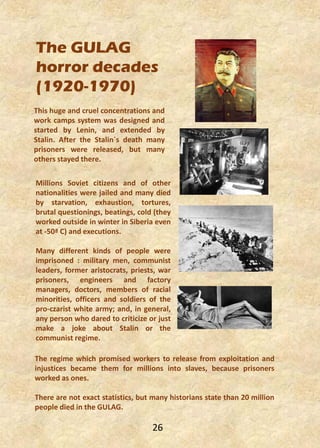
The GULAG
horror decades
(1920-1970)
The regime which promised workers to release from exploitation and
injustices became them for millions into slaves, because prisoners
worked as ones.
There are not exact statistics, but many historians state than 20 million
people died in the GULAG.
This huge and cruel concentrations and
work camps system was designed and
started by Lenin, and extended by
Stalin. After the Stalin´s death many
prisoners were released, but many
others stayed there.
Millions Soviet citizens and of other
nationalities were jailed and many died
by starvation, exhaustion, tortures,
brutal questionings, beatings, cold (they
worked outside in winter in Siberia even
at -50ª C) and executions.
Many different kinds of people were
imprisoned : military men, communist
leaders, former aristocrats, priests, war
prisoners, engineers and factory
managers, doctors, members of racial
minorities, officers and soldiers of the
pro-czarist white army; and, in general,
any person who dared to criticize or just
make a joke about Stalin or the
communist regime.
26
27
A shadow has fallen upon the scenes so
lately lighted by the Allied victory…. From
Stettin in the Baltic to Trieste in the Adriatic
an iron curtain has descended across the
Continent.
Winston Churchill, 1946
We hope to see a Europe where men of
every country will think as much of being a
European as of belonging to their native
land, and that without losing any of their
love and loyalty of their birthplace. We
hope wherever they go in this wide domain,
to which we set no limits in the European
Continent, they will truly feel "Here I am at
home. I am a citizen of this country too
Winston Churchill
in the very midst of the sound and the fury
of our history: “Let us rejoice.” Let us
rejoice, indeed, at having witnessed the
death of a lying and comfort-loving Europe
and at being faced with cruel truths.
Marcel Camus 1957
If Adenauer were here with us in the sauna,
we could see for ourselves that Germany is
and will remain divided but also that
Germany never will rise again.
Nikita Khrushchev, 1957
28
The Cold War shaped a continent artificially divided between East and
West. The countries of Western Europe remained vulnerable in the face
of Soviet power and dependent on the military protection of the USA.
They faced the urgent challenge of rebuilding their economies to achieve
prosperity and security.
Despite these tensions, the 1950s and 60s were something of an
economic ‘golden age’ for Western Europe, years of growth and full
employment. Governments shared a Keynesian commitment to direct
state intervention in order to manage economies and to the
maintenance of the ‘welfare state’ – providing health care, housing and
pensions. This affluence coupled with technological innovation brought
about enormous material changes to societies in which consumer goods
such as cars, televisions, fridges and washing machines became widely
affordable.
In the immediate post-war years, in the ruined capitals of Western
Europe, leaders could look back at the traumatic decades of conflict,
depression and political extremism, they could look East to the hostile
Soviet Bloc, they could look within their states at the numbers enticed
by indigenous communist parties, and they could reflect on their own
diminished status. There could be no return to the discredited ways of
the past, but each country’s way forward would vary according to its
unique circumstances. The key partnership in this new Europe was that
of the old enemies France and Germany.
For Germany, greater economic and political integration with
neighboring states, in particular France was a strategy for overcoming
the destructive legacy of nationalism and hostility and a route towards
political rehabilitation and economic recovery.
29
The relationship with France was a key aspect of West Germany’s
recovery. Adenauer agreed to French proposals to join the European
Coal and Steel Community (ECSC) in order to co-ordinate production in
the coal and steel industries. Politically, the agreement aimed to break
the pattern of hostility between France and Germany by identifying and
developing areas of mutual interest. The Treaty obliged members
(France, Germany, Italy, Belgium, the Netherlands, and Luxemburg) to
agree to the principle of supranationality – handing over control of the
industries to an international body.
30
Cold War begins as Europe is polarized East versus West. The Cold
War was the geopolitical, ideological, and economic struggle between
two world superpowers, the USA and the USSR, that started in 1947
at the end of the Second World War and lasted until the dissolution of
the Soviet Union on December 26, 1991.
The Cold War was marked by continuous rivalry between the two
former World War II allies. Conflict spanned from subtle espionage in
the biggest cities of the world to violent combat in the tropical jungles
of Vietnam.
It ranged from nuclear submarines gliding noiselessly through the
depths of the oceans to the most technologically-advanced satellites
in geosynchronous orbits in space. In basketball and hockey, in ballet
and the arts, from the Berlin Wall to the movies, the political and
cultural war waged by Communists and Capitalists was a colossal
confrontation on a scale never before seen in human history. One of
the earliest events in the origin of the Cold War arose from the anti-
Communism remarks of British leader Winston Churchill.
Beginning of Cold War
31
The Schuman Declaration begins the process of European integration.
The Schuman Declaration was presented by French foreign minister
Robert Schuman on 9 May 1950.
It proposed the creation of a European Coal and Steel Community,
whose members would pool coal and steel production.
The ECSC (founding members: France, West Germany, Italy, the
Netherlands, Belgium and Luxembourg) was the first of a series of
supranational European institutions that would ultimately become
today's "European Union".
1950
Discovery of
Cortisone
In 1950 the Polish chemist
Tadeusz Reichstein won the
Nobel Prize in Medicine for his
work on hormones.
Cortisone is a steroid hormone.
It is one of the main hormones
released by the adrenal gland in
response to stress. Cortisone
suppresses the immune system,
reducing inflammation and
pain.
Schuman Declaration, 1950
32
The invention of
VTR (1951)
Charles Ginsburg led the research team at Ampex
Corporation in developing the first practical
videotape recorder (VTR). In 1951, the first video
tape recorder (VTR) captured live images from
television cameras by converting the information
into electrical impulses and saving the
information onto magnetic tape. Ampex sold the
first VTR for $50,000 in 1956.The first VCassetteR
or VCR were sold by Sony in 1971.
Maria Calas inaugurates the lyrical
season at " Teatro alla Scala" in Milan
with opera "I Vespri Siciliani" by Verdi,
a real triumph marked by endless
applauses and shouts of " bis ". There
follow tours in Italy (Verona , Venice,
Rome ) and Chicago , " Metropolitan
Opera" in New York , " Covent Garden"
in London works " Lucia di
Lammermoor " by Donizetti , " Aida ," "
Il Trovatore " and "La Traviata "by Verdi
, " Norma " Belin and others. Maria
Callas is the stage name of Cecilia
Sophia Anna Maria Kalogeropoulos ,
famous soprano, considered by some
as the greatest singer of opera in the
second half of the twentieth century,
called "La Divina" or "Regina della
lirica" .
1951.- Maria Callas inaugurates the lyrical
season at “Teatro alla Scala” in Milan
33
Explosion of the termonuclear
bomb “Yvi Mike” on 1st November
1952
The reign of
Elizabeth II
begins, 1952:
«God Save the Queen». On
this day in 1952, after a
long illness, King George VI
of Great Britain and
Northern Ireland dies in his
sleep at the royal estate at
Sandringham. Princess
Elizabeth, the oldest of the
king’s two daughters and
next in line to succeed him,
was in Kenya at the time of
her father’s death; she was
crowned at the age of 27.
1952-
Hydrogen
Bomb
On Nov. 1, 1952, the United
States conducted its first
nuclear test of a fusion device,
or “hydrogen bomb,” at
Eniwetok in the Marshall
Islands. News of the event
surfaced more than two weeks
later, when The New York
Times reported : “The Atomic
Energy Commission announced
tonight ‘satisfactory’
experiments in hydrogen
weapon research. In a three-
paragraph announcement, the
Commission did not go so far as
to state that a full-scale
hydrogen bomb had been
detonated, but it did say
‘experiments contributing’ to
hydrogen bomb research had
been completed”.
34
The Development of
Color Television (1953)
A German patent in 1904 contained the earliest recorded
proposal for a color television system. In 1925, Zworykin
filed a patent disclosure for an all-electronic colour
television system. Both of these systems were not
successful, however, they were the first for color television.
A successful color television system began commercial
broadcasting, first authorized by the FCC on December 17,
1953 based on a system designed by RCA.
1953: Death of
Aristides de Sousa
Mendes
He found himself confronted in June of
1940 with the reality of many thousands
of refugees outside the Portuguese
consulate attempting to escape the
horrors of the Nazi war.
These people were in desperate need of
visas to get out of France, and a
Portuguese visa would allow them safe
passage through Spain to Lisbon, where
they could find liberty to travel to other
parts of the globe. Because of his good
work he’s known as “the Portuguese
Schindler”.
35
1953 Discovery of
Nucleic Acid
Double Helical Structure
Francis Crick was a British
molecular biologist,
biophysicist, and
neuroscientist, most noted
for being a co-discoverer of
the structure of the DNA
molecule in 1953 with James
Watson. Together with
Watson and Maurice
Wilkins, he was jointly
awarded the 1962 Nobel
Prize in Physiology or
Medicine "for their
discoveries concerning the
molecular structure of
nucleic acids and its
significance for information
transfer in living material".
James Watson is an American molecular biologist, geneticist and
zoologist. He met Crick and discovered their common interest in
solving the DNA structure. They thought it should be possible to
correctly guess its structure, given both the experimental evidence at
King's College plus careful examination of the possible stereo chemical
configurations of polynucleotide chains. Their first serious effort, in
the late fall of 1951, was unsatisfactory. Their second effort based
upon more experimental evidence and better appreciation of the
nucleic acid literature, resulted, early in March 1953, in the proposal
of the complementary double-helical configuration. Rosalind Franklin
was an English chemist and X-ray crystallographer who made
contributions to the understanding of the molecular structures of
DNA (deoxyribonucleic acid), RNA (ribonucleic acid), viruses, coal, and
graphite. Although her works on coal and viruses were appreciated in
her lifetime, her contributions to the discovery of DNA were largely
recognized posthumously.
36
37
38
1953: The East German Uprising
On June 16th, 1953,
construction workers in
East Berlin rose in protest
against government
demands to increase
productivity. That was the
initial catalyst, but soon
enough the movement was
calling for a free country
and the resignation of the
government. Within two
days, nearly a million East
Germans joined the
protests and began rioting
across hundreds of East
German cities and towns.
The movement was violently suppressed a day later by Soviet
troops and tanks and East German police. Hundreds of people were
reportedly killed. In spite of the intervention of Soviet Forces, the
wave of strikes and protests was not easily brought under control.
Even after 17th June, there were demonstrations in more than 500
towns and villages.
The 1953 uprising in East Germany is not as well remembered today
as the Hungarian Revolution of 1956 or the Prague Spring of 1968,
but it was no less consequential.
39
1953.- The first Premiere of
Waiting for Godot, by Samuel Beckett
Waiting for Godot is
an absurdist play by Samuel
Beckett, in which two
characters, Vladimir and
Estragon, wait endlessly and in
vain for the arrival of someone
named Godot. Godot's
absence, as well as numerous
other aspects of the play, have
led to many interpretations
since the play's 1953 premiere.
It was voted "the most
significant English language
play of the 20th century".
1954: Turkey
signs European
Convention of
Human Rights
Being one of countries that adopted
the European Convention of Human
Rights, Turkey takes pride in being
among the countries which from the
outset have embraced the modern
human rights regime founded by the
Convention.
40
The French Empire begins to be dismantled; withdraws from Vietnam.
At the Geneva Conference the Viet Minh was reluctant to accept
dividing the country between north and south at the 17th parallel., But
arguments by China's Zhou En-lai moved them to acceptance. The
agreement held that the French were to remain in the southern half
temporarily. "Emperor" Bao Dai was to remain as President in the
South and Ngo Dien Diem, a Catholic, was to be his prime minister until
elections in 1956 that were supposed to re-united the country. In the
interim, French forces were to withdraw from the North and Viet Minh
forces from the South. Laos was acknowledged as fully independent.
French prisoners after
Dien Bien Phu battle
The Viet Minh agreed to recognize
the independence of Cambodia
and it withdrew its forces from
there and from Laos. An
International Control Commission
was set up to oversee the
implementation of the Geneva
Accords, consisting of
commissioners from India, Canada,
and Poland. The Accords were
signed on July 21, 1954.
1954 UEFA foundation.
It was founded on 15th June 1954 in Basel,
Switzerland, after consultation between the
Italian, French, and Belgian associations.
Initially, the European football union had only
25 members. In the1990s this number doubled.
The Danish Ebbe Schwartz was the 1st President.
France withdraws
from Vietnam, 1954
41
The process of recovery the
standard of life before the Spanish
Civil War lasted 15 years. It was too
much because the international
environment (WWII) and the
wrong economic policy. Although
there was economic growth in the
50´s this economic development
was based in fragile pillars,
actually, in 1959 the Spanish
economy was in a blind alley
The centre of Madrid in 1955
1954: Foundation of
CERN
1954, the GDP per capita previous
to the Spanish Civil War is
reached 15 years later of its end
On 29th September 1954 the convection for the creation of the
biggest nuclear research center known as CERN (French name “Conseil
Européen pour la Recherche Nucléaire”) was signed by 12 at first
states- founders, among which Greece as well. The laboratory is today
equipped with the biggest particle accelerator, cyclotron and in the
beginning it was engaged in studying atomic nucleus, but soon it
began to deal with the study of interactions between subatomic
particles.
Its main function is to provide the particle accelerators and other
infrastructure needed in the field of high-energy physics.
CERN operates a network of six accelerators and a decelerator. Each
machine in the chain increases the energy of particle beams before
delivering them to experiments or to the next more powerful
accelerator.
Nowadays around 10000 scientists and engineers from 500
universities from all over the world and of 80 different nationalities
are employed in the CERN.
42
1954.- Discovery of NFG
In 1954 it was
discovered the nerve
growth factor known as
NFG by the neurologist
Rita Levi Montalcini and
the biochemist Stanley
Cohen.
The NFG is involved in
the regulation of
growth, maintenance,
proliferation, and
survival of certain target
neurons. Thanks to this
discovery Rita Levi-
Montalcini and Stanley
Cohen won the Nobel
Prize in Medicine.
First
atomic
clock
(1955)
In 1955 Louis Essen invented the
first accurate atomic clock. It was
cesium standard atomic clock based
on transition of caesium-133 atom.
Louis Essen built it with Jack Perry
at the National Physical Laboratory
in the United Kingdom. Calibration
of the caesium standard atomic
clock was carried out by the use of
the astronomical time scale. The
Cesium standard is being used until
now, for example in GPS satellites.
43
USSR Creates a rival military coalition, the Warsaw Pact. The Soviet
Union and seven of its European satellites sign a treaty establishing
the Warsaw Pact, a mutual defense organization that put the Soviets
in command of the armed forces of the member states.
The Warsaw Pact, so named because the treaty was signed in Warsaw,
included the Soviet Union, Albania, Poland, Romania, Hungary, East
Germany, Czechoslovakia, and Bulgaria as members. The treaty called
on the member states to come to the defense of any member attacked
by an outside force and it set up a unified military command under
Marshal Ivan S. Konev of the Soviet Union.
The introduction to the treaty
establishing the Warsaw Pact
indicated the reason for its
existence. This revolved around
“Western Germany, which is
being remilitarized, and her
inclusion in the North Atlantic
bloc, which increases the danger
of a new war and creates a threat
to the national security of peace-
loving states.”
This passage referred to the
decision by the United States and
the other members of the North
Atlantic Treaty Organization
(NATO) on May 9, 1955 to make
West Germany a member of
NATO and allow that nation to
remilitarize. The Soviets obviously
saw this as a direct threat and
responded with the Warsaw Pact.
Warsaw Pact, 1955
44
The city of Trieste, called Zone A, was
handed over to Italy while the southern
part of the territory (Zone B) comprising
Istria and some parts of the Carso, was
given to Yugoslavia.
In 1955 George Emil Palade, a Romanian
physician and researcher, was the first to
describe the endoplasmic reticulum ribosomes.
The ribosomes, also called "the corpuscles of
Palade" or "the heart of protein biosynthesis"
(the complex process by which each cell
synthesizes proteins without which life would
not be possible), has been in the attention of the
scientific world for over 60 years.
Without the contribution of ribosomes, the
genetic message could not be " read " and
therefore proteins could not be synthesized.
1955.- Discovery of Ribosomes
October 26 1955.-
Trieste becomes officialy
part of Italy
45
Suez Crisis signals the end of the effective power of the British
Empire. On October 29, 1956, Israeli armed forces pushed into
Egypt toward the Suez Canal after Egyptian president Gamal Abdel
Nasser (1918-70) nationalized the canal in July of that same year,
initiating the Suez Crisis.
French and English paratrooper take
Suez Channel
1956: Suez Crisis
The Israelis soon were joined by French and British forces, which
nearly brought the Soviet Union into the conflict, and damaged
their relationships with the United States. In the end, the
British, French and Israeli governments withdrew their troops in
late 1956 and early 1957.
46
Polish October
revolution 1956
Protests by workers in June 1956 in
Poznań had highlighted the people's
dissatisfaction with their situation. In
October, the events set in motion
resulted in the rise in power of the
reformers' faction, led by Władysław
Gomułka. After brief, but tense,
negotiations, the Soviets gave
permission for Gomułka to stay in
control and made several other
concessions resulting in greater
autonomy for the Polish government.
For Polish citizens this meant a
temporary liberalization. Eventually
though, hopes for full liberalization
were proven false, as Gomułka's regime
became more oppressive. Nonetheless,
the era of Stalinization in Poland had
ended.
Demonstrations in Poznan 1956
Władysław Gomułka, at
the height of his
popularity, on 24
October 1956,
addressing hundreds of
thousands of people in
Warsaw, asked for an
end to demonstrations
and a return to work.
"United with the
working class and the
nation", he concluded,
"the Party will lead
Poland along a new way
of socialism"
47
Hungarian Uprising defeated by Soviet military forces. From 1945 on
the Hungarians were under the control of Moscow. All wealth of
whatever nature was taken from Hungary by the Russians who
showed their power by putting thousands of Russian troops and
hundreds of tanks in Hungary. The Hungarian leader, Rakosi, was put
in power by Stalin of Russia. WhenStalin died in 1953 all people in
Eastern Europe were given some hope that they might be free from
Soviet (Russian) rule.
Hungarian rebels
In February 1956, the new
Russian leader Khruschev made
a bitter attack on the dead
Stalin and his policies and in
July 1956 in a gesture to the
Hungarians, Rakosi was forced
to resign. In fact, the
Hungarians had expected more
but they did not get it. This
situation, combined with 1) a
bad harvest 2) fuel shortages 3)
a cold and wet autumn all
created a volatile situation.
On October 23rd 1956,
students and workers took to
the streets of Budapest (the
capital of Hungary ) and issued
their Sixteen Points which
included personal freedom,
more food, the removal of the
secret police, the removal of
Russian control etc. Poland had
already been granted rights in
1956 which had been gained by
street protests and displays of
rebellion. Hungary followed
likewise.
1956.- Hungarian Uprising
48
The most important exhibits are "The Portrait of painter Darascu"
"Head of a Child" in bronze, "Sleep". Being invited by the curator of
the Museum, M.H.Maxy, and also by the painter Camille Ressu,
Brancusi does not accept the invitation.
Only in 1964 Brancusi was "rediscovered" in Romania as a national
genius and therefore the monumental ensemble from Targu-Jiu with
the sculpture “Endless Column of ( gratitude)”, “The Table of
Silence” and “The Gate of Kiss” was restaured and cared for after
having been in ruin for a quarter of a century and had almost been
torn down.
1956.- Bucharest. The Art Museum of the
Romanian People´s Republic
opens the first personal exhibition of
Brancusi in Europe
Central figure in the
modern artistic
movement,
Constantin Brancusi
is considered one of
the greatest
sculptors of the
twentieth century.
His sculptures are
characterized by
elegance and the
sensible use of
materials, combining
simplicity of
Romanian folk art
with sophistication
of Parisian
avantgarde.
49
The European Economic
Community, also known as
the Common Market, was
created in 1957 by the Treaty
of Rome, signed by Belgium,
France, Italy, Luxembourg,
the Netherlands, and West
Germany and was a major
step in Europe’s movement
toward economic and
political union.
The EEC was designed to create a common market among its
members through the elimination of most trade barriers and the
establishment of a common external trade policy. The treaty also
provided for a common agricultural policy, which was established in
1962 to protect EEC farmers from agricultural imports.
Politically, the EEC aimed to reduce tensions in the aftermath of
World War II. In particular, it was hoped that integration would
promote a lasting reconciliation of France and Germany, thereby
reducing the potential for war.
In organizational and legal terms, the EEC was the precursor of the
current European Union. The idea behind the EEC was that the
Member States should be so closely interlinked as to be structurally
unable to wage war on one another. And the nature of relations
among the Member States did indeed change: despite persisting
national sensitivities, war was no longer an option.
Founding of the
European Economic Community.
Treaty of Rome, 1957
50
The United Kingdom, Denmark,
and Ireland joined the EEC in
1973, followed by Greece in
1981 and Portugal and Spain in
1986. The former East Germany
was admitted as part of
reunified Germany in 1990.
By the Maastricht Treaty
(formally known as the Treaty
on European Union), which
went into force on November 1,
1993, the European Economic
Community was renamed the
European Community.
It was the world's first artificial satellite was about the size
of a beach ball (58 cm. or 22.8 inches in diameter),
weighed only 83.6 kg. or 183.9 pounds, and took about 98
minutes to orbit the Earth on its elliptical path. That
launch ushered in new political, military, technological,
and scientific developments. While the Sputnik launch was
a single event, it marked the start of the space age and the
U.S.-U.S.S.R space race.
4th October 1957
Launch of Sputnik I.The
Beginning of the Space Age
51
Rune Elmqvist (1906–1996)
developed the first
implantable pacemaker in
1958, working under the
direction of Åke Senning,
senior physician and cardiac
surgeon at the Karolinska
University Hospital in Solna,
Sweden. Elmqvist initially
worked as a physician (having
trained in Lund), but later
worked as an engineer and
inventor. In 1948, he
developed the first inkjet ECG
printer which he called the
mingograph while working at
Elema-Schönander, a company
which later became Siemens-
Elema. In 1957, he received an
honorary doctorate.
1958.- Pacemaker (cardiac
stimulator)
1959.- Spanish Nobel
Prize in Medicine
The Nobel Prize in
Physiology or Medicine
1959 was awarded
jointly to Severo Ochoa
and Arthur Kornberg
“for their discovery of
the mechanisms in the
biological synthesis of
ribonucleic acid and
deoxyribonucleic acid
52
53
• On 24th of May 1958, , the Advisory Committee of
Contracting States of the Warsaw Treaty approves the retreat of
the Soviet troops from the Romanian territory
• Romania wanted the Red Army to leave its territory and
U.S.S.R. was taking into consideration restoring its image
severely affected by the military intervention against Hungary in
October 1956
• On the 24th of May 1958, Romania and U.S.S.R. signed an
agreement on repatriation of Soviet soldiers (25.000) stationed
on the national territory. The agreement provided a calendar for
staggering the number of individuals during June and August
1958, as well as so called manifestations of the Soviet-Romanian
solidarity and friendship.
• Externally, the
departure of the Soviet
army meant facilitating
the upcoming
distancing between
Romania and Moscow.
• Internally, the
regime from Bucharest
acted in order to avoid
any possible
"surprises" ordering a
new wave of arrests
and harshening the
ideological control
Retreat of Soviet Troops from
Romania, 1958
54
It was founded in Great Britain
but became famous with the
American artists Andy Warhol
and Roy Lichtenstein. This artistic
movement came from the
abstract expressionism and mixed
different traditional artistic
movements like cartoons,
photography, drawings and
posters with the artistic prints
like advertisements and
supermarket brochures. So we
have the so-called POPular art,
that is the commercial art of
people.
Jaroslav Heyrovský’s Nobel prize (1959)
Jaroslav Heyrovský was a Czech chemist and
inventor. He invented polarographic method for
which he was awarded with the Nobel prize on 10.
12. 1959. Ne was nominated 18 times, 14 times in
chemistry, once in physics and three times in
physiology or medicine. He was also awarded the
State Prize and First Grade in 1951 and in 1955 the
Order of the Czechoslovak Republic. On the moon
is crater named Heyrovský in his honour.
Pop Art
55
Great Britain:
The
Independent Group
The members of the Independent Group were the
first artists to present mass media imagery,
acknowledging the challenges to traditional art
categories occurring in America and Britain after
1945.
Britain in the early 1950s was still emerging from
the austerity of the post-war years, and its citizens
were ambivalent about American popular culture.
In 1952, a gathering of artists in London calling
themselves the Independent Group began meeting
regularly to discuss topics such as mass culture's
place in fine art, the found object, and science and
technology. Members included Edouardo Paolozzi,
Richard Hamilton, architects Alison and Peter
Smithson, and critics Lawrence Alloway and Reyner
Banham.
)
Richard Hamilton,
Just What Is It That
Makes
Today's Homes So
Different, So
Appealing? (1956)
The peace symbol is one of the most
recognized symbols around the world. Its
history begins in Britain, where it was
designed by Gerald Holtom to be used as a
symbol against nuclear arms.
56
The 60´s
57
Freedom has many difficulties and
democracy is not perfect, but we have
never had to put a wall up to keep our
people in, to prevent them from leaving us.
John F. Kennedy, 1963.
The emergence of this new world poses a
vital issue: will outer space be preserved for
peaceful use and developed for the benefit
of all mankind? Or will it become another
focus for the arms race—and thus an area
of dangerous and sterile competition? The
choice is urgent. And it is ours to make
Dwight D. Eisenhower, 1961.
Two thousand years ago the proudest boast
was "civis Romanus sum." Today, in the
world of freedom, the proudest boast is
"Ich bin ein Berliner.“
John Fitzgerald Kennedy, 1963
Be realistic, demand the impossible.
Beneath the paving stones - the beach!
May 68 Paris graffitti
liberal in us! We are collectivists! We are
communists! There will be no Prague Spring
here!
Fidel Castro
The 60´s
58
The 1960s, in particular, were years of artistic experimentation and
media led internationalisation of popular culture. Many Western
European countries experienced a degree of social liberalisation; the
availability of the contraceptive pill facilitated changes in sexual
behaviour, the influence of religion went through a period of decline,
legislation decriminalising homosexuality, adultery and blasphemy
were passed, and censorship laws were relaxed.
The 60´s
A general outlook
The relationship with France was a key aspect of West Germany’s
recovery. Adenauer agreed to French proposals to join the European
Coal and Steel Community (ECSC) in order to co-ordinate production in
the coal and steel industries. Politically, the agreement aimed to break
the pattern of hostility between France and Germany by identifying
and developing areas of mutual interest. The Treaty obliged members
(France, Germany, Italy, Belgium, the Netherlands, and Luxemburg) to
agree to the principle of supranationality – handing over control of
the industries to an international body. For West Germany, being
welcomed into an international organization alongside neighboring
states, the Treaty represented a confirmation of the new state’s
legitimacy and rehabilitation
Not all West European states were ready to commit to the process of
integration. In particular, Britain’s experience of War, undefeated and
triumphant, vindicated a confident nationalism and an insular sense of
security based on standing apart, some might say aloof, from the
troubles of the continent. The proven strength of British ties with the
British Commonwealth and with the USA further diminished the
appeal of European integration. At an instinctive, emotional, historical
level there was a sense that the ‘Island Nation’ did not quite belong to
‘Europe’ and so Britain passed up the opportunity to provide
leadership.
http://www.internationalschoolhistory.net/western_europe/europe/rebuilding_europe.htm
59
By the late 1950s, the Stalinist economic system began to show signs
of stagnation in both the USSR and Eastern Europe, though the
process was more critical in the latter. This meant that the communist
governments imposed by the Soviet Union could not deliver on their
promise of a better life, which was their only claim to legitimacy.
Polish economists were probably the first to state the need for
economic reform and work out a reform model, but the party leader,
Gomulka, refused to consider it. There were some limited Soviet
experiments in economic reform in the mid-1960s, but reform
implementation went much further in Hungary than anywhere else in
the bloc, beginning in 1968.
Although developments in the Soviet Union always affected its
satellites in Eastern Europe, some of the latter were ahead of Moscow.
This is particularly true of Czechoslovakia in 1968, Poland in 1980-81
and then 1989, when Hungary was a close second. In particular, the
Prague Spring of 1968, which the Soviet-led Warsaw Pact armies
crushed in late August that year, had a significant impact on Soviet
dissent of the late 1960s and early 1970s. It pointed the way for
Mikhail S. Gorbachev's reform program twenty years later.
We will look first at key developments in Eastern European states,
then Khrushchev's USSR and the early years of Brezhnev, followed by
the Prague Spring of 1968 in Czechoslovakia and dissent in the Soviet
Union.
http://acienciala.faculty.ku.edu/communistnationssince1917/ch7.htl
60
1960.- The invention of
Laser
On May 16, 1960, the laser was born. The world would never be the
same. Recognized as one of the top ten technological achievements of
the twentieth century, the laser's presence in the world is ubiquitous.
Its continual expansion of the boundaries of science, medicine,
industry, and entertainment has resulted in fiber-optic
communication, CDs, CD-ROMs, and DVDs. Without the laser, millions
would be blind who now see. There would be no smart bombs,
supermarket bar code readers, certain life-saving cancer treatments,
or precise navigation techniques for commercial aircraft. New and
popular procedures that enable one to be rid of eyeglasses, remove
unsightly moles, wrinkles, and tattoos, and even streamline bikini
lines, would have never come to be.
The laser is now the basis for laser fusion
developments at the National Ignition
Facility at the Lawrence-Livermore Labs in
California as well as the Pan European HiPer
(High Power Laser Energy Research) Facility
to produce inexhaustible, inexpensive and
carbon-free energy. There are few areas in
technology not influenced by the laser.
The inventor of this amazing technology
was Theodore Maiman. Educated as an
experimental physicist, Maiman launched
the ruby laser onto the world stage in 1960,
and continued developing it and its uses in
the decades since. He gained world
recognition with awards such as the Wolf
Prize, the Japan Prize, and induction into
the Inventors' Hall of Fame. In 2000 he
authored The Laser Odyssey, which
chronicles the years leading up to his
invention, as well as describing his
subsequent professional and personal
journeys.
61
27 may 1960: The
First Military Coup of
the Turkish History
On 27 May 1960, General Cemal Gürsel led
a coup d'etat that removed President Celal
Bayar, prime minister Adnan Menderes,
and his cabinet from power and dissolved
the parliament. Several members of the
Menderes government were charged with
various crimes ranging from misuse of
public funds to abrogation of the
Constitution and high treason. Arraigned
before a joint civilian - military tribunal, a
number of those charged were sentenced
to prison terms and former Premier
Menderes was executed along with two
other ministers.
The 1960 coup
occurred against a
backdrop of escalating
tension between the
government and
opposition that
threatened to erupt
into civil war
1960: Bathyscaphe “Trieste”
Apart from exploring space, man also desired to explore the depth of
the ocean. On 23rd January 1960, Swiss Jacques Piccard (son of
Auguste Piccard -a scientist from Switzerland who had experimented
with buoyancy methods for his balloon flights) boarded in his
bathyscaphe named Trieste and descended in the deepest known part
of the sea, the “Challenger Deep”, in the Mariana Trench near Guam
island in the Pacific. He actually reached a depth of 10916 meters.
In the following
years same other
diving vessels were
made, but sea
bottom exploring
was considered to
be not important
from both a
financial and
military point of
view.
62
1961. Maia
Plisetskaia,
prima ballerina
Maia Plisetskaia is appointed as
prima ballerina assoluta of the
Bolshoi, according to Tim Scholl
her style was individual,
iconoclastic and her presence in
stage electrified the audience
1961 Design
of the first
synchrotron
In 1961 the physician Carlo Bernardini designed, together with other
scientists, the so-called synchrotron, that is a particular type of cyclic
particle accelerator.
Synchrotrons can be used as particles colliders. In this kind of colliders,
two beams of different particles are accelerated in opposite directions to
study the resulting particles and waves of the collision
63
Construction of the
Berlin Philharmonic
1960-1963
The Berlin Philharmonic
was built by Hans
Scharoun between 1960
and 1963 and is located in
Berlin, Germany.
The Berlin Philharmonic
Concert Hall, headquarters
building for the Berlin
Philharmonic Orchestra, is
internationally recognized
as the concert hall with the
best acoustics worldwide.
.The original headquarters was destroyed during World War II. It is a
unique building, asymmetrical, which has a main concert hall in the
form of a pentagon. The seats offer good position to see the stage
because the height increases irregularly for easier visibility. The
stage is in the middle of the room, providing a special atmosphere
for both artists and the public
The Beatles were an English rock band, formed in Liverpool in 1960.
With members John Lennon, Paul McCartney, George Harrison and
Ringo Starr, they became widely regarded as the foremost and most
influential act of the rock era. They gained popularity in the United
Kingdom after their first hit, "Love Me Do", in late 1962. In the early
1960s, their enormous popularity first emerged as "Beatlemania”.
They acquired the nickname "the Fab Four" as Beatlemania grew in
Britain over the following year, and by early 1964 they had become
international stars, leading the "British Invasion" of the United
States pop market.
64
1961: Construction
of the Berlin Wall
The Berlin Wall was a barrier that
divided Berlin from 1961 to 1989.
Constructed by the German
Democratic Republic, starting on
13 August 1961, the wall
completely cut off West Berlin
from surrounding East Germany.
On that night of August, East
German soldiers laid down more
than 30 miles of barbed wire
barrier through the heart of
Berlin. East Berlin citizens were
forbidden to pass into West
Berlin, and the number of
checkpoints in which Westerners
could cross the border was
drastically reduced.
The Berlin Wall would prevent the
West from having further
influence on the East, stop the
flow of migrants out of the
communist sector and ultimately
become the most iconic image of
the Cold War in Europe.
It remained in place until
November 9, 1989, when the
border between East and West
Berlin was reopened and the wall
itself was finally dismantled.
65
On 12 April 1961
Russian astronaut
Yuri Gagarin
travelled as a first
human to the
space. He flew with
the space shift
called Vostok 1. It
was made for one
person and the
weight was five
tunes. The duration
of the flight around
whole Earth was
one hour and 48
minutes. The flight
was about 200
kilometres above
the Earth. He
returned without
injuries after he
catapulted himself
7 kilometres above
the Earth.
Birth of WWF, 1961
In 1961, in the small town of
Morges in Switzerland, a
group of eminent people
made a commitment to the
natural world. They called
for urgent worldwide action
to stop vast numbers of wild
animals being hunted out of
existence and habitats
destroyed. The 'Morges
Manifesto' was the basis for
the establishment of the first
global green organization –
the World Wildlife Fund
(now called simply WWF).
66
First flight to the space,1961
1961: Goa free from Portuguese
domination
Portugal has overruled India
for more than 450 years.
However, on December 18th
the Indian troops entered in
Goa, Daman and Diu, almost
without resistance.
The integration of Portuguese India in the Indian India was demanded
by the Indian Prime Minister, Jawaharlal Nehru, since de independence
of the British Empire in 1947.
Colonial
Portuguese
troops
departing
after the
Indian
occupation
1961: Portuguese Colonial War
(1961-1974)
After World War II, the United Nations decided that Portugal, among
other countries, had to give autonomy to its colonies. Portugal refused
to accomplish this determination and attempted to resist this tide and
maintain the integrity of the empire. The result was a long war period,
based on guerrilla activity, which started in 1961.
It was the period of confrontation between the Portuguese Army and
the liberation movements of the former overseas provinces of Angola,
Guinea-Bissau and Mozambique.
After World War II, the United Nations
decided that Portugal, among other
countries, had to give autonomy to its
colonies. Portugal refused to accomplish
this determination and attempted to
resist this tide and maintain the integrity
of the empire. The result was a long war
period, based on guerrilla activity, which
started in 1961.
It was the period of confrontation
between the Portuguese Army and the
liberation movements of the former
overseas provinces of Angola, Guinea-
Bissau and Mozambique.
67
Arte Povera (1962 -1972)
1963: The
Invention of
Cassette
In August 1963 Lou Ottens, a member of Philips company,
presents an invention of his, in the Berlin radio exhibition. It
is the “cassette”, which is mass produced next year.
Its use was spread quickly as it was easy to use and could be
used again many times. However, its success reached a pick
quite later, during the eighties, with the use of “Walkman”.
Nowadays it has gone out of use as it has been replaced by
digital visual storage means such as CD and DVD.
Arte Povera - "poor art" or "impoverished art" - was the
most significant and influential avant-garde movement
to emerge in Europe in the 1960s. Believing that
modernity threatened to erase our sense of memory
along with all signs of the past, the Arte Povera group
sought to contrast the new and the old in order to
complicate our sense of the effects of passing time.
In addition to opposing the technological design of
American Minimalism, artists associated with Arte
Povera also rejected what they perceived as its scientific
rationalism. Luciano Fabro was an Italian artist, theorist
and author associated the Arte Povera movement, and is
often cited as the unofficial father of the movement
68
In 1962 Harry Hess published the sea-
floor spreading hypothesis. According to
him, seafloor was created at mid-
oceanic ridges by the convection of the
earth's mantle and pushing the old crust
away. Geophysicist Frederick John Vine
and the Canadian geologist Lawrence W.
Morley independently realized that it
wasn’t alright. In 1963 Drummond Hoyle
Mathews joined them and together they
published their own hypothesis. It was
based on the Hess’ hypothesis with
some additions about geomagnetism –
it basically proved that the sea floor
spreads by measuring flips in the
magnetic orientation of the sea floor
samples they took.
Lava going out from the sea ground
Vine–Matthews–
Morley hypothesis
(1963)
69
1963. "The Picasso Museum" opens in
Barcelona
Symbol of the twentieth century, the
great artist Pablo Picasso was a
painter, sculptor, engraver and
ceramist. He became leader of the
cubist movement with his friend
Georges Braque. Endowed with an
exceptional creativity, he tried all the
artistic movements of the twentieth
century: surrealism, expressionism
and neo - classicism to become one of
the undisputed masters of modern
art.
Picasso transformed his life into
legend. After years spent among the
rich people from Montmartre, he
became, thanks to his innovative
genius and spirit, and also to his
famous friendships and his amorous
adventures - the most famous painter
of the twentieth century.
70
Op Art
(1965)
Time Magazine coined the term
Op Art in 1964 to refer a form of
abstract art that used optical
illusions. These works derived by
the philological studies of the
German Gropius, who proved that
visual effects and colours caused
influences in the human mind.
There are suggestive examples of
these works various international
museums.
1964 Design of "Programma
101"
The Programma 101, also known as
Perottina, was the first commercial
"desktop computer". Produced by the
Italian manufacturer Olivetti and
invented by the Italian engineer Pier
Giorgio Perotto. It is usually called
desktop calculator . The Programma
101 was able to calculate the basic
four arithmetic functions, plus square
root, absolute value, and fractional
part.
About ten Programma 101 were sold
to NASA and used to plan the Apollo
11 landing on the moon.
71
In 1968 Nicolae Ceausescu strongly
condemned the intervention of five
member states of the Treaty from Warsaw
(the Soviet Union, Bulgaria, The Democratic
Republic of Germany, Poland and Hungary)
in Czechoslovakia, when “The Prague
Spring” put an end to the political reforms
initiated by Aleksander Dubcek
Not few were those who appreciated that this
position was not actually the point of view of the
country’s leadership. They thought it was just a
temporary and uncontrolled outburst of Ceausescu’s.
Many affirmed that it was, in fact, a duplicitous
attitude of the Romanian Communist Party, which
externally promoted principles with a wide
international recognition (acknowledgement of the
national independence and sovereignty, non-
interference in the internal affairs, equality of rights,
mutual respect) whereas internally it continues the
Stalinist politics, being hostile to any reform
Ceaucescu in 1988
Reconstrution of Ceaucescu and his wife´s execution
1965-1989
Nicolae
Ceausescu’s
Regime
72
A movement in French cinema in the 1960s, led by directors such as
Claude Chabrol, Jean Luc Godard, François Truffaut, Alain Resnais and
Erich Rohmer, that abandoned traditional narrative techniques in
favor of greater use of symbols and abstraction and dealt with
themes of social alienation, psychopathology and sexual love. This
movement was a kind of protest against commercial cinema. Without
great financial support, the first films connoted with this expression
were characterized by their authors' youth and common will of
transgressing the rules usually accepted of the commercial movies.
The most emblematic films are Hiroshima mon amour (1959) of Alain
Resnais, Les Quatre Cents Coups (1959) and Jules et Jim (1962) of
François Truffaut and À bout de Souffle (1960) of Jean-Luc Godard.
In 1965 Hayflick
observed that cells
are able to divide a
limited number of
times, and the
closer the limit the
more the signs of
aging show.
Hayflick limit is
considered to be one
of the causes of
human aging.
The Hayflick Limit, 1965
Nouvelle
Vague
(New
Wave)
73
Pink Floyd
Pink Floyd was an English rock band formed in
London. They were distinguished by their use of
philosophical lyrics, sonic experimentation,
extended compositions and elaborate live
shows.
Pink Floyd was founded in 1965 by students Syd
Barrett, Nick Mason, Roger Waters, and Richard
Wright. They gained popularity performing in
London's underground music scene during the
late 1960s. David Gilmour joined as a fifth
member in December 1967; Syd Barrett left the
band in April 1968 due to deteriorating mental
health. Roger Waters became the band's
dominant songwriter by the mid-1970s. Richard
Wright left Pink Floyd in 1979, followed by Roger
Waters in 1985.
Happening
A happening is a performance, event
or situation meant to be considered
art, usually as performance art.
Happenings occur anywhere and are
often multi-disciplinary, with a
nonlinear narrative and the active
participation of the audience. Key
elements of happenings are planned
but artists sometimes retain room
for improvisation. This new media
art aspect to happenings eliminates
the boundary between the artwork
and its viewer.
In the late 1960s, perhaps due to the
depiction in films of hippie culture,
the term was used much less
specifically to mean any gathering of
interest from a pool hall meetup or a
jamming of a few young people to a
beer blast or fancy formal party.
74
1967: Establishment of the
Dictatorship in Greece
Despite the fact that the Democratic Greek Army (Δ.Σ.Ε) was defeated
during the civil war (1946- 1949), there was an intense fear of the rise
of the left in Greece.
Under this justification, a group of junior officers, led by the colonels
George Papadopoulos, Stylianos Patakos and Nikolaos Makarezos
overthrow the Greek government and declare martial law, on 21 April
1967, just before the scheduled elections.
They named their coup
“revolution to save the nation” or
“the revolution of the 21st April”
but for the Greek people it was
always “the junta of the colonels”.
They began by arresting hundreds
of known and suspected leftists as
well as public figures.
The “regime of the colonels”
lasted seven years during which
thousands of communists were
thrown into prison or internal
exile on islands like Makronissos.
Censorship, arrests, beatings,
torture, and killings were all part
of the “cure of the cancer of
communism” which the colonels
had in mind for Greece.
The dictatorship ended on 24 July
1974 under the pressure of the
Turkish invasion of Cyprus.
The colonels G. Papadopoulos,
S. Pattakos and N. Makarezos
Tanks in the centre of Athens
75
Pulsar (1967)
Pulsar is a short name for
pulsating radio star. It is
highly magnetized, rotating
neutron star that emits a
beam of electromagnetic
radiation. The effort of
radiation regularly change.
It calls May effect. These
pulsar stars were explored
by scientists Jocelyn Bell
Burnell and Antony Hewish
from Cambridge University.
They said that was the new
type of a star that is shine
only one year.
A school of painting that flourished after World War II until the early
1960s, characterized by the view that art is nonrepresentational and
chiefly improvisational. Abstract art is defined as art that has no
reference to any figurative reality. In its wider definition the term
describes art that depicts real forms in a simplified or rather reduced
way - keeping only an illusion of the original natural subject. The
abstract paintings of Joan Miró are a good example of this wider
definition. The term non-figurative is used as a synonym.
Abstract
expressionism
76
May 1968 Events in France
The events that took place in France
during May and June 1968 started as a
students’ protest over the closing of
the University of Paris Nanterre
campus and culminated in mass
workplaces’ occupations and a general
strike of about 10 million workers. The
protests reached such a point that
political leaders feared civil war or
revolution.
As a consequence the French National
Assembly was collapsed and the
president De Gaulle took the decision
to lead the country to national
elections after which his political party
raised even more powerful. May 1968
is identified with changes of the social
values and the transition from
conservatism to liberalism.
Charles de Gaulle
Alain Krivine
Daniel Cohn-Bendit Georges Pompidou
77
1968. The Spring of Prague
Alexander Dubcek, main leader of the Prague Spring, replaced the
hitherto immovable Novotny at the head of the Communist Party of
Czechoslovakia. In the first months of his government Dubcek
represented the innovative spirit known as the " the Spring of
Prague“
According to Dubcek himself, his ideas were resumed in the motto
“Socialism with a human face” The media began to work fluidly and
radio and TV were able to provide free political opinions. That was a
great step forward for the Czechs and Slovaks in that time.
The media even published the
names of corrupt politicians.
Soviet Union was expectant and on
the alert because its hegemony was
in danger. The other communist
European governments were against
Dubcek´s reforms too.
The facts triggered on 20th August
when more than 200,000 soldiers
and 2,300 tanks of the Warsaw Pact
countries invaded Czechoslovakia
crushing the Spring of Prague. This
liberal experience lasted eight
months and the invasion just one
day. The Czech troops were not able
of repelling the invasion. Dubcek
himself called people not to fight
but some violent facts happened.
This invasion generated an
emigration wave. More than 70,000
Czech people leave the country and
240,000 more did the same until
1970.
78
Concorde –
1969 - 2003
The famous omnipresent internet began as
a way to connect all US army‘s and
government’s computers. New arisen
organization Advanced Research Projects
Agency, also ARPA, meant to develop the
solution created ARPAnet. Problems,
caused by connection of different models
of computers, led to designing new
protocols. In 1989 was created first
website.
79
1969:
Birth of
Internet -
Arpanet
16.1.1969 – Jan Palach
burned himself
on the
Wenceslaw Square (Prague)
Jan Palach was a twenty-one
years old student of Charles
University in Prague. After the
Soviet invasion in 1968 he
burned himself on the
Wenceslaw Square. He intended
to show his disagree with the
system. His funeral turned into a
major protest against the
occupation.
He inspired another student, Jan
Zajíc, to do the same thing a
month later.
80
1969: Soyuz 4
and 5: the
first
engagement of
two ships in
space
Aleksei Stanislavovich Yeliseyev went to space for the first space in
January 1969 on board of the Soyuz 5, a joint mission with Soyuz 4,
and was the first engagement of two Russian ships in space. It was
also the first time that Yeliseyev and another crew member were
transferred from ships in orbit, returning to Soyuz 4.
81
The 70´s
82
Even a purely moral act that has no
hope of any immediate and visible
political effect can gradually and
indirectly, over time, gain in political
significance.
Vaclav Havel, 1969
Everything has been tied and well tied
Francisco Franco, referring to his
succession, 1969
Some Socialists seem to believe that
people should be numbers in a State
computer. We believe they should be
individuals. We are all unequal. No
one, thank heavens, is like anyone else,
however much the Socialists may
pretend otherwise. We believe that
everyone has the right to be unequal
but to us every human being is equally
important.
Margaret Thatcher, 1975
The 70´s
83
Western Europe’s ‘golden age’ of economic growth came to an end
during the 1970s for a number of reasons. Increased global
competition from the Far East cut into Western Europe’s share of
world exports. The ‘oil shocks’ – substantial increases in the price of
oil in 1973 and 1981 distorted non-oil producers’ balance of
payments, forcing states to reduce imports and hindering global
trade. Economic stagnation and higher unemployment were coupled
with the inflationary rise in oil prices to produce the new
phenomenon of ‘stagflation’.
Meanwhile, the slower birth rates of these years led to pessimistic
projections of social welfare costs. Under these strains the Western
European political consensus began to break. The application of
monetarist economic theory, in which unemployment could be
tolerated as a weapon to contain inflation, was pursued with
particular enthusiasm in Britain. To politicians on the Right, such as
Britain’s Margaret Thatcher, it was the interventionist state itself
which disrupted the natural efficiency of free markets and impeded
economic growth.
Economic polarization – a widening gap between the richest and the
poorest – was experienced in many countries including Britain,
though not Germany. Heavy industry declined in relative size and
importance to other (technological, service) sectors of the economy
and accelerated the fragmentation of the traditional unionized
working class.
The 70´s
A general outlook
84
At the same time, greater social and geographical mobility broke
traditional ‘tribal’ political allegiances and challenged political parties
to seek new methods of attracting support. European states had
welcomed mass immigration during the boom years to make up the
labor shortage, but as jobs became scarce there was an increase in
racial tension and indeed violence, encouraged by overtly racist
political parties. The role of women continued to develop as the
greater numbers of women in employment asserted demands for
equality.
The legalization of abortion was achieved in Germany in 1975 and
Spain in 1985. Growing evidence of man-made environmental
degradation led to the emergence of Green politics, with the Green
Party in Germany achieving electoral successes in the 1980s.
Western European states faced the challenges of violent terrorist
organizations during these decades. ETA in Spain carried out a
campaign of murder and bombing in the name of Basque nationalism.
In West Germany, the extreme left Red Army Faction/Baader-Meinhof
Gang attacked the state through ideological motives. Western Europe
remained dependent on the USA for its defense and it was through
NATO that military security was maintained. The 1970s saw a
relaxation of Cold War tensions.
The German version of detente was to pursue the Ostpolitik strategy
of Willy Brandt and establish relations with the GDR. The
superpowers reached agreements on arms reduction, and through the
Helsinki Agreements of 1975 accepted each other’s spheres of
influence, recognized borders, and established international
standards of human rights – on paper at least
http://www.internationalschoolhistory.net/western_europe/europe/
unifying_europe.htm
85
1970 Polish protests
The Polish 1970 protests occurred in northern Poland in December
1970. The protests were sparked by a sudden increase of prices of food
and other everyday items.
As a result of the riots, which were put down by the Polish People's
Army and the Citizen's Militia, at least 42 people were killed and more
than 1,000 wounded.
Demonstrations against the price rises broke out in the northern Baltic
coastal cities. Gomułka's right-hand man, Zenon Kliszko, made matters
worse by ordering the army to fire on workers as they tried to return to
their factories.
The regime was afraid of a wave of sabotage that was being started,
which however is often believed to be inspired by the secret police,
who wanted to legitimize a harsh response to the protesters.
Polish 1970 protests in Gdynia: the body of
Janek Wiśniewski (real name Zbyszek
Godlewski) is carried by the demonstrators.
Monument to victims of December
1970 in Gdynia
86
1970- Glastonbury Festival
Glastonbury Festival is a five-day festival of contemporary performing
arts that takes place near Pilton, Somerset, it is also the largest
festival in open area in the world In addition to contemporary music,
the festival hosts dance, comedy, theatre, circus, cabaret, and other
arts. Leading pop and rock artists have headlined, alongside
thousands of others appearing on smaller stages and performance
areas. Films and albums recorded at Glastonbury have been released,
and the festival receives extensive television and newspaper
coverage.
Created by Michael Eavis, Glastonbury was influenced by the hippie
culture and free festival movements. The first festival was called Pilton
Festival, after watching a presentation to open-air by Led Zeppelin in
1970. The festival still retains vestiges of this tradition, such as the
Green Fields area, which includes sections known as the Green Futures
and Healing Fields. After the 1970s, the festival took place almost
every year and grew in size, with the number of attendees sometimes
being swollen by gatecrashers.
An art exhibition made of old cars formed part of the festival in 2011
87
Soyuz 11 was the only
manned mission to
board the world's first
space station, Salyut 1.
The mission arrived at
the space station on 7
June 1971 and
departed on 30 June.
The mission ended in
disaster when the crew
capsule depressurized
during preparations for
reentry, killing the
three-man crew.
The Soyuz 11 crew
members were Georgy
Dobrovolsky, Vladislav
Volkov, and Viktor
Patsayev and they
were the only humans
to have died in space.
They were given a large
state funeral and
buried in the Kremlin
Wall Necropolis at Red
Square, Moscow near
the remains of Yuri
Gagarin.
1971- The
disaster
of the
Soyuz 11
88
1971- Manoel de Oliveira
Manoel Cândido Pinto de Oliveira (11 December 1908
– 2 April 2015) was a Portuguese film director and
screenwriter born in Cedofeita, Porto. He first began
making films in 1927, when he and some friends
attempted to make a film about World War I. In 1931
he completed his first film Douro, Faina Fluvial, a
documentary about his home city Porto made in the
city symphony genre. He made his feature film debut
in 1942 with Aniki-Bóbó.
In 1971 Oliveira made his second narrative film Past
and Present, a social satire that both set the standard
for his film career afterwards and gained him
recognition in the global film community. He
continued making films of growing ambition
throughout the 1970s and 1980s . In March 2008 he
was reported to be the oldest active film director in
the world.
Still from “Amor
de Perdiçao”,
the main work
of Oliveira in
the 70´s
89
Turkısh coup by
memorandum
(1971)
The Turkish economy
stagnated in the late 1960s,
and the recession caused
widespread unrest: workers'
groups staged demonstrations,
sometimes violent, and right-
wing groups carried out
attacks of their own. The
currency was devalued in
1960; annual inflation reached
nearly 80 per cent. So in March
the military intervened second
time, an effort to "restore
order," it said.
Memduh Tagmac, the chief of
the general staff, gave a
memorandum to the prime
minister, Suleyman Demirel. It
accused his government of
driving the country into
anarchy, and demanded the
formation of a "strong and
credible government inspired
by Ataturk's views."
Demirel resigned hours later, after meeting with his cabinet.The
military did not rule directly during this period. It first asked Nihat
Erim, a member of the right-wing Republican People's Party, to form a
caretaker government; it was the first of several which governed
Turkey until 1973, when Fahri Koruturk (a retired naval officer) was
installed as president by the parliament.
The main leadres of the coup
Coup scene
90
Liquid crystals are liquid
chemicals, which allow light to
pass through. Electricity make
them align in patterns to create
numbers or letters. In 1888
Austrian chemist, Friedrich
Reinitzer, discovered liquid
crystals in cholesterol extracted
from carrots. Richard Williams
in his experiments in 1962
created a striped pattern in a
thin layer of liquid crystal by the
application of a voltage.
Between 1964 and 1968 was
created first liquid crystal
display called DSM but due to
great power consumption they
replace it with improved version
The idea of microprocessor began
with order from Japanese agency
Busicom. They ask twelve chip from
a new company Intel. They replayed
they could not produce twelve of
them, but one single chip, which
would do all the work. The Intel
4004 Microprocessor had more than
2300 transistors in 3 by 4
millimeters.
1971: The
First
Microprocessor
- Intel 4004
Microprocessor
1971: The First
LCD (liquid-
crystal display)
91
Premiere of A Clockwork
Orange by Stanley
Kubrick (1971)
A Clockwork Orange is a film
written, produced and directed by
Stanley Kubrick and based in an
Anthony Burgess ´novel.
Its style is satirical and science
fiction. The main character is a
rapist and a charismatic and
sociopathic delinquent who likes
classical music and “ultra-
violence”.
He leads a small gang of thugs. The film chronicles the
horrific crime spree of his gang, his capture, and
attempted rehabilitation via controversial
psychological conditioning.
The film can be seen as a criticism against psychiatry,
young gangs and behaviorist theory in psychology in
the frame of a futuristic dystopic society
Alex, the evil protagonist
The criminal gnag
Stanley Kubrick,
the film director
92
1971. Joan Miró´s mural in the Wilhem
Hack Museum in Germany
Joan Miró i Ferrà was born
on 20th of April in 1893 in
Barcelona. He was
a Spanish painter, sculptor,
and ceramicist. Earning
international acclaim, his
work has been interpreted
as Surrealist, a search for
the subconscious mind, a
re-creation of the
childhood, and a
manifestation of Catalan
pride.
One of the aspects of his
work is his facet as mural
designer.
In 1971 he made a great
mural for the Wilhelm-
Hack-Museum in
Ludwigshafen am Rhein
(Germany)
This museum stores up a great collection of
expresionist art
Joan Miró
93
1971-1977 – Construction of Centre
George Pompidou
The idea for a multicultural complex,
bringing together in one place different
forms of art and literature, developed
from the ideas of France's first Minister
of Cultural Affairs André Malraux.
It was officially opened on 31st of
January in 1977 and was named after
the French president from 1969 to
1974. By the mid-1980s, the Centre
Pompidou was becoming the victim of
its huge and unexpected popularity, its
many activities, and a complex
administrative structure.
When Dominique Bozo returned to the Centre in 1981 as Director of
the Musée national moderne he re-installed the museum, bringing out
the full range of its collections and displayed the many major
acquisitions that had been made. Up to now this gallery has been a
controversial element of Paris architecture attracting tourist from all
around the world.
94
1972: Bloody Sunday
On Sunday, January 30th, 1972, In
Londonderry, Northern Ireland, 14
unarmed civil rights demonstrators
were shot dead and 13 others were
injured, by British Army paratroopers.
Many of the victims were shot while
fleeing from the soldiers and some
were shot while trying to help the
wounded.
The march began as a peaceful
demonstration by some 10,000 people,
organized by the Northern Ireland Civil
Rights Association, in opposition to the
British government’s policy to
imprison suspected members of the
IRA without trial.
The incident remained a source of controversy for decades. In June
2010, the Saville Report, the final pronouncement of a government
inquiry, initiated by the British Prime Minister Tony Blair in 1998,
concluded that none of the victims had posed any threat to the soldiers
and that their shooting was without justification.
95
1972: Munich Massacre
It was September 5th, 1972 and the Olympic Games in Munich were
already in progress when members of the Israeli mission were
kidnapped by the Palestinian terrorist organization named "Black
September." Among the requests of the kidnappers were the release of
hundreds of Palestinians from the Israeli jails, the release of German
terrorists Andreas Baader and Ulrike Meinhof, as well as their own safe
escape from West Germany.
The kidnapping ended with the
unsuccessful intervention of the
German police, during which nine
athletes, one policeman and five
terrorists were killed.
Three days after the Massacre of
Munich, on September 8th, the
Israelis, in retaliation, bombed the
Palestinian camps in Lebanon and
Syria, causing the death of more
than 100 people. Those of the
terrorists who survived found
refuge in Libya, but not for long.
They were exterminated by the
Israeli intelligence service, Mossad,
as part of the operation "Wrath of
God".
96
Normalization in
Czechoslovakia
- 1969–75
The normalization in Czechoslovakia in the period 1969-1975 was
characterized by initial restoration of the conditions prevailing before
the reform period led by Alexander Dubček.
When Gustáv Husák replaced Alexander Dubček as leader of the KSČ
in April 1969 after the military intervention of Warsaw Pact armies,
his regime acted quickly to "normalize" the country's political
situation. The chief objectives of Husák's normalization were the
restoration of firm party rule and the reestablishment of
Czechoslovakia's status as a committed member of the socialist bloc.
Husák managed to reestablish centralized control over economy and
remove reformers from leadership positions.
Gustav
Husak
One of the first consumer products to
make use of integrated circuits was the
electronic calculator. Indeed, during the
late 1960s and early 1970s the
development of electronics for
calculators was at the forefront of
technology and was often mentioned in
electronics journals, and even in daily
newspapers. The Europe like the whole
world was astounded in 1971 and 1972
when the first pocket electronic
calculators became available in the shops
and enabled everyone to carry a means
to instant answers to their mathematical
needs.
Pocket
Calculators
Introduced
(1972)
97
The 1973 oil crisis began in
October 1973 when the
members of the Organization of
Arab Petroleum Exporting
Countries (OAPEC, consisting of
the Arab members of OPEC plus
Egypt and Syria) proclaimed an
oil embargo. By the end of the
embargo in March 1974, the
price of oil had risen from $3 per
barrel to nearly $12 globally; US
prices were significantly higher.
The oil crisis, or "shock", the
embargo caused had many
short-term and long-term effects
on global politics and the global
economy. It was later called the
"first oil shock", followed by the
1979 oil crisis, termed the
"second oil shock." The embargo
was a response to American
involvement in the 1973 Yom
Kippur War.
Oil crisis – 1973
Brıtaın joıns the EEC (1973)
In 1961 UK applied for the entry into
EEC (next to Ireland and Denmark)
but the French president De Gaulle,
skeptical with the expansion of the
organization denied it to UK, thinking
this country was a Trojan Horse of
USA. When De Gaulle retired in 1969
was possible to reactivate the
negotation
98
On June 1st, in a chemical
factory, in Flixborough, Great
Britain, during a chemical
experiment, 29 people were
killed and 36 were seriously
injured by the biggest
explosion happened in Britain
after the second World War. 40
tons of cyclohexane leaked into
the air, forming huge vapor
clouds lasted for many days.
1974: The
Explosion in
Flixborough
1973.- The first edition
of Archipelago Gulag
The first edition of Archipelago Gulag was
published in Russian in Paris. The
manuscript went out clandestinely from
Russia.
This heartbreaking book testifies to the
brutality of the Soviet concentration
camps. His author, Aleksandr Solzhenitsyn,
suffered eight years of imprisonment and
later, three of exile because criticizing the
Stalin´s regime in private letter to a friend
of him.
The publication of Archipelago Gulag
brought to light the repressive character of
communism, an aspect that many western
intellectuals did not know or did not want
to know.
Aleksandr Solzhenitsyn
99
1974 Discovery of the Skeleton of
the Australopithecus Lucy
On 24 November 1974 some paleoanthropologists
discovered in Ethiopia the most completed skeleton of an
Paleolithic human being. This skeleton was 3 millions of
years old and it was composed by 52 bones and it was a
woman. The same day of the discovery, the
paleoanthropologists gave it a name: Lucy, taking the cue
from a famous song of Beatles: Lucy in the sky with
diamonds.
Donald Johanson and Tom Gray, the Lucy´s
discoverers
100
1974.- The Romanian
scientist George Emil Palade
received the Nobel Prize for
Physiology or Medicine
In 1974, he received the Nobel Prize for
Physiology or Medicine “for discoveries
concerning the functional organization of
the cell that were seminal events in the
development of modern cell biology”.
He was born in Iasi. He graduated from a
high school in Buzau and from the
University of Medicine in Bucharest. He
showed his passion for scientific research,
becoming a university assistant while he
was still a student. In 1945 he received an
invitation to work for a couple of months
for the Biology department of New York
University, USA and then he was invited to
work as a researcher at Rockefeller Institute
in New York. Because of the political
situation in the country, he decided not to
come back and he remains with his family
in New York.
Stockholm, December, 10th,
1974, King Karl Gustav XVI
giving him the Nobel Prize
101
1974: The Athens
Polytechnic Uprising
On Wednesday, November
14th, 1973, a massive and
dynamic expression of
people’s opposition against
the regime of the Colonels,
took place in Athens by the
sit- in at the Polytechnic
School. Those who sat- in
were mainly students, pupils
and workers.
The unrests had actually
begun earlier in November,
when, during the Gheorghios
Papandreou memorial
service, there was a
demonstration and later in
February, when there was a
sit-in at the Athens Law
School due to the prohibition
of student elections at
universities and the
compulsory recruitment of
the students.
The sit- in at the Athens Polytechnic School was escalated to a massive
anti-junta uprising and ended in blood on Saturday, November 17th, at
2:59 am when three battle tanks were thrown at the University.
While negotiations were continued, one of them, located opposite the
main gate, retreated a bit and then fell violently on it.
102
On July 20th, 1974, about 40000 Turkish
soldiers, supported by the Turkish air
force and navy, invaded the northern
coast of Cyprus. The code name of the
operation was “Operation Atilla”. More
than one quarter of the population of
Cyprus was expelled from the occupied
northern part of the island, where Greek
Cypriots constituted 80% of the
population.
The reaction of the Greek side was
inexplicably delayed. Turkey declared
that there was no invasion, but
"peaceful operation" to restore
constitutional order in Cyprus, which
was abolished by the coup against
Makarios a few days ago. Turkey
continues until today to occupy the 37%
of the Cyprus Democracy territory and
the largest part of the island’s coastline.
This national tragedy for Greek people
had, as a direct consequence, the
collapse of the dictatorship regime in
Greece. The leaders of the army, having
lost control of the situation, decided, in a
meeting held on July 23th, 1974, to hand
over the administration of the country to
the politicians.
Turkish soldiers in Cyprus
Archbishop Makarios
Map of
cyprus
showing the
division
103
1974: The
Turkish
Invasion of
Cyprus
1974: The
“Carnation
Revolution”
in Portugal
On April 25th,1974, early in the
morning, the "carnation revolution", a
leftist’ military officer’s coup, begun in
Portugal, which led to the overthrow of
the dictatorship and the return of
democracy in the country after 48
years.
Since May 1926, a military coup had
installed in Portugal a fascist
dictatorship led by António de Oliveira
Salazar. In the early 70s, Portugal was
financially bleeding. The effort to
preserve the colonial power was
absorbing 40% of the country’s budget.
Some of the low-ranking soldiers, who
were dissatisfied with the country's
progress and their professional
development, formed the "Movement
of the Armed Forces", in order to
change the situation.
The revolution lasted practically six hours and it was almost bloodless
(with only four dead soldiers). It is known as the "Carnation Revolution"
because many government soldiers had placed carnations on the
barrels of their weapons by the instigation of the residents.
Revolutionaries’ prevalence resulted in the dissolution of colonial
Portugal. Guinea gained independence in 1974 and a year later
Mozambique, Angola and Cape Verde Islands. The "Carnation
Revolution" caused the so-called "third wave of democratization",
which spread to Greece, Spain and Latin America.
Marcelo Caetano,
the deposed
dictator
104
1974: Restoration of Democracy
in Greece
July 24, 1974 is an important day in Modern Greek history as it marks
the day democracy was restored after seven years of military
dictatorship.
After the tragedy of Cyprus, the dictators in Athens, unable to handle
the situation, decided to pass the government to the hands of
politicians, who, on their side, decided to recall Konstantinos
Karamanlis from Paris.
The arrival of K. Karamanlis at the airport
on the night of July 24, 1974
Head of a government of
"National Unity", managed with
decisive moves to fully restore
the functioning of democracy in
Greece.
He obtained the release of all
political prisoners, the
legalization of the Greek
Communist Party, amnesty for
political offenses, closing of a
political prisoner camp in Gyaros
and other such camps, the return
of nationality to Greeks who were
stripped of Greek citizenship by
the Junta and all actions required
for Greek society to return to
normalcy, especially in the Armed
Forces and Police.
The current “Third Hellenic
Republic” established by the
Constitution of 1975, is the
longest uninterrupted period of
stability and peace in the history
of the Modern Greek state.
105
1975: The Helsinki Accords
On August 1st, 1975, during the last day of the Conference on Security
and Cooperation in Europe (CSCE), in Helsinki, Finland, thirty five
countries, including the USA, Canada, and all European nations except
Albania, signed the so called “Helsinki Final Act” or the “Helsinki
Accords”.
The Helsinki Accords were
primarily an effort to reduce
tension between the Soviet and
Western blocs by securing their
common acceptance of the post-
World War II status quo in
Europe. The agreement pledged
the 35 signatory nations to
respect human rights and
fundamental liberties and co-
operate in economic, scientific,
humanitarian, and other areas. It
was also a kind of “code of
conduct” of the states to their
citizens, because "it specifies that
the participating countries will
respect human rights and
fundamental liberties and lays the
foundation for further
development of the process for
Security and Cooperation in
Europe”.
The Helsinki Accords served as
the groundwork for the later
Organization for Security and
Cooperation in Europe (OSCE),
established under the Paris
Charter.
The Soviet leader Breznev signing the
accord
The American leader Gerald Ford
Caricature referring inter-German accords
106
Spain transition to democracy
20 November 1975
The Spanish transition to democracy was
the era when Spain moved from the
dictatorship of Francisco Franco to a liberal
democratic state. The transition is usually
said to have begun with Franco's death on
20 November 1975, while its completion is
marked by the electoral victory of the
socialist PSOE on 28 October 1982.
Franco ruled until his death on 20
November 1975, when control was given
to King Juan Carlos. In the last few months
before Franco's death, the Spanish state
went into a paralysis.
This was capitalized upon by King Hassan II
of Morocco, who ordered the 'Green
March' into Western Sahara, Spain's last
colonial possession.
107
1975.- The European
Space Agency and the
Ariane Rocket
The European Space Agency is an European organization created in
1975, that is the gateway to the space of the European continent.
Its mission consist of configuring the development of the European
space capacity and to ensure that the investment in the space
activities continues to deliver benefits to the citizens of Europe.
The Ariane rocket is a family of
launch vehicles designed and made
in Europe.
It has some versions:
-Ariane 1: first takeoff successfully
in December, 1979.
-Ariane 2: first takeoff successfully
in November, 1987.
-Ariane 3: first takeoff successfully
in August, 1984.
-Ariane 4: first takeoff successfully
in June, 1988.
-Ariane 5: first takeoff successfully
in October, 1997.
-Ariane 6: actually in development,
provided the first takeoff for 2021-
2022.
108
1975.- The independence of the
Portuguese colonies
The rise of Soviet influence among the
Movimento das Forças Armadas's
military (MFA) and working class, and
the cost and unpopularity of the
Portuguese Colonial War (1961–1974), in
which Portugal resisted to the emerging
nationalist guerrilla movements in some
of its African territories, eventually led
to the collapse of the Estado Novo
regime in 1974.
Known as the "Carnation Revolution",
one of the first acts of the MFA-led
government which then came into
power – the National Salvation Junta
(Junta de Salvação Nacional) – was to
end the wars and negotiate Portuguese
withdrawal from its African colonies.
These events prompted a mass exodus of
Portuguese citizens from Portugal's
African territories (mostly from Angola
and Mozambique), creating over a
million Portuguese refugees – the
retornados. Portugal's new ruling
authorities also recognized Goa and
other Portuguese India's territories
invaded by India's military forces, as
Indian territories. Benin's claims over
São João Baptista de Ajudá were
accepted by Portugal in 1974.
109
1976: The Seveso Disaster
Seveso, a small town in Lombardy, north
Italy, was the focus of an unprecedented
tragedy. There was an ICMESA factory,
owned by a Swiss company, which produced
chemicals. On July 10th, 1976, due to a faulty
safety valve, there was a great leakage of
poisonous gas called "dioxin". The company,
although aware of the incident, avoided
informing the authorities and so the
residents ignored the deadly risks.
Ten days later and while the company was
forced to admit what had happened, the
inhabitants of the area were ordered to leave
their homes without taking anything with
them. The authorities took the decision to
kill all the animals in an area of about 700
acres. The economy received fatal blows, by
closing all industrial units around Seveso and
by leaving hundreds of workers without
work.
In front of the teratogenic potential, the Ministry of Health proposed
abortion for pregnant women if the fetus was less than three months
old.
In this climate of panic and terror, the Italian government gave
permission to ICMESA Company to blast the Seveso’s installations
with the excuse of reducing contamination. In that way, however, any
evidence of the criminal company’s responsibility was disappeared.
110
July, 18th, 1976 Nadia Comăneci received
the first ten in the history of gymnastics
A 14 - year-old girl
amazed the sports
world with a
performance which was
very difficult to be
equalized: ”the perfect
ten” in Summer
Olympic Games in
Montreal. The
electronic displays were
not programmed to
show ten, that is why
everybody could see
1.00
Nadia Comaneci obtained 7
times the perfect scoring in
that edition of the Olympic
Games, winning 3 gold medals,
a silver medal and a bronze
medal
Since then, Nadia Comăneci has been considered the first sportive
with a perfect exercise. She also holds the record for being the
youngest Olympic gymnastics all-around champion ever
With the revised age-eligibility requirements in the sport (gymnasts
must now turn 16 in the calendar year to compete in the Olympics; in
1976 gymnasts had to be 14 by the first day of the competition), it is
currently not possible to legally break this record.
111
The Bagsvaerd
Church ın Denmark
Completed by Jørn
Utzon in1976
The white concrete roof undulates over the space like drifting clouds, a
continuous source of inspiration for many of Utzon's architectural
creations. Not only does the roof appear to float, but even the walls
seem to dissolve into the light-flooded annexes. The altar wall solely
consists of an airy web of fine, slender tiles.
Complete different Bagsværd Church thus lends an organic shape to a
rigorous design. Completed in 1976, this unique building has added a
new dimension to the way Danish churches are conceived, designed,
and built. The altar carpets and other artworks were created by Jørn
Utzon's daughter, weaver and ceramicist Lin Utzon.
Seen from the outside,
Bagsværd Church with its
smooth, white concrete
facades and greyish
aluminium roofs more
resembles a modern industrial
plant rather than a house of
prayer. Stepping inside, one is
greeted by a flood of light and
a visual poetry of soft shapes
and edgy curves in the
building, designed by world
renowned Danish architect
Jørn Utzon.
Bagsvhaerd Church
Jørn Utzon more known as the architect
of the Sidney Opera House
112
Rıchard Rogers
desıgns the Lloyd’s
Buıldıng (1976)
Lloyd's Building was originally
designed by Richard Rogers, an
architect that had worked on
numerous projects throughout the
world. Rogers was one of two
architects that designed the famed
Pompidou Centre in Paris, France.
Rogers began his design in 1976 and
was greatly influenced by
Archigram's work.
Lloyd's Building was one of
the most innovative buildings
of its time in London. To this
day, it is still seen as one of
the most unique buildings in
London by many architectural
scholars. It is comprised of six
towers, three of which are
considered to be the "main"
towers. The other three
towers are considered service
towers. The design places the
staircases, lifts, and service
conduits on the outside of the
building. This was intended to
give the rectangular interior
of the building a less
cluttered feel. It also imparts
an industrial and unique look
to the outside of the building.
There are a total of 12 glass
lifts attached to the outside
of the building.
113
Charter 77 – 1976 – 1992
Charte1976 to 1992, named after the document Charter 77 from
January 1977. Charter 77 criticized the government for failing to
implement human rights provisions of a number of documents it had
signed, including the 1960 Constitution of Czechoslovakia.r 77 was an
informal civic initiative in communist Czechoslovakia from
Founding members, signatories and architects
were Jiří Němec, Václav Benda, Ladislav
Hejdánek, Václav Havel, Jan Patočka and
many others.
Spreading the text of the document was
considered a political crime by the communist
regime. After the 1989 Velvet Revolution,
many of its members played important roles
in Czech and Slovak politics.
114
German autumn - 1977
The German Autumn (German:
Deutscher Herbst) was a set of events in
late 1977, associated with the
kidnapping and murder of industrialist
Hanns Martin Schleyer, president of the
Confederation of German Employers'
Associations (BDA) and the Federation of
German Industries (BDI), by the Red
Army Faction (RAF) insurgent group, and
the hijacking of the Lufthansa airplane
"Landshut" by the Popular Front for the
Liberation of Palestine (PFLP).
They demanded the release of ten RAF
members detained at the Stammheim
Prison plus two Palestinian compatriots
held in Turkey and US$15 million in
exchange for the hostages.
The assassination of Siegfried Buback, the attorney-general of West
Germany on 7 April 1977, and the failed kidnapping and murder of
the banker Jürgen Ponto on 30 July 1977, marked the beginning of the
German Autumn. It ended on 18 October, with the liberation of the
"Landshut", the death of the leading figures of the first generation of
the RAF in their prison cells, and the death of Schleyer.
115
1977: Death of Andreas Baader
and Gudrun Ensslin
On October 18th, 1977, three of the leading members of the RAF (Red
Army Faction) Andreas Baader, Gudrun Ensslin and Jan-Carl Raspe,
were found dead in their cells, in Stammheim prison. The authorities
claimed suicide, their friends murder. A year earlier Ulrike Meinhof was
found hanged in her cell.
The Red Army Faction, also known as Baader- Meinhof Group, was a
leftist terrorist group which had conducted criminal acts in West
Germany since 1968. RAF’s members engaged in a series of terrorist
attacks, including killings, executions, kidnappings, hijackings,
bombings, bank robberies and more.
It was held responsible for thirty-four deaths, including many
secondary targets, such as chauffeurs and bodyguards, and many
injuries in its almost thirty years of activity.
On 20th April 1998, an eight-page typewritten letter in German was
faxed to the Reuters news agency, signed "RAF" with the sub-
machine-gun red star, declaring that the group had been dissolved.
Andreas Baader and Gudrun Ensslin Ulrike Meinhof
116
In 30’s of 20th century appeared a theory called nuclear magnetic
resonance, which shows certain relations between protons and
neutrons. But the theory was impossible to transfer to real life
because of low technical developement and in that time was X-ray
quite popular method, so it was pushed to background.
Later, in 50’s men Bloch and Purcell came with magnetic resonance
itself and in 1977 was constructed first machine for medical purpose
by Raymond V. Damadian. Nowadys, MRI technology is used very
often, even though it is very expensive, because it shows probably
the most exact states of human health issues.
Vergina, a small town in northern
Greece, became the center of
international interest at the end of 1977,
when the well-known Greek
archaeologist Manolis Andronikos
unearthed the burial site of the kings of
Macedon, including the tomb of Philip II,
father of Alexander the Great.
In a not looted royal tomb, inside a
golden urn, kept for many centuries
there were the bones of the Macedonian
king. The discovery is considered to be
the most important one for the 20th
century in Greece and had an enormous
universal impact.
1977: The Royal
Tombs of
Vergina
1977: Magnetic
Resonance
Imaging
117
1978: The
Assassination
of Aldo Moro
On March 16th, the former Italian
Prime Minister, Aldo Moro, was
kidnapped by the “Red Brigades”
and five of his bodyguards were
instantly killed. Moro, by that day,
was due to sign a controversial
agreement with the Communist
Party.
54 days later he himself was found
dead inside a car, parked
symbolically between the
headquarters of the Christian
Democrats and the Communist
Party, in Rome.
The “Red Brigades” (Brigate
Rosse) was a Marxist-Leninist
terrorist organization, activated in
Italy. It was responsible for a
variety of violent acts included
murders, kidnappings and
robberies during the “leaden
years” and aimed to destabilize
Italy. The organization barely
survived the last years of the Cold
War, and during the 1980s lost
strength because of mass arrests
of its members by the police.
Place where Aldo Moro was
kidnapped, in the road, a
bodyguard´s corpse
Aldo Moro kidnapped
The Aldo Moro´s corpse
118
On 6 August Pope Paul VI died. On 26 August of
the same year he was succeeded by Pope John
Paul I who died only after thirty-three days of
papacy. On 6 October 1978 the Polish cardinal
Karol Wojtyła was elected Pople, with the name
of John Paul II. His papacy lasted 27 years and he
left a deep track in our modern history.
Pope Paul VI
Pope John Paul I
Pope John Paul II
16 october 1978
Election of Pope
John Paul II
He was elected by the second Papal conclave of 1978,
which was called after Pope John Paul I, who was
elected in August after the death of Pope Paul VI, died
after thirty-three days. Cardinal Wojtyła was elected on
the third day of the conclave and adopted his
predecessor's name in tribute to him.
In the years since his death, John Paul II has been
canonized as a saint by the Catholic Church. He is
referred to by Catholics as St. John Paul the Great, for
example as a name for institutions. It is said he played
an important role next to Margaret Thatcher and
Ronald Reagan in the collapse of communism in Europe
1978 Pope Paul VI Death
119
1978 – The
World’s First
Test Tube Baby
When Louise Joy Brown was born, on July 25, 1978, she was a
miracle to her parents, who had been trying for nine years to
have a baby and to millions watching from around the world.
That’s because she was the first human to have been born after
conception by in vitro fertilization or IVF.
She was born at Oldham General Hospital, Oldham, England by
planned Caesarean section and she weighed about 5 pounds.
Her parents, Lesley and John Brown, had been trying to
conceive for nine years. Lesley faced complications of blocked
fallopian tubes.
On 10 November
1977, Lesley Brown
underwent a
procedure, later to
become known as
IVF (in vitro
fertilization),
developed by
Patrick Steptoe and
Robert Edwards.
Edwards was
awarded the 2010
Nobel Prize in
Medicine for this
work.
Louise with her parents
The two scientists, authors of this
fertilization technique
120
1979:
Margaret
Thatcher as
British prime
minister
On May 4th, the Conservative
Party won the election and
Margaret Thatcher became Prime
Minister of Great Britain. Her
main task was to reverse the
downward trend of the economy,
increase competitiveness, and
highlight the country’s role in the
international arena.
A Soviet newspaper gave her the
nickname "Iron Lady", which
accompanied her throughout all
her political career. She served in
this post until 1990 and
implemented a mass
privatization program and an
unconditional conflict with
British trade unions aimed at
shrinking state sector.
More than any other political
leader, Thatcher (along perhaps
with her “political love” Ronald
Reagan) was the personification
of the capitalist juggernaut that
swept the whole planet during
the decades of 80 and 90.
Her heritage is today
controversial. Liberals think she
was a very positive political
leader, but leftist people think
her decisions were wrong and
against the worker´s rights.
Arthur Scargill, the red, the miner
Union leader and Thatcher´s
archenemey
Margaret Tharcher
121
1979: Motorola
DynaTAC 8000X
The first model of cellular phone was
presented at 1947, but in that time there
could be only twenty-tree phone
conversations possible. In April 1973 Dr
Martin Cooper, a former general manager for
the systems division at Motorola, made the
first call with portable cellphone. The first
Motorola model was DynaTAC 8000X. It took
ten hours to charge it and it lasted only thirty
minutes. Despite the incredible demand, it
took cellular phone service 37 years to
become commercially available.
In 1979, Sony and Philips set up a joint task
force of engineers to design a new digital
audio disc. After a year of experimentation
and discussion, the Red Book CD-DA
standard was published in 1980. After their
commercial release in 1982, compact discs
and their players were extremely popular.
The Compact Disc is an evolution of Laser
Disc technology, where a focused laser
beam enables the high information density
required for high-quality digital audio
signals.
1979
Launch of
the First
Compact
Disc
122
Odysseus Elytıs awarded nobel prıze
(1979)
The Nobel Prize in Literature 1979 was awarded to Odysseus
Elytis "for his poetry, which, against the background of Greek
tradition, depicts with sensuous strength and intellectual clear-
sightedness modern man's struggle for freedom and
creativeness".
In the Genesis, hymn Elytis refers to the Venetian Fortress in the Heracleion
harbor, place where the poet was born
1979: The Soviet Invasion of
Afghanistan
On December 27th, 1979, began the nine-year conflict, known as the
Soviet–Afghan War, between Soviet forces backed by the ruling
Democratic Party of Marxist Afghan People and Mujahideen, a
resistance group backed by USA. "It was a war for our own benefit, but
poured their own blood," declared the former CIA agent, Frank
Anderson.
The war formally ended in February
1989 and it is considered to be the
"Vietnam" of the Russians, who, by
estimations, have lost 15,000 soldiers.
Losses of the Afghans reached 1
million people. Political analysts have
defined the war in Afghanistan as the
beginning of the end for the Soviet
Union as it was the conflict that led to
its disintegration.
Afghan guerrilla
123
124
Not long ago, if you wanted to seize
political power in a country you had merely
to control the army and the police. Today it
is only in the most backward countries that
fascist generals, in carrying out a coup
d'état, still use tanks. If a country has
reached a high degree of industrialization
the whole scene changes. The day after the
fall of Khrushchev, the editors of Pravda,
Izvestiia, the heads of the radio and
television were replaced; the army wasn't
called out. Today a country belongs to the
person who controls communications.
Umbetto Eco, 1986
If once again Germany destabilizes Europe,
then Germany will be not be divided again,
but wiped off the map. East and West have
the necessary technology in order to
enforce this verdict. If Germany begins
again, there is no other solution.
Lech Walesa
125
The European Community expanded to include Greece in 1981, and
Spain and Portugal in 1986. Moves to deepen political integration
were more problematic, but the European Community endured as a
force of stability while the opposing Eastern Bloc crumbled.
It was this collapse of the Soviet Empire from 1989 that ended
Europe’s division; bringing East and West back together and facilitating
German reunification in 1990.
The historical fears aroused by this were given expression by Margaret
Thatcher who reportedly told a former German ambassador it would
be “at least another 40 years before the British could trust the
Germans again.”
This characteristically British invocation of the War ignored the
Community’s achievement in preventing the development of ‘a
German Europe’ by nurturing ‘a European Germany’.
For the newly free countries of Eastern Europe, the European Union
became something to aspire to, a guarantor of stability in a turbulent
era. Moreover, the expansion to include these countries created new
alignments and diluted the ability of any one member to dominate.
In the final decade of the century, the EU faced a series of challenges.
The end of the Cold War removed one of the external reasons for the
EU’s existence, reducing the grand vision to a narrower pursuit of
commercial advantage. The war in Yugoslavia exposed the EU’s
inability to pursue an effective, coordinated foreign policy.
The 80´s
A general outlook
http://www.internationalschoolhistory.net/western_europe/europe/
unifying_europe.htm
126
Street art is a visual art created
in public locations and it is
usually unsanctioned artwork
executed outside of the context
of traditional art venues.
The term gained popularity
during the graffiti art boom of
the early 1980s and continues to
be applied to subsequent
incarnations. As the 1980s
progressed, a shift occurred
from text-based works of early
in the decade to visually
conceptual street art. Today
"street art" became a realistic
career consideration, and
offshoots such as stencil graffiti
were in their infancy. Wheat
pasted poster art, Stencil graffiti,
sticker art and street installation
or sculpture are common forms
of modern street art. During the
1980's street art was used to
promote bands and the clubs
where they performed evolved
into actual artwork or copy-art
and became a common sight in
cities worldwide
Street art is often motivated by a
preference on the part of the
artist to communicate directly
with the public at large, free
from perceived confines of the
formal art world.
1980- Street Art
127
The Name of the
Rose (Italian: Il
nome della rosa) is
the 1980 debut
novel by Italian
author Umberto
Eco. It is a historical
murder mystery set
in an Italian
monastery, in the
year 1327, an
intellectual mystery
combining semiotics
in fiction, biblical
analysis, medieval
studies and literary
theory. It has been
translated into many
languages since
then.
Release of the novel
“The Name of the Rose”
(1980)
Czeslaw Mılosz
awarded Nobel
Prıze (1980)
The Nobel Prize in Literature 1980 was
awarded to Czeslaw Milosz "who with
uncompromising clear-sightedness voices
man's exposed condition in a world of
severe conflicts".
Czeslaw Mılosz
128
17 september 1980
foundation of trade
union
The shipyard workers, led by
the electrician Lech Walesa,
in Gdansk organized
"Solidarity" - the first
independent workers'
organization in a country
under communist rule. Soon
it has 10 million members.
Solidarity is a Polish trade
union that was founded on
17 September 1980 at the
Gdańsk Shipyard under the
leadership of Lech Wałęsa It
was the first trade union in a
Warsaw Pact country that
was not controlled by a
communist party.
Its membership reached 9.5
million members before its
September 1981 Congress
(when it reached 10 milion,
which constituted one third
of the total working-age
population of Poland.
Polish Police trying to control a Solidarnosc
demostration
Lech Walessa, leader of Solidarnosc
129
1980 Mılıtary Coup ın Turkey
The 1980 military coup was launched “to bring peace to a polarized
society where thousands of people were being killed on the streets,”
according to the coup generals and their supporters.
The results, however, were devastating:
•The Turkish Parliament was dissolved,
the Constitution was revoked, all
political parties were shut down and
their assets were seized.
•650,000 people were taken into
custody
•230,000 people were put on trial
•1,683,000 people were blacklisted
•Military prosecutors demanded the
death penalty for 7,000 people
•517 people received the death
penalty
•50 people were hanged
•The military rule revoked the
citizenships of more than 14,000
people
•388,000 citizens were denied Turkish
passports
•30,000 people fled Turkey to seek
refuge abroad
•299 inmates died in prisons due to
"indeterminate" reasons
•14 inmates died in hunger strikes
•171 people died under torture
•3 journalists were killed
•4,000 years of prison time was
requested for 400 journalists
•31 journalists were jailed
•Newspapers could not print for 300
days
•937 movies were banned from
screening
The social-democrat Ecevit and the
conservative Demirel, who had
power alternately lost it because
the coup
Coup scene
The young Erdal Eren was hanged
by the coup authorities
130
1980.- “La Movida” of Madrid
The Madrid night was always very active,
not only for the night walks of young people
but because a great interest in the
underground or alternative cultures. All this
was germinating since the young cultural
movements in the 60´s and 70´s that came
from Europe through the touristic boom.
After the collapse of dictatorship and with
the arrival of the democracy this trend had
the chance of developing completely. It was
part of the change and cultural and
ideological liberalization that the most of
Spanish people, especially the youngest
ones, experienced.
The beginnings were between 1977-78 around the musical groups of
the “Madrid New Wave” inspired in punk groups of Los Angeles,
London or New York.
“La Movida” reached its golden age in the eighties, firstly in Madrid
and later in other cities. It expressed itself in many fields of creative
productions, such as cinema, music, comics, photography, literature,
press, fashion design, graffiti, etc. Maybe the best known figure of “La
Movida” is the filmmaker Pedro Almodóvar, but many other artists did
great creative activities.
Pedro Almodovar
Callao Square, in the
centre of Madrid
The musical group “Radio
Futura” in its punky period
Pictures of the famous
photographer Ouka Lele
Flamboyant clothes designes
by Agatha Ruiz de la Prada
131
Greece becomes
the tenth
member of the
European
Communıty
(1981)
The Netherlands take over the
Presidency of The Council of the
European Communities. Greece becomes
the 10th member of the European
Community.
Beginning
of the
French
train à
grande
vitesse
(TGV) 1981
From its first service in September 1981, the French train à grande
vitesse (TGV) has set a pace in European high-speed (initially above
200km/h) rail operations.
Not only has the TGV developed with successive fleet orders, the
dedicated high-speed network on which they are primarily designed to
run, the lignes à grande vitesse(LGV), continue to expand within France
and across borders. By mid-2008, the French government had made a
new commitment to high-speed rail which, if carried through, could see
the format break out from the main Paris centered radial routes, well
on the way to being a true national network.
132
1981.- Failed
attempt of
coup against
the young
democracy in
Spain.
In 1981, political tension reached a
dangerous level. Economic
problems (inflation,
unemployment) and security and
political problems (terrorism and
separatism) caused exasperation of
the extreme-right wing people, the
military men and in general people
“nostalgic” of dictatorial regime.
In this context, some officers from
army and police did a coup. The first
hours were confused but when the
king Juan Carlos appeared on TV
calling to come back to the
headquarters to military men the
situation become clearer and those
who took part in the coup
surrendered.
The next day, great demonstrations
in the main Spanish cities claimed
for democracy and against the coup.
Colonel of Guardia Civil Antonio
Tejero, the main figure of the coup,
enters armed in Parliament
The General Milans del Bosch took out
the tanks in the streets of Valencia to
“assure the order”
133
Martial law in
Poland, 1981
Martial law in Poland refers to the
period of time from December 13, 1981
to July 22, 1983, when the
authoritarian communist government
of the People's Republic of Poland
drastically restricted normal life by
introducing martial law in an attempt
to crush political opposition.
Thousands of opposition activists were
jailed without charge and as many as
100 killed.
Although martial law was lifted in 1983,
many of the political prisoners were
not released until a general amnesty in
1986.
Even after martial law was lifted, a
number of restrictions remained in
place for several years that drastically
reduced the civil liberties of the
citizenry. It also led to severe economic
consequences. The ruling military
dictatorship instituted major price rises
(dubbed "economic reforms"), which
resulted in a fall in real wages of 20% or
more.
The resulting economic crisis led to the
rationing of most products and
materials, including basic foodstuffs.
Polish shop with no supplies
The instigators of the martial
law, such as Wojciech
Jaruzelski, argue that the army
crackdown rescued Poland
from a possibly disastrous
military intervention of the
Soviet Union, East Germany,
and other Warsaw Pact
countries (similar to the
earlier "fraternal aid"
interventions in Hungary 1956,
and Czechoslovakia 1968.
Public figures who supported
the introduction of martial law
would also refer to that threat.
The General Wojciech Jaruzelski
134
The first attempted assassination of
Pope John Paul II took place on
Wednesday, 13 May 1981, in St.
Peter's Square at Vatican City.
The Pope was shot and wounded by
Mehmet Ali Ağca while he was
entering the square. The Pope was
struck four times, and suffered severe
blood loss.
Ağca was apprehended immediately,
and later sentenced to life in prison by
an Italian court.
The Pope later forgave Ağca
for the assassination
attempt. He was pardoned
by Italian president Carlo
Azeglio Ciampi at the Pope's
request and was deported to
Turkey in June 2000.
1981 Pope John Paul II
assassination attempt
The Pope a few seconds before being
shooted
The frustrated
assassin,
Mehmet Ali
Agca
1982: Death of Maria
Helena Vieira da Silva
Vieira a Silva (1908-1982) was a
Portuguese painter who lived in
France for many years.
France was, in fact, fundamental
to her work. She belongs to the
Cubistic style.
Red flags, 1939
The Grey Room, 1950
135
1983 Death of the last italian king Umberto II
Umberto II was the last King of Italy, reigning
for slightly over a month, from 9 May 1946 to
12 June 1946. However, he was de facto head
of state from 1944 to 1946. He was nicknamed
the May King.
Umberto II lived for 37 years in exile, in
Cascais, Portugal. He never set foot in his
native land again; the 1947 constitution of the
Italian Republic not only forbade amending
the constitution to restore the monarchy, but
until 2002 barred all male heirs to the defunct
Italian throne from ever returning to Italian
soil. Female members of the Savoy family
were not barred, except queens consort.
At the time when Umberto was dying, in 1983, President Sandro
Pertini wanted the Italian Parliament to allow Umberto to return to
his native country
Sandro Pertini, president
of the Italian Republic
1983 -
The
discovery
of W and
Z bosons
The discovery of the W and Z bosons themselves
had to wait for the construction of a particle
accelerator powerful enough to produce them. The
first such machine that became available was the
Super Proton Synchrotron, where unambiguous
signals of W bosons were seen in January 1983
during a series of experiments made possible by
Carlo Rubbia and Simon van der Meer.
Artistic recreation of a particles collision in a particles accelerator
Carlo Rubbia Simon van der Meer
136
AIDS epidemics are developing in
Europe: one in gay men who have
visited the US, another in people with
links to central Africa. On May 20th,
1983, there are the first reports of HIV
as a possible cause of AIDS, by
independent virology teams led by Luc
Montagnier and Robert Gallo.
Montagnier and his team examined samples
taken from Rozenbaum's AIDS patients and
found the virus that would later become
known as HIV in a lymph node biopsy.
They named it "lymphadenopathy-
associated virus", or LAV, since it was not
yet clear that it was the cause of AIDS, and
published their findings in the journal
Science in 1983.
Today it is agreed that Montagnier's group
first isolated HIV, but the team of the
American Robert Gallo is credited with
discovering that the virus causes AIDS and
with generating much of the science that
made the discovery possible, including a
technique previously developed by Gallo's
lab for growing T cells in the laboratory.
One year before, in 1982, Willy Rozenbaum, a clinician at the Hôpital
Bichat hospital in Paris, asked Montagnier for assistance in
establishing the cause of a mysterious new syndrome, AIDS (known at
the time as "Gay-related immune deficiency" or GRID). Rozenbaum
had suggested at scientific meetings that the cause of the disease
might be a retrovirus.
Luc Montaigner and Robert
Gallo
David Kirby, being in the throes
of death because AID and
surrounded by his family. By
Therese Frare
When Montagnier's group first published their discovery, they said
HIV's role in causing AIDS "remains to be determined."
137
1983 – AIDS’ first victims in
Europe
In the early 80’s the relation between U.S and USSR was tensed.
NATO’s decision to install medium- range ballistic missiles in Europe
marks the era of a continuing military build-up for both sides. The
danger of a nuclear war is now obvious in the international arena
while the disarmament negotiation reaches no conclusion.
Millions of citizens all around Europe went out the streets of Bonn,
Copenhagen, Paris, London, Helsinki, Oslo, Prague, Athens and Rome
to demonstrate against Cruise and Pershing II, demanding a halt to
NATO plans to set up Europe as a nuclear battlefield. NATO’s
consistency is tested.
The anti-nuclear protests and peace movements all over the world
finally achieved some results. The “Intermediate-Range Nuclear Forces
Treaty”, signed by U.S. President Ronald Reagan and General Secretary
Mikhail Gorbachev in 1987, eliminated nuclear and conventional
ground-launched ballistic and cruise missiles concluding that “nuclear
war cannot be won and should not be fought”.
Tomahawk cruise missile escorted by F-14
11th October 1984: Jaroslav Seifert
received Nobel prize
Jaroslav Seifert was a famous
Czechoslovak writer and mainly a poet. On
11th October he‘s received Nobel Prize for
literature and became second Czech, who
got this award. During the 1920s he was
considered a leading representative of the
Czechoslovakian artistic avant-garde
1983: The Euro- Missiles
Crisis
138
Mıkhaıl Gorbachev
calls for Glasnost and
Perestroıka (1985)
When Mikhail S. Gorbachev became general secretary of the
Communist Party of the Soviet Union in March 1985, he launched his
nation on a dramatic new course. His dual program of “perestroika”
(“restructuring”) and “glasnost” (“openness”) introduced profound
changes in economic practice, internal affairs and international
relations.
Within five years, Gorbachev’s revolutionary program swept
communist governments throughout Eastern Europe from power and
brought an end to the Cold War (1945-91), the largely political and
economic rivalry between the Soviets and the United States and their
respective allies that emerged following World War II. Gorbachev’s
actions also inadvertently set the stage for the 1991 collapse of the
Soviet Union, which dissolved into 15 individual republics. He resigned
from office on December 25, 1991.
139
Today the “.eu” top-level internet domain gives Europe its own
Internet identity. It aims to boost the visibility of the European Union
(EU) on the Internet, increase users’ choice of domain names and
promote the development of electronic commerce within the
internal market.
1985: The
first
European
capital of
culture:
Athens
The “European Capital of
Culture” program was
initially called the “European
City of Culture” and was
conceived in 1983, by
Melina Mercouri, then
serving as Greek Minister of
Culture. Mercouri believed
that at the time, culture was
not given the same attention
as politics and economics
and a project for promoting
European cultures within
the member states should
be pursued.
Melina Mercouri
The first domain name,
created in January of
1985, was
actually Nordu.net,
which was used to serve
as the identifier of the
first root server,
nic.nordu.net.
Symbolics.com was the
first domain name to be
registered through the
DNS (Domain Name
System) process.
140
First Internet Domain Name
Registered (1985)
Hole in the Ozone Layer
Discovered (1985)
They reported the
October ozone loss in
1985. Satellite
measurements then
confirmed that the
springtime ozone loss
was a continent-wide
feature.
The banning of use of
CFCs and HCFCs for
many industrial
purposes has left this
problem in the process
of being resolved
The Antarctic
Ozone Hole was
discovered by the
British Antarctic
Survey from data
obtained with a
ground-based
instrument from a
measuring station
at Halley Bay,
Antarctica, in the
1981-1983
periods.
1986 – The
Giotto´s space
mission
Giotto was a European robotic
spacecraft mission from the European
Space Agency. The spacecraft flew by
and studied Halley's Comet and in
doing so became the first spacecraft
to make close up observations of a
comet. On 13 March 1986, the
mission succeeded in approaching
Halley's nucleus at a distance of 596
kilometres.
Artistic recreation of the spacecraft
Giotto approaching to the Halleys
´Comet
141
1986. Mircea Eliade´s death
Mircea Eliade (May, 13th,
1907 - april, 22nd, 1986) was
the foundator of the World’s
History of Religions. He was
also a famous writer
philosopher and professor at
Chicago University. He wrote
30 volumes of scientific,
literary and philosophical
works, all of them being
translated into 18 languages,
and 1200 articles and reviews
on various themes. His
complete work has over 80
volumes, without taking into
account his intimate diaries
and manuscripts. In 1990, he
was considered a post-
mortem member of the
Romanian Academy
Mircea Eliade
In 1985, the History of Religions
Department in Chicago received
Mircea Eliade’s name. After his death,
there appeared 16 volumes of the
Ecyclopaedia of Religions coordinated
and attended by Eliade as an editor, in
the final years of his life.
1986. EmilCioran
publishes Aveux et
anathèmes
Emil Cioran (April, 8th,1911,
Rășinari - June, 20th, 1995, Paris)
was a Romanian philosopher and
writer settled in France, where he
lived until his death, without
asking for French citizenship.
Some great themes are presented
in Cioran’s work: the original sin,
the tragic sense of history, the end
of civilization, the threatening of
evil, the obsession of absolute,
etc. Cioran was a great
philosopher passionate of history,
which he knew well through his
extensive readings
142
Spaın and Portugal become
members of the European
Communıty (1986)
Like Greece, Spain and
Portugal were two
Mediterranean countries that
were emerging from
dictatorship and seeking to
consolidate their newly
restored democracies. Having
long been marginalised in
Europe both economically and
politically, Spain and Portugal
also suffered from outdated
industrial and agricultural
sectors compared with the
Member States of the
European Economic
Community (EEC).
Membership of the EEC appeared to be the ideal solution to the
problems facing these countries in transition. On 1 January 1986,
Spain and Portugal acceded to the European Economic Community,
which thus became the ‘Europe of the Twelve’. The accession process
for Portugal and Spain was more lengthy and difficult than that for
Greece because of the considerable economic interests involved and
the weight of the Spanish economy.
143
The Chernobyl nuclear facility is located in Ukraine about 20 km south
of the border with Belarus. At the time of the accident, the plant had
four working reactors (units 1, 2, 3, and 4).
The accident occurred in the very early morning of 26 April 1986 when
operators ran a test on an electric control system of unit 4. The
accident happened because of a combination of basic engineering
deficiencies in the reactor and faulty actions of the operators. The
safety systems had been switched off, and the reactor was being
operated under improper, unstable conditions, a situation which
allowed an uncontrollable power surge to occur. This power surge
caused the nuclear fuel to overheat and led to a series of steam
explosions that severely damaged the reactor building and completely
destroyed the unit 4 reactor.
The radioactive materials from
the damaged reactor were
mainly released over a 10-day
period. An initial high release
rate on the first day resulted
from the explosions in the
reactor. There followed a five-
day period of declining
releases associated with the
hot air and fumes from the
burning graphite core material.
In the next few days, the
release rate increased until day
10, when the releases dropped
abruptly, thus ending the
period of intense release. The
radioactive materials released
by the accident deposited with
greatest density in the regions
surrounding the reactor in the
European part of the former
Soviet Union.
Chernobly Nuclear Dısaster (1986)
The explosions started
numerous fires on the roofs of
the reactor building and the
machine hall, which were
extinguished by firefighters
after a few hours.
Approximately 20 hours after
the explosions, a large fire
started as the material in the
reactor set fire to combustible
gases. The large fire burned
during 10 days. Helicopters
repeatedly dumped neutron-
absorbing compounds and fire-
control materials into the
crater formed by the
destruction of the reactor and
later the reactor structure was
cooled with liquid nitrogen
using pipelines originating from
another reactor unit.
144
Single
European
Act, 1986
The Single European Act (SEA) revises
the Treaties of Rome in order to add
new momentum to European
integration and to complete the
internal market. It amends the rules
governing the operation of the
European institutions and expands
Community powers, notably in the
field of research and development, the
environment and common foreign
policy. The SEA, signed in Luxembourg
on 17 February 1986 by the nine
Member States and on
28 February 1986 by Denmark, Italy
and Greece, is the first major
amendment of the Treaty establishing
the European Economic Community
(EEC).
1986.- Mir.
the Soviet
space
station
(and after
Russian)
MIR was the name
of the famous
originally Soviet
space station,
which after the
collapse of the
USSR became
Russian. Through a
lot of international
collaborations, it
was accessible to
cosmonauts and
astronauts from
many countries.
145
The MIR was assembled in orbit by connecting successive different
modules, each launched separately from the 19 February 1986 until
1996. It was located in an orbit between 300 and 400 km from Earth,
orbiting our planet completely in less than two hours. It served as test
laboratory for many scientific experiments and astronomical
observations, establishing records of permanence of humans in space.
After a fire in February 1997, the station began to become old and
obsolete, with the subsequent chain of failures that continued up to its
deorbitation and disintegrating in the atmosphere. It resulted destroyed
on 23 March 2001, by a controlled fall over the Pacific Ocean.
RESEARCHES
.- The study of life in space.
.- Effects of microgravity.
- Experiments of special
technology.
.- Detailed observations of the
Earth.
.- NASA began to use the MIR to
prepare astronauts for long stays
in orbit; we must remember that
the Mir astronauts received
dozens of nations.
.- The activities of NASA in the
Mir included the following
missions: STS-60, STS-63, STS-71,
STS-74, STS-76, STS-79, STS-81,
STS-84, STS-86, STS -89, and STS-
91.
146
Torture Conventıon (1987)
The Convention against
Torture and Other
Cruel, Inhuman or
Degrading Treatment
or Punishment (the
“Torture Convention”)
was adopted by the
General Assembly of
the United Nations on
10 December 1984
(resolution 39/46).
The Convention
entered into force on
26 June 1987 after it
had been ratified by 20
States. The Torture
Convention was the
result of many years’
work
Medically referred to as Bovine
spongiform encephalopathy (BSE),
“mad cow disease” is a
neurodegenerative disease that
can mutate and spread to humans.
BSE is caused by a misfolded
protein—a prion. In the United
Kingdom, the country worst
affected by an epidemic in 1986-98,
more than 180,000 cattle were
infected and 4.4 million
slaughtered during the eradication
program.
A cow showing a common
symptom of the disease
147
1986- Mad Cow
Disease in
Europe
DNA First Used to
Convict Criminals
(1987)
With the
exception of
identical twins
all humans have
a unique set of
DNA that is
presented in
their hair, skin,
blood and other
body fluids.
Because of this
genetic
fingerprint,
forensic testing
has become an
invaluable
source of
physical
evidence for
law
enforcement in
obtaining
convictions and
in exonerating
the wrongly
accused.
In 1985, Professor Alec
Jeffrey of the University of
Leicester discovered that
each person carried a
genetic fingerprint in his
or her DNA. This discovery
was first put to the test in
an immigration case; a
year later, DNA profiling
was used in a criminal
case---a double homicide
in England---and helped
prove the innocence of a
man who gave police a
false confession. The DNA
obtained from crime
scenes in 1983 and 1986
proved that the same man
raped and killed the two
young girls.
With the killer's DNA on file and new
crime fighting technology at their
disposal, police collected blood samples
from more than 5,000 men in the
community. The killer was eventually
caught. In the United States, in 1987, a
rapist in Florida was the first person to
be convicted through the use of DNA
evidence.
Alec Jeffreys at work in his
University of Leicester
laboratory, 1985
148
16th December 1989. The
Beginning of the Revolution
from Timisoara
On the 16th December a protest broke in Timișoara, as an echo to the
government’s attempt to evacuate the reformed pastor László Tőkés. He
had recently criticized the regime in the international mass-media and
the government considered that he was instigating to ethnical dispute.
At government’s request, the bishop revoked him from his position,
depriving him of his right to live in the apartment in which he was
entitled to as a pastor. The parishioners and many passers-by joined the
protest, being unfamiliar with the details and finding out from the
sustainers of the pastor that this was a new attept of the communist
regime to restrict the religious freedom. The protests
continued on the
next day, the 17th
December. The
protesters went into
the County
Committee and threw
out the window the
party’s documents,
the propaganda
flyers, Ceaușescu’s
works and other
symbols of the
communist power.
The Army failed in its
attempt to restore
order, managing to
turn Timișoara into
Hell: gun fires,
victims, street fights,
cars in flames. After 8
P.M. there were
shootings.
Disturbances in Timisoara
149
25th December 1989
The Execution of the
Ceausescu’s
On the 24th of December 1989, by
a decree of the CFSN signed by
Ion Iliescu, the Exceptional
Military Court was constituted.
The Panel of Judges consisted of
two military judges, three
representatives of the people.
The trial began on the 25th
December, in the garrison of
Târgoviște. The charges were
Genocide - over 60.000
victims;
Undermining the State
power by organizing
armed actions against the
people and the State
power.
Property damage offence
of public organizations,
the destruction of and
damage to buildings,
explosions in cities etc.
Undermining the national
economy.
Attempt to run away from
the country with funds of
over a billion dollars
deposited in banks
abroad.
The sentence to death was pronounced at 14:45 and, although the
verdict admitted appeal, it was executed five minutes later in the
garrison’s yard
The Ceaucescus
fleeing onto a
helicopter from
the seat of the
Central
Committee of
the Romanian
Communist
Party (22th
December 1989)
The Ceaucescus in the Court
Ceaucescu dead
150
World Wide Web Invented
(1989)
Tim Berners-Lee
1983-1989
Pyramid
addition to
Louvre
The Louvre Pyramid is a large glass and metal pyramid designed by
Chinese American architect I.M. Pei, who is responsible for the design
of the Miho museum in Japan, the MasterCard office building in
Purchase, New York, the Rock and Roll Hall of Fame museum in
Cleveland or National Gallery of Art in Washington D.C. It’s
surrounded by three smaller pyramids, in the main courtyard of the
Louvre Palace. The large pyramid serves as the main entrance to the
Louvre Museum. Completed in 1989, it has become a landmark of the
city of Paris.
In March 1989 Tim Berners-Lee, a
scientist working at CERN, submitted
a proposal to develop a radical new
way of linking and sharing information
over the internet. The document was
entitled Information Management: A
Proposal. And so the web was born.
151
The Berlin
Wall's fall,
1989The 80s were years of
changes and political crises
in the U.R.S.S. The Eastern
European countries were
under the soviet control.
On the 9th November 1989,
Günter Schabowski, the
spokesman for East
Germany, said in an
interview that the
government was going to
allow the population to
travel to the western side
of the Wall. When they
asked him when was that
going to happen, he
answered that, in a way, it
was already happening.
When the Germans heard
these words, thousands of
people came close to the
Berlin Wall and started
screaming, asking to open
the gates. The soldiers who
were near the Berlin Wall
were surprised and before
they knew, they were
opening the gates.
While this was happening, the
population from the eastern side
went close to the Wall and started to
break it down with hammers and
pickaxes. From the western side the
Germans screamed and demanded to
let the western Germans get out.
The unbelievable happened and
people who hadn’t seen each other
for many years hugged one another.
Families and friends got together for
the first time in years. The following
day the Eastern people broke over
the western shops and there was a
vast queue of cars that left the
western side towards home.
The following months, the Berlin Wall was gradually destroyed. In
1990, Germany was finally a single country and today there’s only a
small part of the Wall left, which is one kilometre long and is
decorated with graffiti from several artists.
The Berlin Wall is considered a German historical heritage.
152
4 april 1989
Signing of the
Round Table
Agreement in
Poland
The Polish Round Table Talks took
place in Warsaw, Poland from
February 6, to April 5,1989.
The government initiated the
discussion with the banned trade
union Solidarność and other
opposition groups in an attempt to
defuse growing social unrest.
An agreement ("Round Table
Agreement") was signed on April 4,
1989. The most important
demands, including those reflected
in the April Novelization, were:
.- Legalization of independent
trade unions
.- The introduction of the office of
President (thereby annulling the
power of the Communist party
general secretary), who would be
elected to a 6-year term
.- The formation of a Senate.At the Round Table Talks
the communist regime and
Solidarity leaders arrive at
a compromise regarding
semi-free elections. The
latter result in an
overwhelming victory for
Solidarity. The communists
are forced to cede power to
a democratic government.
Original table displayed in Presidential
Palace in Warsaw
153
Velvet Revolution
17 November 1989
Velvet Revolution was a non-violent
transition of power in what was then
Czechoslovakia. The period of upheaval and
transition took place from November 17 to
December 29, 1989.Popular
demonstrations against
the one-party
government of the
Communist Party of
Czechoslovakia
combined students and
older dissidents. The end result was the end of 41 years of
rule in Czechoslovakia, and the subsequent
conversion to a parliamentary republic. On
November 17, 1989 - International
Students' Day, riot police suppressed a
student demonstration in Prague.
That event sparked a series of
demonstrations from November 19 to
late December. By November 20, the
number of protesters assembled in
Prague had grown from 200,000 the
previous day to an estimated 500,000.
A two-hour general strike involving all
citizens of Czechoslovakia was held on
November 27. On November 24, the
entire top leadership of the Communist
Party, including General Secretary Miloš
Jakeš, resigned.
154
155
'When we started, we did not
understand the depth of the
problems we faced'.
Mikhail Gorbachev, 1990
I don't have to do anything to stop it;
the Soviets will do it for me. They will
never allow this greater Germany just
opposite them.
François Mitterrand, November 28th
1989
'Our country has not been lucky. It
was decided to carry out this Marxist
experiment on us. In the end, we
proved that there is no place for this
idea—it has simply pushed us off the
path taken by the world's civilized
countries'.
Boris Yeltsin, 1991
'The existence of the Czech nation
was never a certainty, and precisely
this uncertainty constitutes its most
striking aspect'.
Milan Kundera
156
With the fall of Communism in Central and East Europe, the Europeans
felt closer. In 1993, the common market with the “four liberties”
(circulation or movement of goods, services, people and capitals)
culminated. In this decade were signed important treaties, such as the
Maastricht and the European Union ones in 1993, and the Amsterdam
Treaty in 1999. The citizens were worried about environment and for
defense and security matters.
In 1995, three countries joined EU: Austria, Finland and Sweden. The
agreements signed in Schengen, a little Luxembourg town, allowed
gradually citizens to travel without need of passport to cross borders.
Million young people studied in other countries with EU grants.
Communication became easier with the progressive use of mobile
phones and the Internet.
In 1991 in the Balkans, Yugoslavia began to break up. The clashes
started before in Croatia and later in Bosnia, where Serbians, Croatians
and Muslims fought each other in a bloody civil war.
In 1992 in Maastrich (Netherlands) was signed the Treaty of the
European Union, that was an important milestone with the
establishment of clear rules for the future common currency, foreign
and security policies and for a narrower cooperation in justice and
home matters. According to the Treaty, the name of European Union
became official
The 90´s
A general outlook
157
In 1993, the common market and the four freedoms mentioned above
were established. There were more than 200 regulations passed
gradually since 1986 in the areas of taxes policy, economic activities,
professional skills and opening of frontiers. The free circulation of
some services was postponed.
On January 1995, Austria, Finland and Sweden joined EU. The 15
members covered almost completely Western Europe.
On March 1996 the Schengen Treaty came into effect in seven
countries (Germany, Belgium, France, Luxembourg, Netherlands,
Portugal and Spain). The travelers of these nationalities can pass
through borders without passport controls. Since then, other
countries joined the “Schengen Area”
On June 1997 the Treaty of Amsterdam was signed, based in the
achievements of the Maastricht Treaty, that established plans to
reform the European institutions, give to EU a stronger voice in the
international affairs and to devote more financial resources for
employment and citizen´s rights.
On December 1997, the EU leaders agreed to begin negotiations for
accession of ten central and eastern European countries: Bulgaria,
Slovakia, Slovenia, Estonia, Latvia, Lithuania, Hungary, Poland, Czech
Republic and Romania. The Mediterranean islands of Cyprus and
Malta were included too. In 2000, the changes in the Nice Treaty
opened the doors to an enlargement of the EU through the
reformation of regulations of vote.
On 1st January 1999 Euro came into effect in eleven countries only for
financial transactions. Notes and coins arrived two years later.
158
Break-Away of
Soviet
Republics
(1990)
The central Soviet Union
government was forced
to allow more autonomy
to the individual
republics. Republics such
as Lithuania, Latvia and
Estonia assert
independence from the
USSR.
Several Eastern European nations were liberated upon the collapse of
the Soviet Union, enabling them to democratize and become integrated
with the rest of Europe, leading to a more influential and consolidated
European Union. Each former Soviet Republic in Eastern Europe elects
for an independent and democratic government. Newly-independent
republics include Estonia, Latvia, Lithuania, Belarus, Ukraine, Moldova,
Czechoslovakia and Russian Federation (the dominant republic in the
former USSR).
Soviet Military Response to
Break-Away Republics
The Soviet Army attempts to suppress independence movements, but
further damages their authority as several are killed, creating public
relations backlash.
159
The Rolling Stones in Cezch Republic, 1990
In the year 1990 the famous rock band
The Rolling Stones appeared in Strahov
instead of the traditional communist
spartakiaeds. Before the concert, the
band met with Prezident Václav Havel.
This concert meant so much for people
in Czech Republic after years of
prohibitions and the hole Prague was
drugged by again acquired freedom,
and so the stadium was soon crowded
and the concert is known as the symbol
of freedom till now.
The Signing of the Schengen
Agreement, 1990
The Schengen Agreement is a
treaty which led to the creation of
Europe´s Schengen Area. It was
signed on June 14, 1985 by five of
the ten member states (Belgium,
France, Luxembourg, the
Netherlands and West Germany)
near the town of Schengen in
Luxembourg.
It was just the main idea, a plan
which proposed measures
intended to abolish border
checks. Five years later, in 1990,
the same five states signed the
Schengen Convention which got
these measures into working.
160
1990 - Mani Pulite
Mani Pulite was a nationwide judicial
investigation into political corruption in
Italy held in the 1990s. Mani Pulite led to
the demise of the so-called "First
Republic", resulting in the disappearance
of many political parties. Some politicians
and industry leaders committed suicide
after their crimes were exposed. Antonio
Di Pietro was the main judicial figure in
charge of the operation.
1991- Linux system
created by the
Finnish Linus
Torvalds
It was the year 1991 and Linus Torvalds,
who was a student of computer science of
the University of Helsinki, began to
program the first lines of code in an
operative system (finally called LINUX) as a
hobby and without being able to imagine
the great impact that would bring.
On October 5, 1991, Linus announced the
first official version of Linux (version 0.02).
Since this time, many versions with help of
programmers around the world have
become.
This system is free and done by a huge community of volunteer
programmers from everywhere. It is seen by many people as an
alternative to the payment systems such as Microsoft.
161
The “Mineriads” in
Bucharest, 1990
In the 1990s, the miners were summoned
to Bucharest by president Ion Iliescu, in
order to stop the conflicts between the
power and the political opposition.
In the first mineriad (28th-29th January
1990) over five thousand miners from Jiu
Valley arrive in the capital city, armed with
bats and chains, determined to silence, by
all means, the leaders and supporters of all
the parties that weren’t governing. The
headquarters of the main opposition
parties are devastated
The life of the leaders of these parties is in danger, some of them being
forced to hide from the “popular fury”
20 May 1990
The First Free
Elections in
Romania
The first parliamentary and
presidential elections in
Romania, after the events in
December 1989, took place on
the 20th of May 1990, being, at
the same time, the first free
elections after more than 50
years. The recently earned
freedom and the desire of a new
beginning made the Romanians
go in 1990 to the presidential
elections to vote; the number of
people who went to vote has
never been equaled
"Blind man’s Sunday" on the 20th of May 1990. It was the day which
gathered all the records related to elections in Romania: almost the
whole population with a right to vote went to the ballot boxes and the
president was elected even from the first tour.
162
Attempted Coup
within Soviet
Union (1991)
Most soviet republics were in favor
of maintaining the Soviet Union,
but with greater decentralization
and local autonomy. Key members
of Gorbachev's cabinet were
appalled by the weakening of
central authority, and staged a
coup, placing Gorbachev under
house arrest, and hoping to rally
public support in their favor.
However, popular opinion was
largely against the stance, and
protested the coup. The coup
organizers were forced to
surrender themselves. Despite
returning to office as Head of
State, Gorbachev was now
impotent as a leader, as his
leadership had been completely
undermined.
Dismantling of
the USSR
(1991):
After the failed coup,
individual republics began to
operate with complete
autonomy, taking possession
of Soviet property on their
territory. The USSR
recognized independence of
the three Baltic states
(Lithuania, Latvia, Estonia).
When Russian President
Yelstin moved to disband the
Soviet Union, removing
Gorbachev from power, he
was largely supported by the
Russian populace. Ukraine
and Belarus also supported
the move. Only 5 of the 15
republics sign off on this.
After all the republics had ratified the dissolution of the Soviet Union
in December, Gorbachev resigned, acknowledging the end of the
union.
163
1991: The Gulf War
The “Gulf War” was a war
waged by coalition forces from
34 nations, led by the United
States, against Iraq, in response
to Iraq's invasion and
annexation of Kuwait, on
August 2, 1990. Iraq’s leader,
Saddam Hussein, ordered the
invasion and occupation of
Kuwait with the apparent aim
of acquiring that nation’s large
oil reserves, canceling a large
debt Iraq owed Kuwait, and
expanding Iraqi power in the
region.
Iraq’s invasion and the potential threat it then posed to Saudi Arabia,
the world’s largest oil producer and exporter, prompted the United
States and its western European NATO allies to rush troops to Saudi
Arabia to deter a possible attack. On November 29 the UN Security
Council authorized the use of force against Iraq if it did not withdraw
from Kuwait by January 15, 1991.
The allied coalition’s military offensive against Iraq began on January
16–17, 1991, with a massive U.S.-led air campaign that continued
throughout the war. Over the next few weeks, this sustained aerial
bombardment, which had been named “Operation Desert Storm”,
destroyed Iraq’s air defenses before attacking its communications
networks, government buildings, weapons plants, oil refineries, and
bridges and roads.
There are no official figures for the Iraqi military operation. Estimates
of the number of Iraqi troops in the Kuwait range from 180,000 to
630,000 and estimates of Iraqi military deaths range from 8,000 to
100,000. The allies, by contrast, lost about 300 troops in the conflict.
The war was marked by the introduction of live news broadcasts from
the front lines of the battle, principally by the US network CNN.
164
1991: The End of the Warsaw Pact
By the late-1980s, anti-Soviet and anticommunist movements
throughout Eastern Europe began to crack the Warsaw Pact. In 1990,
East Germany left the Warsaw Pact in preparation for its reunification
with West Germany. Poland and Czechoslovakia also indicated their
strong desire to withdraw. Faced with these protests—and suffering
from a faltering economy and unstable political situation—the Soviet
Union bowed to the inevitable. In March 1991, Soviet military
commanders relinquished their control of Warsaw Pact forces. A few
months later, the pact’s Political Consultative Committee met for one
final time and formally recognized what had already effectively
occurred—the Warsaw Pact was no more.
After 36 years
in existence,
the Warsaw
Pact—the
military alliance
between the
Soviet Union
and its eastern
European
satellites—
comes to an
end.
The action was
yet another
sign that the
Soviet Union
was losing
control over its
former allies
and that the
Cold War was
falling apart.
Beginning of
Yugoslavian Wars (1991)
Began with demonstrations in Kosovo (region within Serbia) by
Albanians, which resulted in counter demonstrations by Kosovo Serbs,
a minority in Kosovo. Serbs were the dominant ethnic group within
Yugoslavia throughout its history. The Serb-dominated Yugoslavian
government simply takes the side of the Serbs. Finding continued Serb
dominance and oppression unacceptable, Slovenia, Croatia,
Macedonia and Bosnia & Herzegovina separate from Yugoslavia,
claiming independence. Serbia becomes Serbia and Montenegro
(named the Federal Republic of Yugoslavia). Serbia encouraged Serb
revolts within these newly-claimed independent regions.
165
Reasons for Yugoslavia's
Collapse
1. Economic Issues: After the fall of the USSR, western nations,
including the U.S., implemented trade barriers against Yugoslavia,
which still had a communist government. During the Cold War,
Yugoslavia refused to ally with the Soviet Union, inviting concessions
from western nations, in hopes of keeping Yugoslavia out from under
Soviet influence and control. Without this incentive, western nations
became economically hostile toward Yugoslavia, badly damaging the
once thriving economy.
2. Ethnic Divides: Yugoslavia is comprised of several ethnic groups
which only consolidated into a unified nation after WWI. Serbia had
long been the dominant South Slav ethnic group, going back to the
Middle Ages, and continued to assert itself as the dominant partner in
the nation of Yugoslavia. Serb-biased policy sparked ethnic tensions
within Yugoslavia, which became especially evident with the falling
economy.
3. Increased Autonomy for Ethnic Groups: By the early 1990s, most
ethnic groups demanded increased autonomy, in response to Serb
hegemony. The Serbia-dominant government was forced to concede.
Increased autonomy led to demands for independence. Serbs then
fought fiercely to maintain centralized rule over its fellow South Slav
brethren.
166
Ten-Day War in
Slovenia - Part of
Yugoslavia Wars -
(1991)
First armed conflict in Yugoslav
Wars is between the Serb-
controlled federal army and the
Slovenes. Slovenes withstood the
Serbs, ensuring independence.
Independence
from Yugoslavia
for Macedonia
(1991)
Macedonia's declaration of
independence unchallenged by
Yugoslavia. In 2001, ethnic Albanians
attempt to carve out an Albanian
nation within Macedonia, potentially
to be combined with Albanian-
dominated Kosovo. Macedonia's
army successfully extinguishes the
threat.
1991.- First “real”
election in Poland
First parliamentary elections since fall
of communism. Soviet troops start to
leave Poland.
167
1991 - The
Croatian War of
Independence
The Croatian War of
Independence was fought from
1991 to 1995 between Croat
forces loyal to the government of
Croatia and the Serb-controlled
Yugoslav People's Army (JNA)
and local Serb forces, with the
JNA ending its combat
operations in Croatia by 1992. In
Croatia, the war is primarily
referred to as the "Homeland
War".
Pierre Soulages is a French painter,
engraver, and sculptor. In 2014 François
Hollande described him as "the world's
greatest living artist".
1992 - Pierre Soulages won
the "Praemium Imperiale“
for painting
Miro a Barcelone
168
The Georges
Charpak´s
Multiwire Chamber
(physics Nobel
Prize in 1992)
With the multiwire chamber it became
possible to determine the trajectories
of the numerous charged particles
produced in high energy particle
collisions with great precision. In
addition, the data taking rate increased
a lot, making it possible to detect very
rare processes. This leads to a
breakthrough in the detailed study of
many rare processes.
Belem Cultural Centre, 1992
Belem Cultural Centre
(simply referred to as
CCB) is located in the
main square of Belem,
opposite to Hieronymus
Monastery (Mosteiro dos
Jerónimos).
Originally controversial for its modern architecture, the Belem Cultural
Centre was built to host Portugal’s presidency of the European Union in
1992.
The Belem Cultural Centre has an extensive calendar of events that
hosts touring operas, ballets, art displays and is the permanent home
of the Berardo Museum.
169
Bosnian War of
Independence -
Part of Yugoslavia
Wars- (1992-95)
The war spread to Bosnia in 1992, the bloodiest and most covered
part of Yugoslavia Wars. It staged the Bosnian Muslims against the
Bosnian Serbs. The Bosnian Croats fought against the Serbs as well,
but also fought against the Muslims on occasion. Atrocities were
committed by all sides, but Bosnian Muslims were victimized the
most, and a large number of Muslim civilians were killed by Bosnian
Serbs. The UN and NATO also participated at various times, often
switching sides. In 1995, the international-brokered end to the war
established an independent Bosnia & Herzegovina, the most
ethnically-mixed of all the former-Yugoslavia nations. Croat, Serb,
Muslim and mixed zones were established to ensure fair
representation for all sects.
170
The “Maastricht treaty”,
formally “The Treaty on
European Union”, was
signed on February 7, 1992,
by the members of the
European Community in
Maastricht, Netherlands and
entered into force on
November 1, 1993.
The treaty established a European Union (EU), with EU citizenship
granted to every person who was a citizen of a member state. EU
citizenship enabled people to vote and run for office in local and
European Parliament elections in the EU country in which they lived,
regardless of their nationality. The treaty also provided for the
introduction of a central banking system and a common currency (the
euro), committed members to implementing common foreign and
security policies and called for greater cooperation on various other
issues, including the environment, policing and social policy.
Russian Constitutional
Crisis (1993):
The Parliament opposed Yelstin’s rapid
privatization policies (termed "shock
therapy"). They voted to depose Yelstin as
President of Russia, but Yelstin calls in the
special forces to have dissenting
Parliamentary members detained, resulting
in riots. Yeltsin managed to maintain power,
but Parliament is no longer relevant, as
Yelstin uses the incident to push through a
new constitution dictating a much stronger
office of presidency, and a diminished
Parliament
1992: The Maastricht Treaty
171
Split-Up of Czechoslovakia (1993)
After attaining complete sovereignty as a nation with the collapse of the
Soviet Union, Slovaks in Czechoslovakia call for greater autonomy in the
Czech-led nation. This resulted in the peaceful split of the nation into the
Czech Republic and the Republic of Slovakia.
Turkey’s first
female Prime
Minister: Tansu
Çiller (1993)
In 1993 Tansu Çiller was elected Turkey’s first female Prime Minister.
Born in Oct. 9th 1946, Tansu Çiller was the daughter of a Turkish
governor of Bilecik province during the 1950s. She graduated from the
School of Economics at Robert College after finishing the American
College for Girls in Istanbul. She received her M.S. from the University
of New Hampshire and Ph.D. from the University of Connecticut. In
1978, she became a lecturer at Boğaziçi University in Istanbul and in
1983 she was appointed as professor by the same institution.
172
Le Dîner de Cons, 1993
Le Dîner de Cons is a French comedy
play by Francis Veber. It was released
the 18th of September of 1993 in Paris
at the Théâtre des Variétés. The main
actors that played it were Jacques
Villeret, Claude Brasseur, Michel Robbe
and Cécile Pallas.
Every Wednesday night the wealthy editor Pierre Brochant and his
friends have a meal together. There is a game coupled with the meal:
each one of them has to bring an “idiot”. The game consists in making
the idiots talk about their ideas and passions so the hosts can laugh
at them. At the end they will choose the “idiot of the evening”. Pierre
Brochant has invited his idiot home so they could go to the dinner
together, but unfortunately he gets a severe pain in his back an
cannot go to the meal. Even worse, the idiot tries to help him all the
time and naturally does everything wrong and aggravates every
situation.
Finally a doubt remains: who are the most idiot ones? The “suposedly
idiots” or the dinner organizers?
Years later in 1998 the
author of the play
transformed it into a
film which got three
Cesar prizes. In 2010 it
was released an
American version
(Dinner of Schmucks)
but it was less
successful.
173
Herta Müller publishes
“The Animal of the
Heart”, 1993
“The Animal of the Heart” (in German -
Herztier) is a novel written by Herta
Müller and published in 1993 in
Germany.
The novel portrays four young people
living under the totalitarian police
regime during the Communist
Dictatorship from Romania.
The narrator is a young German woman,
just like the author herself. According to
her own claim, Müller wrote this book
„in memory of her Romanian friends
who were killed under Ceausescu’s
regime. ”
The novel was translated into English by Michael Hofmann and it
was published in 1996 and 1998 in the USA. The English translation
of the novel was awarded, in 1998, the prestigious International
Prize IMPAC Dublin Literary Award, the most generous prize for a
single fiction work published in English.
After the announcement of the award of the Nobel Prize in Literature
in 2009 to the writer Herta Müller, the novel “The Animal of the
Heart” entered the bestseller list on the site Amazon.com.
174
The Eurotunnel
(The Channel
Tunnel) 1994 The Eurotunnel is a railway
tunnel, opened on 6 May 1994,
which crosses the English
Channel, linking France with the
United Kingdom. It is an
important infrastructure for
international transport. The
crossing can be done either by
car or by Eurostar train and takes
approximately 35 minutes
between Coquelles (Calais town)
in France, and Folkestone in the
UK.
It is the third longest tunnel in
the world, only surpassed by the
Seikan tunnel and the Gotthard
tunnel. The tunnel is operated by
the Franco-British company
Eurotunnel. In 2013 it reached a
volume of turnover of 1090
million Euros, surpassing for the
first time the figure of 1000
million.
The Eurotunnel rail service has
two variants: the Eurostar, for
passengers, and the Shuttle,
which transports trucks, cars and
motorbikes. It has a length of 50.5
km, 39 of them submarines,
making it the second longest
submarine tunnel in the world,
with an average depth of 40
meters, behind the Seikan Tunnel,
whose length is 53 km, at 240m of
depth.
The construction of this tunnel
was a great engineering challenge
and the fulfillment of a
centenarian dream.
175
Animal Cloning. The
sheep Dolly.- 1996
Dolly (5 July 1996 – 14 February 2003) was
a female domestic sheep, and the first
mammal cloned from an adult somatic cell,
using the process of nuclear transfer. She
was cloned by Ian Wilmut, Keith Campbell
and other colleagues at the Roslin Institute,
part of the University of Edinburgh,
Scotland, and the biotechnology company
PPL Therapeutics, located near Edinburgh.
The cell used as the donor for the cloning of
Dolly was taken from a mammary gland,
and the production of a healthy clone
therefore proved that a cell taken from a
specific part of the body could recreate a
whole individual.
Ian Wilmut
The first WI-FI standard, 1997
On June 1997 was created the first
standard under code 802.11. It was
very slow – transmission speed was
just 2 Mb/s. The speed depends on
the Wi-Fi standard but nowadays it
can be up to 600 Mb/s. The biggest
company producing wireless net
devices TP-Link established on
world’s market in 2005. First
standards used WEP security since
1997 but it wasn’t very safe. So in
2002 was discovered much safer
security – WPA. And 2 years later
was added new standard WPA2
(which is popular nowadays.
176
Deconstructivism is an "anti-
geometric" form of 20th
century architecture that first
appeared in the late 1980s, in
California and Europe.
Greatly facilitated by
computer software
developed by the aerospace
industry, deconstructivist
architecture espouses a non-
rectilinear approach to
design which often distorts
the exterior of a structure.
Deconstructivism was
pioneered by Frank O. Gehry
, one of the most innovative
architects of the postmodern
era.
The Guggenheim
Museum of Bilbao,
1997.
Other famous practitioners have included Peter Eisenman, the firm
Coop Himmel, Rem Koolhaas and Daniel Libeskind. The best-known
deconstructivist buildings include: the Guggenheim Museum (Bilbao),
Nationale Nederlanden Building (Prague), and The Experience Music
Project (Seattle), all designed by Frank Gehry; UFA-Palast (Dresden),
designed by Coop Himmelb(l)au; and Seattle Library designed by Rem
Koolhaas.
The last king of
Romania, Mihai I,
receives back the
Romanian
citizenship, 1997
177
1997: Princess Diana death
On August 31, 1997, Diana, Princess of
Wales, dies in Pitie-Salpetiere Hospital,
Paris, after suffering massive chest
injuries in an early morning car accident.
The accident happened after the princess
left the Ritz Hotel in the French capital
with her companion, Dodi Al Fayed - son
of Harrods owner, Mohammed Al Fayed.
He, as well as the driver of the Mercedes-
Benz S280, Henri Paul, was pronounced
dead at the scene; the bodyguard of
Diana and Dodi, Trevor Rees-Jones, was
the only survivor.
Diana's death was met with extraordinary public expressions of grief
and her funeral at Westminster Abbey, on 6 September, drew an
estimated 3 million mourners and onlookers in London and worldwide
television coverage watched by 2.5 billion people. It was aired to 200
countries in 44 languages. Singer Elton John performed a new version
of his song "Candle in the Wind" at the service.
The driver lost control of the Mercedes in a highway underpass. He was
driving at excessive speeds in a reckless attempt to escape paparazzi
photographers. An 18-month French judicial investigation though,
concluded, in 1999, that the crash was caused by Paul, who lost control
at high speed while intoxicated.
1998 - Emanuele
Luszzati designes a
baby park
Emanuele Luzzati made in Santa Margherita Ligure (GE), together with
Emanuele Conte, a baby park inspired by the Magic Flute by Mozart
and Jean Dubuffet works.
178
Tony Blair and the
Third Way (1997-
2007)
In politics, the Third Way is a position similar to centrism that tries to
reconcile right-wing and left-wing politics by proposing a varying
synthesis of right-wing economic and left-wing social policies. The Third
Way was created as a serious re-evaluation of political policies inside
various centre-left progressive movements in response to international
doubt regarding the economic viability of the state. The Third Way is
promoted by some social democratic and social liberal movements.
For Tony Blair, the First Way is individualism, aka neo-liberalism or
Thatcherism. It did some good thing but it neglected social solidarity
and national cohesion. The Second Way is old-style social democracy
embracing the nationalism. And the Third Way supports the social
democracy's old egalitarian goals - opportunity for poor people plus
social solidarity - but is pragmatic about how to achieve them.
Government's job is to be kind and supportive to capitalism, or as the
Prime Minister prefers to put it, has to ensure business is confident,
successful and profitable. The state must not second employment
decisions by private firms.
It should, instead, promote competitive markets, boost human capital
and ensure 'effective access to the labor market'.
In the Third Way citizens do have
responsibilities as well as rights,
including the social obligation to
bring up children as competent,
responsible citizens and to
support those such as teachers
who are employed in the task.
Under these premises, the
British economic performance in
this period was positive and Tony
Blair got to keep in power for a
decade.
179
Post Modern Coup in
Turkey (1997)
The date Feb. 28, which has become
a political term in Turkey, comes
from the National Security Council
(NSC) meeting that took place on
Feb. 28, 1997. That particular NSC
meeting was historic, for it included
not only a military ultimatum given
to the government of Necmettin
Erbakan, Turkey’s first Islamist prime
minister, but also the beginning of a
“process” that would target anyone
who stood in the military’s way.
The prime minister Necmettin
Erbakan was forced to resign
Kosovo War - Part of
Yugoslavia Wars
(1998-99)The majority ethnic-Albanians in the
region of Kosovo begin a separatist
movement against Yugoslavia.
Serbia sent troops into Kosovo to re-
assert control. After evidence of brutal
civilian killings are uncovered, NATO
undertakes a bombing campaign
against Serbia to force it to withdraw,
which it does in 1999.
NATO maintains peacekeeping forces
in Kosovo. Kosovo remains an
autonomous province of
Serbia/Yugoslavia. This paves the way
for Kosovo independence in 2008,
protested by Serbia, which was
powerless to prevent it.
180
The Good Friday Agreement, 1998
The Good Friday Agreement (GFA) or Belfast
Agreement was a major political development
in the Northern Ireland peace process of the
1990s.
Northern Ireland's present devolved system of
government is based on the agreement. The
agreement also created a number of
institutions between Northern Ireland and the
Republic of Ireland, and between the Republic
of Ireland and the United Kingdom.
The agreement is made up of two inter-related
documents, both agreed in Belfast on Good
Friday, 10 April 1998 about:
a.- a multi-party agreement by most of
Northern Ireland's political parties;
b.- an international agreement between the
British and Irish governments (the British-Irish
Agreement).
d.- The status and system of government of
Northern Ireland within the United Kingdom.
g.- Issues relating to sovereignty, civil and
cultural rights, decommissioning of weapons,
justice and policing were central to the
agreement, etc.
Since then, the political situation in those
territories, victims of political violence and
terrorism for decades, has become more
peaceful and democratic.
181
East Train Station, 1998
Lisbon East Train Station (Gare do Oriente) is one of the most important
railway and bus stations in Lisbon. It was built by a well known Spanish
architect named Santiago Calatrava.
East Train Station has a roof of glass and steel made to look like a row
of trees. It was completed in 1998 and it is one the largest stations in
the world.
EXPO 98 was a World Trade Fair hosted in
Lisbon between 22 May to 30 September in
1998. Its theme was "The oceans: a heritage
for the future".
It had the purpose of commemorating the 500
years of the Portuguese Discoveries. This
project was very important for Lisbon and
completely revitalised a poor district,
transforming it in one of the trendiest areas of
the capital.
After Expo 98 the area was transformed into
Nations Park (Parque das Nações) and it is a
popular tourist area with bars, restaurants and
the Oceanarium.
182
Stuckism (1999 onwards)
A controversial British art group, co-founded in 1999 by Charles
Thomson and Billy Childish along with eleven other artists. The name
stems from an insult to Childish delivered by British artist Tracey Emin,
who advised him that his art was 'Stuck'.
Rejecting the sterile nature of Conceptual art, as well as Performance
and Installation by YBAs like Emin, which they claim is essentially
devoid of artistic value, Stuckist artists favour a return to more
painterly qualities as exemplified by figurative painting and other
representational art. The group held numerous exhibitions in Britain
during the early 2000s, including "The First Art Show of the New
Millennium" (Jan 1st 2000), and "The Resignation of Sir Nicholas
Serota" (March 2000), along with several annual shows entitled "The
Real Turner Prize Show", as well as a number of other events. The group
also in Paris, Hamburg, Cologne, Leipzig, New Jersey, New Haven USA
and Melbourne Australia.
Stuckism was also
featured in two recent
books: "Styles, Schools
and Movements: an
Encyclopaedic Guide to
Modern Art," by Amy
Dempsey; and "The
Tastemakers: UK Art
Now," by Rosie Millard.
A Stuckist gallery was
also opened in central
London. Members of the
Stuckist group included,
among others, Charles
Thomson, Billy Childish,
Bill Lewis, Philip
Absolon, Sanchia Lewis,
Sheila Clark, Ella Guru,
and Joe Machine.
The Last Supper' - Ella Guru
183
The X-ray Space Laboratory
XXM-Newton, 1999
XMM-Newton is an X-ray space
observatory, named like that for the
physicist and astronomer Sir Isaac Newton,
maybe the best scientist ever, launched by
the European Space Agency on December
1999 on an Ariane 5 rocket.
The spacecraft is tasked with investigating
interstellar X-ray sources, performing
narrow- and broad-range spectroscopy,
and performing the first simultaneous
imaging of objects in both X-ray and
optical (visible and ultraviolet)
wavelengths. Originally scheduled for a
two-year mission, the spacecraft remains
in good health and has received mission
extensions through 2016.
The observational scope of XMM-Newton
includes the detection of X-ray emissions
from astronomical objects, detailed
studies of star-forming regions,
investigation of the formation and
evolution of galaxies clusters, the
environment of supermassive black holes
and mapping of the mysterious dark
matter.
XMM-Newton is a 10.8 meters long space telescope, and is 16.16 m
wide with solar panels deployed. At launch, it weighed 3,764
kilograms. The spacecraft has three degrees of stabilization. This
stabilization is achieved through the use of the spacecraft's Attitude &
Orbit Control Subsystem. These systems also allow the spacecraft to
point at different celestial targets, and can turn the craft at a maximum
of 90 degrees per hour.
184
The first
fifteen years
of the 21th
century
185
Also today, the yearning for freedom may
well make totalitarian regimes tremble and
fall. We have followed with great interest
and empathy the profound changes in
North Africa and in the Arab world.
Freedom is indivisible. Each and every one
has the same right to freedom, be it in
North Africa or Belarus, in Myanmar or
Iran. Still, the struggle for freedom is
demanding far too many sacrifices…
Angela Merkel, 2011
We don't claim that there is plenty of
money. Greek people are not asking for
money. They are asking for work and the
ability to make a living.
Alexis Tsipras, 2012
To operate an intelligence network against
the Islamist terror is terribly difficult
because they don't have a central command
and control center such as we would
understand. Therefore you cannot penetrate
at the top and find out what will happen on
the ground.
John le Carré, 2008)
The first fifteen
years
of the 21th century
186
In the 21th century, twenty-eight European nations have pooled their
resources and made a common commitment to a common destiny.
The European Union — with 508 million people — makes up seven
percent of the world’s population. (The United States has 315 million,
or five percent.) Europe now has the world’s largest economy, with a
GDP of $18 trillion (slightly larger than the US’s). Now the third-largest
government on earth (after China and India), the EU is unique in that it
has no claim to territory.
With the 1992 Treaty of Maastricht, the EEC became the European
Union (EU) — now clearly much more than just a free-trade zone. Its
agenda: to develop a common currency (the euro, 2002), a common
defense and foreign policy, and a common stance on justice and
human rights. In 2004, 10 new nations joined the EU, bringing total
membership to 25.
Still, many EU residents aren’t totally sold on the idea. When you talk
to average Europeans about their new union and its advantages —
including the ability to stand toe-to-toe with America in trade
negotiations — you don’t sense a lot of enthusiasm. While political
and business leaders are rah-rah EU cheerleaders, it seems most
residents are “Euroskeptics” who prefer to focus on the fiascos. (For
example, the adoption of the euro currency resulted in less buying
power for individuals — and Europeans love to complain about it.)
The 21th century
A General Outlook
187
Europe’s new consciousness is global. The idea is to expand human
empathy, not national territory. The focus is on sustainability, peace,
and harmony. It challenges the idea that progress be measured in
material advances.
Two major problems facing Europe are how it treats its immigrant
population and how the EU’s ethnic European population is both
shrinking and growing older. In these last years the jihadist terrorism
has punched bloody attacks in the heart of several European cities,
including the Turkish ones.
Rather than assimilating into a “melting pot” like in the United States,
today’s immigrant groups are now parts of diasporas: cultural groups
who roam the planet but stay connected. Tapping into easy global
communications and cheap travel, they have no interest in melting
into the land they now call home. Within the world’s 200 nations,
ethnographers have identified about 2,000 ethnic groups. Their
“homeland” is not their physical residence but their shared customs,
language, religion, and traditions. Communities of Tunisians in Paris,
Pakistanis in Norway, and Brazilians in Portugal are not about to
dissolve into those cultures.
Probably the most pervasive cultural issue Europe faces right now is
the rampant and ever-increasing tide of anti-immigration, anti-
Semitism, and anti-Islam. Some of it is simply the tensions of
assimilating a new culture into an old one — Turkish guest workers in
Germany, Algerian Muslims in France, black Africans from former
colonies in Portugal.
In France, they’re debating (bitterly) whether to allow Muslim girls to
wear their traditional headgear to schools that have standard dress
codes. Would banning the scarves be enforcing democracy... or
squelching diversity? In the Netherlands, a prominent filmmaker —
Theo Van Gogh, the artist’s great-grandnephew — was killed on the
street, apparently for making a movie criticizing Islam.
188
Throwing gas on the fire are politicians who capitalize on — frankly —
racist attitudes. Thanks to this latent strain in Europe, right-wingers
with an anti-immigrant stance (such as France’s Marine Le Pen) do
surprisingly well in election after election.
If you study the demographics, it seems Europe is becoming an old
folks’ home. While American politicians fret about reforming Social
Security, Europe is doubly worried. By 2050, its population will have
dropped by 13 percent, a third of all Europeans will be over 60, and
the median age of Europe will be 57 (compared to 35 in the United
States). Governments are combating Europe’s very low birth rate with
incentives such as tax breaks for having kids. But, not surprisingly, cool
and comfy European DINKs (double income, no kids) are not about to
have children just for a tax break.
Europe is in a bind. With a stagnant and even dropping indigenous
population and floods of immigrants, its make-up and ethnicity is
changing. Without immigration, the Continent will depopulate, and
the European Dream will wilt rather than flourish. The big challenge
for the Europeans is keeping its population up and incorporate its
immigrants constructively into a vision of the future that brings
fairness and justice to all. How Europe handles its demographic
challenges remains to be seen.
Adapted from:
https://www.ricksteves.com/tv-programmers/pledge/a-united-
europe-in-the-21st-century-eclipsing-the-american-dream
189
The Year 2000 problem , 2000
The Year 2000 problem is also
known as the Millennium bug.
The assumption that a twentieth-
century date was always
understood caused various
errors, such as the incorrect
display of dates, and the
inaccurate ordering of automated
dated records or real-time events.
Year 2000 must be recognized as a leap year. Companies and
organizations worldwide checked, fixed, and upgraded their computer
systems. The number of computer failures is not known.
Atonement, by Ian McEwan, 2001
Ian McEwan (Aldershot, Reino Unido, 1948) became famous mainly
thanks to his novel Atonement, and nowadays is one of the most
important European writers .
This British metafiction novel
concerning the understanding and
responding to the need for
personal atonement.
Set in three time periods, 1935
England, Second World War England
and France, and present-day England, it
covers an upper-class girl's half-
innocent mistake that ruins lives; her
adulthood in the shadow of that
mistake; and a reflection on the nature
of writing.
In 2007, the book was adapted into a BAFTA and Academy Award-
nominated film of the same title, starring Saoirse Ronan, James
McAvoy and Keira Knightley, and directed by Joe Wright.
190
2001: The 27th G8 Summit
The 27th G8 summit was held in Genoa, Italy, on July 21–22, 2001 and
is remembered as the peak of the worldwide anti-globalization
movement as well as for human crimes against demonstrators.
Outside the militarized area where the leaders of Canada, the
European Commission, France, Germany, Italy, Japan, Russia, the
United Kingdom and the United States were discussing the future of
the world economy, 200,000 people gathered to demonstrate against
them and against global capitalism.
An anti-globalization demonstrator (Carlo Giuliani) was killed after
being shot in the head by an Italian paramilitary trooper. According to
reports he was run over by a police jeep after being hit by at least two
bullets.
The mobilization in
Genoa was the biggest
in the history of an anti-
capitalist movement
that was emerging at
dawn of the new
century. People from all
walks of life marched
against the idea of
capitalist globalization
as symbolized by the
G8.
191
2002: Euro started
as official currency
of the Eurozone
The euro is the official currency of the
Eurozone, which consists of 19 of the 28
member states of the European Union.
It was launched on 1 January 1999 as a
virtual currency for cash-less payments and
accounting purposes.
Physical euro coins and banknotes entered
into circulation on 1 January 2002, making
it the day-to-day operating currency of its
original members and by May 2002 had
completely replaced the former currencies.
The euro is the second largest reserve currency as well as the second
most traded currency in the world after the United States dollar.
Additionally it is the most tangible proof of European integration and
it is used by some 338.6 million people every day.
The benefits of the common currency are immediately obvious to
anyone travelling abroad or shopping online on websites based in
another EU country.
192
Madrid Terrorist
Attacks, 2004
The 2004 Madrid train bombings (also known in Spain as 11-M) were
nearly simultaneous coordinated bombings on the morning of 11
March 2004. The explosions killed 192 people and injured around
2050. The official investigation concluded that the attacks were
directed by an Al-Qaeda-inspired terrorist cell, although no direct Al-
This happening created political tension between the two main
Spanish Parties: Spanish Socialist Workers' Party (PSOE) and Popular
Party (PP). These two parties accused each other of concealing or
distorting evidence for electoral reasons. The bombings occurred
three days before general elections in which PP was defeated.
193
The Space probe Rosetta, 2004
Rosetta was a space probe built by
the European Space Agency and launched on
2nd March 2004. Rosetta performed a
detailed study of comet 67P/Churyumov–
Gerasimenko. During its journey to the
comet, the spacecraft flew by Mars and the
asteroids 21 Lutetia and 2867 Šteins. On 6th
August 2014, the spacecraft reached the
comet and performed a series of maneuvers
to be captured in its orbit.
2004
Enlargement
of the
European
Union
In 2004 took place the largest
expansion of the European Union. This
enlargement was the biggest in terms
of number of states, territory, and
population; nevertheless, it was not
the largest in terms of GDP.
It concerned 7 former- Eastern block’s
countries (Czech Republic, Estonia,
Hungary, Latvia, Lithuania, Poland and
Slovenia), an ex-Yugoslavian country
(Slovakia) and two Mediterranean
countries (Malta and Cyprus). As a
whole, they are also called the “A10”
countries.
Accession negotiations began on 31st
March 1998 with the six best-prepared
countries (Cyprus, Estonia, Hungary,
Poland, the Czech Republic and
Slovenia), and on 15 February 2000
with all the other candidate countries
(Bulgaria, Latvia, Lithuania, Malta,
Romania and Slovakia) .The Treaty of
Accession 2003 was signed on 16 April
2003 and ratified on 1 May 2004
This historic enlargement of
the EU from 15 to 25
members is the culmination
of a long accession process
leading to the reunification of
a Europe that had been
divided for half a century by
the Iron Curtain and the Cold
War.
194
Mariza in the Royal Festival Hall,
London, 2005 Mariza, in full Mariza dos Reis
Nunes, is one of the most
widely acclaimed fado singers
in Portugal.
She was born in December 16,
1973, in Mozambique. She has
popularized fado, a traditional
Portuguese musical genre that
combines a narrative vocal
style with acoustic Portuguese
guitar, to a global audience.
Mariza has received many prestigious and important awards in her
career. Here are some of her albums: Fado in Me (2002); Curved
Fado (2003); Live in London (2005); Transparent (2005); Concert in
Lisbon (2006); Earth (2008); Traditional Fado (2010) and World (2015).
2004: Torre Agbar
The Agbar tower, one of the
symbols of contemporary
Barcelona, was built in 2004 as an
office building, by the Agbar
water company. It was designed
by the French architect Jean
Nouvel in association with the
company b720 Arquitectos from
Barcelona. It is said that Nouvel
was inspired by the organic forms
of Gaudí’s buildings in Barcelona
and by the hills of the
Montserrat. The building is often
compared to a geyser reaching
the sky above Barcelona.
At this moment, the Torre Agbar
is the highest building in
Barcelona. Only the Sagrada
Familia will surmount it once the
construction works are over - the
building regulations in Barcelona
do not allow any other building to
be taller than the Sagrada Familia.
195
2005: Angela Merkel
becomes the first woman to
take over the chancellery of
Germany
The Federal Chancellor is the traditional
way to name the Head of Government in
Germany. After many years of men’s
governments, Angela Merkel was elected
Chancellor of Germany in 2005.
Angela Merkel was born in Hamburg in
1954, and in 1986 she obtained a
doctorate in Physics. On 22thNovember
2005, she became the first woman to get
the power in Germany.
Her political party is the Christian
Democrat Union, with conservative
aspects. She started being Minister for
the Women, the Youth and the
Environment before being Chancellor.
The main goals which she has got are: keep the German productivity,
increase the economic and political power in Europe, get closer to
Russia and relaunch the European Union.
Merkel has leaded the G8 and she was President of the European
Council. Being one of the first women in getting these important
positions has led her to win many prizes.
196
2005 - London Bombings
The 7th July 2005 London
bombings, sometimes
referred to as 7/7, were a
series of coordinated
terrorist suicide bomb
attacks central in London,
which targeted civilians
using the public transport
system during the rush
hour.
On the morning of Thursday, 7 July 2005, four Islamist extremists
separately detonated three bombs in quick succession aboard
London Underground trains across the city and, later, a fourth on a
double-decker bus in Tavistock Square.
Fifty-two people were killed and over 700 more were injured in the
attacks, making it Britain’s worst terrorist incident since the 1988
bombing of Pan Am Flight 103 over Lockerbie, Scotland, as well as
the country’s first ever Islamist suicide attack.
197
The first test flight of the
giant Airbus A380 airplane.
2005
The Airbus A 380 is a plane
manufactured by the European
company ‘’Airbus’’. It was the
first airplane with two covered
along its entire fuselage. It has
a maximum capacity of 853
passengers, that is, it is the
world's largest commercial
airplane.
In the summer of 1988 a group
of Airbus engineers started
working in secret on the
development of a large-
capacity airplane with the
objective of completing its
range of products and to break
the dominion of Boeing on
transoceanic flights with its
Boeing 747 from early 1970's.
The first flight of the Airbus A380 had to be postponed on several
occasions due to technical problems; finally, the 27 of April of 2005, the
airplane with a weight of 421 tons (the higher weight of the history of a
plane) took off to the International Airport of Toulouse.
The flight lasted 3 hours and 54 minutes; later, Jacques Rosay, the chief
of the project, said that it had been "like riding a bike"
198
Giant
Magnetoresistance
(Physics Nobel
Prize in 2007)
Giant magnetoresistance (GMR)
is a quantum mechanical
magnetoresistance effect
observed in thin film structures
composed of alternating
ferromagnetic and nonmagnetic
layers.
The effect manifests itself as a
significant decrease (typically 10–
80%) in electrical resistance in
the presence of a magnetic field.
The "giant magnetoresistive" (GMR) effect was discovered in the late
1980s by two European scientists working independently: Peter
Gruenberg of the KFA research institute in Julich, Germany, and Albert
Fert of the University of Paris-Sud.
2007 The premier of the Romanian film
“4 months, 3 weeks and 2 days”, 2007
This film is on the problem of abortion and tells the dramatic story
of two Romanian women who have an abortation in an illegal way
Many international prices have recognized the
unquestionable quality of this film, such as:
.- “Palme d’or”, Cannes Film Festival
.- Prize FIPRESCI, Cannes Film Festival
.- Prize for the best film, European Film Awards
.- Pize for the best director, European Film Awards
.- Prize FIPRESCI, San Sebastián Film Festival
.- Nominated: the best script, European Film
Awards, Golden Globe
199
January the 1st 2007.
Romania becomes, together
with Bulgaria, member of EU
with full rights
After signing the Accession Treaty on the
25th of April 2005, Romania becomes an
acceding state, obtaining active observer
status in all EU institutions being
necessary to ensure the presence of
Romanian representatives in the
European institutions and their working
groups.
On the 1st of January 2007, Romania
becomes a member with full rights of the
EU, being the seventh country in the EU
by number of inhabitants.
The country designates 35 deputies for
the European Parliament, but their
number will decrease through a
reorganization of the places in the
Parliament stated in the Treaty from
Nice.
Romanian became one of the official
languages of the Union (the seventh by
the number of speakers, in close
competition with Dutch, in such way that
that any citizen of the EU will be able to
address the institutions in this language.
The name "European Union" in
Romanian received official status.
200
Van Gogh in Vienna, 2008
In the year 2008 Vienna hosted the
biggest exhibition of Van Gogh in
central Europe.
They showed 150 paintings of this
amazing postimpressionistic French
artist.
Visitors haven´t seen just paintings
but also pen drawings, charcoal
drawings and gouaches. The
attendance exceeded 100 thousands
visitors just on the first three days.
Entropa, 2009
Entropa was made by David
Černý in 2009 for an exhibition
in Brusel. This sculpture of
Europen Union depicted the
states and stereotypes
associated with each one.
This controversial sculpture was
made to cooperate with slogan
„Europe without bariers“ what
it trully did. After the year it
come back to Prague where it is
exhibited in National Theatre.
201
2009: Greece Debt Crisis
The Greek crisis, which was actually a
sovereign debt crisis in the aftermath
of the financial crisis of 2007–08,
started in late 2009 triggered by the
turmoil of the Great Recession,
structural weaknesses in the Greek
economy and revelations that
previous data on government debt
levels and deficits had been
undercounted by the Greek
government.
On November 2009, the Greek Prime
Minister George Papandreou admits
that the Greek economy is in
"intensive care", as European finance
ministers express concern about the
size of the country's debt.
On February 2, 2010, he announces a wider austerity package,
including a freeze on public sector pay and higher taxes for low and
middle-income households and appeals for unity over financial crisis.
Despite the efforts, the country required bailout loans in 2010, 2012
and 2015 from the I.M.F, Euro group and European Central Bank. After
a popular referendum which rejected further austerity measures
required for the third bailout and after closure of banks across the
country (which lasted for several weeks), on June 30, 2015, Greece
became the first developed country to fail to make an IMF loan
repayment.
The social effects of the austerity measures on the Greek population
were severe. In February 2012, it was reported that 20,000 Greeks had
been made homeless during the preceding year and that 20 per cent of
shops in the historic city center of Athens were empty.
202
Treaty of Lisbon, 2009
The Treaty of Lisbon is an international
agreement that supplements all existing
treaties that form the constitutional basis
of the European Union.
It had been signed by the EU member
states on December 13, 2007; and entered
into force on December 1, 2009. The
Czech Republic was the last one to join
the treaty on November 13, 2009.
2009: The Acropolis
Museum opened to
the public
The Treaty of Lisbon concretizes the Maastricht Treaty (mentioned
above)and the Treaty of Rome (1957). By now, it´s the most recent
document establishing basis of the European Union.
On June 21st, 2009, the new
Acropolis Museum, one of
the best archaeological
museums of the world and
the most visited museum in
Greece, opened to the
public.
Designed by the architects
Bernard Tschumi and
Michael Photiadis, the New
Acropolis Museum was
founded to exhibit all the
significant finds from the
Sacred Rock and its foothills.
It hosts its collections across
three levels, as well as in the
archaeological excavation
that lies at its foundations.
With 8,000 square meters of exhibition
space and a full range of visitor
amenities, the Acropolis Museum tells
the story of life on the Athenian
Acropolis and its surroundings by
uniting collections formerly dispersed
in multiple institutions, including the
small Acropolis Museum built in the
19th century.
203
2010.- The European
Financial Stability Facility
(EFSF)
The EFSF is a special purpose vehicle
financed by members of the Euro Zone
to address the European sovereign-
debt crisis.
It was agreed by the Council of the
European Union on 9 May 2010, with
the objective of preserving financial
stability in Europe by providing
financial assistance to Euro Zone states
in economic difficulty.
The Facility's headquarters are in Luxembourg City, as are those of the
European Stability Mechanism.
Treasury management services and administrative support are
provided to the Facility by the European Investment Bank through a
service level contract.
Since the establishment of the European Stability Mechanism, the
activities of the EFSF are carried out by the ESM.
204
The Portuguese mathematician
Tomás Oliveira e Silva
demonstrates the Goldbach
Conjeture , 2012
Goldbach's conjecture is a mathematical problem proposed by the
Prussian Christian Goldbach, one of the oldest unresolved problems in
mathematics, a problem that everyone understands but whose
solution hasn’t yet come from his approach on June 7, 1742, Where
Christian Goldbach wrote a letter to Leonhard Euler (one of the
greatest mathematicians of all time), suggesting that he think a
demonstration for the following statement because he couldn’t think
of: "Every positive even number, greater than two, can be written as
the sum of two prime numbers."
6 = 3 + 3
8 = 3 + 5
24 = 11 + 13 = 7 + 17
.....
84 = 11 + 73
100 = 3 + 97
870 = 7 + 863
From 1742 until today no one could solve the problem, but no one
could show that it is false. In 1855 it was known that the first 10,000
numbers complied and in 1940 it was reached 100,000.
Until today it is known that the conjecture is true for all even numbers
that are less than 4x10^18, or less than a number 4 followed by
eighteen zeros.
The Portuguese mathematician Tomás Oliveira e Silva demonstrated
this hypothesis on April 2012.
205
Brain’s GPS
System,
Nobel Prize
2014
The Nobel Prize for physiology or medicine has been awarded to the UK-
based researcher Prof John O'Keefe as well as May-Britt Moser and
Edvard Moser because they have discovered the brain's "GPS system".
This "internal GPS" brain “allows us to guide in different places and
demonstrates the existence of a cellular basis for a high level of
cognitive function“.
2014:
Replacement
in the Spanish
head of state
The 2nd of July of 2014 was announced
the abdication of the Spanish king Juan
Carlos I. The king, 76 years old, decided
to transfer the power to his son Felipe,
the Prince of Asturias, becoming in the
head of state, with the name of Felipe
VI.
Juan Carlos I was proclaimed king of
Spain the 19th of November of 1975,
when Franco died, ending with 39
years of dictatorship. He has had a very
important role in the Spanish history,
because he was one of the promoters
of the Spanish democratic transition,
with the entry of Spain in the EU.
For the abdication, was necessary to create an Organic Law. An Organic
Law is a law that required the favorable vote of the absolute majority of
the members of the Congress.
The reasons of the abdication were his problematic health, an increasing
unpopularity and the political situation.
206
European
refugee crisis,
2015
The European refugee crisis
began in 2015 when the count
of people coming into the
European Union increased
rapidly.
They have been running away
because of the war in their
homes or just because of
economic reasons.
The entrants have been travelling across the Mediterranean Sea or
through Southeast Europe. The most common purpose of these
people is to get to Western and Northern Europe, especially to
Germany, Sweden, Austria, France or the Benelux.
The European Union hadn´t been prepared for such a large amount of
people coming inside its borders to stay there permanently. It is still
dealing with this problem. Biggest issues have of course
207
Slaughter in the Charlie Hebdo
office, 2015
On 7 January 2015, two brothers
who belonged to a terrorist group
of Al-Qaeda, forced their way into
the offices of the French satirical
weekly newspaper Charlie Hebdo.
They were armed and killed 12
people and injured 11 others. Later
Al-Qaeda took responsibility for the
attack.
This attack occurred because the
two brothers thought that Charlie
Hebdo publications were offending
Allah and his prophet Mohammed.
The brothers took hostages at a
signage company in Dammartin-en-
Goële on 9 January and were shot
and dead by the Police when they
emerged shooting to the Police
from the building.
On 11 January, about two million people, met in Paris for a rally of
national unity. The phrase “Je suis Charlie” became a common slogan of
support at the rallies and in social media. The staff of Charlie Hebdo
continued with the publication.
208
Paris’ Attacks, 2015
The November 2015 Paris
attacks (also known as 11/13)
were a series of terrorist attacks
that occurred on Friday 13
November 2015 in Paris, France.
Three suicide bombers struck
outside the Stade de France, in
Saint-Denis, during a football
match. This was followed by
several mass shootings and a
suicide bombing, at cafés and
restaurants.
Gunmen carried out another
mass shooting and took
hostages at a concert in the
Bataclan theatre, leading to a
stand-off with the police. The
attackers were shot or blew
themselves up when police
raided the theatre.
The attackers killed 130 people. Other 368 people were injured, seven
of the attackers died, while the authorities continued to search for
accomplices.
The Islamic State of Iraq and the Levant (ISIL) claimed responsibility
for the attacks, saying that it was the retaliation for the French
airstrikes on ISIL targets in Syria and Iraq.
209
Crimea war, 2015
2014 Crimean crisis was a political and institutional crisis that
occurred following the Ukrainian revolution in 2014.
On 27 February masked Russian troops took over the Supreme council
of Crimea, and captured strategic places across Crimea, which led to
the installation of the pro-Russian government in Crimea and the
declaration of Crimea's independence.
Armed opponents of the new authorities in Kiev have taken a number
of important buildings in the Crimea, including the parliament
building and two airports. Kiev accused Russia of intervening in the
internal affairs of Ukraine, while the Russian side officially denied
such claims.
Ukraine considers the annexation to be a violation of international law
and agreements by Russia. The event was condemned by many world
leaders as an illegal annexation of Ukrainian territory
Following a Crimean referendum, held on 16 March 2014, in which
separation was favored by a large majority of voters. The resolution
calls upon all States and international organizations not to recognize
or to imply the recognition of Russia's annexation.
Multiple interests are focused in the Crimean invasion, and they by
Russia for the extension of gas pipelines and the military base in
Crimea, whose location between the Mediterranean Sea and the Dead
Sea is strategic.
210
2015 - Informal
Council in
Brussels
EU leaders met at an
informal European Council
in Brussels to discuss three
challenges facing Europe:
restoring peace in Ukraine,
fighting terrorism and
improving the European
Monetary Union,
particularly in the light of
the change of government
in Greece, whose new
Prime Minister, Alexis
Tsipras, asked for a review
of its situation.
The controversial and irreverent
French writer Michel Houllebecq
published the novel Submission
(Soumission). This novel
speculates in a very credible way
about an Islamic president of the
French Republic in 2022. The novel
was a very successful best seller .
Houllebecq, a vigorous and
original thinker, has been accused
of islamophobic, cynical and near
the principles of the Marine Le
Pen´s Front National.
2015, Publication of
Submission by Michele
Houllebecq
211
PICTURES SOURCES
The 40´s
http://estaticos.elperiodico.com/resources/
http://www.history.com/topics/world-war-ii/yalta-conference
http://www.traveler.es/viajes/rankings/galerias/
http://www.jewishvirtuallibrary.org/jsource/Holocaust/nurtrialtoc.html
http://www.eldiario.es/politica/FOTOS-momentos-historicos-Plaza-
Oriente_12_272742726.html
https://sites.google.com/site/coldwarhotspotslathrop/greek-civil-war-1
http://www.historynet.com/berlin-airlift-operation-vittles.htm
https://www.amazon.com/Anne-Frank-Diary-Young-Girl/dp/0553296981
http://www.peoplequiz.com/biographies-34058-George_Marshall.htm
http://hac.bard.edu/about/hannaharendt/
https://soberaniadigital.com/2016/05/02/posible-escision-en-la-actual-
otan/
http://www.sensacine.com/peliculas/pelicula-4742/
212
PICTURES SOURCES
The 50´s
https://www.thinglink.com/scene/781948380866674690
http://letsproodostogethe.wixsite.com/euroscola/single-
post/2016/04/06/Schuman-Declaration
http://www.moonmagazine.info/maria-callas-historia-de-una-pasion/
https://es.pinterest.com/kentix/elizabeth-ii/
http://dataphys.org/list/watson-and-cricks-3d-model-of-dna/
https://todayinsci.com/F/Franklin_Rosalind/FranklinRosalind-
Quotations.htm
https://www.thelocal.de/userdata/images/article/de/12541.jpg
https://en.wikipedia.org/wiki/Waiting_for_Godot
http://timelife.com/products/vietnam-the-10-000-day-war
http://www.todocoleccion.net/postales-madrid/
https://es.wikipedia.org/wiki/Organizaci%C3%B3n_Europea_para_la_In
vestigaci%C3%B3n_Nuclear
http://eltablerodepiedra.blogspot.com.es/2011/10/cern-camino-de-
conocimient.html
https://en.wikipedia.org/wiki/Rita_Levi-Montalcini
http://egiptopedia.es/el-canal-de-suez/
https://early-cold-war-
events.wikispaces.com/file/view/hungary.jpg/109348667/hungary.jpg
https://www.wikiart.org/en/constantin-brancusi
http://www.historiasiglo20.org/europe/traroma.htm
http://www.sciencemuseum.org.uk/visitmuseum/Plan_your_visit/exhib
itions/cosmonauts/
http://www.deviantart.com/morelikethis/131249616
http://es.phaidon.com/agenda/art/articles/2011/september/13/
213
PICTURES SOURCES
The 60´s
https://en.wikipedia.org/wiki/Auguste_Piccard
http://weheartit.com/entry/group/42907407
https://neutrons.ornl.gov/nomad/xray
https://au.pinterest.com/explore/berlin-philarmonic/
https://lilylahijadelencargado.wordpress.com/tag/the-beatles/
http://es.quadernsdebitacola.com/2014/06/25-aniversario-caida-muro-
berlin.html
http://desmotivaciones.es/carteles/gagarin/comentarios
http://visualizingportugal.com/col-vn-forgotten-war/
https://es.wikipedia.org/wiki/Fuente_hidrotermal
http://www.instituto-picasso.com/es/picasso.html
http://www.op-art.co.uk/
http://www.abc.es/archivo/20141105/abci-ceaucescu-ultimo-discurso-
ejecucion-201411041814.html
http://telomeres.synthasite.com/the-hayflick-limit.php
http://www.popmatters.com/feature/150984-why-not-pink-floyd/
http://greece.greekreporter.com/2013/04/20/for-some-greeces-junta-
lives-on/
https://es.pinterest.com/explore/joan-miró/
https://es.pinterest.com/leauds/may-68/
http://www.aworldtowin.net/resources/PragueSpring.html
http://www.baesystems.com/en/heritage/bac-concorde
http://www.radio.cz/es/static/agosto-1968/palach
http://mek.kosmo.cz/newware/nw009p.htm
214
PICTURES SOURCES
The 70´s
http://www.spottinghistory.com/view/1679/monument-to-the-victims-
of-december-1970/
http://www.ukrockfestivals.com/glastonbury-festival-1985.html
http://www.spacesafetymagazine.com/space-disasters/soyuz-11/crew-
home-misfortunes-soyuz-11/
http://www.marienbad.com.ar/documento/manoel-de-oliveira-el-cine-y-
el-capital
http://www.viaurbis.com/que-ver-en-estambul.html?c=estambul-que-ver
https://www.emaze.com/@AFLFCTZC/A-Clockwork-Orange
http://www.architravel.com/architravel/building/centre-george-
pompidou/
http://www.bbc.co.uk/history/bloody_sunday
http://vodli.com/2012/10
http://transmissionsmedia.com/stagflation-and-the-1970s-oil-crisis/
http://accidentsoilandgas.blogspot.com.es/2013/04/v-
behaviorurldefaultvmlo.html
http://www.sciencefriday.com/segments/lucys-bones/
https://thehotelnafsika.wordpress.com/2011/11/17/athens-polytechnic-
uprising/
http://www.kazantzakispublications.org/en/archive08.php
http://www.huffingtonpost.com/adst/the-carnation-
revolution_b_8208322.html
https://www.fordlibrarymuseum.gov/avproj/helsinki.htm
http://quintanapaz.es/summer-course-the-values-of-the-spanish-
transition-to-democracy-today/
http://www.dailymail.co.uk/sciencetech/article-1357855/
http://spacenews.com/esa-industrial-policy-limits-ariane-5-cost-savings-
potential/
http://greenliving.about.com/od/greenprograms/a/Seveso-TCDD.htm
https://es.pinterest.com/pin/45317539976172724/
https://www.lloyds.com/lloyds/about-us/the-lloyds-building
http://www.ixent.org/any1978.htm
https://en.wikipedia.org/wiki/Hanns_Martin_Schleyer
https://uk.pinterest.com/pin/311522499202307836/
http://www.diarioelsol.info/7-aldo-moro-dos-mananas-1978/
http://www.parroquiavaldespartera.com/de-nuevo-un-papa-a-los-
altares-el-papa-montini
215
PICTURES SOURCES
The 80´s
http://www.lagranepoca.com/blogs/57988-umberto-eco-y-la-
investigacion-academica.html
http://www.dw.com/es/lech-walesa-cumple-70-a%C3%B1os/g-
17122048
http://obozrevatel-net-12.cheap-pills-for-
you.com/page/erdal_eren_fotos_de_fantasmas/
https://www.discogs.com/artist/97472-Radio-Futura
http://www.elmundo.es/cronica/2016/02/21/56c87fd3e2704ec76b8b4
598.html
http://www.videofact.com/english/stanwoj5.htm
http://simpatiadesbordante.blogspot.com.es/2008/04/los-misterios-
del-atentado-de-mehmet.html
http://www.unbagagliodinotizie.com/2016/07/8-luglio-1978-sandro-
pertini-presidente.html
http://time.com/3503000/behind-the-picture-the-photo-that-changed-
the-face-of-aids/
https://hmcontemporaneo.wordpress.com/2011/05/10/la-perestroika-
segun-gorbachov/
http://www.europarl.europa.eu/news/en/news-
room/20150605STO63231/a-major-step-in-history-30-years-since-
spain-and-portugal-joined-the-eu
https://www.chernobylwel.com/ES/740/chernobil/
https://es.wikipedia.org/wiki/Mir_(estación_espacial)
http://www.birminghammail.co.uk/news/health/20-years-on-mad-cow-
8795952
http://www.dailymail.co.uk/news/article-1236406/Romanian-city-
marks-20-years-protest-sparked-revolution-led-Ceausescus-death.html
http://historyconflicts.com/the-fall-of-the-berlin-wall/
https://eu.boell.org/en/2014/09/15/democracies-without-democrats
216
PICTURES SOURCES
The 90´s
http://rollingstones.topmusic.center/
http://lopezdoriga.com/tag/schengen/
http://atcoitec.com/linus-torvalds-the-genius-behind-the-creation-of-
linux-kernel/
http://wikivisually.com/wiki/Category:Riots_and_civil_disorder_in_Rom
ania
http://www.lainformacion.com/politica/anos-golpe-Gorbachov-
principio-URSS_0_945806319.html
http://www.rtve.es/noticias/20110819/rusia-conmemora-20-anos-del-
golpe-estado-contra-gorbachov/455925.shtml
https://tackk.com/l46tb6
http://travels.bowenplace.com/europe_2008/history_8/
http://www.thefewgoodmen.com/thefgmforum/threads/croatian-war-
of-independence-1991-1995.411/
https://commons.wikimedia.org/wiki/File:Centro_Cultural_de_Belem_8
298.jpg
http://www.cbsnews.com/pictures/anniversary-of-srebrenica-
massacre-in-bosnian-war/
https://www.rt.com/politics/october-crisis-russia-politics-671/
http://www.kapsamhaber.com/siyaset/tansu-ciller-hangi-adayi-
destekliyor-h16188.html
http://www.steffenroth.com/herta-mueller/
http://www.4rail.net/ref_services_eurotunnel.php
http://dolly.roslin.ed.ac.uk/
https://www.guggenheim-bilbao.eus/it/informazioni-utili/orari-e-
tariffe/
http://www.nydailynews.com/news/princess-diana-death-back-
headlines-shook-world-gallery-1.1148281
http://www.azquotes.com/quote/1433170
http://education.niassembly.gov.uk/post_16/snapshots_of_devolution/
gfa
https://commons.wikimedia.org/wiki/File:Gare_do_Oriente.jpg
http://solarsystem.nasa.gov/galleries/xmm-newton
217
PICTURES SOURCES
The first fifteen years of the 21th century
http://eclaireurs-15om.skyrock.com/4.html
https://www.bookdepository.com/Atonement-Ian-
McEwan/9780099507383
http://www.gettyimages.es/evento/genoa-g8-summit-protests-
115221429
https://shariaunveiled.wordpress.com/tag/madrid/
http://interestingengineering.com/mission-complete-rip-rosetta-
space-probe/
http://planesconhijos.com/planes-gratis/torre-agbar-espectaculo-
de-luces-en-barcelona/
https://alchetron.com/Mariza-225738-W
https://es.wikipedia.org/wiki/Angela_Merkel
http://www.asiansunday.co.uk/77-london-bombings-reflections-on-
the-last-decade/
http://desenmascarandoconlaverdad.blogspot.com.es/2014/02/el-
avion-airbus-a380.html#.WH_BONLhBdg
http://www.impawards.com/2007/four_months_three_weeks_and_
two_days.html
http://www.davidcerny.cz/en/entropa.html
http://www.isanet.org/Publications/ISQ/Posts/ID/4828/Understandi
ng-Grexit
https://euobserver.com/institutional/25001
http://www.shutterstock.com/pic-399184930/stock-photo-athens-
feb-the-new-acropolis-museum-opened-to-the-public-on-june-
designed-by.html
http://www.dailymail.co.uk/news/article-2662329/A-kiss-new-
Queen-Spain-King-Felipe-takes-crown-tearful-Juan-Carlos-Letizia-
worlds-glamorous-monarchs-wife.html
http://yournewswire.com/russia-claims-refugees-invading-europe-
orchestrated-by-us-and-uk/
http://www.independent.ie/world-news/europe/france-marks-one-
year-anniversary-of-charlie-hebdo-slaughter-34333221.html
https://www.yahoo.com/news/report-isis-had-bigger-plans-
000000943.html
http://www.newyorker.com/news/news-desk/putin-goes-to-war
218

Chronicle

  • 1.
    IES CLARA CAMPOAMOR(SPAIN) EVENING HIGH SCHOOL OF AIGALEO (GREECE) GYMNÁZIUM CESKOLIPSKÁ (CZECH REPUBLIC) PLATEJA INSTITUTE (ITALY) LICEUM OGOLNOSZTALCACE IM. ADAMA MICKIEWICZA (POLAND) AGRUPAMENTO DE ESCOLAS AUGUSTO CABRITA (PORTUGAL) LICEUL TEHNOLOGIC “GRIGORE MOISIL” (ROMANIA) MAÇKA ANADOLU IMAM HATIP LISESI (TURKEY) I
  • 2.
    Introduction This chronicle wasprepared as a part of Erasmus+ Project “70 Years of European History 1945-2015” by following schools, their teachers and students: .- IES CLARA CAMPOAMOR (SPAIN) .- EVENING HIGH SCHOOL OF AIGALEO (GREECE) .- GYMNÁZIUM CESKOLIPSKÁ (CZECH REPUBLIC) .- PLATEJA INSTITUTE (ITALY) .- LICEUM OGOLNOSZTALCACE IM. ADAMA MICKIEWICZA (POLAND) .- AGRUPAMENTO DE ESCOLAS AUGUSTO CABRITA (PORTUGAL) .- LICEUL TEHNOLOGIC “GRIGORE MOISIL” (ROMANIA) .- MAÇKA ANADOLU IMAM HATIP LISESI (TURKEY) The idea of the “70 Y.E.H” project was born under the acceptance of how few things students know about European History, about the process of European unification and the reasons that led to it. We strongly believe that in times of crisis such we are experiencing in recent years it is crucial to cultivate the “shared memory” to enhance the faith of young people to common European values and to promote discussion on issues regarding our common future as European citizens. This project is designed to contribute to the improvement of all participants ‘knowledge of European History and to provide them the opportunity to develop critical thinking on issues concerning E.U. Motivated by the above considerations, eight upper secondary schools of different types (general education, vocational, theological and private) were joined in order to accomplish the following aims: 1. Learn more about the historic events that took place in Europe after the end of World War II II
  • 3.
    2. Find outhow these events effected on the artistic evolution in painting, literature, cinema and music 3. Connect the historic events with the scientific and technological development of the European countries by that time . 4. Find out the reasons that made the creation of the E.U necessary 5. Cultivate skills in searching and using information critically 6. Introduce new methods and teaching tools with a European dimension within school education by exchanging teaching practices 7. Expand digital competences of both students and school education staff 8. Stimulate the curiosity of students 9. Contribute to the increase and deepening of knowledge, aiming to achieve better performances. 10. Foster the spirit of cooperation between people from different cultures and contribute to the removal of existing geographic, national and ideological borders in the school environment 11. Cause reflection and debate on issues about E.U and our common future in it 12. Promote the development of a common European consciousness and identity and contribute to students’ development into active European citizens. Local activities include: information research, workshops, debates in classroom, interactive classes, webinars on the web2.0 tools, lectures, on line conferences, presentations, informative seminars, study visits to museums /art centers / scientific laboratories, meetings among members of the local teams, competitions, exhibitions and dissemination activities. III
  • 4.
    We expect thatthis project will have an impact on students by offering them a different education prospective, discovering new ways of learning and achieving greater cognitive development by cultivating most of the „21st century skills” like critical thinking, research skills, team work, ICT competences etc. At the same time this project will equip teachers with new tools for interdisciplinary teaching for courses like History, Art and Science and will help them to introduce a European dimension in the classroom. IV
  • 5.
    Index Page The 40´s sincethe end of the Second World War 1 The 50´s 27 The 60´s 57 The 70´s 82 The 80´s 124 The 90´s 155 The first fifteen years of the 21th century 185 Pictures sources 212 V
  • 7.
  • 8.
    All historical workon the events of this period will have to be pursued or considered in relation to the events of Auschwitz .. . Here, all historicization reaches its limits'. Saul Friedlander The problem of evil will be the fundamental question of postwar intellectual life in Europe… as death became the fundamental problem after the last war.” Hannah Arendt, 1945 This was no slow decadence that came to the Europeanized world; other civilizations rolled and crumbled down, the European civilization was, as it were, blown up. HG. Wells. War in the Air (1908) To most people it must have been apparent, even before the Second World War made it obvious, that the time when European nations could quarrel among themselves for world dominion is dead and gone. Europe has nothing more to look for in this direction, and any European who still hankers after world power must fall victim either to despair or to ridicule, like the many Napoleons in lunatic asylums'. Max Frisch. July, 1948 2
  • 9.
    In the springof 1945 all Europe was at the mercy of the three great powers which got to defeat decisively Germany. The continent was disorganized and impoverished. Millions refugees or “displaced people”, as they were called by the ally bureaucrats, needed to receive some housing and food. It was necessary some months to come back at home the foreign workers in Germany, but, some of them, whose houses were in territory under Soviet dominion were reluctant to do it. Millions war prisoners were in the hands of the Allies, and many of them who were in Soviet Union lasted several years to come back. During the war, the German government had brought to Third Reich many German people from other parts of Europe and expelled Slavs from areas such as Western Poland and Sudetenland, which was added to Germany. Now, the war finished, a movement in the opposite direction began, because many eastern Germans fled from the Soviet army advance, meanwhile the German inhabitants of Czechoslovakia and from the provinces now transferred to Poland were expelled in the mass. 3
  • 10.
    Western Germany hadto pay attention to 10-12 million German refugees from East Europe. After the Frist World War the attempt made to assure the rights of the national minorities had failed; after the Second World War, it was adopted a more brutal solution that provoked in many of the territories in dispute the national minorities did not exist anymore. The deep differences between westerners and Soviets shaped the two blocks that divided the world in the next decades. The first result of the end of the war was the loss of the European dominance in the world Western Europe recovered thanks to the Marshall Plan (1947) and in 1950 it reached the prewar level. In the Soviet Block, a strict planning set in motion the recovery. In 1949 The NATO was born and the German division took place. The Berlin blockade (1948-194) was the first great test of force between westerners and Soviets. Other important events of this time were the Greek Civil War (1946-1949) the communist coup in Prague and the end of democracy and Czechoslovakia (1948) and the explosion of the first Soviet atomic bomb (1949) 4
  • 11.
    1945: Yalta Conference TheYalta Conference (sometimes called the Crimea Conference) took place in February 1945 and was the second wartime meeting of the three chief Allied leaders: the British Prime Minister Winston Churchill, the Soviet Premier Joseph Stalin and the U.S. President Franklin D. Roosevelt. The purpose of the meeting was to discuss Europe's post-war reorganization. It had already been decided that Germany would be divided into occupied zones, the German military industry would be abolished or confiscated and major war criminals would be tried before an international court, which subsequently was conducted at Nurnberg. Each of the three leaders traveled to Yalta for different reasons. Roosevelt came because of his desire to create a United Nations Organization before World War II ended. Churchill feared the growing power of the Soviet Union in a devastated Europe. Stalin was intent on protecting the Soviet Union against another German invasion and his position at the conference was of someone who felt so strong that he could dictate terms. Much time was spent on Poland issue because as Stalin stated "for the Soviet government, the question of Poland was one of honor and security". The three men agreed to move the Polish eastern boundary westward and to restore western Belorussia and western Ukraine to the Soviet Union. Stalin also promised free elections in Poland despite the Soviet sponsored provisional government recently installed by him in Polish territories occupied by the Red Army. He never kept his promise. Churchill, Rosevelt and Stalin in the Yalta Conference (1945 Conference table of the Yalta Conference in the Livadiya Palace (Ukraine) 5
  • 12.
    Roosevelt obtained acommitment by Stalin to participate in the United Nations once it was agreed that each of the five permanent members of the Security Council would have veto power. Stalin also agreed to enter the fight against the Empire of Japan within 90 days after the defeat of Germany. The Yalta agreements were disputed even before the Potsdam Conference later that year. The subsequent outbreak of the cold war and Soviet successes in Eastern Europe led to much criticism in the United States of the Yalta Conference and of Roosevelt, who was accused of delivering Eastern Europe to Communist domination. February 1 1945 - Right to vote for women in Italy: Thanks to the liberation war, Italy built the basis for its future democratic life, giving all citizens the right to choose the Parliament members. 6
  • 13.
    1945: Nobel Prizefor Medicine and Physiology was awarded jointly to sir Alexander Fleming, Ernst Boris Chain and Sir Howard Walter Florey Sir Scot Alexander Fleming (a Scottish biologist, pharmacologist and botanist) discovered penicillin based on careful study as well as accidental factors. He served as a military doctor during the First World War and he observed that antiseptics only temporarily cured the wounded soldiers. Later in his laboratory he realized that same samples of microbe culture, which he had thrown away, showed a kind of mold fighting bacteria. That fact led him, after much research, to discover a fungus, penicillin, which could fight bacteria. Because of this discovery and its curative effect in various infectious diseases, in 1945, he was awarded together with Ernst Boris Chain (a German-born British biochemist) and Sir Howard Walter Florey (an Australian pharmacologist and pathologist) the Nobel prize for Medicine and Physiology. 7
  • 14.
    On October 24th,representatives of 51 countries met in San Francisco at the United Nations Conference to draw up the United Nations Charter. Representatives of over eighty percent of the world's population, people of every race, religion and continent, all committed to set up an organization which would preserve international peace and security, maintain developing friendly relations among nations and promote social progress, better living standards and human rights. 1945: Founding of the United Nations Two other important objectives described in the Charter, which was signed in June 1945, were: respect for the principles of equal rights and self- determination of all peoples and international cooperation in solving economic, social, cultural, and humanitarian problems around the world. Maintaining peace was the practical responsibility of the new U.N. Security Council, made up of the United States, Great Britain, France, the Soviet Union and China. Each of these countries would have veto power over the other. United Nations Day is celebrated on 24th October each year. 8
  • 15.
    They happened from20th November 1945 to 1st October 1946 in Nuremberg (Germany) The Nuremberg Trials were a series of military courts, held by the Allied forces after World War II, which were most notable for the prosecution of prominent members of the political, military, and economic leadership of Nazi Germany who planned, carried out, or otherwise participated in The Holocaust and other war crimes. 1945.- The Nuremberg Trials Indictements .- Participation in a common plan or conspiracy for the accomplishment of a crime against peace. .- Planning, initiating and waging wars of aggression and other crimes against peace. .- War crimes. .-Crimes against Humanity Accused No criminal organizations: State (Government and army). Criminal organizations: Nazi power organizations, such as the Gestapo, the SS and the Nazi Party (we can highlight Karl Dönitz, Rudolf Hess, Hermann Goering, Alfred Jodl, etc) Adolf Hitler, Joseph Goebbels and Heinrich Himmler died before being judged. Adolf Eichmann, Martin Bormann and Josef Mengele escaped from Gerrmany. 9
  • 16.
    April 23 1946- Vespa was patented: «It's not just a motorcycle, rather a little two wheels car ». It is one of the many advertisements that accompanied the birth of this means of transport, considered one of the most important Italian symbols. 1945.- The International Isolation towards the Franco´s Spain 1945.- The conference of San Francisco denies the entry of Spain in the UN. 1946.- Sentence against the Franco´s Regime by the UN. 1946.- Tripartite note: USA, Great Britain and France declare against Franco. Demonstration in Spain for supporting Franco and against UN choice 10
  • 17.
    1946: The GreekCivil War By the end of the Second World War, the Civil War began in Greece. It lasted for three years (1946-1949) and led to social and political polarization of the country. The Greek Civil War, internationally regarded as the first act of the cold war in the postwar history, was the military conflict with the largest losses in human lives for the country since 1830 up today. The Greek Civil War was actually the conflict that took place in Greece between the Greek government army and the forces of the Democratic Army of Greece (under the control of the Communist Party of Greece). This war instigated by the British resulted in with the defeat of the Democratic Army. June 2 1946 - Italy becomes a Republic: In this day there was a referendum that asked Italian people which state form it wanted to give to the country. 11
  • 18.
    1946: The First Multi-partyElections in Turkey The Law on Parliamentary Elections was enacted on 5 June 1945 to replace the Law on Deputy Elections. A group that broke away from the Republican People’s Party founded Development Party of Turkey on 18 July 1945. Democrat Party (DP) was founded on 7 January 1946. Therefore, transition to a multi-party system, which would be tried for the third time in the political history of the Republic of Turkey, took place. Election results were controversial as the first multi-party elections in the history of the Republic of Turkey were held by means of open ballot, secret counting and assessment. In 1934, Turkish women were given the right to vote and to stand as candidates in general elections before many European countries. 1946.-Kazantzakis´best seller Nikos Kazantzakis's novel “The life and adventures of Alexis Zorbas” was published in Athens and the following year in Paris. The author begins to be translated quickly. His popularity increases after the release of Mihalis Kakoyannis’s film in 1962. It was awarded 3 Oscars and the novel was published in over 100 countries. 12
  • 19.
    The Berlin airlift– 1946/47 The Berlin Blockade (24 June 1948 – 12 May 1949) was one of the first major international crises of the Cold War. During the multinational occupation of post–World War II Germany, the Soviet Union blocked the Western Allies' railway, road, and canal access to the sectors of Berlin under Western control. The Soviets offered to drop the blockade if the Western Allies withdrew the newly introduced Deutschmark from West Berlin. In response, the Western Allies organized the Berlin airlift to carry supplies to the people of West Berlin, over 200,000 flights in one year, providing to the West Berliners up to 8,893 tons of necessities each day, such as fuel and food. The Soviets did not disrupt the airlift for fear this might lead to open conflict By the spring of 1949, the airlift was clearly succeeding, and by April it was delivering more cargo than had previously been transported into the city by rail. On 12 May 1949, the USSR lifted the blockade of West Berlin. The Berlin Blockade served to highlight the competing ideological and economic visions for postwar Europe Berliner children watch an US Air Force Douglas C-54 Skymaster landing at Tempelhof Airport, 1948 C-47 Skytrains unloading at Tempelhof Airport during the Berlin Airlift. 13
  • 20.
    1947.- Publication of DoktorFaustus by Thomas Mann In Doctor Faustus the author takes as reference the old German legend of ‘Faust’, as well as their various versions, as well as several elements of the lives and work of Nietzsche, Beethoven and Arnold Schönberg. The novel tells the story of composer Adrian Leverkuhn, who agrees with the devil for the artistic glory. Through the tragic figure of his protagonist, Mann charts a refined design of the corruption of German culture of his time, which would lead to the horrors of the Second World War. 12th March 1947 The announcement of Truman Doctrine The American president, Harry Truman announced the doctrine which was an American foreign policy to stop Soviet imperialism during the Cold War. 14
  • 21.
    The Unité d'habitation(Housing Unit) is the name of a modernist residential housing design developed by Le Corbusier, with the collaboration of Nadir Afonso, painter and architect. The concept formed the basis of several housing developments designed by him throughout Europe with this name. The most famous of these developments is located in south Marseille. The first and most famous of these buildings, also known as Cité radieuse (Radiant City) and, informally, as La Maison du Fada is located in Marseille, France, and was built between 1947 and 1952. One of Le Corbusiers's most famous works, it proved enormously influential and is often cited as the initial inspiration of the Brutalist architectural style and philosophy. The Le Corbusier´s Unité d´Habitacion (1947-1952) The building is constructed in rough-cast concrete. The Unité in Marseille is pending designation as a World Heritage site by UNESCO. It is designated as an historic monument by the French Ministry of Culture. The Marseille building, developed with Corbusier's designers Shadrach Woods, George Candilis, comprises 337 apartments arranged over twelve stories. The building also incorporates shops with architectural bookshop, sporting, medical and educational facilities, a hotel which is open to the public, and a gastronomic restaurant. 15
  • 22.
    30th of December1947. Abdication of King Mihail. The Popular Republic of Romania is proclaimed On Tuesday, the 30th of December, the king is urgently invited to Bucharest to discuss with the prime minister about “a family matter”. Petru Groza came to the meeting together with Gheorghe Gheorghiu Dej, and he handed Mihai a declaration of abdication which had been prepared before, in which it was presented the fact that the country had decided to change politics and monarchy as it was an obstacle preventing progress. The king asked him to leave. Being blackmailed with the death of 1000 of students which had been arrested, the king resigned and signed the abdication act. In the evening, The Great National Assembly was urgently summoned being led by Mihail Sadoveanu and the republic was proclaimed. 16
  • 23.
    25th June 1947- Publicationof the Diary of Anne Frank It is a book of the writings from the diary kept by Anne Frank while she was in hiding for two years with her family during the Nazi occupation of the Netherlands. The diary was retrieved by Miep Gies, who gave it to Anne's father, Otto Frank, the family's only known survivor. The diary has been published in more than 60 different languages. Transistor A transistor is a semiconductor device used to ampify or switch electronic signals and electrical power. The first working transistor was constructed by John Bardeen and Walter Brattain in December 16, 1947. The following year , William Bradford Shockley from the same laboratory developed a theory junction transistor, which has managed to build in the 1950s. For the invention of the transistor they received the Nobel Prize for Physics in 1956. 17
  • 24.
    1947.- The MarshallPlan The Marshall Plan (Officially called European Recovery Program, ERP) was an American initiative to help Western Europe. The Americans gave economic help for 13.000 million dollars to rebuild those European countries devastated in the Second World War. This plan was working for four years since April 1948. The objectives of USA were recovering those areas destroyed by war, to erase barriers to international trade, to modernize the European industry, and make prosperous Europe again. All these goals were set aside for avoiding the propagation of Communism which in that time had a great influence in the Post war Europe. The grants of the plan were divided into the countries taking in account the population of every one. The biggest amounts of money were given to the great industrial powers. The general results were positive because in a few years Europe was able to set in motion all its human and economic resources. The prosperity came back to Europe. George Marshall and Harry Truman, the two American leaders who launched this project 18
  • 25.
    1948:Universal Declaration of Human Rights Thehuge loss of lives and the violation of rights held during the two world wars were the driving forces behind the development of modern tools for human rights. The Declaration was drafted by representatives of all regions of the world and encompassed all legal traditions. Formally adopted by the United Nations on December 10th, 1948, it is the most universal human rights document in existence, delineating the thirty fundamental rights that form the basis for a democratic society. The document begins by recognizing that ‘the inherent dignity of all members of the human family is the foundation of freedom, justice and peace in the world’. It declares that human rights are universal – to be enjoyed by all people, no matter who they are or where they live. It includes civil and political rights, like the right to life, liberty, free speech and privacy. It also includes economic, social and cultural rights, like the right to social security, health and education. The Universal Declaration is not a treaty, so it does not directly create legal obligations for countries. However, it is an expression of the fundamental values shared by all members of the international community. Today, the Declaration is a living document that has been signed by the 192 member states of U.N and it is accepted as a contract between a government and its people throughout the world. According to the Guinness Book of World Records, it is the most translated document in the world. 19
  • 26.
    India was thelargest colony of Great Britain. Chronology of independence: 1945-1948 Main pro-independence leaders: Pandit Nehru and Mahatma Gandhi, leaders of the Congress Party (Hindu) and Muhammad Ali Jinnah, leader of the Muslim League (Islamic) Gandhi became internationally famous for his strategy of "Non-violence" and "Civil disobedience" to the British authorities and by his way of being: peaceful, austere and mystical. Reaction of Great Britain: Although there were episodes of bloody repression by the British colonial authorities, Britain finally acted with flexibility and peacefully by granting independence to the India in 1948 Consequences: from the huge territory of the British India emerged great nations: India (Hindu), Pakistan (Muslim), Burma and Sri Lanka. Some decades later Pakistan broke off and Bangladesh emerged as independent country after a bloody civil war. Important events: After reaching independence there were atrocious massacres between Hindus and Muslims and mass displacements of population. Lord and Lady Mountbatten with Mahatma Gandhi 1948.- The proccess of the European colonies independence starts with the Indian independence from the United Kingdom 20
  • 27.
    1949: North AtlanticTreaty Organization (NATO) The North Atlantic Treaty Organization was created in 1949 by the United States, Canada, and several Western European nations to provide collective security against the Soviet Union. According to its founding treaty: “NATO’s essential purpose is to safeguard the freedom and security of its members through political and military means. NATO promotes democratic values and encourages consultation and cooperation on defense and security issues to build trust and, in the long run, prevent conflict.” The North Atlantic Treaty was signed, as a result of extended negotiations, on April 4th, 1949 and the signatories agreed that “an armed attack against one or more of them… shall be considered an attack against them all.” NATO stood as the main U.S. military alliance against the Soviet Union throughout the duration of the Cold War. 21
  • 28.
    23 may 1949 TheCouncil of Mutual Economical Benefit (CMEB) It was created on the initiative of the USSR as an economic organisation of the communist states to constitute an equivalent of the European Economic Community. It had the mission to stimulate the trade between the countries in the Eastern block because, in reality, the USSR were not able to offer to the communist countries assistance compared to the one the USA gave to the Occidental countries. Members of the CMEB were: the USSR, the DRG, Bulgaria, Poland, Czechoslovakia, Hungary and Romania. The CMEB did not manage to fulfil the goal for which it had been created, mainly because of the centralised planned system of the economy of the member states, the trade of goods being made by means of bilateral negotiations with keeping the balance of payment. 22
  • 29.
    1949: Founding of the Council of Europe Itis considered to be the oldest political organization in Europe. Even before the end of the Second World War, it became clear that the conflicting views of the Western victorious powers and the USSR could often only be papered over by means of uneasy compromises. The division between the respective spheres of influence and the split of the continent led to the idea of the “United States of Europe” as W. Churchill called it, in a speech at the University of Zurich, in 1946. On 28th January 1949, the States in the Western European Union established the Council of Europe in order to foster cooperation among its member countries in the area of economic and social progress. Actual aims of the Council are: -to protect human rights, pluralist democracy and the rule of law -to promote awareness and encourage the development of Europe's cultural identity and diversity -to find common solutions to the challenges facing European society -to consolidate democratic stability in Europe by backing political, legislative and constitutional reform. The headquarters of the Council of Europe are in Strasbourg, France. Today it includes 47 member states, 28 of which are members of the European Union and unlike the European Union, it cannot make binding laws. The best known body of the Council of Europe is the European Court of Human Rights 23
  • 30.
    1949 - Lobotomy Lobotomyis a surgical procedure in the brain and has been used in the past in severe cases of schizophrenia. About 6 % of patients did not survive the operation, and several others had serious personality disorders. It was developed by the Portuguese doctor Egas Monis which, in 1949, received a Nobel Prize for this contribution to medicine. Starting from the 50’s, lobotomy was banned in most countries, the lobotomy is no longer practiced because of serious side effects, and is considered as one of the most barbaric episodes in the history of psychiatry. 1948 - DDT (dichlorodiphenyltrichloroethane) DDT was first synthesized in 1874. It’s colorless, tasteless and nearly odorless. In 1939 Paul Hermann Müller discovered its insecticidal properties. He would later be awarded with the Nobel Prize of medicine, in 1948, due to this discovery. DDT was largely used in WW2 to control diseases that spread throw insects, such as mosquitoes. It was also used with agricultural applications as an insecticide. In 1962 a biologist published a book where he questioned the environmental impacts of the wide use of DDT, which was mainly in bird communities, and even stated that the usage of several pesticides could lead to cancer in humans. Later, the usage of DDT was banned worldwide on its agricultural applications although the usage of DDT to control diseases is still allowed, in spite being very controversial. 24
  • 31.
    Italian Neorealism Italian neorealismalso known as the Golden Age of Italian Cinema, is a national film movement characterized by stories set amongst the poor and the working class, filmed on location, frequently using non-professional actors. Neorealism was a sign of cultural change and social progress in Italy. Its films presented contemporary stories and ideas and were often shot in streets as the Cinecittà film studios which had been damaged significantly during the war. Neorealism became famous globally in 1946 with Roberto Rossellini's Rome, Open City, when it won the Grand Prize at the Cannes Film Festival as the first major film produced in Italy after the war. The Bicycle Thief of Vittorio de Sicca (1948) is also representative of the genre, with non-professional actors, and a story that details the hardships of working-class life after the war. 1949: Portugal joins NATO NATO’s partners accepted Portugal as a member. In fact, in spite of being a dictatorship, the Portuguese regime fought against communism. NATO map in the 50´s 25 Still from bitter rice by Giusseppe de Santis Still from The thief of bicycles by Vittorio de Sica
  • 32.
    The GULAG horror decades (1920-1970) Theregime which promised workers to release from exploitation and injustices became them for millions into slaves, because prisoners worked as ones. There are not exact statistics, but many historians state than 20 million people died in the GULAG. This huge and cruel concentrations and work camps system was designed and started by Lenin, and extended by Stalin. After the Stalin´s death many prisoners were released, but many others stayed there. Millions Soviet citizens and of other nationalities were jailed and many died by starvation, exhaustion, tortures, brutal questionings, beatings, cold (they worked outside in winter in Siberia even at -50ª C) and executions. Many different kinds of people were imprisoned : military men, communist leaders, former aristocrats, priests, war prisoners, engineers and factory managers, doctors, members of racial minorities, officers and soldiers of the pro-czarist white army; and, in general, any person who dared to criticize or just make a joke about Stalin or the communist regime. 26
  • 33.
  • 34.
    A shadow hasfallen upon the scenes so lately lighted by the Allied victory…. From Stettin in the Baltic to Trieste in the Adriatic an iron curtain has descended across the Continent. Winston Churchill, 1946 We hope to see a Europe where men of every country will think as much of being a European as of belonging to their native land, and that without losing any of their love and loyalty of their birthplace. We hope wherever they go in this wide domain, to which we set no limits in the European Continent, they will truly feel "Here I am at home. I am a citizen of this country too Winston Churchill in the very midst of the sound and the fury of our history: “Let us rejoice.” Let us rejoice, indeed, at having witnessed the death of a lying and comfort-loving Europe and at being faced with cruel truths. Marcel Camus 1957 If Adenauer were here with us in the sauna, we could see for ourselves that Germany is and will remain divided but also that Germany never will rise again. Nikita Khrushchev, 1957 28
  • 35.
    The Cold Warshaped a continent artificially divided between East and West. The countries of Western Europe remained vulnerable in the face of Soviet power and dependent on the military protection of the USA. They faced the urgent challenge of rebuilding their economies to achieve prosperity and security. Despite these tensions, the 1950s and 60s were something of an economic ‘golden age’ for Western Europe, years of growth and full employment. Governments shared a Keynesian commitment to direct state intervention in order to manage economies and to the maintenance of the ‘welfare state’ – providing health care, housing and pensions. This affluence coupled with technological innovation brought about enormous material changes to societies in which consumer goods such as cars, televisions, fridges and washing machines became widely affordable. In the immediate post-war years, in the ruined capitals of Western Europe, leaders could look back at the traumatic decades of conflict, depression and political extremism, they could look East to the hostile Soviet Bloc, they could look within their states at the numbers enticed by indigenous communist parties, and they could reflect on their own diminished status. There could be no return to the discredited ways of the past, but each country’s way forward would vary according to its unique circumstances. The key partnership in this new Europe was that of the old enemies France and Germany. For Germany, greater economic and political integration with neighboring states, in particular France was a strategy for overcoming the destructive legacy of nationalism and hostility and a route towards political rehabilitation and economic recovery. 29
  • 36.
    The relationship withFrance was a key aspect of West Germany’s recovery. Adenauer agreed to French proposals to join the European Coal and Steel Community (ECSC) in order to co-ordinate production in the coal and steel industries. Politically, the agreement aimed to break the pattern of hostility between France and Germany by identifying and developing areas of mutual interest. The Treaty obliged members (France, Germany, Italy, Belgium, the Netherlands, and Luxemburg) to agree to the principle of supranationality – handing over control of the industries to an international body. 30
  • 37.
    Cold War beginsas Europe is polarized East versus West. The Cold War was the geopolitical, ideological, and economic struggle between two world superpowers, the USA and the USSR, that started in 1947 at the end of the Second World War and lasted until the dissolution of the Soviet Union on December 26, 1991. The Cold War was marked by continuous rivalry between the two former World War II allies. Conflict spanned from subtle espionage in the biggest cities of the world to violent combat in the tropical jungles of Vietnam. It ranged from nuclear submarines gliding noiselessly through the depths of the oceans to the most technologically-advanced satellites in geosynchronous orbits in space. In basketball and hockey, in ballet and the arts, from the Berlin Wall to the movies, the political and cultural war waged by Communists and Capitalists was a colossal confrontation on a scale never before seen in human history. One of the earliest events in the origin of the Cold War arose from the anti- Communism remarks of British leader Winston Churchill. Beginning of Cold War 31
  • 38.
    The Schuman Declarationbegins the process of European integration. The Schuman Declaration was presented by French foreign minister Robert Schuman on 9 May 1950. It proposed the creation of a European Coal and Steel Community, whose members would pool coal and steel production. The ECSC (founding members: France, West Germany, Italy, the Netherlands, Belgium and Luxembourg) was the first of a series of supranational European institutions that would ultimately become today's "European Union". 1950 Discovery of Cortisone In 1950 the Polish chemist Tadeusz Reichstein won the Nobel Prize in Medicine for his work on hormones. Cortisone is a steroid hormone. It is one of the main hormones released by the adrenal gland in response to stress. Cortisone suppresses the immune system, reducing inflammation and pain. Schuman Declaration, 1950 32
  • 39.
    The invention of VTR(1951) Charles Ginsburg led the research team at Ampex Corporation in developing the first practical videotape recorder (VTR). In 1951, the first video tape recorder (VTR) captured live images from television cameras by converting the information into electrical impulses and saving the information onto magnetic tape. Ampex sold the first VTR for $50,000 in 1956.The first VCassetteR or VCR were sold by Sony in 1971. Maria Calas inaugurates the lyrical season at " Teatro alla Scala" in Milan with opera "I Vespri Siciliani" by Verdi, a real triumph marked by endless applauses and shouts of " bis ". There follow tours in Italy (Verona , Venice, Rome ) and Chicago , " Metropolitan Opera" in New York , " Covent Garden" in London works " Lucia di Lammermoor " by Donizetti , " Aida ," " Il Trovatore " and "La Traviata "by Verdi , " Norma " Belin and others. Maria Callas is the stage name of Cecilia Sophia Anna Maria Kalogeropoulos , famous soprano, considered by some as the greatest singer of opera in the second half of the twentieth century, called "La Divina" or "Regina della lirica" . 1951.- Maria Callas inaugurates the lyrical season at “Teatro alla Scala” in Milan 33
  • 40.
    Explosion of thetermonuclear bomb “Yvi Mike” on 1st November 1952 The reign of Elizabeth II begins, 1952: «God Save the Queen». On this day in 1952, after a long illness, King George VI of Great Britain and Northern Ireland dies in his sleep at the royal estate at Sandringham. Princess Elizabeth, the oldest of the king’s two daughters and next in line to succeed him, was in Kenya at the time of her father’s death; she was crowned at the age of 27. 1952- Hydrogen Bomb On Nov. 1, 1952, the United States conducted its first nuclear test of a fusion device, or “hydrogen bomb,” at Eniwetok in the Marshall Islands. News of the event surfaced more than two weeks later, when The New York Times reported : “The Atomic Energy Commission announced tonight ‘satisfactory’ experiments in hydrogen weapon research. In a three- paragraph announcement, the Commission did not go so far as to state that a full-scale hydrogen bomb had been detonated, but it did say ‘experiments contributing’ to hydrogen bomb research had been completed”. 34
  • 41.
    The Development of ColorTelevision (1953) A German patent in 1904 contained the earliest recorded proposal for a color television system. In 1925, Zworykin filed a patent disclosure for an all-electronic colour television system. Both of these systems were not successful, however, they were the first for color television. A successful color television system began commercial broadcasting, first authorized by the FCC on December 17, 1953 based on a system designed by RCA. 1953: Death of Aristides de Sousa Mendes He found himself confronted in June of 1940 with the reality of many thousands of refugees outside the Portuguese consulate attempting to escape the horrors of the Nazi war. These people were in desperate need of visas to get out of France, and a Portuguese visa would allow them safe passage through Spain to Lisbon, where they could find liberty to travel to other parts of the globe. Because of his good work he’s known as “the Portuguese Schindler”. 35
  • 42.
    1953 Discovery of NucleicAcid Double Helical Structure Francis Crick was a British molecular biologist, biophysicist, and neuroscientist, most noted for being a co-discoverer of the structure of the DNA molecule in 1953 with James Watson. Together with Watson and Maurice Wilkins, he was jointly awarded the 1962 Nobel Prize in Physiology or Medicine "for their discoveries concerning the molecular structure of nucleic acids and its significance for information transfer in living material". James Watson is an American molecular biologist, geneticist and zoologist. He met Crick and discovered their common interest in solving the DNA structure. They thought it should be possible to correctly guess its structure, given both the experimental evidence at King's College plus careful examination of the possible stereo chemical configurations of polynucleotide chains. Their first serious effort, in the late fall of 1951, was unsatisfactory. Their second effort based upon more experimental evidence and better appreciation of the nucleic acid literature, resulted, early in March 1953, in the proposal of the complementary double-helical configuration. Rosalind Franklin was an English chemist and X-ray crystallographer who made contributions to the understanding of the molecular structures of DNA (deoxyribonucleic acid), RNA (ribonucleic acid), viruses, coal, and graphite. Although her works on coal and viruses were appreciated in her lifetime, her contributions to the discovery of DNA were largely recognized posthumously. 36
  • 43.
  • 44.
  • 45.
    1953: The EastGerman Uprising On June 16th, 1953, construction workers in East Berlin rose in protest against government demands to increase productivity. That was the initial catalyst, but soon enough the movement was calling for a free country and the resignation of the government. Within two days, nearly a million East Germans joined the protests and began rioting across hundreds of East German cities and towns. The movement was violently suppressed a day later by Soviet troops and tanks and East German police. Hundreds of people were reportedly killed. In spite of the intervention of Soviet Forces, the wave of strikes and protests was not easily brought under control. Even after 17th June, there were demonstrations in more than 500 towns and villages. The 1953 uprising in East Germany is not as well remembered today as the Hungarian Revolution of 1956 or the Prague Spring of 1968, but it was no less consequential. 39
  • 46.
    1953.- The firstPremiere of Waiting for Godot, by Samuel Beckett Waiting for Godot is an absurdist play by Samuel Beckett, in which two characters, Vladimir and Estragon, wait endlessly and in vain for the arrival of someone named Godot. Godot's absence, as well as numerous other aspects of the play, have led to many interpretations since the play's 1953 premiere. It was voted "the most significant English language play of the 20th century". 1954: Turkey signs European Convention of Human Rights Being one of countries that adopted the European Convention of Human Rights, Turkey takes pride in being among the countries which from the outset have embraced the modern human rights regime founded by the Convention. 40
  • 47.
    The French Empirebegins to be dismantled; withdraws from Vietnam. At the Geneva Conference the Viet Minh was reluctant to accept dividing the country between north and south at the 17th parallel., But arguments by China's Zhou En-lai moved them to acceptance. The agreement held that the French were to remain in the southern half temporarily. "Emperor" Bao Dai was to remain as President in the South and Ngo Dien Diem, a Catholic, was to be his prime minister until elections in 1956 that were supposed to re-united the country. In the interim, French forces were to withdraw from the North and Viet Minh forces from the South. Laos was acknowledged as fully independent. French prisoners after Dien Bien Phu battle The Viet Minh agreed to recognize the independence of Cambodia and it withdrew its forces from there and from Laos. An International Control Commission was set up to oversee the implementation of the Geneva Accords, consisting of commissioners from India, Canada, and Poland. The Accords were signed on July 21, 1954. 1954 UEFA foundation. It was founded on 15th June 1954 in Basel, Switzerland, after consultation between the Italian, French, and Belgian associations. Initially, the European football union had only 25 members. In the1990s this number doubled. The Danish Ebbe Schwartz was the 1st President. France withdraws from Vietnam, 1954 41
  • 48.
    The process ofrecovery the standard of life before the Spanish Civil War lasted 15 years. It was too much because the international environment (WWII) and the wrong economic policy. Although there was economic growth in the 50´s this economic development was based in fragile pillars, actually, in 1959 the Spanish economy was in a blind alley The centre of Madrid in 1955 1954: Foundation of CERN 1954, the GDP per capita previous to the Spanish Civil War is reached 15 years later of its end On 29th September 1954 the convection for the creation of the biggest nuclear research center known as CERN (French name “Conseil Européen pour la Recherche Nucléaire”) was signed by 12 at first states- founders, among which Greece as well. The laboratory is today equipped with the biggest particle accelerator, cyclotron and in the beginning it was engaged in studying atomic nucleus, but soon it began to deal with the study of interactions between subatomic particles. Its main function is to provide the particle accelerators and other infrastructure needed in the field of high-energy physics. CERN operates a network of six accelerators and a decelerator. Each machine in the chain increases the energy of particle beams before delivering them to experiments or to the next more powerful accelerator. Nowadays around 10000 scientists and engineers from 500 universities from all over the world and of 80 different nationalities are employed in the CERN. 42
  • 49.
    1954.- Discovery ofNFG In 1954 it was discovered the nerve growth factor known as NFG by the neurologist Rita Levi Montalcini and the biochemist Stanley Cohen. The NFG is involved in the regulation of growth, maintenance, proliferation, and survival of certain target neurons. Thanks to this discovery Rita Levi- Montalcini and Stanley Cohen won the Nobel Prize in Medicine. First atomic clock (1955) In 1955 Louis Essen invented the first accurate atomic clock. It was cesium standard atomic clock based on transition of caesium-133 atom. Louis Essen built it with Jack Perry at the National Physical Laboratory in the United Kingdom. Calibration of the caesium standard atomic clock was carried out by the use of the astronomical time scale. The Cesium standard is being used until now, for example in GPS satellites. 43
  • 50.
    USSR Creates arival military coalition, the Warsaw Pact. The Soviet Union and seven of its European satellites sign a treaty establishing the Warsaw Pact, a mutual defense organization that put the Soviets in command of the armed forces of the member states. The Warsaw Pact, so named because the treaty was signed in Warsaw, included the Soviet Union, Albania, Poland, Romania, Hungary, East Germany, Czechoslovakia, and Bulgaria as members. The treaty called on the member states to come to the defense of any member attacked by an outside force and it set up a unified military command under Marshal Ivan S. Konev of the Soviet Union. The introduction to the treaty establishing the Warsaw Pact indicated the reason for its existence. This revolved around “Western Germany, which is being remilitarized, and her inclusion in the North Atlantic bloc, which increases the danger of a new war and creates a threat to the national security of peace- loving states.” This passage referred to the decision by the United States and the other members of the North Atlantic Treaty Organization (NATO) on May 9, 1955 to make West Germany a member of NATO and allow that nation to remilitarize. The Soviets obviously saw this as a direct threat and responded with the Warsaw Pact. Warsaw Pact, 1955 44
  • 51.
    The city ofTrieste, called Zone A, was handed over to Italy while the southern part of the territory (Zone B) comprising Istria and some parts of the Carso, was given to Yugoslavia. In 1955 George Emil Palade, a Romanian physician and researcher, was the first to describe the endoplasmic reticulum ribosomes. The ribosomes, also called "the corpuscles of Palade" or "the heart of protein biosynthesis" (the complex process by which each cell synthesizes proteins without which life would not be possible), has been in the attention of the scientific world for over 60 years. Without the contribution of ribosomes, the genetic message could not be " read " and therefore proteins could not be synthesized. 1955.- Discovery of Ribosomes October 26 1955.- Trieste becomes officialy part of Italy 45
  • 52.
    Suez Crisis signalsthe end of the effective power of the British Empire. On October 29, 1956, Israeli armed forces pushed into Egypt toward the Suez Canal after Egyptian president Gamal Abdel Nasser (1918-70) nationalized the canal in July of that same year, initiating the Suez Crisis. French and English paratrooper take Suez Channel 1956: Suez Crisis The Israelis soon were joined by French and British forces, which nearly brought the Soviet Union into the conflict, and damaged their relationships with the United States. In the end, the British, French and Israeli governments withdrew their troops in late 1956 and early 1957. 46
  • 53.
    Polish October revolution 1956 Protestsby workers in June 1956 in Poznań had highlighted the people's dissatisfaction with their situation. In October, the events set in motion resulted in the rise in power of the reformers' faction, led by Władysław Gomułka. After brief, but tense, negotiations, the Soviets gave permission for Gomułka to stay in control and made several other concessions resulting in greater autonomy for the Polish government. For Polish citizens this meant a temporary liberalization. Eventually though, hopes for full liberalization were proven false, as Gomułka's regime became more oppressive. Nonetheless, the era of Stalinization in Poland had ended. Demonstrations in Poznan 1956 Władysław Gomułka, at the height of his popularity, on 24 October 1956, addressing hundreds of thousands of people in Warsaw, asked for an end to demonstrations and a return to work. "United with the working class and the nation", he concluded, "the Party will lead Poland along a new way of socialism" 47
  • 54.
    Hungarian Uprising defeatedby Soviet military forces. From 1945 on the Hungarians were under the control of Moscow. All wealth of whatever nature was taken from Hungary by the Russians who showed their power by putting thousands of Russian troops and hundreds of tanks in Hungary. The Hungarian leader, Rakosi, was put in power by Stalin of Russia. WhenStalin died in 1953 all people in Eastern Europe were given some hope that they might be free from Soviet (Russian) rule. Hungarian rebels In February 1956, the new Russian leader Khruschev made a bitter attack on the dead Stalin and his policies and in July 1956 in a gesture to the Hungarians, Rakosi was forced to resign. In fact, the Hungarians had expected more but they did not get it. This situation, combined with 1) a bad harvest 2) fuel shortages 3) a cold and wet autumn all created a volatile situation. On October 23rd 1956, students and workers took to the streets of Budapest (the capital of Hungary ) and issued their Sixteen Points which included personal freedom, more food, the removal of the secret police, the removal of Russian control etc. Poland had already been granted rights in 1956 which had been gained by street protests and displays of rebellion. Hungary followed likewise. 1956.- Hungarian Uprising 48
  • 55.
    The most importantexhibits are "The Portrait of painter Darascu" "Head of a Child" in bronze, "Sleep". Being invited by the curator of the Museum, M.H.Maxy, and also by the painter Camille Ressu, Brancusi does not accept the invitation. Only in 1964 Brancusi was "rediscovered" in Romania as a national genius and therefore the monumental ensemble from Targu-Jiu with the sculpture “Endless Column of ( gratitude)”, “The Table of Silence” and “The Gate of Kiss” was restaured and cared for after having been in ruin for a quarter of a century and had almost been torn down. 1956.- Bucharest. The Art Museum of the Romanian People´s Republic opens the first personal exhibition of Brancusi in Europe Central figure in the modern artistic movement, Constantin Brancusi is considered one of the greatest sculptors of the twentieth century. His sculptures are characterized by elegance and the sensible use of materials, combining simplicity of Romanian folk art with sophistication of Parisian avantgarde. 49
  • 56.
    The European Economic Community,also known as the Common Market, was created in 1957 by the Treaty of Rome, signed by Belgium, France, Italy, Luxembourg, the Netherlands, and West Germany and was a major step in Europe’s movement toward economic and political union. The EEC was designed to create a common market among its members through the elimination of most trade barriers and the establishment of a common external trade policy. The treaty also provided for a common agricultural policy, which was established in 1962 to protect EEC farmers from agricultural imports. Politically, the EEC aimed to reduce tensions in the aftermath of World War II. In particular, it was hoped that integration would promote a lasting reconciliation of France and Germany, thereby reducing the potential for war. In organizational and legal terms, the EEC was the precursor of the current European Union. The idea behind the EEC was that the Member States should be so closely interlinked as to be structurally unable to wage war on one another. And the nature of relations among the Member States did indeed change: despite persisting national sensitivities, war was no longer an option. Founding of the European Economic Community. Treaty of Rome, 1957 50
  • 57.
    The United Kingdom,Denmark, and Ireland joined the EEC in 1973, followed by Greece in 1981 and Portugal and Spain in 1986. The former East Germany was admitted as part of reunified Germany in 1990. By the Maastricht Treaty (formally known as the Treaty on European Union), which went into force on November 1, 1993, the European Economic Community was renamed the European Community. It was the world's first artificial satellite was about the size of a beach ball (58 cm. or 22.8 inches in diameter), weighed only 83.6 kg. or 183.9 pounds, and took about 98 minutes to orbit the Earth on its elliptical path. That launch ushered in new political, military, technological, and scientific developments. While the Sputnik launch was a single event, it marked the start of the space age and the U.S.-U.S.S.R space race. 4th October 1957 Launch of Sputnik I.The Beginning of the Space Age 51
  • 58.
    Rune Elmqvist (1906–1996) developedthe first implantable pacemaker in 1958, working under the direction of Åke Senning, senior physician and cardiac surgeon at the Karolinska University Hospital in Solna, Sweden. Elmqvist initially worked as a physician (having trained in Lund), but later worked as an engineer and inventor. In 1948, he developed the first inkjet ECG printer which he called the mingograph while working at Elema-Schönander, a company which later became Siemens- Elema. In 1957, he received an honorary doctorate. 1958.- Pacemaker (cardiac stimulator) 1959.- Spanish Nobel Prize in Medicine The Nobel Prize in Physiology or Medicine 1959 was awarded jointly to Severo Ochoa and Arthur Kornberg “for their discovery of the mechanisms in the biological synthesis of ribonucleic acid and deoxyribonucleic acid 52
  • 59.
  • 60.
    • On 24thof May 1958, , the Advisory Committee of Contracting States of the Warsaw Treaty approves the retreat of the Soviet troops from the Romanian territory • Romania wanted the Red Army to leave its territory and U.S.S.R. was taking into consideration restoring its image severely affected by the military intervention against Hungary in October 1956 • On the 24th of May 1958, Romania and U.S.S.R. signed an agreement on repatriation of Soviet soldiers (25.000) stationed on the national territory. The agreement provided a calendar for staggering the number of individuals during June and August 1958, as well as so called manifestations of the Soviet-Romanian solidarity and friendship. • Externally, the departure of the Soviet army meant facilitating the upcoming distancing between Romania and Moscow. • Internally, the regime from Bucharest acted in order to avoid any possible "surprises" ordering a new wave of arrests and harshening the ideological control Retreat of Soviet Troops from Romania, 1958 54
  • 61.
    It was foundedin Great Britain but became famous with the American artists Andy Warhol and Roy Lichtenstein. This artistic movement came from the abstract expressionism and mixed different traditional artistic movements like cartoons, photography, drawings and posters with the artistic prints like advertisements and supermarket brochures. So we have the so-called POPular art, that is the commercial art of people. Jaroslav Heyrovský’s Nobel prize (1959) Jaroslav Heyrovský was a Czech chemist and inventor. He invented polarographic method for which he was awarded with the Nobel prize on 10. 12. 1959. Ne was nominated 18 times, 14 times in chemistry, once in physics and three times in physiology or medicine. He was also awarded the State Prize and First Grade in 1951 and in 1955 the Order of the Czechoslovak Republic. On the moon is crater named Heyrovský in his honour. Pop Art 55
  • 62.
    Great Britain: The Independent Group Themembers of the Independent Group were the first artists to present mass media imagery, acknowledging the challenges to traditional art categories occurring in America and Britain after 1945. Britain in the early 1950s was still emerging from the austerity of the post-war years, and its citizens were ambivalent about American popular culture. In 1952, a gathering of artists in London calling themselves the Independent Group began meeting regularly to discuss topics such as mass culture's place in fine art, the found object, and science and technology. Members included Edouardo Paolozzi, Richard Hamilton, architects Alison and Peter Smithson, and critics Lawrence Alloway and Reyner Banham. ) Richard Hamilton, Just What Is It That Makes Today's Homes So Different, So Appealing? (1956) The peace symbol is one of the most recognized symbols around the world. Its history begins in Britain, where it was designed by Gerald Holtom to be used as a symbol against nuclear arms. 56
  • 63.
  • 64.
    Freedom has manydifficulties and democracy is not perfect, but we have never had to put a wall up to keep our people in, to prevent them from leaving us. John F. Kennedy, 1963. The emergence of this new world poses a vital issue: will outer space be preserved for peaceful use and developed for the benefit of all mankind? Or will it become another focus for the arms race—and thus an area of dangerous and sterile competition? The choice is urgent. And it is ours to make Dwight D. Eisenhower, 1961. Two thousand years ago the proudest boast was "civis Romanus sum." Today, in the world of freedom, the proudest boast is "Ich bin ein Berliner.“ John Fitzgerald Kennedy, 1963 Be realistic, demand the impossible. Beneath the paving stones - the beach! May 68 Paris graffitti liberal in us! We are collectivists! We are communists! There will be no Prague Spring here! Fidel Castro The 60´s 58
  • 65.
    The 1960s, inparticular, were years of artistic experimentation and media led internationalisation of popular culture. Many Western European countries experienced a degree of social liberalisation; the availability of the contraceptive pill facilitated changes in sexual behaviour, the influence of religion went through a period of decline, legislation decriminalising homosexuality, adultery and blasphemy were passed, and censorship laws were relaxed. The 60´s A general outlook The relationship with France was a key aspect of West Germany’s recovery. Adenauer agreed to French proposals to join the European Coal and Steel Community (ECSC) in order to co-ordinate production in the coal and steel industries. Politically, the agreement aimed to break the pattern of hostility between France and Germany by identifying and developing areas of mutual interest. The Treaty obliged members (France, Germany, Italy, Belgium, the Netherlands, and Luxemburg) to agree to the principle of supranationality – handing over control of the industries to an international body. For West Germany, being welcomed into an international organization alongside neighboring states, the Treaty represented a confirmation of the new state’s legitimacy and rehabilitation Not all West European states were ready to commit to the process of integration. In particular, Britain’s experience of War, undefeated and triumphant, vindicated a confident nationalism and an insular sense of security based on standing apart, some might say aloof, from the troubles of the continent. The proven strength of British ties with the British Commonwealth and with the USA further diminished the appeal of European integration. At an instinctive, emotional, historical level there was a sense that the ‘Island Nation’ did not quite belong to ‘Europe’ and so Britain passed up the opportunity to provide leadership. http://www.internationalschoolhistory.net/western_europe/europe/rebuilding_europe.htm 59
  • 66.
    By the late1950s, the Stalinist economic system began to show signs of stagnation in both the USSR and Eastern Europe, though the process was more critical in the latter. This meant that the communist governments imposed by the Soviet Union could not deliver on their promise of a better life, which was their only claim to legitimacy. Polish economists were probably the first to state the need for economic reform and work out a reform model, but the party leader, Gomulka, refused to consider it. There were some limited Soviet experiments in economic reform in the mid-1960s, but reform implementation went much further in Hungary than anywhere else in the bloc, beginning in 1968. Although developments in the Soviet Union always affected its satellites in Eastern Europe, some of the latter were ahead of Moscow. This is particularly true of Czechoslovakia in 1968, Poland in 1980-81 and then 1989, when Hungary was a close second. In particular, the Prague Spring of 1968, which the Soviet-led Warsaw Pact armies crushed in late August that year, had a significant impact on Soviet dissent of the late 1960s and early 1970s. It pointed the way for Mikhail S. Gorbachev's reform program twenty years later. We will look first at key developments in Eastern European states, then Khrushchev's USSR and the early years of Brezhnev, followed by the Prague Spring of 1968 in Czechoslovakia and dissent in the Soviet Union. http://acienciala.faculty.ku.edu/communistnationssince1917/ch7.htl 60
  • 67.
    1960.- The inventionof Laser On May 16, 1960, the laser was born. The world would never be the same. Recognized as one of the top ten technological achievements of the twentieth century, the laser's presence in the world is ubiquitous. Its continual expansion of the boundaries of science, medicine, industry, and entertainment has resulted in fiber-optic communication, CDs, CD-ROMs, and DVDs. Without the laser, millions would be blind who now see. There would be no smart bombs, supermarket bar code readers, certain life-saving cancer treatments, or precise navigation techniques for commercial aircraft. New and popular procedures that enable one to be rid of eyeglasses, remove unsightly moles, wrinkles, and tattoos, and even streamline bikini lines, would have never come to be. The laser is now the basis for laser fusion developments at the National Ignition Facility at the Lawrence-Livermore Labs in California as well as the Pan European HiPer (High Power Laser Energy Research) Facility to produce inexhaustible, inexpensive and carbon-free energy. There are few areas in technology not influenced by the laser. The inventor of this amazing technology was Theodore Maiman. Educated as an experimental physicist, Maiman launched the ruby laser onto the world stage in 1960, and continued developing it and its uses in the decades since. He gained world recognition with awards such as the Wolf Prize, the Japan Prize, and induction into the Inventors' Hall of Fame. In 2000 he authored The Laser Odyssey, which chronicles the years leading up to his invention, as well as describing his subsequent professional and personal journeys. 61
  • 68.
    27 may 1960:The First Military Coup of the Turkish History On 27 May 1960, General Cemal Gürsel led a coup d'etat that removed President Celal Bayar, prime minister Adnan Menderes, and his cabinet from power and dissolved the parliament. Several members of the Menderes government were charged with various crimes ranging from misuse of public funds to abrogation of the Constitution and high treason. Arraigned before a joint civilian - military tribunal, a number of those charged were sentenced to prison terms and former Premier Menderes was executed along with two other ministers. The 1960 coup occurred against a backdrop of escalating tension between the government and opposition that threatened to erupt into civil war 1960: Bathyscaphe “Trieste” Apart from exploring space, man also desired to explore the depth of the ocean. On 23rd January 1960, Swiss Jacques Piccard (son of Auguste Piccard -a scientist from Switzerland who had experimented with buoyancy methods for his balloon flights) boarded in his bathyscaphe named Trieste and descended in the deepest known part of the sea, the “Challenger Deep”, in the Mariana Trench near Guam island in the Pacific. He actually reached a depth of 10916 meters. In the following years same other diving vessels were made, but sea bottom exploring was considered to be not important from both a financial and military point of view. 62
  • 69.
    1961. Maia Plisetskaia, prima ballerina MaiaPlisetskaia is appointed as prima ballerina assoluta of the Bolshoi, according to Tim Scholl her style was individual, iconoclastic and her presence in stage electrified the audience 1961 Design of the first synchrotron In 1961 the physician Carlo Bernardini designed, together with other scientists, the so-called synchrotron, that is a particular type of cyclic particle accelerator. Synchrotrons can be used as particles colliders. In this kind of colliders, two beams of different particles are accelerated in opposite directions to study the resulting particles and waves of the collision 63
  • 70.
    Construction of the BerlinPhilharmonic 1960-1963 The Berlin Philharmonic was built by Hans Scharoun between 1960 and 1963 and is located in Berlin, Germany. The Berlin Philharmonic Concert Hall, headquarters building for the Berlin Philharmonic Orchestra, is internationally recognized as the concert hall with the best acoustics worldwide. .The original headquarters was destroyed during World War II. It is a unique building, asymmetrical, which has a main concert hall in the form of a pentagon. The seats offer good position to see the stage because the height increases irregularly for easier visibility. The stage is in the middle of the room, providing a special atmosphere for both artists and the public The Beatles were an English rock band, formed in Liverpool in 1960. With members John Lennon, Paul McCartney, George Harrison and Ringo Starr, they became widely regarded as the foremost and most influential act of the rock era. They gained popularity in the United Kingdom after their first hit, "Love Me Do", in late 1962. In the early 1960s, their enormous popularity first emerged as "Beatlemania”. They acquired the nickname "the Fab Four" as Beatlemania grew in Britain over the following year, and by early 1964 they had become international stars, leading the "British Invasion" of the United States pop market. 64
  • 71.
    1961: Construction of theBerlin Wall The Berlin Wall was a barrier that divided Berlin from 1961 to 1989. Constructed by the German Democratic Republic, starting on 13 August 1961, the wall completely cut off West Berlin from surrounding East Germany. On that night of August, East German soldiers laid down more than 30 miles of barbed wire barrier through the heart of Berlin. East Berlin citizens were forbidden to pass into West Berlin, and the number of checkpoints in which Westerners could cross the border was drastically reduced. The Berlin Wall would prevent the West from having further influence on the East, stop the flow of migrants out of the communist sector and ultimately become the most iconic image of the Cold War in Europe. It remained in place until November 9, 1989, when the border between East and West Berlin was reopened and the wall itself was finally dismantled. 65
  • 72.
    On 12 April1961 Russian astronaut Yuri Gagarin travelled as a first human to the space. He flew with the space shift called Vostok 1. It was made for one person and the weight was five tunes. The duration of the flight around whole Earth was one hour and 48 minutes. The flight was about 200 kilometres above the Earth. He returned without injuries after he catapulted himself 7 kilometres above the Earth. Birth of WWF, 1961 In 1961, in the small town of Morges in Switzerland, a group of eminent people made a commitment to the natural world. They called for urgent worldwide action to stop vast numbers of wild animals being hunted out of existence and habitats destroyed. The 'Morges Manifesto' was the basis for the establishment of the first global green organization – the World Wildlife Fund (now called simply WWF). 66 First flight to the space,1961
  • 73.
    1961: Goa freefrom Portuguese domination Portugal has overruled India for more than 450 years. However, on December 18th the Indian troops entered in Goa, Daman and Diu, almost without resistance. The integration of Portuguese India in the Indian India was demanded by the Indian Prime Minister, Jawaharlal Nehru, since de independence of the British Empire in 1947. Colonial Portuguese troops departing after the Indian occupation 1961: Portuguese Colonial War (1961-1974) After World War II, the United Nations decided that Portugal, among other countries, had to give autonomy to its colonies. Portugal refused to accomplish this determination and attempted to resist this tide and maintain the integrity of the empire. The result was a long war period, based on guerrilla activity, which started in 1961. It was the period of confrontation between the Portuguese Army and the liberation movements of the former overseas provinces of Angola, Guinea-Bissau and Mozambique. After World War II, the United Nations decided that Portugal, among other countries, had to give autonomy to its colonies. Portugal refused to accomplish this determination and attempted to resist this tide and maintain the integrity of the empire. The result was a long war period, based on guerrilla activity, which started in 1961. It was the period of confrontation between the Portuguese Army and the liberation movements of the former overseas provinces of Angola, Guinea- Bissau and Mozambique. 67
  • 74.
    Arte Povera (1962-1972) 1963: The Invention of Cassette In August 1963 Lou Ottens, a member of Philips company, presents an invention of his, in the Berlin radio exhibition. It is the “cassette”, which is mass produced next year. Its use was spread quickly as it was easy to use and could be used again many times. However, its success reached a pick quite later, during the eighties, with the use of “Walkman”. Nowadays it has gone out of use as it has been replaced by digital visual storage means such as CD and DVD. Arte Povera - "poor art" or "impoverished art" - was the most significant and influential avant-garde movement to emerge in Europe in the 1960s. Believing that modernity threatened to erase our sense of memory along with all signs of the past, the Arte Povera group sought to contrast the new and the old in order to complicate our sense of the effects of passing time. In addition to opposing the technological design of American Minimalism, artists associated with Arte Povera also rejected what they perceived as its scientific rationalism. Luciano Fabro was an Italian artist, theorist and author associated the Arte Povera movement, and is often cited as the unofficial father of the movement 68
  • 75.
    In 1962 HarryHess published the sea- floor spreading hypothesis. According to him, seafloor was created at mid- oceanic ridges by the convection of the earth's mantle and pushing the old crust away. Geophysicist Frederick John Vine and the Canadian geologist Lawrence W. Morley independently realized that it wasn’t alright. In 1963 Drummond Hoyle Mathews joined them and together they published their own hypothesis. It was based on the Hess’ hypothesis with some additions about geomagnetism – it basically proved that the sea floor spreads by measuring flips in the magnetic orientation of the sea floor samples they took. Lava going out from the sea ground Vine–Matthews– Morley hypothesis (1963) 69
  • 76.
    1963. "The PicassoMuseum" opens in Barcelona Symbol of the twentieth century, the great artist Pablo Picasso was a painter, sculptor, engraver and ceramist. He became leader of the cubist movement with his friend Georges Braque. Endowed with an exceptional creativity, he tried all the artistic movements of the twentieth century: surrealism, expressionism and neo - classicism to become one of the undisputed masters of modern art. Picasso transformed his life into legend. After years spent among the rich people from Montmartre, he became, thanks to his innovative genius and spirit, and also to his famous friendships and his amorous adventures - the most famous painter of the twentieth century. 70
  • 77.
    Op Art (1965) Time Magazinecoined the term Op Art in 1964 to refer a form of abstract art that used optical illusions. These works derived by the philological studies of the German Gropius, who proved that visual effects and colours caused influences in the human mind. There are suggestive examples of these works various international museums. 1964 Design of "Programma 101" The Programma 101, also known as Perottina, was the first commercial "desktop computer". Produced by the Italian manufacturer Olivetti and invented by the Italian engineer Pier Giorgio Perotto. It is usually called desktop calculator . The Programma 101 was able to calculate the basic four arithmetic functions, plus square root, absolute value, and fractional part. About ten Programma 101 were sold to NASA and used to plan the Apollo 11 landing on the moon. 71
  • 78.
    In 1968 NicolaeCeausescu strongly condemned the intervention of five member states of the Treaty from Warsaw (the Soviet Union, Bulgaria, The Democratic Republic of Germany, Poland and Hungary) in Czechoslovakia, when “The Prague Spring” put an end to the political reforms initiated by Aleksander Dubcek Not few were those who appreciated that this position was not actually the point of view of the country’s leadership. They thought it was just a temporary and uncontrolled outburst of Ceausescu’s. Many affirmed that it was, in fact, a duplicitous attitude of the Romanian Communist Party, which externally promoted principles with a wide international recognition (acknowledgement of the national independence and sovereignty, non- interference in the internal affairs, equality of rights, mutual respect) whereas internally it continues the Stalinist politics, being hostile to any reform Ceaucescu in 1988 Reconstrution of Ceaucescu and his wife´s execution 1965-1989 Nicolae Ceausescu’s Regime 72
  • 79.
    A movement inFrench cinema in the 1960s, led by directors such as Claude Chabrol, Jean Luc Godard, François Truffaut, Alain Resnais and Erich Rohmer, that abandoned traditional narrative techniques in favor of greater use of symbols and abstraction and dealt with themes of social alienation, psychopathology and sexual love. This movement was a kind of protest against commercial cinema. Without great financial support, the first films connoted with this expression were characterized by their authors' youth and common will of transgressing the rules usually accepted of the commercial movies. The most emblematic films are Hiroshima mon amour (1959) of Alain Resnais, Les Quatre Cents Coups (1959) and Jules et Jim (1962) of François Truffaut and À bout de Souffle (1960) of Jean-Luc Godard. In 1965 Hayflick observed that cells are able to divide a limited number of times, and the closer the limit the more the signs of aging show. Hayflick limit is considered to be one of the causes of human aging. The Hayflick Limit, 1965 Nouvelle Vague (New Wave) 73
  • 80.
    Pink Floyd Pink Floydwas an English rock band formed in London. They were distinguished by their use of philosophical lyrics, sonic experimentation, extended compositions and elaborate live shows. Pink Floyd was founded in 1965 by students Syd Barrett, Nick Mason, Roger Waters, and Richard Wright. They gained popularity performing in London's underground music scene during the late 1960s. David Gilmour joined as a fifth member in December 1967; Syd Barrett left the band in April 1968 due to deteriorating mental health. Roger Waters became the band's dominant songwriter by the mid-1970s. Richard Wright left Pink Floyd in 1979, followed by Roger Waters in 1985. Happening A happening is a performance, event or situation meant to be considered art, usually as performance art. Happenings occur anywhere and are often multi-disciplinary, with a nonlinear narrative and the active participation of the audience. Key elements of happenings are planned but artists sometimes retain room for improvisation. This new media art aspect to happenings eliminates the boundary between the artwork and its viewer. In the late 1960s, perhaps due to the depiction in films of hippie culture, the term was used much less specifically to mean any gathering of interest from a pool hall meetup or a jamming of a few young people to a beer blast or fancy formal party. 74
  • 81.
    1967: Establishment ofthe Dictatorship in Greece Despite the fact that the Democratic Greek Army (Δ.Σ.Ε) was defeated during the civil war (1946- 1949), there was an intense fear of the rise of the left in Greece. Under this justification, a group of junior officers, led by the colonels George Papadopoulos, Stylianos Patakos and Nikolaos Makarezos overthrow the Greek government and declare martial law, on 21 April 1967, just before the scheduled elections. They named their coup “revolution to save the nation” or “the revolution of the 21st April” but for the Greek people it was always “the junta of the colonels”. They began by arresting hundreds of known and suspected leftists as well as public figures. The “regime of the colonels” lasted seven years during which thousands of communists were thrown into prison or internal exile on islands like Makronissos. Censorship, arrests, beatings, torture, and killings were all part of the “cure of the cancer of communism” which the colonels had in mind for Greece. The dictatorship ended on 24 July 1974 under the pressure of the Turkish invasion of Cyprus. The colonels G. Papadopoulos, S. Pattakos and N. Makarezos Tanks in the centre of Athens 75
  • 82.
    Pulsar (1967) Pulsar isa short name for pulsating radio star. It is highly magnetized, rotating neutron star that emits a beam of electromagnetic radiation. The effort of radiation regularly change. It calls May effect. These pulsar stars were explored by scientists Jocelyn Bell Burnell and Antony Hewish from Cambridge University. They said that was the new type of a star that is shine only one year. A school of painting that flourished after World War II until the early 1960s, characterized by the view that art is nonrepresentational and chiefly improvisational. Abstract art is defined as art that has no reference to any figurative reality. In its wider definition the term describes art that depicts real forms in a simplified or rather reduced way - keeping only an illusion of the original natural subject. The abstract paintings of Joan Miró are a good example of this wider definition. The term non-figurative is used as a synonym. Abstract expressionism 76
  • 83.
    May 1968 Eventsin France The events that took place in France during May and June 1968 started as a students’ protest over the closing of the University of Paris Nanterre campus and culminated in mass workplaces’ occupations and a general strike of about 10 million workers. The protests reached such a point that political leaders feared civil war or revolution. As a consequence the French National Assembly was collapsed and the president De Gaulle took the decision to lead the country to national elections after which his political party raised even more powerful. May 1968 is identified with changes of the social values and the transition from conservatism to liberalism. Charles de Gaulle Alain Krivine Daniel Cohn-Bendit Georges Pompidou 77
  • 84.
    1968. The Springof Prague Alexander Dubcek, main leader of the Prague Spring, replaced the hitherto immovable Novotny at the head of the Communist Party of Czechoslovakia. In the first months of his government Dubcek represented the innovative spirit known as the " the Spring of Prague“ According to Dubcek himself, his ideas were resumed in the motto “Socialism with a human face” The media began to work fluidly and radio and TV were able to provide free political opinions. That was a great step forward for the Czechs and Slovaks in that time. The media even published the names of corrupt politicians. Soviet Union was expectant and on the alert because its hegemony was in danger. The other communist European governments were against Dubcek´s reforms too. The facts triggered on 20th August when more than 200,000 soldiers and 2,300 tanks of the Warsaw Pact countries invaded Czechoslovakia crushing the Spring of Prague. This liberal experience lasted eight months and the invasion just one day. The Czech troops were not able of repelling the invasion. Dubcek himself called people not to fight but some violent facts happened. This invasion generated an emigration wave. More than 70,000 Czech people leave the country and 240,000 more did the same until 1970. 78
  • 85.
    Concorde – 1969 -2003 The famous omnipresent internet began as a way to connect all US army‘s and government’s computers. New arisen organization Advanced Research Projects Agency, also ARPA, meant to develop the solution created ARPAnet. Problems, caused by connection of different models of computers, led to designing new protocols. In 1989 was created first website. 79 1969: Birth of Internet - Arpanet
  • 86.
    16.1.1969 – JanPalach burned himself on the Wenceslaw Square (Prague) Jan Palach was a twenty-one years old student of Charles University in Prague. After the Soviet invasion in 1968 he burned himself on the Wenceslaw Square. He intended to show his disagree with the system. His funeral turned into a major protest against the occupation. He inspired another student, Jan Zajíc, to do the same thing a month later. 80
  • 87.
    1969: Soyuz 4 and5: the first engagement of two ships in space Aleksei Stanislavovich Yeliseyev went to space for the first space in January 1969 on board of the Soyuz 5, a joint mission with Soyuz 4, and was the first engagement of two Russian ships in space. It was also the first time that Yeliseyev and another crew member were transferred from ships in orbit, returning to Soyuz 4. 81
  • 89.
  • 90.
    Even a purelymoral act that has no hope of any immediate and visible political effect can gradually and indirectly, over time, gain in political significance. Vaclav Havel, 1969 Everything has been tied and well tied Francisco Franco, referring to his succession, 1969 Some Socialists seem to believe that people should be numbers in a State computer. We believe they should be individuals. We are all unequal. No one, thank heavens, is like anyone else, however much the Socialists may pretend otherwise. We believe that everyone has the right to be unequal but to us every human being is equally important. Margaret Thatcher, 1975 The 70´s 83
  • 91.
    Western Europe’s ‘goldenage’ of economic growth came to an end during the 1970s for a number of reasons. Increased global competition from the Far East cut into Western Europe’s share of world exports. The ‘oil shocks’ – substantial increases in the price of oil in 1973 and 1981 distorted non-oil producers’ balance of payments, forcing states to reduce imports and hindering global trade. Economic stagnation and higher unemployment were coupled with the inflationary rise in oil prices to produce the new phenomenon of ‘stagflation’. Meanwhile, the slower birth rates of these years led to pessimistic projections of social welfare costs. Under these strains the Western European political consensus began to break. The application of monetarist economic theory, in which unemployment could be tolerated as a weapon to contain inflation, was pursued with particular enthusiasm in Britain. To politicians on the Right, such as Britain’s Margaret Thatcher, it was the interventionist state itself which disrupted the natural efficiency of free markets and impeded economic growth. Economic polarization – a widening gap between the richest and the poorest – was experienced in many countries including Britain, though not Germany. Heavy industry declined in relative size and importance to other (technological, service) sectors of the economy and accelerated the fragmentation of the traditional unionized working class. The 70´s A general outlook 84
  • 92.
    At the sametime, greater social and geographical mobility broke traditional ‘tribal’ political allegiances and challenged political parties to seek new methods of attracting support. European states had welcomed mass immigration during the boom years to make up the labor shortage, but as jobs became scarce there was an increase in racial tension and indeed violence, encouraged by overtly racist political parties. The role of women continued to develop as the greater numbers of women in employment asserted demands for equality. The legalization of abortion was achieved in Germany in 1975 and Spain in 1985. Growing evidence of man-made environmental degradation led to the emergence of Green politics, with the Green Party in Germany achieving electoral successes in the 1980s. Western European states faced the challenges of violent terrorist organizations during these decades. ETA in Spain carried out a campaign of murder and bombing in the name of Basque nationalism. In West Germany, the extreme left Red Army Faction/Baader-Meinhof Gang attacked the state through ideological motives. Western Europe remained dependent on the USA for its defense and it was through NATO that military security was maintained. The 1970s saw a relaxation of Cold War tensions. The German version of detente was to pursue the Ostpolitik strategy of Willy Brandt and establish relations with the GDR. The superpowers reached agreements on arms reduction, and through the Helsinki Agreements of 1975 accepted each other’s spheres of influence, recognized borders, and established international standards of human rights – on paper at least http://www.internationalschoolhistory.net/western_europe/europe/ unifying_europe.htm 85
  • 93.
    1970 Polish protests ThePolish 1970 protests occurred in northern Poland in December 1970. The protests were sparked by a sudden increase of prices of food and other everyday items. As a result of the riots, which were put down by the Polish People's Army and the Citizen's Militia, at least 42 people were killed and more than 1,000 wounded. Demonstrations against the price rises broke out in the northern Baltic coastal cities. Gomułka's right-hand man, Zenon Kliszko, made matters worse by ordering the army to fire on workers as they tried to return to their factories. The regime was afraid of a wave of sabotage that was being started, which however is often believed to be inspired by the secret police, who wanted to legitimize a harsh response to the protesters. Polish 1970 protests in Gdynia: the body of Janek Wiśniewski (real name Zbyszek Godlewski) is carried by the demonstrators. Monument to victims of December 1970 in Gdynia 86
  • 94.
    1970- Glastonbury Festival GlastonburyFestival is a five-day festival of contemporary performing arts that takes place near Pilton, Somerset, it is also the largest festival in open area in the world In addition to contemporary music, the festival hosts dance, comedy, theatre, circus, cabaret, and other arts. Leading pop and rock artists have headlined, alongside thousands of others appearing on smaller stages and performance areas. Films and albums recorded at Glastonbury have been released, and the festival receives extensive television and newspaper coverage. Created by Michael Eavis, Glastonbury was influenced by the hippie culture and free festival movements. The first festival was called Pilton Festival, after watching a presentation to open-air by Led Zeppelin in 1970. The festival still retains vestiges of this tradition, such as the Green Fields area, which includes sections known as the Green Futures and Healing Fields. After the 1970s, the festival took place almost every year and grew in size, with the number of attendees sometimes being swollen by gatecrashers. An art exhibition made of old cars formed part of the festival in 2011 87
  • 95.
    Soyuz 11 wasthe only manned mission to board the world's first space station, Salyut 1. The mission arrived at the space station on 7 June 1971 and departed on 30 June. The mission ended in disaster when the crew capsule depressurized during preparations for reentry, killing the three-man crew. The Soyuz 11 crew members were Georgy Dobrovolsky, Vladislav Volkov, and Viktor Patsayev and they were the only humans to have died in space. They were given a large state funeral and buried in the Kremlin Wall Necropolis at Red Square, Moscow near the remains of Yuri Gagarin. 1971- The disaster of the Soyuz 11 88
  • 96.
    1971- Manoel deOliveira Manoel Cândido Pinto de Oliveira (11 December 1908 – 2 April 2015) was a Portuguese film director and screenwriter born in Cedofeita, Porto. He first began making films in 1927, when he and some friends attempted to make a film about World War I. In 1931 he completed his first film Douro, Faina Fluvial, a documentary about his home city Porto made in the city symphony genre. He made his feature film debut in 1942 with Aniki-Bóbó. In 1971 Oliveira made his second narrative film Past and Present, a social satire that both set the standard for his film career afterwards and gained him recognition in the global film community. He continued making films of growing ambition throughout the 1970s and 1980s . In March 2008 he was reported to be the oldest active film director in the world. Still from “Amor de Perdiçao”, the main work of Oliveira in the 70´s 89
  • 97.
    Turkısh coup by memorandum (1971) TheTurkish economy stagnated in the late 1960s, and the recession caused widespread unrest: workers' groups staged demonstrations, sometimes violent, and right- wing groups carried out attacks of their own. The currency was devalued in 1960; annual inflation reached nearly 80 per cent. So in March the military intervened second time, an effort to "restore order," it said. Memduh Tagmac, the chief of the general staff, gave a memorandum to the prime minister, Suleyman Demirel. It accused his government of driving the country into anarchy, and demanded the formation of a "strong and credible government inspired by Ataturk's views." Demirel resigned hours later, after meeting with his cabinet.The military did not rule directly during this period. It first asked Nihat Erim, a member of the right-wing Republican People's Party, to form a caretaker government; it was the first of several which governed Turkey until 1973, when Fahri Koruturk (a retired naval officer) was installed as president by the parliament. The main leadres of the coup Coup scene 90
  • 98.
    Liquid crystals areliquid chemicals, which allow light to pass through. Electricity make them align in patterns to create numbers or letters. In 1888 Austrian chemist, Friedrich Reinitzer, discovered liquid crystals in cholesterol extracted from carrots. Richard Williams in his experiments in 1962 created a striped pattern in a thin layer of liquid crystal by the application of a voltage. Between 1964 and 1968 was created first liquid crystal display called DSM but due to great power consumption they replace it with improved version The idea of microprocessor began with order from Japanese agency Busicom. They ask twelve chip from a new company Intel. They replayed they could not produce twelve of them, but one single chip, which would do all the work. The Intel 4004 Microprocessor had more than 2300 transistors in 3 by 4 millimeters. 1971: The First Microprocessor - Intel 4004 Microprocessor 1971: The First LCD (liquid- crystal display) 91
  • 99.
    Premiere of AClockwork Orange by Stanley Kubrick (1971) A Clockwork Orange is a film written, produced and directed by Stanley Kubrick and based in an Anthony Burgess ´novel. Its style is satirical and science fiction. The main character is a rapist and a charismatic and sociopathic delinquent who likes classical music and “ultra- violence”. He leads a small gang of thugs. The film chronicles the horrific crime spree of his gang, his capture, and attempted rehabilitation via controversial psychological conditioning. The film can be seen as a criticism against psychiatry, young gangs and behaviorist theory in psychology in the frame of a futuristic dystopic society Alex, the evil protagonist The criminal gnag Stanley Kubrick, the film director 92
  • 100.
    1971. Joan Miró´smural in the Wilhem Hack Museum in Germany Joan Miró i Ferrà was born on 20th of April in 1893 in Barcelona. He was a Spanish painter, sculptor, and ceramicist. Earning international acclaim, his work has been interpreted as Surrealist, a search for the subconscious mind, a re-creation of the childhood, and a manifestation of Catalan pride. One of the aspects of his work is his facet as mural designer. In 1971 he made a great mural for the Wilhelm- Hack-Museum in Ludwigshafen am Rhein (Germany) This museum stores up a great collection of expresionist art Joan Miró 93
  • 101.
    1971-1977 – Constructionof Centre George Pompidou The idea for a multicultural complex, bringing together in one place different forms of art and literature, developed from the ideas of France's first Minister of Cultural Affairs André Malraux. It was officially opened on 31st of January in 1977 and was named after the French president from 1969 to 1974. By the mid-1980s, the Centre Pompidou was becoming the victim of its huge and unexpected popularity, its many activities, and a complex administrative structure. When Dominique Bozo returned to the Centre in 1981 as Director of the Musée national moderne he re-installed the museum, bringing out the full range of its collections and displayed the many major acquisitions that had been made. Up to now this gallery has been a controversial element of Paris architecture attracting tourist from all around the world. 94
  • 102.
    1972: Bloody Sunday OnSunday, January 30th, 1972, In Londonderry, Northern Ireland, 14 unarmed civil rights demonstrators were shot dead and 13 others were injured, by British Army paratroopers. Many of the victims were shot while fleeing from the soldiers and some were shot while trying to help the wounded. The march began as a peaceful demonstration by some 10,000 people, organized by the Northern Ireland Civil Rights Association, in opposition to the British government’s policy to imprison suspected members of the IRA without trial. The incident remained a source of controversy for decades. In June 2010, the Saville Report, the final pronouncement of a government inquiry, initiated by the British Prime Minister Tony Blair in 1998, concluded that none of the victims had posed any threat to the soldiers and that their shooting was without justification. 95
  • 103.
    1972: Munich Massacre Itwas September 5th, 1972 and the Olympic Games in Munich were already in progress when members of the Israeli mission were kidnapped by the Palestinian terrorist organization named "Black September." Among the requests of the kidnappers were the release of hundreds of Palestinians from the Israeli jails, the release of German terrorists Andreas Baader and Ulrike Meinhof, as well as their own safe escape from West Germany. The kidnapping ended with the unsuccessful intervention of the German police, during which nine athletes, one policeman and five terrorists were killed. Three days after the Massacre of Munich, on September 8th, the Israelis, in retaliation, bombed the Palestinian camps in Lebanon and Syria, causing the death of more than 100 people. Those of the terrorists who survived found refuge in Libya, but not for long. They were exterminated by the Israeli intelligence service, Mossad, as part of the operation "Wrath of God". 96
  • 104.
    Normalization in Czechoslovakia - 1969–75 Thenormalization in Czechoslovakia in the period 1969-1975 was characterized by initial restoration of the conditions prevailing before the reform period led by Alexander Dubček. When Gustáv Husák replaced Alexander Dubček as leader of the KSČ in April 1969 after the military intervention of Warsaw Pact armies, his regime acted quickly to "normalize" the country's political situation. The chief objectives of Husák's normalization were the restoration of firm party rule and the reestablishment of Czechoslovakia's status as a committed member of the socialist bloc. Husák managed to reestablish centralized control over economy and remove reformers from leadership positions. Gustav Husak One of the first consumer products to make use of integrated circuits was the electronic calculator. Indeed, during the late 1960s and early 1970s the development of electronics for calculators was at the forefront of technology and was often mentioned in electronics journals, and even in daily newspapers. The Europe like the whole world was astounded in 1971 and 1972 when the first pocket electronic calculators became available in the shops and enabled everyone to carry a means to instant answers to their mathematical needs. Pocket Calculators Introduced (1972) 97
  • 105.
    The 1973 oilcrisis began in October 1973 when the members of the Organization of Arab Petroleum Exporting Countries (OAPEC, consisting of the Arab members of OPEC plus Egypt and Syria) proclaimed an oil embargo. By the end of the embargo in March 1974, the price of oil had risen from $3 per barrel to nearly $12 globally; US prices were significantly higher. The oil crisis, or "shock", the embargo caused had many short-term and long-term effects on global politics and the global economy. It was later called the "first oil shock", followed by the 1979 oil crisis, termed the "second oil shock." The embargo was a response to American involvement in the 1973 Yom Kippur War. Oil crisis – 1973 Brıtaın joıns the EEC (1973) In 1961 UK applied for the entry into EEC (next to Ireland and Denmark) but the French president De Gaulle, skeptical with the expansion of the organization denied it to UK, thinking this country was a Trojan Horse of USA. When De Gaulle retired in 1969 was possible to reactivate the negotation 98
  • 106.
    On June 1st,in a chemical factory, in Flixborough, Great Britain, during a chemical experiment, 29 people were killed and 36 were seriously injured by the biggest explosion happened in Britain after the second World War. 40 tons of cyclohexane leaked into the air, forming huge vapor clouds lasted for many days. 1974: The Explosion in Flixborough 1973.- The first edition of Archipelago Gulag The first edition of Archipelago Gulag was published in Russian in Paris. The manuscript went out clandestinely from Russia. This heartbreaking book testifies to the brutality of the Soviet concentration camps. His author, Aleksandr Solzhenitsyn, suffered eight years of imprisonment and later, three of exile because criticizing the Stalin´s regime in private letter to a friend of him. The publication of Archipelago Gulag brought to light the repressive character of communism, an aspect that many western intellectuals did not know or did not want to know. Aleksandr Solzhenitsyn 99
  • 107.
    1974 Discovery ofthe Skeleton of the Australopithecus Lucy On 24 November 1974 some paleoanthropologists discovered in Ethiopia the most completed skeleton of an Paleolithic human being. This skeleton was 3 millions of years old and it was composed by 52 bones and it was a woman. The same day of the discovery, the paleoanthropologists gave it a name: Lucy, taking the cue from a famous song of Beatles: Lucy in the sky with diamonds. Donald Johanson and Tom Gray, the Lucy´s discoverers 100
  • 108.
    1974.- The Romanian scientistGeorge Emil Palade received the Nobel Prize for Physiology or Medicine In 1974, he received the Nobel Prize for Physiology or Medicine “for discoveries concerning the functional organization of the cell that were seminal events in the development of modern cell biology”. He was born in Iasi. He graduated from a high school in Buzau and from the University of Medicine in Bucharest. He showed his passion for scientific research, becoming a university assistant while he was still a student. In 1945 he received an invitation to work for a couple of months for the Biology department of New York University, USA and then he was invited to work as a researcher at Rockefeller Institute in New York. Because of the political situation in the country, he decided not to come back and he remains with his family in New York. Stockholm, December, 10th, 1974, King Karl Gustav XVI giving him the Nobel Prize 101
  • 109.
    1974: The Athens PolytechnicUprising On Wednesday, November 14th, 1973, a massive and dynamic expression of people’s opposition against the regime of the Colonels, took place in Athens by the sit- in at the Polytechnic School. Those who sat- in were mainly students, pupils and workers. The unrests had actually begun earlier in November, when, during the Gheorghios Papandreou memorial service, there was a demonstration and later in February, when there was a sit-in at the Athens Law School due to the prohibition of student elections at universities and the compulsory recruitment of the students. The sit- in at the Athens Polytechnic School was escalated to a massive anti-junta uprising and ended in blood on Saturday, November 17th, at 2:59 am when three battle tanks were thrown at the University. While negotiations were continued, one of them, located opposite the main gate, retreated a bit and then fell violently on it. 102
  • 110.
    On July 20th,1974, about 40000 Turkish soldiers, supported by the Turkish air force and navy, invaded the northern coast of Cyprus. The code name of the operation was “Operation Atilla”. More than one quarter of the population of Cyprus was expelled from the occupied northern part of the island, where Greek Cypriots constituted 80% of the population. The reaction of the Greek side was inexplicably delayed. Turkey declared that there was no invasion, but "peaceful operation" to restore constitutional order in Cyprus, which was abolished by the coup against Makarios a few days ago. Turkey continues until today to occupy the 37% of the Cyprus Democracy territory and the largest part of the island’s coastline. This national tragedy for Greek people had, as a direct consequence, the collapse of the dictatorship regime in Greece. The leaders of the army, having lost control of the situation, decided, in a meeting held on July 23th, 1974, to hand over the administration of the country to the politicians. Turkish soldiers in Cyprus Archbishop Makarios Map of cyprus showing the division 103 1974: The Turkish Invasion of Cyprus
  • 111.
    1974: The “Carnation Revolution” in Portugal OnApril 25th,1974, early in the morning, the "carnation revolution", a leftist’ military officer’s coup, begun in Portugal, which led to the overthrow of the dictatorship and the return of democracy in the country after 48 years. Since May 1926, a military coup had installed in Portugal a fascist dictatorship led by António de Oliveira Salazar. In the early 70s, Portugal was financially bleeding. The effort to preserve the colonial power was absorbing 40% of the country’s budget. Some of the low-ranking soldiers, who were dissatisfied with the country's progress and their professional development, formed the "Movement of the Armed Forces", in order to change the situation. The revolution lasted practically six hours and it was almost bloodless (with only four dead soldiers). It is known as the "Carnation Revolution" because many government soldiers had placed carnations on the barrels of their weapons by the instigation of the residents. Revolutionaries’ prevalence resulted in the dissolution of colonial Portugal. Guinea gained independence in 1974 and a year later Mozambique, Angola and Cape Verde Islands. The "Carnation Revolution" caused the so-called "third wave of democratization", which spread to Greece, Spain and Latin America. Marcelo Caetano, the deposed dictator 104
  • 112.
    1974: Restoration ofDemocracy in Greece July 24, 1974 is an important day in Modern Greek history as it marks the day democracy was restored after seven years of military dictatorship. After the tragedy of Cyprus, the dictators in Athens, unable to handle the situation, decided to pass the government to the hands of politicians, who, on their side, decided to recall Konstantinos Karamanlis from Paris. The arrival of K. Karamanlis at the airport on the night of July 24, 1974 Head of a government of "National Unity", managed with decisive moves to fully restore the functioning of democracy in Greece. He obtained the release of all political prisoners, the legalization of the Greek Communist Party, amnesty for political offenses, closing of a political prisoner camp in Gyaros and other such camps, the return of nationality to Greeks who were stripped of Greek citizenship by the Junta and all actions required for Greek society to return to normalcy, especially in the Armed Forces and Police. The current “Third Hellenic Republic” established by the Constitution of 1975, is the longest uninterrupted period of stability and peace in the history of the Modern Greek state. 105
  • 113.
    1975: The HelsinkiAccords On August 1st, 1975, during the last day of the Conference on Security and Cooperation in Europe (CSCE), in Helsinki, Finland, thirty five countries, including the USA, Canada, and all European nations except Albania, signed the so called “Helsinki Final Act” or the “Helsinki Accords”. The Helsinki Accords were primarily an effort to reduce tension between the Soviet and Western blocs by securing their common acceptance of the post- World War II status quo in Europe. The agreement pledged the 35 signatory nations to respect human rights and fundamental liberties and co- operate in economic, scientific, humanitarian, and other areas. It was also a kind of “code of conduct” of the states to their citizens, because "it specifies that the participating countries will respect human rights and fundamental liberties and lays the foundation for further development of the process for Security and Cooperation in Europe”. The Helsinki Accords served as the groundwork for the later Organization for Security and Cooperation in Europe (OSCE), established under the Paris Charter. The Soviet leader Breznev signing the accord The American leader Gerald Ford Caricature referring inter-German accords 106
  • 114.
    Spain transition todemocracy 20 November 1975 The Spanish transition to democracy was the era when Spain moved from the dictatorship of Francisco Franco to a liberal democratic state. The transition is usually said to have begun with Franco's death on 20 November 1975, while its completion is marked by the electoral victory of the socialist PSOE on 28 October 1982. Franco ruled until his death on 20 November 1975, when control was given to King Juan Carlos. In the last few months before Franco's death, the Spanish state went into a paralysis. This was capitalized upon by King Hassan II of Morocco, who ordered the 'Green March' into Western Sahara, Spain's last colonial possession. 107
  • 115.
    1975.- The European SpaceAgency and the Ariane Rocket The European Space Agency is an European organization created in 1975, that is the gateway to the space of the European continent. Its mission consist of configuring the development of the European space capacity and to ensure that the investment in the space activities continues to deliver benefits to the citizens of Europe. The Ariane rocket is a family of launch vehicles designed and made in Europe. It has some versions: -Ariane 1: first takeoff successfully in December, 1979. -Ariane 2: first takeoff successfully in November, 1987. -Ariane 3: first takeoff successfully in August, 1984. -Ariane 4: first takeoff successfully in June, 1988. -Ariane 5: first takeoff successfully in October, 1997. -Ariane 6: actually in development, provided the first takeoff for 2021- 2022. 108
  • 116.
    1975.- The independenceof the Portuguese colonies The rise of Soviet influence among the Movimento das Forças Armadas's military (MFA) and working class, and the cost and unpopularity of the Portuguese Colonial War (1961–1974), in which Portugal resisted to the emerging nationalist guerrilla movements in some of its African territories, eventually led to the collapse of the Estado Novo regime in 1974. Known as the "Carnation Revolution", one of the first acts of the MFA-led government which then came into power – the National Salvation Junta (Junta de Salvação Nacional) – was to end the wars and negotiate Portuguese withdrawal from its African colonies. These events prompted a mass exodus of Portuguese citizens from Portugal's African territories (mostly from Angola and Mozambique), creating over a million Portuguese refugees – the retornados. Portugal's new ruling authorities also recognized Goa and other Portuguese India's territories invaded by India's military forces, as Indian territories. Benin's claims over São João Baptista de Ajudá were accepted by Portugal in 1974. 109
  • 117.
    1976: The SevesoDisaster Seveso, a small town in Lombardy, north Italy, was the focus of an unprecedented tragedy. There was an ICMESA factory, owned by a Swiss company, which produced chemicals. On July 10th, 1976, due to a faulty safety valve, there was a great leakage of poisonous gas called "dioxin". The company, although aware of the incident, avoided informing the authorities and so the residents ignored the deadly risks. Ten days later and while the company was forced to admit what had happened, the inhabitants of the area were ordered to leave their homes without taking anything with them. The authorities took the decision to kill all the animals in an area of about 700 acres. The economy received fatal blows, by closing all industrial units around Seveso and by leaving hundreds of workers without work. In front of the teratogenic potential, the Ministry of Health proposed abortion for pregnant women if the fetus was less than three months old. In this climate of panic and terror, the Italian government gave permission to ICMESA Company to blast the Seveso’s installations with the excuse of reducing contamination. In that way, however, any evidence of the criminal company’s responsibility was disappeared. 110
  • 118.
    July, 18th, 1976Nadia Comăneci received the first ten in the history of gymnastics A 14 - year-old girl amazed the sports world with a performance which was very difficult to be equalized: ”the perfect ten” in Summer Olympic Games in Montreal. The electronic displays were not programmed to show ten, that is why everybody could see 1.00 Nadia Comaneci obtained 7 times the perfect scoring in that edition of the Olympic Games, winning 3 gold medals, a silver medal and a bronze medal Since then, Nadia Comăneci has been considered the first sportive with a perfect exercise. She also holds the record for being the youngest Olympic gymnastics all-around champion ever With the revised age-eligibility requirements in the sport (gymnasts must now turn 16 in the calendar year to compete in the Olympics; in 1976 gymnasts had to be 14 by the first day of the competition), it is currently not possible to legally break this record. 111
  • 119.
    The Bagsvaerd Church ınDenmark Completed by Jørn Utzon in1976 The white concrete roof undulates over the space like drifting clouds, a continuous source of inspiration for many of Utzon's architectural creations. Not only does the roof appear to float, but even the walls seem to dissolve into the light-flooded annexes. The altar wall solely consists of an airy web of fine, slender tiles. Complete different Bagsværd Church thus lends an organic shape to a rigorous design. Completed in 1976, this unique building has added a new dimension to the way Danish churches are conceived, designed, and built. The altar carpets and other artworks were created by Jørn Utzon's daughter, weaver and ceramicist Lin Utzon. Seen from the outside, Bagsværd Church with its smooth, white concrete facades and greyish aluminium roofs more resembles a modern industrial plant rather than a house of prayer. Stepping inside, one is greeted by a flood of light and a visual poetry of soft shapes and edgy curves in the building, designed by world renowned Danish architect Jørn Utzon. Bagsvhaerd Church Jørn Utzon more known as the architect of the Sidney Opera House 112
  • 120.
    Rıchard Rogers desıgns theLloyd’s Buıldıng (1976) Lloyd's Building was originally designed by Richard Rogers, an architect that had worked on numerous projects throughout the world. Rogers was one of two architects that designed the famed Pompidou Centre in Paris, France. Rogers began his design in 1976 and was greatly influenced by Archigram's work. Lloyd's Building was one of the most innovative buildings of its time in London. To this day, it is still seen as one of the most unique buildings in London by many architectural scholars. It is comprised of six towers, three of which are considered to be the "main" towers. The other three towers are considered service towers. The design places the staircases, lifts, and service conduits on the outside of the building. This was intended to give the rectangular interior of the building a less cluttered feel. It also imparts an industrial and unique look to the outside of the building. There are a total of 12 glass lifts attached to the outside of the building. 113
  • 121.
    Charter 77 –1976 – 1992 Charte1976 to 1992, named after the document Charter 77 from January 1977. Charter 77 criticized the government for failing to implement human rights provisions of a number of documents it had signed, including the 1960 Constitution of Czechoslovakia.r 77 was an informal civic initiative in communist Czechoslovakia from Founding members, signatories and architects were Jiří Němec, Václav Benda, Ladislav Hejdánek, Václav Havel, Jan Patočka and many others. Spreading the text of the document was considered a political crime by the communist regime. After the 1989 Velvet Revolution, many of its members played important roles in Czech and Slovak politics. 114
  • 122.
    German autumn -1977 The German Autumn (German: Deutscher Herbst) was a set of events in late 1977, associated with the kidnapping and murder of industrialist Hanns Martin Schleyer, president of the Confederation of German Employers' Associations (BDA) and the Federation of German Industries (BDI), by the Red Army Faction (RAF) insurgent group, and the hijacking of the Lufthansa airplane "Landshut" by the Popular Front for the Liberation of Palestine (PFLP). They demanded the release of ten RAF members detained at the Stammheim Prison plus two Palestinian compatriots held in Turkey and US$15 million in exchange for the hostages. The assassination of Siegfried Buback, the attorney-general of West Germany on 7 April 1977, and the failed kidnapping and murder of the banker Jürgen Ponto on 30 July 1977, marked the beginning of the German Autumn. It ended on 18 October, with the liberation of the "Landshut", the death of the leading figures of the first generation of the RAF in their prison cells, and the death of Schleyer. 115
  • 123.
    1977: Death ofAndreas Baader and Gudrun Ensslin On October 18th, 1977, three of the leading members of the RAF (Red Army Faction) Andreas Baader, Gudrun Ensslin and Jan-Carl Raspe, were found dead in their cells, in Stammheim prison. The authorities claimed suicide, their friends murder. A year earlier Ulrike Meinhof was found hanged in her cell. The Red Army Faction, also known as Baader- Meinhof Group, was a leftist terrorist group which had conducted criminal acts in West Germany since 1968. RAF’s members engaged in a series of terrorist attacks, including killings, executions, kidnappings, hijackings, bombings, bank robberies and more. It was held responsible for thirty-four deaths, including many secondary targets, such as chauffeurs and bodyguards, and many injuries in its almost thirty years of activity. On 20th April 1998, an eight-page typewritten letter in German was faxed to the Reuters news agency, signed "RAF" with the sub- machine-gun red star, declaring that the group had been dissolved. Andreas Baader and Gudrun Ensslin Ulrike Meinhof 116
  • 124.
    In 30’s of20th century appeared a theory called nuclear magnetic resonance, which shows certain relations between protons and neutrons. But the theory was impossible to transfer to real life because of low technical developement and in that time was X-ray quite popular method, so it was pushed to background. Later, in 50’s men Bloch and Purcell came with magnetic resonance itself and in 1977 was constructed first machine for medical purpose by Raymond V. Damadian. Nowadys, MRI technology is used very often, even though it is very expensive, because it shows probably the most exact states of human health issues. Vergina, a small town in northern Greece, became the center of international interest at the end of 1977, when the well-known Greek archaeologist Manolis Andronikos unearthed the burial site of the kings of Macedon, including the tomb of Philip II, father of Alexander the Great. In a not looted royal tomb, inside a golden urn, kept for many centuries there were the bones of the Macedonian king. The discovery is considered to be the most important one for the 20th century in Greece and had an enormous universal impact. 1977: The Royal Tombs of Vergina 1977: Magnetic Resonance Imaging 117
  • 125.
    1978: The Assassination of AldoMoro On March 16th, the former Italian Prime Minister, Aldo Moro, was kidnapped by the “Red Brigades” and five of his bodyguards were instantly killed. Moro, by that day, was due to sign a controversial agreement with the Communist Party. 54 days later he himself was found dead inside a car, parked symbolically between the headquarters of the Christian Democrats and the Communist Party, in Rome. The “Red Brigades” (Brigate Rosse) was a Marxist-Leninist terrorist organization, activated in Italy. It was responsible for a variety of violent acts included murders, kidnappings and robberies during the “leaden years” and aimed to destabilize Italy. The organization barely survived the last years of the Cold War, and during the 1980s lost strength because of mass arrests of its members by the police. Place where Aldo Moro was kidnapped, in the road, a bodyguard´s corpse Aldo Moro kidnapped The Aldo Moro´s corpse 118
  • 126.
    On 6 AugustPope Paul VI died. On 26 August of the same year he was succeeded by Pope John Paul I who died only after thirty-three days of papacy. On 6 October 1978 the Polish cardinal Karol Wojtyła was elected Pople, with the name of John Paul II. His papacy lasted 27 years and he left a deep track in our modern history. Pope Paul VI Pope John Paul I Pope John Paul II 16 october 1978 Election of Pope John Paul II He was elected by the second Papal conclave of 1978, which was called after Pope John Paul I, who was elected in August after the death of Pope Paul VI, died after thirty-three days. Cardinal Wojtyła was elected on the third day of the conclave and adopted his predecessor's name in tribute to him. In the years since his death, John Paul II has been canonized as a saint by the Catholic Church. He is referred to by Catholics as St. John Paul the Great, for example as a name for institutions. It is said he played an important role next to Margaret Thatcher and Ronald Reagan in the collapse of communism in Europe 1978 Pope Paul VI Death 119
  • 127.
    1978 – The World’sFirst Test Tube Baby When Louise Joy Brown was born, on July 25, 1978, she was a miracle to her parents, who had been trying for nine years to have a baby and to millions watching from around the world. That’s because she was the first human to have been born after conception by in vitro fertilization or IVF. She was born at Oldham General Hospital, Oldham, England by planned Caesarean section and she weighed about 5 pounds. Her parents, Lesley and John Brown, had been trying to conceive for nine years. Lesley faced complications of blocked fallopian tubes. On 10 November 1977, Lesley Brown underwent a procedure, later to become known as IVF (in vitro fertilization), developed by Patrick Steptoe and Robert Edwards. Edwards was awarded the 2010 Nobel Prize in Medicine for this work. Louise with her parents The two scientists, authors of this fertilization technique 120
  • 128.
    1979: Margaret Thatcher as British prime minister OnMay 4th, the Conservative Party won the election and Margaret Thatcher became Prime Minister of Great Britain. Her main task was to reverse the downward trend of the economy, increase competitiveness, and highlight the country’s role in the international arena. A Soviet newspaper gave her the nickname "Iron Lady", which accompanied her throughout all her political career. She served in this post until 1990 and implemented a mass privatization program and an unconditional conflict with British trade unions aimed at shrinking state sector. More than any other political leader, Thatcher (along perhaps with her “political love” Ronald Reagan) was the personification of the capitalist juggernaut that swept the whole planet during the decades of 80 and 90. Her heritage is today controversial. Liberals think she was a very positive political leader, but leftist people think her decisions were wrong and against the worker´s rights. Arthur Scargill, the red, the miner Union leader and Thatcher´s archenemey Margaret Tharcher 121
  • 129.
    1979: Motorola DynaTAC 8000X Thefirst model of cellular phone was presented at 1947, but in that time there could be only twenty-tree phone conversations possible. In April 1973 Dr Martin Cooper, a former general manager for the systems division at Motorola, made the first call with portable cellphone. The first Motorola model was DynaTAC 8000X. It took ten hours to charge it and it lasted only thirty minutes. Despite the incredible demand, it took cellular phone service 37 years to become commercially available. In 1979, Sony and Philips set up a joint task force of engineers to design a new digital audio disc. After a year of experimentation and discussion, the Red Book CD-DA standard was published in 1980. After their commercial release in 1982, compact discs and their players were extremely popular. The Compact Disc is an evolution of Laser Disc technology, where a focused laser beam enables the high information density required for high-quality digital audio signals. 1979 Launch of the First Compact Disc 122
  • 130.
    Odysseus Elytıs awardednobel prıze (1979) The Nobel Prize in Literature 1979 was awarded to Odysseus Elytis "for his poetry, which, against the background of Greek tradition, depicts with sensuous strength and intellectual clear- sightedness modern man's struggle for freedom and creativeness". In the Genesis, hymn Elytis refers to the Venetian Fortress in the Heracleion harbor, place where the poet was born 1979: The Soviet Invasion of Afghanistan On December 27th, 1979, began the nine-year conflict, known as the Soviet–Afghan War, between Soviet forces backed by the ruling Democratic Party of Marxist Afghan People and Mujahideen, a resistance group backed by USA. "It was a war for our own benefit, but poured their own blood," declared the former CIA agent, Frank Anderson. The war formally ended in February 1989 and it is considered to be the "Vietnam" of the Russians, who, by estimations, have lost 15,000 soldiers. Losses of the Afghans reached 1 million people. Political analysts have defined the war in Afghanistan as the beginning of the end for the Soviet Union as it was the conflict that led to its disintegration. Afghan guerrilla 123
  • 131.
  • 132.
    Not long ago,if you wanted to seize political power in a country you had merely to control the army and the police. Today it is only in the most backward countries that fascist generals, in carrying out a coup d'état, still use tanks. If a country has reached a high degree of industrialization the whole scene changes. The day after the fall of Khrushchev, the editors of Pravda, Izvestiia, the heads of the radio and television were replaced; the army wasn't called out. Today a country belongs to the person who controls communications. Umbetto Eco, 1986 If once again Germany destabilizes Europe, then Germany will be not be divided again, but wiped off the map. East and West have the necessary technology in order to enforce this verdict. If Germany begins again, there is no other solution. Lech Walesa 125
  • 133.
    The European Communityexpanded to include Greece in 1981, and Spain and Portugal in 1986. Moves to deepen political integration were more problematic, but the European Community endured as a force of stability while the opposing Eastern Bloc crumbled. It was this collapse of the Soviet Empire from 1989 that ended Europe’s division; bringing East and West back together and facilitating German reunification in 1990. The historical fears aroused by this were given expression by Margaret Thatcher who reportedly told a former German ambassador it would be “at least another 40 years before the British could trust the Germans again.” This characteristically British invocation of the War ignored the Community’s achievement in preventing the development of ‘a German Europe’ by nurturing ‘a European Germany’. For the newly free countries of Eastern Europe, the European Union became something to aspire to, a guarantor of stability in a turbulent era. Moreover, the expansion to include these countries created new alignments and diluted the ability of any one member to dominate. In the final decade of the century, the EU faced a series of challenges. The end of the Cold War removed one of the external reasons for the EU’s existence, reducing the grand vision to a narrower pursuit of commercial advantage. The war in Yugoslavia exposed the EU’s inability to pursue an effective, coordinated foreign policy. The 80´s A general outlook http://www.internationalschoolhistory.net/western_europe/europe/ unifying_europe.htm 126
  • 134.
    Street art isa visual art created in public locations and it is usually unsanctioned artwork executed outside of the context of traditional art venues. The term gained popularity during the graffiti art boom of the early 1980s and continues to be applied to subsequent incarnations. As the 1980s progressed, a shift occurred from text-based works of early in the decade to visually conceptual street art. Today "street art" became a realistic career consideration, and offshoots such as stencil graffiti were in their infancy. Wheat pasted poster art, Stencil graffiti, sticker art and street installation or sculpture are common forms of modern street art. During the 1980's street art was used to promote bands and the clubs where they performed evolved into actual artwork or copy-art and became a common sight in cities worldwide Street art is often motivated by a preference on the part of the artist to communicate directly with the public at large, free from perceived confines of the formal art world. 1980- Street Art 127
  • 135.
    The Name ofthe Rose (Italian: Il nome della rosa) is the 1980 debut novel by Italian author Umberto Eco. It is a historical murder mystery set in an Italian monastery, in the year 1327, an intellectual mystery combining semiotics in fiction, biblical analysis, medieval studies and literary theory. It has been translated into many languages since then. Release of the novel “The Name of the Rose” (1980) Czeslaw Mılosz awarded Nobel Prıze (1980) The Nobel Prize in Literature 1980 was awarded to Czeslaw Milosz "who with uncompromising clear-sightedness voices man's exposed condition in a world of severe conflicts". Czeslaw Mılosz 128
  • 136.
    17 september 1980 foundationof trade union The shipyard workers, led by the electrician Lech Walesa, in Gdansk organized "Solidarity" - the first independent workers' organization in a country under communist rule. Soon it has 10 million members. Solidarity is a Polish trade union that was founded on 17 September 1980 at the Gdańsk Shipyard under the leadership of Lech Wałęsa It was the first trade union in a Warsaw Pact country that was not controlled by a communist party. Its membership reached 9.5 million members before its September 1981 Congress (when it reached 10 milion, which constituted one third of the total working-age population of Poland. Polish Police trying to control a Solidarnosc demostration Lech Walessa, leader of Solidarnosc 129
  • 137.
    1980 Mılıtary Coupın Turkey The 1980 military coup was launched “to bring peace to a polarized society where thousands of people were being killed on the streets,” according to the coup generals and their supporters. The results, however, were devastating: •The Turkish Parliament was dissolved, the Constitution was revoked, all political parties were shut down and their assets were seized. •650,000 people were taken into custody •230,000 people were put on trial •1,683,000 people were blacklisted •Military prosecutors demanded the death penalty for 7,000 people •517 people received the death penalty •50 people were hanged •The military rule revoked the citizenships of more than 14,000 people •388,000 citizens were denied Turkish passports •30,000 people fled Turkey to seek refuge abroad •299 inmates died in prisons due to "indeterminate" reasons •14 inmates died in hunger strikes •171 people died under torture •3 journalists were killed •4,000 years of prison time was requested for 400 journalists •31 journalists were jailed •Newspapers could not print for 300 days •937 movies were banned from screening The social-democrat Ecevit and the conservative Demirel, who had power alternately lost it because the coup Coup scene The young Erdal Eren was hanged by the coup authorities 130
  • 138.
    1980.- “La Movida”of Madrid The Madrid night was always very active, not only for the night walks of young people but because a great interest in the underground or alternative cultures. All this was germinating since the young cultural movements in the 60´s and 70´s that came from Europe through the touristic boom. After the collapse of dictatorship and with the arrival of the democracy this trend had the chance of developing completely. It was part of the change and cultural and ideological liberalization that the most of Spanish people, especially the youngest ones, experienced. The beginnings were between 1977-78 around the musical groups of the “Madrid New Wave” inspired in punk groups of Los Angeles, London or New York. “La Movida” reached its golden age in the eighties, firstly in Madrid and later in other cities. It expressed itself in many fields of creative productions, such as cinema, music, comics, photography, literature, press, fashion design, graffiti, etc. Maybe the best known figure of “La Movida” is the filmmaker Pedro Almodóvar, but many other artists did great creative activities. Pedro Almodovar Callao Square, in the centre of Madrid The musical group “Radio Futura” in its punky period Pictures of the famous photographer Ouka Lele Flamboyant clothes designes by Agatha Ruiz de la Prada 131
  • 139.
    Greece becomes the tenth memberof the European Communıty (1981) The Netherlands take over the Presidency of The Council of the European Communities. Greece becomes the 10th member of the European Community. Beginning of the French train à grande vitesse (TGV) 1981 From its first service in September 1981, the French train à grande vitesse (TGV) has set a pace in European high-speed (initially above 200km/h) rail operations. Not only has the TGV developed with successive fleet orders, the dedicated high-speed network on which they are primarily designed to run, the lignes à grande vitesse(LGV), continue to expand within France and across borders. By mid-2008, the French government had made a new commitment to high-speed rail which, if carried through, could see the format break out from the main Paris centered radial routes, well on the way to being a true national network. 132
  • 140.
    1981.- Failed attempt of coupagainst the young democracy in Spain. In 1981, political tension reached a dangerous level. Economic problems (inflation, unemployment) and security and political problems (terrorism and separatism) caused exasperation of the extreme-right wing people, the military men and in general people “nostalgic” of dictatorial regime. In this context, some officers from army and police did a coup. The first hours were confused but when the king Juan Carlos appeared on TV calling to come back to the headquarters to military men the situation become clearer and those who took part in the coup surrendered. The next day, great demonstrations in the main Spanish cities claimed for democracy and against the coup. Colonel of Guardia Civil Antonio Tejero, the main figure of the coup, enters armed in Parliament The General Milans del Bosch took out the tanks in the streets of Valencia to “assure the order” 133
  • 141.
    Martial law in Poland,1981 Martial law in Poland refers to the period of time from December 13, 1981 to July 22, 1983, when the authoritarian communist government of the People's Republic of Poland drastically restricted normal life by introducing martial law in an attempt to crush political opposition. Thousands of opposition activists were jailed without charge and as many as 100 killed. Although martial law was lifted in 1983, many of the political prisoners were not released until a general amnesty in 1986. Even after martial law was lifted, a number of restrictions remained in place for several years that drastically reduced the civil liberties of the citizenry. It also led to severe economic consequences. The ruling military dictatorship instituted major price rises (dubbed "economic reforms"), which resulted in a fall in real wages of 20% or more. The resulting economic crisis led to the rationing of most products and materials, including basic foodstuffs. Polish shop with no supplies The instigators of the martial law, such as Wojciech Jaruzelski, argue that the army crackdown rescued Poland from a possibly disastrous military intervention of the Soviet Union, East Germany, and other Warsaw Pact countries (similar to the earlier "fraternal aid" interventions in Hungary 1956, and Czechoslovakia 1968. Public figures who supported the introduction of martial law would also refer to that threat. The General Wojciech Jaruzelski 134
  • 142.
    The first attemptedassassination of Pope John Paul II took place on Wednesday, 13 May 1981, in St. Peter's Square at Vatican City. The Pope was shot and wounded by Mehmet Ali Ağca while he was entering the square. The Pope was struck four times, and suffered severe blood loss. Ağca was apprehended immediately, and later sentenced to life in prison by an Italian court. The Pope later forgave Ağca for the assassination attempt. He was pardoned by Italian president Carlo Azeglio Ciampi at the Pope's request and was deported to Turkey in June 2000. 1981 Pope John Paul II assassination attempt The Pope a few seconds before being shooted The frustrated assassin, Mehmet Ali Agca 1982: Death of Maria Helena Vieira da Silva Vieira a Silva (1908-1982) was a Portuguese painter who lived in France for many years. France was, in fact, fundamental to her work. She belongs to the Cubistic style. Red flags, 1939 The Grey Room, 1950 135
  • 143.
    1983 Death ofthe last italian king Umberto II Umberto II was the last King of Italy, reigning for slightly over a month, from 9 May 1946 to 12 June 1946. However, he was de facto head of state from 1944 to 1946. He was nicknamed the May King. Umberto II lived for 37 years in exile, in Cascais, Portugal. He never set foot in his native land again; the 1947 constitution of the Italian Republic not only forbade amending the constitution to restore the monarchy, but until 2002 barred all male heirs to the defunct Italian throne from ever returning to Italian soil. Female members of the Savoy family were not barred, except queens consort. At the time when Umberto was dying, in 1983, President Sandro Pertini wanted the Italian Parliament to allow Umberto to return to his native country Sandro Pertini, president of the Italian Republic 1983 - The discovery of W and Z bosons The discovery of the W and Z bosons themselves had to wait for the construction of a particle accelerator powerful enough to produce them. The first such machine that became available was the Super Proton Synchrotron, where unambiguous signals of W bosons were seen in January 1983 during a series of experiments made possible by Carlo Rubbia and Simon van der Meer. Artistic recreation of a particles collision in a particles accelerator Carlo Rubbia Simon van der Meer 136
  • 144.
    AIDS epidemics aredeveloping in Europe: one in gay men who have visited the US, another in people with links to central Africa. On May 20th, 1983, there are the first reports of HIV as a possible cause of AIDS, by independent virology teams led by Luc Montagnier and Robert Gallo. Montagnier and his team examined samples taken from Rozenbaum's AIDS patients and found the virus that would later become known as HIV in a lymph node biopsy. They named it "lymphadenopathy- associated virus", or LAV, since it was not yet clear that it was the cause of AIDS, and published their findings in the journal Science in 1983. Today it is agreed that Montagnier's group first isolated HIV, but the team of the American Robert Gallo is credited with discovering that the virus causes AIDS and with generating much of the science that made the discovery possible, including a technique previously developed by Gallo's lab for growing T cells in the laboratory. One year before, in 1982, Willy Rozenbaum, a clinician at the Hôpital Bichat hospital in Paris, asked Montagnier for assistance in establishing the cause of a mysterious new syndrome, AIDS (known at the time as "Gay-related immune deficiency" or GRID). Rozenbaum had suggested at scientific meetings that the cause of the disease might be a retrovirus. Luc Montaigner and Robert Gallo David Kirby, being in the throes of death because AID and surrounded by his family. By Therese Frare When Montagnier's group first published their discovery, they said HIV's role in causing AIDS "remains to be determined." 137 1983 – AIDS’ first victims in Europe
  • 145.
    In the early80’s the relation between U.S and USSR was tensed. NATO’s decision to install medium- range ballistic missiles in Europe marks the era of a continuing military build-up for both sides. The danger of a nuclear war is now obvious in the international arena while the disarmament negotiation reaches no conclusion. Millions of citizens all around Europe went out the streets of Bonn, Copenhagen, Paris, London, Helsinki, Oslo, Prague, Athens and Rome to demonstrate against Cruise and Pershing II, demanding a halt to NATO plans to set up Europe as a nuclear battlefield. NATO’s consistency is tested. The anti-nuclear protests and peace movements all over the world finally achieved some results. The “Intermediate-Range Nuclear Forces Treaty”, signed by U.S. President Ronald Reagan and General Secretary Mikhail Gorbachev in 1987, eliminated nuclear and conventional ground-launched ballistic and cruise missiles concluding that “nuclear war cannot be won and should not be fought”. Tomahawk cruise missile escorted by F-14 11th October 1984: Jaroslav Seifert received Nobel prize Jaroslav Seifert was a famous Czechoslovak writer and mainly a poet. On 11th October he‘s received Nobel Prize for literature and became second Czech, who got this award. During the 1920s he was considered a leading representative of the Czechoslovakian artistic avant-garde 1983: The Euro- Missiles Crisis 138
  • 146.
    Mıkhaıl Gorbachev calls forGlasnost and Perestroıka (1985) When Mikhail S. Gorbachev became general secretary of the Communist Party of the Soviet Union in March 1985, he launched his nation on a dramatic new course. His dual program of “perestroika” (“restructuring”) and “glasnost” (“openness”) introduced profound changes in economic practice, internal affairs and international relations. Within five years, Gorbachev’s revolutionary program swept communist governments throughout Eastern Europe from power and brought an end to the Cold War (1945-91), the largely political and economic rivalry between the Soviets and the United States and their respective allies that emerged following World War II. Gorbachev’s actions also inadvertently set the stage for the 1991 collapse of the Soviet Union, which dissolved into 15 individual republics. He resigned from office on December 25, 1991. 139
  • 147.
    Today the “.eu”top-level internet domain gives Europe its own Internet identity. It aims to boost the visibility of the European Union (EU) on the Internet, increase users’ choice of domain names and promote the development of electronic commerce within the internal market. 1985: The first European capital of culture: Athens The “European Capital of Culture” program was initially called the “European City of Culture” and was conceived in 1983, by Melina Mercouri, then serving as Greek Minister of Culture. Mercouri believed that at the time, culture was not given the same attention as politics and economics and a project for promoting European cultures within the member states should be pursued. Melina Mercouri The first domain name, created in January of 1985, was actually Nordu.net, which was used to serve as the identifier of the first root server, nic.nordu.net. Symbolics.com was the first domain name to be registered through the DNS (Domain Name System) process. 140 First Internet Domain Name Registered (1985)
  • 148.
    Hole in theOzone Layer Discovered (1985) They reported the October ozone loss in 1985. Satellite measurements then confirmed that the springtime ozone loss was a continent-wide feature. The banning of use of CFCs and HCFCs for many industrial purposes has left this problem in the process of being resolved The Antarctic Ozone Hole was discovered by the British Antarctic Survey from data obtained with a ground-based instrument from a measuring station at Halley Bay, Antarctica, in the 1981-1983 periods. 1986 – The Giotto´s space mission Giotto was a European robotic spacecraft mission from the European Space Agency. The spacecraft flew by and studied Halley's Comet and in doing so became the first spacecraft to make close up observations of a comet. On 13 March 1986, the mission succeeded in approaching Halley's nucleus at a distance of 596 kilometres. Artistic recreation of the spacecraft Giotto approaching to the Halleys ´Comet 141
  • 149.
    1986. Mircea Eliade´sdeath Mircea Eliade (May, 13th, 1907 - april, 22nd, 1986) was the foundator of the World’s History of Religions. He was also a famous writer philosopher and professor at Chicago University. He wrote 30 volumes of scientific, literary and philosophical works, all of them being translated into 18 languages, and 1200 articles and reviews on various themes. His complete work has over 80 volumes, without taking into account his intimate diaries and manuscripts. In 1990, he was considered a post- mortem member of the Romanian Academy Mircea Eliade In 1985, the History of Religions Department in Chicago received Mircea Eliade’s name. After his death, there appeared 16 volumes of the Ecyclopaedia of Religions coordinated and attended by Eliade as an editor, in the final years of his life. 1986. EmilCioran publishes Aveux et anathèmes Emil Cioran (April, 8th,1911, Rășinari - June, 20th, 1995, Paris) was a Romanian philosopher and writer settled in France, where he lived until his death, without asking for French citizenship. Some great themes are presented in Cioran’s work: the original sin, the tragic sense of history, the end of civilization, the threatening of evil, the obsession of absolute, etc. Cioran was a great philosopher passionate of history, which he knew well through his extensive readings 142
  • 150.
    Spaın and Portugalbecome members of the European Communıty (1986) Like Greece, Spain and Portugal were two Mediterranean countries that were emerging from dictatorship and seeking to consolidate their newly restored democracies. Having long been marginalised in Europe both economically and politically, Spain and Portugal also suffered from outdated industrial and agricultural sectors compared with the Member States of the European Economic Community (EEC). Membership of the EEC appeared to be the ideal solution to the problems facing these countries in transition. On 1 January 1986, Spain and Portugal acceded to the European Economic Community, which thus became the ‘Europe of the Twelve’. The accession process for Portugal and Spain was more lengthy and difficult than that for Greece because of the considerable economic interests involved and the weight of the Spanish economy. 143
  • 151.
    The Chernobyl nuclearfacility is located in Ukraine about 20 km south of the border with Belarus. At the time of the accident, the plant had four working reactors (units 1, 2, 3, and 4). The accident occurred in the very early morning of 26 April 1986 when operators ran a test on an electric control system of unit 4. The accident happened because of a combination of basic engineering deficiencies in the reactor and faulty actions of the operators. The safety systems had been switched off, and the reactor was being operated under improper, unstable conditions, a situation which allowed an uncontrollable power surge to occur. This power surge caused the nuclear fuel to overheat and led to a series of steam explosions that severely damaged the reactor building and completely destroyed the unit 4 reactor. The radioactive materials from the damaged reactor were mainly released over a 10-day period. An initial high release rate on the first day resulted from the explosions in the reactor. There followed a five- day period of declining releases associated with the hot air and fumes from the burning graphite core material. In the next few days, the release rate increased until day 10, when the releases dropped abruptly, thus ending the period of intense release. The radioactive materials released by the accident deposited with greatest density in the regions surrounding the reactor in the European part of the former Soviet Union. Chernobly Nuclear Dısaster (1986) The explosions started numerous fires on the roofs of the reactor building and the machine hall, which were extinguished by firefighters after a few hours. Approximately 20 hours after the explosions, a large fire started as the material in the reactor set fire to combustible gases. The large fire burned during 10 days. Helicopters repeatedly dumped neutron- absorbing compounds and fire- control materials into the crater formed by the destruction of the reactor and later the reactor structure was cooled with liquid nitrogen using pipelines originating from another reactor unit. 144
  • 152.
    Single European Act, 1986 The SingleEuropean Act (SEA) revises the Treaties of Rome in order to add new momentum to European integration and to complete the internal market. It amends the rules governing the operation of the European institutions and expands Community powers, notably in the field of research and development, the environment and common foreign policy. The SEA, signed in Luxembourg on 17 February 1986 by the nine Member States and on 28 February 1986 by Denmark, Italy and Greece, is the first major amendment of the Treaty establishing the European Economic Community (EEC). 1986.- Mir. the Soviet space station (and after Russian) MIR was the name of the famous originally Soviet space station, which after the collapse of the USSR became Russian. Through a lot of international collaborations, it was accessible to cosmonauts and astronauts from many countries. 145
  • 153.
    The MIR wasassembled in orbit by connecting successive different modules, each launched separately from the 19 February 1986 until 1996. It was located in an orbit between 300 and 400 km from Earth, orbiting our planet completely in less than two hours. It served as test laboratory for many scientific experiments and astronomical observations, establishing records of permanence of humans in space. After a fire in February 1997, the station began to become old and obsolete, with the subsequent chain of failures that continued up to its deorbitation and disintegrating in the atmosphere. It resulted destroyed on 23 March 2001, by a controlled fall over the Pacific Ocean. RESEARCHES .- The study of life in space. .- Effects of microgravity. - Experiments of special technology. .- Detailed observations of the Earth. .- NASA began to use the MIR to prepare astronauts for long stays in orbit; we must remember that the Mir astronauts received dozens of nations. .- The activities of NASA in the Mir included the following missions: STS-60, STS-63, STS-71, STS-74, STS-76, STS-79, STS-81, STS-84, STS-86, STS -89, and STS- 91. 146
  • 154.
    Torture Conventıon (1987) TheConvention against Torture and Other Cruel, Inhuman or Degrading Treatment or Punishment (the “Torture Convention”) was adopted by the General Assembly of the United Nations on 10 December 1984 (resolution 39/46). The Convention entered into force on 26 June 1987 after it had been ratified by 20 States. The Torture Convention was the result of many years’ work Medically referred to as Bovine spongiform encephalopathy (BSE), “mad cow disease” is a neurodegenerative disease that can mutate and spread to humans. BSE is caused by a misfolded protein—a prion. In the United Kingdom, the country worst affected by an epidemic in 1986-98, more than 180,000 cattle were infected and 4.4 million slaughtered during the eradication program. A cow showing a common symptom of the disease 147 1986- Mad Cow Disease in Europe
  • 155.
    DNA First Usedto Convict Criminals (1987) With the exception of identical twins all humans have a unique set of DNA that is presented in their hair, skin, blood and other body fluids. Because of this genetic fingerprint, forensic testing has become an invaluable source of physical evidence for law enforcement in obtaining convictions and in exonerating the wrongly accused. In 1985, Professor Alec Jeffrey of the University of Leicester discovered that each person carried a genetic fingerprint in his or her DNA. This discovery was first put to the test in an immigration case; a year later, DNA profiling was used in a criminal case---a double homicide in England---and helped prove the innocence of a man who gave police a false confession. The DNA obtained from crime scenes in 1983 and 1986 proved that the same man raped and killed the two young girls. With the killer's DNA on file and new crime fighting technology at their disposal, police collected blood samples from more than 5,000 men in the community. The killer was eventually caught. In the United States, in 1987, a rapist in Florida was the first person to be convicted through the use of DNA evidence. Alec Jeffreys at work in his University of Leicester laboratory, 1985 148
  • 156.
    16th December 1989.The Beginning of the Revolution from Timisoara On the 16th December a protest broke in Timișoara, as an echo to the government’s attempt to evacuate the reformed pastor László Tőkés. He had recently criticized the regime in the international mass-media and the government considered that he was instigating to ethnical dispute. At government’s request, the bishop revoked him from his position, depriving him of his right to live in the apartment in which he was entitled to as a pastor. The parishioners and many passers-by joined the protest, being unfamiliar with the details and finding out from the sustainers of the pastor that this was a new attept of the communist regime to restrict the religious freedom. The protests continued on the next day, the 17th December. The protesters went into the County Committee and threw out the window the party’s documents, the propaganda flyers, Ceaușescu’s works and other symbols of the communist power. The Army failed in its attempt to restore order, managing to turn Timișoara into Hell: gun fires, victims, street fights, cars in flames. After 8 P.M. there were shootings. Disturbances in Timisoara 149
  • 157.
    25th December 1989 TheExecution of the Ceausescu’s On the 24th of December 1989, by a decree of the CFSN signed by Ion Iliescu, the Exceptional Military Court was constituted. The Panel of Judges consisted of two military judges, three representatives of the people. The trial began on the 25th December, in the garrison of Târgoviște. The charges were Genocide - over 60.000 victims; Undermining the State power by organizing armed actions against the people and the State power. Property damage offence of public organizations, the destruction of and damage to buildings, explosions in cities etc. Undermining the national economy. Attempt to run away from the country with funds of over a billion dollars deposited in banks abroad. The sentence to death was pronounced at 14:45 and, although the verdict admitted appeal, it was executed five minutes later in the garrison’s yard The Ceaucescus fleeing onto a helicopter from the seat of the Central Committee of the Romanian Communist Party (22th December 1989) The Ceaucescus in the Court Ceaucescu dead 150
  • 158.
    World Wide WebInvented (1989) Tim Berners-Lee 1983-1989 Pyramid addition to Louvre The Louvre Pyramid is a large glass and metal pyramid designed by Chinese American architect I.M. Pei, who is responsible for the design of the Miho museum in Japan, the MasterCard office building in Purchase, New York, the Rock and Roll Hall of Fame museum in Cleveland or National Gallery of Art in Washington D.C. It’s surrounded by three smaller pyramids, in the main courtyard of the Louvre Palace. The large pyramid serves as the main entrance to the Louvre Museum. Completed in 1989, it has become a landmark of the city of Paris. In March 1989 Tim Berners-Lee, a scientist working at CERN, submitted a proposal to develop a radical new way of linking and sharing information over the internet. The document was entitled Information Management: A Proposal. And so the web was born. 151
  • 159.
    The Berlin Wall's fall, 1989The80s were years of changes and political crises in the U.R.S.S. The Eastern European countries were under the soviet control. On the 9th November 1989, Günter Schabowski, the spokesman for East Germany, said in an interview that the government was going to allow the population to travel to the western side of the Wall. When they asked him when was that going to happen, he answered that, in a way, it was already happening. When the Germans heard these words, thousands of people came close to the Berlin Wall and started screaming, asking to open the gates. The soldiers who were near the Berlin Wall were surprised and before they knew, they were opening the gates. While this was happening, the population from the eastern side went close to the Wall and started to break it down with hammers and pickaxes. From the western side the Germans screamed and demanded to let the western Germans get out. The unbelievable happened and people who hadn’t seen each other for many years hugged one another. Families and friends got together for the first time in years. The following day the Eastern people broke over the western shops and there was a vast queue of cars that left the western side towards home. The following months, the Berlin Wall was gradually destroyed. In 1990, Germany was finally a single country and today there’s only a small part of the Wall left, which is one kilometre long and is decorated with graffiti from several artists. The Berlin Wall is considered a German historical heritage. 152
  • 160.
    4 april 1989 Signingof the Round Table Agreement in Poland The Polish Round Table Talks took place in Warsaw, Poland from February 6, to April 5,1989. The government initiated the discussion with the banned trade union Solidarność and other opposition groups in an attempt to defuse growing social unrest. An agreement ("Round Table Agreement") was signed on April 4, 1989. The most important demands, including those reflected in the April Novelization, were: .- Legalization of independent trade unions .- The introduction of the office of President (thereby annulling the power of the Communist party general secretary), who would be elected to a 6-year term .- The formation of a Senate.At the Round Table Talks the communist regime and Solidarity leaders arrive at a compromise regarding semi-free elections. The latter result in an overwhelming victory for Solidarity. The communists are forced to cede power to a democratic government. Original table displayed in Presidential Palace in Warsaw 153
  • 161.
    Velvet Revolution 17 November1989 Velvet Revolution was a non-violent transition of power in what was then Czechoslovakia. The period of upheaval and transition took place from November 17 to December 29, 1989.Popular demonstrations against the one-party government of the Communist Party of Czechoslovakia combined students and older dissidents. The end result was the end of 41 years of rule in Czechoslovakia, and the subsequent conversion to a parliamentary republic. On November 17, 1989 - International Students' Day, riot police suppressed a student demonstration in Prague. That event sparked a series of demonstrations from November 19 to late December. By November 20, the number of protesters assembled in Prague had grown from 200,000 the previous day to an estimated 500,000. A two-hour general strike involving all citizens of Czechoslovakia was held on November 27. On November 24, the entire top leadership of the Communist Party, including General Secretary Miloš Jakeš, resigned. 154
  • 163.
  • 164.
    'When we started,we did not understand the depth of the problems we faced'. Mikhail Gorbachev, 1990 I don't have to do anything to stop it; the Soviets will do it for me. They will never allow this greater Germany just opposite them. François Mitterrand, November 28th 1989 'Our country has not been lucky. It was decided to carry out this Marxist experiment on us. In the end, we proved that there is no place for this idea—it has simply pushed us off the path taken by the world's civilized countries'. Boris Yeltsin, 1991 'The existence of the Czech nation was never a certainty, and precisely this uncertainty constitutes its most striking aspect'. Milan Kundera 156
  • 165.
    With the fallof Communism in Central and East Europe, the Europeans felt closer. In 1993, the common market with the “four liberties” (circulation or movement of goods, services, people and capitals) culminated. In this decade were signed important treaties, such as the Maastricht and the European Union ones in 1993, and the Amsterdam Treaty in 1999. The citizens were worried about environment and for defense and security matters. In 1995, three countries joined EU: Austria, Finland and Sweden. The agreements signed in Schengen, a little Luxembourg town, allowed gradually citizens to travel without need of passport to cross borders. Million young people studied in other countries with EU grants. Communication became easier with the progressive use of mobile phones and the Internet. In 1991 in the Balkans, Yugoslavia began to break up. The clashes started before in Croatia and later in Bosnia, where Serbians, Croatians and Muslims fought each other in a bloody civil war. In 1992 in Maastrich (Netherlands) was signed the Treaty of the European Union, that was an important milestone with the establishment of clear rules for the future common currency, foreign and security policies and for a narrower cooperation in justice and home matters. According to the Treaty, the name of European Union became official The 90´s A general outlook 157
  • 166.
    In 1993, thecommon market and the four freedoms mentioned above were established. There were more than 200 regulations passed gradually since 1986 in the areas of taxes policy, economic activities, professional skills and opening of frontiers. The free circulation of some services was postponed. On January 1995, Austria, Finland and Sweden joined EU. The 15 members covered almost completely Western Europe. On March 1996 the Schengen Treaty came into effect in seven countries (Germany, Belgium, France, Luxembourg, Netherlands, Portugal and Spain). The travelers of these nationalities can pass through borders without passport controls. Since then, other countries joined the “Schengen Area” On June 1997 the Treaty of Amsterdam was signed, based in the achievements of the Maastricht Treaty, that established plans to reform the European institutions, give to EU a stronger voice in the international affairs and to devote more financial resources for employment and citizen´s rights. On December 1997, the EU leaders agreed to begin negotiations for accession of ten central and eastern European countries: Bulgaria, Slovakia, Slovenia, Estonia, Latvia, Lithuania, Hungary, Poland, Czech Republic and Romania. The Mediterranean islands of Cyprus and Malta were included too. In 2000, the changes in the Nice Treaty opened the doors to an enlargement of the EU through the reformation of regulations of vote. On 1st January 1999 Euro came into effect in eleven countries only for financial transactions. Notes and coins arrived two years later. 158
  • 167.
    Break-Away of Soviet Republics (1990) The centralSoviet Union government was forced to allow more autonomy to the individual republics. Republics such as Lithuania, Latvia and Estonia assert independence from the USSR. Several Eastern European nations were liberated upon the collapse of the Soviet Union, enabling them to democratize and become integrated with the rest of Europe, leading to a more influential and consolidated European Union. Each former Soviet Republic in Eastern Europe elects for an independent and democratic government. Newly-independent republics include Estonia, Latvia, Lithuania, Belarus, Ukraine, Moldova, Czechoslovakia and Russian Federation (the dominant republic in the former USSR). Soviet Military Response to Break-Away Republics The Soviet Army attempts to suppress independence movements, but further damages their authority as several are killed, creating public relations backlash. 159
  • 168.
    The Rolling Stonesin Cezch Republic, 1990 In the year 1990 the famous rock band The Rolling Stones appeared in Strahov instead of the traditional communist spartakiaeds. Before the concert, the band met with Prezident Václav Havel. This concert meant so much for people in Czech Republic after years of prohibitions and the hole Prague was drugged by again acquired freedom, and so the stadium was soon crowded and the concert is known as the symbol of freedom till now. The Signing of the Schengen Agreement, 1990 The Schengen Agreement is a treaty which led to the creation of Europe´s Schengen Area. It was signed on June 14, 1985 by five of the ten member states (Belgium, France, Luxembourg, the Netherlands and West Germany) near the town of Schengen in Luxembourg. It was just the main idea, a plan which proposed measures intended to abolish border checks. Five years later, in 1990, the same five states signed the Schengen Convention which got these measures into working. 160
  • 169.
    1990 - ManiPulite Mani Pulite was a nationwide judicial investigation into political corruption in Italy held in the 1990s. Mani Pulite led to the demise of the so-called "First Republic", resulting in the disappearance of many political parties. Some politicians and industry leaders committed suicide after their crimes were exposed. Antonio Di Pietro was the main judicial figure in charge of the operation. 1991- Linux system created by the Finnish Linus Torvalds It was the year 1991 and Linus Torvalds, who was a student of computer science of the University of Helsinki, began to program the first lines of code in an operative system (finally called LINUX) as a hobby and without being able to imagine the great impact that would bring. On October 5, 1991, Linus announced the first official version of Linux (version 0.02). Since this time, many versions with help of programmers around the world have become. This system is free and done by a huge community of volunteer programmers from everywhere. It is seen by many people as an alternative to the payment systems such as Microsoft. 161
  • 170.
    The “Mineriads” in Bucharest,1990 In the 1990s, the miners were summoned to Bucharest by president Ion Iliescu, in order to stop the conflicts between the power and the political opposition. In the first mineriad (28th-29th January 1990) over five thousand miners from Jiu Valley arrive in the capital city, armed with bats and chains, determined to silence, by all means, the leaders and supporters of all the parties that weren’t governing. The headquarters of the main opposition parties are devastated The life of the leaders of these parties is in danger, some of them being forced to hide from the “popular fury” 20 May 1990 The First Free Elections in Romania The first parliamentary and presidential elections in Romania, after the events in December 1989, took place on the 20th of May 1990, being, at the same time, the first free elections after more than 50 years. The recently earned freedom and the desire of a new beginning made the Romanians go in 1990 to the presidential elections to vote; the number of people who went to vote has never been equaled "Blind man’s Sunday" on the 20th of May 1990. It was the day which gathered all the records related to elections in Romania: almost the whole population with a right to vote went to the ballot boxes and the president was elected even from the first tour. 162
  • 171.
    Attempted Coup within Soviet Union(1991) Most soviet republics were in favor of maintaining the Soviet Union, but with greater decentralization and local autonomy. Key members of Gorbachev's cabinet were appalled by the weakening of central authority, and staged a coup, placing Gorbachev under house arrest, and hoping to rally public support in their favor. However, popular opinion was largely against the stance, and protested the coup. The coup organizers were forced to surrender themselves. Despite returning to office as Head of State, Gorbachev was now impotent as a leader, as his leadership had been completely undermined. Dismantling of the USSR (1991): After the failed coup, individual republics began to operate with complete autonomy, taking possession of Soviet property on their territory. The USSR recognized independence of the three Baltic states (Lithuania, Latvia, Estonia). When Russian President Yelstin moved to disband the Soviet Union, removing Gorbachev from power, he was largely supported by the Russian populace. Ukraine and Belarus also supported the move. Only 5 of the 15 republics sign off on this. After all the republics had ratified the dissolution of the Soviet Union in December, Gorbachev resigned, acknowledging the end of the union. 163
  • 172.
    1991: The GulfWar The “Gulf War” was a war waged by coalition forces from 34 nations, led by the United States, against Iraq, in response to Iraq's invasion and annexation of Kuwait, on August 2, 1990. Iraq’s leader, Saddam Hussein, ordered the invasion and occupation of Kuwait with the apparent aim of acquiring that nation’s large oil reserves, canceling a large debt Iraq owed Kuwait, and expanding Iraqi power in the region. Iraq’s invasion and the potential threat it then posed to Saudi Arabia, the world’s largest oil producer and exporter, prompted the United States and its western European NATO allies to rush troops to Saudi Arabia to deter a possible attack. On November 29 the UN Security Council authorized the use of force against Iraq if it did not withdraw from Kuwait by January 15, 1991. The allied coalition’s military offensive against Iraq began on January 16–17, 1991, with a massive U.S.-led air campaign that continued throughout the war. Over the next few weeks, this sustained aerial bombardment, which had been named “Operation Desert Storm”, destroyed Iraq’s air defenses before attacking its communications networks, government buildings, weapons plants, oil refineries, and bridges and roads. There are no official figures for the Iraqi military operation. Estimates of the number of Iraqi troops in the Kuwait range from 180,000 to 630,000 and estimates of Iraqi military deaths range from 8,000 to 100,000. The allies, by contrast, lost about 300 troops in the conflict. The war was marked by the introduction of live news broadcasts from the front lines of the battle, principally by the US network CNN. 164
  • 173.
    1991: The Endof the Warsaw Pact By the late-1980s, anti-Soviet and anticommunist movements throughout Eastern Europe began to crack the Warsaw Pact. In 1990, East Germany left the Warsaw Pact in preparation for its reunification with West Germany. Poland and Czechoslovakia also indicated their strong desire to withdraw. Faced with these protests—and suffering from a faltering economy and unstable political situation—the Soviet Union bowed to the inevitable. In March 1991, Soviet military commanders relinquished their control of Warsaw Pact forces. A few months later, the pact’s Political Consultative Committee met for one final time and formally recognized what had already effectively occurred—the Warsaw Pact was no more. After 36 years in existence, the Warsaw Pact—the military alliance between the Soviet Union and its eastern European satellites— comes to an end. The action was yet another sign that the Soviet Union was losing control over its former allies and that the Cold War was falling apart. Beginning of Yugoslavian Wars (1991) Began with demonstrations in Kosovo (region within Serbia) by Albanians, which resulted in counter demonstrations by Kosovo Serbs, a minority in Kosovo. Serbs were the dominant ethnic group within Yugoslavia throughout its history. The Serb-dominated Yugoslavian government simply takes the side of the Serbs. Finding continued Serb dominance and oppression unacceptable, Slovenia, Croatia, Macedonia and Bosnia & Herzegovina separate from Yugoslavia, claiming independence. Serbia becomes Serbia and Montenegro (named the Federal Republic of Yugoslavia). Serbia encouraged Serb revolts within these newly-claimed independent regions. 165
  • 174.
    Reasons for Yugoslavia's Collapse 1.Economic Issues: After the fall of the USSR, western nations, including the U.S., implemented trade barriers against Yugoslavia, which still had a communist government. During the Cold War, Yugoslavia refused to ally with the Soviet Union, inviting concessions from western nations, in hopes of keeping Yugoslavia out from under Soviet influence and control. Without this incentive, western nations became economically hostile toward Yugoslavia, badly damaging the once thriving economy. 2. Ethnic Divides: Yugoslavia is comprised of several ethnic groups which only consolidated into a unified nation after WWI. Serbia had long been the dominant South Slav ethnic group, going back to the Middle Ages, and continued to assert itself as the dominant partner in the nation of Yugoslavia. Serb-biased policy sparked ethnic tensions within Yugoslavia, which became especially evident with the falling economy. 3. Increased Autonomy for Ethnic Groups: By the early 1990s, most ethnic groups demanded increased autonomy, in response to Serb hegemony. The Serbia-dominant government was forced to concede. Increased autonomy led to demands for independence. Serbs then fought fiercely to maintain centralized rule over its fellow South Slav brethren. 166
  • 175.
    Ten-Day War in Slovenia- Part of Yugoslavia Wars - (1991) First armed conflict in Yugoslav Wars is between the Serb- controlled federal army and the Slovenes. Slovenes withstood the Serbs, ensuring independence. Independence from Yugoslavia for Macedonia (1991) Macedonia's declaration of independence unchallenged by Yugoslavia. In 2001, ethnic Albanians attempt to carve out an Albanian nation within Macedonia, potentially to be combined with Albanian- dominated Kosovo. Macedonia's army successfully extinguishes the threat. 1991.- First “real” election in Poland First parliamentary elections since fall of communism. Soviet troops start to leave Poland. 167
  • 176.
    1991 - The CroatianWar of Independence The Croatian War of Independence was fought from 1991 to 1995 between Croat forces loyal to the government of Croatia and the Serb-controlled Yugoslav People's Army (JNA) and local Serb forces, with the JNA ending its combat operations in Croatia by 1992. In Croatia, the war is primarily referred to as the "Homeland War". Pierre Soulages is a French painter, engraver, and sculptor. In 2014 François Hollande described him as "the world's greatest living artist". 1992 - Pierre Soulages won the "Praemium Imperiale“ for painting Miro a Barcelone 168
  • 177.
    The Georges Charpak´s Multiwire Chamber (physicsNobel Prize in 1992) With the multiwire chamber it became possible to determine the trajectories of the numerous charged particles produced in high energy particle collisions with great precision. In addition, the data taking rate increased a lot, making it possible to detect very rare processes. This leads to a breakthrough in the detailed study of many rare processes. Belem Cultural Centre, 1992 Belem Cultural Centre (simply referred to as CCB) is located in the main square of Belem, opposite to Hieronymus Monastery (Mosteiro dos Jerónimos). Originally controversial for its modern architecture, the Belem Cultural Centre was built to host Portugal’s presidency of the European Union in 1992. The Belem Cultural Centre has an extensive calendar of events that hosts touring operas, ballets, art displays and is the permanent home of the Berardo Museum. 169
  • 178.
    Bosnian War of Independence- Part of Yugoslavia Wars- (1992-95) The war spread to Bosnia in 1992, the bloodiest and most covered part of Yugoslavia Wars. It staged the Bosnian Muslims against the Bosnian Serbs. The Bosnian Croats fought against the Serbs as well, but also fought against the Muslims on occasion. Atrocities were committed by all sides, but Bosnian Muslims were victimized the most, and a large number of Muslim civilians were killed by Bosnian Serbs. The UN and NATO also participated at various times, often switching sides. In 1995, the international-brokered end to the war established an independent Bosnia & Herzegovina, the most ethnically-mixed of all the former-Yugoslavia nations. Croat, Serb, Muslim and mixed zones were established to ensure fair representation for all sects. 170
  • 179.
    The “Maastricht treaty”, formally“The Treaty on European Union”, was signed on February 7, 1992, by the members of the European Community in Maastricht, Netherlands and entered into force on November 1, 1993. The treaty established a European Union (EU), with EU citizenship granted to every person who was a citizen of a member state. EU citizenship enabled people to vote and run for office in local and European Parliament elections in the EU country in which they lived, regardless of their nationality. The treaty also provided for the introduction of a central banking system and a common currency (the euro), committed members to implementing common foreign and security policies and called for greater cooperation on various other issues, including the environment, policing and social policy. Russian Constitutional Crisis (1993): The Parliament opposed Yelstin’s rapid privatization policies (termed "shock therapy"). They voted to depose Yelstin as President of Russia, but Yelstin calls in the special forces to have dissenting Parliamentary members detained, resulting in riots. Yeltsin managed to maintain power, but Parliament is no longer relevant, as Yelstin uses the incident to push through a new constitution dictating a much stronger office of presidency, and a diminished Parliament 1992: The Maastricht Treaty 171
  • 180.
    Split-Up of Czechoslovakia(1993) After attaining complete sovereignty as a nation with the collapse of the Soviet Union, Slovaks in Czechoslovakia call for greater autonomy in the Czech-led nation. This resulted in the peaceful split of the nation into the Czech Republic and the Republic of Slovakia. Turkey’s first female Prime Minister: Tansu Çiller (1993) In 1993 Tansu Çiller was elected Turkey’s first female Prime Minister. Born in Oct. 9th 1946, Tansu Çiller was the daughter of a Turkish governor of Bilecik province during the 1950s. She graduated from the School of Economics at Robert College after finishing the American College for Girls in Istanbul. She received her M.S. from the University of New Hampshire and Ph.D. from the University of Connecticut. In 1978, she became a lecturer at Boğaziçi University in Istanbul and in 1983 she was appointed as professor by the same institution. 172
  • 181.
    Le Dîner deCons, 1993 Le Dîner de Cons is a French comedy play by Francis Veber. It was released the 18th of September of 1993 in Paris at the Théâtre des Variétés. The main actors that played it were Jacques Villeret, Claude Brasseur, Michel Robbe and Cécile Pallas. Every Wednesday night the wealthy editor Pierre Brochant and his friends have a meal together. There is a game coupled with the meal: each one of them has to bring an “idiot”. The game consists in making the idiots talk about their ideas and passions so the hosts can laugh at them. At the end they will choose the “idiot of the evening”. Pierre Brochant has invited his idiot home so they could go to the dinner together, but unfortunately he gets a severe pain in his back an cannot go to the meal. Even worse, the idiot tries to help him all the time and naturally does everything wrong and aggravates every situation. Finally a doubt remains: who are the most idiot ones? The “suposedly idiots” or the dinner organizers? Years later in 1998 the author of the play transformed it into a film which got three Cesar prizes. In 2010 it was released an American version (Dinner of Schmucks) but it was less successful. 173
  • 182.
    Herta Müller publishes “TheAnimal of the Heart”, 1993 “The Animal of the Heart” (in German - Herztier) is a novel written by Herta Müller and published in 1993 in Germany. The novel portrays four young people living under the totalitarian police regime during the Communist Dictatorship from Romania. The narrator is a young German woman, just like the author herself. According to her own claim, Müller wrote this book „in memory of her Romanian friends who were killed under Ceausescu’s regime. ” The novel was translated into English by Michael Hofmann and it was published in 1996 and 1998 in the USA. The English translation of the novel was awarded, in 1998, the prestigious International Prize IMPAC Dublin Literary Award, the most generous prize for a single fiction work published in English. After the announcement of the award of the Nobel Prize in Literature in 2009 to the writer Herta Müller, the novel “The Animal of the Heart” entered the bestseller list on the site Amazon.com. 174
  • 183.
    The Eurotunnel (The Channel Tunnel)1994 The Eurotunnel is a railway tunnel, opened on 6 May 1994, which crosses the English Channel, linking France with the United Kingdom. It is an important infrastructure for international transport. The crossing can be done either by car or by Eurostar train and takes approximately 35 minutes between Coquelles (Calais town) in France, and Folkestone in the UK. It is the third longest tunnel in the world, only surpassed by the Seikan tunnel and the Gotthard tunnel. The tunnel is operated by the Franco-British company Eurotunnel. In 2013 it reached a volume of turnover of 1090 million Euros, surpassing for the first time the figure of 1000 million. The Eurotunnel rail service has two variants: the Eurostar, for passengers, and the Shuttle, which transports trucks, cars and motorbikes. It has a length of 50.5 km, 39 of them submarines, making it the second longest submarine tunnel in the world, with an average depth of 40 meters, behind the Seikan Tunnel, whose length is 53 km, at 240m of depth. The construction of this tunnel was a great engineering challenge and the fulfillment of a centenarian dream. 175
  • 184.
    Animal Cloning. The sheepDolly.- 1996 Dolly (5 July 1996 – 14 February 2003) was a female domestic sheep, and the first mammal cloned from an adult somatic cell, using the process of nuclear transfer. She was cloned by Ian Wilmut, Keith Campbell and other colleagues at the Roslin Institute, part of the University of Edinburgh, Scotland, and the biotechnology company PPL Therapeutics, located near Edinburgh. The cell used as the donor for the cloning of Dolly was taken from a mammary gland, and the production of a healthy clone therefore proved that a cell taken from a specific part of the body could recreate a whole individual. Ian Wilmut The first WI-FI standard, 1997 On June 1997 was created the first standard under code 802.11. It was very slow – transmission speed was just 2 Mb/s. The speed depends on the Wi-Fi standard but nowadays it can be up to 600 Mb/s. The biggest company producing wireless net devices TP-Link established on world’s market in 2005. First standards used WEP security since 1997 but it wasn’t very safe. So in 2002 was discovered much safer security – WPA. And 2 years later was added new standard WPA2 (which is popular nowadays. 176
  • 185.
    Deconstructivism is an"anti- geometric" form of 20th century architecture that first appeared in the late 1980s, in California and Europe. Greatly facilitated by computer software developed by the aerospace industry, deconstructivist architecture espouses a non- rectilinear approach to design which often distorts the exterior of a structure. Deconstructivism was pioneered by Frank O. Gehry , one of the most innovative architects of the postmodern era. The Guggenheim Museum of Bilbao, 1997. Other famous practitioners have included Peter Eisenman, the firm Coop Himmel, Rem Koolhaas and Daniel Libeskind. The best-known deconstructivist buildings include: the Guggenheim Museum (Bilbao), Nationale Nederlanden Building (Prague), and The Experience Music Project (Seattle), all designed by Frank Gehry; UFA-Palast (Dresden), designed by Coop Himmelb(l)au; and Seattle Library designed by Rem Koolhaas. The last king of Romania, Mihai I, receives back the Romanian citizenship, 1997 177
  • 186.
    1997: Princess Dianadeath On August 31, 1997, Diana, Princess of Wales, dies in Pitie-Salpetiere Hospital, Paris, after suffering massive chest injuries in an early morning car accident. The accident happened after the princess left the Ritz Hotel in the French capital with her companion, Dodi Al Fayed - son of Harrods owner, Mohammed Al Fayed. He, as well as the driver of the Mercedes- Benz S280, Henri Paul, was pronounced dead at the scene; the bodyguard of Diana and Dodi, Trevor Rees-Jones, was the only survivor. Diana's death was met with extraordinary public expressions of grief and her funeral at Westminster Abbey, on 6 September, drew an estimated 3 million mourners and onlookers in London and worldwide television coverage watched by 2.5 billion people. It was aired to 200 countries in 44 languages. Singer Elton John performed a new version of his song "Candle in the Wind" at the service. The driver lost control of the Mercedes in a highway underpass. He was driving at excessive speeds in a reckless attempt to escape paparazzi photographers. An 18-month French judicial investigation though, concluded, in 1999, that the crash was caused by Paul, who lost control at high speed while intoxicated. 1998 - Emanuele Luszzati designes a baby park Emanuele Luzzati made in Santa Margherita Ligure (GE), together with Emanuele Conte, a baby park inspired by the Magic Flute by Mozart and Jean Dubuffet works. 178
  • 187.
    Tony Blair andthe Third Way (1997- 2007) In politics, the Third Way is a position similar to centrism that tries to reconcile right-wing and left-wing politics by proposing a varying synthesis of right-wing economic and left-wing social policies. The Third Way was created as a serious re-evaluation of political policies inside various centre-left progressive movements in response to international doubt regarding the economic viability of the state. The Third Way is promoted by some social democratic and social liberal movements. For Tony Blair, the First Way is individualism, aka neo-liberalism or Thatcherism. It did some good thing but it neglected social solidarity and national cohesion. The Second Way is old-style social democracy embracing the nationalism. And the Third Way supports the social democracy's old egalitarian goals - opportunity for poor people plus social solidarity - but is pragmatic about how to achieve them. Government's job is to be kind and supportive to capitalism, or as the Prime Minister prefers to put it, has to ensure business is confident, successful and profitable. The state must not second employment decisions by private firms. It should, instead, promote competitive markets, boost human capital and ensure 'effective access to the labor market'. In the Third Way citizens do have responsibilities as well as rights, including the social obligation to bring up children as competent, responsible citizens and to support those such as teachers who are employed in the task. Under these premises, the British economic performance in this period was positive and Tony Blair got to keep in power for a decade. 179
  • 188.
    Post Modern Coupin Turkey (1997) The date Feb. 28, which has become a political term in Turkey, comes from the National Security Council (NSC) meeting that took place on Feb. 28, 1997. That particular NSC meeting was historic, for it included not only a military ultimatum given to the government of Necmettin Erbakan, Turkey’s first Islamist prime minister, but also the beginning of a “process” that would target anyone who stood in the military’s way. The prime minister Necmettin Erbakan was forced to resign Kosovo War - Part of Yugoslavia Wars (1998-99)The majority ethnic-Albanians in the region of Kosovo begin a separatist movement against Yugoslavia. Serbia sent troops into Kosovo to re- assert control. After evidence of brutal civilian killings are uncovered, NATO undertakes a bombing campaign against Serbia to force it to withdraw, which it does in 1999. NATO maintains peacekeeping forces in Kosovo. Kosovo remains an autonomous province of Serbia/Yugoslavia. This paves the way for Kosovo independence in 2008, protested by Serbia, which was powerless to prevent it. 180
  • 189.
    The Good FridayAgreement, 1998 The Good Friday Agreement (GFA) or Belfast Agreement was a major political development in the Northern Ireland peace process of the 1990s. Northern Ireland's present devolved system of government is based on the agreement. The agreement also created a number of institutions between Northern Ireland and the Republic of Ireland, and between the Republic of Ireland and the United Kingdom. The agreement is made up of two inter-related documents, both agreed in Belfast on Good Friday, 10 April 1998 about: a.- a multi-party agreement by most of Northern Ireland's political parties; b.- an international agreement between the British and Irish governments (the British-Irish Agreement). d.- The status and system of government of Northern Ireland within the United Kingdom. g.- Issues relating to sovereignty, civil and cultural rights, decommissioning of weapons, justice and policing were central to the agreement, etc. Since then, the political situation in those territories, victims of political violence and terrorism for decades, has become more peaceful and democratic. 181
  • 190.
    East Train Station,1998 Lisbon East Train Station (Gare do Oriente) is one of the most important railway and bus stations in Lisbon. It was built by a well known Spanish architect named Santiago Calatrava. East Train Station has a roof of glass and steel made to look like a row of trees. It was completed in 1998 and it is one the largest stations in the world. EXPO 98 was a World Trade Fair hosted in Lisbon between 22 May to 30 September in 1998. Its theme was "The oceans: a heritage for the future". It had the purpose of commemorating the 500 years of the Portuguese Discoveries. This project was very important for Lisbon and completely revitalised a poor district, transforming it in one of the trendiest areas of the capital. After Expo 98 the area was transformed into Nations Park (Parque das Nações) and it is a popular tourist area with bars, restaurants and the Oceanarium. 182
  • 191.
    Stuckism (1999 onwards) Acontroversial British art group, co-founded in 1999 by Charles Thomson and Billy Childish along with eleven other artists. The name stems from an insult to Childish delivered by British artist Tracey Emin, who advised him that his art was 'Stuck'. Rejecting the sterile nature of Conceptual art, as well as Performance and Installation by YBAs like Emin, which they claim is essentially devoid of artistic value, Stuckist artists favour a return to more painterly qualities as exemplified by figurative painting and other representational art. The group held numerous exhibitions in Britain during the early 2000s, including "The First Art Show of the New Millennium" (Jan 1st 2000), and "The Resignation of Sir Nicholas Serota" (March 2000), along with several annual shows entitled "The Real Turner Prize Show", as well as a number of other events. The group also in Paris, Hamburg, Cologne, Leipzig, New Jersey, New Haven USA and Melbourne Australia. Stuckism was also featured in two recent books: "Styles, Schools and Movements: an Encyclopaedic Guide to Modern Art," by Amy Dempsey; and "The Tastemakers: UK Art Now," by Rosie Millard. A Stuckist gallery was also opened in central London. Members of the Stuckist group included, among others, Charles Thomson, Billy Childish, Bill Lewis, Philip Absolon, Sanchia Lewis, Sheila Clark, Ella Guru, and Joe Machine. The Last Supper' - Ella Guru 183
  • 192.
    The X-ray SpaceLaboratory XXM-Newton, 1999 XMM-Newton is an X-ray space observatory, named like that for the physicist and astronomer Sir Isaac Newton, maybe the best scientist ever, launched by the European Space Agency on December 1999 on an Ariane 5 rocket. The spacecraft is tasked with investigating interstellar X-ray sources, performing narrow- and broad-range spectroscopy, and performing the first simultaneous imaging of objects in both X-ray and optical (visible and ultraviolet) wavelengths. Originally scheduled for a two-year mission, the spacecraft remains in good health and has received mission extensions through 2016. The observational scope of XMM-Newton includes the detection of X-ray emissions from astronomical objects, detailed studies of star-forming regions, investigation of the formation and evolution of galaxies clusters, the environment of supermassive black holes and mapping of the mysterious dark matter. XMM-Newton is a 10.8 meters long space telescope, and is 16.16 m wide with solar panels deployed. At launch, it weighed 3,764 kilograms. The spacecraft has three degrees of stabilization. This stabilization is achieved through the use of the spacecraft's Attitude & Orbit Control Subsystem. These systems also allow the spacecraft to point at different celestial targets, and can turn the craft at a maximum of 90 degrees per hour. 184
  • 193.
    The first fifteen years ofthe 21th century 185
  • 194.
    Also today, theyearning for freedom may well make totalitarian regimes tremble and fall. We have followed with great interest and empathy the profound changes in North Africa and in the Arab world. Freedom is indivisible. Each and every one has the same right to freedom, be it in North Africa or Belarus, in Myanmar or Iran. Still, the struggle for freedom is demanding far too many sacrifices… Angela Merkel, 2011 We don't claim that there is plenty of money. Greek people are not asking for money. They are asking for work and the ability to make a living. Alexis Tsipras, 2012 To operate an intelligence network against the Islamist terror is terribly difficult because they don't have a central command and control center such as we would understand. Therefore you cannot penetrate at the top and find out what will happen on the ground. John le Carré, 2008) The first fifteen years of the 21th century 186
  • 195.
    In the 21thcentury, twenty-eight European nations have pooled their resources and made a common commitment to a common destiny. The European Union — with 508 million people — makes up seven percent of the world’s population. (The United States has 315 million, or five percent.) Europe now has the world’s largest economy, with a GDP of $18 trillion (slightly larger than the US’s). Now the third-largest government on earth (after China and India), the EU is unique in that it has no claim to territory. With the 1992 Treaty of Maastricht, the EEC became the European Union (EU) — now clearly much more than just a free-trade zone. Its agenda: to develop a common currency (the euro, 2002), a common defense and foreign policy, and a common stance on justice and human rights. In 2004, 10 new nations joined the EU, bringing total membership to 25. Still, many EU residents aren’t totally sold on the idea. When you talk to average Europeans about their new union and its advantages — including the ability to stand toe-to-toe with America in trade negotiations — you don’t sense a lot of enthusiasm. While political and business leaders are rah-rah EU cheerleaders, it seems most residents are “Euroskeptics” who prefer to focus on the fiascos. (For example, the adoption of the euro currency resulted in less buying power for individuals — and Europeans love to complain about it.) The 21th century A General Outlook 187
  • 196.
    Europe’s new consciousnessis global. The idea is to expand human empathy, not national territory. The focus is on sustainability, peace, and harmony. It challenges the idea that progress be measured in material advances. Two major problems facing Europe are how it treats its immigrant population and how the EU’s ethnic European population is both shrinking and growing older. In these last years the jihadist terrorism has punched bloody attacks in the heart of several European cities, including the Turkish ones. Rather than assimilating into a “melting pot” like in the United States, today’s immigrant groups are now parts of diasporas: cultural groups who roam the planet but stay connected. Tapping into easy global communications and cheap travel, they have no interest in melting into the land they now call home. Within the world’s 200 nations, ethnographers have identified about 2,000 ethnic groups. Their “homeland” is not their physical residence but their shared customs, language, religion, and traditions. Communities of Tunisians in Paris, Pakistanis in Norway, and Brazilians in Portugal are not about to dissolve into those cultures. Probably the most pervasive cultural issue Europe faces right now is the rampant and ever-increasing tide of anti-immigration, anti- Semitism, and anti-Islam. Some of it is simply the tensions of assimilating a new culture into an old one — Turkish guest workers in Germany, Algerian Muslims in France, black Africans from former colonies in Portugal. In France, they’re debating (bitterly) whether to allow Muslim girls to wear their traditional headgear to schools that have standard dress codes. Would banning the scarves be enforcing democracy... or squelching diversity? In the Netherlands, a prominent filmmaker — Theo Van Gogh, the artist’s great-grandnephew — was killed on the street, apparently for making a movie criticizing Islam. 188
  • 197.
    Throwing gas onthe fire are politicians who capitalize on — frankly — racist attitudes. Thanks to this latent strain in Europe, right-wingers with an anti-immigrant stance (such as France’s Marine Le Pen) do surprisingly well in election after election. If you study the demographics, it seems Europe is becoming an old folks’ home. While American politicians fret about reforming Social Security, Europe is doubly worried. By 2050, its population will have dropped by 13 percent, a third of all Europeans will be over 60, and the median age of Europe will be 57 (compared to 35 in the United States). Governments are combating Europe’s very low birth rate with incentives such as tax breaks for having kids. But, not surprisingly, cool and comfy European DINKs (double income, no kids) are not about to have children just for a tax break. Europe is in a bind. With a stagnant and even dropping indigenous population and floods of immigrants, its make-up and ethnicity is changing. Without immigration, the Continent will depopulate, and the European Dream will wilt rather than flourish. The big challenge for the Europeans is keeping its population up and incorporate its immigrants constructively into a vision of the future that brings fairness and justice to all. How Europe handles its demographic challenges remains to be seen. Adapted from: https://www.ricksteves.com/tv-programmers/pledge/a-united- europe-in-the-21st-century-eclipsing-the-american-dream 189
  • 198.
    The Year 2000problem , 2000 The Year 2000 problem is also known as the Millennium bug. The assumption that a twentieth- century date was always understood caused various errors, such as the incorrect display of dates, and the inaccurate ordering of automated dated records or real-time events. Year 2000 must be recognized as a leap year. Companies and organizations worldwide checked, fixed, and upgraded their computer systems. The number of computer failures is not known. Atonement, by Ian McEwan, 2001 Ian McEwan (Aldershot, Reino Unido, 1948) became famous mainly thanks to his novel Atonement, and nowadays is one of the most important European writers . This British metafiction novel concerning the understanding and responding to the need for personal atonement. Set in three time periods, 1935 England, Second World War England and France, and present-day England, it covers an upper-class girl's half- innocent mistake that ruins lives; her adulthood in the shadow of that mistake; and a reflection on the nature of writing. In 2007, the book was adapted into a BAFTA and Academy Award- nominated film of the same title, starring Saoirse Ronan, James McAvoy and Keira Knightley, and directed by Joe Wright. 190
  • 199.
    2001: The 27thG8 Summit The 27th G8 summit was held in Genoa, Italy, on July 21–22, 2001 and is remembered as the peak of the worldwide anti-globalization movement as well as for human crimes against demonstrators. Outside the militarized area where the leaders of Canada, the European Commission, France, Germany, Italy, Japan, Russia, the United Kingdom and the United States were discussing the future of the world economy, 200,000 people gathered to demonstrate against them and against global capitalism. An anti-globalization demonstrator (Carlo Giuliani) was killed after being shot in the head by an Italian paramilitary trooper. According to reports he was run over by a police jeep after being hit by at least two bullets. The mobilization in Genoa was the biggest in the history of an anti- capitalist movement that was emerging at dawn of the new century. People from all walks of life marched against the idea of capitalist globalization as symbolized by the G8. 191
  • 200.
    2002: Euro started asofficial currency of the Eurozone The euro is the official currency of the Eurozone, which consists of 19 of the 28 member states of the European Union. It was launched on 1 January 1999 as a virtual currency for cash-less payments and accounting purposes. Physical euro coins and banknotes entered into circulation on 1 January 2002, making it the day-to-day operating currency of its original members and by May 2002 had completely replaced the former currencies. The euro is the second largest reserve currency as well as the second most traded currency in the world after the United States dollar. Additionally it is the most tangible proof of European integration and it is used by some 338.6 million people every day. The benefits of the common currency are immediately obvious to anyone travelling abroad or shopping online on websites based in another EU country. 192
  • 201.
    Madrid Terrorist Attacks, 2004 The2004 Madrid train bombings (also known in Spain as 11-M) were nearly simultaneous coordinated bombings on the morning of 11 March 2004. The explosions killed 192 people and injured around 2050. The official investigation concluded that the attacks were directed by an Al-Qaeda-inspired terrorist cell, although no direct Al- This happening created political tension between the two main Spanish Parties: Spanish Socialist Workers' Party (PSOE) and Popular Party (PP). These two parties accused each other of concealing or distorting evidence for electoral reasons. The bombings occurred three days before general elections in which PP was defeated. 193
  • 202.
    The Space probeRosetta, 2004 Rosetta was a space probe built by the European Space Agency and launched on 2nd March 2004. Rosetta performed a detailed study of comet 67P/Churyumov– Gerasimenko. During its journey to the comet, the spacecraft flew by Mars and the asteroids 21 Lutetia and 2867 Šteins. On 6th August 2014, the spacecraft reached the comet and performed a series of maneuvers to be captured in its orbit. 2004 Enlargement of the European Union In 2004 took place the largest expansion of the European Union. This enlargement was the biggest in terms of number of states, territory, and population; nevertheless, it was not the largest in terms of GDP. It concerned 7 former- Eastern block’s countries (Czech Republic, Estonia, Hungary, Latvia, Lithuania, Poland and Slovenia), an ex-Yugoslavian country (Slovakia) and two Mediterranean countries (Malta and Cyprus). As a whole, they are also called the “A10” countries. Accession negotiations began on 31st March 1998 with the six best-prepared countries (Cyprus, Estonia, Hungary, Poland, the Czech Republic and Slovenia), and on 15 February 2000 with all the other candidate countries (Bulgaria, Latvia, Lithuania, Malta, Romania and Slovakia) .The Treaty of Accession 2003 was signed on 16 April 2003 and ratified on 1 May 2004 This historic enlargement of the EU from 15 to 25 members is the culmination of a long accession process leading to the reunification of a Europe that had been divided for half a century by the Iron Curtain and the Cold War. 194
  • 203.
    Mariza in theRoyal Festival Hall, London, 2005 Mariza, in full Mariza dos Reis Nunes, is one of the most widely acclaimed fado singers in Portugal. She was born in December 16, 1973, in Mozambique. She has popularized fado, a traditional Portuguese musical genre that combines a narrative vocal style with acoustic Portuguese guitar, to a global audience. Mariza has received many prestigious and important awards in her career. Here are some of her albums: Fado in Me (2002); Curved Fado (2003); Live in London (2005); Transparent (2005); Concert in Lisbon (2006); Earth (2008); Traditional Fado (2010) and World (2015). 2004: Torre Agbar The Agbar tower, one of the symbols of contemporary Barcelona, was built in 2004 as an office building, by the Agbar water company. It was designed by the French architect Jean Nouvel in association with the company b720 Arquitectos from Barcelona. It is said that Nouvel was inspired by the organic forms of Gaudí’s buildings in Barcelona and by the hills of the Montserrat. The building is often compared to a geyser reaching the sky above Barcelona. At this moment, the Torre Agbar is the highest building in Barcelona. Only the Sagrada Familia will surmount it once the construction works are over - the building regulations in Barcelona do not allow any other building to be taller than the Sagrada Familia. 195
  • 204.
    2005: Angela Merkel becomesthe first woman to take over the chancellery of Germany The Federal Chancellor is the traditional way to name the Head of Government in Germany. After many years of men’s governments, Angela Merkel was elected Chancellor of Germany in 2005. Angela Merkel was born in Hamburg in 1954, and in 1986 she obtained a doctorate in Physics. On 22thNovember 2005, she became the first woman to get the power in Germany. Her political party is the Christian Democrat Union, with conservative aspects. She started being Minister for the Women, the Youth and the Environment before being Chancellor. The main goals which she has got are: keep the German productivity, increase the economic and political power in Europe, get closer to Russia and relaunch the European Union. Merkel has leaded the G8 and she was President of the European Council. Being one of the first women in getting these important positions has led her to win many prizes. 196
  • 205.
    2005 - LondonBombings The 7th July 2005 London bombings, sometimes referred to as 7/7, were a series of coordinated terrorist suicide bomb attacks central in London, which targeted civilians using the public transport system during the rush hour. On the morning of Thursday, 7 July 2005, four Islamist extremists separately detonated three bombs in quick succession aboard London Underground trains across the city and, later, a fourth on a double-decker bus in Tavistock Square. Fifty-two people were killed and over 700 more were injured in the attacks, making it Britain’s worst terrorist incident since the 1988 bombing of Pan Am Flight 103 over Lockerbie, Scotland, as well as the country’s first ever Islamist suicide attack. 197
  • 206.
    The first testflight of the giant Airbus A380 airplane. 2005 The Airbus A 380 is a plane manufactured by the European company ‘’Airbus’’. It was the first airplane with two covered along its entire fuselage. It has a maximum capacity of 853 passengers, that is, it is the world's largest commercial airplane. In the summer of 1988 a group of Airbus engineers started working in secret on the development of a large- capacity airplane with the objective of completing its range of products and to break the dominion of Boeing on transoceanic flights with its Boeing 747 from early 1970's. The first flight of the Airbus A380 had to be postponed on several occasions due to technical problems; finally, the 27 of April of 2005, the airplane with a weight of 421 tons (the higher weight of the history of a plane) took off to the International Airport of Toulouse. The flight lasted 3 hours and 54 minutes; later, Jacques Rosay, the chief of the project, said that it had been "like riding a bike" 198
  • 207.
    Giant Magnetoresistance (Physics Nobel Prize in2007) Giant magnetoresistance (GMR) is a quantum mechanical magnetoresistance effect observed in thin film structures composed of alternating ferromagnetic and nonmagnetic layers. The effect manifests itself as a significant decrease (typically 10– 80%) in electrical resistance in the presence of a magnetic field. The "giant magnetoresistive" (GMR) effect was discovered in the late 1980s by two European scientists working independently: Peter Gruenberg of the KFA research institute in Julich, Germany, and Albert Fert of the University of Paris-Sud. 2007 The premier of the Romanian film “4 months, 3 weeks and 2 days”, 2007 This film is on the problem of abortion and tells the dramatic story of two Romanian women who have an abortation in an illegal way Many international prices have recognized the unquestionable quality of this film, such as: .- “Palme d’or”, Cannes Film Festival .- Prize FIPRESCI, Cannes Film Festival .- Prize for the best film, European Film Awards .- Pize for the best director, European Film Awards .- Prize FIPRESCI, San Sebastián Film Festival .- Nominated: the best script, European Film Awards, Golden Globe 199
  • 208.
    January the 1st2007. Romania becomes, together with Bulgaria, member of EU with full rights After signing the Accession Treaty on the 25th of April 2005, Romania becomes an acceding state, obtaining active observer status in all EU institutions being necessary to ensure the presence of Romanian representatives in the European institutions and their working groups. On the 1st of January 2007, Romania becomes a member with full rights of the EU, being the seventh country in the EU by number of inhabitants. The country designates 35 deputies for the European Parliament, but their number will decrease through a reorganization of the places in the Parliament stated in the Treaty from Nice. Romanian became one of the official languages of the Union (the seventh by the number of speakers, in close competition with Dutch, in such way that that any citizen of the EU will be able to address the institutions in this language. The name "European Union" in Romanian received official status. 200
  • 209.
    Van Gogh inVienna, 2008 In the year 2008 Vienna hosted the biggest exhibition of Van Gogh in central Europe. They showed 150 paintings of this amazing postimpressionistic French artist. Visitors haven´t seen just paintings but also pen drawings, charcoal drawings and gouaches. The attendance exceeded 100 thousands visitors just on the first three days. Entropa, 2009 Entropa was made by David Černý in 2009 for an exhibition in Brusel. This sculpture of Europen Union depicted the states and stereotypes associated with each one. This controversial sculpture was made to cooperate with slogan „Europe without bariers“ what it trully did. After the year it come back to Prague where it is exhibited in National Theatre. 201
  • 210.
    2009: Greece DebtCrisis The Greek crisis, which was actually a sovereign debt crisis in the aftermath of the financial crisis of 2007–08, started in late 2009 triggered by the turmoil of the Great Recession, structural weaknesses in the Greek economy and revelations that previous data on government debt levels and deficits had been undercounted by the Greek government. On November 2009, the Greek Prime Minister George Papandreou admits that the Greek economy is in "intensive care", as European finance ministers express concern about the size of the country's debt. On February 2, 2010, he announces a wider austerity package, including a freeze on public sector pay and higher taxes for low and middle-income households and appeals for unity over financial crisis. Despite the efforts, the country required bailout loans in 2010, 2012 and 2015 from the I.M.F, Euro group and European Central Bank. After a popular referendum which rejected further austerity measures required for the third bailout and after closure of banks across the country (which lasted for several weeks), on June 30, 2015, Greece became the first developed country to fail to make an IMF loan repayment. The social effects of the austerity measures on the Greek population were severe. In February 2012, it was reported that 20,000 Greeks had been made homeless during the preceding year and that 20 per cent of shops in the historic city center of Athens were empty. 202
  • 211.
    Treaty of Lisbon,2009 The Treaty of Lisbon is an international agreement that supplements all existing treaties that form the constitutional basis of the European Union. It had been signed by the EU member states on December 13, 2007; and entered into force on December 1, 2009. The Czech Republic was the last one to join the treaty on November 13, 2009. 2009: The Acropolis Museum opened to the public The Treaty of Lisbon concretizes the Maastricht Treaty (mentioned above)and the Treaty of Rome (1957). By now, it´s the most recent document establishing basis of the European Union. On June 21st, 2009, the new Acropolis Museum, one of the best archaeological museums of the world and the most visited museum in Greece, opened to the public. Designed by the architects Bernard Tschumi and Michael Photiadis, the New Acropolis Museum was founded to exhibit all the significant finds from the Sacred Rock and its foothills. It hosts its collections across three levels, as well as in the archaeological excavation that lies at its foundations. With 8,000 square meters of exhibition space and a full range of visitor amenities, the Acropolis Museum tells the story of life on the Athenian Acropolis and its surroundings by uniting collections formerly dispersed in multiple institutions, including the small Acropolis Museum built in the 19th century. 203
  • 212.
    2010.- The European FinancialStability Facility (EFSF) The EFSF is a special purpose vehicle financed by members of the Euro Zone to address the European sovereign- debt crisis. It was agreed by the Council of the European Union on 9 May 2010, with the objective of preserving financial stability in Europe by providing financial assistance to Euro Zone states in economic difficulty. The Facility's headquarters are in Luxembourg City, as are those of the European Stability Mechanism. Treasury management services and administrative support are provided to the Facility by the European Investment Bank through a service level contract. Since the establishment of the European Stability Mechanism, the activities of the EFSF are carried out by the ESM. 204
  • 213.
    The Portuguese mathematician TomásOliveira e Silva demonstrates the Goldbach Conjeture , 2012 Goldbach's conjecture is a mathematical problem proposed by the Prussian Christian Goldbach, one of the oldest unresolved problems in mathematics, a problem that everyone understands but whose solution hasn’t yet come from his approach on June 7, 1742, Where Christian Goldbach wrote a letter to Leonhard Euler (one of the greatest mathematicians of all time), suggesting that he think a demonstration for the following statement because he couldn’t think of: "Every positive even number, greater than two, can be written as the sum of two prime numbers." 6 = 3 + 3 8 = 3 + 5 24 = 11 + 13 = 7 + 17 ..... 84 = 11 + 73 100 = 3 + 97 870 = 7 + 863 From 1742 until today no one could solve the problem, but no one could show that it is false. In 1855 it was known that the first 10,000 numbers complied and in 1940 it was reached 100,000. Until today it is known that the conjecture is true for all even numbers that are less than 4x10^18, or less than a number 4 followed by eighteen zeros. The Portuguese mathematician Tomás Oliveira e Silva demonstrated this hypothesis on April 2012. 205
  • 214.
    Brain’s GPS System, Nobel Prize 2014 TheNobel Prize for physiology or medicine has been awarded to the UK- based researcher Prof John O'Keefe as well as May-Britt Moser and Edvard Moser because they have discovered the brain's "GPS system". This "internal GPS" brain “allows us to guide in different places and demonstrates the existence of a cellular basis for a high level of cognitive function“. 2014: Replacement in the Spanish head of state The 2nd of July of 2014 was announced the abdication of the Spanish king Juan Carlos I. The king, 76 years old, decided to transfer the power to his son Felipe, the Prince of Asturias, becoming in the head of state, with the name of Felipe VI. Juan Carlos I was proclaimed king of Spain the 19th of November of 1975, when Franco died, ending with 39 years of dictatorship. He has had a very important role in the Spanish history, because he was one of the promoters of the Spanish democratic transition, with the entry of Spain in the EU. For the abdication, was necessary to create an Organic Law. An Organic Law is a law that required the favorable vote of the absolute majority of the members of the Congress. The reasons of the abdication were his problematic health, an increasing unpopularity and the political situation. 206
  • 215.
    European refugee crisis, 2015 The Europeanrefugee crisis began in 2015 when the count of people coming into the European Union increased rapidly. They have been running away because of the war in their homes or just because of economic reasons. The entrants have been travelling across the Mediterranean Sea or through Southeast Europe. The most common purpose of these people is to get to Western and Northern Europe, especially to Germany, Sweden, Austria, France or the Benelux. The European Union hadn´t been prepared for such a large amount of people coming inside its borders to stay there permanently. It is still dealing with this problem. Biggest issues have of course 207
  • 216.
    Slaughter in theCharlie Hebdo office, 2015 On 7 January 2015, two brothers who belonged to a terrorist group of Al-Qaeda, forced their way into the offices of the French satirical weekly newspaper Charlie Hebdo. They were armed and killed 12 people and injured 11 others. Later Al-Qaeda took responsibility for the attack. This attack occurred because the two brothers thought that Charlie Hebdo publications were offending Allah and his prophet Mohammed. The brothers took hostages at a signage company in Dammartin-en- Goële on 9 January and were shot and dead by the Police when they emerged shooting to the Police from the building. On 11 January, about two million people, met in Paris for a rally of national unity. The phrase “Je suis Charlie” became a common slogan of support at the rallies and in social media. The staff of Charlie Hebdo continued with the publication. 208
  • 217.
    Paris’ Attacks, 2015 TheNovember 2015 Paris attacks (also known as 11/13) were a series of terrorist attacks that occurred on Friday 13 November 2015 in Paris, France. Three suicide bombers struck outside the Stade de France, in Saint-Denis, during a football match. This was followed by several mass shootings and a suicide bombing, at cafés and restaurants. Gunmen carried out another mass shooting and took hostages at a concert in the Bataclan theatre, leading to a stand-off with the police. The attackers were shot or blew themselves up when police raided the theatre. The attackers killed 130 people. Other 368 people were injured, seven of the attackers died, while the authorities continued to search for accomplices. The Islamic State of Iraq and the Levant (ISIL) claimed responsibility for the attacks, saying that it was the retaliation for the French airstrikes on ISIL targets in Syria and Iraq. 209
  • 218.
    Crimea war, 2015 2014Crimean crisis was a political and institutional crisis that occurred following the Ukrainian revolution in 2014. On 27 February masked Russian troops took over the Supreme council of Crimea, and captured strategic places across Crimea, which led to the installation of the pro-Russian government in Crimea and the declaration of Crimea's independence. Armed opponents of the new authorities in Kiev have taken a number of important buildings in the Crimea, including the parliament building and two airports. Kiev accused Russia of intervening in the internal affairs of Ukraine, while the Russian side officially denied such claims. Ukraine considers the annexation to be a violation of international law and agreements by Russia. The event was condemned by many world leaders as an illegal annexation of Ukrainian territory Following a Crimean referendum, held on 16 March 2014, in which separation was favored by a large majority of voters. The resolution calls upon all States and international organizations not to recognize or to imply the recognition of Russia's annexation. Multiple interests are focused in the Crimean invasion, and they by Russia for the extension of gas pipelines and the military base in Crimea, whose location between the Mediterranean Sea and the Dead Sea is strategic. 210
  • 219.
    2015 - Informal Councilin Brussels EU leaders met at an informal European Council in Brussels to discuss three challenges facing Europe: restoring peace in Ukraine, fighting terrorism and improving the European Monetary Union, particularly in the light of the change of government in Greece, whose new Prime Minister, Alexis Tsipras, asked for a review of its situation. The controversial and irreverent French writer Michel Houllebecq published the novel Submission (Soumission). This novel speculates in a very credible way about an Islamic president of the French Republic in 2022. The novel was a very successful best seller . Houllebecq, a vigorous and original thinker, has been accused of islamophobic, cynical and near the principles of the Marine Le Pen´s Front National. 2015, Publication of Submission by Michele Houllebecq 211
  • 220.
  • 221.
    PICTURES SOURCES The 50´s https://www.thinglink.com/scene/781948380866674690 http://letsproodostogethe.wixsite.com/euroscola/single- post/2016/04/06/Schuman-Declaration http://www.moonmagazine.info/maria-callas-historia-de-una-pasion/ https://es.pinterest.com/kentix/elizabeth-ii/ http://dataphys.org/list/watson-and-cricks-3d-model-of-dna/ https://todayinsci.com/F/Franklin_Rosalind/FranklinRosalind- Quotations.htm https://www.thelocal.de/userdata/images/article/de/12541.jpg https://en.wikipedia.org/wiki/Waiting_for_Godot http://timelife.com/products/vietnam-the-10-000-day-war http://www.todocoleccion.net/postales-madrid/ https://es.wikipedia.org/wiki/Organizaci%C3%B3n_Europea_para_la_In vestigaci%C3%B3n_Nuclear http://eltablerodepiedra.blogspot.com.es/2011/10/cern-camino-de- conocimient.html https://en.wikipedia.org/wiki/Rita_Levi-Montalcini http://egiptopedia.es/el-canal-de-suez/ https://early-cold-war- events.wikispaces.com/file/view/hungary.jpg/109348667/hungary.jpg https://www.wikiart.org/en/constantin-brancusi http://www.historiasiglo20.org/europe/traroma.htm http://www.sciencemuseum.org.uk/visitmuseum/Plan_your_visit/exhib itions/cosmonauts/ http://www.deviantart.com/morelikethis/131249616 http://es.phaidon.com/agenda/art/articles/2011/september/13/ 213
  • 222.
    PICTURES SOURCES The 60´s https://en.wikipedia.org/wiki/Auguste_Piccard http://weheartit.com/entry/group/42907407 https://neutrons.ornl.gov/nomad/xray https://au.pinterest.com/explore/berlin-philarmonic/ https://lilylahijadelencargado.wordpress.com/tag/the-beatles/ http://es.quadernsdebitacola.com/2014/06/25-aniversario-caida-muro- berlin.html http://desmotivaciones.es/carteles/gagarin/comentarios http://visualizingportugal.com/col-vn-forgotten-war/ https://es.wikipedia.org/wiki/Fuente_hidrotermal http://www.instituto-picasso.com/es/picasso.html http://www.op-art.co.uk/ http://www.abc.es/archivo/20141105/abci-ceaucescu-ultimo-discurso- ejecucion-201411041814.html http://telomeres.synthasite.com/the-hayflick-limit.php http://www.popmatters.com/feature/150984-why-not-pink-floyd/ http://greece.greekreporter.com/2013/04/20/for-some-greeces-junta- lives-on/ https://es.pinterest.com/explore/joan-miró/ https://es.pinterest.com/leauds/may-68/ http://www.aworldtowin.net/resources/PragueSpring.html http://www.baesystems.com/en/heritage/bac-concorde http://www.radio.cz/es/static/agosto-1968/palach http://mek.kosmo.cz/newware/nw009p.htm 214
  • 223.
    PICTURES SOURCES The 70´s http://www.spottinghistory.com/view/1679/monument-to-the-victims- of-december-1970/ http://www.ukrockfestivals.com/glastonbury-festival-1985.html http://www.spacesafetymagazine.com/space-disasters/soyuz-11/crew- home-misfortunes-soyuz-11/ http://www.marienbad.com.ar/documento/manoel-de-oliveira-el-cine-y- el-capital http://www.viaurbis.com/que-ver-en-estambul.html?c=estambul-que-ver https://www.emaze.com/@AFLFCTZC/A-Clockwork-Orange http://www.architravel.com/architravel/building/centre-george- pompidou/ http://www.bbc.co.uk/history/bloody_sunday http://vodli.com/2012/10 http://transmissionsmedia.com/stagflation-and-the-1970s-oil-crisis/ http://accidentsoilandgas.blogspot.com.es/2013/04/v- behaviorurldefaultvmlo.html http://www.sciencefriday.com/segments/lucys-bones/ https://thehotelnafsika.wordpress.com/2011/11/17/athens-polytechnic- uprising/ http://www.kazantzakispublications.org/en/archive08.php http://www.huffingtonpost.com/adst/the-carnation- revolution_b_8208322.html https://www.fordlibrarymuseum.gov/avproj/helsinki.htm http://quintanapaz.es/summer-course-the-values-of-the-spanish- transition-to-democracy-today/ http://www.dailymail.co.uk/sciencetech/article-1357855/ http://spacenews.com/esa-industrial-policy-limits-ariane-5-cost-savings- potential/ http://greenliving.about.com/od/greenprograms/a/Seveso-TCDD.htm https://es.pinterest.com/pin/45317539976172724/ https://www.lloyds.com/lloyds/about-us/the-lloyds-building http://www.ixent.org/any1978.htm https://en.wikipedia.org/wiki/Hanns_Martin_Schleyer https://uk.pinterest.com/pin/311522499202307836/ http://www.diarioelsol.info/7-aldo-moro-dos-mananas-1978/ http://www.parroquiavaldespartera.com/de-nuevo-un-papa-a-los- altares-el-papa-montini 215
  • 224.
    PICTURES SOURCES The 80´s http://www.lagranepoca.com/blogs/57988-umberto-eco-y-la- investigacion-academica.html http://www.dw.com/es/lech-walesa-cumple-70-a%C3%B1os/g- 17122048 http://obozrevatel-net-12.cheap-pills-for- you.com/page/erdal_eren_fotos_de_fantasmas/ https://www.discogs.com/artist/97472-Radio-Futura http://www.elmundo.es/cronica/2016/02/21/56c87fd3e2704ec76b8b4 598.html http://www.videofact.com/english/stanwoj5.htm http://simpatiadesbordante.blogspot.com.es/2008/04/los-misterios- del-atentado-de-mehmet.html http://www.unbagagliodinotizie.com/2016/07/8-luglio-1978-sandro- pertini-presidente.html http://time.com/3503000/behind-the-picture-the-photo-that-changed- the-face-of-aids/ https://hmcontemporaneo.wordpress.com/2011/05/10/la-perestroika- segun-gorbachov/ http://www.europarl.europa.eu/news/en/news- room/20150605STO63231/a-major-step-in-history-30-years-since- spain-and-portugal-joined-the-eu https://www.chernobylwel.com/ES/740/chernobil/ https://es.wikipedia.org/wiki/Mir_(estación_espacial) http://www.birminghammail.co.uk/news/health/20-years-on-mad-cow- 8795952 http://www.dailymail.co.uk/news/article-1236406/Romanian-city- marks-20-years-protest-sparked-revolution-led-Ceausescus-death.html http://historyconflicts.com/the-fall-of-the-berlin-wall/ https://eu.boell.org/en/2014/09/15/democracies-without-democrats 216
  • 225.
    PICTURES SOURCES The 90´s http://rollingstones.topmusic.center/ http://lopezdoriga.com/tag/schengen/ http://atcoitec.com/linus-torvalds-the-genius-behind-the-creation-of- linux-kernel/ http://wikivisually.com/wiki/Category:Riots_and_civil_disorder_in_Rom ania http://www.lainformacion.com/politica/anos-golpe-Gorbachov- principio-URSS_0_945806319.html http://www.rtve.es/noticias/20110819/rusia-conmemora-20-anos-del- golpe-estado-contra-gorbachov/455925.shtml https://tackk.com/l46tb6 http://travels.bowenplace.com/europe_2008/history_8/ http://www.thefewgoodmen.com/thefgmforum/threads/croatian-war- of-independence-1991-1995.411/ https://commons.wikimedia.org/wiki/File:Centro_Cultural_de_Belem_8 298.jpg http://www.cbsnews.com/pictures/anniversary-of-srebrenica- massacre-in-bosnian-war/ https://www.rt.com/politics/october-crisis-russia-politics-671/ http://www.kapsamhaber.com/siyaset/tansu-ciller-hangi-adayi- destekliyor-h16188.html http://www.steffenroth.com/herta-mueller/ http://www.4rail.net/ref_services_eurotunnel.php http://dolly.roslin.ed.ac.uk/ https://www.guggenheim-bilbao.eus/it/informazioni-utili/orari-e- tariffe/ http://www.nydailynews.com/news/princess-diana-death-back- headlines-shook-world-gallery-1.1148281 http://www.azquotes.com/quote/1433170 http://education.niassembly.gov.uk/post_16/snapshots_of_devolution/ gfa https://commons.wikimedia.org/wiki/File:Gare_do_Oriente.jpg http://solarsystem.nasa.gov/galleries/xmm-newton 217
  • 226.
    PICTURES SOURCES The firstfifteen years of the 21th century http://eclaireurs-15om.skyrock.com/4.html https://www.bookdepository.com/Atonement-Ian- McEwan/9780099507383 http://www.gettyimages.es/evento/genoa-g8-summit-protests- 115221429 https://shariaunveiled.wordpress.com/tag/madrid/ http://interestingengineering.com/mission-complete-rip-rosetta- space-probe/ http://planesconhijos.com/planes-gratis/torre-agbar-espectaculo- de-luces-en-barcelona/ https://alchetron.com/Mariza-225738-W https://es.wikipedia.org/wiki/Angela_Merkel http://www.asiansunday.co.uk/77-london-bombings-reflections-on- the-last-decade/ http://desenmascarandoconlaverdad.blogspot.com.es/2014/02/el- avion-airbus-a380.html#.WH_BONLhBdg http://www.impawards.com/2007/four_months_three_weeks_and_ two_days.html http://www.davidcerny.cz/en/entropa.html http://www.isanet.org/Publications/ISQ/Posts/ID/4828/Understandi ng-Grexit https://euobserver.com/institutional/25001 http://www.shutterstock.com/pic-399184930/stock-photo-athens- feb-the-new-acropolis-museum-opened-to-the-public-on-june- designed-by.html http://www.dailymail.co.uk/news/article-2662329/A-kiss-new- Queen-Spain-King-Felipe-takes-crown-tearful-Juan-Carlos-Letizia- worlds-glamorous-monarchs-wife.html http://yournewswire.com/russia-claims-refugees-invading-europe- orchestrated-by-us-and-uk/ http://www.independent.ie/world-news/europe/france-marks-one- year-anniversary-of-charlie-hebdo-slaughter-34333221.html https://www.yahoo.com/news/report-isis-had-bigger-plans- 000000943.html http://www.newyorker.com/news/news-desk/putin-goes-to-war 218