EU Time LineEU Time Line
from 1945 to 1959from 1945 to 1959
from 1960 to 1969from 1960 to 1969
from 1970 to 1979from 1970 to 1979
from 1980 to 1989from 1980 to 1989
from 1990 to 1999from 1990 to 1999
from 2000 to todayfrom 2000 to today
dsd
1945-1959The beginnings of cooperation
1960-1969A period of economic growth
1970-1979A growing community
1980-1989The fall of the Berlin Wall
1990-1999A Europe without frontiers
2000-todayA decade of further expansion
1945 -1959
A peaceful Europe – the beginnings of cooperation
The historical roots of the European Union lie in the Second World War. Europeans
are determined to prevent such killing and destruction ever happening again. Soon
after the war, Europe is split into East and West as the 40-year-long Cold War
begins. West European nations create the Council of Europe in 1949. It is a first
step towards cooperation between them, but six countries want to go further.
9 May 1950 — French Foreign Minister Robert Schuman presents a
plan for deeper cooperation. Later, every 9 May is celebrated as
'Europe Day'.
18 April 1951
Based on the Schuman plan, six countries sign a treaty to run their
heavy industries – coal and steel – under a common management. In
this way, none can on its own make the weapons of war to turn against
the other, as in the past. The six are Germany, France, Italy, the
Netherlands, Belgium and Luxembourg.
Founding Member States: Germany, France,
Italy, the Netherlands, Belgium and
Luxembourg.
Sir Winston Churchill (1874-1965)
Churchill, a former army officer, war reporter and British Prime Minister (1940-45 and
1951-55), was one of the first to call for the creation of a 'United States of
Europe'.Following the experience of the Second World War, he was convinced that only a
united Europe could guarantee peace. His aim was to eliminate the European ills of
nationalism and war-mongering once and for all.
He formulated his conclusions drawn from the lessons of history in his famous 'Speech to
the academic youth' held at the University of Zurich in 1946: "There is a remedy which ...
would in a few years make all Europe ... free and ... happy. It is to re-create the European
family, or as much of it as we can, and to provide it with a structure under which it can
dwell in peace, in safety and in freedom. We must build a kind of United States of Europe."
Thus the driving force behind the anti-Hitler coalition became an active fighter in Europe's
cause.
Sir Winston Churchill also made a name for himself as a painter and writer; in 1953 he was
awarded the Nobel Prize for Literature.
Alcide de Gasperi (1881-1954)
From 1945 up until 1953, Alcide de Gasperi, in his roles as Prime Minister and Minister for
Foreign Affairs, forged the path of Italy's internal and external policies in the post-war
years.
He was born in the region of Trentino-Alto Adige (South Tyrol) which had, until 1918,
belonged to Austria. Like other exceptional statesmen of his time, he campaigned
actively for European unity. His experiences of fascism and war - he was imprisoned
between 1926 and 1929 before finding asylum in the Vatican - led to his conviction that
only the union of Europe could prevent their recurrence.
Time and again he promoted initiatives for the fusion of Western Europe, working on the
realisation of the Marshall Plan and creating close economic ties with other European
countries, in particular France. Furthermore, he supported the Schumann Plan for the
foundation of the European Coal and Steel Community, and helped develop the idea of
the common European defence policy.
25 March 1957
Building on the success of the Coal and
Steel Treaty, the six countries expand
cooperation to other economic sectors.
They sign the Treaty of Rome, creating
the European Economic Community
(EEC), or ‘common market’. The idea is
for people, goods and services to move
freely across borders.
Curiosity
Clothes and accessories of the 1950s.
In the 1950s, most children have little pocket
money. They wear the same kind of clothes as
their parents. But their taste in music changes
with the start of rock and roll.
Later, blue jeans appear, mainly for boys. Girls
still wear full skirts and ankle socks. One of the
most popular crazes of the decade is the hula
hoop.
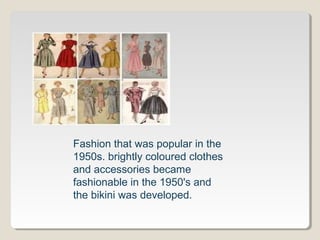
Fashion that was popular in the
1950s. brightly coloured clothes
and accessories became
fashionable in the 1950's and
the bikini was developed.
In August 1961, the communist authorities in East Germany build
a wall across Berlin to prevent their citizens from escaping to a
freer life in the West. A few people still escape; others are shot
by guards in the attempt.
‘Beatlemania’ sweeps the world in 1963. The Beatles, the first
pop supergroup, attract huge crowds of teenagers wherever they
appear. They stimulate a cultural revolution, widening the
generation gap.
The Beatles: Ringo Starr
on drums and, from left to right,
Paul McCartney, George Harrison
and John Lennon.
The ‘Swinging Sixties’ – a period of economic
growth
The 1960s sees the emergence of 'youth culture’,
with groups such as The Beatles attracting huge
crowds of teenage fans wherever they appear,
helping to stimulate a cultural revolution and
widening the generation gap. It is a good period for
the economy, helped by the fact that EU countries
stop charging custom duties when they trade with
each other. They also agree joint control over food
production, so that everybody now has enough to
eat - and soon there is even surplus agricultural
produce. May 1968 becomes famous for student
riots in Paris, and many changes in society and
behaviour become associated with the so-called ‘68
generation’.
Curiosity
Clothes and accessories of the 1960s.
In the 1960s, young people affirm their identity.
Their ideas often differ from those of adults and a
true youth culture emerges. The pop industry
booms, helped by television, transistor radios and
LPs (long-playing records). Teenagers make fashion
statements: miniskirts and high boots for girls, and
long hair and pointed shoes for boys. This is a time
when EU countries experience growth and rising
prosperity — the golden sixties.
Fashion1960s
1960s
The Americans reassert their supremacy
in space by landing a man on the moon in
July 1969.
CRONOLOGIA
1992
7 febbraio
Firma a Maastricht del trattato sull’Unione europea (che pone le
premesse per una politica estera e di sicurezza comune, una maggiore
cooperazione nei settori della giustizia e degli affari interni e la
creazione di un’Unione economica e monetaria comprendente una
moneta unica), che entra in vigore il 1° novembre 1993
1993
1 gennaio
Completamento del mercato unico europeo
2002
1 gennaio
Immissione in circolazione dei biglietti e delle monete in Euro.
GRAN
BRETAGNIA
SCANDINAVIA
EST
EUROPA
SUD -OVEST
GRAN BRETAGNA
SCANDINAVIA
EST
EUROPA
Gli stati membri dell’UE
Sono 27, infatti dal 1°
gennaio
2007 sono entrate la
Romania
e la Bulgaria tuttavia non
tutti
gli stati hanno aderito
all’Euro
In azzurro sono indicati
gli stati
UE che hanno
mantenuto una
moneta propria in verde
gli stati che hanno
adottato l’Euro
GRAN BRETAGNA
SCANDINAVIA
EST
EUROPA
SUD OVEST
Eu time line
Eu time line

Eu time line

  • 1.
    EU Time LineEUTime Line from 1945 to 1959from 1945 to 1959 from 1960 to 1969from 1960 to 1969 from 1970 to 1979from 1970 to 1979 from 1980 to 1989from 1980 to 1989 from 1990 to 1999from 1990 to 1999 from 2000 to todayfrom 2000 to today dsd
  • 2.
    1945-1959The beginnings ofcooperation 1960-1969A period of economic growth 1970-1979A growing community 1980-1989The fall of the Berlin Wall 1990-1999A Europe without frontiers 2000-todayA decade of further expansion
  • 3.
    1945 -1959 A peacefulEurope – the beginnings of cooperation The historical roots of the European Union lie in the Second World War. Europeans are determined to prevent such killing and destruction ever happening again. Soon after the war, Europe is split into East and West as the 40-year-long Cold War begins. West European nations create the Council of Europe in 1949. It is a first step towards cooperation between them, but six countries want to go further. 9 May 1950 — French Foreign Minister Robert Schuman presents a plan for deeper cooperation. Later, every 9 May is celebrated as 'Europe Day'.
  • 4.
    18 April 1951 Basedon the Schuman plan, six countries sign a treaty to run their heavy industries – coal and steel – under a common management. In this way, none can on its own make the weapons of war to turn against the other, as in the past. The six are Germany, France, Italy, the Netherlands, Belgium and Luxembourg. Founding Member States: Germany, France, Italy, the Netherlands, Belgium and Luxembourg.
  • 5.
    Sir Winston Churchill(1874-1965) Churchill, a former army officer, war reporter and British Prime Minister (1940-45 and 1951-55), was one of the first to call for the creation of a 'United States of Europe'.Following the experience of the Second World War, he was convinced that only a united Europe could guarantee peace. His aim was to eliminate the European ills of nationalism and war-mongering once and for all. He formulated his conclusions drawn from the lessons of history in his famous 'Speech to the academic youth' held at the University of Zurich in 1946: "There is a remedy which ... would in a few years make all Europe ... free and ... happy. It is to re-create the European family, or as much of it as we can, and to provide it with a structure under which it can dwell in peace, in safety and in freedom. We must build a kind of United States of Europe." Thus the driving force behind the anti-Hitler coalition became an active fighter in Europe's cause. Sir Winston Churchill also made a name for himself as a painter and writer; in 1953 he was awarded the Nobel Prize for Literature. Alcide de Gasperi (1881-1954) From 1945 up until 1953, Alcide de Gasperi, in his roles as Prime Minister and Minister for Foreign Affairs, forged the path of Italy's internal and external policies in the post-war years. He was born in the region of Trentino-Alto Adige (South Tyrol) which had, until 1918, belonged to Austria. Like other exceptional statesmen of his time, he campaigned actively for European unity. His experiences of fascism and war - he was imprisoned between 1926 and 1929 before finding asylum in the Vatican - led to his conviction that only the union of Europe could prevent their recurrence. Time and again he promoted initiatives for the fusion of Western Europe, working on the realisation of the Marshall Plan and creating close economic ties with other European countries, in particular France. Furthermore, he supported the Schumann Plan for the foundation of the European Coal and Steel Community, and helped develop the idea of the common European defence policy.
  • 6.
    25 March 1957 Buildingon the success of the Coal and Steel Treaty, the six countries expand cooperation to other economic sectors. They sign the Treaty of Rome, creating the European Economic Community (EEC), or ‘common market’. The idea is for people, goods and services to move freely across borders.
  • 7.
    Curiosity Clothes and accessoriesof the 1950s. In the 1950s, most children have little pocket money. They wear the same kind of clothes as their parents. But their taste in music changes with the start of rock and roll. Later, blue jeans appear, mainly for boys. Girls still wear full skirts and ankle socks. One of the most popular crazes of the decade is the hula hoop.
  • 8.
    Fashion that waspopular in the 1950s. brightly coloured clothes and accessories became fashionable in the 1950's and the bikini was developed.
  • 9.
    In August 1961,the communist authorities in East Germany build a wall across Berlin to prevent their citizens from escaping to a freer life in the West. A few people still escape; others are shot by guards in the attempt. ‘Beatlemania’ sweeps the world in 1963. The Beatles, the first pop supergroup, attract huge crowds of teenagers wherever they appear. They stimulate a cultural revolution, widening the generation gap. The Beatles: Ringo Starr on drums and, from left to right, Paul McCartney, George Harrison and John Lennon.
  • 11.
    The ‘Swinging Sixties’– a period of economic growth The 1960s sees the emergence of 'youth culture’, with groups such as The Beatles attracting huge crowds of teenage fans wherever they appear, helping to stimulate a cultural revolution and widening the generation gap. It is a good period for the economy, helped by the fact that EU countries stop charging custom duties when they trade with each other. They also agree joint control over food production, so that everybody now has enough to eat - and soon there is even surplus agricultural produce. May 1968 becomes famous for student riots in Paris, and many changes in society and behaviour become associated with the so-called ‘68 generation’.
  • 12.
    Curiosity Clothes and accessoriesof the 1960s. In the 1960s, young people affirm their identity. Their ideas often differ from those of adults and a true youth culture emerges. The pop industry booms, helped by television, transistor radios and LPs (long-playing records). Teenagers make fashion statements: miniskirts and high boots for girls, and long hair and pointed shoes for boys. This is a time when EU countries experience growth and rising prosperity — the golden sixties.
  • 13.
  • 14.
    The Americans reasserttheir supremacy in space by landing a man on the moon in July 1969.
  • 15.
    CRONOLOGIA 1992 7 febbraio Firma aMaastricht del trattato sull’Unione europea (che pone le premesse per una politica estera e di sicurezza comune, una maggiore cooperazione nei settori della giustizia e degli affari interni e la creazione di un’Unione economica e monetaria comprendente una moneta unica), che entra in vigore il 1° novembre 1993 1993 1 gennaio Completamento del mercato unico europeo 2002 1 gennaio Immissione in circolazione dei biglietti e delle monete in Euro.
  • 16.
  • 17.
    Gli stati membridell’UE Sono 27, infatti dal 1° gennaio 2007 sono entrate la Romania e la Bulgaria tuttavia non tutti gli stati hanno aderito all’Euro In azzurro sono indicati gli stati UE che hanno mantenuto una moneta propria in verde gli stati che hanno adottato l’Euro GRAN BRETAGNA SCANDINAVIA EST EUROPA SUD OVEST

Editor's Notes