




4th Grading Review Class
World History – Social III
 Prepared by: Mr. Kenno Jan M.
           Caballero
Parts of the Review
1.    Key Terms / Concepts
2.    Important People
3.    Significant Things
4.    Analysis
                 Coverage of the Long Test
•    Renaissance
•     Protestant Reformation and Counter-
      Reformation
•     Age of Exploration (European Colonial Empire)
•     Industrial Revolution
•     World War I
Definition of Key Terms and Key Concepts – Necessary for Analysis

KEY TERMS / KEY CONCEPTS
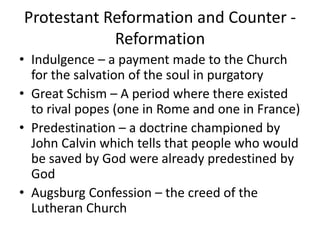
Protestant Reformation and Counter -
            Reformation
• Indulgence – a payment made to the Church
  for the salvation of the soul in purgatory
• Great Schism – A period where there existed
  to rival popes (one in Rome and one in France)
• Predestination – a doctrine championed by
  John Calvin which tells that people who would
  be saved by God were already predestined by
  God
• Augsburg Confession – the creed of the
  Lutheran Church
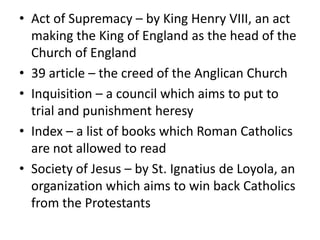
• Act of Supremacy – by King Henry VIII, an act
  making the King of England as the head of the
  Church of England
• 39 article – the creed of the Anglican Church
• Inquisition – a council which aims to put to
  trial and punishment heresy
• Index – a list of books which Roman Catholics
  are not allowed to read
• Society of Jesus – by St. Ignatius de Loyola, an
  organization which aims to win back Catholics
  from the Protestants
Age of Exploration
• Treaty of Tordesillas – A papal bull which
  divides the World into two between
  Spain(West) and Portugal(East)
• Mercantilism – An economic doctrine which
  asserts that the basis of the greatness of a
  nation would be the amount of gold and silver
  that its possess
• Commercial Revolution – “Commerce” An
  expansion of foreign trade
Industrial Revolution
• Industrial Revolution – a non-violent change in
  the way of life of humans which transforms the
  economic and technological aspects of society;
  the replacement of human labor by machines
• Domestic/Cottage Industries - a method of
  production in which raw materials are distributed
  to employees who work at home to produce
  goods
• Factory system – a method of production in
  which workers are brought together to produce
  goods by machines in factories
• Bessemer process - removal of impurities
  from iron to make it harder
• Macadamization – new way of building roads
• Capitalism – the economic system that is
  based on a free market and open competition
• Laissez faire – No government intervention in
  business
• Communism – A politico-economic system
  where the means of production would be
  held in common and everyone’s needs would
  be met
World War I
• Imperialism – extending of a nation’s power
  through the conquest of other land for
  economic and political advantages
• Jingoism/Chauvinism – extreme nationalism
  which looks down to other as “inferior”
• Militarism – a principle of placing the military
  in the top priority of a country building up
  powerful armies and great navies
• Triple Alliance – Germany, Austria-Hungary, Italy
• Triple Entente – Britain, France, Russia
• Black Hand – A Serbian Secret Group which aims
  to liberate Serbian lands from the hands of the
  Austrian-Hungarian Empire
• Trench Warfare – Method of war which builds up
  defensive positions to protect territories gained
• Ace – A title given to a pilot who downed 5
  enemy aircrafts being witnessed by three people
• Kaiser – German Emperor
• Czar – Russian Emperor
• Zimmerman note/code
• Fourteen Points – plans for peace by Pres.
  Wilson
• Armistice – a halt to fighting; 11th month of
  the 11th day of the 11th hour all fighting will
  cease.
• Treaty of Versailles – aims to made Germany
  pay for the war by crippling them
People who made a difference

IMPORTANT PEOPLE
• Martin Luther – “Father of the Protestant
  Reformation; translated the Bible into
  German; 95 Theses
• Johann Gutenburg – Inventor of the Printing
  Press
• John Wycliffe – Translated the Bible to English
• Desiderius Erasmus – wrote the “In Praise of
  Folly:
• Philip Melanchton – Augsburg Confessions
• John Calvin – Calvinism; Predestination
• John Knox – Presbyterianism-Scotland
• King Henry VIII – “Defender of the Faith”; Act
  of Supremacy
• Council of Trent
• St. Ignatius de Loyola – Founder of the Society
  of Jesus
• Francis Xavier – Apostle to the Indies
•   Amerigo Vespucci – New World
•   Christopher Columbus – discovers America
•   Elizabeth I – “Mistress of the Seas”
•   Hernando Cortez – conquered Mexico
•   Ferdinand Magellan – discovered the Philippines
•   Miguel Lopez de Legaspi – conquered the
    Philippines
•   Henry Ford – Assembly line
•   Daimler Gottlieb – Internal Combustion engine
•   Rudolf Diesel – Diesel engine
•   Wright Brothers – Airplane
•   Alexander Graham Bell – Telephone
•   Samuel Morse – Telegraph
•    Henry Bessemer – Bessemer Process
•   John Mc Adam - Macadamization
• George Stephenson – Steam locomotive (Rocket)
• Robert Fulton – Steamship (Clermont)
• Karl Marx – “Communist Manifesto”; Father of
  Communism
• Adam Smith – “Wealth of Nations”; Father of
  Modern Economics – Capitalism
• Archduke Francis Ferdinand – Heir to the
  Austrian-Hungarian throne
• Gavrilo Princip – Assassin of the Black Hand
  Movement
• “Red Baron” – Greatest ace of the Great war
• Pres. Woodrow Wilson – 14 points; League of
  Nations
• Vladimir Lenin – Father of Communist Russia
• Joseph Stalin – made Russia into a great power
Things to remember

SIGNIFICANT THINGS
• Invention of the Printing Press by Gutenburg
• Corruption in the Church –
  Simony, Indulgence, luxurious life of
  clergy, unbiblical practices
• Posting of the Ninety-five these in Wittenburg by
  Martin Luther
• Salvation by Grace through Faith
• Bible as Sole guide for man’s salvation
• Excommunication of Martin Luther
• Spread Of Protestantism
• Catholic Counter-Reformation
• Council of Trent
• Missionary Achievements
• Pioneer of the Exploration – Portugal
• Discovery of a new route by sea to Asia by
  Portugal
• Demarcation set by Rome
• Treaty of Tordesillas
• Exploration of France, Netherlands, Britain
• Imperialism of European countries
• Africa as the Dark Continent
• Old World – Europe; New World – Americas
• Great Britain as pioneer of the Industrial
  Revolution
• Agricultural Revolution – Industrial Revolution
• Industrial Revolution starts with the Textile
  Industry
• Improvement on Manufacturing (Mass
  Production), Transportation, and
  Communication
• Shift from Domestic to Factory system
• Assembly line improves the factory
• Shift from Mercantilism to Capitalism
• Capitalism vs. Communism
• Urbanization
• Assassination of Archduke Francis Ferdinand
  starts World War 1 – the Great War
• Great War – “the war to end all wars”
• Austria attacks Serbia; Serbia backed by Russia
• Austria-Hungary backed by Germany
• Russia backed by France
• Germany attacks Belgium; Great Britain joins
  the War: World War I begins
• Stalemate – both side are not winning
• Zimmerman code/note
• Sinking of the Lusitania
• 1917 – withdrawal of Russia from the war
• Germany surrenders despite not being
  defeated
• 11th hour of the 11th day of the 11th month all
  fighting would cease – Armistice
• Treaty of Versailles
• Collapse of Four World Empires –
  German, Austrian-
  Hungarian, Ottoman, Russian
ANALYSIS
Protestant Reformation and Counter-
             Reformation
• Causes: Decline of the Papacy, Luxury of the
  Church, Simony, Immoralities, Certain Church
  doctrines that are not based form the Bible -
  Indulgences
• Theological Issues: Sola Scriptura, Sola
  Gratia, Sola Fide
• Start of the Reformation: Posting of the 95
  Theses
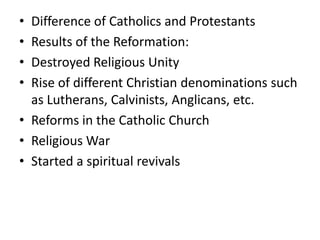
• Difference of Catholics and Protestants
• Results of the Reformation:
• Destroyed Religious Unity
• Rise of different Christian denominations such
  as Lutherans, Calvinists, Anglicans, etc.
• Reforms in the Catholic Church
• Religious War
• Started a spiritual revivals
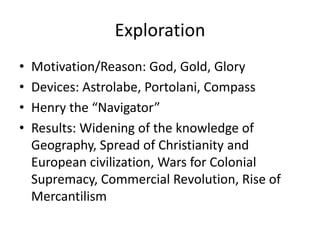
Exploration
•   Motivation/Reason: God, Gold, Glory
•   Devices: Astrolabe, Portolani, Compass
•   Henry the “Navigator”
•   Results: Widening of the knowledge of
    Geography, Spread of Christianity and
    European civilization, Wars for Colonial
    Supremacy, Commercial Revolution, Rise of
    Mercantilism
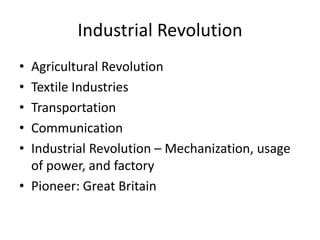
Industrial Revolution
• Agricultural Revolution
• Textile Industries
• Transportation
• Communication
• Industrial Revolution – Mechanization, usage
  of power, and factory
• Pioneer: Great Britain
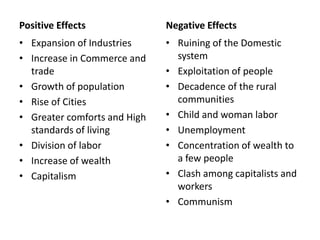
Positive Effects              Negative Effects
• Expansion of Industries     • Ruining of the Domestic
• Increase in Commerce and      system
  trade                       • Exploitation of people
• Growth of population        • Decadence of the rural
• Rise of Cities                communities
• Greater comforts and High   • Child and woman labor
  standards of living         • Unemployment
• Division of labor           • Concentration of wealth to
• Increase of wealth            a few people
• Capitalism                  • Clash among capitalists and
                                workers
                              • Communism
World War I
• Causes: Extreme
  Nationalism, Imperialism, Militarism, and Rival
  Alliances
• Tripe Alliance – Germany, Austria-
  Hungary, Italy
• Triple Entente – Britain, France, Russia
• Central Powers – Germany, Austria-
  Hungary, Ottoman, Bulgaria, etc.
• Allies Powers –
  Britain, France, Russia, U.S, Japan
•   Formation of Alliances
•   Assassination of Archduke Francis Ferdinand
•   Austria-Hungary vs. Serbia
•   Russia aids Serbia
•   Germany helps Austria-Hungary
•   France declares war to the Central Powers
•   Germany attacks Belgium so it could go to
    France
•   Britain declares war
•   Stalemate – Trench warfare
•   American entry to the war
•   Armistice
•   Treaty of Versailles

4th grading review class social studies

  • 1.
    4th Grading ReviewClass World History – Social III Prepared by: Mr. Kenno Jan M. Caballero
  • 2.
    Parts of theReview 1. Key Terms / Concepts 2. Important People 3. Significant Things 4. Analysis Coverage of the Long Test • Renaissance • Protestant Reformation and Counter- Reformation • Age of Exploration (European Colonial Empire) • Industrial Revolution • World War I
  • 3.
    Definition of KeyTerms and Key Concepts – Necessary for Analysis KEY TERMS / KEY CONCEPTS
  • 4.
    Protestant Reformation andCounter - Reformation • Indulgence – a payment made to the Church for the salvation of the soul in purgatory • Great Schism – A period where there existed to rival popes (one in Rome and one in France) • Predestination – a doctrine championed by John Calvin which tells that people who would be saved by God were already predestined by God • Augsburg Confession – the creed of the Lutheran Church
  • 5.
    • Act ofSupremacy – by King Henry VIII, an act making the King of England as the head of the Church of England • 39 article – the creed of the Anglican Church • Inquisition – a council which aims to put to trial and punishment heresy • Index – a list of books which Roman Catholics are not allowed to read • Society of Jesus – by St. Ignatius de Loyola, an organization which aims to win back Catholics from the Protestants
  • 6.
    Age of Exploration •Treaty of Tordesillas – A papal bull which divides the World into two between Spain(West) and Portugal(East) • Mercantilism – An economic doctrine which asserts that the basis of the greatness of a nation would be the amount of gold and silver that its possess • Commercial Revolution – “Commerce” An expansion of foreign trade
  • 7.
    Industrial Revolution • IndustrialRevolution – a non-violent change in the way of life of humans which transforms the economic and technological aspects of society; the replacement of human labor by machines • Domestic/Cottage Industries - a method of production in which raw materials are distributed to employees who work at home to produce goods • Factory system – a method of production in which workers are brought together to produce goods by machines in factories
  • 8.
    • Bessemer process- removal of impurities from iron to make it harder • Macadamization – new way of building roads • Capitalism – the economic system that is based on a free market and open competition • Laissez faire – No government intervention in business • Communism – A politico-economic system where the means of production would be held in common and everyone’s needs would be met
  • 9.
    World War I •Imperialism – extending of a nation’s power through the conquest of other land for economic and political advantages • Jingoism/Chauvinism – extreme nationalism which looks down to other as “inferior” • Militarism – a principle of placing the military in the top priority of a country building up powerful armies and great navies
  • 10.
    • Triple Alliance– Germany, Austria-Hungary, Italy • Triple Entente – Britain, France, Russia • Black Hand – A Serbian Secret Group which aims to liberate Serbian lands from the hands of the Austrian-Hungarian Empire • Trench Warfare – Method of war which builds up defensive positions to protect territories gained • Ace – A title given to a pilot who downed 5 enemy aircrafts being witnessed by three people • Kaiser – German Emperor • Czar – Russian Emperor
  • 11.
    • Zimmerman note/code •Fourteen Points – plans for peace by Pres. Wilson • Armistice – a halt to fighting; 11th month of the 11th day of the 11th hour all fighting will cease. • Treaty of Versailles – aims to made Germany pay for the war by crippling them
  • 12.
    People who madea difference IMPORTANT PEOPLE
  • 13.
    • Martin Luther– “Father of the Protestant Reformation; translated the Bible into German; 95 Theses • Johann Gutenburg – Inventor of the Printing Press • John Wycliffe – Translated the Bible to English • Desiderius Erasmus – wrote the “In Praise of Folly: • Philip Melanchton – Augsburg Confessions
  • 14.
    • John Calvin– Calvinism; Predestination • John Knox – Presbyterianism-Scotland • King Henry VIII – “Defender of the Faith”; Act of Supremacy • Council of Trent • St. Ignatius de Loyola – Founder of the Society of Jesus • Francis Xavier – Apostle to the Indies
  • 15.
    Amerigo Vespucci – New World • Christopher Columbus – discovers America • Elizabeth I – “Mistress of the Seas” • Hernando Cortez – conquered Mexico • Ferdinand Magellan – discovered the Philippines • Miguel Lopez de Legaspi – conquered the Philippines • Henry Ford – Assembly line • Daimler Gottlieb – Internal Combustion engine • Rudolf Diesel – Diesel engine • Wright Brothers – Airplane • Alexander Graham Bell – Telephone • Samuel Morse – Telegraph • Henry Bessemer – Bessemer Process • John Mc Adam - Macadamization
  • 16.
    • George Stephenson– Steam locomotive (Rocket) • Robert Fulton – Steamship (Clermont) • Karl Marx – “Communist Manifesto”; Father of Communism • Adam Smith – “Wealth of Nations”; Father of Modern Economics – Capitalism • Archduke Francis Ferdinand – Heir to the Austrian-Hungarian throne • Gavrilo Princip – Assassin of the Black Hand Movement • “Red Baron” – Greatest ace of the Great war • Pres. Woodrow Wilson – 14 points; League of Nations • Vladimir Lenin – Father of Communist Russia • Joseph Stalin – made Russia into a great power
  • 17.
  • 18.
    • Invention ofthe Printing Press by Gutenburg • Corruption in the Church – Simony, Indulgence, luxurious life of clergy, unbiblical practices • Posting of the Ninety-five these in Wittenburg by Martin Luther • Salvation by Grace through Faith • Bible as Sole guide for man’s salvation • Excommunication of Martin Luther • Spread Of Protestantism • Catholic Counter-Reformation • Council of Trent • Missionary Achievements • Pioneer of the Exploration – Portugal
  • 19.
    • Discovery ofa new route by sea to Asia by Portugal • Demarcation set by Rome • Treaty of Tordesillas • Exploration of France, Netherlands, Britain • Imperialism of European countries • Africa as the Dark Continent • Old World – Europe; New World – Americas • Great Britain as pioneer of the Industrial Revolution • Agricultural Revolution – Industrial Revolution • Industrial Revolution starts with the Textile Industry
  • 20.
    • Improvement onManufacturing (Mass Production), Transportation, and Communication • Shift from Domestic to Factory system • Assembly line improves the factory • Shift from Mercantilism to Capitalism • Capitalism vs. Communism • Urbanization • Assassination of Archduke Francis Ferdinand starts World War 1 – the Great War • Great War – “the war to end all wars” • Austria attacks Serbia; Serbia backed by Russia
  • 21.
    • Austria-Hungary backedby Germany • Russia backed by France • Germany attacks Belgium; Great Britain joins the War: World War I begins • Stalemate – both side are not winning • Zimmerman code/note • Sinking of the Lusitania • 1917 – withdrawal of Russia from the war • Germany surrenders despite not being defeated • 11th hour of the 11th day of the 11th month all fighting would cease – Armistice • Treaty of Versailles
  • 22.
    • Collapse ofFour World Empires – German, Austrian- Hungarian, Ottoman, Russian
  • 23.
  • 24.
    Protestant Reformation andCounter- Reformation • Causes: Decline of the Papacy, Luxury of the Church, Simony, Immoralities, Certain Church doctrines that are not based form the Bible - Indulgences • Theological Issues: Sola Scriptura, Sola Gratia, Sola Fide • Start of the Reformation: Posting of the 95 Theses
  • 25.
    • Difference ofCatholics and Protestants • Results of the Reformation: • Destroyed Religious Unity • Rise of different Christian denominations such as Lutherans, Calvinists, Anglicans, etc. • Reforms in the Catholic Church • Religious War • Started a spiritual revivals
  • 26.
    Exploration • Motivation/Reason: God, Gold, Glory • Devices: Astrolabe, Portolani, Compass • Henry the “Navigator” • Results: Widening of the knowledge of Geography, Spread of Christianity and European civilization, Wars for Colonial Supremacy, Commercial Revolution, Rise of Mercantilism
  • 27.
    Industrial Revolution • AgriculturalRevolution • Textile Industries • Transportation • Communication • Industrial Revolution – Mechanization, usage of power, and factory • Pioneer: Great Britain
  • 28.
    Positive Effects Negative Effects • Expansion of Industries • Ruining of the Domestic • Increase in Commerce and system trade • Exploitation of people • Growth of population • Decadence of the rural • Rise of Cities communities • Greater comforts and High • Child and woman labor standards of living • Unemployment • Division of labor • Concentration of wealth to • Increase of wealth a few people • Capitalism • Clash among capitalists and workers • Communism
  • 29.
    World War I •Causes: Extreme Nationalism, Imperialism, Militarism, and Rival Alliances • Tripe Alliance – Germany, Austria- Hungary, Italy • Triple Entente – Britain, France, Russia • Central Powers – Germany, Austria- Hungary, Ottoman, Bulgaria, etc. • Allies Powers – Britain, France, Russia, U.S, Japan
  • 30.
    Formation of Alliances • Assassination of Archduke Francis Ferdinand • Austria-Hungary vs. Serbia • Russia aids Serbia • Germany helps Austria-Hungary • France declares war to the Central Powers • Germany attacks Belgium so it could go to France • Britain declares war • Stalemate – Trench warfare • American entry to the war • Armistice • Treaty of Versailles