1492 – 1789
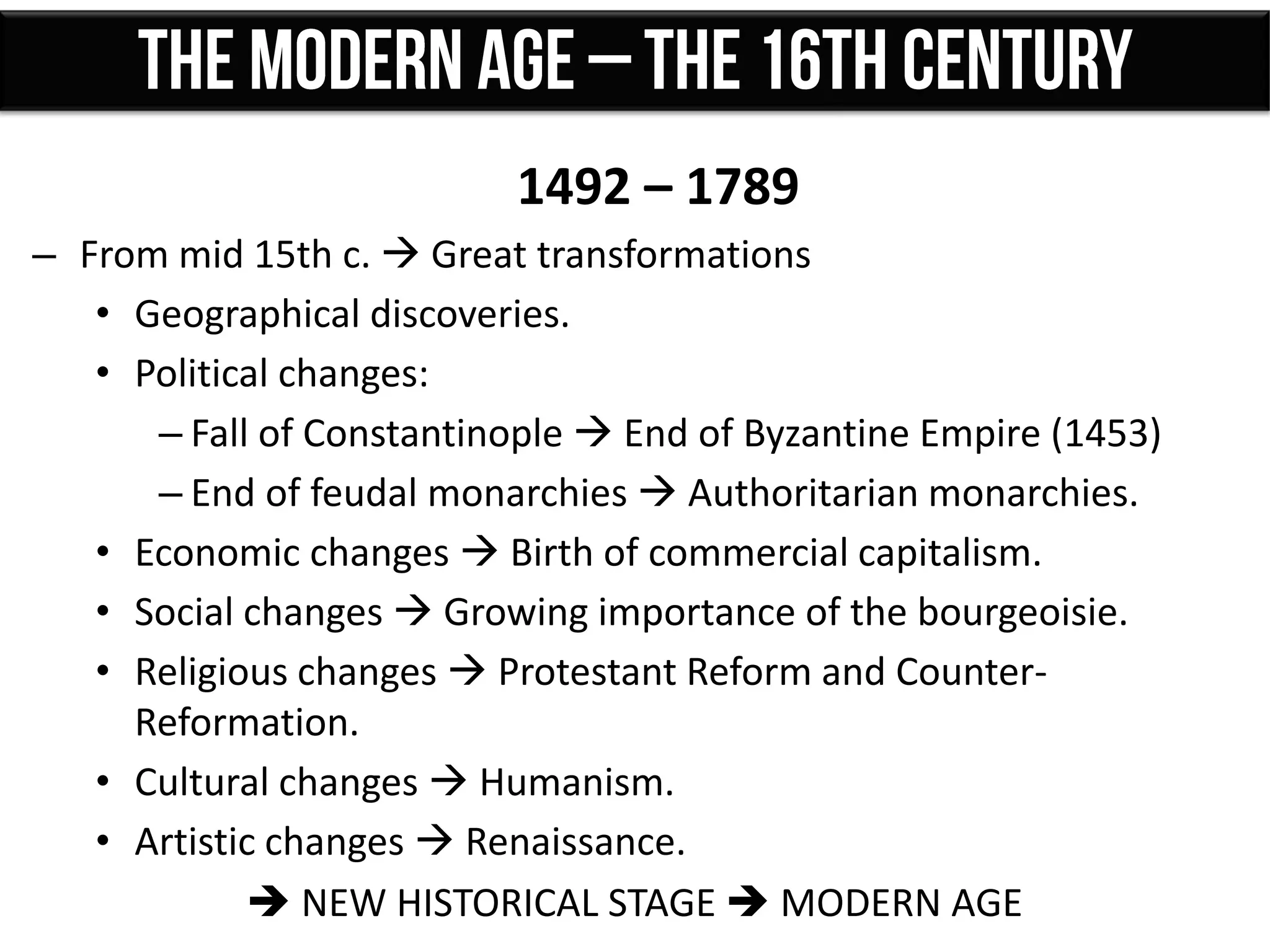
– From mid 15th c.  Great transformations
• Geographical discoveries.
• Political changes:
– Fall of Constantinople  End of Byzantine Empire (1453)
– End of feudal monarchies  Authoritarian monarchies.
• Economic changes  Birth of commercial capitalism.
• Social changes  Growing importance of the bourgeoisie.
• Religious changes  Protestant Reform and Counter-
Reformation.
• Cultural changes  Humanism.
• Artistic changes  Renaissance.
 NEW HISTORICAL STAGE  MODERN AGE
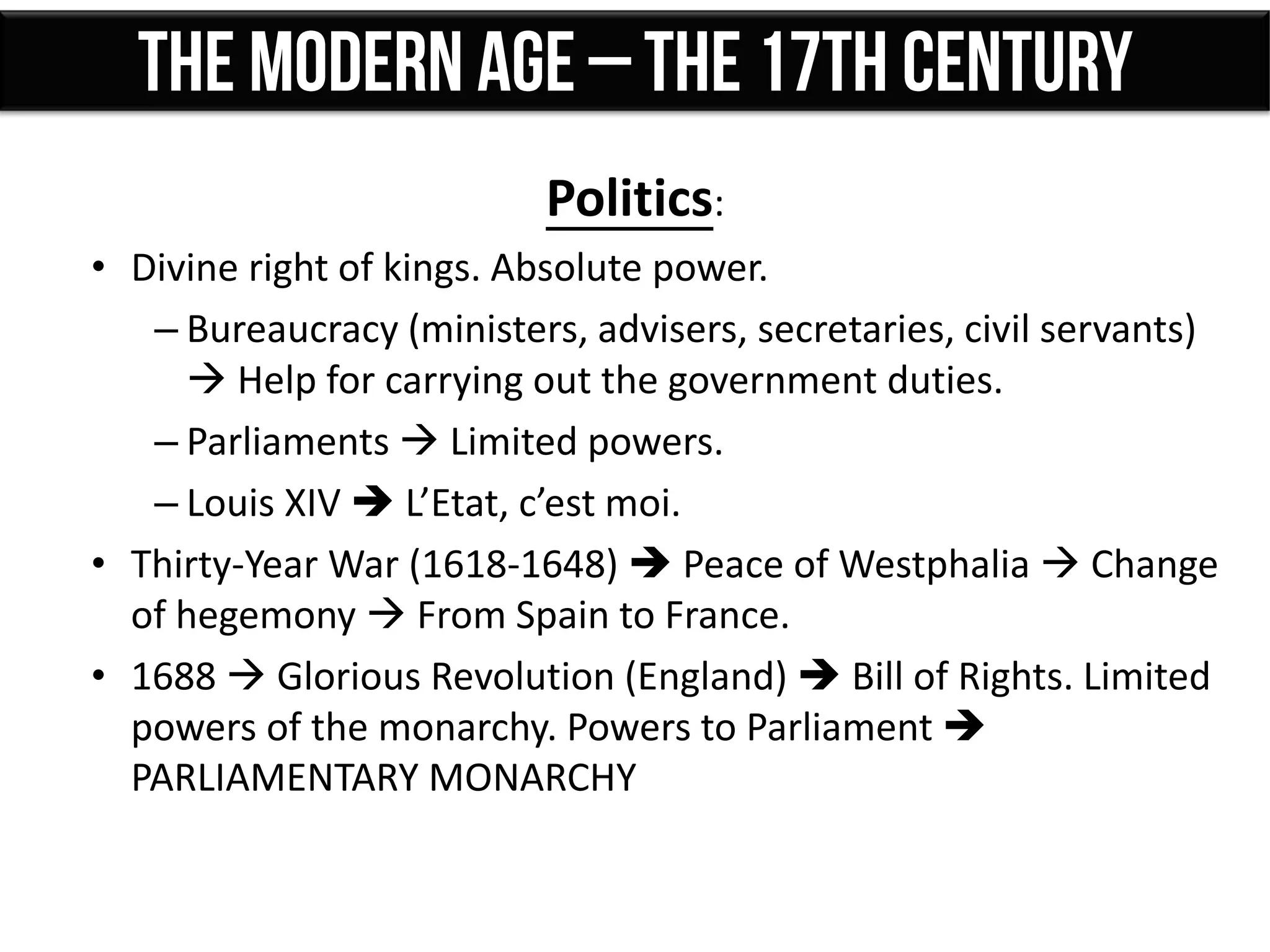
Politics:
• Divine right of kings. Absolute power.
– Bureaucracy (ministers, advisers, secretaries, civil servants)
 Help for carrying out the government duties.
– Parliaments  Limited powers.
– Louis XIV  L’Etat, c’est moi.
• Thirty-Year War (1618-1648)  Peace of Westphalia  Change
of hegemony  From Spain to France.
• 1688  Glorious Revolution (England)  Bill of Rights. Limited
powers of the monarchy. Powers to Parliament 
PARLIAMENTARY MONARCHY
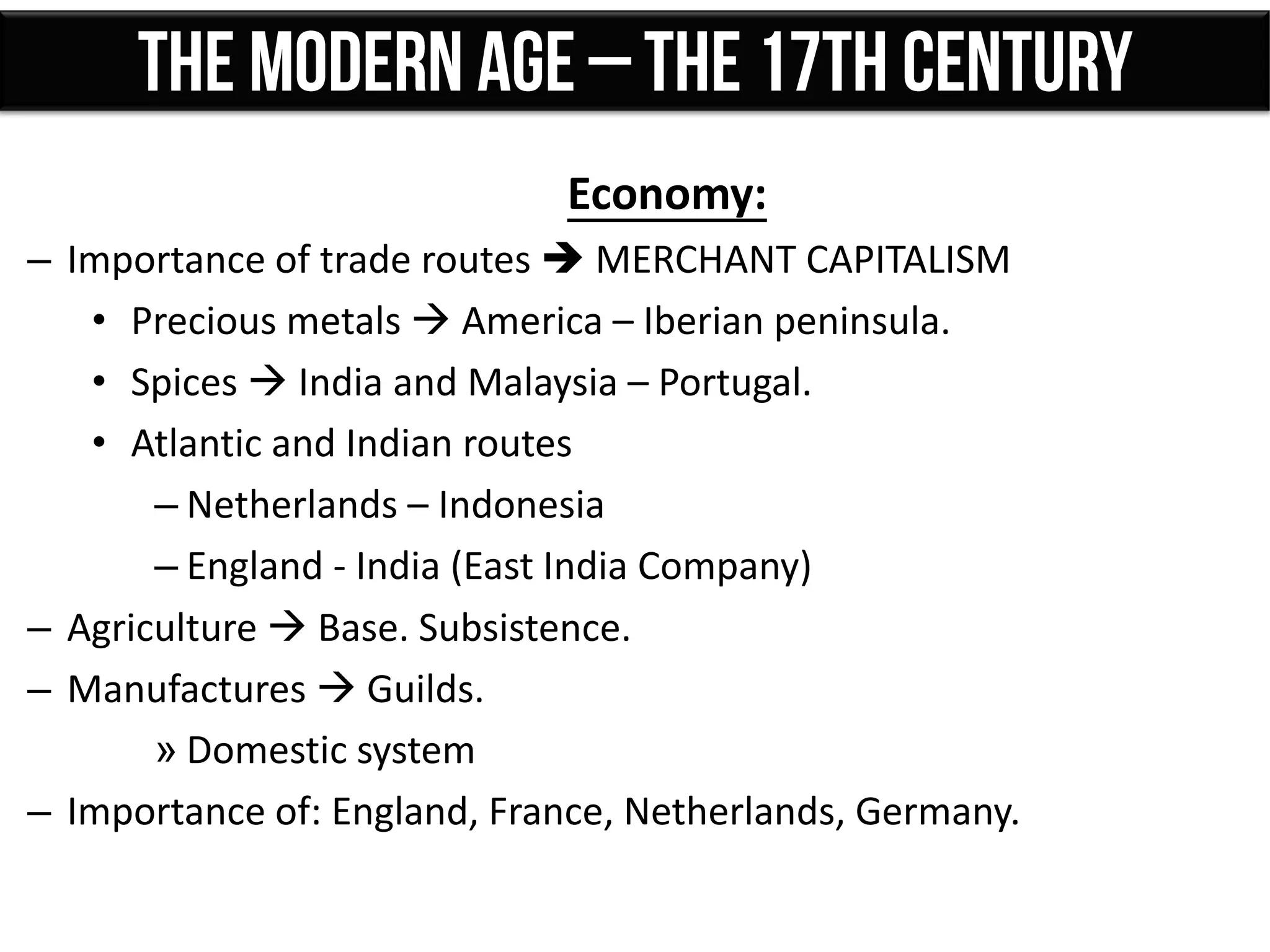
Economy:
– Importance of trade routes  MERCHANT CAPITALISM
• Precious metals  America – Iberian peninsula.
• Spices  India and Malaysia – Portugal.
• Atlantic and Indian routes
– Netherlands – Indonesia
– England - India (East India Company)
– Agriculture  Base. Subsistence.
– Manufactures  Guilds.
» Domestic system
– Importance of: England, France, Netherlands, Germany.
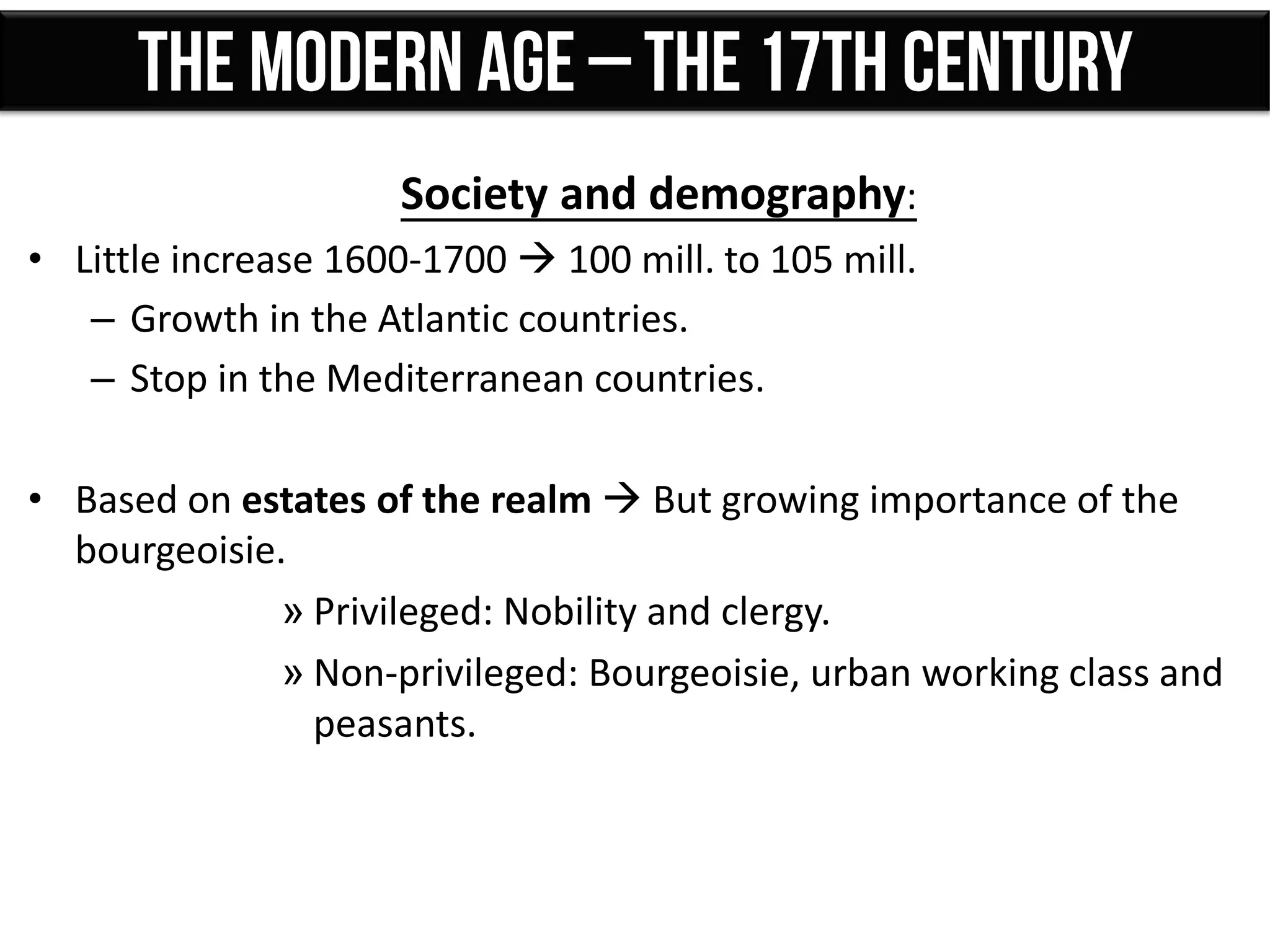
Society and demography:
• Little increase 1600-1700  100 mill. to 105 mill.
– Growth in the Atlantic countries.
– Stop in the Mediterranean countries.
• Based on estates of the realm  But growing importance of the
bourgeoisie.
» Privileged: Nobility and clergy.
» Non-privileged: Bourgeoisie, urban working class and
peasants.
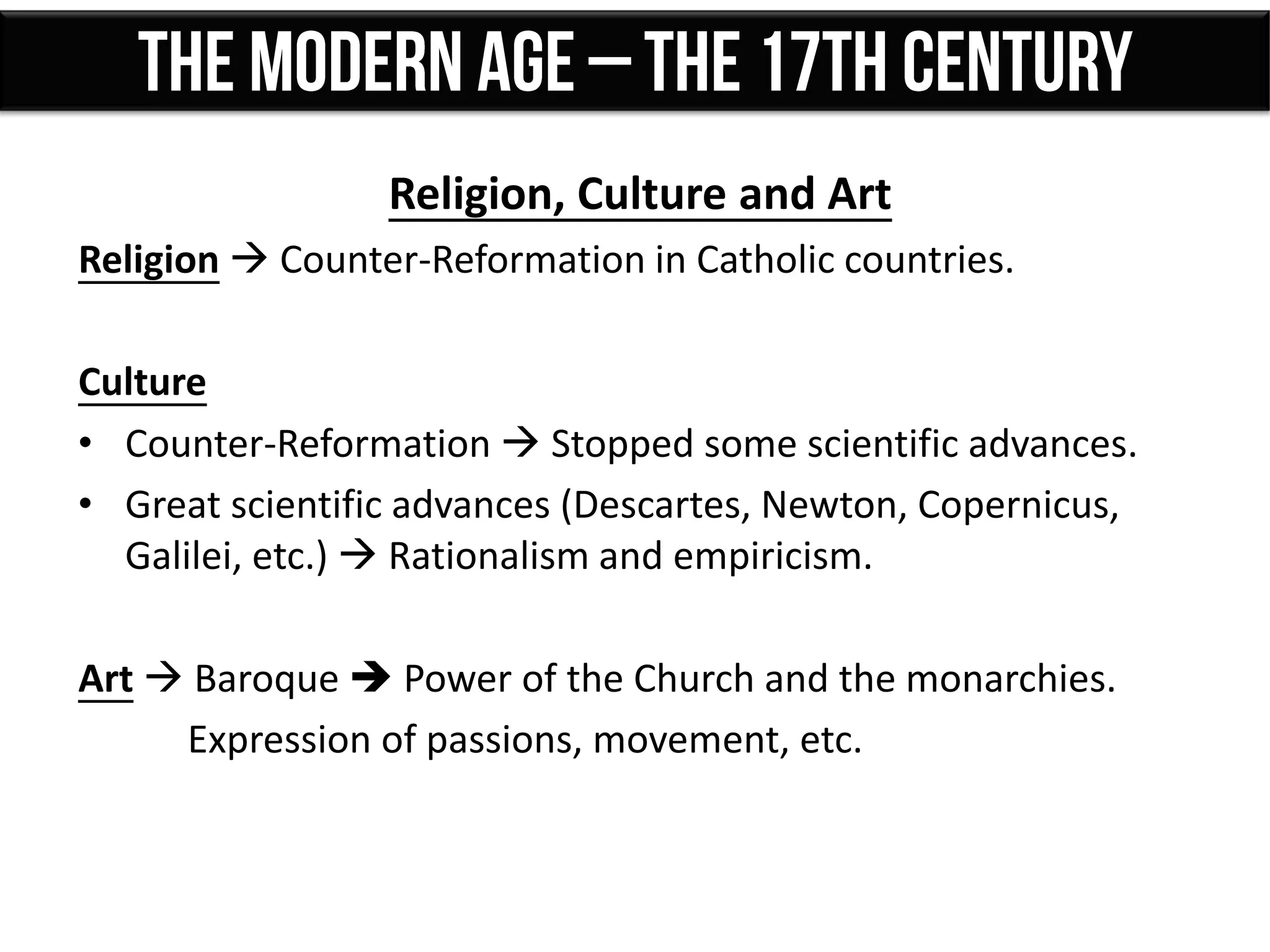
Religion, Culture and Art
Religion  Counter-Reformation in Catholic countries.
Culture
• Counter-Reformation  Stopped some scientific advances.
• Great scientific advances (Descartes, Newton, Copernicus,
Galilei, etc.)  Rationalism and empiricism.
Art  Baroque  Power of the Church and the monarchies.
Expression of passions, movement, etc.
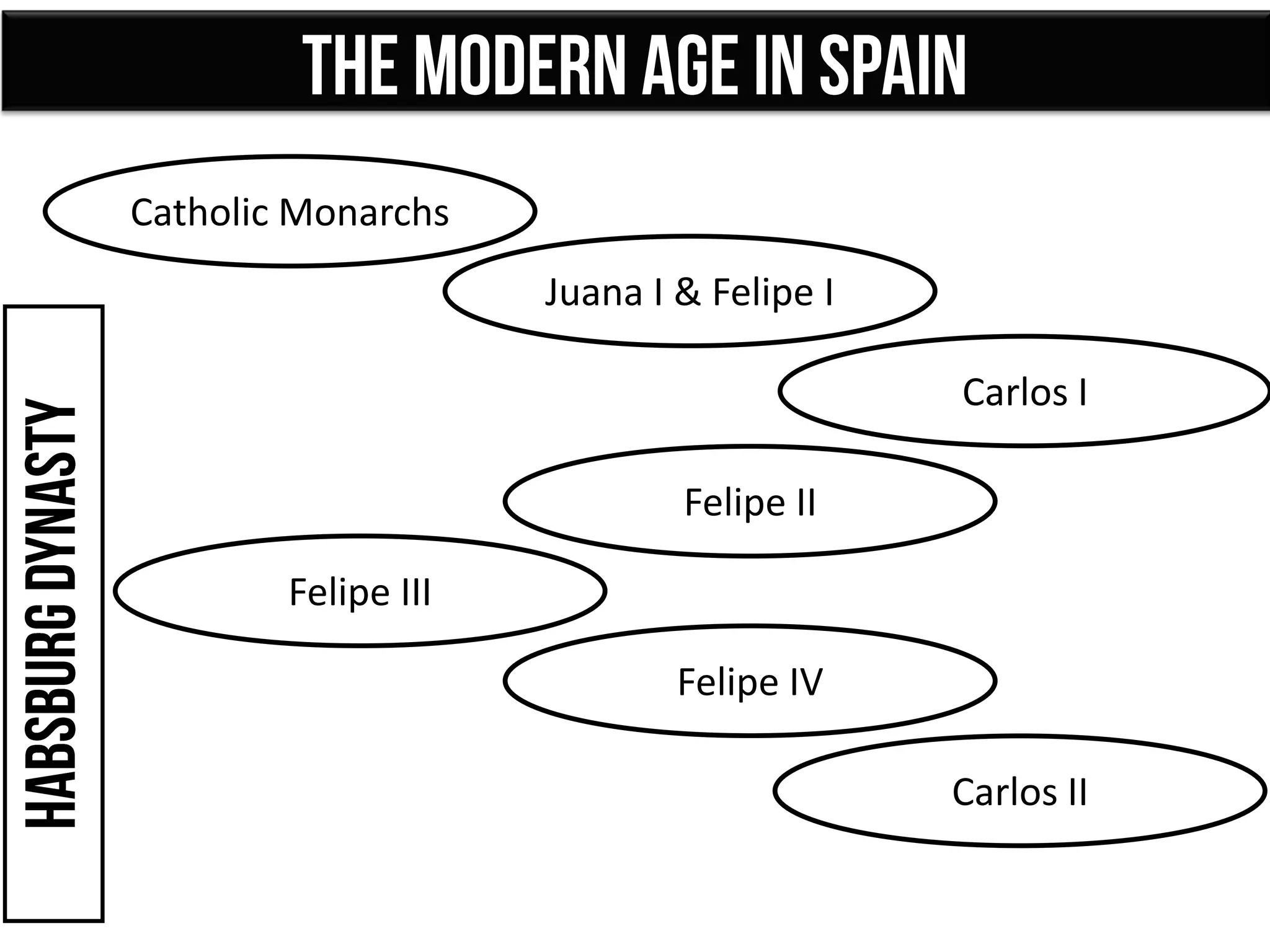
Catholic Monarchs
Juana I & Felipe I
Carlos I
Felipe II
Felipe III
Felipe IV
Carlos II
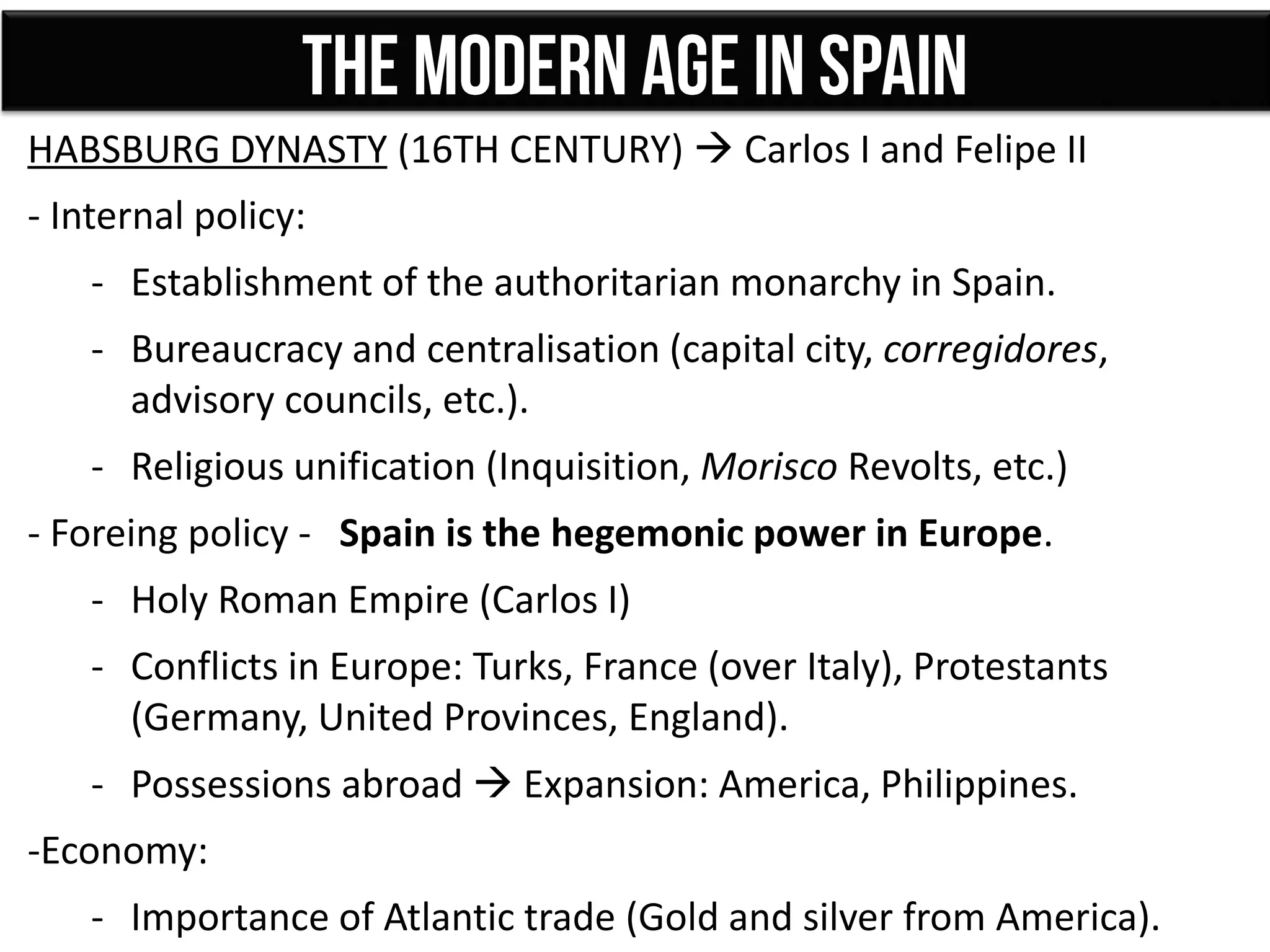
HABSBURG DYNASTY (16TH CENTURY)  Carlos I and Felipe II
- Internal policy:
- Establishment of the authoritarian monarchy in Spain.
- Bureaucracy and centralisation (capital city, corregidores,
advisory councils, etc.).
- Religious unification (Inquisition, Morisco Revolts, etc.)
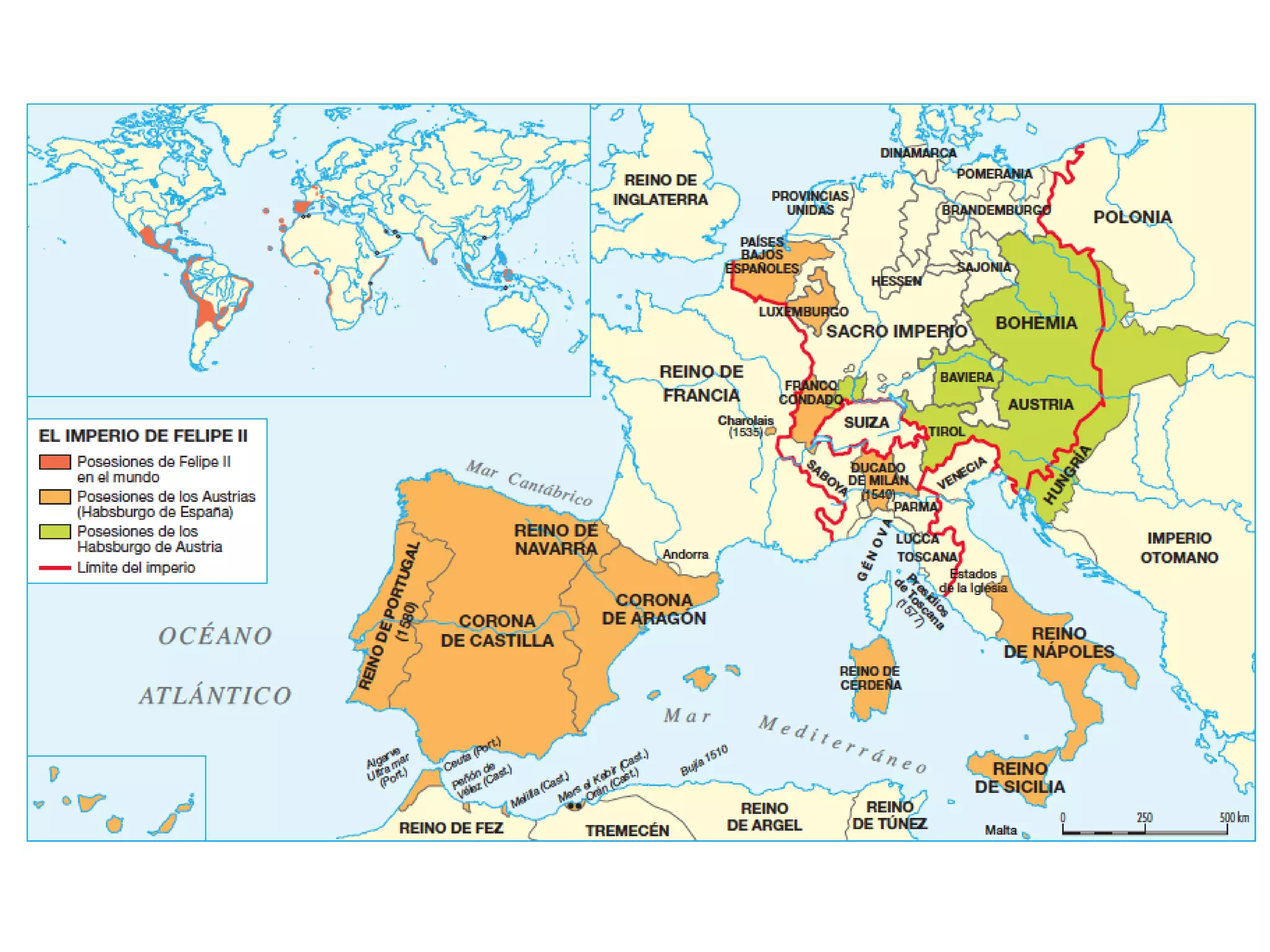
- Foreing policy - Spain is the hegemonic power in Europe.
- Holy Roman Empire (Carlos I)
- Conflicts in Europe: Turks, France (over Italy), Protestants
(Germany, United Provinces, England).
- Possessions abroad  Expansion: America, Philippines.
-Economy:
- Importance of Atlantic trade (Gold and silver from America).
HABSBURG DYNASTY (17TH CENTURY)  Felipe III, Felipe IV and
Carlos II.
General decline
- Internal policy:
- Attempts to reform the State (Conde-Duque de Olivares).
- Internal conflicts (Andalusia, Portugal and Catalonia [Guerra dels
Segadors]).
- Religious unification (Inquisition, Morisco Revolts, etc.)
- Foreign policy:
- Thirty-Years’ War (1618-1648)  Peace of Westphalia  End of
hegemony.
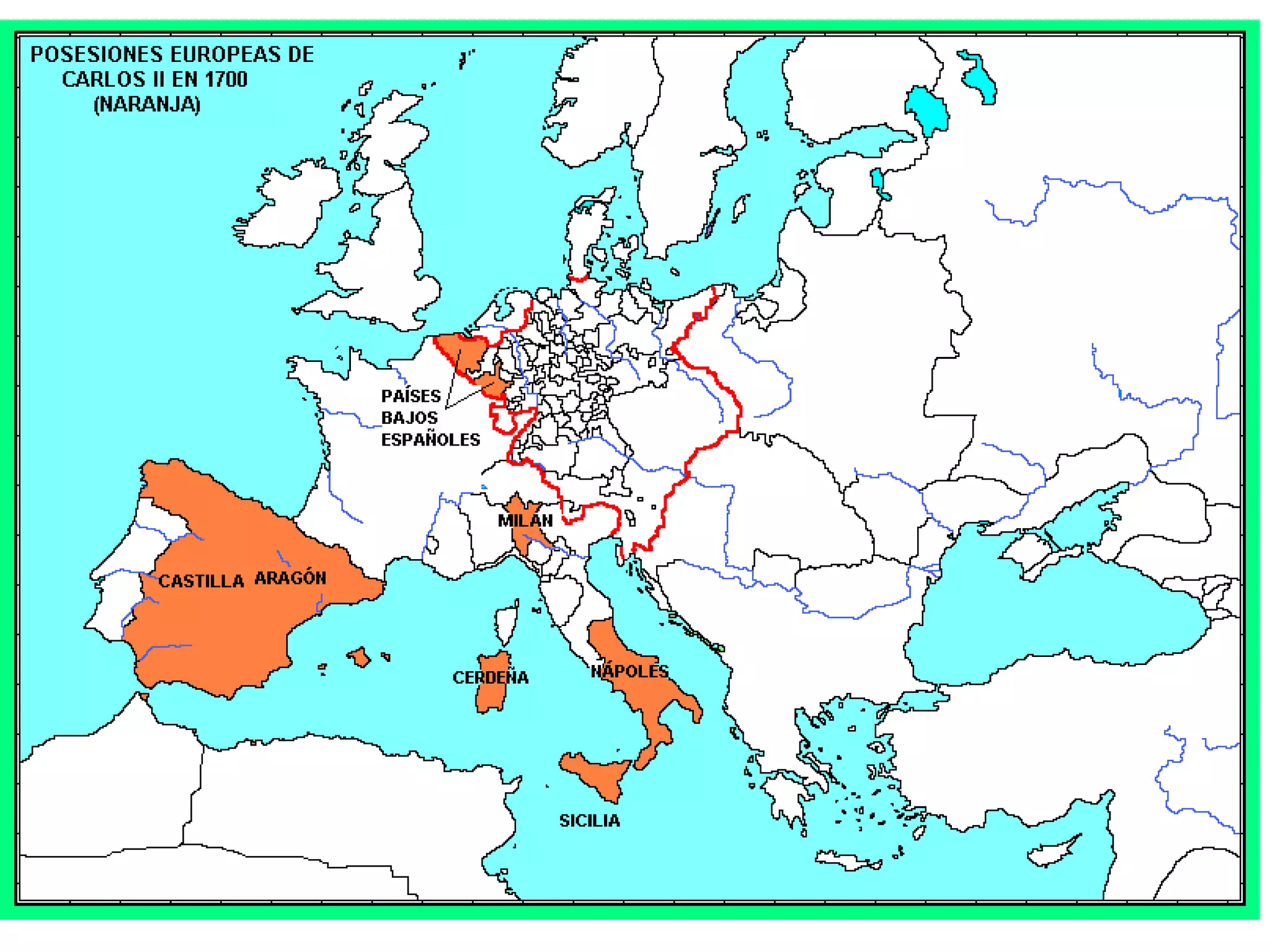
- Independence of the Netherlands.
HABSBURG DYNASTY (17TH CENTURY)  Felipe III, Felipe IV and
Carlos II.
Economy:
- Loss of population  hunger and epidemics; expulsion of the
moriscos.
- Crisis (mostly Castilla)  Agriculture, livestock, handcrafts and
trade affected.
- Loss of revenue for the Crown  Less income + less metals from
America + more expenditure.
Revision - 16th and 17th centuries.pdf

Revision - 16th and 17th centuries.pdf

  • 2.
    1492 – 1789 –From mid 15th c.  Great transformations • Geographical discoveries. • Political changes: – Fall of Constantinople  End of Byzantine Empire (1453) – End of feudal monarchies  Authoritarian monarchies. • Economic changes  Birth of commercial capitalism. • Social changes  Growing importance of the bourgeoisie. • Religious changes  Protestant Reform and Counter- Reformation. • Cultural changes  Humanism. • Artistic changes  Renaissance.  NEW HISTORICAL STAGE  MODERN AGE
  • 3.
    Politics: • Divine rightof kings. Absolute power. – Bureaucracy (ministers, advisers, secretaries, civil servants)  Help for carrying out the government duties. – Parliaments  Limited powers. – Louis XIV  L’Etat, c’est moi. • Thirty-Year War (1618-1648)  Peace of Westphalia  Change of hegemony  From Spain to France. • 1688  Glorious Revolution (England)  Bill of Rights. Limited powers of the monarchy. Powers to Parliament  PARLIAMENTARY MONARCHY
  • 4.
    Economy: – Importance oftrade routes  MERCHANT CAPITALISM • Precious metals  America – Iberian peninsula. • Spices  India and Malaysia – Portugal. • Atlantic and Indian routes – Netherlands – Indonesia – England - India (East India Company) – Agriculture  Base. Subsistence. – Manufactures  Guilds. » Domestic system – Importance of: England, France, Netherlands, Germany.
  • 5.
    Society and demography: •Little increase 1600-1700  100 mill. to 105 mill. – Growth in the Atlantic countries. – Stop in the Mediterranean countries. • Based on estates of the realm  But growing importance of the bourgeoisie. » Privileged: Nobility and clergy. » Non-privileged: Bourgeoisie, urban working class and peasants.
  • 6.
    Religion, Culture andArt Religion  Counter-Reformation in Catholic countries. Culture • Counter-Reformation  Stopped some scientific advances. • Great scientific advances (Descartes, Newton, Copernicus, Galilei, etc.)  Rationalism and empiricism. Art  Baroque  Power of the Church and the monarchies. Expression of passions, movement, etc.
  • 7.
    Catholic Monarchs Juana I& Felipe I Carlos I Felipe II Felipe III Felipe IV Carlos II
  • 8.
    HABSBURG DYNASTY (16THCENTURY)  Carlos I and Felipe II - Internal policy: - Establishment of the authoritarian monarchy in Spain. - Bureaucracy and centralisation (capital city, corregidores, advisory councils, etc.). - Religious unification (Inquisition, Morisco Revolts, etc.) - Foreing policy - Spain is the hegemonic power in Europe. - Holy Roman Empire (Carlos I) - Conflicts in Europe: Turks, France (over Italy), Protestants (Germany, United Provinces, England). - Possessions abroad  Expansion: America, Philippines. -Economy: - Importance of Atlantic trade (Gold and silver from America).
  • 10.
    HABSBURG DYNASTY (17THCENTURY)  Felipe III, Felipe IV and Carlos II. General decline - Internal policy: - Attempts to reform the State (Conde-Duque de Olivares). - Internal conflicts (Andalusia, Portugal and Catalonia [Guerra dels Segadors]). - Religious unification (Inquisition, Morisco Revolts, etc.) - Foreign policy: - Thirty-Years’ War (1618-1648)  Peace of Westphalia  End of hegemony. - Independence of the Netherlands.
  • 11.
    HABSBURG DYNASTY (17THCENTURY)  Felipe III, Felipe IV and Carlos II. Economy: - Loss of population  hunger and epidemics; expulsion of the moriscos. - Crisis (mostly Castilla)  Agriculture, livestock, handcrafts and trade affected. - Loss of revenue for the Crown  Less income + less metals from America + more expenditure.