27-28 May 2013, Munich, Germany
EuroBioForum 2013 2nd Annual Conference
Emmanuelle Benzimra
General Delegate
European PErsonalised MEDicine association EPEMED
Navigating the Challenges of Personalized
Medicine Access in Europe
EuroBioforum - MUNICH
27 May 2013
Emmanuelle BENZIMRA, General Delegate
ebenzimra@epemed.org
www.epemed.org
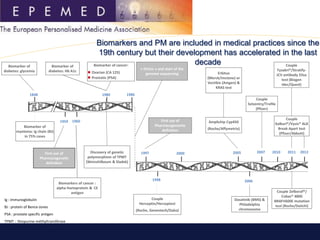
Biomarkers and PM are included in medical practices since the
19th century but their development has accelerated in the last
decade
1960
Biomarkers of cancer :
alpha-foetoprotein & CE
antigen
Couple
Herceptin/Herceptest
(Roche, Genentech/Dako)
Amplichip Cyp450
(Roche/Affymetrix)
1848
Biomarker of
myeloma: Ig chain (BJ)
in 75% cases
Ig : immunoglobulin
BJ : protein of Bence-Jones
PSA : prostate specific antigen
TPMT : thiopurine-méthyltransférase
1980
Biomarker of
diabetes: glycemia
Biomarker of
diabetes: Hb A1c
Couple
Selzentry/Trofile
(Pfizer)
Biomarker of cancer:
 Ovarian (CA 125)
 Prostatic (PSA)
1998
20102000 2005 2007
2006
Erbitux
(Merck/Imclone) or
Vectibix (Amgen) &
KRAS test
Dasatinib (BMS) &
Philadelphia
chromosome
« Omics » and start of the
genome sequencing
1986
First use of
Pharmacogenetic
definition
1959
Discovery of genetic
polymorphism of TPMT
(Weinshilboum & Sladek)
1997
First use of
Pharmacogenomic
definition
2011
Couple Zelboraf®/
Cobas® 4800
BRAFV600E mutation
test (Roche/Daiichi)
2012
Couple
Tysabri®/Stratify-
JCV antibody Elisa
test (Biogen
Idec/Quest)
Couple
Xalkori®/Vysis® ALK
Break Apart test
(Pfizer/Abbott)
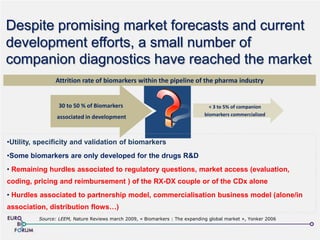
Despite promising market forecasts and current
development efforts, a small number of
companion diagnostics have reached the market
< 3 to 5% of companion
biomarkers commercialized
30 to 50 % of Biomarkers
associated in development
•Utility, specificity and validation of biomarkers
•Some biomarkers are only developed for the drugs R&D
• Remaining hurdles associated to regulatory questions, market access (evaluation,
coding, pricing and reimbursement ) of the RX-DX couple or of the CDx alone
• Hurdles associated to partnership model, commercialisation business model (alone/in
association, distribution flows…)
Attrition rate of biomarkers within the pipeline of the pharma industry
Source: LEEM, Nature Reviews march 2009, « Biomarkers : The expanding global market », Yonker 2006
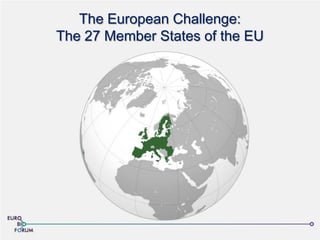
The European Challenge:
The 27 Member States of the EU
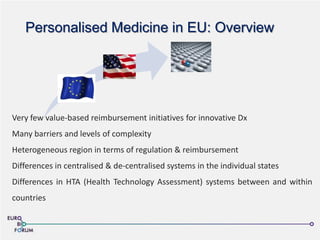
Personalised Medicine in EU: Overview
Very few value-based reimbursement initiatives for innovative Dx
Many barriers and levels of complexity
Heterogeneous region in terms of regulation & reimbursement
Differences in centralised & de-centralised systems in the individual states
Differences in HTA (Health Technology Assessment) systems between and within
countries
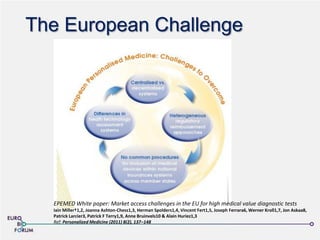
The European Challenge
EPEMED White paper: Market access challenges in the EU for high medical value diagnostic tests
Iain Miller†1,2, Joanna Ashton-Chess1,3, Herman Spolders1,4, Vincent Fert1,5, Joseph Ferrara6, Werner Kroll1,7, Jon Askaa8,
Patrick Larcier3, Patrick F Terry1,9, Anne Bruinvels10 & Alain Huriez1,3
Ref: Personalized Medicine (2011) 8(2), 137–148
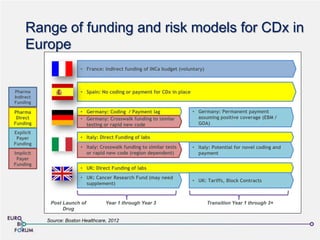
Range of funding and risk models for CDx in
Europe
Source: Boston Healthcare, 2012
Pharma
Direct
Funding
Explicit
Payer
Funding
Pharma
Indirect
Funding
Implicit
Payer
Funding
• Spain: No coding or payment for CDx in place
• France: Indirect funding of INCa budget (voluntary)
• Germany: Permanent payment
assuming positive coverage (EBM /
GOA)
• Germany: Coding / Payment lag
Year 1 through Year 3 Transition Year 1 through 3+Post Launch of
Drug
• UK: Cancer Research Fund (may need
supplement)
• UK: Direct Funding of labs
• UK: Tariffs, Block Contracts
• Italy: Crosswalk funding to similar tests
or rapid new code (region dependent)
• Italy: Direct Funding of labs
• Italy: Potential for novel coding and
payment
• Germany: Crosswalk funding to similar
testing or rapid new code
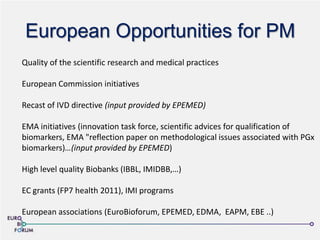
European Opportunities for PM
Quality of the scientific research and medical practices
European Commission initiatives
Recast of IVD directive (input provided by EPEMED)
EMA initiatives (innovation task force, scientific advices for qualification of
biomarkers, EMA "reflection paper on methodological issues associated with PGx
biomarkers)…(input provided by EPEMED)
High level quality Biobanks (IBBL, IMIDBB,…)
EC grants (FP7 health 2011), IMI programs
European associations (EuroBioforum, EPEMED, EDMA, EAPM, EBE ..)
Why EPEMED ?
EPEMED is an independent, broad and inclusive not-for-profit organisation founded
in 2009 and bringing together forces in personalised medicine in the EU.
A central point of communication for the different parties involved in progressing
personalised medicine
Addressing issues in personalised medicine that confront the industry, regulators,
payers & insurers as well as governments in Europe
Aiming to provide a platform for the harmonisation of personalised medicine
development and implementation across Europe, focusing on the role of
diagnostics, to make personalised medicine a reality
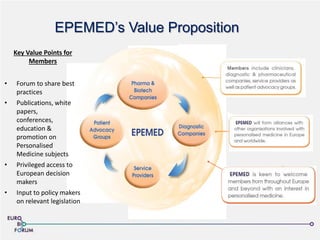
EPEMED’s Value Proposition
Key Value Points for
Members
• Forum to share best
practices
• Publications, white
papers,
conferences,
education &
promotion on
Personalised
Medicine subjects
• Privileged access to
European decision
makers
• Input to policy makers
on relevant legislation
Success Factors: EPEMED’s
propositions
One of the major current issues related to the EU low market uptake of IVD
Personalized Medicine tests is the reimbursement process, which is complex,
heavy, non-harmonised, and carried out by different commissions in every
country, in most of cases handling also drugs dossiers.
There are not appropriate competences at payers level ensuring dossiers
submitted are understood and evaluated in a fair and knowledgeable manner.
Moreover, PM being one of the most striking examples of innovation, tools
should be there to nourish research results and to help them turning into
marketable products.
Success Factors: EPEMED’s
propositions
European wide coordination initiative is needed among health technology bodies
which reimburse all diagnostics - including molecular diagnostics, companion
diagnostics, and personalised medicine products in order to ensure reimbursement
allows innovation. Clarification and description of requirements to be met for
reimbursement.
A more unified and coordinated accreditation procedures should be established
for European clinical testing laboratories, enabling to break the actual national
protectionism.
A more focused and coordinated effort should be established to make use of
patient registries, patient biological samples, and patient outcome data in a
targeted personalised medicine development program with results published in a
timely manner.
EPEMED 2012-2013 European Market Access
Study
15 months collaboration: EPEMED & La Charité Institute for Social Medicine, Epidemiology,
and Health Economics, Universitätsmedizin Berlin (Pr Stefan Willich & Dr Markus Buecheler)
Scope: Personalized Medicine in Europe - Navigating Market Access Challenges for Co-
developed and further Combined Molecular Rx/Dx Technologies and Realizing the Potential
Aim: Devise recommendations how to shape a post-approval environment that facilitates
broad and equitable access to CDx/Rx.
Approach: Description of the post-approval patient access pathways for CDx/Rx in 5 largest
EU countries (Ge, UK, Fr, I, S)
• Analyse best practices and barriers to patient access
• Develop recommendations after interviews with KOLs
Deliverables (starting Q4 2013): Study report, peer-reviewed paper, position paper,
conferences.
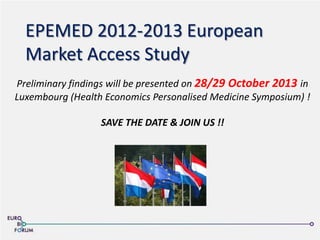
EPEMED 2012-2013 European
Market Access Study
Preliminary findings will be presented on 28/29 October 2013 in
Luxembourg (Health Economics Personalised Medicine Symposium) !
SAVE THE DATE & JOIN US !!

EuroBioForum 2013 - Day 1 | Emmanuelle Benzimra

  • 1.
    27-28 May 2013,Munich, Germany EuroBioForum 2013 2nd Annual Conference Emmanuelle Benzimra General Delegate European PErsonalised MEDicine association EPEMED
  • 2.
    Navigating the Challengesof Personalized Medicine Access in Europe EuroBioforum - MUNICH 27 May 2013 Emmanuelle BENZIMRA, General Delegate ebenzimra@epemed.org www.epemed.org
  • 3.
    Biomarkers and PMare included in medical practices since the 19th century but their development has accelerated in the last decade 1960 Biomarkers of cancer : alpha-foetoprotein & CE antigen Couple Herceptin/Herceptest (Roche, Genentech/Dako) Amplichip Cyp450 (Roche/Affymetrix) 1848 Biomarker of myeloma: Ig chain (BJ) in 75% cases Ig : immunoglobulin BJ : protein of Bence-Jones PSA : prostate specific antigen TPMT : thiopurine-méthyltransférase 1980 Biomarker of diabetes: glycemia Biomarker of diabetes: Hb A1c Couple Selzentry/Trofile (Pfizer) Biomarker of cancer:  Ovarian (CA 125)  Prostatic (PSA) 1998 20102000 2005 2007 2006 Erbitux (Merck/Imclone) or Vectibix (Amgen) & KRAS test Dasatinib (BMS) & Philadelphia chromosome « Omics » and start of the genome sequencing 1986 First use of Pharmacogenetic definition 1959 Discovery of genetic polymorphism of TPMT (Weinshilboum & Sladek) 1997 First use of Pharmacogenomic definition 2011 Couple Zelboraf®/ Cobas® 4800 BRAFV600E mutation test (Roche/Daiichi) 2012 Couple Tysabri®/Stratify- JCV antibody Elisa test (Biogen Idec/Quest) Couple Xalkori®/Vysis® ALK Break Apart test (Pfizer/Abbott)
  • 4.
    Despite promising marketforecasts and current development efforts, a small number of companion diagnostics have reached the market < 3 to 5% of companion biomarkers commercialized 30 to 50 % of Biomarkers associated in development •Utility, specificity and validation of biomarkers •Some biomarkers are only developed for the drugs R&D • Remaining hurdles associated to regulatory questions, market access (evaluation, coding, pricing and reimbursement ) of the RX-DX couple or of the CDx alone • Hurdles associated to partnership model, commercialisation business model (alone/in association, distribution flows…) Attrition rate of biomarkers within the pipeline of the pharma industry Source: LEEM, Nature Reviews march 2009, « Biomarkers : The expanding global market », Yonker 2006
  • 5.
    The European Challenge: The27 Member States of the EU
  • 6.
    Personalised Medicine inEU: Overview Very few value-based reimbursement initiatives for innovative Dx Many barriers and levels of complexity Heterogeneous region in terms of regulation & reimbursement Differences in centralised & de-centralised systems in the individual states Differences in HTA (Health Technology Assessment) systems between and within countries
  • 7.
    The European Challenge EPEMEDWhite paper: Market access challenges in the EU for high medical value diagnostic tests Iain Miller†1,2, Joanna Ashton-Chess1,3, Herman Spolders1,4, Vincent Fert1,5, Joseph Ferrara6, Werner Kroll1,7, Jon Askaa8, Patrick Larcier3, Patrick F Terry1,9, Anne Bruinvels10 & Alain Huriez1,3 Ref: Personalized Medicine (2011) 8(2), 137–148
  • 8.
    Range of fundingand risk models for CDx in Europe Source: Boston Healthcare, 2012 Pharma Direct Funding Explicit Payer Funding Pharma Indirect Funding Implicit Payer Funding • Spain: No coding or payment for CDx in place • France: Indirect funding of INCa budget (voluntary) • Germany: Permanent payment assuming positive coverage (EBM / GOA) • Germany: Coding / Payment lag Year 1 through Year 3 Transition Year 1 through 3+Post Launch of Drug • UK: Cancer Research Fund (may need supplement) • UK: Direct Funding of labs • UK: Tariffs, Block Contracts • Italy: Crosswalk funding to similar tests or rapid new code (region dependent) • Italy: Direct Funding of labs • Italy: Potential for novel coding and payment • Germany: Crosswalk funding to similar testing or rapid new code
  • 9.
    European Opportunities forPM Quality of the scientific research and medical practices European Commission initiatives Recast of IVD directive (input provided by EPEMED) EMA initiatives (innovation task force, scientific advices for qualification of biomarkers, EMA "reflection paper on methodological issues associated with PGx biomarkers)…(input provided by EPEMED) High level quality Biobanks (IBBL, IMIDBB,…) EC grants (FP7 health 2011), IMI programs European associations (EuroBioforum, EPEMED, EDMA, EAPM, EBE ..)
  • 10.
    Why EPEMED ? EPEMEDis an independent, broad and inclusive not-for-profit organisation founded in 2009 and bringing together forces in personalised medicine in the EU. A central point of communication for the different parties involved in progressing personalised medicine Addressing issues in personalised medicine that confront the industry, regulators, payers & insurers as well as governments in Europe Aiming to provide a platform for the harmonisation of personalised medicine development and implementation across Europe, focusing on the role of diagnostics, to make personalised medicine a reality
  • 11.
    EPEMED’s Value Proposition KeyValue Points for Members • Forum to share best practices • Publications, white papers, conferences, education & promotion on Personalised Medicine subjects • Privileged access to European decision makers • Input to policy makers on relevant legislation
  • 12.
    Success Factors: EPEMED’s propositions Oneof the major current issues related to the EU low market uptake of IVD Personalized Medicine tests is the reimbursement process, which is complex, heavy, non-harmonised, and carried out by different commissions in every country, in most of cases handling also drugs dossiers. There are not appropriate competences at payers level ensuring dossiers submitted are understood and evaluated in a fair and knowledgeable manner. Moreover, PM being one of the most striking examples of innovation, tools should be there to nourish research results and to help them turning into marketable products.
  • 13.
    Success Factors: EPEMED’s propositions Europeanwide coordination initiative is needed among health technology bodies which reimburse all diagnostics - including molecular diagnostics, companion diagnostics, and personalised medicine products in order to ensure reimbursement allows innovation. Clarification and description of requirements to be met for reimbursement. A more unified and coordinated accreditation procedures should be established for European clinical testing laboratories, enabling to break the actual national protectionism. A more focused and coordinated effort should be established to make use of patient registries, patient biological samples, and patient outcome data in a targeted personalised medicine development program with results published in a timely manner.
  • 14.
    EPEMED 2012-2013 EuropeanMarket Access Study 15 months collaboration: EPEMED & La Charité Institute for Social Medicine, Epidemiology, and Health Economics, Universitätsmedizin Berlin (Pr Stefan Willich & Dr Markus Buecheler) Scope: Personalized Medicine in Europe - Navigating Market Access Challenges for Co- developed and further Combined Molecular Rx/Dx Technologies and Realizing the Potential Aim: Devise recommendations how to shape a post-approval environment that facilitates broad and equitable access to CDx/Rx. Approach: Description of the post-approval patient access pathways for CDx/Rx in 5 largest EU countries (Ge, UK, Fr, I, S) • Analyse best practices and barriers to patient access • Develop recommendations after interviews with KOLs Deliverables (starting Q4 2013): Study report, peer-reviewed paper, position paper, conferences.
  • 15.
    EPEMED 2012-2013 European MarketAccess Study Preliminary findings will be presented on 28/29 October 2013 in Luxembourg (Health Economics Personalised Medicine Symposium) ! SAVE THE DATE & JOIN US !!