Bluestone Heights
Roy Larick
1) Streams into Sewers
City of Euclid
boundary
Google Earth aerial viewer
Restoring the Pulse
© 2015 Bluestone Heights
Bluestone
Heights
bluestoneheights.org
3) Integrated Planning
4) Eco-Greenways
of Nature in Euclid
2) Initial Green Solutions
5) Euclid Ecology Unit
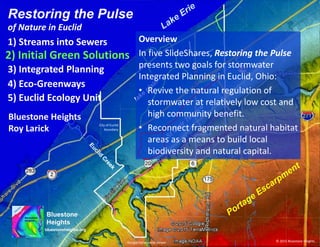
Overview
In five SlideShares, Restoring the Pulse
presents two goals for stormwater
Integrated Planning in Euclid, Ohio:
• Revive the natural regulation of
stormwater at relatively low cost and
high community benefit.
• Reconnect fragmented natural habitat
areas as a means to build local
biodiversity and natural capital.
LillyCreek
BabbittRun
Creek5
BurkRun
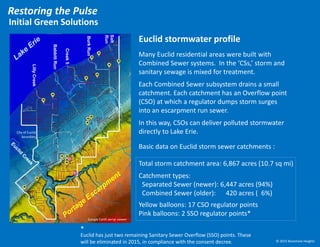
Total storm catchment area: 6,867 acres (10.7 sq mi)
Yellow balloons: 17 CSO regulator points
Pink balloons: 2 SSO regulator points*
Catchment types:
Separated Sewer (newer): 6,447 acres (94%)
Combined Sewer (older): 420 acres ( 6%)
Initial Green Solutions
Restoring the Pulse
Salt
Run
Euclid stormwater profile
Many Euclid residential areas were built with
Combined Sewer systems. In the ‘CSs,’ storm and
sanitary sewage is mixed for treatment.
Each Combined Sewer subsystem drains a small
catchment. Each catchment has an Overflow point
(CSO) at which a regulator dumps storm surges
into an escarpment run sewer.
In this way, CSOs can deliver polluted stormwater
directly to Lake Erie.
Euclid has just two remaining Sanitary Sewer Overflow (SSO) points.
These will be eliminated in 2015, in compliance with the consent
decree.
City of Euclid
boundary
Google Earth aerial viewer
Basic data on Euclid storm sewer catchments :
*
© 2015 Bluestone Heights
Euclid storm sewers
LillyCreek
BabbittRun
Creek5
BurkRun
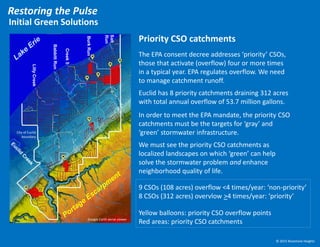
9 CSOs (108 acres) overflow <4 times/year: ‘non-priority’
8 CSOs (312 acres) overvlow >4 times/year: ‘priority’
The EPA consent decree addresses ‘priority’ CSOs,
those that activate (overflow) four or more times
in a typical year. EPA regulates overflow. We need
to manage catchment runoff.
Euclid has 8 priority catchments draining 312 acres
with total annual overflow of 53.7 million gallons.
In order to meet the EPA mandate, the priority CSO
catchments must be the targets for ‘gray’ and
‘green’ stormwater infrastructure.
We must see the priority CSO catchments as
localized landscapes on which ‘green’ can help
solve the stormwater problem and enhance
neighborhood quality of life.
Yellow balloons: priority CSO overflow points
Red areas: priority CSO catchments
Priority CSO catchments
City of Euclid
boundary
Google Earth aerial viewer
© 2015 Bluestone Heights
Initial Green Solutions
Restoring the Pulse
Salt
Run
Euclid storm sewers
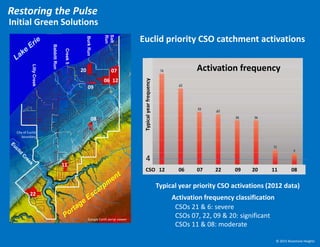
Typical year priority CSO activations (2012 data)
Activation frequency
LillyCreek
BabbittRun
Creek5
BurkRun
20 07
1206
09
08
11
22
CSO 12 06 07 22 09 20 11 08
CSOs 21 & 6: severe
CSOs 07, 22, 09 & 20: significant
CSOs 11 & 08: moderate
Activation frequency classification
Typicalyearfrequency
Euclid priority CSO catchment activations
4
City of Euclid
boundary
Google Earth aerial viewer
© 2015 Bluestone Heights
Initial Green Solutions
Restoring the Pulse
Salt
Run
Euclid storm sewers
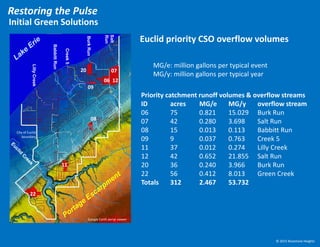
Priority catchment runoff volumes & overflow streams
ID acres MG/e MG/y overflow stream
06 75 0.821 15.029 Burk Run
07 42 0.280 3.698 Salt Run
08 15 0.013 0.113 Babbitt Run
09 9 0.037 0.763 Creek 5
11 37 0.012 0.274 Lilly Creek
12 42 0.652 21.855 Salt Run
20 36 0.240 3.966 Burk Run
22 56 0.412 8.013 Green Creek
Totals 312 2.467 53.732
LillyCreek
BabbittRun
Creek5
BurkRun
20 07
1206
09
08
11
22
Euclid priority CSO overflow volumes
MG/e: million gallons per typical event
MG/y: million gallons per typical year
City of Euclid
boundary
Google Earth aerial viewer
© 2015 Bluestone Heights
Initial Green Solutions
Restoring the Pulse
Salt
Run
Euclid storm sewers
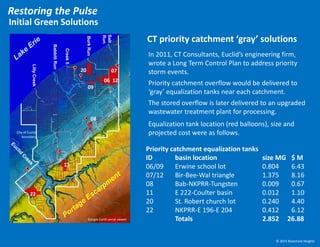
In 2011, CT Consultants, Euclid’s engineering firm,
wrote a Long Term Control Plan to address priority
storm events.
Priority catchment overflow would be delivered to
‘gray’ equalization tanks near each catchment.
The stored overflow is later delivered to an upgraded
wastewater treatment plant for processing.
Equalization tank location (red balloons), size and
projected cost were as follows.
LillyCreek
BabbittRun
Creek5
BurkRun
20 07
1206
09
08
11
22
CT priority catchment ‘gray’ solutions
Priority catchment equalization tanks
ID basin location size MG $ M
06/09 Erwine school lot 0.804 6.43
07/12 Bir-Bee-Wal triangle 1.375 8.16
08 Bab-NKPRR-Tungsten 0.009 0.67
11 E 222-Coulter basin 0.012 1.10
20 St. Robert church lot 0.240 4.40
22 NKPRR-E 196-E 204 0.412 6.12
Totals 2.852 26.88
City of Euclid
boundary
Google Earth aerial viewer
© 2015 Bluestone Heights
Initial Green Solutions
Restoring the Pulse
Salt
Run
Euclid storm sewers
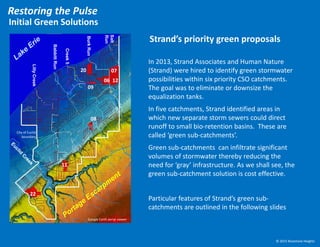
In 2013, Strand Associates and Human Nature
(Strand) were hired to identify green stormwater
possibilities within six priority CSO catchments.
The goal was to eliminate or downsize the
equalization tanks.
In five catchments, Strand identified areas in
which new separate storm sewers could direct
runoff to small bio-retention basins. These are
called ‘green sub-catchments’.
Green sub-catchments can infiltrate significant
volumes of stormwater thereby reducing the
need for ‘gray’ infrastructure. As we shall see, the
green sub-catchment solution is cost effective.
Particular features of Strand’s green sub-
catchments are outlined in the following slides
LillyCreek
BabbittRun
Creek5
BurkRun
20 07
1206
09
08
11
22
Strand’s priority green proposals
City of Euclid
boundary
Google Earth aerial viewer
© 2015 Bluestone Heights
Initial Green Solutions
Restoring the Pulse
Salt
Run
Euclid storm sewers
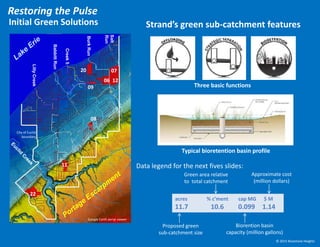
Data legend for the next fives slides:
Typical bioretention basin profile
LillyCreek
BabbittRun
Creek5
BurkRun
20 07
1206
09
08
11
22 acres % c’ment cap MG $ M
11.7 10.6 0.099 1.14
Strand’s green sub-catchment features
Proposed green
sub-catchment size
Green area relative
to total catchment
Biorention basin
capacity (million gallons)
Approximate cost
(million dollars)
Three basic functions
City of Euclid
boundary
Google Earth aerial viewer
© 2015 Bluestone Heights
Initial Green Solutions
Restoring the Pulse
Salt
Run
Euclid storm sewers
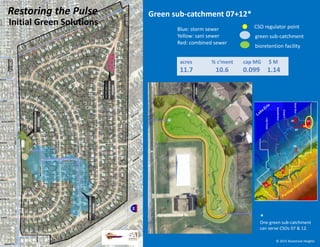
Green sub-catchment 07+12*
Blue: storm sewer
Yellow: sani sewer
Red: combined sewer
CSO regulator point
green sub-catchment
bioretention facility
acres % c’ment cap MG $ M
11.7 10.6 0.099 1.14
Initial Green Solutions
Restoring the Pulse
One green sub-catchment
can serve CSOs 07 & 12.
*
© 2015 Bluestone Heights
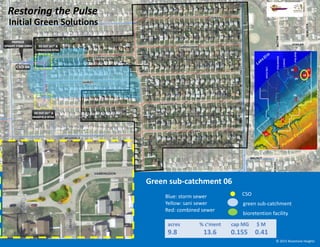
Green sub-catchment 06
Blue: storm sewer
Yellow: sani sewer
Red: combined sewer
CSO
green sub-catchment
bioretention facility
acres % c’ment cap MG $ M
9.8 13.6 0.155 0.41
Initial Green Solutions
Restoring the Pulse
© 2015 Bluestone Heights
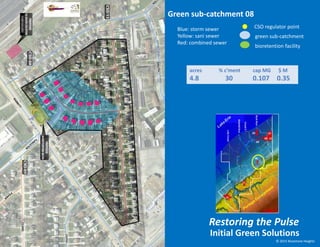
Green sub-catchment 08
Blue: storm sewer
Yellow: sani sewer
Red: combined sewer
CSO regulator point
green sub-catchment
bioretention facility
acres % c’ment cap MG $ M
4.8 30 0.107 0.35
Initial Green Solutions
Restoring the Pulse
© 2015 Bluestone Heights
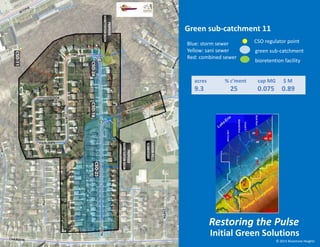
Green sub-catchment 11
Blue: storm sewer
Yellow: sani sewer
Red: combined sewer
CSO regulator point
green sub-catchment
bioretention facility
acres % c’ment cap MG $ M
9.3 25 0.075 0.89
Initial Green Solutions
Restoring the Pulse
© 2015 Bluestone Heights
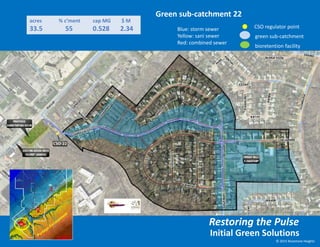
Green sub-catchment 22
Blue: storm sewer
Yellow: sani sewer
Red: combined sewer
CSO regulator point
green sub-catchment
bioretention facility
acres % c’ment cap MG $ M
33.5 55 0.528 2.34
Initial Green Solutions
Restoring the Pulse
© 2015 Bluestone Heights
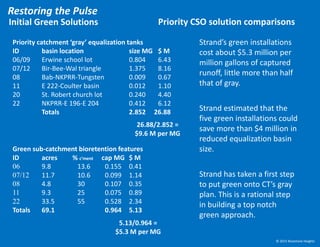
Priority catchment ‘gray’ equalization tanks
ID basin location size MG $ M
06/09 Erwine school lot 0.804 6.43
07/12 Bir-Bee-Wal triangle 1.375 8.16
08 Bab-NKPRR-Tungsten 0.009 0.67
11 E 222-Coulter basin 0.012 1.10
20 St. Robert church lot 0.240 4.40
22 NKPRR-E 196-E 204 0.412 6.12
Totals 2.852 26.88
Green sub-catchment bioretention features
ID acres % c’ment cap MG $ M
06 9.8 13.6 0.155 0.41
07/12 11.7 10.6 0.099 1.14
08 4.8 30 0.107 0.35
11 9.3 25 0.075 0.89
22 33.5 55 0.528 2.34
Totals 69.1 0.964 5.13
5.13/0.964 =
$5.3 M per MG
26.88/2.852 =
$9.6 M per MG
Priority CSO solution comparisons
Strand’s green installations
cost about $5.3 million per
million gallons of captured
runoff, little more than half
that of gray.
Strand estimated that the
five green installations could
save more than $4 million in
reduced equalization basin
size.
Strand has taken a first step
to put green onto CT’s gray
plan. This is a rational step
in building a top notch
green approach.
© 2015 Bluestone Heights
Initial Green Solutions
Restoring the Pulse
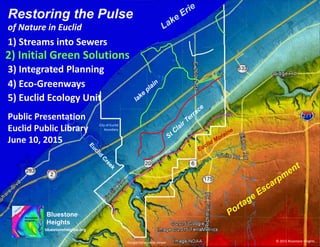
Public Presentation
Euclid Public Library
June 10, 2015
City of Euclid
boundary
© 2015 Bluestone Heights
1) Streams into Sewers
Google Earth aerial viewer
Restoring the Pulse
Bluestone
Heights
bluestoneheights.org
3) Integrated Planning
4) Eco-Greenways
of Nature in Euclid
2) Initial Green Solutions
5) Euclid Ecology Unit
Roy Larick
Walk back in time
Look to the Future
Bluestone Heights
© 2015 Bluestone Heights
A production by
bluestoneheights.org
roylarick@gmail.com
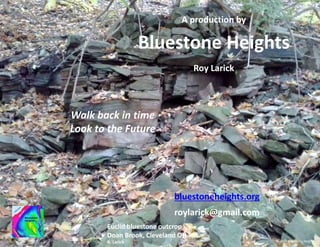
Euclid bluestone outcrop
Doan Brook, Cleveland OHR. Larick

Euclid Initial Green Solutions

  • 1.
    Bluestone Heights Roy Larick 1)Streams into Sewers City of Euclid boundary Google Earth aerial viewer Restoring the Pulse © 2015 Bluestone Heights Bluestone Heights bluestoneheights.org 3) Integrated Planning 4) Eco-Greenways of Nature in Euclid 2) Initial Green Solutions 5) Euclid Ecology Unit Overview In five SlideShares, Restoring the Pulse presents two goals for stormwater Integrated Planning in Euclid, Ohio: • Revive the natural regulation of stormwater at relatively low cost and high community benefit. • Reconnect fragmented natural habitat areas as a means to build local biodiversity and natural capital.
  • 2.
    LillyCreek BabbittRun Creek5 BurkRun Total storm catchmentarea: 6,867 acres (10.7 sq mi) Yellow balloons: 17 CSO regulator points Pink balloons: 2 SSO regulator points* Catchment types: Separated Sewer (newer): 6,447 acres (94%) Combined Sewer (older): 420 acres ( 6%) Initial Green Solutions Restoring the Pulse Salt Run Euclid stormwater profile Many Euclid residential areas were built with Combined Sewer systems. In the ‘CSs,’ storm and sanitary sewage is mixed for treatment. Each Combined Sewer subsystem drains a small catchment. Each catchment has an Overflow point (CSO) at which a regulator dumps storm surges into an escarpment run sewer. In this way, CSOs can deliver polluted stormwater directly to Lake Erie. Euclid has just two remaining Sanitary Sewer Overflow (SSO) points. These will be eliminated in 2015, in compliance with the consent decree. City of Euclid boundary Google Earth aerial viewer Basic data on Euclid storm sewer catchments : * © 2015 Bluestone Heights Euclid storm sewers
  • 3.
    LillyCreek BabbittRun Creek5 BurkRun 9 CSOs (108acres) overflow <4 times/year: ‘non-priority’ 8 CSOs (312 acres) overvlow >4 times/year: ‘priority’ The EPA consent decree addresses ‘priority’ CSOs, those that activate (overflow) four or more times in a typical year. EPA regulates overflow. We need to manage catchment runoff. Euclid has 8 priority catchments draining 312 acres with total annual overflow of 53.7 million gallons. In order to meet the EPA mandate, the priority CSO catchments must be the targets for ‘gray’ and ‘green’ stormwater infrastructure. We must see the priority CSO catchments as localized landscapes on which ‘green’ can help solve the stormwater problem and enhance neighborhood quality of life. Yellow balloons: priority CSO overflow points Red areas: priority CSO catchments Priority CSO catchments City of Euclid boundary Google Earth aerial viewer © 2015 Bluestone Heights Initial Green Solutions Restoring the Pulse Salt Run Euclid storm sewers
  • 4.
    Typical year priorityCSO activations (2012 data) Activation frequency LillyCreek BabbittRun Creek5 BurkRun 20 07 1206 09 08 11 22 CSO 12 06 07 22 09 20 11 08 CSOs 21 & 6: severe CSOs 07, 22, 09 & 20: significant CSOs 11 & 08: moderate Activation frequency classification Typicalyearfrequency Euclid priority CSO catchment activations 4 City of Euclid boundary Google Earth aerial viewer © 2015 Bluestone Heights Initial Green Solutions Restoring the Pulse Salt Run Euclid storm sewers
  • 5.
    Priority catchment runoffvolumes & overflow streams ID acres MG/e MG/y overflow stream 06 75 0.821 15.029 Burk Run 07 42 0.280 3.698 Salt Run 08 15 0.013 0.113 Babbitt Run 09 9 0.037 0.763 Creek 5 11 37 0.012 0.274 Lilly Creek 12 42 0.652 21.855 Salt Run 20 36 0.240 3.966 Burk Run 22 56 0.412 8.013 Green Creek Totals 312 2.467 53.732 LillyCreek BabbittRun Creek5 BurkRun 20 07 1206 09 08 11 22 Euclid priority CSO overflow volumes MG/e: million gallons per typical event MG/y: million gallons per typical year City of Euclid boundary Google Earth aerial viewer © 2015 Bluestone Heights Initial Green Solutions Restoring the Pulse Salt Run Euclid storm sewers
  • 6.
    In 2011, CTConsultants, Euclid’s engineering firm, wrote a Long Term Control Plan to address priority storm events. Priority catchment overflow would be delivered to ‘gray’ equalization tanks near each catchment. The stored overflow is later delivered to an upgraded wastewater treatment plant for processing. Equalization tank location (red balloons), size and projected cost were as follows. LillyCreek BabbittRun Creek5 BurkRun 20 07 1206 09 08 11 22 CT priority catchment ‘gray’ solutions Priority catchment equalization tanks ID basin location size MG $ M 06/09 Erwine school lot 0.804 6.43 07/12 Bir-Bee-Wal triangle 1.375 8.16 08 Bab-NKPRR-Tungsten 0.009 0.67 11 E 222-Coulter basin 0.012 1.10 20 St. Robert church lot 0.240 4.40 22 NKPRR-E 196-E 204 0.412 6.12 Totals 2.852 26.88 City of Euclid boundary Google Earth aerial viewer © 2015 Bluestone Heights Initial Green Solutions Restoring the Pulse Salt Run Euclid storm sewers
  • 7.
    In 2013, StrandAssociates and Human Nature (Strand) were hired to identify green stormwater possibilities within six priority CSO catchments. The goal was to eliminate or downsize the equalization tanks. In five catchments, Strand identified areas in which new separate storm sewers could direct runoff to small bio-retention basins. These are called ‘green sub-catchments’. Green sub-catchments can infiltrate significant volumes of stormwater thereby reducing the need for ‘gray’ infrastructure. As we shall see, the green sub-catchment solution is cost effective. Particular features of Strand’s green sub- catchments are outlined in the following slides LillyCreek BabbittRun Creek5 BurkRun 20 07 1206 09 08 11 22 Strand’s priority green proposals City of Euclid boundary Google Earth aerial viewer © 2015 Bluestone Heights Initial Green Solutions Restoring the Pulse Salt Run Euclid storm sewers
  • 8.
    Data legend forthe next fives slides: Typical bioretention basin profile LillyCreek BabbittRun Creek5 BurkRun 20 07 1206 09 08 11 22 acres % c’ment cap MG $ M 11.7 10.6 0.099 1.14 Strand’s green sub-catchment features Proposed green sub-catchment size Green area relative to total catchment Biorention basin capacity (million gallons) Approximate cost (million dollars) Three basic functions City of Euclid boundary Google Earth aerial viewer © 2015 Bluestone Heights Initial Green Solutions Restoring the Pulse Salt Run Euclid storm sewers
  • 9.
    Green sub-catchment 07+12* Blue:storm sewer Yellow: sani sewer Red: combined sewer CSO regulator point green sub-catchment bioretention facility acres % c’ment cap MG $ M 11.7 10.6 0.099 1.14 Initial Green Solutions Restoring the Pulse One green sub-catchment can serve CSOs 07 & 12. * © 2015 Bluestone Heights
  • 10.
    Green sub-catchment 06 Blue:storm sewer Yellow: sani sewer Red: combined sewer CSO green sub-catchment bioretention facility acres % c’ment cap MG $ M 9.8 13.6 0.155 0.41 Initial Green Solutions Restoring the Pulse © 2015 Bluestone Heights
  • 11.
    Green sub-catchment 08 Blue:storm sewer Yellow: sani sewer Red: combined sewer CSO regulator point green sub-catchment bioretention facility acres % c’ment cap MG $ M 4.8 30 0.107 0.35 Initial Green Solutions Restoring the Pulse © 2015 Bluestone Heights
  • 12.
    Green sub-catchment 11 Blue:storm sewer Yellow: sani sewer Red: combined sewer CSO regulator point green sub-catchment bioretention facility acres % c’ment cap MG $ M 9.3 25 0.075 0.89 Initial Green Solutions Restoring the Pulse © 2015 Bluestone Heights
  • 13.
    Green sub-catchment 22 Blue:storm sewer Yellow: sani sewer Red: combined sewer CSO regulator point green sub-catchment bioretention facility acres % c’ment cap MG $ M 33.5 55 0.528 2.34 Initial Green Solutions Restoring the Pulse © 2015 Bluestone Heights
  • 14.
    Priority catchment ‘gray’equalization tanks ID basin location size MG $ M 06/09 Erwine school lot 0.804 6.43 07/12 Bir-Bee-Wal triangle 1.375 8.16 08 Bab-NKPRR-Tungsten 0.009 0.67 11 E 222-Coulter basin 0.012 1.10 20 St. Robert church lot 0.240 4.40 22 NKPRR-E 196-E 204 0.412 6.12 Totals 2.852 26.88 Green sub-catchment bioretention features ID acres % c’ment cap MG $ M 06 9.8 13.6 0.155 0.41 07/12 11.7 10.6 0.099 1.14 08 4.8 30 0.107 0.35 11 9.3 25 0.075 0.89 22 33.5 55 0.528 2.34 Totals 69.1 0.964 5.13 5.13/0.964 = $5.3 M per MG 26.88/2.852 = $9.6 M per MG Priority CSO solution comparisons Strand’s green installations cost about $5.3 million per million gallons of captured runoff, little more than half that of gray. Strand estimated that the five green installations could save more than $4 million in reduced equalization basin size. Strand has taken a first step to put green onto CT’s gray plan. This is a rational step in building a top notch green approach. © 2015 Bluestone Heights Initial Green Solutions Restoring the Pulse
  • 15.
    Public Presentation Euclid PublicLibrary June 10, 2015 City of Euclid boundary © 2015 Bluestone Heights 1) Streams into Sewers Google Earth aerial viewer Restoring the Pulse Bluestone Heights bluestoneheights.org 3) Integrated Planning 4) Eco-Greenways of Nature in Euclid 2) Initial Green Solutions 5) Euclid Ecology Unit
  • 16.
    Roy Larick Walk backin time Look to the Future Bluestone Heights © 2015 Bluestone Heights A production by bluestoneheights.org roylarick@gmail.com Euclid bluestone outcrop Doan Brook, Cleveland OHR. Larick