An Archaeological Study Tour
Megaliths & Monuments
Brittany, France & Wiltshire, England
212-986-3054
886-740-5130
archtours@aol.com
Stonehenge
© 2015 Bluestone Heights
May 4-18, 2016
Research news (2015-2016)
on the European Neolithic
Roy Larick, Lecturer
15 Days
Megaliths & Monuments, 2016
Research news relevant to the Neolithic of northwest Europe
Roy Larick, Lecturer
Archaeological Tours study tour
.
This year's news focuses on the genetic
basis for understanding the Neolithic.
We are at the peak of modeling ancient
gene flow based on modern and 'fossil'
DNA. Addressed is the genetic makeup of
prehistoric European humans, dogs, and
wheat.
Bare-bones summaries of current research
papers. Basic data, graphics and links only.
News items to be fleshed out on tour.
Includes links to the original abstracts--the online
papers usually lie behind a paywall.
© 2015 Bluestone Heights
Farming’s effect on the Homo sapiens skeleton
Gradual decline in mobility with the adoption of food production in Europe
Christopher Ruff et al.
PNAS, July, 2015 (Vol. 112, pg. 7147)
1,842 European skeletons spanning 33
kyr, Upper Paleolithic to 20th century
Decreased bending strength implies a
decline of mobility as agriculture came to
dominate how people produced food.
The original decline in mobility was more
important than subsequent changes in
farming technology.
http://www.pnas.org/content/112/23/7147.abstract
Decreased bending strength of leg bones
accompanied the shift. The trend was not
apparent during the last 2 ka, as
agriculture became more mechanized.
From the Neolithic to Roman eras (7-
2 ka) humans shifted from mobile to
an increasingly sedentary lifestyles.
© 2015 Bluestone Heights
The study measured the strength of the tibia,
femur, and humerus. The authors found little
change in mediolateral, or side-to-side, bending
strength in all the bones over time, but a decline in
anteroposterior, or front-to-back, bending strength
of the tibia and femur beginning in the Neolithic
Period (7 ka), and continuing through the
Iron/Roman Period (2 ka).
The results suggest that mild changes in
activity levels may be insufficient to
stimulate changes in bone mass and that
vigorous exercise may be required to
increase bone strength.
Temporal trends in bending
strength relative to body size
[mm3
/(kg·mm)·104
]. (A) Femoral
A–P strength. (B) Tibial A–P
strength. (C) Humeral A–P
strength. (D) Femoral M–L
strength. (E)Tibial M–L strength.
(F) Humeral M–L strength.
Males: blue; females: red.
Exotic objects of the European Neolithic
Signs of Wealth: Inequalities in the Neolithic
National Museum of Prehistory, Les Eyzies
June 27 to November 15, 2015
As Neolithic communities dispersed into
Europe, 8-4.2 ka, they brought new
techniques for making and ornamenting
material culture. Intricate manufacturing
could produce very beautiful pieces.
High-value items usually signified wealth
and distinction for the owner. Some were
hoarded to be used in relations between
the elites or with supernatural powers.
High-value items often featured exotic raw
materials, some traveling hundreds of
kilometers from quarry to workshop.
Likewise, finished pieces, including
necklaces, daggers, axes, bracelets, could
circulate for long distances and times.
Signs of Wealth features "object sign"
artifacts in exotic materials still valuable in
our day (jade, gold, turquoise, jet, etc).
(Larick’s paraphrase)
15 ka, all humans lived by foraging wild animals
and plants. Exploiting such resources worked best
when people lived in tiny bands and moved
around a lot. Individual foragers could not build
much wealth or power. They tended to be very
poor but very equal.
SoL: $1.10 per day (1990 values)
12 ka, foragers numbered 6 million
11 ka, population exploded with farming
2 ka, farmers numbered 250 million
By 1800 AD, foraging was almost extinct
With farming, big social groups stayed in one place
working their fields. They flourished at the expense
of smaller, less sedentary ones. Farmers were
typically richer than foragers
SoL: $1.50-$2.20 per day
Farming’s effect on wealth distribution
To each age its inequality
Ian Morris
New York Times, July 9, 2015
Farming needed more complicated divisions of
labor than foraging. Some people became
aristocrats or godlike kings; others became
peasants or slaves. Economic inequality surged.
Modern Europe: three ancestral populations
Ancient and modern human genomes suggest three
ancestral populations for present-day Europeans
Iosif Lazaridis, et al.
Nature 18 September 2014
Current Europeans derive from 3 populations:
1) west European hunter-gatherers (WHG)
2) ancient north Eurasians (ANE)
3) early European farmers (EEF)
http://genetics.med.harvard.edu/reich/Reich_Lab/Welcome_files/2014_Nature_Lazaridis_EuropeThreeAncestries_1.pdf
Proportions of ancestry from each of
three inferred ancestral populations
(EEF, ANE and WHG)
Three-way mixture model
Blue: present-day samples
Red: ancient samples
Green: reconstructed ancestral populations
Solid lines: descent without mixture
Dashed lines: admixture
Genome sequencing makes clear what
the archaeology makes difficult
© 2015 Bluestone Heights
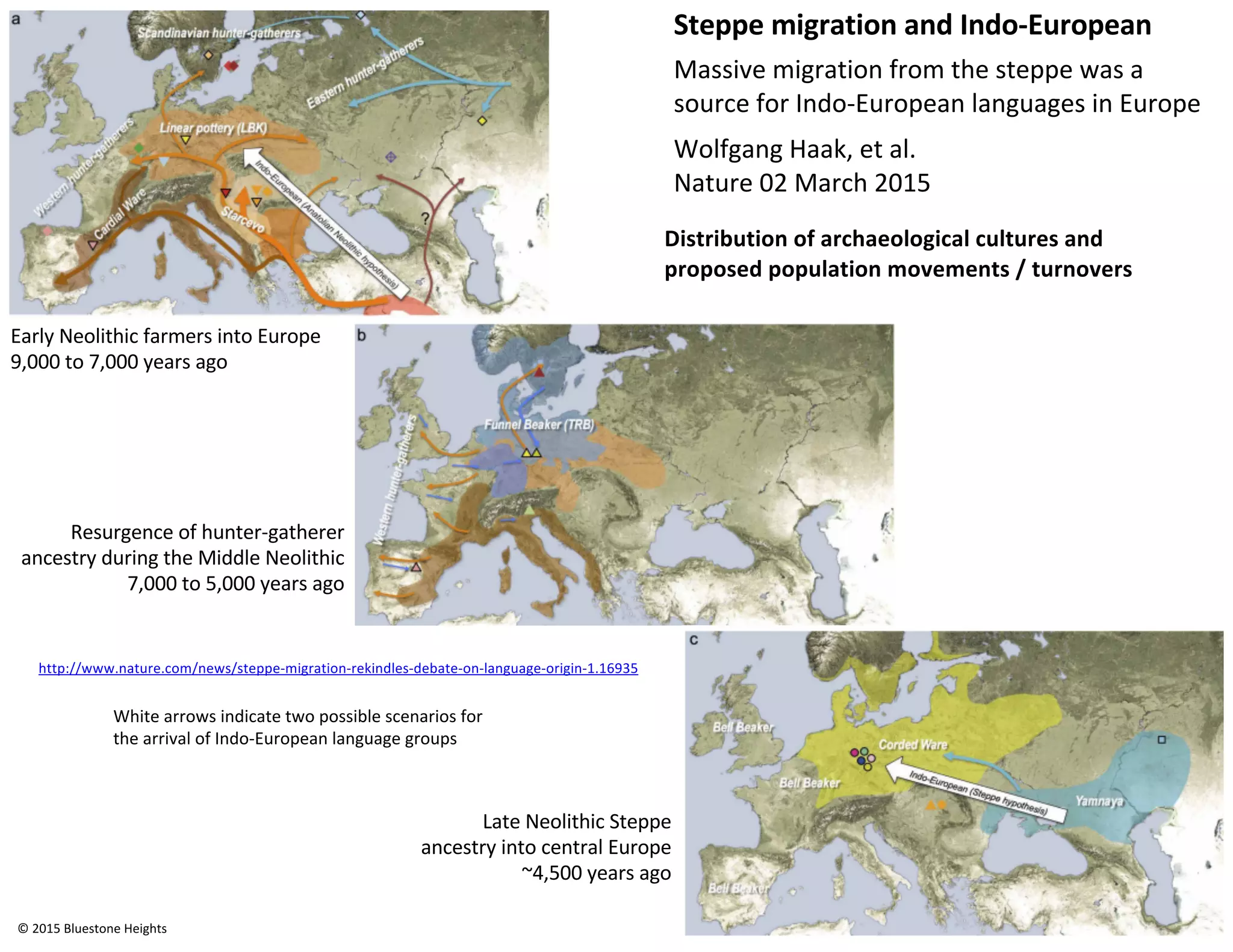
Steppe migration and Indo-European
Massive migration from the steppe was a
source for Indo-European languages in Europe
Evan Galloway
Nature 17 February 2015
Two fresh studies — one of ancient human
DNA, the other a newly constructed
genealogical ‘tree’ of languages — point to
the steppes of Ukraine and Russia as the
origin of this major language family,
rekindling a long-standing debate.
http://www.nature.com/news/steppe-migration-rekindles-debate-on-language-origin-1.16935
© 2015 Bluestone Heights
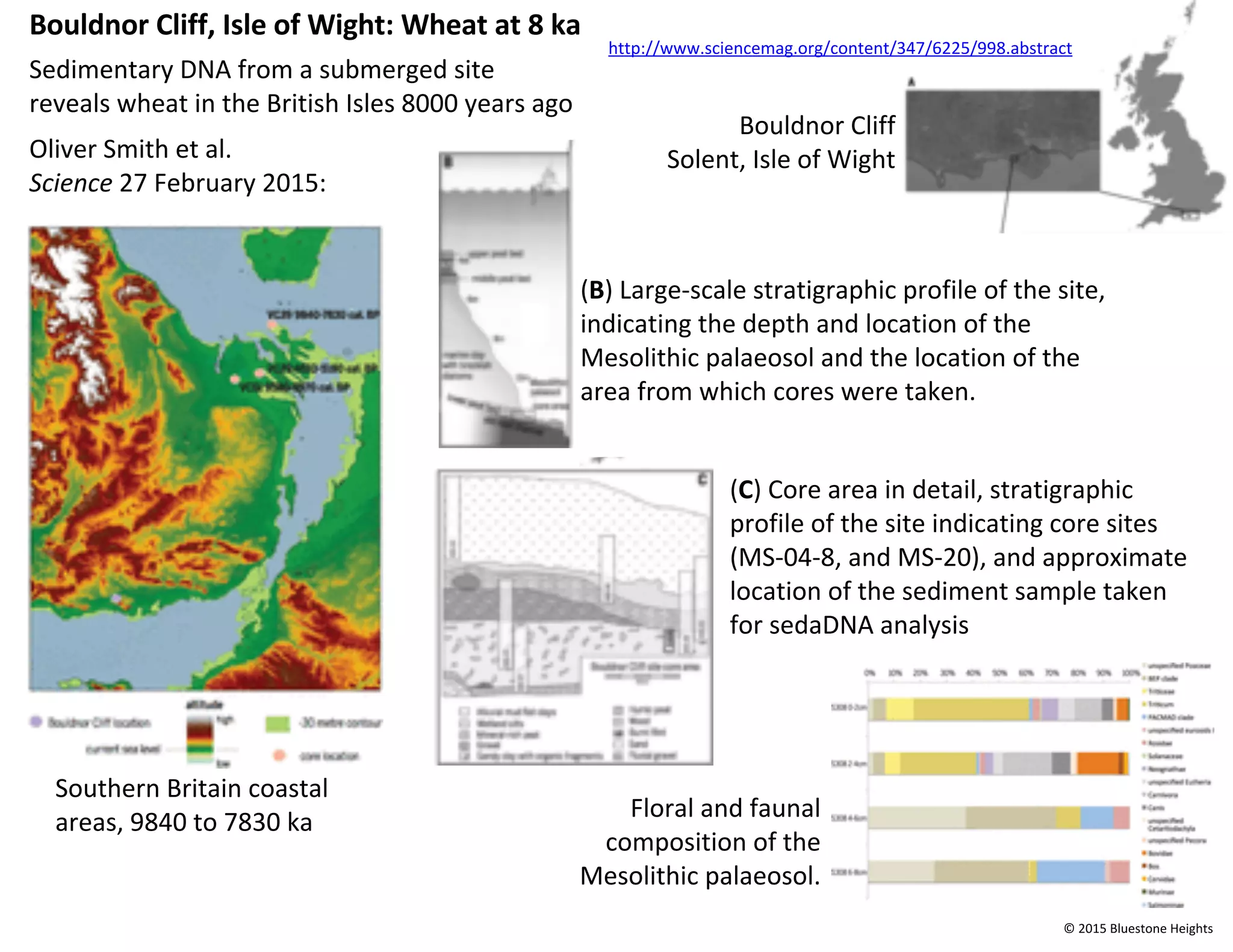
(B) Large-scale stratigraphic profile of the site,
indicating the depth and location of the
Mesolithic palaeosol and the location of the
area from which cores were taken.
Southern Britain coastal
areas, 9840 to 7830 ka
Floral and faunal
composition of the
Mesolithic palaeosol.
Bouldnor Cliff, Isle of Wight: Wheat at 8 ka
Sedimentary DNA from a submerged site
reveals wheat in the British Isles 8000 years ago
Oliver Smith et al.
Science 27 February 2015:
Bouldnor Cliff
Solent, Isle of Wight
(C) Core area in detail, stratigraphic
profile of the site indicating core sites
(MS-04-8, and MS-20), and approximate
location of the sediment sample taken
for sedaDNA analysis
http://www.sciencemag.org/content/347/6225/998.abstract
© 2015 Bluestone Heights
Steppe migration and Indo-European
Massive migration from the steppe was a
source for Indo-European languages in Europe
Wolfgang Haak, et al.
Nature 02 March 2015
http://www.nature.com/news/steppe-migration-rekindles-debate-on-language-origin-1.16935
Distribution of archaeological cultures and
proposed population movements / turnovers
Early Neolithic farmers into Europe
9,000 to 7,000 years ago
Late Neolithic Steppe
ancestry into central Europe
~4,500 years ago
Resurgence of hunter-gatherer
ancestry during the Middle Neolithic
7,000 to 5,000 years ago
White arrows indicate two possible scenarios for
the arrival of Indo-European language groups
© 2015 Bluestone Heights
Flow of Anglo-Saxons from present-day
Germany into Britain after the departure of
the Romans in 410 AD.
Interbred with locals, not replacing them.
Danish Vikings occupied Britain 700s to
1100s AD, left little genomic signature.
British Isles mapped by genetic ancestry
The fine-scale genetic structure of the British
population migrations
Stephen Leslie, et al.
Nature 18 March 2015
Among 17 genomic clusters, central and southern
Englander are the largest group.
Many groupings are more isolated, such as the
split between Devonians and Cornish in Britain’s
southwest.
People who trace ancestry to the Orkney Islands,
off the northeast coast of Scotland, fell into three
distinct categories.
likely so differentiated because the islands made
it hard for different populations to mingle.
Timeline
9600 BC Late Paleo hunter-gatherers colonize upon glacial retreat
2500 BC Influx of settlers from east and western coastal routes
54 BC Julius Caesar invades/defeats British tribal chief Cassivellaunus
410 AD Collapse of Roman rule, Britain descends into the chaos
400-500 AD Large influx of Angles and Saxons
600-700 AD Anglo-Saxon rule throughout Britain–Welsh kings resist
865 AD Large-scale invasion by Danish Vikings
1066 AD Norman invasion
© 2015 Bluestone Heights
http://www.nature.com/news/british-isles-mapped-out-by-genetic-ancestry-1.17136
aDNA 2015: Neolithic insights
Major transitions in human evolution revisited:
A tribute to ancient DNA
Ermini, Der Sarkissian, Willerslev & Orlando
Journal of Human Evolution 26 March 2015
WHG mtDNA, Spain to W Russia ~ 30 to 4.1 ka
suggests relative homogeneity in the mtDNA gene
pool, with haplogroup U as dominant. Modern
mtDNA: haplogroup U the oldest in Europe
aDNA reveals that Neolithic dietary
shift introduced changes to our
genomes and microbiomes
post-Mesolithic aDNA indicates the Neolithic
as the main event responsible for the genetic
discontinuity observed between WHG and
present-day populations. Early European
farmers (EEF) of the Linearband keramik
culture (LBK) in Germany (~7.5 ka) were
genetically different from WHG
German Late Neolithic Corded Ware
culture (~4.8 kyr ago) saw introduction of
mtDNA lineages I and U2 from an eastern
European origin. The Corded Ware culture
co-existed in Germany with Bell Beaker
culture (BBC), which is thought to have
left a substantial legacy on the mtDNA of
central Europeans,
aDNA to pinpoint wild ancestors of
domestic species. Full genome sequencing
will reveal genetic pathways to the
diversity of today’s forms, and cultural
contexts, particular traits arose.
Using >120 diagrams and photographs,
Wiseman summarizes the monument's
construction and its archaeological
excavation.
Stonehenge has for many centuries been
viewed through the shroud of stark
majesty; a shambling folly in grand decay,
singularly stoic and alone out on the
blustery Salisbury Plain, England
Atkinson called the builders 'Howling
Savages'. Stukeley 'Our Rude Cousins'. But
how did such brutes erect this monument
with a precision unmatched until Roman
times - 2,000 years later?
Stonehenge
Stonehenge and the Neolithic Cosmos: A New
Look at the Oldest Mystery in the World
Neil S. Wisemman
30 March 2015
The text is quirky with some self-
deprecating humour, making it highly
readable. I found myself drawn into the
monument's story and like a good novel,
at its end I was left wanting more.
http://www.amazon.com/Stonehenge-Neolithic-Cosmos-Oldest-
Mystery/dp/0692362827/
© 2015 Bluestone Heights
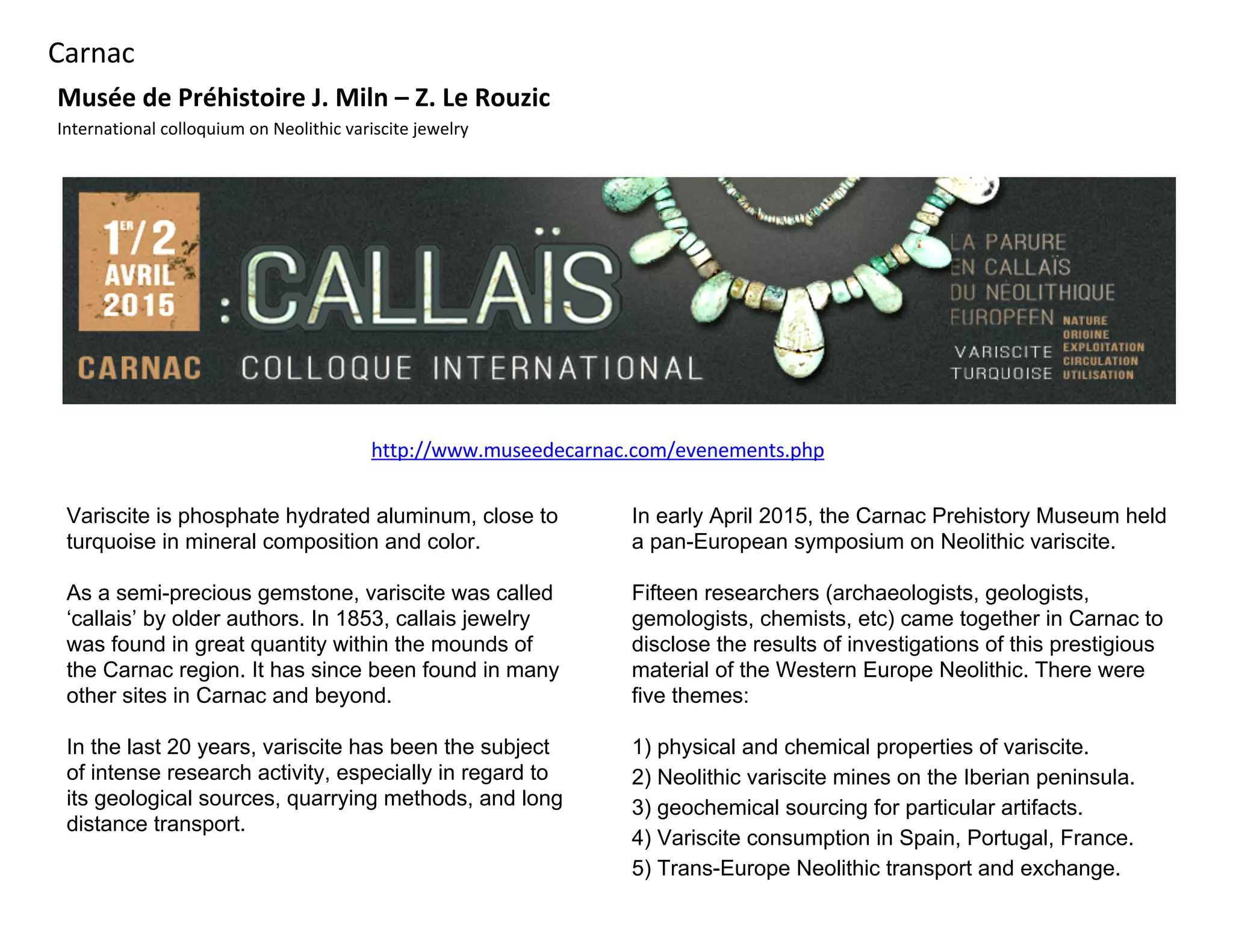
Carnac
Musée de Préhistoire J. Miln – Z. Le Rouzic
International colloquium on Neolithic variscite jewelry
http://www.museedecarnac.com/evenements.php
Variscite is phosphate hydrated aluminum, close to
turquoise in mineral composition and color.
As a semi-precious gemstone, variscite was called
‘callais’ by older authors. In 1853, callais jewelry
was found in great quantity within the mounds of
the Carnac region. It has since been found in many
other sites in Carnac and beyond.
In the last 20 years, variscite has been the subject
of intense research activity, especially in regard to
its geological sources, quarrying methods, and long
distance transport.
In early April 2015, the Carnac Prehistory Museum held
a pan-European symposium on Neolithic variscite.
Fifteen researchers (archaeologists, geologists,
gemologists, chemists, etc) came together in Carnac to
disclose the results of investigations of this prestigious
material of the Western Europe Neolithic. There were
five themes:
1) physical and chemical properties of variscite.
2) Neolithic variscite mines on the Iberian peninsula.
3) geochemical sourcing for particular artifacts.
4) Variscite consumption in Spain, Portugal, France.
5) Trans-Europe Neolithic transport and exchange.
Modern Humans and Dogs
The Invaders: How Humans and Their
Dogs Drove Neanderthals to Extinction
Pat Shipman, UCSD (2015)
Modern humans domesticated dogs soon
after Neanderthals began to disappear (33 ka)
This alliance between two predator species,
gave moderns success in hunting large Ice Age
mammals--a distinct and ultimately decisive
advantage for human invaders at a time when
climate change made both humans and
Neanderthals vulnerable.
Genome Sequencing Highlights Genes Under
Selection and the Dynamic Early History of Dogs
Robert Wayne, Beth Shapiro, et al.
Nature, 2013
Dogs split from European wolves 30-18 ka
Modern humans hunted grassland steppe
hoping to widen scope with more DNA
from fossils outside of Europe, while also
looking at the genes of living dogs that
might hold important clues.
Some wolves began to scavenge left
carcasses. As they migrated along with
people, some were isolated from others.
http://www.nytimes.com/2013/11/14/science/wolf-to-dog-scientists-agree-on-how-but-not-where.html?action=click&contentCollection=Science&module=RelatedCoverage&region=Marginalia&pgtype=article
Paleolithic dog fossil recovered from a cave in Belgium
© 2015 Bluestone Heights
http://www.wsj.com/articles/book-review-the-invaders-by-pat-shipman-1426884980
An Archaeological Study Tour
Megaliths & Monuments
Brittany, France & Wiltshire, England
212-986-3054
886-740-5130
archtours@aol.com
Stonehenge
© 2015 Bluestone Heights
May 6-20, 2015
Roy Larick, Lecturer
15 Days
I look forward to meeting you on
Megaliths & Monuments 2015
Roy Larick
Walk back in time
Look to the Future
Euclid bluestone outcrop
Doan Brook, Cleveland OH
Bluestone Heights
© 2015 Bluestone HeightsR. Larick
A production by
bluestoneheights.org
roylarick@gmail.com

Megaliths & Monuments news, 2016

  • 1.
    An Archaeological StudyTour Megaliths & Monuments Brittany, France & Wiltshire, England 212-986-3054 886-740-5130 archtours@aol.com Stonehenge © 2015 Bluestone Heights May 4-18, 2016 Research news (2015-2016) on the European Neolithic Roy Larick, Lecturer 15 Days
  • 2.
    Megaliths & Monuments,2016 Research news relevant to the Neolithic of northwest Europe Roy Larick, Lecturer Archaeological Tours study tour . This year's news focuses on the genetic basis for understanding the Neolithic. We are at the peak of modeling ancient gene flow based on modern and 'fossil' DNA. Addressed is the genetic makeup of prehistoric European humans, dogs, and wheat. Bare-bones summaries of current research papers. Basic data, graphics and links only. News items to be fleshed out on tour. Includes links to the original abstracts--the online papers usually lie behind a paywall. © 2015 Bluestone Heights
  • 3.
    Farming’s effect onthe Homo sapiens skeleton Gradual decline in mobility with the adoption of food production in Europe Christopher Ruff et al. PNAS, July, 2015 (Vol. 112, pg. 7147) 1,842 European skeletons spanning 33 kyr, Upper Paleolithic to 20th century Decreased bending strength implies a decline of mobility as agriculture came to dominate how people produced food. The original decline in mobility was more important than subsequent changes in farming technology. http://www.pnas.org/content/112/23/7147.abstract Decreased bending strength of leg bones accompanied the shift. The trend was not apparent during the last 2 ka, as agriculture became more mechanized. From the Neolithic to Roman eras (7- 2 ka) humans shifted from mobile to an increasingly sedentary lifestyles. © 2015 Bluestone Heights The study measured the strength of the tibia, femur, and humerus. The authors found little change in mediolateral, or side-to-side, bending strength in all the bones over time, but a decline in anteroposterior, or front-to-back, bending strength of the tibia and femur beginning in the Neolithic Period (7 ka), and continuing through the Iron/Roman Period (2 ka). The results suggest that mild changes in activity levels may be insufficient to stimulate changes in bone mass and that vigorous exercise may be required to increase bone strength. Temporal trends in bending strength relative to body size [mm3 /(kg·mm)·104 ]. (A) Femoral A–P strength. (B) Tibial A–P strength. (C) Humeral A–P strength. (D) Femoral M–L strength. (E)Tibial M–L strength. (F) Humeral M–L strength. Males: blue; females: red.
  • 4.
    Exotic objects ofthe European Neolithic Signs of Wealth: Inequalities in the Neolithic National Museum of Prehistory, Les Eyzies June 27 to November 15, 2015 As Neolithic communities dispersed into Europe, 8-4.2 ka, they brought new techniques for making and ornamenting material culture. Intricate manufacturing could produce very beautiful pieces. High-value items usually signified wealth and distinction for the owner. Some were hoarded to be used in relations between the elites or with supernatural powers. High-value items often featured exotic raw materials, some traveling hundreds of kilometers from quarry to workshop. Likewise, finished pieces, including necklaces, daggers, axes, bracelets, could circulate for long distances and times. Signs of Wealth features "object sign" artifacts in exotic materials still valuable in our day (jade, gold, turquoise, jet, etc). (Larick’s paraphrase)
  • 5.
    15 ka, allhumans lived by foraging wild animals and plants. Exploiting such resources worked best when people lived in tiny bands and moved around a lot. Individual foragers could not build much wealth or power. They tended to be very poor but very equal. SoL: $1.10 per day (1990 values) 12 ka, foragers numbered 6 million 11 ka, population exploded with farming 2 ka, farmers numbered 250 million By 1800 AD, foraging was almost extinct With farming, big social groups stayed in one place working their fields. They flourished at the expense of smaller, less sedentary ones. Farmers were typically richer than foragers SoL: $1.50-$2.20 per day Farming’s effect on wealth distribution To each age its inequality Ian Morris New York Times, July 9, 2015 Farming needed more complicated divisions of labor than foraging. Some people became aristocrats or godlike kings; others became peasants or slaves. Economic inequality surged.
  • 6.
    Modern Europe: threeancestral populations Ancient and modern human genomes suggest three ancestral populations for present-day Europeans Iosif Lazaridis, et al. Nature 18 September 2014 Current Europeans derive from 3 populations: 1) west European hunter-gatherers (WHG) 2) ancient north Eurasians (ANE) 3) early European farmers (EEF) http://genetics.med.harvard.edu/reich/Reich_Lab/Welcome_files/2014_Nature_Lazaridis_EuropeThreeAncestries_1.pdf Proportions of ancestry from each of three inferred ancestral populations (EEF, ANE and WHG) Three-way mixture model Blue: present-day samples Red: ancient samples Green: reconstructed ancestral populations Solid lines: descent without mixture Dashed lines: admixture Genome sequencing makes clear what the archaeology makes difficult © 2015 Bluestone Heights
  • 7.
    Steppe migration andIndo-European Massive migration from the steppe was a source for Indo-European languages in Europe Evan Galloway Nature 17 February 2015 Two fresh studies — one of ancient human DNA, the other a newly constructed genealogical ‘tree’ of languages — point to the steppes of Ukraine and Russia as the origin of this major language family, rekindling a long-standing debate. http://www.nature.com/news/steppe-migration-rekindles-debate-on-language-origin-1.16935 © 2015 Bluestone Heights
  • 8.
    (B) Large-scale stratigraphicprofile of the site, indicating the depth and location of the Mesolithic palaeosol and the location of the area from which cores were taken. Southern Britain coastal areas, 9840 to 7830 ka Floral and faunal composition of the Mesolithic palaeosol. Bouldnor Cliff, Isle of Wight: Wheat at 8 ka Sedimentary DNA from a submerged site reveals wheat in the British Isles 8000 years ago Oliver Smith et al. Science 27 February 2015: Bouldnor Cliff Solent, Isle of Wight (C) Core area in detail, stratigraphic profile of the site indicating core sites (MS-04-8, and MS-20), and approximate location of the sediment sample taken for sedaDNA analysis http://www.sciencemag.org/content/347/6225/998.abstract © 2015 Bluestone Heights
  • 9.
    Steppe migration andIndo-European Massive migration from the steppe was a source for Indo-European languages in Europe Wolfgang Haak, et al. Nature 02 March 2015 http://www.nature.com/news/steppe-migration-rekindles-debate-on-language-origin-1.16935 Distribution of archaeological cultures and proposed population movements / turnovers Early Neolithic farmers into Europe 9,000 to 7,000 years ago Late Neolithic Steppe ancestry into central Europe ~4,500 years ago Resurgence of hunter-gatherer ancestry during the Middle Neolithic 7,000 to 5,000 years ago White arrows indicate two possible scenarios for the arrival of Indo-European language groups © 2015 Bluestone Heights
  • 10.
    Flow of Anglo-Saxonsfrom present-day Germany into Britain after the departure of the Romans in 410 AD. Interbred with locals, not replacing them. Danish Vikings occupied Britain 700s to 1100s AD, left little genomic signature. British Isles mapped by genetic ancestry The fine-scale genetic structure of the British population migrations Stephen Leslie, et al. Nature 18 March 2015 Among 17 genomic clusters, central and southern Englander are the largest group. Many groupings are more isolated, such as the split between Devonians and Cornish in Britain’s southwest. People who trace ancestry to the Orkney Islands, off the northeast coast of Scotland, fell into three distinct categories. likely so differentiated because the islands made it hard for different populations to mingle. Timeline 9600 BC Late Paleo hunter-gatherers colonize upon glacial retreat 2500 BC Influx of settlers from east and western coastal routes 54 BC Julius Caesar invades/defeats British tribal chief Cassivellaunus 410 AD Collapse of Roman rule, Britain descends into the chaos 400-500 AD Large influx of Angles and Saxons 600-700 AD Anglo-Saxon rule throughout Britain–Welsh kings resist 865 AD Large-scale invasion by Danish Vikings 1066 AD Norman invasion © 2015 Bluestone Heights http://www.nature.com/news/british-isles-mapped-out-by-genetic-ancestry-1.17136
  • 11.
    aDNA 2015: Neolithicinsights Major transitions in human evolution revisited: A tribute to ancient DNA Ermini, Der Sarkissian, Willerslev & Orlando Journal of Human Evolution 26 March 2015 WHG mtDNA, Spain to W Russia ~ 30 to 4.1 ka suggests relative homogeneity in the mtDNA gene pool, with haplogroup U as dominant. Modern mtDNA: haplogroup U the oldest in Europe aDNA reveals that Neolithic dietary shift introduced changes to our genomes and microbiomes post-Mesolithic aDNA indicates the Neolithic as the main event responsible for the genetic discontinuity observed between WHG and present-day populations. Early European farmers (EEF) of the Linearband keramik culture (LBK) in Germany (~7.5 ka) were genetically different from WHG German Late Neolithic Corded Ware culture (~4.8 kyr ago) saw introduction of mtDNA lineages I and U2 from an eastern European origin. The Corded Ware culture co-existed in Germany with Bell Beaker culture (BBC), which is thought to have left a substantial legacy on the mtDNA of central Europeans, aDNA to pinpoint wild ancestors of domestic species. Full genome sequencing will reveal genetic pathways to the diversity of today’s forms, and cultural contexts, particular traits arose.
  • 12.
    Using >120 diagramsand photographs, Wiseman summarizes the monument's construction and its archaeological excavation. Stonehenge has for many centuries been viewed through the shroud of stark majesty; a shambling folly in grand decay, singularly stoic and alone out on the blustery Salisbury Plain, England Atkinson called the builders 'Howling Savages'. Stukeley 'Our Rude Cousins'. But how did such brutes erect this monument with a precision unmatched until Roman times - 2,000 years later? Stonehenge Stonehenge and the Neolithic Cosmos: A New Look at the Oldest Mystery in the World Neil S. Wisemman 30 March 2015 The text is quirky with some self- deprecating humour, making it highly readable. I found myself drawn into the monument's story and like a good novel, at its end I was left wanting more. http://www.amazon.com/Stonehenge-Neolithic-Cosmos-Oldest- Mystery/dp/0692362827/ © 2015 Bluestone Heights
  • 13.
    Carnac Musée de PréhistoireJ. Miln – Z. Le Rouzic International colloquium on Neolithic variscite jewelry http://www.museedecarnac.com/evenements.php Variscite is phosphate hydrated aluminum, close to turquoise in mineral composition and color. As a semi-precious gemstone, variscite was called ‘callais’ by older authors. In 1853, callais jewelry was found in great quantity within the mounds of the Carnac region. It has since been found in many other sites in Carnac and beyond. In the last 20 years, variscite has been the subject of intense research activity, especially in regard to its geological sources, quarrying methods, and long distance transport. In early April 2015, the Carnac Prehistory Museum held a pan-European symposium on Neolithic variscite. Fifteen researchers (archaeologists, geologists, gemologists, chemists, etc) came together in Carnac to disclose the results of investigations of this prestigious material of the Western Europe Neolithic. There were five themes: 1) physical and chemical properties of variscite. 2) Neolithic variscite mines on the Iberian peninsula. 3) geochemical sourcing for particular artifacts. 4) Variscite consumption in Spain, Portugal, France. 5) Trans-Europe Neolithic transport and exchange.
  • 14.
    Modern Humans andDogs The Invaders: How Humans and Their Dogs Drove Neanderthals to Extinction Pat Shipman, UCSD (2015) Modern humans domesticated dogs soon after Neanderthals began to disappear (33 ka) This alliance between two predator species, gave moderns success in hunting large Ice Age mammals--a distinct and ultimately decisive advantage for human invaders at a time when climate change made both humans and Neanderthals vulnerable. Genome Sequencing Highlights Genes Under Selection and the Dynamic Early History of Dogs Robert Wayne, Beth Shapiro, et al. Nature, 2013 Dogs split from European wolves 30-18 ka Modern humans hunted grassland steppe hoping to widen scope with more DNA from fossils outside of Europe, while also looking at the genes of living dogs that might hold important clues. Some wolves began to scavenge left carcasses. As they migrated along with people, some were isolated from others. http://www.nytimes.com/2013/11/14/science/wolf-to-dog-scientists-agree-on-how-but-not-where.html?action=click&contentCollection=Science&module=RelatedCoverage&region=Marginalia&pgtype=article Paleolithic dog fossil recovered from a cave in Belgium © 2015 Bluestone Heights http://www.wsj.com/articles/book-review-the-invaders-by-pat-shipman-1426884980
  • 15.
    An Archaeological StudyTour Megaliths & Monuments Brittany, France & Wiltshire, England 212-986-3054 886-740-5130 archtours@aol.com Stonehenge © 2015 Bluestone Heights May 6-20, 2015 Roy Larick, Lecturer 15 Days I look forward to meeting you on Megaliths & Monuments 2015
  • 16.
    Roy Larick Walk backin time Look to the Future Euclid bluestone outcrop Doan Brook, Cleveland OH Bluestone Heights © 2015 Bluestone HeightsR. Larick A production by bluestoneheights.org roylarick@gmail.com