Photo report on Africa RISING research for
development (R4D) and scaling initiatives
field visit in SNNPR, Ethiopia
18–19 October 2018
Introduction
Africa RISING in the Ethiopian highlands has started implementing the second
phase program since October 2016. During the second year (2018) of the
second phase, the project managed to conduct action research through research
for development (R4D) approach and scaling activities through strong
development partnership. The R4D activities are mainly on livestock feed
resources, improved crop varieties, watershed management, fertilizer studies
and small mechanization. The scaling work focused mainly on demonstration of
crop, livestock and natural resources management validated
innovations/technologies, seed multiplication and facilitating dissemination to
reach more areas and farmers.
Fodder beet
Farmers in Lemo woreda of the
RISING site in SNNPR have started
allocating cultivated land to grow
fodder beet to feed their livestock.
After witnessing the benefits, the
demand for fodder beet has
many farmers in Africa RISING sites.
Important issues to be addressed
through research include:
 Seed production and supply
system to sustainably expand
cultivation and benefit more
farmers
 Harvesting interval of matured
tubers
 Protection of cultivated fields from
feeding by wild animals
Sweet lupine seed multiplication in one of the farmer training centres in Lemo woreda,
Shurmo Kebele. The seed from 2018 will be collected and distributed to more farmers
on a revolving seed system arrangements. This will improve scaling of sweet lupin in
2019 cropping season.
Desho grass and vetch mixture
This is a new research initiative to
address farmers concerns of soil
fertility depletion effects because
of the frequent desho grass
on cultivated fields. More research
is needed on the planting pattern
of desho and vetch, experimental
plots setup (desho alone vs
vetch mixture) and soil
Many farmers in Lemo are being
motivated to plant and use more
livestock feed sources. Eshetu
Delese in Jawe Done kebele of the
Africa RISING site participated in
different Africa RISING
innovations: sweet lupin, oat-
vetch mixture, desho grass-vetch
mixture, alfalfa, fodder beet, tree
Lucerne and water harvesting
pond.
Workneh Dubale, Africa RISING site coordinator in SNNPR, showing how one of the
farmers in Jawe kebele is growing oat-vetch-natural grass mixture for livestock feed.
According to him, farmers believe that allowing natural grasses to grow in an oat-vetch
mixture and feeding to livestock provide more energy and make them healthy.
Africa RISING has introduced alfalfa as one of the protein rich feed sources. Some alfalfa
plants in few farmers fields are drying. There is a need to quickly collect plant samples
and take it to plant health laboratory to identify whether it is caused by a disease or
Assefa Abbiyo (Hadiya Zonal crop extension expert, SNNPR) monitoring the faba bean
improved seed multiplication in Upper Gana Africa RISING kebele planted during the
2018 main cropping season. Group of farmers, through a clustered approach, have
planted more than 10 ha of land with improved faba bean variety. The seed from this
multiplication initiative will be distributed to more farmers in the 2019 cropping season
through a revolving seed arrangements.
Bread wheat seed multiplication using cluster approach in Analemo woreda, SNNPR. A
total of 5 ha of land is covered, and the seed from this season is expected to benefit
more farmers and speed up Africa RISING scaling initiatives in the region.
Integrated (organic and inorganic fertilizer) soil fertility management studies in Upper
Gana research Kebele. Lupin, Vetch and lablab are used as sources of organic fertilizer.
NPS are used as sources of inorganic fertilizer. A total of 12 treatment combinations are
evaluated at three replications.
Workneh Dubale, Africa RISING site coordinator in SNNPR explaining the performance of
bread wheat planted with minimum tillage and conventional practices as part of small
scale mechanization intervention.
Africa RISING has introduced early fruiting and improved dwarf avocado varieties. These
varieties have become attractive to farmers in terms of generating cash and its
nutritional value to their families. Demand for grafted seedlings is increasing calling for a
locally based seedling grafting schemes and capacity building to benefit more
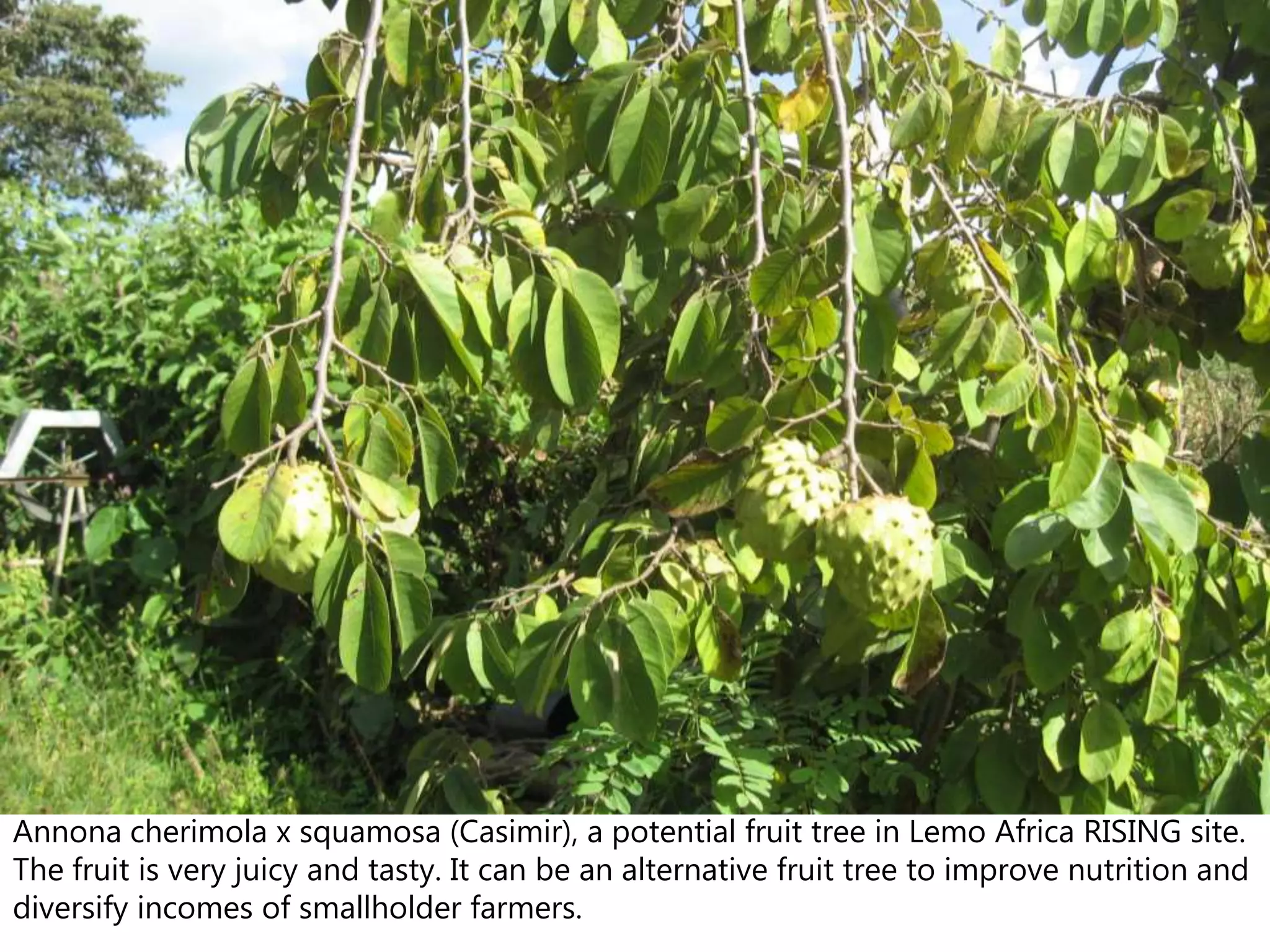
Annona cherimola x squamosa (Casimir), a potential fruit tree in Lemo Africa RISING site.
The fruit is very juicy and tasty. It can be an alternative fruit tree to improve nutrition and
diversify incomes of smallholder farmers.
During the first phase , Africa RISING project introduced bacterial wilt disease tolerant
Enset varieties. Farmers are already multiplying selected Enset varieties/clones and
selling in their localities and beyond. This is helping farmers to generate and diversify
Africa RISING CGIAR partners in Ethiopia
Africa RISING local partners in Ethiopia
Academic institutions:
– Wachemo, Mekelle, Madawolabu, Debre Berhan and Hawassa universities; Maichew
Agricultural College
Regional research organizations:
– Amhara Regional Agricultural Research Institute, Southern Agricultural Research Institute,
Tigray Agricultural Research Institute, Oromia Agricultural Research Institute
Offices of Agriculture:
– Endamehonei (Tigray), Basona Worena (Amhara), Lemo (SNNRP) and Sinana (Oromia)
Federal research organizations:
– Ethiopian Institute for Agricultural Research, Ethiopian Health and Nutrition Research
Institute and Agricultural Transformation Agency
Non government organizations/projects:
– - inter Aide France, Send a Cow, Ethiopian Catholic Church World Vision, GRAD/REST,
Hundie
Private sectors:
– Oromia Seed Enterprise , Fuji Integrated farm, Raya,Dashen and Habesha Breweries
Innovation Laboratories
– SIIL- Sustainable Intensification Innovation Lab, and ILSSI- Innovation Lab for Small-scale
Irrigation
Credits
Produced by Africa RISING Project in Ethiopia
Compiled by Kindu Mekonnen (ILRI)
Photos: Kindu Mekonnen
Our appreciation goes to the site coordinator and his team,
CGIAR team members, and local partner organizations
including farmers, in Africa RISING project site in Lemo and
scaling zones SNNPR.
Africa Research in Sustainable Intensification for the Next Generation
africa-rising.net
This presentation is licensed for use under the Creative Commons Attribution 4.0 International Licence.

Photo report on Africa RISING research for development (R4D) and scaling initiatives field visit in SNNPR, Ethiopia, 18–19 October 2018

  • 1.
    Photo report onAfrica RISING research for development (R4D) and scaling initiatives field visit in SNNPR, Ethiopia 18–19 October 2018
  • 2.
    Introduction Africa RISING inthe Ethiopian highlands has started implementing the second phase program since October 2016. During the second year (2018) of the second phase, the project managed to conduct action research through research for development (R4D) approach and scaling activities through strong development partnership. The R4D activities are mainly on livestock feed resources, improved crop varieties, watershed management, fertilizer studies and small mechanization. The scaling work focused mainly on demonstration of crop, livestock and natural resources management validated innovations/technologies, seed multiplication and facilitating dissemination to reach more areas and farmers.
  • 3.
    Fodder beet Farmers inLemo woreda of the RISING site in SNNPR have started allocating cultivated land to grow fodder beet to feed their livestock. After witnessing the benefits, the demand for fodder beet has many farmers in Africa RISING sites. Important issues to be addressed through research include:  Seed production and supply system to sustainably expand cultivation and benefit more farmers  Harvesting interval of matured tubers  Protection of cultivated fields from feeding by wild animals
  • 5.
    Sweet lupine seedmultiplication in one of the farmer training centres in Lemo woreda, Shurmo Kebele. The seed from 2018 will be collected and distributed to more farmers on a revolving seed system arrangements. This will improve scaling of sweet lupin in 2019 cropping season.
  • 6.
    Desho grass andvetch mixture This is a new research initiative to address farmers concerns of soil fertility depletion effects because of the frequent desho grass on cultivated fields. More research is needed on the planting pattern of desho and vetch, experimental plots setup (desho alone vs vetch mixture) and soil Many farmers in Lemo are being motivated to plant and use more livestock feed sources. Eshetu Delese in Jawe Done kebele of the Africa RISING site participated in different Africa RISING innovations: sweet lupin, oat- vetch mixture, desho grass-vetch mixture, alfalfa, fodder beet, tree Lucerne and water harvesting pond.
  • 7.
    Workneh Dubale, AfricaRISING site coordinator in SNNPR, showing how one of the farmers in Jawe kebele is growing oat-vetch-natural grass mixture for livestock feed. According to him, farmers believe that allowing natural grasses to grow in an oat-vetch mixture and feeding to livestock provide more energy and make them healthy.
  • 8.
    Africa RISING hasintroduced alfalfa as one of the protein rich feed sources. Some alfalfa plants in few farmers fields are drying. There is a need to quickly collect plant samples and take it to plant health laboratory to identify whether it is caused by a disease or
  • 9.
    Assefa Abbiyo (HadiyaZonal crop extension expert, SNNPR) monitoring the faba bean improved seed multiplication in Upper Gana Africa RISING kebele planted during the 2018 main cropping season. Group of farmers, through a clustered approach, have planted more than 10 ha of land with improved faba bean variety. The seed from this multiplication initiative will be distributed to more farmers in the 2019 cropping season through a revolving seed arrangements.
  • 10.
    Bread wheat seedmultiplication using cluster approach in Analemo woreda, SNNPR. A total of 5 ha of land is covered, and the seed from this season is expected to benefit more farmers and speed up Africa RISING scaling initiatives in the region.
  • 11.
    Integrated (organic andinorganic fertilizer) soil fertility management studies in Upper Gana research Kebele. Lupin, Vetch and lablab are used as sources of organic fertilizer. NPS are used as sources of inorganic fertilizer. A total of 12 treatment combinations are evaluated at three replications.
  • 12.
    Workneh Dubale, AfricaRISING site coordinator in SNNPR explaining the performance of bread wheat planted with minimum tillage and conventional practices as part of small scale mechanization intervention.
  • 13.
    Africa RISING hasintroduced early fruiting and improved dwarf avocado varieties. These varieties have become attractive to farmers in terms of generating cash and its nutritional value to their families. Demand for grafted seedlings is increasing calling for a locally based seedling grafting schemes and capacity building to benefit more
  • 14.
    Annona cherimola xsquamosa (Casimir), a potential fruit tree in Lemo Africa RISING site. The fruit is very juicy and tasty. It can be an alternative fruit tree to improve nutrition and diversify incomes of smallholder farmers.
  • 15.
    During the firstphase , Africa RISING project introduced bacterial wilt disease tolerant Enset varieties. Farmers are already multiplying selected Enset varieties/clones and selling in their localities and beyond. This is helping farmers to generate and diversify
  • 16.
    Africa RISING CGIARpartners in Ethiopia
  • 17.
    Africa RISING localpartners in Ethiopia Academic institutions: – Wachemo, Mekelle, Madawolabu, Debre Berhan and Hawassa universities; Maichew Agricultural College Regional research organizations: – Amhara Regional Agricultural Research Institute, Southern Agricultural Research Institute, Tigray Agricultural Research Institute, Oromia Agricultural Research Institute Offices of Agriculture: – Endamehonei (Tigray), Basona Worena (Amhara), Lemo (SNNRP) and Sinana (Oromia) Federal research organizations: – Ethiopian Institute for Agricultural Research, Ethiopian Health and Nutrition Research Institute and Agricultural Transformation Agency Non government organizations/projects: – - inter Aide France, Send a Cow, Ethiopian Catholic Church World Vision, GRAD/REST, Hundie Private sectors: – Oromia Seed Enterprise , Fuji Integrated farm, Raya,Dashen and Habesha Breweries Innovation Laboratories – SIIL- Sustainable Intensification Innovation Lab, and ILSSI- Innovation Lab for Small-scale Irrigation
  • 18.
    Credits Produced by AfricaRISING Project in Ethiopia Compiled by Kindu Mekonnen (ILRI) Photos: Kindu Mekonnen Our appreciation goes to the site coordinator and his team, CGIAR team members, and local partner organizations including farmers, in Africa RISING project site in Lemo and scaling zones SNNPR.
  • 19.
    Africa Research inSustainable Intensification for the Next Generation africa-rising.net This presentation is licensed for use under the Creative Commons Attribution 4.0 International Licence.

Editor's Notes